A hydraulic component usually gets judged in the quietest moment of its life. It's on a quote, sitting in a spreadsheet, reduced to a line item and a purchase price. The problem starts later, when that “good value” pump, valve or power pack is fitted to a machine that can't afford to stop.
A familiar version goes like this. A lower-cost pump is approved because the specification looks close enough. Months later, the machine drops out of service. Maintenance calls in extra labour, production loses output, and someone starts chasing an urgent replacement that isn't on a local shelf. By then, the original saving has vanished. The business hasn't bought a cheaper component at all. It has bought a more expensive ownership experience.
That's where total cost ownership matters. In hydraulics, the invoice rarely tells the full story. Reliability, contamination tolerance, efficiency, repairability, lead time, support and end-of-life value all affect what the system really costs over time.
Beyond the Price Tag An Introduction to TCO
Procurement managers often inherit a difficult brief. Keep capital spend under control, but don't expose operations to risk. In hydraulic systems, those two goals only stay aligned if you assess the asset over its working life rather than at point of purchase.
Total cost ownership does exactly that. It looks past the catalogue price and asks what the equipment will cost to buy, install, run, maintain, repair and eventually replace or dispose of. In a plant environment, that's the only useful way to compare two options that appear similar on paper.
The difference becomes obvious when a failed component stops a press, conveyor, baler, tipper, compact power unit or agricultural attachment. Labour is redirected. Production slips. Service teams scramble for parts. Transport costs rise. The machine still needs fixing, but now the business is paying for disruption as well as hardware.
Where procurement decisions usually go wrong
The weakest buying decisions tend to share the same traits:
- Price is treated as the main filter and serviceability is checked too late.
- Duty cycle is ignored so a component suited to light use ends up in a demanding application.
- Downtime is treated as maintenance's problem instead of part of the buying decision.
- Spare parts lead time isn't priced in even when the machine is operationally critical.
A better buying process links technical selection to finance from the start. If your team already works through broader master strategic and financial planning, hydraulic TCO fits neatly into that discipline. It gives procurement and engineering a shared basis for deciding when a higher initial spend is the lower-risk, lower-cost choice.
A hydraulic system is cheap only if it stays available, efficient and repairable in the duty it was bought for.
Why TCO is Critical for Hydraulic Equipment
Hydraulic equipment punishes poor assumptions faster than many other asset classes. These systems work under pressure, often in dirty environments, with variable loads, heat, shock and long operating hours. A specification that looks “near enough” can become expensive once real use begins.
UK procurement practice has moved firmly towards whole-life thinking. Guidance used in procurement describes TCO as the true total cost of a capital acquisition across its life cycle, including purchasing, operating, replacement and upgrade costs according to UK procurement TCO guidance. That logic fits hydraulic systems exactly, because the operational consequences of failure are rarely limited to the failed part.
Hydraulics turn hidden costs into real costs
A valve on a shelf is a small expense. A valve that stops a machine is something else entirely.
When a hydraulic fault takes out a production asset, the cost chain widens quickly:
- Operations lose output while the machine is unavailable.
- Maintenance absorbs unplanned work and delays other jobs.
- Stores may need emergency purchasing rather than planned replenishment.
- Management loses schedule certainty if customer orders or internal production targets slip.
That's why a higher-quality component can be the cheaper option in practice. If it reduces failure frequency, extends service intervals or shortens repair time, it lowers ownership cost even when the purchase price is higher.
Why sticker-price buying fails in plant environments
Hydraulic systems are interconnected. A poor pump choice affects oil condition, heat, seal life and the stress seen by other components. A badly matched motor or valve can create inefficiency, unstable operation or avoidable wear. Procurement teams who buy purely on line-item cost often don't see those interactions until the machine is already in service.
Use a whole-life lens when any of these conditions apply:
| Situation | Why TCO matters |
|---|---|
| High utilisation equipment | Running cost and wear accumulate quickly |
| Critical production assets | Downtime can outweigh purchase savings |
| Mobile machinery in the field | Access, service response and parts availability matter more |
| Custom power packs | Design choices affect energy use, maintenance access and future modifications |
Practical rule: If one failed hydraulic component can stop a revenue-generating machine, the buying decision is not about price alone.
The Seven Core Components of Hydraulic TCO
A sound TCO model needs structure. Without it, teams remember the obvious costs and miss the expensive ones. In hydraulics, I'd break the model into seven core components so nothing important gets left outside the decision.
One widely cited TCO explanation notes that the initial purchase price can be about 10% of total ownership cost, with the remaining 90% spread across operation, maintenance, downtime, disposal and other hidden costs over the asset life according to this TCO explanation. That's a useful reminder for hydraulic buyers because repairability and long service life often change the economics more than the day-one invoice does.
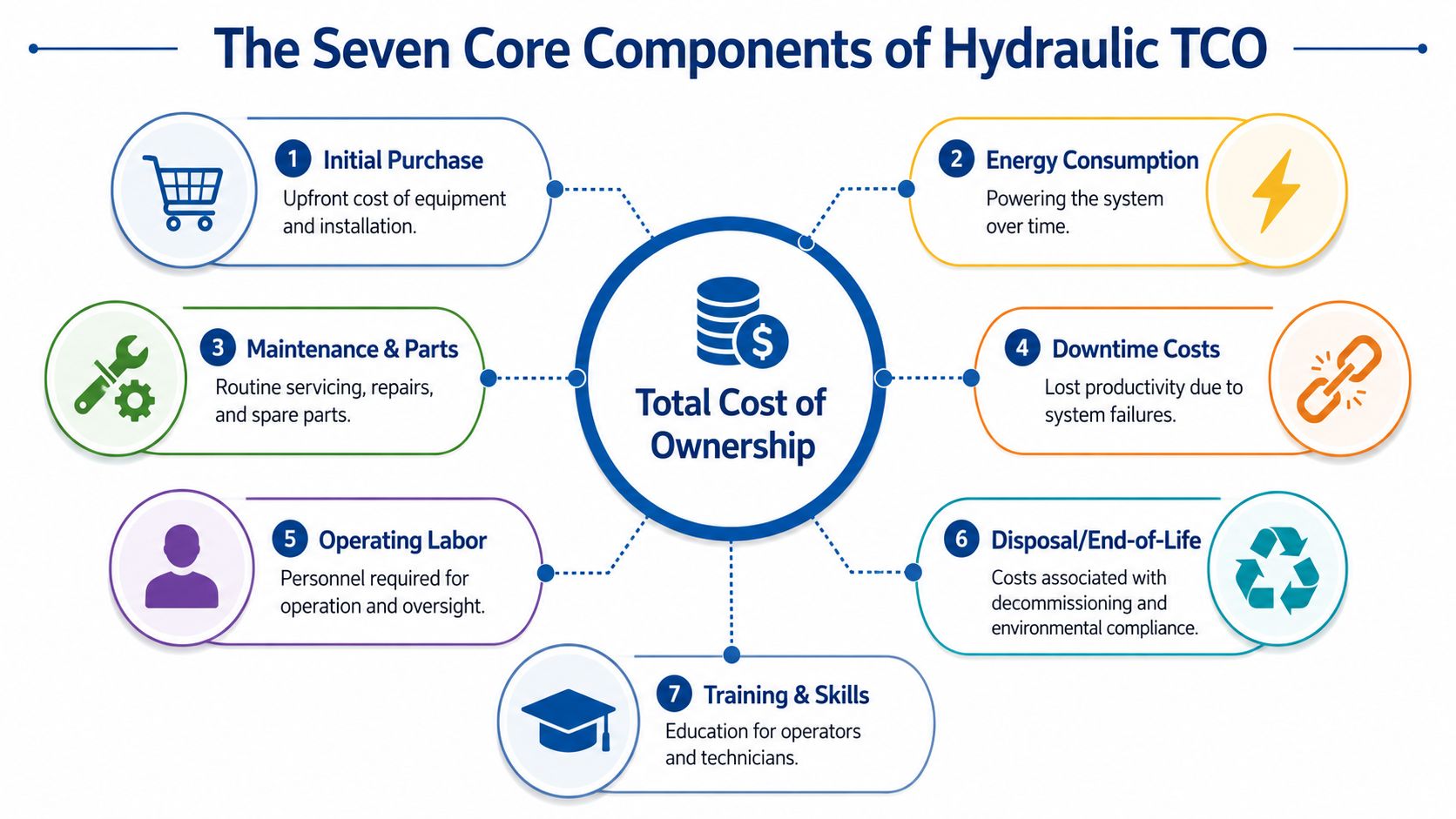
Initial purchase and installation
Capital cost is the visible figure. It includes the pump, motor, valve bank, reservoir, filters, controls, fittings and assembly.
Installation cost sits close behind it. That covers mounting, pipework or hosework, electrical connection, commissioning oil, flushing, testing and any machine downtime needed to fit the new unit. A low-priced power pack that takes longer to install or needs rework can lose its apparent advantage before the machine returns to service.
Energy and operating labour
Energy matters more than many buyers expect, especially on continuously running industrial systems. Pump efficiency, pressure losses, heat generation and control strategy all influence electricity use. A unit that idles inefficiently or runs hotter than necessary pushes cost into the utility bill and often into cooling and maintenance as well.
Operating labour is easy to forget. If a system needs frequent adjustment, constant operator workarounds or repeated supervision because it performs inconsistently, that labour belongs in the ownership model.
Maintenance and spare parts
Routine maintenance includes filters, oil changes, seals, inspections, cleaning and planned service labour. Here, hydraulics reward correct specification. Better contamination control, sensible filtration and accessible layouts reduce the cost of keeping the system healthy. For teams reviewing this in detail, a focused approach to hydraulic contamination control often has more impact than chasing the cheapest replacement component.
Spare parts deserve their own line. If a machine uses uncommon components, non-standard interfaces or parts with long lead times, the carrying cost and outage risk both increase. Standardisation usually lowers TCO because stores can support more assets with fewer stocked items.
Downtime, training and end-of-life
Downtime isn't just the mechanic's time. It includes lost machine output, disrupted schedules, idle operators and the organisational cost of recovery. In many hydraulic applications, this is the biggest ownership driver even though it doesn't appear on the supplier quote.
Training and skills also belong in the model. A system that technicians understand is faster to maintain and diagnose. One that needs specialist intervention for basic faults raises service dependency.
Disposal and end-of-life complete the picture. Draining oil, handling contaminated consumables, removing equipment and recovering residual value all affect the final number.
A useful discipline here is to map costs in the same way finance teams organise wider business expense categories. It stops hydraulic ownership costs being scattered across maintenance, operations, energy and capex reports where nobody sees the full total.
The best hydraulic buy is rarely the one with the smallest invoice. It's the one that creates the least friction over the whole service life.
A Practical TCO Calculation Example
Theory is useful, but buying decisions usually get approved or rejected on a working comparison. A simple side-by-side model is often enough to show why the lowest initial quote isn't the lowest lifetime cost.
Use a 5-year view for a practical comparison. That aligns with UK whole-life costing practice discussed later in this article and is long enough to expose differences in maintenance, downtime and running behaviour.
The setup
Assume you're comparing two hydraulic power packs for a recurring industrial duty:
- Pack A is the lower-cost standard option.
- Pack B is a better-built, high-efficiency option with easier servicing and lower risk of unplanned stoppage.
Because the brief prohibits invented figures beyond the verified data, the table below uses a qualitative scoring model in GBP terms rather than fabricated numeric costs. It still gives procurement and engineering a usable way to compare options before inserting site-specific values.
TCO Comparison Standard vs High-Efficiency Hydraulic Power Pack 5-Year
| Cost Component | Pack A (Standard) | Pack B (High-Efficiency) |
|---|---|---|
| Initial purchase | Lower upfront spend | Higher upfront spend |
| Installation | Similar if drop-in fit, can rise if extra adaptation is needed | Similar, often easier to justify if supplied correctly specified |
| Energy consumption | Typically higher if efficiency is poorer or heat losses are greater | Typically lower if the system is better matched and more efficient |
| Maintenance labour | More frequent intervention if service intervals are shorter | Less frequent intervention if design and component quality are better |
| Routine parts and consumables | Higher filter, seal or wear-part exposure over time | Lower if the system runs cleaner and more steadily |
| Downtime cost | Higher risk if failures are more frequent or harder to resolve | Lower risk if reliability and serviceability are better |
| Critical spare parts | Higher risk if parts are less available or require longer lead time | Lower risk if parts are easier to source and standardise |
| Training and fault-finding | More operator and technician time if behaviour is inconsistent | Less time if operation is stable and fault diagnosis is straightforward |
| End-of-life or replacement | Lower residual value if wear is heavier or support is weaker | Better residual or reuse potential if condition and support remain strong |
| Overall 5-year TCO | Often higher despite lower purchase price | Often lower despite higher purchase price |
How to turn the table into a real decision
Start with the costs your team already knows. Purchase price, installation labour, planned maintenance items and electricity are usually straightforward to collect. The harder part is downtime.
For each machine, ask four direct questions:
- What does one hour of this asset being unavailable cost the business?
- How often is the asset expected to run?
- How long would a typical hydraulic repair take with parts on hand?
- How long would it take if the part had to be sourced after failure?
That changes the conversation quickly. A pump that saves money on purchase but adds outage risk is no longer “cheaper”. It is shifting cost from capex into operations.
What usually separates Pack B from Pack A
The higher-value power pack doesn't win because it's expensive. It wins when its design reduces ownership costs that buyers often underweight at quotation stage.
Typical reasons include:
- Cleaner system design that protects pumps and valves
- Better access for servicing so maintenance takes less time
- Lower heat generation which supports oil life and component life
- More stable operation which reduces troubleshooting
- Better parts support so breakdowns are resolved faster
If you can't explain why the cheaper pack is still cheaper after maintenance, energy and downtime are priced in, you haven't finished the buying decision.
A practical method for your own model
Use this sequence on your next quote comparison:
- List every lifecycle cost under the seven TCO headings.
- Assign known GBP values where your records support them.
- Mark unknowns as low, medium or high risk instead of guessing.
- Ask suppliers specific serviceability questions on spares, lead times and support.
- Compare the 5-year result, not just the day-one price.
That gives procurement a defendable basis for selecting the option with the lower total ownership burden, not just the lower invoice.
Strategies for Lowering Hydraulic System TCO
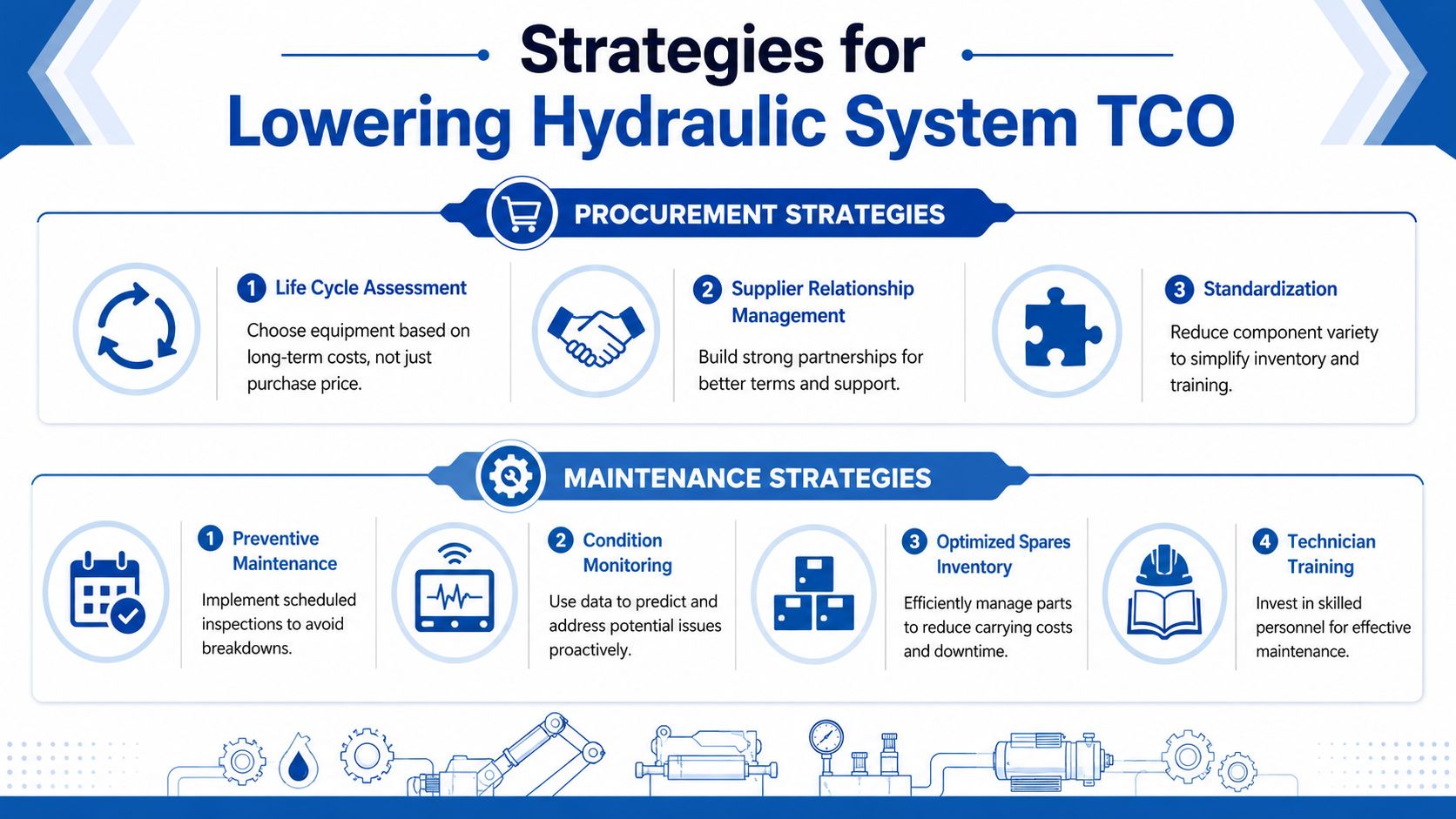
Reducing hydraulic TCO isn't about one clever purchase. It comes from combining specification discipline, maintainability and parts support so the machine stays productive with fewer surprises.
A key challenge in hydraulic TCO is quantifying downtime and serviceability. Standard TCO thinking should convert downtime risk into pound values and consider local stockholding and repair lead times, because the cheapest component can create the highest TCO if it extends outage windows, as outlined in this IBM overview of total cost of ownership.
Procurement choices that cut cost later
A lower-TCO system usually starts with a tighter specification, not a tougher negotiation.
- Specify the duty. Intermittent use, continuous running, pressure spikes, temperature range and contamination exposure all affect what “suitable” really means.
- Standardise where possible. If several machines can use common filters, valves, couplings or pump groups, stores management gets easier and response gets quicker.
- Buy for supportability. Brands and component families with dependable availability lower the risk tied to critical spares.
- Ask about repair path. Can the unit be serviced in situ, or does a minor fault force full removal?
For admin-heavy teams, pulling maintenance records, purchase histories and service notes into one review can be the slowest part of TCO work. Tools built for DigiParser automated data entry can help organise that evidence faster, especially when cost data is scattered across invoices, service sheets and supplier documents.
Maintenance practices that protect ownership cost
A hydraulic system's cheapest failure is the one you prevent.
Practical steps that usually reduce ownership cost include:
- Filter management with scheduled replacement before restriction creates wider damage
- Oil condition checks so contamination or degradation is found early
- Temperature control because overheated systems age oil and seals faster
- Leak correction before low oil level or air ingress creates secondary faults
- Critical spares planning for items that can stop production outright
A useful reference point for this is reducing hydraulic energy consumption, because energy efficiency and system health often move together. Poorly performing hydraulics don't just waste electricity. They also run hotter, stress oil harder and increase wear.
Here's a useful visual overview before going back into the detail:
What works and what doesn't
| Works | Usually backfires |
|---|---|
| Matching components to real duty | Buying to nominal pressure alone |
| Keeping key spares on hand | Ordering after failure on critical assets |
| Routine contamination control | Treating oil cleanliness as an afterthought |
| Accessible service layouts | Compact designs that save space but block maintenance access |
| Standard component platforms | Too many one-off variants across the site |
Good hydraulic procurement and good hydraulic maintenance are the same conversation viewed from different stages of the asset life.
Using Benchmarking and Sensitivity Analysis
A static TCO sheet is a start. A decision-ready one tests what happens when conditions change.
In UK whole-life costing practice, the model should include purchase cost, depreciation, maintenance, fuel or electricity, and disposal value. The practical advice is to build a 3- to 5-year whole-life model using actual duty cycle inputs, maintenance labour rates and spare-part lead times according to Welsh Government TCO guidance. That matters because the most influential costs often sit outside the original invoice.
Benchmark against your own reality
The best benchmark is usually your own maintenance history.
Compare the proposed asset against:
- Current annual service burden
- Typical failure modes
- Average repair duration
- Spare parts delay experience
- Observed electricity use where known
If a new power pack promises better performance but doesn't improve any of those ownership drivers, the business case may be weak. If it materially improves even two or three, the case often strengthens quickly.
Run sensitivity checks before approving spend
Sensitivity analysis shows which assumptions really drive the outcome. In hydraulics, the key variables are usually energy use, downtime duration, maintenance labour and parts lead time.
A simple stress test asks:
- What happens if utilisation rises?
- What happens if electricity costs move against us?
- What happens if one critical spare isn't immediately available?
- What happens if service labour is needed out of hours?
If the lower-priced option only looks attractive under perfect conditions, that's a warning. Real plant environments rarely operate under perfect conditions for long.
For teams adding live operating data into this process, remote monitoring systems for hydraulics can improve the quality of the model. Better visibility on pressure, temperature, running hours and fault events gives you a stronger benchmark and a more credible capex case.
Your TCO Checklists and Next Steps
A good hydraulic buying decision doesn't end when the order is placed. It starts there. The true test is what the system costs to keep productive over its working life.
Use these checklists to keep procurement and engineering aligned.
Buyer's TCO checklist
- Lifetime energy use. Have you compared how each option will affect electricity consumption over the working life?
- Maintenance schedule. Do you know the expected service tasks, intervals and likely labour requirement?
- Critical spare parts lead time. If a pump, valve or filter element fails, how quickly can a replacement be on site?
- Residual or end-of-life value. Is there realistic resale, reuse or trade-in potential?
Engineer's TCO checklist
- Preventive maintenance quality. Is the current schedule preventing faults, or only reacting after symptoms appear?
- Component efficiency. Are the pump, motor, valve and filtration choices right for the actual duty?
- Downtime cost awareness. Has the team priced one hour of lost machine availability for this asset?
- Critical spares stock. Are the parts that stop the machine held on site or readily available?
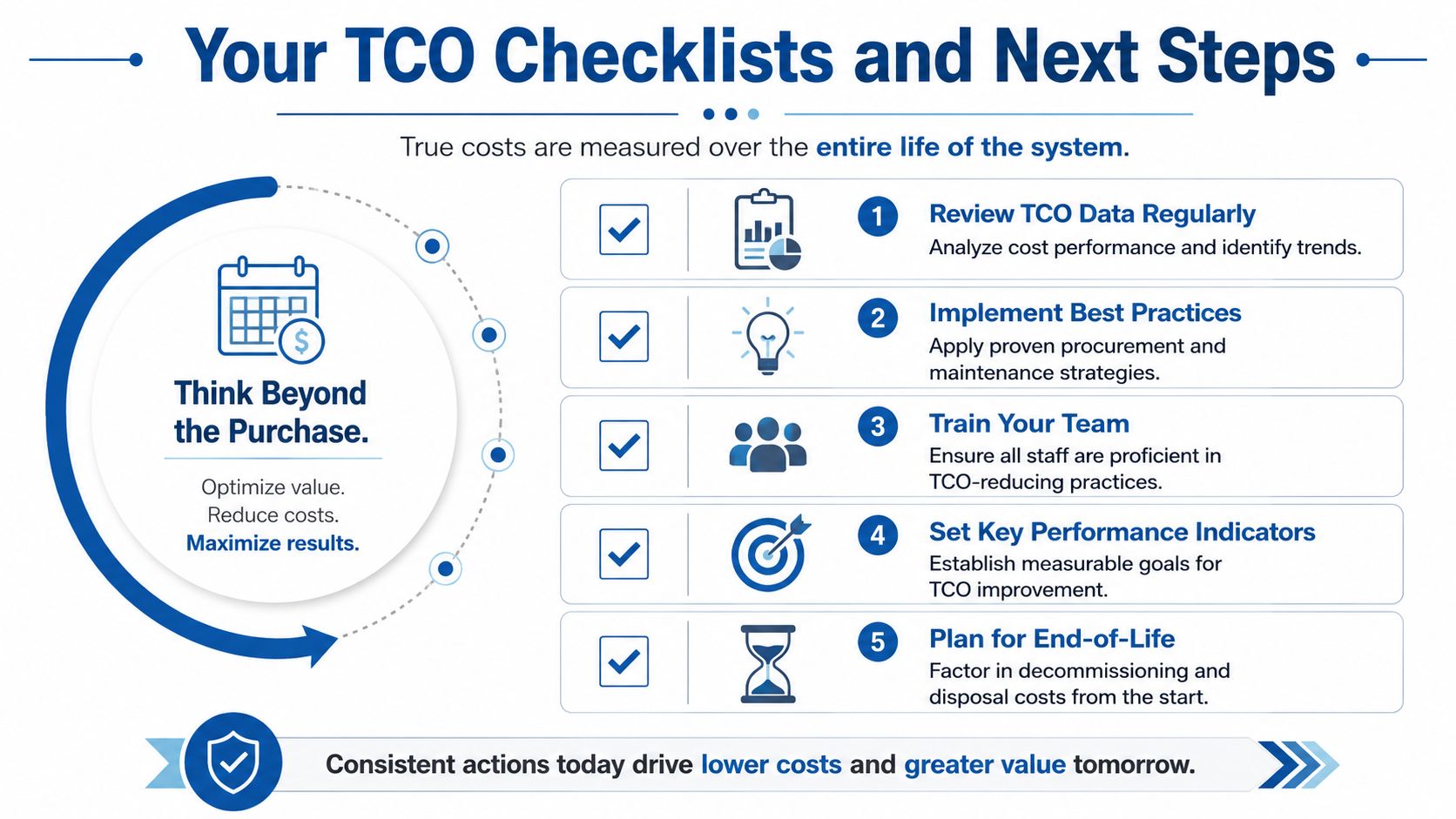
The companies that manage hydraulic cost well don't merely buy harder. They specify better, maintain earlier, standardise intelligently and price downtime accurately. That's how total cost ownership becomes a practical tool rather than a procurement slogan.
If you want help reviewing hydraulic component choices, power pack specification or whole-life cost trade-offs, speak to MA Hydraulics Ltd. Phone 01724 279508 today, or send us a message for expert advice.
