
A hydraulic unit fails on a machine that can't sit idle. The pump is noisy, the oil is discoloured, and production wants an answer before the shift ends. Procurement asks whether the part is under warranty. Maintenance says it was serviced. The supplier asks for commissioning details, pressure records, oil specification, and proof that nobody altered the relief setting.
That's the point where organizations often realize warranty coverage isn't a simple yes or no. In hydraulics, the outcome is usually decided long before the failure. It's decided when the component was selected, how the warranty terms were written, whether the product was registered, and how well the maintenance record stands up when someone external reviews it.
For OEMs, MRO leads, and plant engineers, warranty coverage is really a risk-control system. If you treat it as paperwork that only matters after a breakdown, you'll lose claims that might otherwise have been valid.
Understanding Warranty Fundamentals in UK Hydraulics
Most confusion starts because people use the word warranty to describe three different protections. In practice, they are separate layers, and each one matters for a different reason.
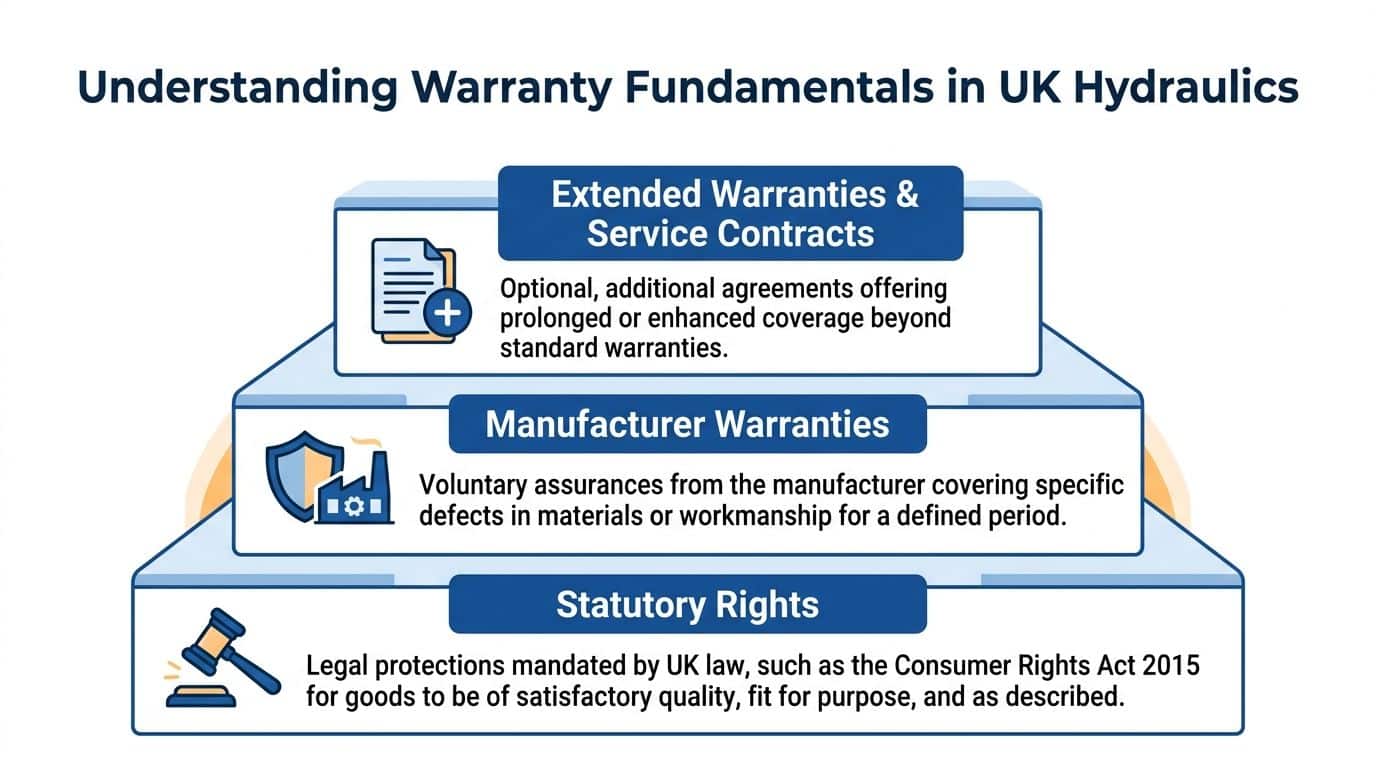
The three layers that sit behind one failed component
Think of warranty protection like a stack.
At the base are statutory rights. These come from law, not from the supplier's brochure. Above that sits the manufacturer's warranty, which is a commercial promise about what the maker will repair, replace, or reject under stated conditions. At the top sits any extended warranty or service contract, which may add extra time or extra cover, but usually comes with tighter rules.
For UK buyers, that base layer matters more than many teams realise. Under the Consumer Rights Act 2015, consumers have a statutory right to bring a legal claim for faulty goods for up to 6 years from purchase in England, Wales, and Northern Ireland, and 5 years in Scotland, independently of any manufacturer's voluntary warranty period. After 6 months, the consumer must demonstrate the fault was inherent, according to this explanation of UK consumer rights and product warranty rules.
That doesn't mean every hydraulic component carries a six-year warranty. It means the legal window for bringing a claim can outlast the written warranty period.
Practical rule: A supplier's warranty can add protection, but it can't strip away legal rights that already exist.
Warranty period versus claim window
This distinction catches out both buyers and service teams. A written warranty might say 12 months from shipment, 24 months from commissioning, or something similar. That is the supplier's stated cover period. A legal claim window is different. It concerns when a claim may still be brought under law, subject to proof and the contract facts.
For a bespoke hydraulic power pack, that difference matters if a defect appears after the commercial warranty expires but points back to a manufacturing issue present from the start. For a standard Group 2 gear pump, the same principle applies, but the practical challenge is evidence. You need to show the failure wasn't caused by contamination, misuse, overheating, or wear.
What this means in day-to-day hydraulic work
When procurement compares quotes, the shortest document often looks simplest. It rarely is. A one-page warranty statement may leave important questions unanswered:
- When does cover start. Delivery, installation, commissioning, or first use?
- What is covered. Materials, workmanship, labour, transport, strip-down time?
- Who carries the burden of proof if a fault appears later.
- Which exclusions apply to seals, hoses, leakage, fluid quality, or pressure abuse.
A good team treats these as engineering controls, not admin details. If you know which layer of protection applies, you can decide whether to push for stronger terms, buy additional cover, or tighten your internal records before a machine ever leaves the workshop.
What Hydraulic Warranty Coverage Typically Includes and Excludes
In hydraulics, warranty coverage usually sounds broad and turns out to be narrow. Most standard terms are built around one phrase: defects in materials or workmanship. That's sensible for a casting fault in a gear pump body, a machining defect in a valve housing, or an assembly error inside a power pack manifold. It is not the same thing as general protection against failure in service.
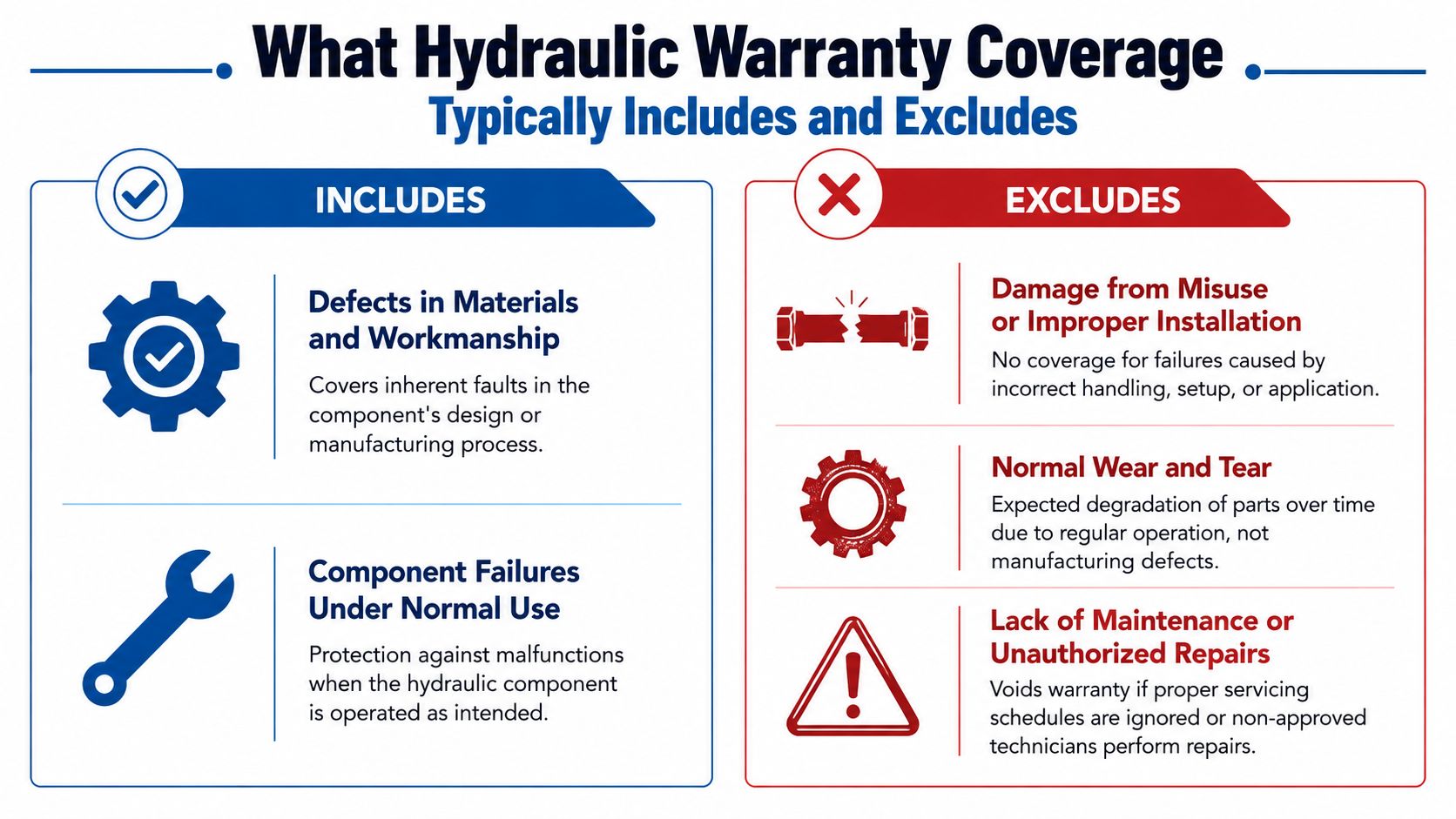
What suppliers usually mean by covered failure
If a component fails because it was made incorrectly, that is the territory where a warranty claim has a chance. Examples in hydraulic practice include a pump with an internal manufacturing defect, a CETOP directional valve with a machining issue affecting spool movement, or a manifold face that was incorrectly finished and causes a sealing problem from first installation.
Normal use matters here. If the part was installed correctly, operated within pressure and temperature limits, and used with the correct fluid and filtration regime, the buyer can argue that the failure points back to the supplied component itself.
A simple way to view it is this:
| Typical covered area | Workshop meaning |
|---|---|
| Defect in materials | The component itself was flawed |
| Defect in workmanship | The part was assembled or manufactured incorrectly |
| Failure in normal intended use | The application matched the specification |
That still doesn't guarantee an approved claim. It just places the failure in the right category.
What gets excluded most often
The biggest disputes rarely involve castings or housings. They involve items that naturally degrade in service.
UK benchmark warranty content explicitly excludes service and consumable items, including hydraulic consumables such as seals, hoses, pipes, and fluid leaks, and standard cover specifically rejects oil or fluid leaks unless a premium plan applies, as shown in this motor warranty content card.
For hydraulics, that exclusion has real consequences. A leak from a shaft seal, a hose rupture, or oil loss at a fitting may be the event that stops the machine, but the supplier may still classify it as consumable wear, installation-related damage, or maintenance failure rather than a covered defect.
The workshop view of common exclusions
A claim is vulnerable when the failed part sits in one of these categories:
- Wear items. Seals, bearings, hoses, filters, clutches, and other parts expected to degrade.
- Contamination damage. Abrasive particles, water ingress, varnish, and poor oil condition.
- Incorrect setup. Relief valve set too high, wrong rotation on a reversible gear motor application, misaligned coupling, or unsupported pipework.
- Environmental exposure. Corrosion, impact damage, water ingress, or external heat.
- Unauthorised intervention. Strip-down by a non-approved repairer, modified settings, or substituted internal parts.
For a bespoke power pack, one failure can span several categories. A pump may seize, but the root cause may be fluid starvation from poor suction design or contamination introduced during hose replacement. If that happens, the supplier won't view the pump as the original problem.
If the failed component is the victim rather than the cause, warranty cover usually falls away.
That's why smart teams investigate failures like engineers, not like claimants. The question isn't only “what broke?” It's “what chain of events made it break, and can we prove the component was at fault first?”
Navigating Warranty Periods and Activation Requirements
A lot of buyers still assume the printed warranty period is the main issue. It isn't. In hydraulic applications, the hidden tripwires are often more important than the headline term.
A component can carry decent warranty coverage on paper and still be impossible to claim against if the activation steps were missed. Registration, commissioning records, first-service evidence, and operating-hour limits all matter.
The term on the page is only the start
One clear example comes from Parker Hydraulic Group. Their standard hydraulic component warranty covers defects for 12 months, but it can be extended to 36 months under the GPP Program if the end user registers the equipment online within 30 days of commissioning, as set out in Parker's hydraulic component warranty terms.
That tells you two things. First, the longer warranty exists only if someone completes the registration step. Second, the trigger is tied to commissioning, not just purchase or delivery.
For procurement teams, this means the handover process has to assign responsibility. If nobody owns product registration, the extended cover is lost before the machine has done a day's work.
Time limits and usage limits can run together
Some warranties are controlled by the calendar. Others are controlled by calendar time and machine use.
For repaired hydraulic cylinders, cover is typically limited to 12 months from delivery or 3000 hours of operation, whichever occurs first, based on these repair warranty conditions. High-utilisation plant can burn through that hourly limit quickly, even when the elapsed time still looks modest on paper.
High-pressure drain cleaning machinery offers another good warning. A standard 24-month warranty is conditional on the machine being serviced within the first year or after 250 working hours by an approved technician, according to these 2-year warranty conditions. Miss that threshold and the warranty can be invalidated.
Three tripwires that catch experienced teams
The failures here are usually procedural, not technical.
- Registration missed. The machine was commissioned, but nobody completed the online activation.
- Service checkpoint ignored. The first mandatory service happened late, or by the wrong person.
- Hours not recorded. A mobile unit exceeded its limit, and there's no reliable usage record to argue otherwise.
A robust handover file should include pressure-setting records, relief valve settings, fluid grade, filter specification, first-start checks, and evidence of condition checks under load. Teams that already work to disciplined pressure testing procedures usually find warranty administration far easier because the commissioning evidence already exists in a usable form.
The best warranty period in the catalogue is worthless if the activation deadline passed unnoticed.
The Warranty Claims Process Step by Step
When a hydraulic component fails, speed matters, but so does discipline. The wrong first move can destroy the evidence you need later. A claim succeeds when the technical story is clear, documented, and professionally presented.
The process below is what separates a credible submission from an argument.
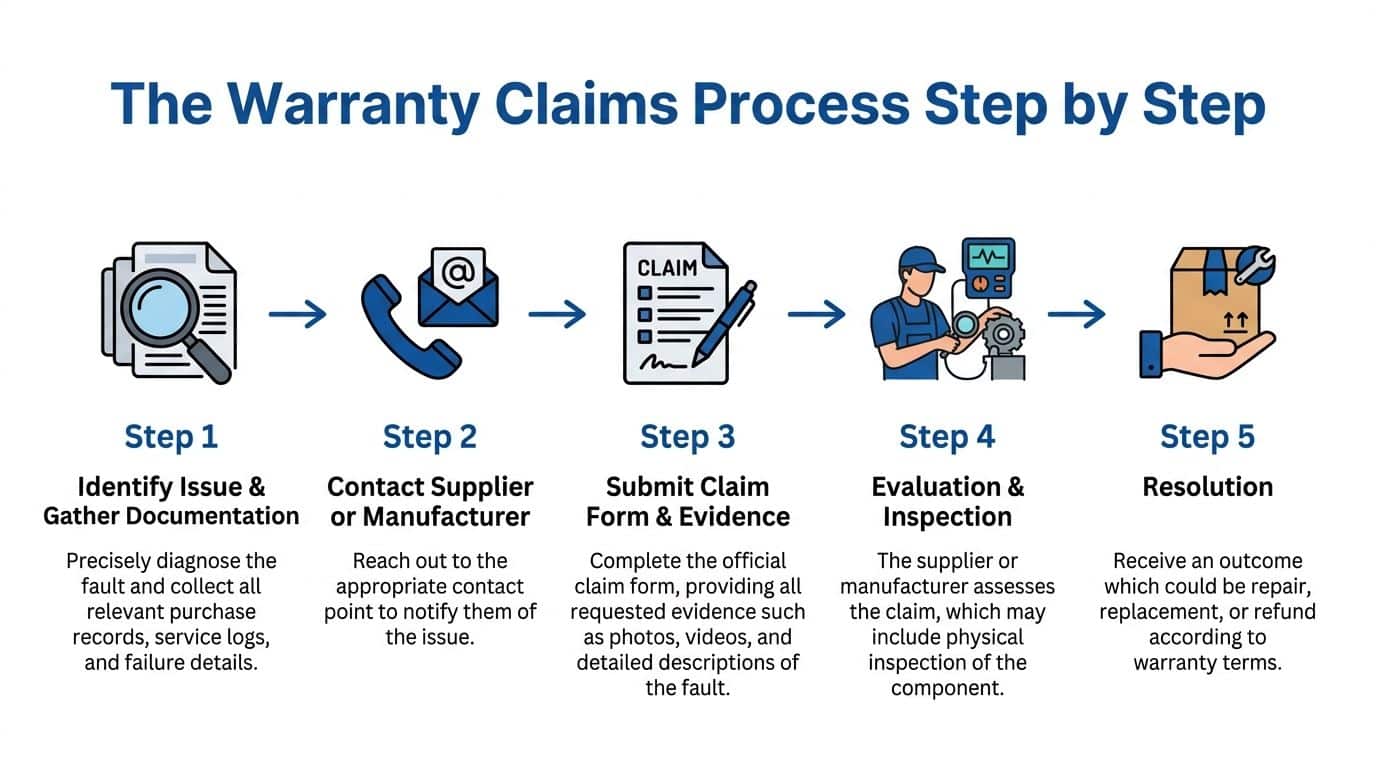
Step one is containment, not strip-down
Isolate the machine and stop secondary damage. If a gear pump is shedding material into the system, continued operation can spread contamination into valves, motors, cylinders, and coolers. If a hose failure has caused oil loss, protect the surrounding equipment and record the fluid condition immediately.
Before anyone dismantles anything, capture the scene:
- Photographs of the failed component in situ
- Nameplate details and part numbers
- Installation layout including hoses, couplings, and orientation
- Oil condition evidence such as visible contamination or discolouration
- Fault chronology with date, symptoms, and operator observations
Build the claim file before you make the call
Suppliers usually ask better questions than customers expect. If you ring up with “the pump has failed”, the next exchange often becomes slow and defensive. If you contact them with a structured evidence pack, the discussion changes.
A strong file typically includes:
- Proof of supply. Order reference, invoice, delivery note, and serial number.
- Commissioning evidence. Start-up checks, pressure settings, and confirmation of intended application.
- Maintenance history. Service dates, filter changes, oil changes, inspections, and any adjustments made.
- Operating context. Hours run, load pattern, environment, and any abnormal event before failure.
- Technical evidence. Photos, videos, fluid analysis if available, and a clear description of the suspected mode of failure.
Suppliers don't reject many claims because the form was missing. They reject them because the evidence leaves room for another explanation.
A short video can help teams brief technicians on what a professional claim process looks like in practice:
Submit early, then preserve the failed part
Notify the supplier promptly and ask whether they want the component returned as found. Don't clean away the evidence. Don't swap internal parts between units. Don't let a local repairer dismantle the component unless the warranty terms expressly allow it.
Keep communication factual. Describe symptoms, operating conditions, and what you've observed. Avoid declaring the root cause too early unless you can support it.
A good claim file doesn't guarantee success, but it changes the balance. It shows that the team controlled the failure, preserved evidence, and understands the difference between a defect claim and a maintenance issue.
Protecting Your Warranty Through Proper Maintenance and Use
The easiest warranty claim is the one you never need to make. In hydraulic systems, proper maintenance doesn't just reduce failure risk. It protects the validity of your warranty coverage when something does go wrong.
That matters because the paperwork is often where claims fail. Data shows that 68% of UK industrial warranty denials in hydraulic systems stem from unclear maintenance-obligation documentation, not actual product faults, according to this discussion of warranty requirements and maintenance obligations.
Good maintenance is only half the job
Many sites service equipment reasonably well but record it badly. A technician may have changed filters, checked couplings, verified fluid level, and inspected return-line contamination indicators, but if the record only says “routine service completed”, that won't help much in a dispute.
The record needs to show compliance with the actual conditions of use. For hydraulics, that usually means logging:
- Fluid specification used and any top-up details
- Filter changes with date and part reference
- Pressure and temperature checks where relevant
- Seal or hose replacements during routine maintenance
- Any abnormal findings such as foaming, noise, drift, leakage, or overheating
The omissions that hurt claims most
A supplier looking at a failed gear pump or valve assembly will often test whether the machine was run outside the intended envelope. If your maintenance file can't answer that, the supplier may default to misuse or neglect.
Common weak points include these:
| Weak record | Likely supplier response |
|---|---|
| No oil history | Possible contamination or wrong fluid |
| No service sign-off | Maintenance compliance unproven |
| Missing hours log | Usage-based conditions can’t be verified |
| No note of setting changes | Relief pressure may have been altered |
Disciplined filing holds significant importance. Teams setting up warranty-sensitive assets should borrow from broader essential document retention guidelines so records stay retrievable, consistent, and usable when a claim appears months later.
Maintenance has to match the warranty conditions
Routine work also needs to follow the supplier's rules, not just site habit. If the warranty requires approved service intervals, specified fluid grades, or named repair channels, local shortcuts can void otherwise valid cover.
The strongest approach is to tie service work to a formal schedule and keep the evidence in one place. A structured programme for hydraulic maintenance scheduling makes this easier because it links tasks, timing, and records instead of relying on memory and scattered worksheets.
A warranty doesn't reward good intentions. It rewards provable compliance.
If you want fewer disputes, treat every maintenance entry as if an external assessor will review it after a failure. Because one day, they probably will.
Contractual Best Practices for Procurement Teams
Most procurement teams focus on price, lead time, and interchangeability. For hydraulic assemblies, that's not enough. The warranty clause often decides who carries the cost when a bespoke power pack fails, a valve bank has to come off a machine, or a pump defect causes wider contamination.
In England and Wales, the statutory limitation period for contractual warranty claims regarding defective hydraulic components is six years from the date of delivery, and this can extend to 12 years only if the warranty terms are executed as a deed, as explained in CMS's guide to warranties in supply contracts for England and Wales. For high-value bespoke contracts, that technical point deserves legal attention during negotiation, not after a dispute starts.
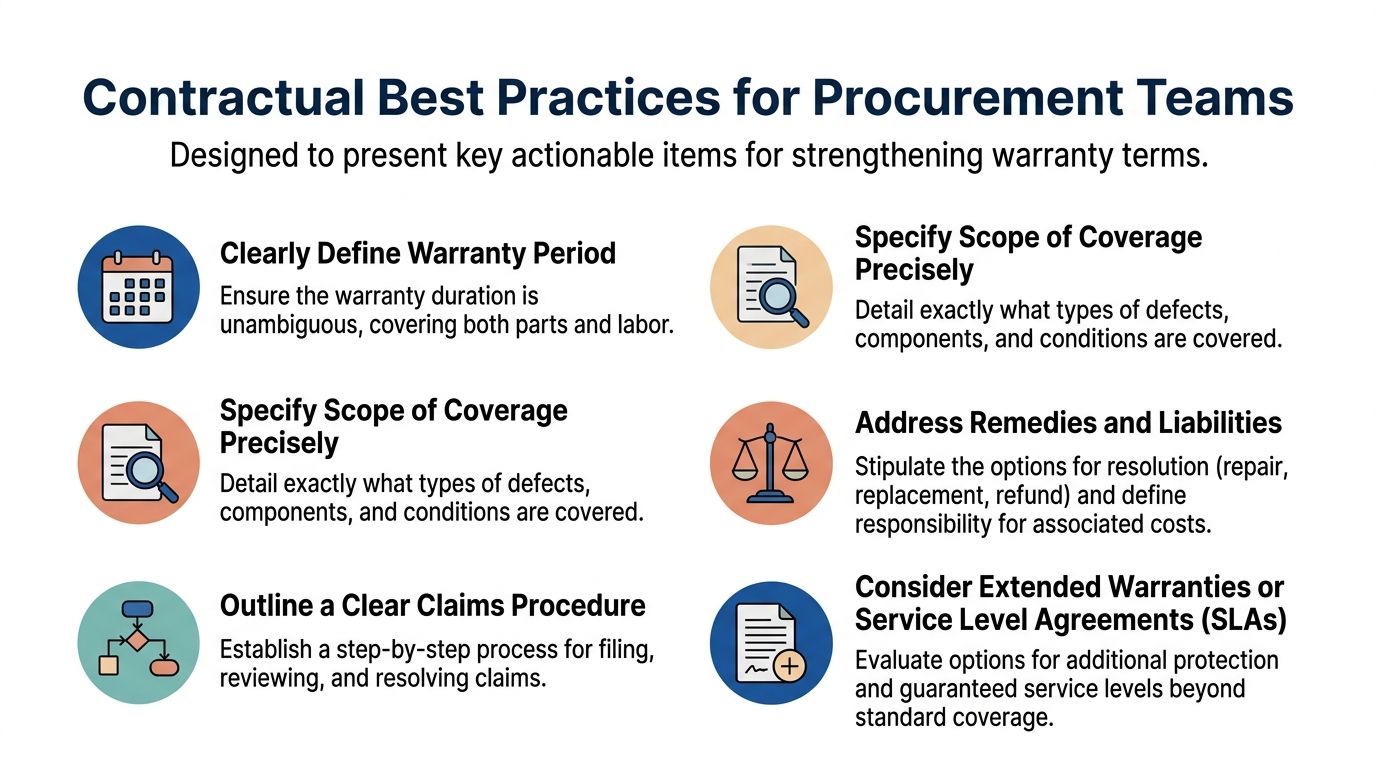
Five terms worth tightening before you place the order
A hydraulic warranty clause should answer operational questions, not just legal ones.
- Start date. State whether the warranty begins at delivery, installation, commissioning, or handover to the end user.
- Scope of cover. Define whether it covers only defective parts or also labour, investigation, collection, and return.
- Remedy route. Clarify whether the supplier may choose repair, replacement, or credit, and within what response time.
- Failure reporting. Set out notification deadlines and what evidence is required.
- Consequential costs. Decide in advance who pays for strip-down, flushing, refitting, and machine downtime.
For procurement managers working in controlled industries, it also helps to think like an auditor. Training resources around lead auditor courses UK can sharpen the way teams review supplier clauses, record obligations, and compliance wording.
Sample wording that prevents common disputes
You don't need a long clause to get better protection. You need a clear one.
Consider language along these lines:
The warranty period shall commence on the date of commissioning, provided commissioning occurs within an agreed period after delivery and is documented by the buyer.
That removes one of the most common arguments in delayed-build projects.
Another useful clause is operational rather than legal:
Where a covered defect is confirmed, the supplier shall state whether the remedy is repair or replacement within a defined review period and shall specify any buyer obligations relating to return, preservation, and inspection of the failed component.
That prevents weeks of delay caused by uncertainty over who is doing what.
Documentation is part of the contract, not an afterthought
If the supplier requires commissioning records, service logs, registration, or authorised servicing, those requirements should be called up clearly in the purchase file and handover pack. Many disputes start because procurement accepted terms that operations never saw.
A proper documentation management process closes that gap. It helps ensure the same file contains the purchase terms, serial numbers, commissioning evidence, service obligations, and any registration deadlines.
Procurement creates better warranty coverage when it aligns contract wording with real machine life. A standard off-the-shelf valve may only need straightforward terms. A bespoke power pack feeding a critical production line needs a far more deliberate agreement.
Common Questions on Hydraulic Warranties and Next Steps
Some warranty questions only show up when the machine changes hands, the failed part has already been repaired once, or the supplier asks for costs nobody discussed at order stage. These aren't edge cases. They are routine commercial problems.
Is a hydraulic warranty transferable
Sometimes yes, sometimes no. Transferability depends on the written terms. Some suppliers tie the warranty to the original purchaser, some to the installed machine, and some require formal notice before a transfer is recognised.
For used machinery, don't assume the remaining warranty coverage follows the asset. Check the original documents before the sale completes. If transfer matters commercially, make it part of the sale paperwork.
Does a repaired component carry the same cover as a new one
Not usually. Repaired items commonly carry more limited cover than new assemblies, and the scope may apply only to the repair work performed rather than the whole unit. That matters for cylinders, pumps, and motors where one subassembly was rebuilt but the rest of the component remains in service.
The practical lesson is simple. When accepting a repaired unit, ask whether the warranty applies to the complete assembly, the repaired area only, or specific replaced parts.
Who pays to remove, ship, inspect, and refit the failed part
That depends on the contract or warranty wording. Many standard warranties focus on the part itself and say little about labour, transport, flushing, or access costs. In mobile plant and agricultural machinery, those costs can exceed the value of the failed component.
Procurement should settle that point before purchase. Maintenance should verify it before failure. If the terms are silent, expect an argument.
What if wear parts were replaced during routine service
That is often where disputes begin. A supplier may say the failed seal, bearing, or hose was a wear component. The buyer may say the wider assembly then failed because of an inherent defect elsewhere. Both positions can exist at once.
The deciding factor is usually the quality of the service record and the failure evidence. If routine replacement work was documented properly and the rest of the system remained within specification, the buyer's position is much stronger.
What should a team do next if it wants fewer warranty disputes
Start before the next order goes out.
Review supplier terms. Assign responsibility for registration and commissioning records. Tie maintenance records to actual warranty obligations. Keep failed components intact until the supplier responds. Write purchase terms that match the importance of the asset, not just the value of the part.
Done properly, warranty coverage becomes one more engineered control. It won't stop every failure, but it will stop avoidable losses caused by missing records, vague clauses, and assumptions nobody checked.
If you need application-specific advice on hydraulic warranty coverage, component selection, or bespoke power pack support, speak with MA Hydraulics Ltd. Phone 01724 279508 today, or send us a message.