
You're on a job with the clock running, the panel's open, the air line's already out of service, and the last thing you need is a fitting that looks right but won't seal once the machine starts vibrating again. That's the moment a 6mm push fit connector earns its keep, because a quick, clean connection matters more than a glossy catalogue picture. If you're working on UK plant, mobile machinery, or a mixed legacy system, the challenge isn't just finding a push-in part, it's matching the tube, the thread, and the service conditions so the joint stays sound after the first restart. For a broader look at compatible hydraulic and pneumatic components, see MA Hydraulics' hydraulics and pneumatics range.
A 6mm push fit connector is a small part, but it sits at the point where convenience can either save a repair or create a leak that comes back next week. In UK maintenance work, that usually means fast air lines, instrumentation tubing, or low-pressure control circuits where access is tight and downtime is expensive in practical terms. The best connectors feel simple because the design is simple, yet the detail behind that simplicity is what decides whether the fitting behaves well in service or becomes another call-back.
Introduction to 6mm Push Fit Connector
A 6mm push fit connector is one of those components that seems ordinary until you need one at 7 a.m. on a cold factory floor. The engineer has the panel open, the tube is already cut, and there's barely enough space to get a spanner in, so a tool-free joint is the only sensible option. That's why these fittings are so common in UK pneumatic maintenance, light control lines, and compact machine assemblies.
The appeal is straightforward. You push the tube in, the fitting grips it, and the seal forms without threaded assembly or special tools. A product listing described as a “Push In Fitting Straight Stem-6mm Tube” is a good shorthand for the basic idea, a compact connector built for seamless tube connections in pneumatic and fluid systems Hydraulic Megastore product description.
Where they show up in real work
On UK sites, these fittings often appear where engineers need quick make-up and break-down. That includes air circuits on mobile equipment, panel-mounted instrumentation, and compact automation systems where space is limited and the line needs to be swapped without re-plumbing the whole assembly.
A practical advantage is reusability, but only when the tube and fitting are treated properly. If the end is damaged, dirty, or the wrong size for the port geometry, the joint can look installed while still being weak. That's why this part deserves more respect than its size suggests.
Practical rule: if the fitting is doing a lot of work in a small space, the tube preparation matters just as much as the connector body.
For UK maintenance teams, value is speed without losing reliability. That's useful on factory equipment, but it's just as important on mobile machinery where access is awkward and service time is short. The connector isn't the whole system, it's the interface, and interfaces are where most assembly mistakes start.
Understanding Push Fit Mechanism
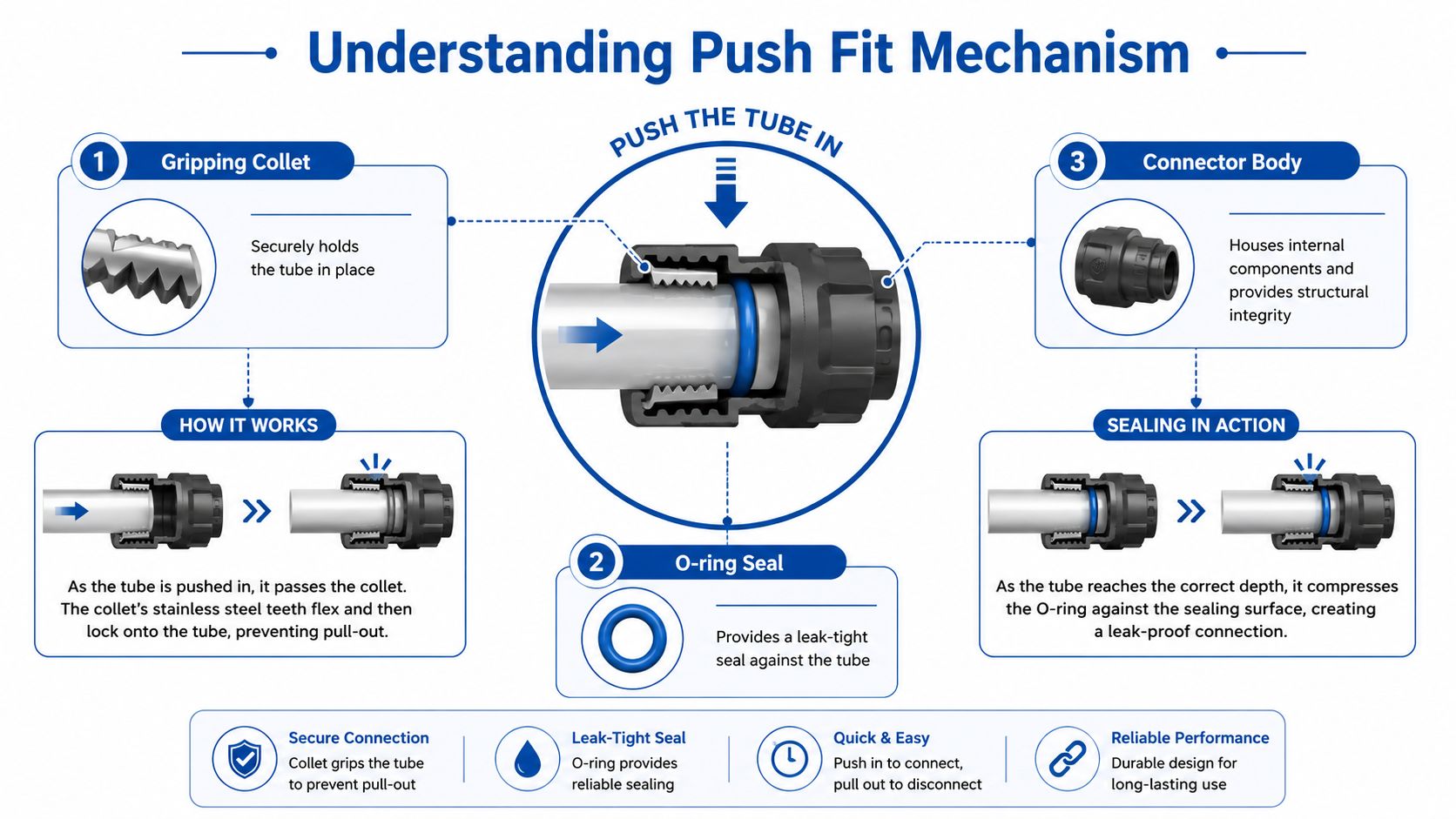
Think of the fitting like a snap-fit electrical plug, not like a traditional threaded adaptor. You don't wind it together piece by piece. You push the tube in once, and the internal parts do the holding and sealing for you.
The basic mechanism is made up of three jobs working at the same time. The connector body gives the fitting its structure, the gripping collet holds the tube, and the O-ring seal closes the gap between tube and body. The tube slides past the gripping element, then the collet bites lightly into the outside diameter while the seal compresses around it, so retention and sealing happen together rather than as separate steps.
Why that matters in the workshop
This design is fast because there's no nut to tighten and no thread to chase. It also keeps the connection compact, which helps when the fitting sits inside a manifold block, behind a guard, or in a crowded control cabinet. The tube can be removed again by pressing the collet, so the joint stays service-friendly.
That said, the mechanism only works properly when the tube is the right size and the outside surface is clean. A push-fit joint is not forgiving in the way a loose hose clip sometimes is, because the internal seal needs a consistent surface to press against. That's why a clean square cut and full insertion are not just good habits, they're part of the sealing system itself.
The tube doesn't “sort itself out” once it's in. The fitting can only seal what you've prepared correctly.
This is also why push-fit parts are so popular for rapid installation and removal in pneumatic and fluid lines. The design removes unnecessary steps, but it shifts responsibility to the person making the joint. In practice, that means tube preparation, size checking, and attention to the mating port matter more than force.
Key Aspects of Materials and Ratings
The body material and seal compound are not background details, they decide whether the connector suits the job. A brass or stainless body is common where the environment is tougher, while composite bodies may suit lighter-duty air work where chemical exposure and mechanical abuse are less severe. Seal choice matters just as much, because nitrile, EPDM, and other compounds behave differently once temperature, fluid type, and vibration enter the picture.
For the pressure side, the key UK reference point here is clear. Fittings with a 6mm tube bore are typically engineered for hydraulic or pneumatic systems with a maximum working pressure of 10 bar (1.0 MPa) when standard nitrile rubber seals are used, which puts them in the low-pressure control segment rather than high-pressure power transmission MA Hydraulics technical guide. That makes them suitable for control and service lines, not for heavy power circuits.
Tube material changes the seal behaviour
Tube choice impacts the fitting's operational behavior. The same UK source notes that flexible tubing such as PU or nylon can produce a 30% to 50% reduction in effective sealing force, and micro-leaks may start to appear after 500+ cycles under those conditions MA Hydraulics technical guide. In plain terms, a tube that bends and relaxes under load won't always support the seal as well as a stiffer one.
| Pressure and Tubing Compatibility Overview | |||
|---|---|---|---|
| Tubing Material | Max Pressure | Sealing Force Reduction | Cycle Life |
| PU | Up to 10 bar | 30% to 50% in flexible-tube use cases | Micro-leaks may appear after 500+ cycles |
| Nylon | Up to 10 bar | 30% to 50% in flexible-tube use cases | Micro-leaks may appear after 500+ cycles |
The practical takeaway is that material selection is not cosmetic. If the tube end deforms, if the outside diameter is inconsistent, or if the line sees repeated movement, the seal has to work harder. That's why compatibility should always be checked against the full assembly, not just the nominal tube size.
For engineers comparing connector families and service conditions, MA Hydraulics' hydraulic fittings types guide is a useful cross-check point when choosing the right fitting style for a given application.
Choosing for Hydraulic Versus Pneumatic Systems
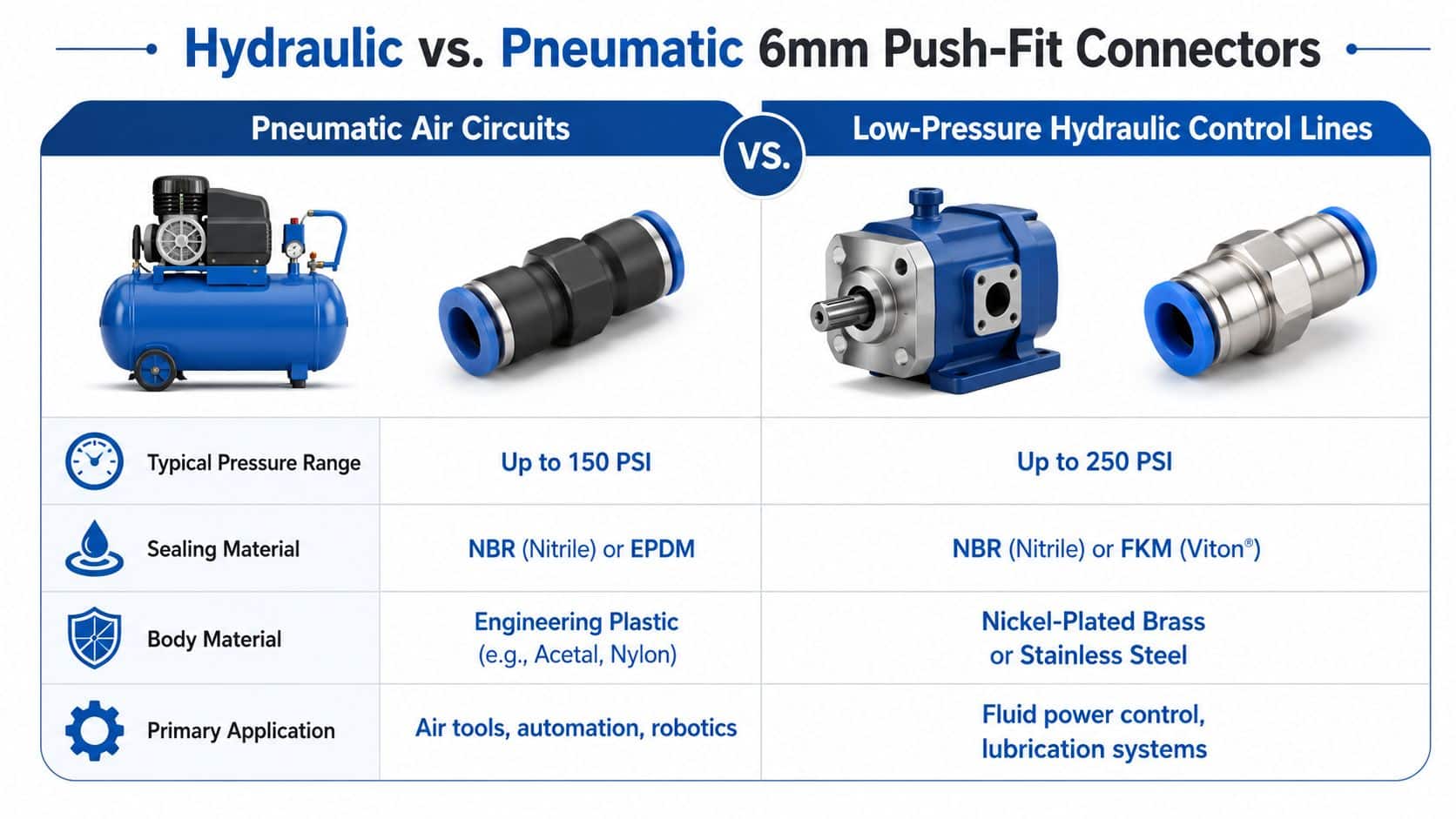
A 6mm fitting can appear in both air and low-pressure fluid work, but the design intent isn't identical. Pneumatic circuits usually reward low mass, easy assembly, and quick rework. Low-pressure hydraulic control lines ask more of the seal, the body, and the tube itself, because fluid behaves differently from air and tends to expose small weaknesses more quickly.
The safest way to think about it is this. Air circuits are forgiving in one sense, because leakage is often easier to tolerate and diagnose. Hydraulic control lines are less forgiving, because the fluid can reveal a weak seal, a thread mismatch, or a badly prepared tube end much sooner.
Matching the application to the connector
In pneumatic service, the fitting often sits in a line that's being installed, removed, or re-routed during maintenance. In hydraulic control work, the same compact push-fit idea can still be useful, but the engineer should be stricter about seal condition, tube stiffness, and port geometry. The line may not carry high power, yet it still needs a proper seal and a stable mechanical interface.
That's also where thread form becomes important. A male M6 x 1.0 connector fits metric threaded ports, while a BSPT variant suits British pipe-thread conventions. The tube size can be right and the assembly can still fail if the thread form doesn't match the port.
For plant engineers dealing with compressed air distribution, MA Hydraulics' compressor air piping guide gives a relevant context for air-side installations and system layout.
Simple rule: if the port geometry is wrong, the fitting doesn't become “close enough”. It just becomes a leak waiting to happen.
In practical UK terms, this means you check the fluid type, the port standard, and the service duty before you order. That habit saves time on site and avoids the common mistake of assuming that all 6mm push-fit parts are interchangeable.
Installation and Removal Best Practices
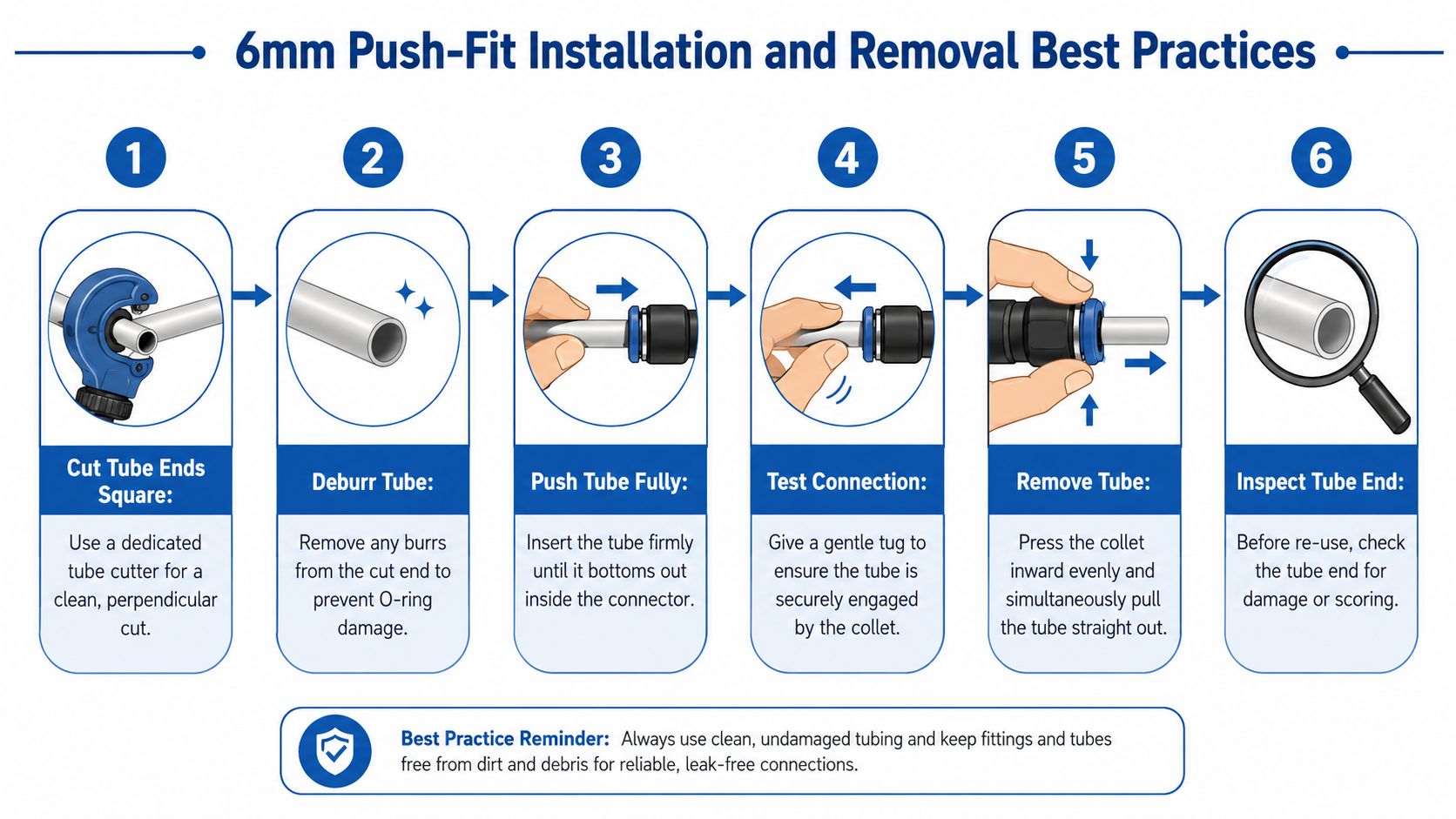
Good installation starts before the tube reaches the fitting. A square cut gives the O-ring a clean surface to work against, and a burr-free end stops the seal from being nicked during insertion. If the tube end is ragged, you've already made the job harder.
The next point is cleanliness. Dust, swarf, and moisture all interfere with sealing, especially on flexible tube where the end can deform slightly as it enters the collet. That's why a dry, clean tube with a proper finish is worth the extra minute it takes to prepare.
The practical sequence
- Cut the tube square. A dedicated tube cutter gives a better result than side cutters or a knife.
- Remove burrs. Even a small edge can damage the O-ring during insertion.
- Push the tube fully home. Seat it to the stop so the gripping and sealing elements do their job.
- Check the grip. A gentle tug should confirm the tube is engaged.
- Remove correctly. Press the collet evenly, then pull the tube straight out.
- Inspect the tube end. If it's scored or deformed, don't re-use it without checking the condition carefully.
The removal step matters because many faults begin during rework. If the tube is dragged out at an angle, the end can ovalise or score, and the next installation may not seal as well. That's especially relevant on PU and nylon, where repeated handling can make the end less reliable, as noted in the earlier compatibility discussion and the referenced maintenance material UK maintenance video on tube preparation and vibration effects.
If you need a quick visual reference while training new technicians, the process is simple enough to explain in one sentence: clean cut, full push, even release.
Troubleshooting Failures and Maintenance Advice
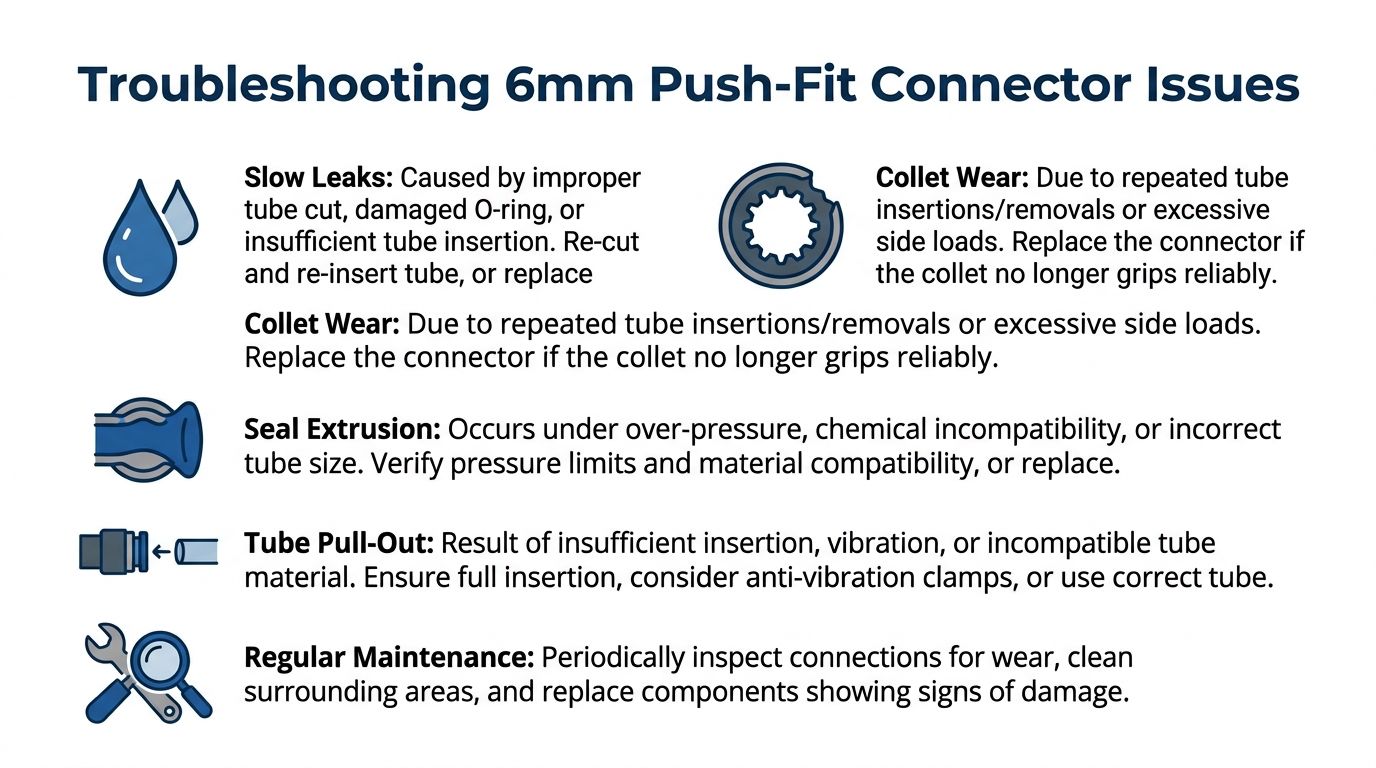
When a push-fit joint starts misbehaving, the fault is usually mechanical, not mysterious. A slow leak often points to a poor cut, contamination, or a seal that's been damaged during insertion. If the tube end wasn't prepared properly, the fitting may still grab it, but it won't seal consistently.
Repeated insertion and removal also wears the gripping elements. Once the collet no longer holds the tube with confidence, replacement is usually the sensible choice rather than trying to coax more life out of it. Side loads make that worse, because the fitting is designed to grip axially, not to act as a bracket.
Common fault patterns
- Slow leaks: Usually linked to an imperfect cut, damaged O-ring, or incomplete insertion.
- Collet wear: Often the result of repeated servicing or side loading on the tube.
- Seal distortion: Usually caused by over-pressure, chemical incompatibility, or the wrong tube size.
- Tube pull-out: Often traced to incomplete insertion, vibration, or a tube material that's too soft for the duty.
Flexible tubing deserves particular attention. The maintenance material notes that PU and nylon can deform or develop micro-leaks if they aren't cut square, thoroughly cleaned, or used under vibration without enough stiffness tube maintenance guidance. That matches what many workshop engineers see in service, where a connection looks fine on day one and then starts weeping after the machine has moved around for a while.
Inspect the joint after the machine has settled into service, not just immediately after installation.
For maintenance, a sensible routine is visual inspection, cleaning of the surrounding area, and prompt replacement of any tube end that shows scoring or crush marks. On rework-heavy equipment, it's worth treating tube ends as consumable rather than assuming they can be reused indefinitely.
Specification Checks and Part Replacement Guidance
Before you order a replacement, check three things first. The tube outside diameter must match the connector, the seal compound must suit the service environment, and the thread form has to match the port. A 6mm push-fit connector in UK practice is commonly specified as a male M6 × 1.0 thread or a BSPT threaded variant, and selecting the wrong thread form can prevent proper sealing even when the tube OD is correct thread compatibility reference.
That's why part numbers matter. Document the fitting body type, thread standard, seal type, and any batch code you can read off the old part. It makes repeat orders easier and reduces the chance of mixing metric and pipe-thread styles on the same machine.
For mixed sourcing, a useful external reference is water filter replacement parts from Water Filtration Systems, because the same style of push-fit logic often appears across fluid-handling assemblies and helps buyers compare fitting families more carefully.
If you're unsure about a replacement, speak to a supplier who can cross-check the tube size, the port form, and the seal choice before you fit it. Phone 01724 279508 today or send us a message https://www.mahydraulics.co.uk/contact-us/ to discuss bespoke requirements or hard-to-find connectors.
If you need help matching a 6mm push fit connector to the right tube, thread, or seal for a UK hydraulic or pneumatic application, call 01724 279508 today or send a message to MA Hydraulics Ltd for practical support on the exact part you need.