

You're on site when the call comes in, a hose has split, the machine's working near a ditch or watercourse, and someone's asking whether the fluid in the tank is “the green stuff” or the standard mineral oil. That's exactly when biodegradable hydraulic fluid stops being a brochure term and becomes a risk decision. Get it right, and you protect the site, the machine, and the paperwork. Get it wrong, and the clean-up, downtime, and compatibility issues land on the maintenance team.
What Biodegradable Hydraulic Fluid Means in Practice
A biodegradable hydraulic fluid is a hydraulic working fluid designed to break down through natural microbial action if it escapes into the environment, instead of lingering like a conventional mineral oil. In UK practice, that matters most where equipment sits beside rivers, canals, wetlands, drainage channels, harbour walls, or sensitive land. The Environment Agency's environmentally acceptable hydraulic fluid guidance makes that point plainly, and the wider BS EN ISO 15380 framework gives procurement teams a language for specifying the chemistry rather than relying on marketing labels (Environment Agency guidance summary).
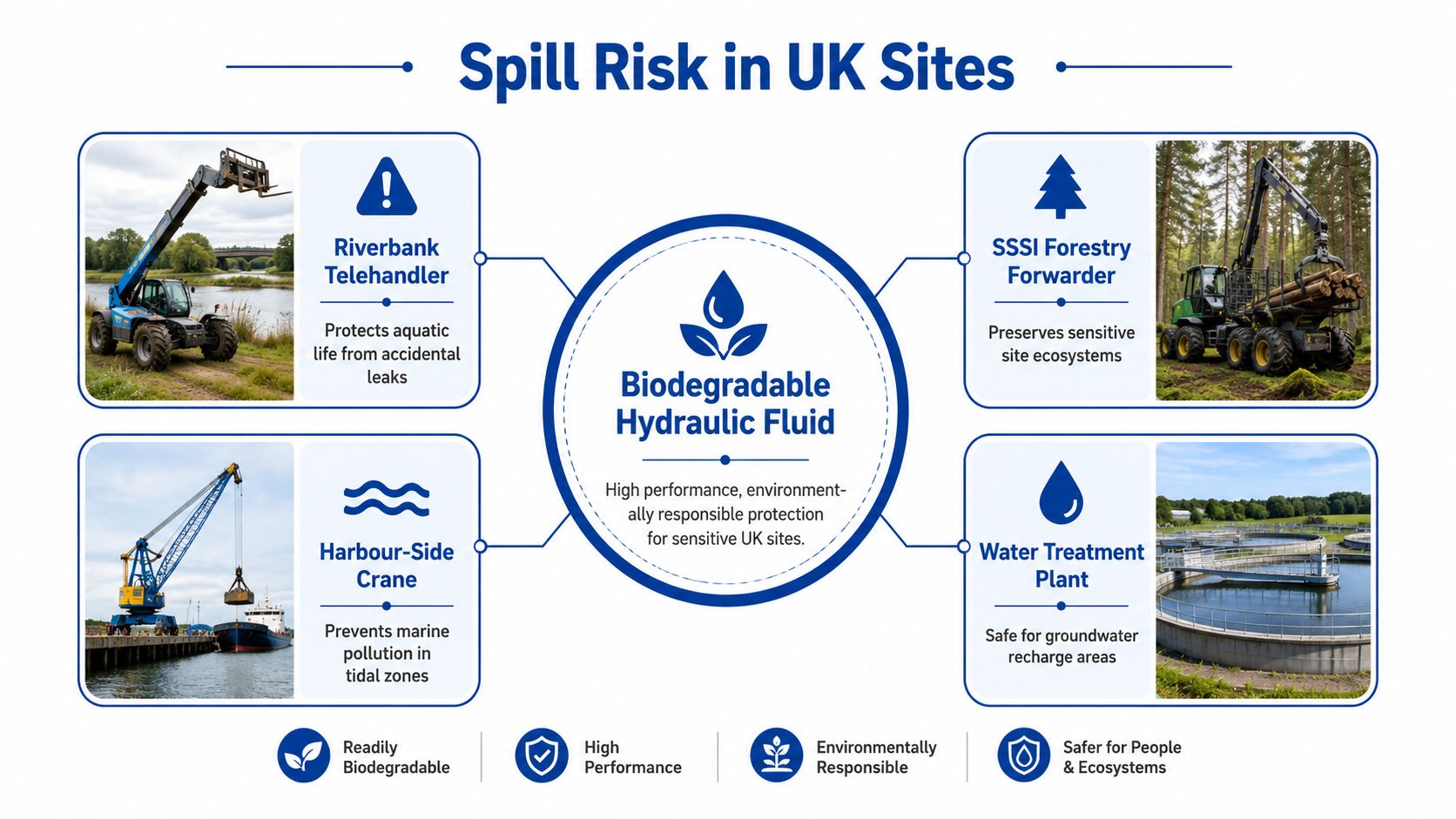
The key point is simple. Biodegradable does not mean harmless, and it does not mean every product on a shelf behaves the same way. It usually means the base stock is chosen for faster environmental breakdown, often an ester chemistry rather than a mineral oil, but the finished fluid still has to do real hydraulic work under pressure, heat, and contamination risk. That's why the best choices are the ones with verified performance data, not vague “eco” branding.
Practical rule: if a fluid is going near a watercourse, the label needs to mean something under load, not just look good on a purchase order.
For a procurement colleague, the clean distinction is this. Readily biodegradable fluids are expected to break down quickly under the right test method, while biodegradable fluids may break down, but not to the same standard or pace. Mineral oil is the opposite end of the spectrum, reliable in many systems but a poor fit where a leak could become an environmental incident.
If you want a broader way of thinking about how material data gets hidden in plain sight, the Polymerize article polymerize unlocks hidden data in materials is a useful example of why chemistry and classification matter, not just the headline product name.
The Main Chemistry Families and How They Compare
The quote sheet usually hides the important detail behind a neat product code. What you're really choosing between is HETG, HEES, HEPR, and, in some specifications, HEPG, each with very different behaviour in heat, seal compatibility, and long-term stability. If a buyer only sees “biodegradable”, the machine shop ends up dealing with the consequences.
What each family is actually doing
HETG is the vegetable-oil route, commonly based on rapeseed or sunflower chemistry. It's the most familiar “natural” option, but it can be less forgiving in hotter service because oxidation stability isn't in the same league as the synthetic ester group. It suits lower-risk mobile kit where the environmental requirement is real, but the thermal duty isn't punishing.
HEES is the workhorse for modern biodegradable hydraulic fluid systems. It's a synthetic ester base stock, usually the best balance of biodegradability, antiwear performance, and thermal stability when you're converting from mineral oil. In my experience, this is the family most OEMs end up approving once they've tested seal behaviour and pump performance properly.
HEPR and HEPG sit in the polyalkylene glycol space, and they're used where specific lubricity or water-related properties matter. They're less of a universal default and more of a technical answer to a narrow problem, which is why they need careful compatibility checks before anyone orders a bulk fill.
Practical rule: don't ask “which biodegradable fluid is best?”, ask “which family fits this duty cycle, this seal set, and this maintenance regime?”
| Biodegradable hydraulic fluid families at a glance | |||
|---|---|---|---|
| Family | Base Stock | Best-Fit Duty | Seal Note |
| HETG | Vegetable oil | Lower-heat mobile plant, moderate spill risk | Check nitrile and polyurethane carefully |
| HEES | Synthetic ester | Forestry, marine, agriculture, factory hydraulics | Usually the most manageable retrofit choice |
| HEPR | Polyalkylene glycol | Specialist duties needing PAG-type behaviour | Verify seals, paint, and compatibility first |
| HEPG | Polyalkylene glycol variants | Narrow, application-led use cases | Treat as a controlled engineering selection |
The detailed trade-off is still the same across all of them. Vegetable-oil esters are generally described as more easily biodegraded and less hazardous than mineral oil lubricants, but they aren't automatically the most stable under temperature or contamination stress (Atlantic Oil biodegradable hydraulic fluid overview). That's why I always push teams to treat environmental performance and hydraulic performance as a pair, not as competing slogans.
For procurement teams trying to translate fluid chemistry into commercial terms, even a different market can be instructive. The way a specialist guide can unpack a low-carbon fuel tax issue, like Australia's LCLF startup tax guide, shows the value of separating chemistry families instead of lumping everything into one green category.
How Biodegradability Is Tested and Certified
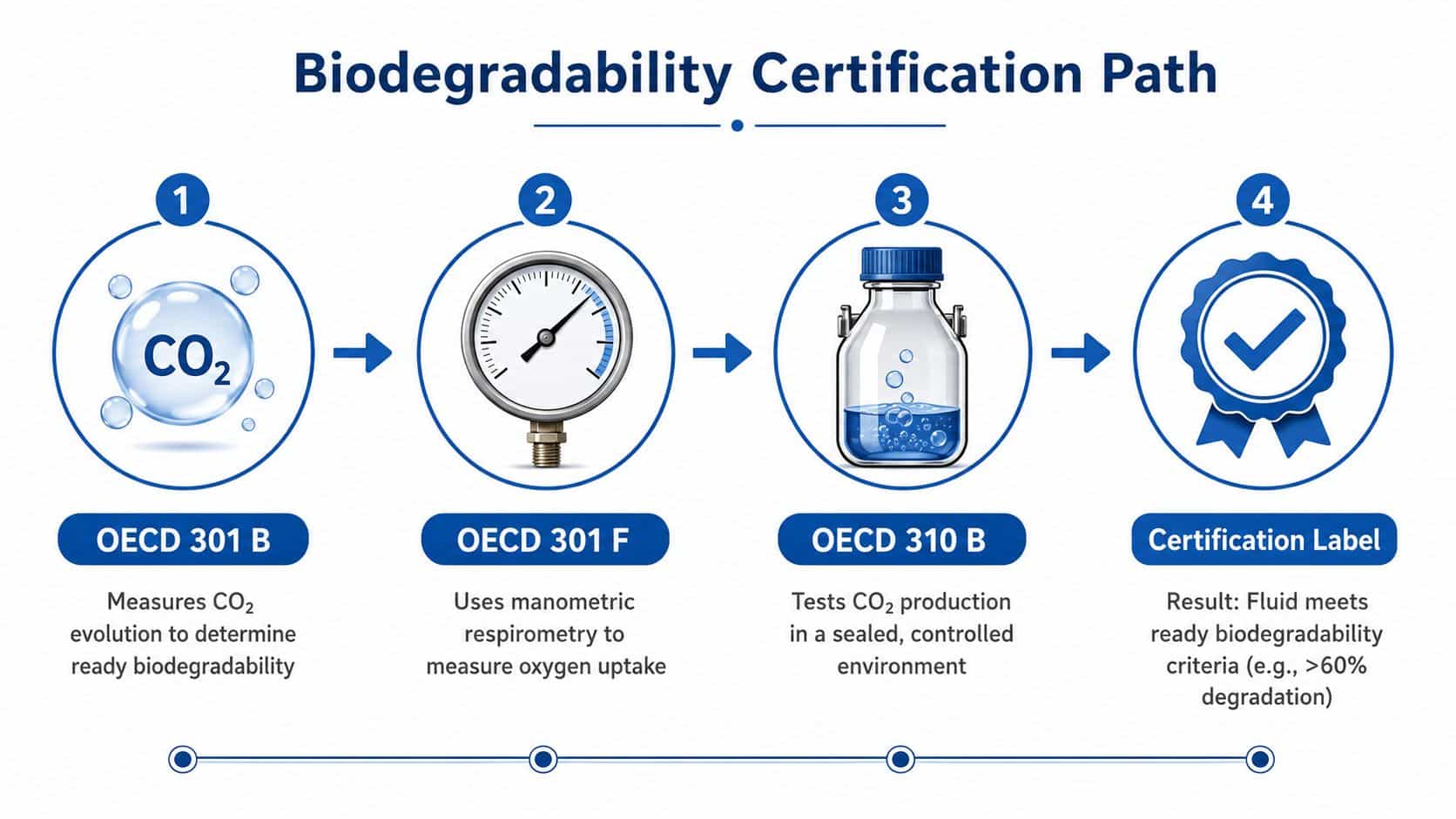
The phrase readily biodegradable only means something if it's tied to a test method. In practice, engineers look for a fluid that reaches at least 60% biodegradation within 28 days, because that's the working benchmark used in offshore guidance and broader technical procurement discussions (IMCA biodegradable lubricants guide). If a data sheet doesn't state the method, the result, and the timeframe, the claim is weak.
The test methods that matter
OECD 301 B measures ready biodegradability through CO2 evolution. OECD 301 F uses manometric respirometry, so it tracks oxygen uptake instead. OECD 310 B is another ready-biodegradability route, this time using sealed vessels and CO2 measurement. In marine and offshore specifications, you may still see CEC-L-33-A-93, which remains relevant in some niche duty sets.
The point of the test isn't academic. It tells you whether the chemistry is likely to break down in an environment where leak consequence matters, and it gives procurement a defensible basis for accepting a fluid on site.
What a data sheet should show
A good data sheet should state more than “biodegradable”. It should tell you the test method, the biodegradation percentage, and the supporting measures that matter to hydraulic systems, especially aquatic toxicity indicators such as LC50 or EC50. If the fluid also carries an environmental label, that helps, but it still needs to be read alongside the chemistry and the duty cycle.
BS EN ISO 15380 is useful because it wraps the families into one classification language. That makes it easier for UK buyers to compare like with like, rather than comparing a vegetable-oil product against a synthetic ester on the basis of marketing copy alone.
If you're checking a sample after commissioning or during a changeover, the oil-analysis route is worth keeping close, so the service team can see whether the fluid in the tank still matches the specification: hydraulic oil analysis support.
Matching the Right Fluid to the Job
A forestry skidder, a harbour crane, a tractor loader, and a factory press all ask different things from hydraulic fluid. The mistake I see most often is someone choosing the same “green” product for every machine because it sounds safer. It isn't safer if the fluid foams, oxidises, or upsets seals.
Forestry and marine use cases
For a forestry skidder, HEES ISO 46 is usually the first chemistry I'd look at. You want high biodegradability, decent low-temperature pumpability, and enough thermal stability to survive hard mobile work without varnish building up too quickly. That's a better fit than a basic vegetable-oil fluid when the machine is out all day in mixed conditions.
For a harbour crane or marine deck machinery, I'd still start with HEES or HEPR, depending on the exact seals, coating systems, and corrosion-protection requirements. The marine environment punishes fluid that can't hold its properties around moisture, salt, and intermittent loading. A neat environmental label won't save a poorly chosen base stock.
Agriculture and factory floor machines
An agricultural tractor loader is where HETG or HEES makes sense, depending on the spill risk, duty, and budget pressure. If the machine spends time near ditches, livestock areas, or drainage features, the environmental argument gets stronger. If it's doing ordinary yard work away from sensitive water, a premium mineral oil may still be the more sensible commercial choice.
A factory-floor machine tool or press often wants HEES ISO 32 or 46 if the site values cleanliness and temperature stability. But don't force biodegradable fluid into a press that runs hot all day just because the sustainability team prefers it. For some continuous-duty high-temperature presses, a standard mineral oil is still the correct answer because the thermal regime and maintenance plan matter more than the environmental label.
A quick selection view
| Duty cycle | Practical choice | Why it fits |
|---|---|---|
| Forestry skidder | HEES ISO 46 | Balanced biodegradability and pumpability |
| Harbour crane | HEES or HEPR | Better for moisture and corrosion-sensitive work |
| Agricultural loader | HETG or HEES | Spill risk and cost need balancing |
| Factory press | HEES ISO 32 or 46, sometimes mineral oil | Temperature stability and duty profile decide |
One thing to remember from the earlier section, the best fluid is the one that meets the site risk without creating a new reliability problem.
Converting an Existing System Without Damaging It
A changeover from mineral oil to biodegradable hydraulic fluid should be treated as a controlled project, not a drain-and-fill job. The system has memory. Residual mineral oil, degraded varnish, and seal history all affect what happens in the first few days after the swap.
What the workshop should check first
Start with the seal material. NBR, HNBR, Viton, and EPDM all behave differently, and ester fluids can shrink some nitrile compounds if the compatibility picture is ignored. That's where retrofit jobs go wrong, because the fluid gets blamed for a problem that was already sitting in the elastomer choice.
Next, look at the flushing plan. A proper conversion normally needs a significant flush, often around three system volumes, and the flush fluid should either be the same grade being introduced or a compatible mineral flush if the family is changing. A quick drain won't clear the old film from valves, lines, and dead spots.
Practical rule: if you can still smell the old oil strongly after the flush, you probably haven't finished the job properly.
Verification before and after the swap
Filtration matters more during a conversion than during normal running. I'd usually favour a finer filter to catch residual varnish and loose debris from the previous charge, then inspect closely during the first warm cycle. Pressure ripple, pump noise, and case temperature tell you a lot before the fluid sample does.
Keep a short field checklist pinned in the workshop.
- Tank sample before changeover: confirm the starting condition and spot contamination.
- Mid-flush sample: check whether the old mineral oil is still present.
- Post-flush sample: verify cleanliness before putting the machine back into service.
- Pressure ripple test: look for cavitation, aeration, or valve instability.
- Thermal image of the pump case: compare the first warm cycle against the known-good baseline.
The first 100 hours are the probation period. That's when seal swelling, additive interaction, and filter loading show up. For a related maintenance approach, the contamination-control guidance at contamination control basics is worth keeping near the service bay because a clean changeover saves more grief than a rushed one.
Performance Trade-offs and Common Misconceptions
The first misconception is that biodegradable fluids are automatically weaker. That used to be a fairer criticism than it is now. Modern HEES packages are built to deliver strong antiwear behaviour, and they're often specified to meet the same kind of pump and gear-scuffing demands that mineral oils handle, provided the formulation and additive package are right.
The second misconception is that all green fluids behave alike. They don't. HETG and HEES can sit at very different points on oxidative stability, thermal endurance, and low-temperature behaviour, which is exactly why a straight “biodegradable” procurement line can be dangerous. If one goes into a hot, dirty circuit that really needs the other, the failure mode is usually ugly and expensive.
The third misconception is that the label solves housekeeping. It doesn't. Tank venting, breather filtration, moisture control, and regular inspection still matter. A saturated HEES can hydrolyse faster than a mineral charge, so water management isn't optional just because the product is biodegradable.
Standout point: the greenest fluid on paper can become the worst fluid in service if the system is dirty, wet, or overheated.
The useful way to think about cost is not just the drum price. Yes, biodegradable fluids usually carry a premium, but in a sensitive site the avoided spill response, cleanup, interruption, and reputational damage often outweigh that extra spend. That's especially true where the machine is part of a compliance-sensitive operation, not just a standalone asset.
Storage, Spill Response and End-of-Life Disposal
Treat storage like the first line of contamination control. Keep drums cool, dry, and sealed, and if an IBC is going to sit for longer than six months, a nitrogen blanket is sensible where the site's procedures allow it. The goal is to stop moisture uptake and oxidation before the fluid even reaches the machine.
For indoor power packs, bunding still matters. Size the tank bund so a leak can be contained rather than migrating into drains or floor channels. That sounds basic, but it's often the detail that separates a manageable maintenance event from a reportable environmental problem.
If a hose bursts near a drain or watercourse, act fast and keep the sequence tight. Stop the source, contain the spread with absorbent, notify the site environmental lead, and hold the used absorbent for licensed disposal. A spill kit for ester-based fluid should use oil-rated absorbents, because HEES is not water-soluble and the wrong absorbent choice just slows the response.
For a broader reminder of how a small leak can turn into an operational issue, the My Safety Manager fuel leak guide is a useful parallel read for response discipline. The same basic principle applies here, contain first, document second, and never let the fluid reach the wrong drain.
Used HEES and HETG must go through a licensed waste-oil collector under the UK waste code 13 01 11*, and they should never go into surface-water drainage. If the tank itself needs attention, the correct hardware and layout matter too, so the guidance on hydraulic oil tank arrangements is worth keeping alongside the waste procedure.
Frequently Asked Questions About Biodegradable Hydraulic Fluid
Can you top up HEES with mineral oil in an emergency
Don't treat that as a normal practice. A small emergency top-up might keep a machine moving long enough to get home, but it changes the blend, muddies the classification, and can create compatibility uncertainty. If the wrong drum is on site, the better answer is usually to isolate the machine, record the exception, and plan a proper drain and flush rather than hoping the mixture will behave.
How does HEES behave in cold starts
HEES usually gives better cold-start behaviour than many people expect, which is one reason it's used in forestry and dock equipment. The exact outcome depends on the grade and the pump, but the family is generally chosen because it can remain workable in colder service while still offering environmental benefit. In a real system, the issue is often not the fluid alone, it's whether the suction line, filter, and breather are clean enough to let the fluid move freely.
Should you choose ISO 32, 46, or 68
Pick the viscosity grade to match the machine's temperature range and pump design, not the marketing label on the drum. ISO 32 suits colder or faster-response systems, ISO 46 is the common middle ground, and ISO 68 is often used where film strength matters more than easy flow. If the OEM specifies a grade, start there and only move if the duty cycle justifies it.
Do biodegradable fluids need shorter change intervals
Not automatically. Service life depends on contamination control, heat load, moisture, and how hard the machine works. A well-specified HEES in a clean, stable system can last well, while a neglected system can ruin any fluid quickly. The drain interval should come from the condition of the oil, the operating history, and the OEM or fluid supplier guidance, not from the word biodegradable on its own.
If you're converting a machine, specifying a new build, or troubleshooting a fluid that doesn't quite match the duty cycle, speak to MA Hydraulics Ltd today on 01724 279508 or send a message through their contact page.