

A hydraulic system rarely fails because of one dramatic event. More often, it gets hotter week by week, oil thins out, seals harden, valves start sticking, and a machine that used to run all shift suddenly trips out halfway through a job. On a mobile unit, that might mean a telehandler slows down on a warm afternoon. On a factory line, it can mean nuisance stoppages that maintenance teams keep chasing without ever fixing the root cause.
That's why asking what is thermal management isn't an academic exercise. In hydraulics, it's the practical work of controlling where heat is generated, how it moves, and how it leaves the system before reliability, efficiency, and uptime start to suffer.
In the UK, this matters more than ever. The government's Climate Change Committee says electricity demand could rise from about 300 TWh in 2021 to 810 TWh by 2035 and around 1,330 TWh by 2050, driven by electrification of heat, transport, and industry, which makes control of heat losses, component temperatures, and cooling loads a foundational engineering issue across energy and industrial systems, as noted in the Electronics Cooling practical statistics guide.
The Cost of Heat An Introduction
A familiar call-out goes like this. The machine starts fine in the morning, runs acceptably for a while, then becomes sluggish as the day warms up. The operator notices slower actuator response, harsher noise from the power unit, and eventually a shutdown or a relief valve chattering when it shouldn't. By the time someone puts a hand near the tank or checks the return line, the system is already running too hot for comfort.
The immediate cost isn't just the repair. It's the stalled job, the waiting labour, the transport disruption, the production slot that's been missed, and the pressure to fit whatever part is available rather than the part that solves the issue. Heat turns minor inefficiencies into expensive failures because it affects the whole circuit at once. Oil condition changes. Leakage rates increase. Component clearances stop behaving as intended.
When heat becomes a business problem
Most engineers have seen systems where overheating was treated as a nuisance instead of a design fault. A fan gets cable-tied on. A larger cooler is added without checking flow path or duty cycle. Someone changes oil grade to mask symptoms. The system runs for a while, but the root cause stays in place.
Practical rule: If temperature rise is repeated, predictable, and linked to production demand, it's no longer a minor heat issue. It's a reliability issue.
Thermal management is the discipline that stops that slide. It isn't just “cooling”. It's deciding how much heat the system creates, what temperature limits matter, what the machine experiences in service, and which intervention gives the best outcome over the life of the equipment.
Reliability starts with control
In hydraulic work, good thermal management usually looks unremarkable. Oil stays within a stable operating band. Pumps don't scream at the end of a shift. Seal life is consistent. Operators stop reporting random performance drift. The point isn't to make the system cold. The point is to keep it stable, repeatable, and efficient under real duty.
That's the standard worth aiming for.
Where Does the Heat Come From
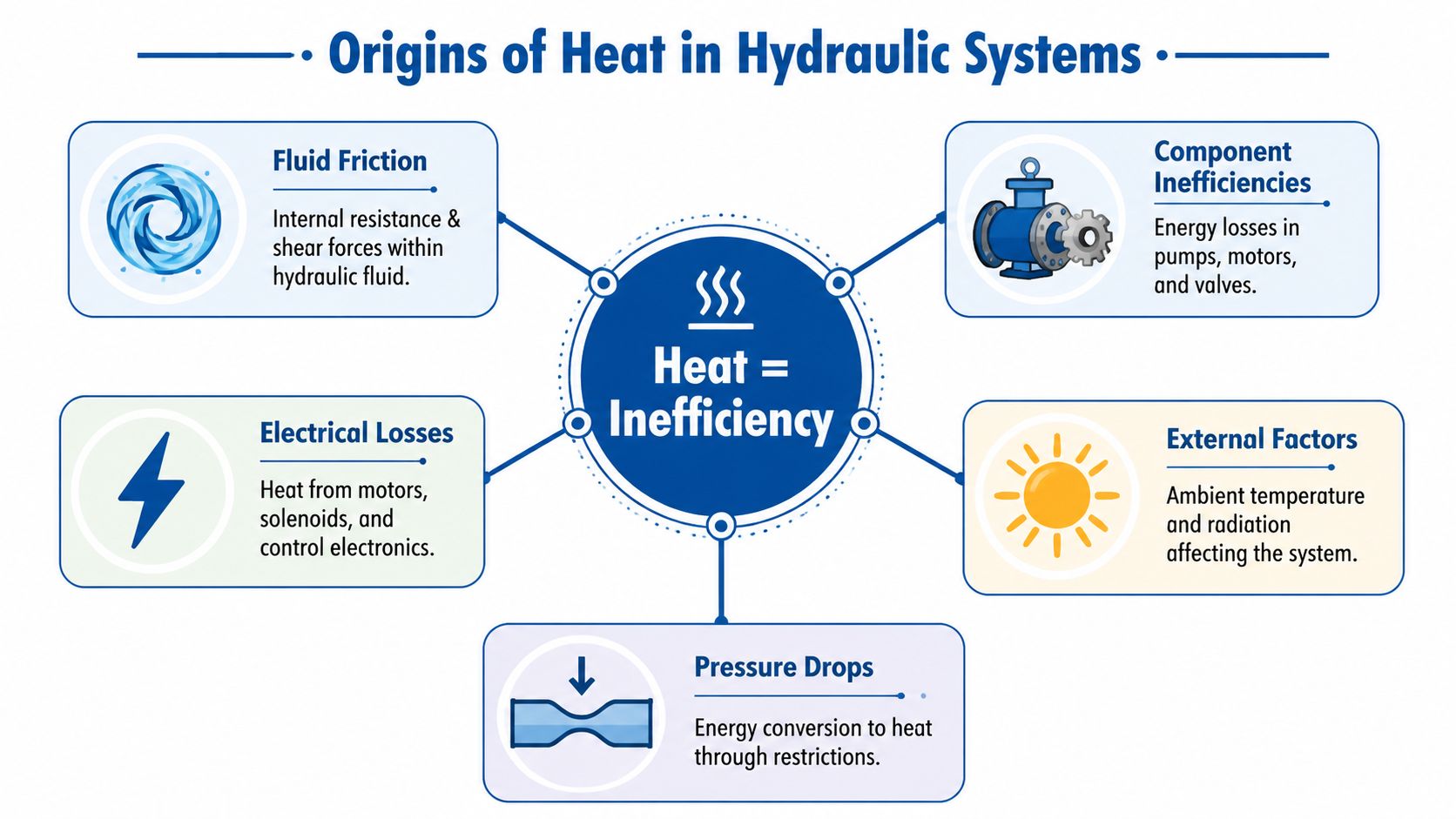
Heat in a hydraulic system is mostly wasted energy. If the circuit were perfectly efficient, every bit of input power would become useful mechanical work. However, some of that power is lost through friction, restriction, leakage, and electrical losses in associated equipment.
Fluid friction and internal shear
Hydraulic oil doesn't move without resistance. Every time it passes through hoses, ports, manifolds, elbows, filters, and valve lands, it loses energy. Inside the fluid itself, shear forces generate heat as layers move at different speeds. That's why a system with long pipe runs, undersized lines, or unnecessary restrictions can run hot even when no component has technically failed.
Think of rubbing your hands together. Friction converts motion into heat. In a hydraulic circuit, the same principle applies, just at system scale and under pressure.
Component inefficiency and pressure loss
Pumps, motors, valves, and cylinders all have losses. Some are mechanical, such as bearing and gear friction. Some are volumetric, such as internal leakage. Some come from throttling, especially where pressure is dropped across a valve to control speed or hold back flow.
The worst offenders are often hiding in plain sight:
- Relief valve bypassing: Oil forced across a relief path dumps useful energy straight into heat.
- Oversized pumps on low-demand circuits: Excess flow has to go somewhere, and too often it's throttled away.
- Sticky or worn valves: Internal bypass and poor spool movement create both heat and unstable control.
- Dirty filters or blocked strainers: Restriction increases pressure drop and pushes thermal load higher.
A hydraulic circuit should be read as both a power system and a collection of small heaters.
Electrical and ambient contributors
Modern hydraulic equipment often includes electric motors, solenoids, inverters, sensors, and control electronics. These also add heat to the enclosure or power pack area. In high-power electronics, thermal stress is dominated by switching and conduction losses in semiconductors, inductors, and capacitors. Flex notes that overheating directly degrades reliability and can cause component failure, and cooling choice depends on heat density and form factor. Heatsinks rely on surface area and air flow, liquid cooling removes heat through a closed coolant loop, and immersion cooling uses electrically nonconductive dielectric fluids, as explained in Flex's guide to thermal management and cooling techniques.
Ambient conditions matter as well. A compact power pack mounted in a poorly ventilated enclosure on mobile plant has far less chance to reject heat than the same unit in a clean, open industrial bay. On hot days, the cooler has less temperature difference to work with, so system weaknesses show up quickly.
Gauging the Heat Defining and Measuring Performance
A system isn't “too hot” because someone says the tank feels hot. It's too hot when temperature starts pushing oil, seals, electronics, and component clearances outside the range the machine can tolerate reliably. Good thermal management starts when temperature becomes a measured condition, not a guess.
What to measure in practice
The most useful readings are rarely taken in one place only. Tank temperature tells you the bulk oil condition, but it won't show a local hotspot on a pump case, valve station, or return manifold. Surface checks with an infrared thermometer are useful for quick comparisons, while fixed sensors give you trend data under load.
I'd usually want to know:
- Reservoir oil temperature: This shows the overall thermal state of the system.
- Cooler inlet and outlet condition: That reveals whether the cooler is rejecting heat.
- Pump and motor surface temperature: A local rise can point to inefficiency or distress.
- Ambient temperature around the power unit: Cooling performance always depends on the surrounding air or water conditions.
- Temperature trend over duty cycle: A machine that stabilises is very different from one that keeps climbing.
For continuous monitoring, properly placed sensors are far more valuable than occasional spot checks. A dedicated hydraulic temperature monitoring approach gives maintenance teams something they can trend, alarm, and compare against workload.
Temperature is only half the story
Oil viscosity matters just as much as the number on the gauge. If oil gets too hot, it thins. Once that happens, internal leakage increases, lubrication margins narrow, and a system can create even more heat because efficiency drops further. That cycle is common on worn pumps and heavily loaded mobile plant.
A fluid with a suitable viscosity index helps maintain more predictable behaviour as temperature changes. It won't fix a bad circuit, but it can make a well-designed circuit more stable across cold starts, warm running, and changing ambient conditions.
Measure trends, not just peaks. A system that reaches a stable temperature may be healthy. A system that climbs every hour is warning you.
Why this matters beyond hydraulics
Thermal performance has become a wider engineering issue across the UK, not just a specialist concern in plant rooms. A major milestone was the rollout of the Energy Performance of Buildings regime. The Energy Performance of Buildings Regulations introduced Energy Performance Certificates in England and Wales in 2007, and by 2024 roughly 40% of homes were still rated EPC D or below, showing how much installed equipment still manages heat inefficiently, according to the UK thermal management market overview.
The principle is the same in industrial hydraulics. If you don't quantify thermal performance, inefficiency stays hidden until reliability suffers.
Practical Cooling Strategies and Components
There's no single best cooling method. The right answer depends on duty cycle, available space, contamination risk, ambient conditions, maintenance access, and whether the machine is mobile or stationary. The mistake I see most often is choosing cooling hardware first and asking thermal questions second.
Start with passive measures
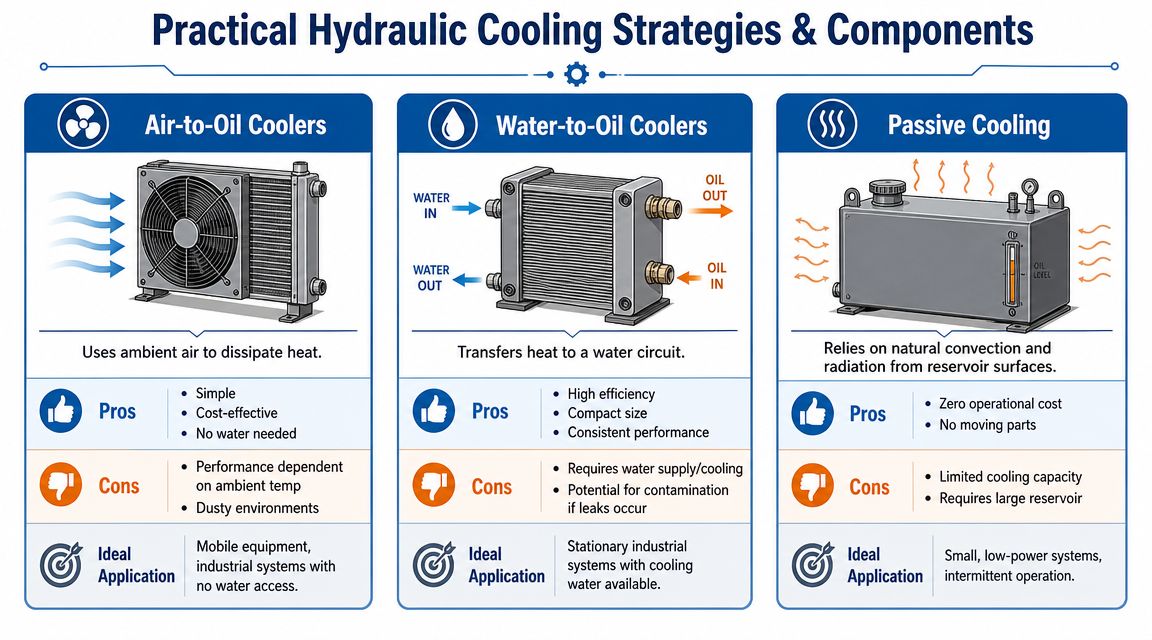
Passive cooling is often overlooked because it doesn't look impressive. Yet it's usually the first place to win back thermal margin without adding failure points.
Useful passive measures include:
- Larger reservoir volume: More oil mass slows temperature rise and gives more surface area for heat rejection.
- Better airflow around the tank and power unit: Hot air trapped around the equipment reduces natural cooling.
- Cleaner layout: Keep hot components from heating each other unnecessarily.
- Reduced restriction: Bigger lines, sensible valve choice, and shorter flow paths cut heat generation at source.
- Surface exposure: Reservoir placement and unobstructed external surfaces help convection and radiation.
These measures don't remove the need for a cooler on hard-worked systems, but they often reduce the size and workload of the active cooler you eventually need.
Comparing active options
Once passive design has been tightened up, active cooling becomes easier to size sensibly.
| Cooling method | Best fit | Strengths | Limitations |
|---|---|---|---|
| Air-to-oil cooler | Mobile equipment and sites with no water supply | Simple installation, familiar maintenance, no water circuit needed | Performance drops as ambient air temperature rises, fins clog in dusty settings |
| Water-to-oil cooler | Fixed industrial plant with stable cooling water available | Compact, steady heat rejection, effective where space is tight | Needs water infrastructure, leak risk must be managed carefully |
| Fan-assisted enclosure cooling | Compact packs and cabinets with local hotspots | Helps electronics and air-side heat build-up | Doesn’t solve a fundamentally inefficient hydraulic circuit |
| Passive-only arrangement | Intermittent or light-duty systems | No moving parts, low upkeep | Limited capacity, often not enough for sustained heavy load |
If you're reviewing options for a working circuit, a dedicated range of hydraulic oil coolers is useful only after you've established the actual thermal load and operating pattern.
Thermal management is a design loop
Panasonic's thermal design guidance gets the sequence right. Engineers define the maximum allowable component temperature, quantify heat generation and thermal conductivity, run thermal simulations, then iterate the design until predicted temperatures sit below the limit. Panasonic also lists practical measures such as changing component placement, upgrading case materials, adding air holes or cooling fans, heatsinks, heat pipes, insulation sheets, and thermal interface materials in its guide to thermal management basics and mitigation.
That logic applies directly to hydraulic systems. Don't bolt on cooling and hope. Set a temperature limit, identify where the heat is created, then change the path by which heat is generated, retained, or rejected.
For air-side hardware, maintenance quality matters more than many teams expect. If a cooler matrix is clogged, even a correctly sized unit underperforms. Anyone looking after finned exchangers and condenser-style coils may find this DIY condenser coil cleaning brush guide useful because the cleaning principles carry across well to dirty cooling surfaces in industrial service.
Designing Thermally Efficient Power Packs
A thermally stable power pack is usually the result of many sensible decisions rather than one clever component. Layout, component selection, fluid choice, enclosure ventilation, return-line design, and expected duty all matter. If one of those is wrong, the cooler ends up carrying a burden it was never meant to carry alone.
Build heat out of the circuit before you cool it
The best power packs aren't just better cooled. They generate less waste heat in the first place.
That usually means:
- Matching pump size to actual demand: Constantly dumping surplus flow is a classic heat generator.
- Choosing efficient valve architecture: Throttling where it isn't needed wastes power.
- Avoiding unnecessary pressure drops: Every avoidable restriction becomes thermal load.
- Keeping suction conditions healthy: Poor inlet conditions raise pump stress and temperature quickly.
- Separating heat sources where possible: Don't mount every hot-running component into the same confined corner.
A lot of overheating problems are designed in during early packaging decisions. Tight spaces may look neat on a drawing, but if there's no path for air movement and no thought given to service access, the pack becomes harder to cool and harder to maintain.
Layout matters more than many drawings show
I've seen otherwise competent units struggle because the return oil entered the reservoir badly, the breather sat in hot recirculated air, or the cooler discharged into a dead pocket with nowhere for the warmed air to escape. Those are packaging problems, not just thermal problems.
A better layout considers:
- Air path. Cool air needs a route in, and hot air needs a route out.
- Reservoir behaviour. Return flow shouldn't churn the whole tank into an aerated hot bath.
- Component spacing. Pumps, motors, manifolds, and drives shouldn't all heat-soak each other.
- Serviceability. If a filter, fan guard, or cooler face can't be cleaned easily, it won't be cleaned properly.
The easiest heat to remove is the heat you never create.
Design for the real duty cycle
Many pack specifications fall short. A system that only sees short intermittent demand behaves very differently from one that runs near-continuously under high load. Mobile machinery also sees a wider spread of ambient conditions, dirt ingress, and installation compromises than a tidy factory power unit.
That's why thermal design has to follow actual use:
- Continuous industrial running: Prioritise stable rejection, easy maintenance, and predictable airflow.
- Mobile plant: Expect dust, blocked matrices, warm weather, and less-than-ideal mounting positions.
- Compact mini power packs: Space is tight, so every inefficiency matters more.
- Intermittent duty packs: Reservoir and structure may carry much of the cooling burden if the off-cycle is long enough.
When reviewing a new build or redesign, a proper hydraulic power pack design process should treat thermal behaviour as part of the main engineering brief, not as an accessory decision near the end.
Fluid choice supports stable operation
Oil selection won't rescue poor design, but it does affect how forgiving the system is. A fluid with suitable viscosity characteristics across expected operating temperatures helps maintain film strength, response, and leakage control from start-up to full working temperature.
That matters even more on equipment that cycles between cold mornings and warm continuous operation. If the fluid swings too far in behaviour, operators often report inconsistent machine feel long before a hard failure appears.
Maintenance and Troubleshooting Overheating Systems
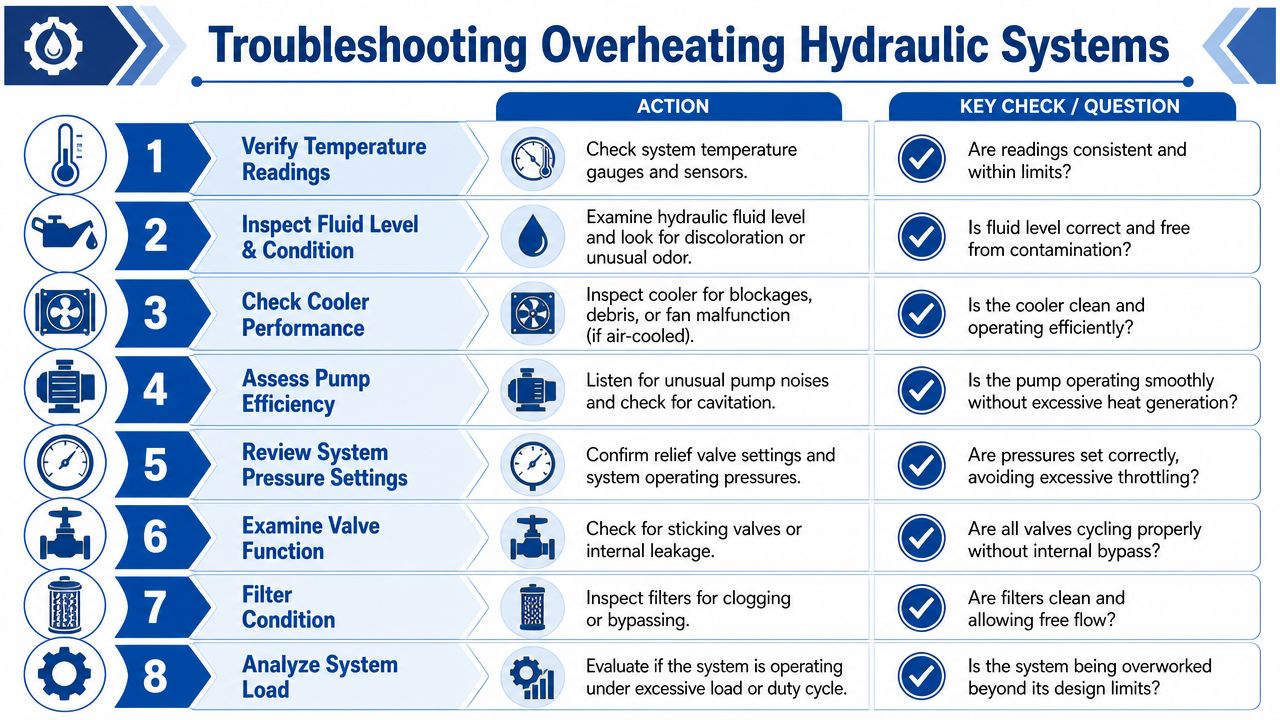
When a hydraulic system overheats, start with the obvious checks first. Too many teams jump straight to replacing pumps or adding a larger cooler, then discover the fault was a blocked matrix, low oil level, or a relief valve set up badly. A clean sequence saves time.
First checks on a hot system
Start with condition and function checks that don't require major strip-down.
- Verify the reading: Confirm the gauge or sensor is believable. Compare with an independent thermometer.
- Check oil level and appearance: Low level, foaming, darkening, or burnt smell all point somewhere useful.
- Inspect the cooler: Look for blocked fins, failed fans, fouled water side, or poor airflow.
- Check filters and strainers: Restriction creates pressure drop and heat.
- Listen to the pump: Cavitation and distress usually announce themselves.
This short video gives a helpful visual view of overheating checks in practice.
Faults that quietly generate heat
If the easy checks don't explain the problem, move deeper into the circuit logic.
A few common heat makers are worth chasing early:
- Relief valve bypassing under normal operation
- Internal leakage in cylinders or hydraulic motors
- Sticking directional or proportional valves
- Pump wear causing efficiency loss
- Duty cycle beyond original design assumptions
- Contaminated oil increasing friction and poor valve behaviour
A pressure reading on its own doesn't tell the full story. You need to know where pressure is being created, where it is being dropped, and whether that drop is doing useful work or heating the oil.
Preventive maintenance is thermal management
Cooling hardware only works if it stays clean and functional. That sounds obvious, but in real service it gets neglected because the machine still runs, just a bit warmer than before. Months later, the same system has damaged seals, degraded oil, and reduced component life.
Useful habits include:
- Routine cooler cleaning: Especially on mobile plant and dusty industrial sites.
- Trend temperature under comparable load: Changes are often more telling than one absolute number.
- Inspect fan motors, guards, and shrouds: Air leaks and failed fans are common.
- Use oil analysis where the duty justifies it: Degradation and contamination often show up before failure.
- Review settings after component changes: Replacement parts can alter pressure loss or bypass behaviour.
For teams building a stronger preventive routine, this overview of Covenant Aire maintenance for HVAC is useful because the maintenance logic is transferable. Clean heat exchange surfaces, verify performance regularly, and don't wait for failure before you act.
The Strategic Importance of Thermal Management
The practical answer to what is thermal management is simple. It's the engineering discipline of keeping heat under control so the machine remains reliable, efficient, and economical to own. In hydraulics, that means reducing waste heat at source, measuring the system properly, selecting the right cooling method, and maintaining the whole arrangement so performance doesn't drift.
What matters most is knowing when a heat issue stops being a generic temperature problem and becomes an uptime problem. That distinction matters in UK industry because heat is tied to energy use and resilience, not just component protection. The UK government's data-centre guidance notes significant cooling demand in concentrated loads, and the Climate Change Committee has highlighted the growing importance of heat rejection and system-level thermal design as industry electrifies. A useful contrarian point is that better cooling isn't always the best answer. Oversized cooling can waste energy and increase lifecycle cost, so the primary job is to right-size thermal control for duty cycle, ambient conditions, and maintenance access, as discussed in Supermicro's overview of thermal management in UK operating contexts.
Right-sized control beats oversized hardware
A well-managed system doesn't chase the lowest possible temperature. It holds an appropriate operating temperature consistently, without burning extra power or adding unnecessary complexity. That's a better result for total cost of ownership than blindly fitting the biggest cooler that will physically fit.
The same principle appears in building envelopes as well. If you want a simple cross-industry example of why controlling heat flow matters before mechanical cooling has to compensate, this article on insulation for South Florida homes makes the broader point clearly. Stop avoidable heat gain or loss first, then size the active system properly.
Thermal management is a strategic engineering choice because it affects uptime, maintenance burden, energy use, and service life at the same time. Get it right, and the machine performs its job. Get it wrong, and heat will keep collecting the bill.
If you need practical advice on thermal control, overheating faults, oil coolers, or a new hydraulic power unit, speak to MA Hydraulics Ltd. Phone 01724 279508 today, or send us a message.
