
A lot of people land on the same problem from different directions. A design engineer has room for a cylinder but not for a full power pack. A service engineer needs a reliable replacement on a tipper or tail lift. A buyer has a machine concept that needs proper hydraulic force, but the available space looks more like a battery box than a plant room.
That's where a mini hydraulic power unit earns its keep. It gives you a self-contained source of hydraulic energy in a compact package, which is why it turns up so often on vehicle-mounted equipment, access gear, agricultural attachments and compact industrial machinery. In UK applications, that matters because machine layouts are usually driven by space, wiring limits, service access and cost just as much as by hydraulic theory.
The broad idea isn't new. Hydraulic transmission had already become an integral part of British industry by the mid-20th century, and compact, application-specific packs are the practical continuation of that shift towards self-contained power in tight spaces. If you're comparing hydraulic drives with other compact prime mover options, these insights on diesel engine power solutions are useful context because they show the same design pressure from a different angle: getting dependable power into a small footprint.
A mini unit can be the right answer. It can also be the wrong one. That's the part too many guides skip. The key lies in understanding pressure, flow, electrical supply, duty cycle, heat and service conditions, then deciding whether a compact pack will cope in practical applications rather than only on a datasheet.
Your Introduction to Compact Hydraulic Power
A typical UK spec problem looks like this: the machine needs reliable hydraulic force, but the only spare space is under a body, inside a pedestal, or beside a battery tray. In that situation, a mini hydraulic power unit gives you a self-contained hydraulic source without laying out a separate motor, pump, reservoir and valve bank across the machine.
That packaging advantage is the reason these units are common on tippers, tail lifts, access platforms, compact process equipment and mobile plant. The compact footprint helps, but footprint alone is not the primary selection criterion. The fundamental question is whether the unit can deliver the required pressure and flow for the actual duty cycle without overheating the oil, overloading the electrical supply or creating awkward service access later.
Compact units became standard because they solve a practical integration problem. British machinery has used hydraulic power for decades, and smaller packaged systems are the modern extension of that approach for tighter installations and cleaner assembly. If you are also comparing compact hydraulic packs with other small prime-mover arrangements, these insights on diesel engine power solutions give useful context on the same space-versus-output problem from a different angle.
The term "mini" can be misleading. It refers to packaging more than capability. Some small units will produce serious pressure, but high pressure on its own does not mean the pack is suitable for continuous or heavy-duty work. That is where poor buying decisions usually start. A unit that looks fine on a catalogue sheet can struggle once it is asked to run too often, too long, or in poor ambient conditions.
For most buyers and design engineers, the decision usually comes down to three practical cases:
- Space on the machine is limited, so a self-contained pack is easier to mount and protect.
- The hydraulic function is intermittent, such as lift, tip, clamp, latch or short-stroke actuation.
- Existing electrical power is available, making a compact DC or AC unit simpler than redesigning the machine around engine-driven hydraulics.
Those are sound reasons to use one. They are not proof that you should.
In UK applications, I would check duty cycle, voltage drop, reservoir size, ambient temperature, ingress protection and service access before getting too interested in headline pressure figures. A compact pack can be the right answer for a short, occasional movement. It can be the wrong answer for repetitive cycling, long hold times, or any job where heat rejection is poor and downtime is expensive. That is why proper hydraulic power pack design for the application and duty cycle matters more than the phrase "mini" on a product page.
Anatomy of a Mini Hydraulic Power Unit
At heart, a mini hydraulic power unit is a group of ordinary hydraulic components packaged with unusual discipline. Nothing in it is magical. The value comes from putting the right parts together in a compact assembly that's easy to mount, wire and service.
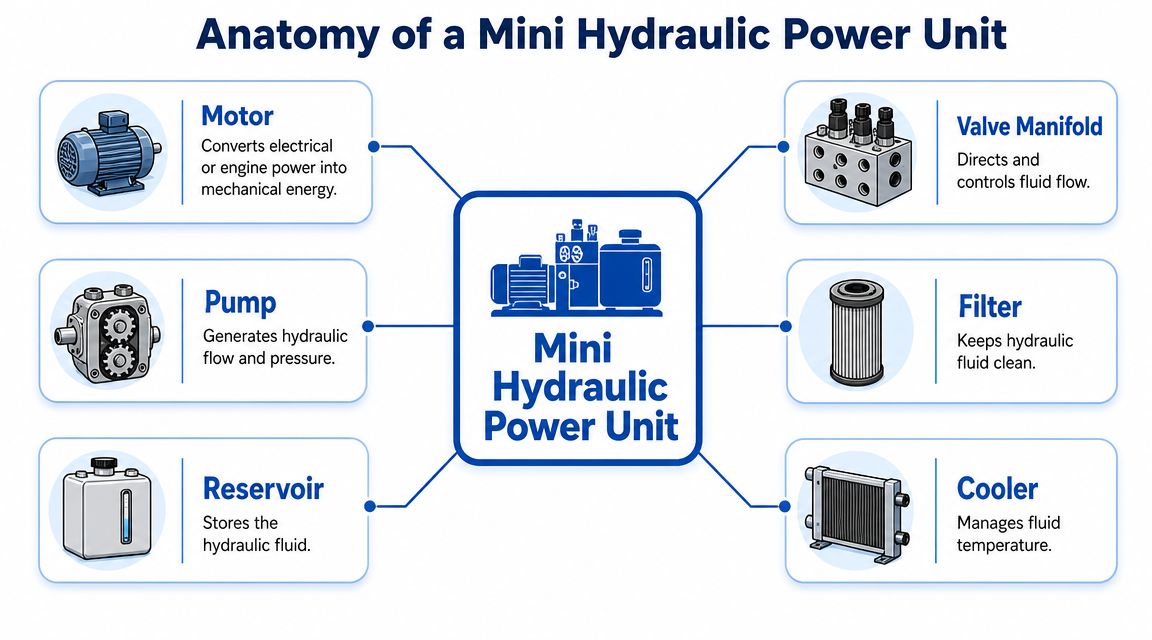
The core parts and what they actually do
Think of the motor as the prime mover, the pump as the flow generator, and the valve manifold as the traffic controller. The reservoir stores the oil, while filtration and, where needed, cooling protect the system from dirt and heat.
The common performance envelope for mini packs is a good clue to what these assemblies are built for. Typical units use reservoirs from 0.8 to 30 litres, with DC motor power from 0.8 kW to 4.0 kW or AC motor power from 0.75 kW to 7.5 kW. They can deliver 0.3 to 25 l/min, pressures up to 370 bar, and an expected service life of around 100,000 cycles, according to this technical guide to hydraulic power unit construction and operation.
How the assembly works as one unit
When the motor turns, it drives the pump. The pump creates oil flow. Pressure only rises when the oil meets resistance, usually from a load on a cylinder or actuator. The manifold then decides where that oil goes and what limits apply. That includes relief protection, directional control and, in many assemblies, load-holding or lowering functions.
This compact integration is why faults often overlap. A weak lift isn't always “a bad pump”. It might be low voltage at the motor, internal leakage in a valve, aerated oil, a clogged suction path, or a relief valve set wrongly for the application.
Practical rule: When a compact unit underperforms, check electrical supply and valve function before assuming the hydraulic rotating group has failed.
Why component layout matters
Packaging affects serviceability more than people expect. A unit may fit the available space but still be awkward in use if the filler cap is inaccessible, the motor has poor ventilation, or the manifold orientation traps air. The best assemblies are the ones that fit the machine and still leave enough room for hands, tools and hose routing.
If you want a good example of how application-specific power unit layouts are handled in another sector, this overview of Crane Elevator hydraulic service is worth a look because it shows how reservoir, pump and valve choices are shaped by the duty rather than chosen in isolation.
For engineers working through a bespoke build, a proper hydraulic power pack design service is often the sensible route when the standard catalogue layout doesn't match the available space, control logic or service requirements.
Understanding Key Performance Specifications
A mini hydraulic power unit often looks convincing on paper right up until it has to lift a loaded platform on a cold morning, cycle repeatedly in a yard, or run from a battery that is already marginal. Specs matter, but only if you read them as a set rather than as separate headline numbers.
Pressure sets force, but not performance on its own
Pressure determines how much load the actuator can overcome. If the cylinder area is known, pressure lets you estimate available force. That part is straightforward.
The practical mistake is treating maximum pressure as the main buying criterion. A compact unit may be rated for high pressure, but that does not mean it will deliver the flow needed for acceptable cycle times at that pressure. In real service, pressure, flow, motor size and valve settings all pull against each other.
Higher pressure can reduce cylinder size, which helps where space is tight. The trade-off is harsher loading on the pump, more heat generation, and less tolerance for poor hose sizing or voltage drop. On small packs, those penalties show up quickly.
Flow decides speed, and speed usually exposes the compromise
Flow is what makes a ram extend at the required rate or a hydraulic motor turn fast enough to do useful work. If the machine must complete a lift, clamp or tip within a set time, flow becomes just as important as pressure.
Many compact units are frequently misunderstood. A pack can look strong because the pressure figure is high, yet still feel slow because the available flow at working pressure is modest. For short, intermittent functions that is often acceptable. For long strokes, repeated cycling or anything close to continuous running, it often is not.
That is also the point where a mini unit may be the wrong choice. If the job needs sustained flow, frequent starts, or long run times, a larger hydraulic power unit for industrial or mobile duty is usually a better engineering decision than trying to force a compact pack beyond its thermal limits.
Motor power and electrical supply put a hard limit on what the unit can sustain
Motor power is not a decorative datasheet line. It is the limit on how much hydraulic work the unit can do for how long before heat, current draw or overload protection become the primary issue.
For battery-fed DC units, the electrical side deserves the same attention as the hydraulic side. A compact pack may perform well on a bench supply and then struggle on the machine because of cable length, undersized conductors, weak battery condition or inadequate charging capacity. The symptom often gets blamed on hydraulics when the root cause is voltage loss under load.
AC units are usually the better fit on fixed plant because the supply is more stable and duty can be managed more easily. DC units earn their keep on mobile equipment, but only where the duty cycle genuinely suits them.
Duty cycle is the specification buyers skip, then pay for later
Mini packs are often selected on maximum pressure and nominal flow, while the primary constraint is duty cycle. A unit that works well for a few seconds at a time can overheat, drain the battery, or shorten motor life if asked to repeat the same movement too frequently.
That matters in UK applications where ambient conditions, enclosure space and cleaning practices vary widely. A tail lift, small tipper, access platform and factory fixture may all use compact hydraulic power, but they do not load the pack in the same way. Intermittent use with long rest periods is one thing. Repetitive cycling through a full shift is another.
Read the specifications as one operating point
A sensible review asks:
- What pressure is required at the actuator, including losses
- What flow is needed to achieve the target movement time
- What motor power and electrical supply can support that load in service
- How long will the unit run per cycle, and how often will it repeat
- What happens to oil temperature if the machine is used harder than expected
If those answers do not sit comfortably together, the pack is probably undersized, or the concept is wrong for the duty. That is the part many spec sheets do not tell you clearly enough.
How to Size and Select the Right Unit
A sizing job usually starts after the machine concept is already fixed. A builder has a body to lift, a clamp to close, or a hatch to open, and the temptation is to pick the smallest pack that matches the pressure on the front page of a catalogue. That is how you end up with a unit that technically works, but runs hot, moves too slowly, or flattens the battery after a few cycles.
Start with the actuator and the work it must do. Then calculate backwards through force, speed, pressure losses, flow demand, motor input, reservoir capacity and the actual operating pattern. On compact units, those choices are tightly linked. A decision that saves space often costs you thermal margin or cycle rate.
Start with the machine, not the power pack
A small vehicle-mounted lift and a compact factory fixture can both use a mini hydraulic power unit, but they should not be sized the same way. The first may only run for short, spaced-out movements. The second may cycle all shift with little time for the motor or oil to recover.
That distinction matters more than brochure claims about compactness. In practice, the first screening question is simple. Is the duty truly intermittent, or is the unit going to be worked hard enough that heat, voltage drop and wear become the actual design limits?
For intermittent functions, a mini unit is often a sensible answer. For frequent cycling or long run periods, it may be the wrong architecture altogether.
Calculate force first, then speed
Force comes from load and cylinder geometry. Speed comes from flow. Both have to be right at the same time.
A common mistake is to size pressure for the worst-case load, then assume the unit will feel acceptable in service. It may lift the load, but still frustrate the operator because the cylinder extends too slowly under normal use. The opposite mistake also turns up. A buyer chases quick movement, specifies more flow, and only later finds the motor current, cable size or reservoir volume no longer make sense for the machine.
Compact packs always involve trade-offs. Higher working pressure can reduce cylinder size and help with packaging, but it increases stress on components and leaves less margin for pressure spikes. More flow improves cycle time, but raises motor demand, heat generation and return-line losses. Small tanks save space and cost, but give the oil less time to de-aerate and shed heat.
A practical selection checklist
| Criterion | Question to Ask | Example Application (Tipper Truck) |
|---|---|---|
| Duty pattern | How many seconds does the motor run per cycle, and how often does that repeat in real use? | Body raises briefly, then the pack rests between loads |
| Required force | What load must the cylinder overcome at the heaviest point of the stroke, including friction and geometry effects? | Loaded body at the start of lift |
| Required speed | What extension or retraction time is acceptable for the operator and the job? | Tipping time must be quick enough for site use without overloading the electrics |
| Electrical supply | Can the battery, alternator, cabling and protection devices support loaded current without excessive voltage drop? | Vehicle wiring and battery condition must support repeated starts |
| Installation space | Is there room for the unit, hose routing, filler and breather access, and safe servicing? | Side-mount or underbody installation with workshop access |
| Circuit function | Does the machine need simple raise and lower, load holding, pilot release, over-centre control or sequencing? | Raise, hold and controlled lowering depending on the body and valve arrangement |
| Operating environment | Will the pack be exposed to rain, road dirt, washdown, cold starts, vibration or salt? | Outdoor UK service with weather exposure and chassis vibration |
| Service access | Can oil level, filters, wiring and hoses be checked without dismantling surrounding equipment? | Routine inspection should be possible during normal workshop maintenance |
Where the machine builder already knows the duty and actuator data, a proper hydraulic power unit specification route helps narrow down motor size, valve layout and reservoir style before the wrong assumptions get built into the chassis or frame.
Check the losses you do not see on the outline drawing
Theoretical cylinder force is only the start. Real systems lose pressure through hoses, fittings, valves and manifolds. Real systems also lose time through cautious flow settings, restrictive ports and voltage drop at the motor.
Junior specifiers often get caught out. The pack fits the available envelope, the actuator moves on a bench test, and everyone signs it off. Then the machine goes outside in January, the oil is thicker, the battery is not at full charge, and the unit that looked acceptable in the workshop now struggles at the start of every shift.
UK applications make this worth checking early. Outdoor mobile equipment, coastal installations and washdown environments all push compact units harder than a clean indoor test stand does.
When a mini unit is the wrong choice
Mini packs are useful, but they are not universal. Choose a larger or more open power pack arrangement when the application involves:
- Long continuous running, where a small reservoir and tightly packaged motor will struggle to control temperature
- High flow for sustained periods, where the electrical input and heat build-up become impractical
- Marginal DC supply, where cable runs, battery condition and repeated starts will cause poor performance
- Low noise requirements, especially if the unit must sit close to operators in an enclosed area
- Frequent field maintenance, where easier access to standard components matters more than minimum package size
That last point is often missed in procurement. A very compact assembly can be attractive on paper, but awkward to service once it is buried in a chassis leg, machine guard or locker.
Buy on operating reality, not headline specification
Selection should end with one blunt question. What will this unit be asked to do on its busiest day?
If the answer includes repeated cycling, poor ventilation, limited battery capacity, awkward service access or strict operator expectations on speed and noise, challenge the mini-unit assumption before the order is placed. A compact pack is a good solution when the duty suits it. It is an expensive compromise when it does not.
Common Applications Across UK Industries
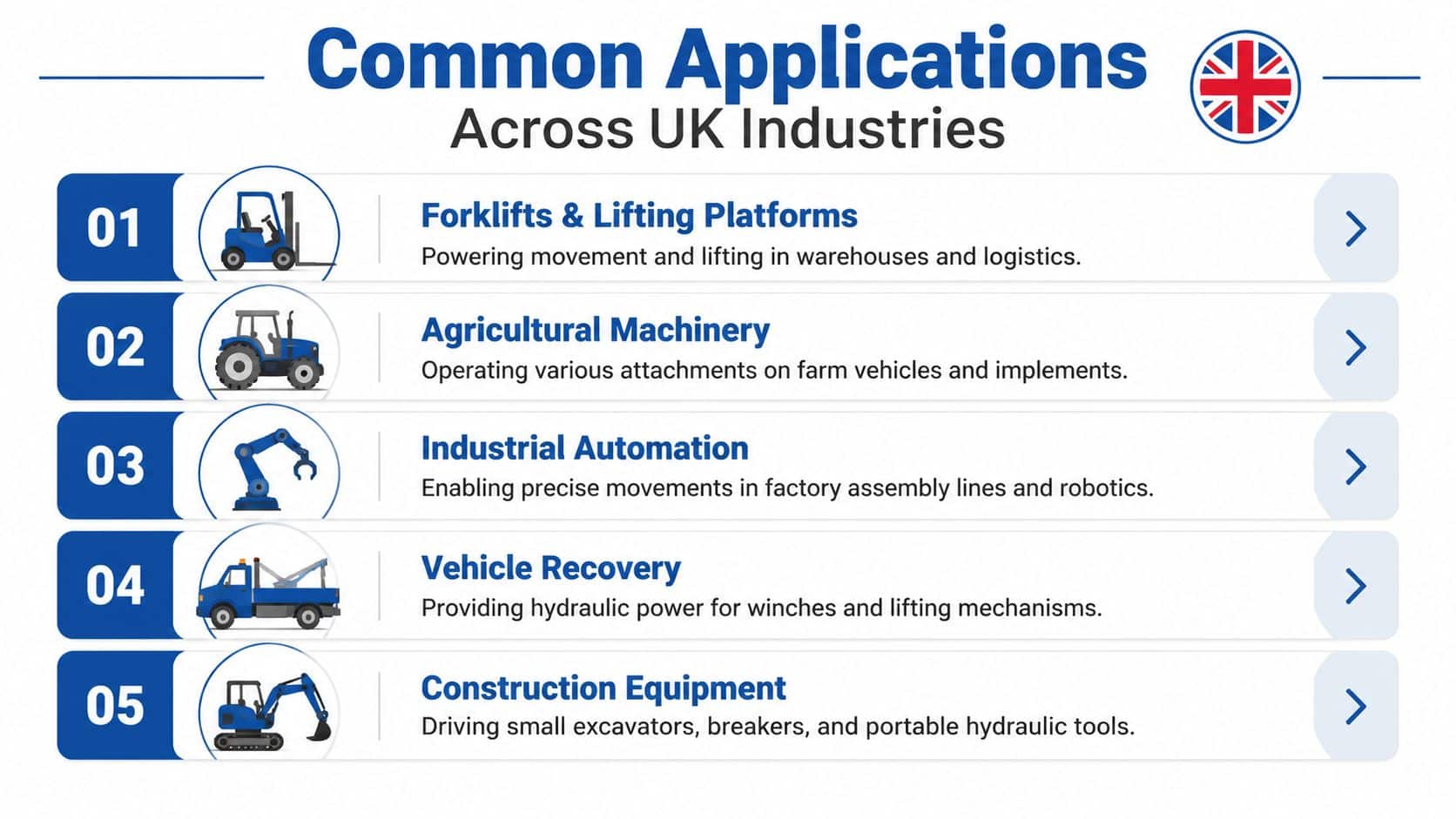
A mini hydraulic power unit earns its keep where space is tight, the movement is intermittent, and running pipework back to a larger pack would be awkward or costly. In UK work, that usually means practical jobs on vehicles, handling kit and small machines rather than high-duty production hydraulics.
Mobile equipment and commercial vehicles
This is still the most common home for a mini unit. Tippers, tail lifts, plant trailers, small recovery bodies and access platforms all need a compact hydraulic source that can mount on the chassis, start on demand and run from 12V or 24V DC.
The attraction is obvious, but so are the compromises. Vehicle-mounted packs suit short lifting or tipping cycles well. They are less happy with repeated back-to-back operation, long hose runs, or poor battery condition. On a cold morning with a tired battery and undersized cables, a unit that looked fine on the data sheet can become slow, noisy and inconsistent under load.
A working example helps. This video shows the sort of compact hydraulic arrangement commonly seen in equipment handling and lifting duties:
Agriculture, workshops and compact industrial machinery
On agricultural and estate equipment, mini packs often drive splitters, small fold functions, attachment movements and service mechanisms where an engine-driven pump would be hard to justify. The unit can sit close to the actuator, which keeps pipework short and simplifies installation.
In workshops and light industrial plant, the same logic applies to clamping fixtures, dock levellers, small scissor lifts, test rigs and one-off machine movements. A local pack is often the sensible answer when one function needs hydraulic force but the rest of the machine is electric or pneumatic.
Reservoir size matters more here than many buyers expect. If the application has a larger cylinder volume or poor cooling, a small tank heats the oil quickly and gives less margin for aeration control. That is one reason to check hydraulic oil tank sizing and layout considerations alongside motor and pump selection, even on a compact unit.
The best applications are local, intermittent jobs where compact packaging matters more than continuous output.
Where they struggle in practice
The trouble cases are usually easy to spot once you look past the headline pressure figure. Mini units are often specified for presses, heavily cycled lifting tables, continuous conveyor functions or long-duration holds with repeated correction. Those duties can push oil temperature up, shorten motor life and expose every weakness in the electrical supply.
Noise can also rule them out in enclosed indoor areas. A small DC or AC pack mounted close to operators may meet the force requirement and still be the wrong engineering choice once sound level, heat and service access are taken seriously.
That is the trade-off many spec sheets miss. Mini power units work well when the machine needs brief, contained hydraulic effort. If the job calls for sustained flow, frequent cycling or easy field service, a larger pack is usually the better answer.
Installation and Maintenance Best Practices
A mini hydraulic power unit often gets blamed for faults that start in the installation. I see the same pattern repeatedly on tail lifts, access equipment and small factory machines. The pack is compact, so it gets squeezed into whatever space is left. Then the motor runs hot, the terminals corrode, the filler cap is awkward to reach, and routine checks stop happening.
Good installation starts with access. Mount the unit where a technician can fill it, inspect it and tighten connections without stripping half the machine around it. Keep clear space around the motor for cooling, and leave room to remove electrical covers, coils and hoses. If the pack sits in a dirty or wet area, protect it from direct spray and road filth rather than assuming the standard finish will cope indefinitely.
Electrical supply deserves as much attention as the hydraulic circuit, especially on DC packs. High current draw, long cable runs and poor earth returns cause more low-speed and no-start complaints than pump defects do. On vehicle-mounted equipment, check cable sizing, battery condition, charging system performance and volt drop under load before condemning the power unit. A pack that looks weak on the machine may be seeing poor voltage at the motor terminals.
Hydraulically, suction conditions matter. A compact unit with marginal oil level, poor breather position or awkward pipe routing can aerate the oil and make the whole system sound harsher than it should. If the installation uses a separate tank or fabricated reservoir, review the hydraulic oil tank layout and access as part of the package, not as an afterthought.
Service checks that catch trouble early
Most failures announce themselves early if someone knows what to watch for.
- Check oil level and appearance. Low level, foam, milky oil or a burnt smell each point to a different problem.
- Inspect hoses, fittings and wiring together. A damp fitting, rubbed hose or heat-marked terminal usually shows the fault path before the machine stops.
- Listen to the motor under normal load. A strained or uneven note can indicate voltage drop, air ingress, contamination or a relief valve working too often.
- Watch actuator movement. Hesitation, drift and jerky motion are useful symptoms, not just operator complaints.
- Feel for heat after a typical cycle. Excessive motor or tank temperature usually means the duty is harsher than the installation allows.
Most mini power unit faults build gradually through heat, contamination, poor voltage supply or bad access for routine checks.
Maintenance habits that actually extend service life
Use the oil grade specified for the machine and the environment it works in. UK outdoor equipment sees cold starts, damp storage and wide seasonal temperature swings. Oil that is too thick on a winter morning can make a healthy pack look undersized. Oil that is too thin when hot reduces efficiency and can worsen internal leakage.
Keep the fluid clean, and treat strainers and filters as service items. Compact packs have little oil volume, so contamination and heat affect them faster than they do on a larger hydraulic system. That is one of the trade-offs buyers miss when they focus only on pressure and footprint.
Leave the relief valve alone unless there is a measured reason to adjust it. Winding the pressure up to overcome slow movement may get the machine working for a short time, but it usually shifts the load onto the motor, wiring and oil temperature. If a unit only performs after pressure has been increased, revisit the cylinder sizing, mechanical condition and actual duty cycle. In many cases, the honest answer is that a mini power unit is the wrong choice for the job.
Your Partner for Custom and Standard Power Units
By the time you've worked through the force, speed, duty cycle, voltage and installation constraints, you usually know whether you need a standard mini unit or a custom build. Standard catalogue assemblies work well when the function is straightforward and the machine layout is forgiving. The moment you need a particular valve logic, mounting pattern, tank orientation or control method, the value shifts from stockholding to application support.
That's why supplier input matters most before the order goes in. A compact pack that is almost right can be more troublesome than one that is clearly wrong, because the faults only appear after installation. The best outcomes usually come from agreeing the actual duty, the electrical conditions, the actuator data and the service environment before the unit is built.
MA Hydraulics Ltd can assemble Hydronit mini power packs to customer specification and manufacture bespoke industrial power packs, which is useful when a machine builder needs a defined motor, pump, manifold or reservoir arrangement rather than a generic off-the-shelf layout.
A good technical conversation at this stage should cover more than hydraulic output. It should also cover mounting orientation, control voltage, wiring expectations, oil choice, service access and what happens if the machine sits unused for long periods between operations. That's the difference between buying a compact unit and specifying one properly.
If you need help specifying a mini hydraulic power unit for a vehicle, machine or industrial application, speak to MA Hydraulics Ltd. Phone 01724 279508 today, or send us a message through the contact page.
