

The hydraulic oil on the shelf is the wrong brand, the original product is no longer available, and production needs the machine running before lunch. A maintenance buyer looking at a container marked ISO VG 46 may assume it is an easy replacement for any other VG 46 oil. That assumption is how pumps, valves and seals end up taking the blame for a procurement decision.
A sound hydraulic oil cross reference compares more than brand names. You need the operating viscosity at 40 °C, the fluid performance class, the base oil and additive system, the seal materials, the relevant OEM approvals and the cleanliness condition of the circuit. UK guidance identifies ISO VG 46 as the default reference point for many plant, agricultural and industrial hydraulic systems operating at moderate temperatures, with ISO VG 32 and ISO VG 68 also widely used across UK applications. Crown Oil's hydraulic oil guide explains why viscosity equivalence is only a starting point.
Why Cross Referencing Hydraulic Oil Matters
Start with three facts before you compare a single product code.
- Running viscosity: confirm the ISO VG grade measured at 40 °C.
- Performance class: identify whether the circuit requires HL, HM, HV or another recognised fluid family.
- Seal compound: check whether the installed seals are compatible with the candidate base oil and additives, including NBR, FKM or EPDM where applicable.
Those checks separate a defensible substitution from a brand swap based on a label. A Shell Tellus S2 V46 product and a Castrol Hyspin AWS 46 product may sit in the same viscosity class, but that doesn't prove they have the same additive package, approvals, temperature behaviour or seal compatibility.
The failure symptoms often appear after the purchase decision has been forgotten. A poor viscosity choice can contribute to pump cavitation, sluggish cold starts, reduced volumetric efficiency and excessive heat. An unsuitable fluid class can cause valve stiction or inadequate anti-wear protection. A seal mismatch may show up as weeping, swelling or shrinkage within weeks rather than years.
Practical rule: treat ISO VG as the first gate, not the final answer.
UK cross-reference work also needs a standards check. The British Fluid Power Association's standards library lists BS EN ISO 12922:2020, which covers hydraulic-fluid categories including HFAE, HFAS, HFB, HFC, HFDR and HFDU. The BFPA standards library demonstrates why a replacement should be checked against its recognised fluid family, not just its commercial name.
Use the rest of this guide as a worksheet. Record the incumbent oil, compare the candidate datasheet, verify seals and approvals, then control the changeover and confirm cleanliness. If any of those records is missing, the substitution isn't ready for release.
ISO VG Viscosity Grades Explained
ISO VG is a viscosity ladder, not a performance class. Its number indicates the oil's nominal kinematic viscosity at 40 °C. UK buyers commonly compare ISO VG 15, 22, 32, 46, 68 and 100 when reviewing hydraulic-oil catalogues, but the grade is only the first filter.
| ISO VG | Viscosity at 40 °C (mm²/s) | Typical UK systems |
|---|---|---|
| ISO VG 15 | Approximately 15 | Light, fast hydraulic circuits and specialist low-viscosity duties |
| ISO VG 22 | Approximately 22 | Cold-start equipment and light mobile applications |
| ISO VG 32 | Approximately 32 | Cold-weather mobile plant, factory hydraulics and machine tools |
| ISO VG 46 | Approximately 46 | General plant, agricultural machinery, presses and industrial hydraulics |
| ISO VG 68 | Approximately 68 | Warmer, heavier-load mobile plant and slower hydraulic equipment |
| ISO VG 100 | Approximately 100 | Slow actuators, winches and older systems with widened clearances |
ISO VG 46 is the usual UK starting point for moderate-temperature plant. ISO VG 32 generally suits colder operation, while ISO VG 68 can support heavier loads or warmer service. ISO VG 100 is for specialist or older circuits that require a thicker oil film. Do not stock or specify it as a general-purpose substitute.
The viscosity figure does not identify anti-wear chemistry, demulsibility, air release, filterability, seal compatibility or the required fluid family under BS EN ISO 12922 and ISO 11158. Two ISO VG 46 oils can therefore carry the same viscosity label while offering different protection and different compatibility with the machine.
Check the pump's cold-start and hot-running conditions. Excessive viscosity at start-up increases inlet losses and can delay lubrication. Insufficient viscosity at operating temperature weakens the lubricating film and may increase internal leakage. Select the viscosity grade for the actual temperature range, then confirm the performance class, seals and contamination-control requirements before approving the product.
Buy on the grade first, but never buy on the grade alone.
ISO 3448 defines ISO VG equivalence through viscosity at 40 °C with approximate limits. Compare the supplier's complete specification with the OEM requirement, including viscosity limits, fluid classification, seal materials and cleanliness expectations. A matching number supports a cross-reference. It does not, by itself, justify a brand substitution.
Hydraulic Oil Performance Classes
Performance classes describe what the fluid is designed to do. In UK procurement, suppliers commonly use ISO and DIN terminology together, so a buyer may see HM and HLP used for broadly comparable anti-wear mineral hydraulic fluids, or HV and HVLP for high-viscosity-index versions.
| Class | Additive package | Typical application | Cross-reference rule |
|---|---|---|---|
| HH | Refined mineral oil without performance additives | Historic or very simple duties | Don’t substitute into modern anti-wear systems without OEM confirmation |
| HL | Rust and oxidation inhibitors | Simple hydraulic or gear duties in benign conditions | Can replace HH only where the equipment permits it |
| HM, often HLP | Anti-wear, anti-foam and oxidation-control chemistry | Modern pumps, valves and general industrial hydraulics | Standard workhorse class for many systems |
| HV, often HVLP | HM-type protection with improved viscosity-temperature behaviour | Outdoor plant, mobile equipment and wide temperature ranges | Suitable only when the OEM and seals permit the higher-VI formulation |
| HG | Tackified fluid for slideways and way lubrication | Machine-tool slideways and combined lubrication duties | Don’t treat as a general HM substitute |
HH is a historic mineral-oil category with little additive protection. HL adds rust and oxidation inhibitors, but it isn't automatically an anti-wear fluid. HM is the familiar modern workhorse, commonly specified where pumps and valves need anti-wear protection.
HV adds viscosity-index improvement so the oil maintains a more useful viscosity over changing temperatures. That makes HVLP a sensible candidate for outdoor or unheated equipment, but it doesn't make every HV product interchangeable with every HM product.
HG is where inexperienced cross-referencing causes trouble. Tackified way oils are formulated to cling to slideways. They shouldn't be treated as ordinary hydraulic oil, and mixing HG residues with HM can create an additive and contamination problem.
For the formal UK framework, Crown Oil's hydraulic oil specification guidance discusses ISO 11158 categories and the way products can also reference DIN 51524 and OEM specifications. ISO 11158:2023 covers mineral-oil categories HH, HL, HM, HV and HG, but it isn't intended to cover extreme circuit designs or unusual temperature and operating conditions.
Use the same class as the incumbent unless the OEM approves a change. As a practical hierarchy, HH to HL to HM to HV can represent increasing performance protection, but that doesn't override seals, temperature limits, additive compatibility or written OEM requirements.
For readers comparing fluid behaviour beyond industrial hydraulics, this explanation of how to improve suspension performance provides useful context on why oil selection depends on more than a viscosity number.
Reading a Hydraulic Oil Datasheet
A supplier datasheet should answer four questions before you place the order. If it only says “hydraulic oil” and gives a viscosity grade, keep looking.
| Datasheet field | Typical value or test | Why it matters for cross-reference |
|---|---|---|
| ISO VG | Viscosity at 40 °C | Confirms the running grade |
| Performance class | HM, HV, HLP, HVLP, DIN 51524 | Shows the protection and temperature category |
| OEM approvals | Denison HF-0, Bosch Rexroth RD 90220 or equivalent listing | Supports suitability for specific equipment |
| Base oil | Mineral paraffinic, PAO or ester | Influences seals, air release and additive compatibility |
First, confirm the ISO VG grade at 40 °C. Then identify the performance class and look for an anti-wear reference such as DIN 51524-2 for HLP or DIN 51524-3 for HVLP. Don't confuse a supplier's statement that a product “meets” a standard with an OEM approval. Those are different claims.
Next, read the approval list carefully. Denison HF-0, Bosch Rexroth RD 90220, Eaton EMD, Parker Denison and Sauer-Danfoss references may signal suitability for demanding modern systems, but the approval still needs to match the equipment and product formulation.
Finally, confirm the base oil. Mineral paraffinic oil, synthetic PAO and ester-based fluids can behave differently around seals, water and air release. If you're uncertain about the incumbent fluid or contamination, arrange hydraulic oil analysis before you authorise the change.
A chemical resistance reference can help when the machine uses unusual coatings, hoses or elastomers. Review what the chemical resistance table covers as supporting material, but use the seal manufacturer's compatibility data for the final decision.
Manufacturer Equivalents and Part Numbers
Brand names make purchasing convenient, but they don't establish equivalence. A product must match the required viscosity, performance class and approvals. Product ranges also change, so an old code on a maintenance record may no longer be the code a UK wholesaler supplies.
The table below is a procurement framework, not a blanket approval list. Verify the current technical datasheet and OEM requirements before ordering. Exact product codes vary by market and formulation, and a supplier's claimed equivalent isn't the same as an OEM approval.
| ISO VG | HM, HLP | HV, HVLP | DIN 51524 |
|---|---|---|---|
| 32 | Shell Tellus S2 M 32, Mobil DTE 24, Castrol Hyspin AWS 32, TotalEnergies Azolla ZS 32, Q8 Haydn 32, Fuchs Renolin B 32 | Shell Tellus S2 V 32, Mobil DTE Excel 32, Castrol Hyspin HVZ 32, TotalEnergies Azolla ZS V 32, Q8 Haydn HV 32, Fuchs Renolin F 32 | HLP or HVLP, confirm Part 2 or Part 3 listing |
| 46 | Shell Tellus S2 M 46, Mobil DTE 25, Castrol Hyspin AWS 46, TotalEnergies Azolla ZS 46, Q8 Haydn 46, Fuchs Renolin B 46 | Shell Tellus S2 V 46, Mobil DTE Excel 46, Castrol Hyspin HVZ 46, TotalEnergies Azolla ZS V 46, Q8 Haydn HV 46, Fuchs Renolin F 46 | HLP or HVLP, confirm Part 2 or Part 3 listing |
| 68 | Shell Tellus S2 M 68, Mobil DTE 26, Castrol Hyspin AWS 68, TotalEnergies Azolla ZS 68, Q8 Haydn 68, Fuchs Renolin B 68 | Shell Tellus S2 V 68, Mobil DTE Excel 68, Castrol Hyspin HVZ 68, TotalEnergies Azolla ZS V 68, Q8 Haydn HV 68, Fuchs Renolin F 68 | HLP or HVLP, confirm Part 2 or Part 3 listing |
Shell Tellus S2 M and V ranges are commonly positioned as general HM and HV workhorses. Mobil DTE Excel products target higher-VI duties, while Castrol Hyspin AWS and HVZ ranges are familiar choices in UK maintenance schedules. TotalEnergies Azolla ZS and ZS V ranges often appear on French-built machinery, and Q8 Haydn products can suit cost-controlled procurement when the specification matches.
Fuchs Renolin B and F ranges are frequently encountered on German machine-builder documentation. Check whether the product is zinc-based or ashless, because additive chemistry can matter on legacy equipment and in circuits with particular seal or component requirements.
Don't order an old code blindly. A listing such as Shell Tellus S2 V46 may have been superseded by Tellus S2 VX 46 in a current range. Ask the distributor to confirm the replacement datasheet, not merely the nearest label.
Viscosity, Temperature and Climate Considerations
Two oils can both be ISO VG 46 at 40 °C and behave very differently during a cold start or sustained hot operation. Viscosity index, or VI, measures how much an oil's viscosity changes as temperature changes. A higher-VI oil generally retains a more usable viscosity across a wider temperature range.
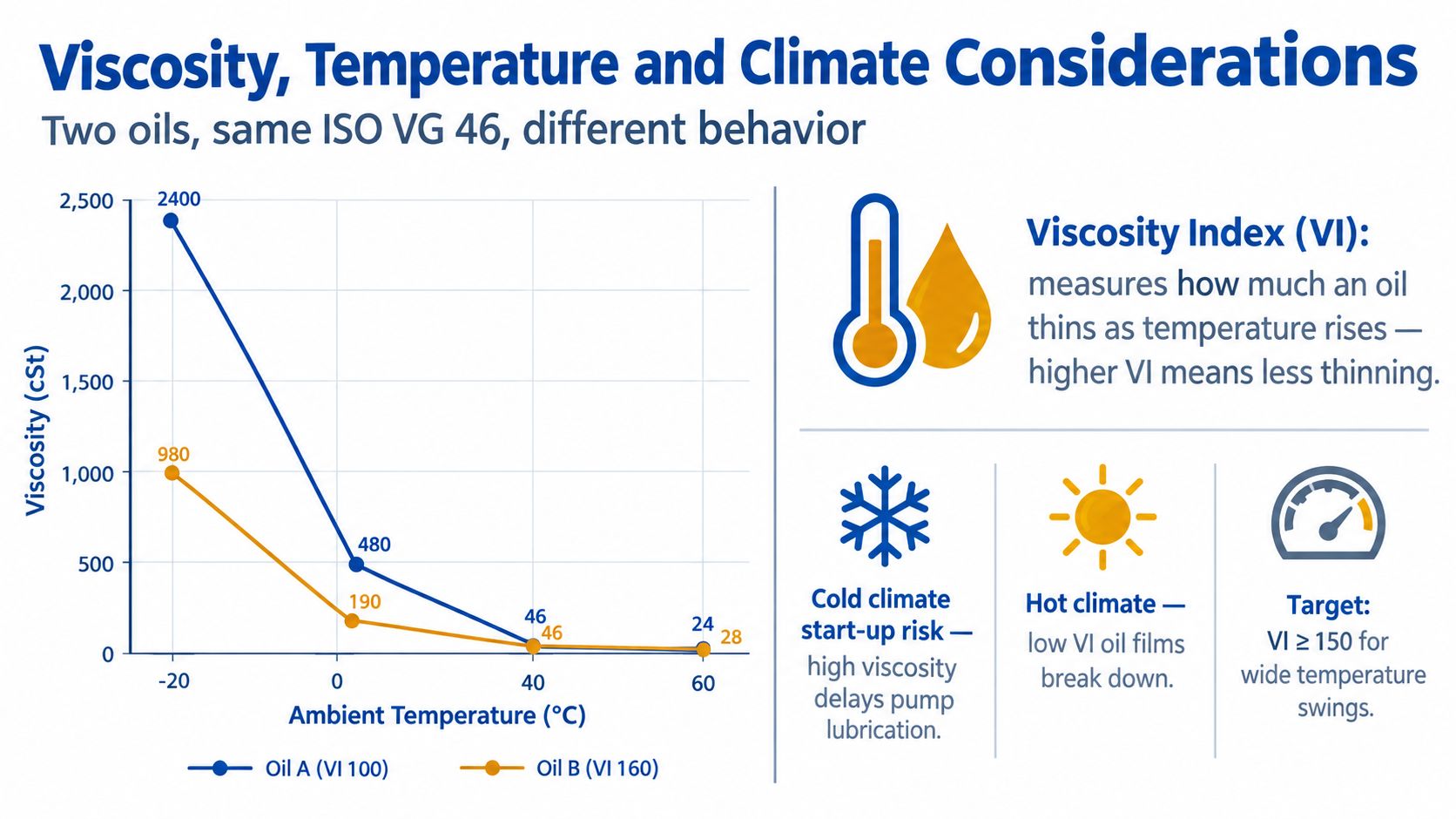
Use the pump inlet's minimum and maximum viscosity requirements as the true boundary. A neat VG 46 number on a datasheet doesn't tell you whether the oil will reach the pump easily after an overnight frost, or whether it will remain thick enough during a long hot duty cycle.
For a UK outdoor quarry machine, VG 32 or a high-VI VG 46 may be more appropriate than a conventional VG 46 if cold start-up is severe. A cold-store machine operating at -20 °C needs a product specifically rated for that environment, potentially a synthetic ISO VG 22 or an arctic-grade fluid. A foundry circuit running continuously hot may need VG 68 HM and an additive package suited to oxidation control, subject to the OEM specification.
Consider a machine yard operating between -5 °C and 35 °C. Don't choose solely from the midpoint temperature. Check the candidate oil's VI, pour point, viscosity-temperature data and the pump manufacturer's permissible inlet viscosity. A high-VI VG 46 may provide a better compromise than switching down to VG 32, particularly if the machine needs adequate film thickness once fully warm.
Temperature changes the answer. The ISO VG label alone doesn't describe the machine's complete operating envelope.
Additives, Contamination and Seal Compatibility
The cross-reference most likely to fail in service is often the one that ignored contamination. UK guidance attributes approximately 70 to 80% of hydraulic failures to particulate contamination, and one source notes that unfiltered new oil can arrive 2 to 20 times dirtier than the ISO 4406 cleanliness level acceptable for many hydraulic systems. The BSI preview on hydraulic-fluid cleanliness explains why new oil shouldn't automatically be treated as clean oil.
A small particle can damage a precision valve long before the bulk fluid looks dirty. Servo and proportional valves have tight clearances, so incoming oil should be filtered through clean transfer equipment and checked rather than poured directly from a drum.
| System type | Recommended seal | ISO 4406 target | Key additive checks |
|---|---|---|---|
| General industrial HM circuit | NBR where specified by the OEM | Set by component manufacturer and duty | Anti-wear, anti-foam and water separation |
| High-VI outdoor circuit | NBR or FKM, subject to supplier data | Maintain the existing system target | VI improver stability, air release and demulsibility |
| Servo or high-pressure piston system | FKM or specified high-performance elastomer | Use the OEM’s cleanliness target | ZDDP level, filterability and varnish control |
| Water-glycol or phosphate-ester circuit | EPDM where specified | Follow the fluid and component manufacturer | Never expose EPDM systems to mineral oil |
NBR commonly suits mineral HM fluids within the seal manufacturer’s temperature limits. FKM can support higher-temperature or synthetic applications where approved. EPDM is intended for water-glycol and phosphate-ester fluids and must not contact mineral oil.
Check zinc dialkyldithiophosphate, or ZDDP, anti-wear loading, as well as demulsibility, foam suppression and water separation. A zinc-free fluid may be necessary for a particular legacy system, but that doesn’t make it a universal replacement.
Before filling, clean the transfer hose, filter the incoming oil and inspect the breather and reservoir. Use ISO cleanliness code guidance to interpret particle-count results, then set the target with the pump, valve and OEM documentation rather than choosing a code by habit.
Safe Substitution Procedure
Use a written changeover record. It protects the equipment, the maintenance team and the warranty position.
- Confirm the OEM fluid sheet. Record ISO VG, performance class, VI requirement and every explicit approval.
- Identify the seal materials. Check the elastomer fitted throughout the circuit, not just the reservoir inspection cover.
- Drain the warm incumbent fluid. Capture the waste and arrange compliant disposal. Warm oil drains more effectively, but personnel still need suitable protection.
- Flush the circuit. Use the replacement oil at reduced flow for at least 10 minutes, then drain it again.
- Replace the filter elements and breather. A new fluid cannot compensate for a blocked filter or contaminated reservoir atmosphere.
- Fill and charge the circuit correctly. Include pump cases, servo lines and other trapped volumes where the machine design requires it.
- Take a commissioning sample. Request laboratory particle count and water-content analysis before releasing the machine to full production.
- Run a controlled duty cycle. Log pump case-drain temperature, system pressure and filter differential pressure, or filter ΔP.
- Resample after 50 operating hours. Compare the result with the agreed ISO 4406 target and improve filtration if the codes deteriorate.
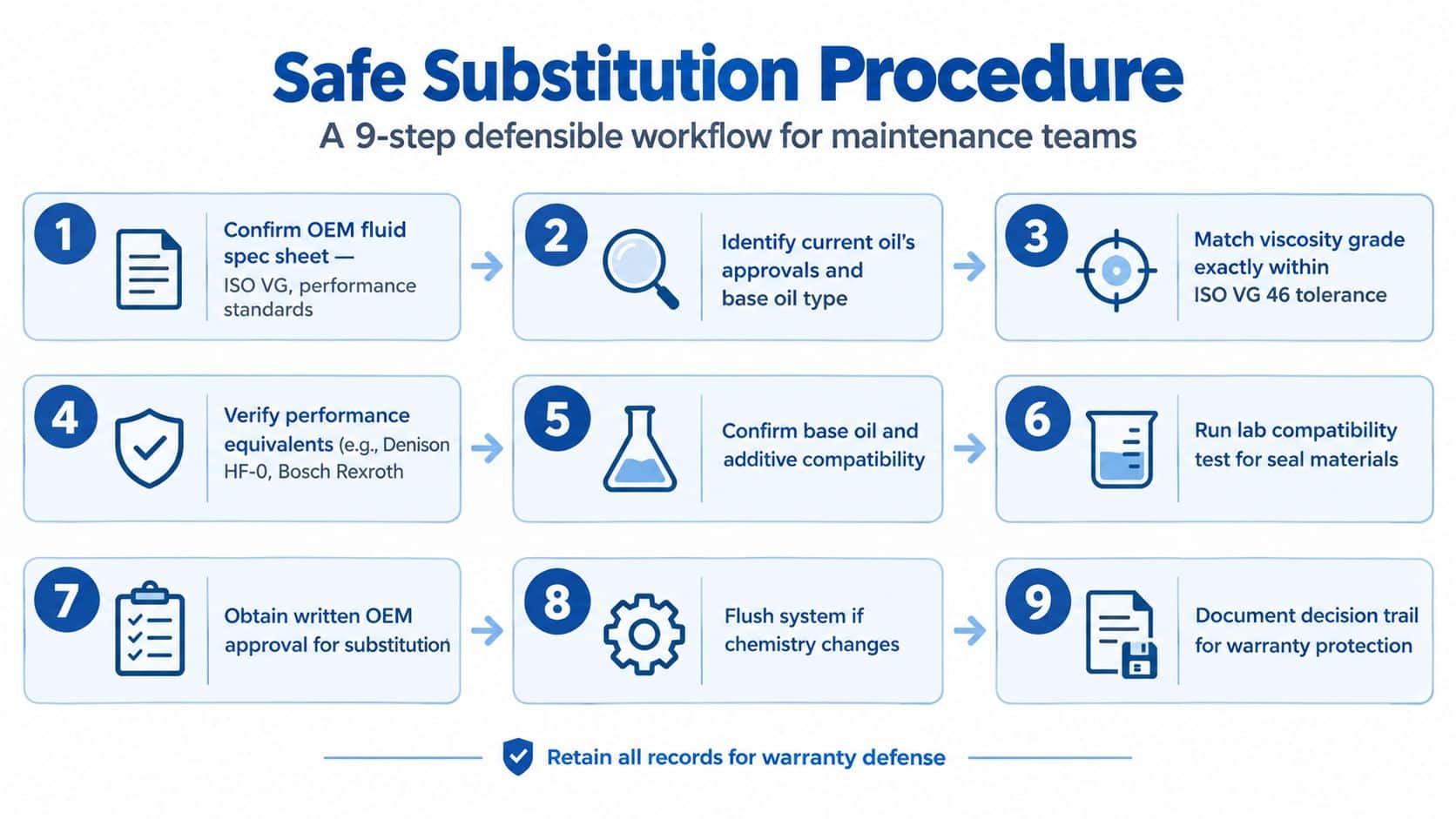
A chemistry change deserves extra control. If the candidate is biodegradable, water-containing, ester-based or otherwise outside the incumbent family, use biodegradable hydraulic fluid guidance and obtain written confirmation from the equipment and fluid manufacturers.
Record the product code, batch, date, samples, filter changes, test results and approving person. If the machine later develops a fault, that decision trail shows whether the oil, cleanliness, seal condition or an unrelated mechanical issue caused it.
Quick Reference Checklist
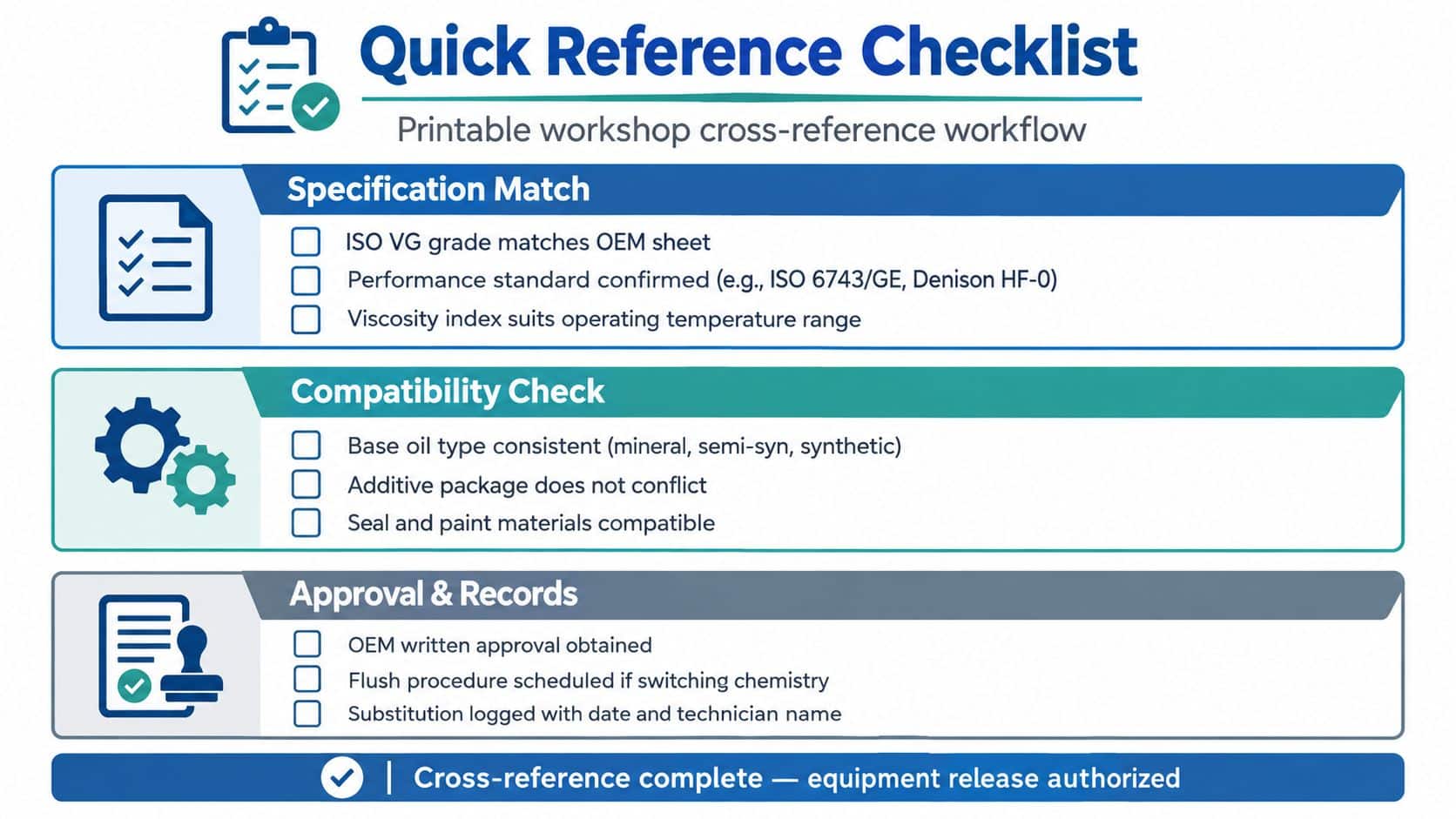
Print this as an A4 workshop sheet and keep it beside the hydraulic store. Tick every box before the substitute container enters the reservoir.
- Specification match: confirm the ISO VG grade, HM or HV class, VI at 40 °C and 100 °C, and pour point.
- Operational match: verify the OEM approval list, seal elastomer compatibility, ambient temperature range and duty-cycle pressure.
- Contamination control: record the filter rating in µm, the target ISO 4406 code, the receipt particle check and water content below 200 ppm.
- Records: write the substitute fluid code, supplier batch number and substitution date in the machine logbook.
- Release decision: hold the machine if any required field is missing, unclear or inconsistent with the OEM sheet.
Use metric units in purchase records, maintenance instructions and labels. UK trade guidance requires metric units in Great Britain, while supplementary imperial indications may appear only when the metric unit is more prominent. The UK Government guidance on units and markings sets out that requirement.
Frequently Asked Questions
When is a substitution genuinely safe
It’s safe only when the ISO VG grade, performance class, seal compatibility and OEM approvals all align with the machine. If one field is unknown, identify it before filling. Ask the supplier for the current datasheet and the OEM for written acceptance where the equipment is under warranty.
Can different brands be mixed
A small top-up may be tolerated by some systems, but that doesn’t prove long-term compatibility. Additives can interact, and residues from the old product can change demulsibility, foam behaviour or filterability. Flush the circuit before switching product families, especially when moving between HM, HV, synthetic, ester or biodegradable formulations.
How should you read an OEM approval list
Look for the exact product and the exact approval, not just a general statement that the oil “meets” an OEM standard. Approvals can be model-specific, and a superseded approval may remain relevant, but the supplier must confirm its current validity. Keep the approval document with the machine’s maintenance record.
What should you do with legacy equipment without a data plate
Identify the previous oil from service records, supplier invoices, container labels or a representative fluid sample. Confirm the viscosity and additive family before choosing a replacement. If no special climate or duty requirement exists, an HM, or HLP, mineral fluid is a sensible default starting point, but confirm seals and pump requirements first.
MA Hydraulics Ltd can help maintenance teams with hydraulic oil cross-references, filters, replacement components and application decisions for mobile and industrial systems. Visit MA Hydraulics Ltd to discuss a hard-to-find specification or call 01724 279508 today, or send a message with the machine details and existing oil data.
