
You're looking at a drum in the stores, a machine waiting in the yard, and a data sheet that lists three oils that all look close enough. They're not. Pick the wrong hydraulic fluid type and you'll still get movement on day one, then you'll pay for it in heat, wear, seal trouble, fire risk or a disposal problem nobody budgeted for. On UK plant, fluid choice is a risk decision first and a purchasing decision second.
Why the Choice of Hydraulic Fluid Matters on UK Plant
A pump came back to a workshop bench with the oil sample in a jam jar beside it. The oil was dark, it smelled burnt, and the warranty paperwork had already been refused. Nobody had fitted a bad pump. Someone had topped up with whatever was to hand, run the machine hot, and assumed ISO VG 46 on two different drums meant the fluids were interchangeable.
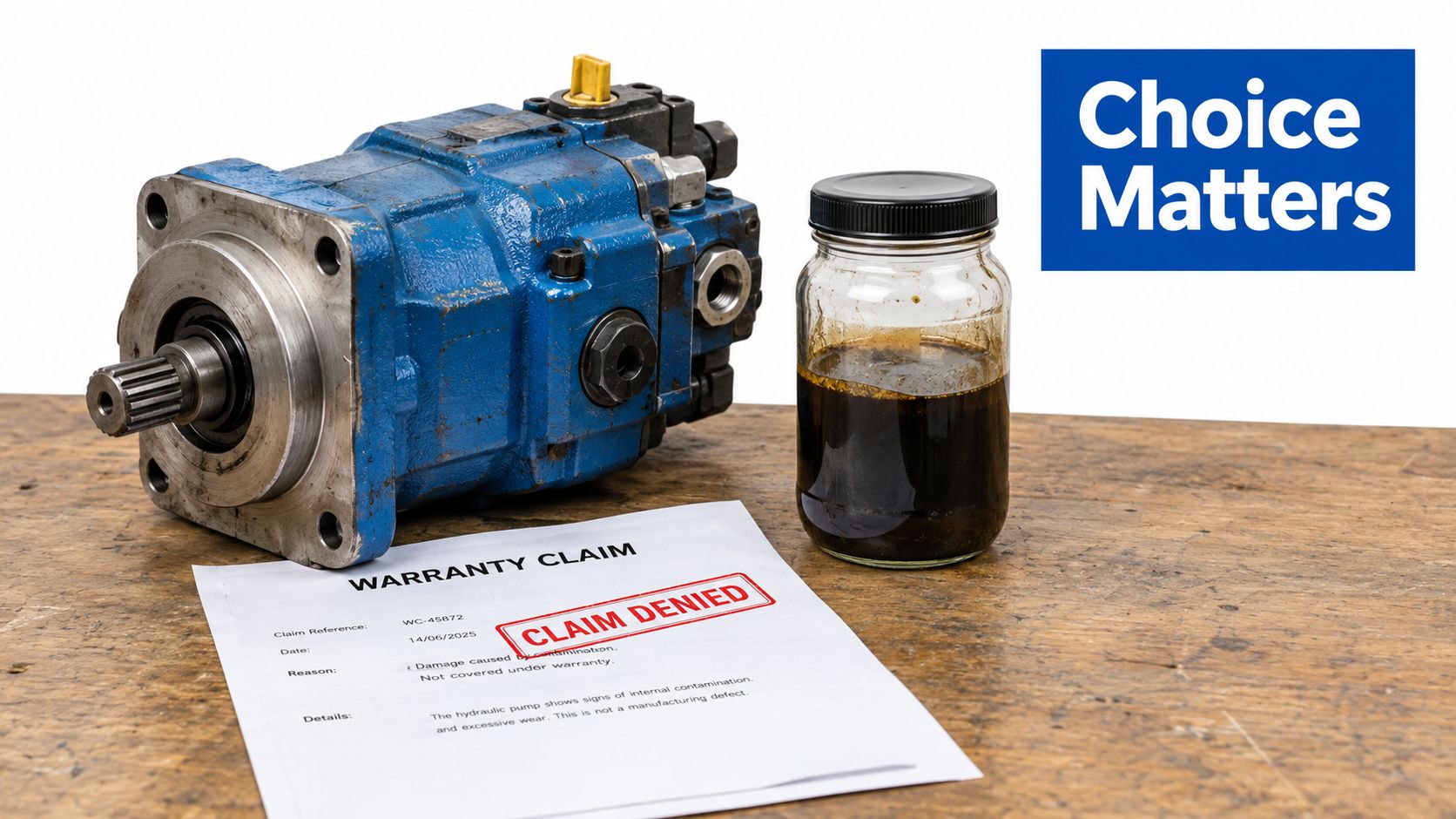
That scene repeats because the fluid does five jobs at once. It transmits power, lubricates pumps and valves, carries heat back to tank and cooler, seals fine clearances, and transports contamination towards the filters. Fail at one job and the operator reports a slow function, a noisy pump or a hot tank, then the team condemns hardware before anyone samples the oil.
What a Wrong Choice Actually Costs
- Pump life falls first: Oil that's too thin when hot lets metal approach metal and raises internal leakage.
- Energy waste follows: Oil that's too thick when cold starves the inlet, encourages cavitation, and makes the prime mover work harder.
- Risk changes with chemistry: A combustible mineral oil near hot work creates a different problem from a biodegradable ester near a watercourse.
- Disposal isn't an afterthought: Spent fluid classification depends on composition, so the route out of site changes with the family you put in.
Machinists face the same trap with cutting and slideway products, which is why a practical guide for machinists and shops from Evo Dyne Products is useful background on treating lubricants as specified engineering materials rather than shop consumables. The discipline transfers directly. You read the machine maker's requirement, you check compatibility, and you record exactly what's in the tank.
Treat the fluid as a component with a part number, a service life and a failure mode. It isn't bulk oil with a colour.
The Four Main Hydraulic Fluid Families Explained
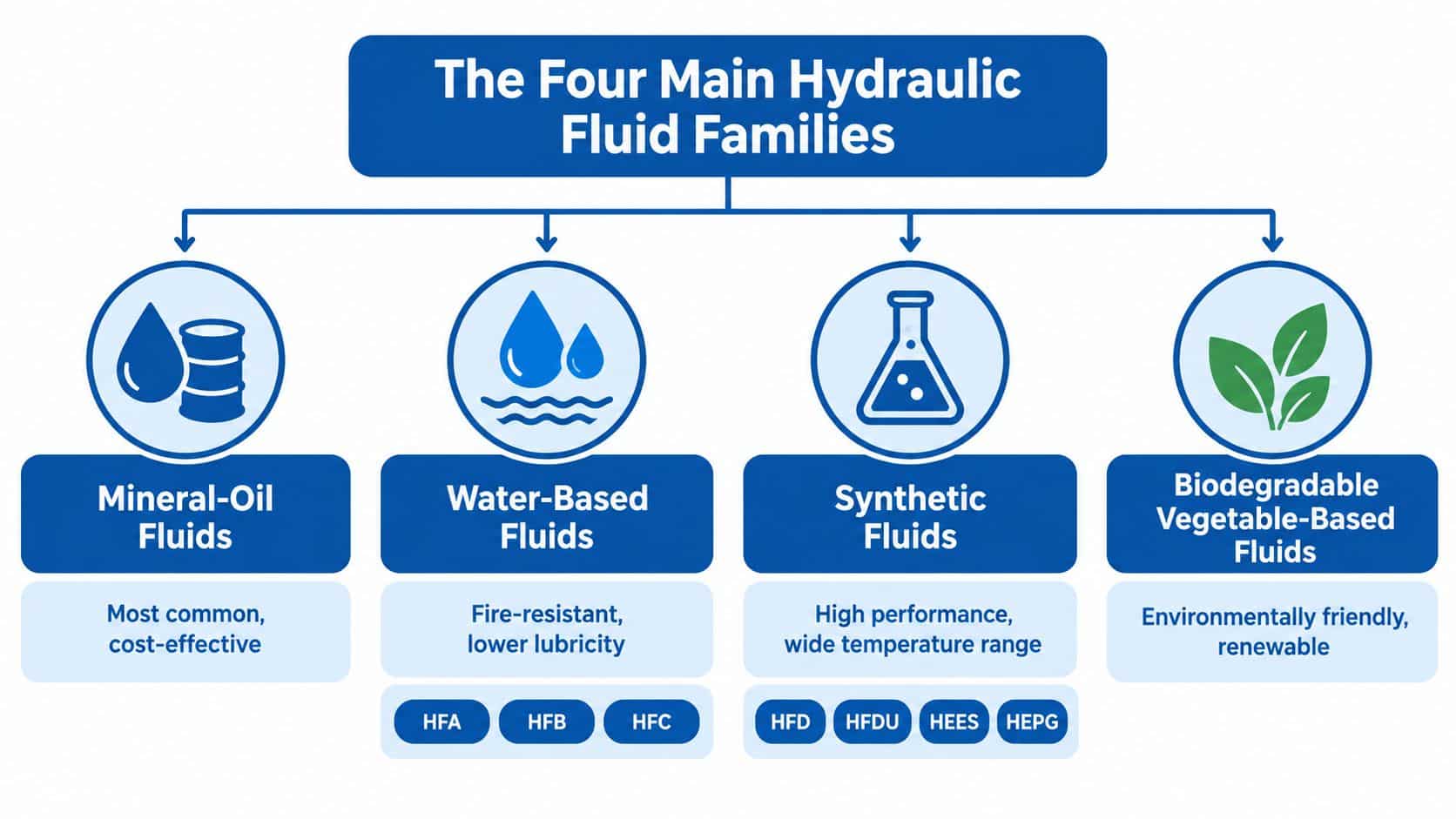
Start with family, not grade. Grade tells you how thick the fluid is at a reference temperature. Family tells you what it's made from, how it behaves with fire and water, and which seals, paints and pumps it'll live with.
Mineral Oil Fluids
Think of these as refined petroleum base oil plus an additive package, broadly like engine oil chemistry adapted for hydraulics. They offer strong lubricity, wide component compatibility and predictable behaviour, which is why they're the default across mobile plant, presses and general factory systems. UK HSE records indicate that mineral-oil-based fluids are used in most above-ground hydraulic systems and can ignite at approximately 420 °C, while specialist HFDU fluids based on fatty-acid esters were developed as a more fire-resistant alternative after serious underground incidents, as set out in HSE guidance on fire-resistant fluids for mining. That ignition point is the limitation you can't additive your way around near flames or very hot surfaces.
Water-Based Fluids
HFA fluids are oil-in-water emulsions with very high water content. HFB types are water-in-oil invert emulsions. HFC fluids are water-glycol solutions. The water does the fire-resistance work, and that's the point. The trade-off is lower lubricity, tighter temperature limits, corrosion control, and the need to monitor water content because evaporation changes concentration, viscosity and protection. They're selected where ignition risk outweighs ultimate wear performance, not as a general upgrade.
Synthetic Fluids
This bucket includes HFD types such as phosphate esters, HFDU fatty-acid esters, HEES synthetic esters and HEPG polyglycols. Don't treat synthetic as one behaviour. Phosphate esters can be highly fire resistant but demanding on seals and paints. Synthetic esters can combine good lubricity with improved fire or environmental performance, depending on formulation. Polyglycols have their own compatibility rules. You must read the exact category, not the marketing label.
Biodegradable Vegetable-Based Fluids
These are typically rapeseed or other vegetable-oil based products, often grouped as HETG. They can break down readily after leakage and suit sensitive outdoor work, but oxidation stability, low-temperature behaviour and water tolerance need closer attention than with a conventional mineral oil. Renewable origin doesn't make a fluid a drop-in replacement.
ISO Viscosity Grades and How to Pick One
An ISO VG grade is the fluid's kinematic viscosity in centistokes at 40 °C. ISO VG 46 means about 46 cSt at that test temperature. It doesn't mean the oil stays at 46 cSt on a frosty morning in a Scottish yard or after four hours of hard work in a warm factory.
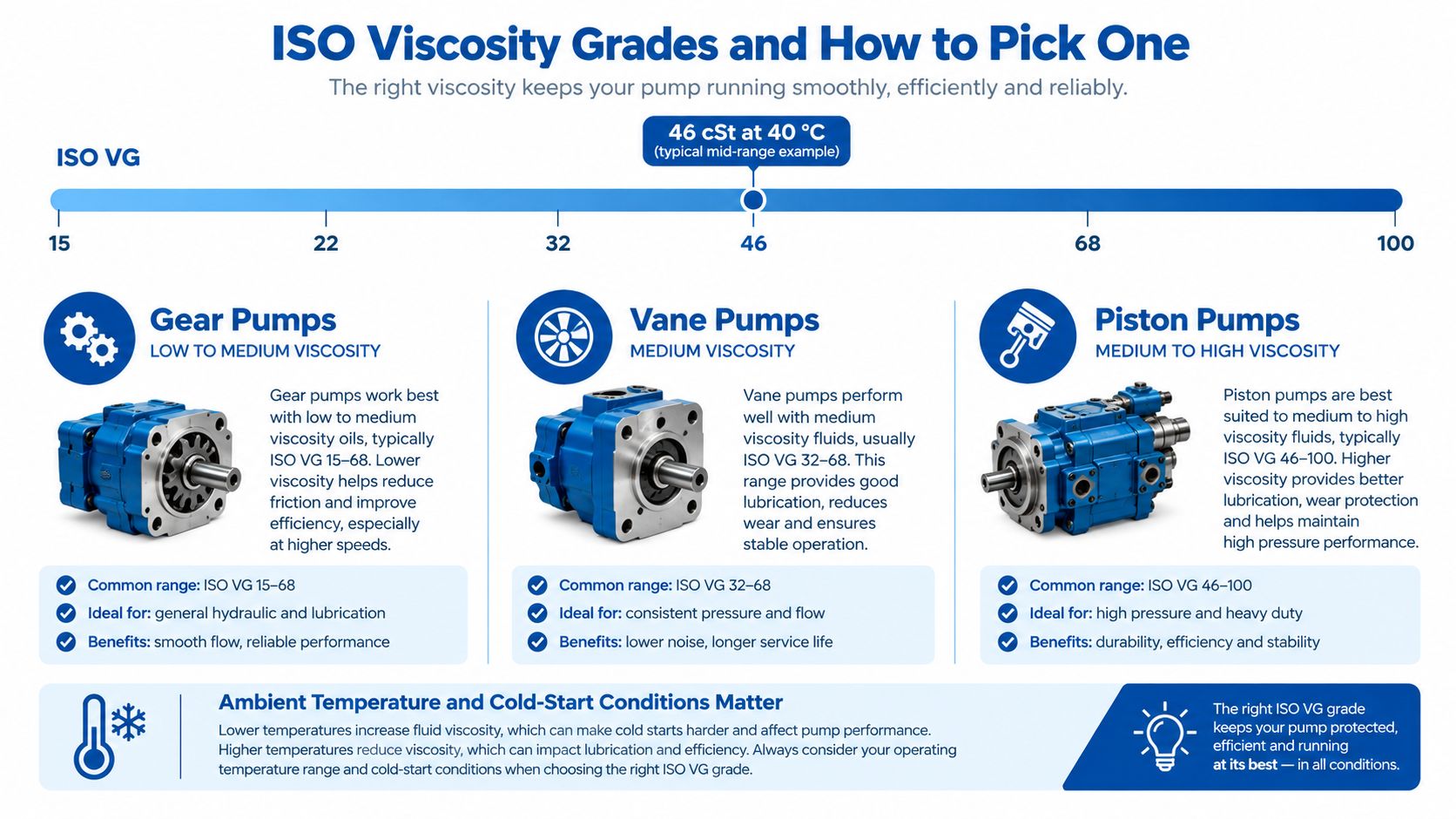
Pick the grade from the operating window, working in this order.
- Start with the pump maker's window: The pump usually has the narrowest acceptable viscosity range and it's often the most expensive component in the circuit.
- Design for the hot end: At full working temperature, the oil must still be thick enough to maintain film strength and limit internal leakage.
- Check the cold start separately: If the oil's too thick at start-up, the pump inlet starves and cavitation damage begins before the machine earns anything.
- Factor in pump type: Gear pumps tolerate a broader range than many vane and piston designs, but tolerance isn't permission to guess.
Here's the trap in the worked-example form buyers miss. A fluid sold as VG 32 can thin well below its nominal grade once hot, behaving more like a lighter oil in service. The same product on a cold start can be far thicker than its label suggests, behaving like a much heavier grade until it warms. That's why one universal grade across a mixed fleet often produces cold cavitation on outdoor machines and hot, weak performance indoors.
Watch this short explainer before you next compare data sheets side by side.
Don't fix worn clearances by moving up a grade. A thicker oil may mask internal leakage briefly, then it raises temperature and ages faster. Use a hydraulic oil cross-reference for comparing specified grades and categories to check equivalents properly, and confirm the viscosity index as well as the headline grade, because viscosity index tells you how much viscosity changes with temperature.
Additives That Decide How the Fluid Behaves in Service
Two drums can both say ISO VG 46 mineral oil and behave differently after a few hundred hours. The base oil sets the foundation. The additive package decides wear, ageing, foam, water separation and cold flow.
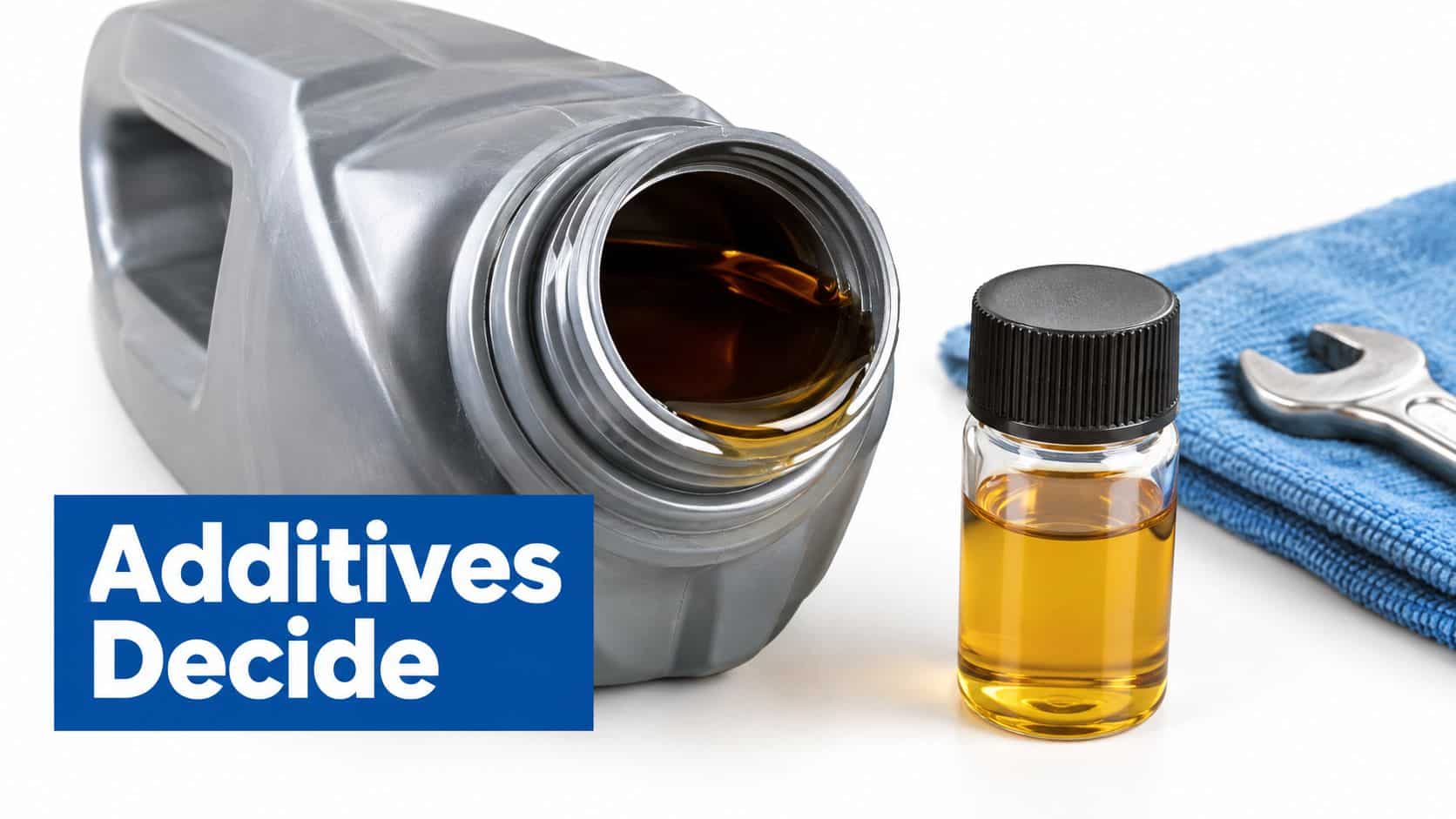
Anti-wear additives form protective films where pump surfaces come under load. They're central to vane and piston pump life, but chemistry matters. Zinc-based anti-wear systems give strong protection in many circuits, yet they can be unsuitable for some components with silver-plated parts, including certain servo applications. That's a specification question, not a preference.
Extreme-pressure additives help under severe boundary lubrication, although they're not a substitute for correct viscosity. If the oil film has collapsed because the oil's too thin when hot, you're asking chemistry to rescue a mechanical problem.
The Supporting Package
- Oxidation inhibitors: Slow the reaction with oxygen and heat that thickens oil, forms acids and creates varnish on valve spools.
- Anti-foam additives: Help entrained air release, but persistent foam usually points to a suction leak, low level or poor tank design.
- Rust and corrosion inhibitors: Protect steel surfaces when water finds its way in through breathers, rods or coolers.
- Demulsifiers: Encourage water to separate so it can be drained, rather than staying emulsified through the circuit.
- Pour-point depressants: Improve low-temperature flow, within limits set by the base fluid and the grade.
Additives deplete. They also interact, which is why topping up one supplier's product with another's because the grade matches is poor practice. Filter blocking, sticky valves and shortened change intervals often trace back to additive fallout or oxidation products, not to a sudden pump defect.
Workshop rule: If you can't name the product already in the tank, don't top it up with a near match and hope. Sample it, identify it, or plan a controlled change.
Fire-Resistant Fluids for UK High-Risk Environments
Fire-resistant doesn't mean fireproof. It means the fluid is formulated to resist ignition and flame propagation better than conventional mineral oil under defined test conditions. You choose these fluids where a pressurised leak could reach a furnace, molten metal, a hot press platen, welding activity or underground ignition sources.
| Fluid Family | Base Stock | Typical Use |
|---|---|---|
| HFA | Oil-in-water emulsion | Underground and high water content applications where lubricity demands are limited |
| HFB | Water-in-oil emulsion | Fire-risk duties needing more lubricity than HFA |
| HFC | Water-glycol solution | Steelworks, foundries and presses near hot surfaces |
| HFDR | Phosphate ester | Severe fire-risk industrial systems built for that chemistry |
| HFDU | Fatty-acid ester | High-risk duties where better lubricity and fire resistance are both needed |
Water-based HFA, HFB and HFC fluids reduce flammability through water content. Their costs are operational. You must control concentration, watch corrosion, respect temperature limits and accept that pump selection and pressures may be more restricted. Evaporation isn't housekeeping detail. It changes the fluid you think you're running.
Synthetic fire-resistant fluids remove much of the water-management burden, but they introduce compatibility work. Seals, hoses, paints, coatings and filter media must suit the chemistry. Phosphate esters in particular shouldn't be poured into a system designed around mineral oil seals and internal paint. HFDU ester fluids can be closer in lubricating behaviour to mineral oil, but closer doesn't mean identical.
What Drives the UK Decision
In British mining and heavy industry, selection is driven by risk assessment, fluid approval and equipment compatibility, not drum price. Approved fluids for UK mines must meet defined fire-resistance and hygiene requirements, including flash point and spray flammability performance under HSE specifications. If you're unsure whether your current oil presents an ignition risk, read guidance on whether hydraulic fluid is flammable before you write the risk assessment.
Ask three questions. What's the credible ignition source? What happens if a hose bursts towards it? Has every elastomer and coating in the circuit been approved for the replacement chemistry? If you can't answer all three, you haven't selected a fluid yet.
Biodegradable Fluids and the UK Environmental Picture
Biodegradable hydraulic fluid is a site decision, not a green badge. It's justified where a leak can credibly reach soil, a drain, a watercourse or sensitive ground, and where the machine and contract can support the change properly.
Biodegradability is commonly assessed using OECD 301(B) or CEC-L-33-A-94 methods over 28 days. One documented bio-hydraulic formulation reports 98% biodegradation after 28 days under OECD 301(B), substantially exceeding the commonly used environmentally acceptable lubricant benchmark of at least 60% biodegradation within that period, according to Crown Oil technical information on bio hydraulic oil. That result belongs to that formulation. It doesn't transfer automatically to every product labelled bio.
Where UK Rules Bite
GOV.UK classifies spent hydraulic oils under European Waste Catalogue codes including 13 01 10, 13 01 11, 13 01 12* and 13 01 13*** depending on composition and hazard status, as explained in GOV.UK guidance on classifying vehicle and oily wastes. Composition changes the disposal route, the paperwork and often the cost in GBP. If a supplier quotes a US example in USD, insist on the GBP UK equivalent before you compare total cost.
Contract conditions can be stricter than general waste law. On UK construction and civil-engineering work, specifications may require biodegradable hydraulic oil for plant operating in, over or within 10 metres of watercourses, vulnerable groundwater zones or sensitive sites, with exceptions only after assessed and formal approval. Procurement teams need to know that before plant arrives on site, not after an environmental audit.
HEES synthetic esters usually offer stronger oxidation and temperature performance than basic vegetable-based fluids, but esters can affect elastomers, hydrolytic stability and varnish behaviour. Water tolerance matters because ester chemistry and water can produce acids if the system is badly controlled. Check pumps, valves, hoses, filters, coatings and seals, then drain and flush where the supplier requires it.
For a fuller breakdown of ester and vegetable-based categories, see guidance on biodegradable hydraulic fluid types and grades. The hierarchy stays simple. Use mineral oil where containment's solid and exposure is low. Use biodegradable fluid where environmental exposure is credible. Verify compatibility before any conversion.
Matching Fluid Type to Mobile and Industrial Use Cases
Mobile and industrial machines punish fluid in different ways. A telehandler starts cold outdoors, works intermittently, breathes dusty air and gets pressure washed. A factory press may run warm for long shifts in cleaner air, with servo or proportional valves that demand cleaner oil and stable viscosity.
Mobile Plant and Agriculture
Tractors, telehandlers, excavators and agricultural implements commonly run mineral oil in the middle viscosity grades specified by the machine maker. The deciding factors are cold-start viscosity, anti-wear protection and water separation, because breathers, cylinder rods and quick-release couplings all invite contamination. Shared implements create the biggest fleet risk. One tractor can collect a different oil from every implement it couples to unless you standardise products and label couplings clearly.
Forestry, estate work and plant near water may justify HEES or vegetable-based biodegradable fluids. That decision must cover the whole machine, including attachments. Converting the tractor and then connecting a mineral-oil implement dilutes the environmental benefit and creates a mixed-chemistry tank.
Materials Handling and Manufacturing
Forklifts and warehouse equipment often favour stable mineral oils with good anti-wear and anti-foam performance, matched to indoor temperature ranges. Factory presses, machine tools and manufacturing cells place more weight on oxidation stability, varnish control and cleanliness, especially with proportional valves. Near furnaces, casting lines or hot presses, the conversation shifts to HFC or HFDU fire-resistant fluids and component compatibility.
Don't separate fluid selection from pressure safety. The UK Health and Safety Executive warns that a fine stream escaping through a pinhole in hydraulic pipework can penetrate the skin and inject fluid into the body, potentially causing severe tissue damage, major surgery or amputation, as detailed in HSE guidance on fluid power safety in agriculture. Hose condition, routing, guarding and depressurisation procedures matter whatever family is in the tank. A biodegradable or fire-resistant fluid injected under pressure is still a surgical emergency.
Never check for a pinhole leak with your hand. Isolate, depressurise, and use card or paper at a safe distance under your site procedure.
Shortlisting therefore starts with duty. Define temperature range, fire exposure, environmental exposure, valve sensitivity and contamination load. Then select the family, then the grade, then the exact product approval.
A Practical Selection Workflow and Where to Get UK Help
Run selection as a conversation between the service engineer, procurement and the fluid supplier, with the machine manual open. Don't start with price per litre in GBP. Start with consequences.
- Define the duty cycle: Record ambient range, working oil temperature, pressure, pump type, valve types and hours between services.
- Set viscosity from data: Choose the grade that stays inside the pump maker's window when hot and still flows at the coldest realistic start.
- Choose family against risk: Mineral oil for general duty, fire-resistant fluid where ignition is credible, biodegradable fluid where leakage can reach ground or water.
- Verify compatibility in writing: Check seals, hoses, paints, coatings, filters and any silver-plated or specialist components.
- Plan the changeover: Decide drain, flush, filter changes, fill filtration, sampling point and the first follow-up sample.
- Confirm disposal before you drain: The waste code follows composition and hazard status, as covered in the earlier section, so agree the route with your waste contractor first.
Keep the maintenance record specific. Write the exact product name, ISO 6743-4 category, viscosity grade, date, machine hours and changeover method. Mixing incompatible chemistries can destabilise additives and shorten seal life, and an unlabelled top-up container undoes careful specification work in seconds.
MA Hydraulics Ltd in Scunthorpe supplies pumps, valves, filters, power packs and bespoke hydraulic builds, and the team can discuss fluid category and grade alongside component selection for mobile and industrial applications. Phone 01724 279508 today, or send us a message through the contact page with the machine, pump and current oil details to hand. Bring the data sheet if you have it. If you don't, bring a sample description, operating temperatures and photographs of the pump plate. That gives an engineer something real to work from.
If you're changing hydraulic fluid types, replacing a pump or specifying a bespoke power pack, talk to MA Hydraulics Ltd for application-led help on matching fluid family, viscosity grade and components. Phone 01724 279508 today, or send a message with your machine and current oil details so the team can advise on a safe, compatible selection.
