
You're normally holding a worn tee in one hand and the machine's parts book in the other, trying to decide whether the failure was a simple split, a pressure-rated adaptor, or a completely different fitting family. That's the core issue behind 1 1/2 tee searches in UK hydraulics, the phrase looks specific, but it can still point to more than one safe or unsafe replacement.
What Buyers Actually Mean by a 1 1/2 Tee
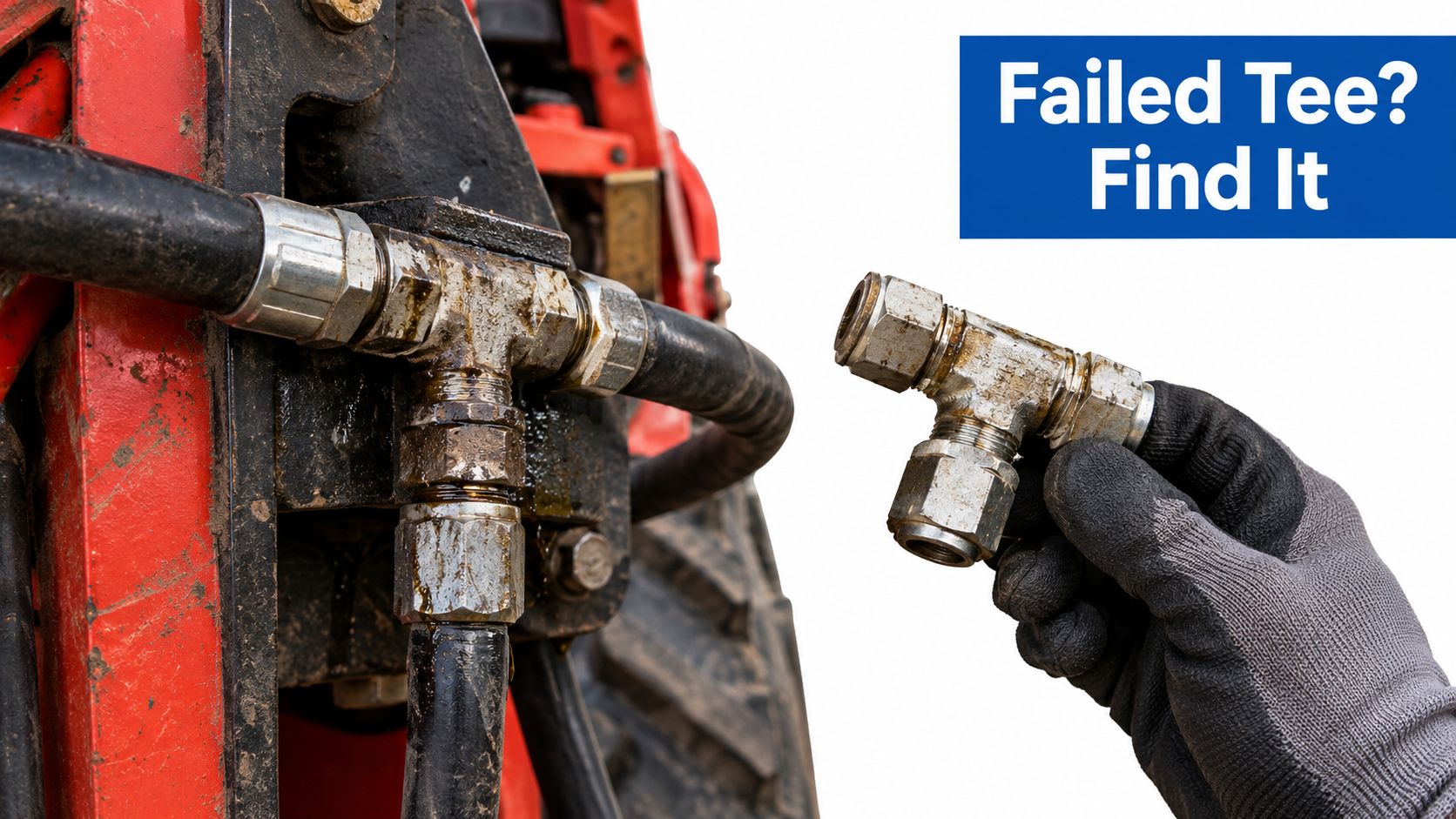
A 1 1/2 tee often appears in a requisition after a fitter removes an unmarked branch fitting from a tractor, telehandler, power pack or industrial line. The wording sounds precise, yet it can describe several different fitting families. Substituting the wrong one can leave a machine with a poor seal, restricted flow or an unsuitable pressure rating.
Three meanings that get mixed together
The commonest interpretation is a 1 1/2-inch BSP tee. UK suppliers list BSP female tees for plumbing and hydraulic adaptor work, including 1 1/2-inch female/female/female versions (Burnett and Hillman's BSP swivel female tee listing). Confirm whether the thread is BSPP parallel or BSPT tapered, because the sealing method and port arrangement may differ even when the nominal size matches.
The description can also mean a 1 1/2-inch nominal bore steel tube tee for non-alloy pipe. Here, the designation relates to nominal bore and tube schedule, not a 38.1 mm outside diameter. For this application, the relevant dimensional reference is BS EN 10255. A third possibility is a metric hydraulic tee with a roughly comparable nominal designation, particularly on imported plant or equipment assembled from mixed systems.
The practical ordering sequence is straightforward: identify the thread family first, then establish whether the tee is equal or reducing, check each end connection, and confirm the pressure class and material. Record the port sizes separately rather than assuming all three are identical.
A body can look right and still be wrong for the machine. A thread may engage without sealing correctly, while a matching thread with a smaller bore can increase restriction and local turbulence. Before the parts counter selects a substitute, specify the thread standard, port layout, material, seal arrangement and pressure requirement.
Dimensions and Standards for 1 1/2 Inch Steel Tube Tees
For UK non-alloy steel tube, the relevant reference is BS EN 10255:2004, which replaced BS 1387 for tubes suitable for welding or threading (BS EN 10255 dimensional guide). The nominal size is DN40, while the tube outside diameter is about 48.3 mm to 48.8 mm, depending on the dimensional series. A “1 1/2 inch” designation therefore does not describe a 38.1 mm outside diameter.
What the size actually tells you
The wall series affects fit-up, weight and the amount of material available for threading or welding. Light, medium and heavy tube can often be distinguished by mass and wall thickness, but a cut sample still needs measurement before a replacement is ordered. The common procurement mistake is treating nominal bore as a finished outside diameter.
| BS EN 10255 dimensional reference for 1 1/2 inch tube | |||
|---|---|---|---|
| Series | Outside diameter (mm) | Wall thickness (mm) | Approx. mass (kg/m) |
| Light | 48.3–48.8 | 2.9 | 3.23 |
| Medium | 48.3–48.8 | 3.2 | 3.57 |
| Heavy | 48.3–48.8 | 4.0 | 4.38 |
A replacement order should state DN40 or 1 1/2 inch, the BS EN 10255 series, material, end type and any thread requirement. A bare “1 1/2 tee” description leaves too much room for substitution, particularly where the host pipe has already been altered.
Confirm how the tee will join the assembly: welded tube, threaded pipe or a socketed connection each requires a different specification. State the tube standard first, then the joining method and branch geometry. For mixed branch sizes, compare reducer options before ordering. In a pressure-bearing assembly, the lowest-rated component governs the whole joint, regardless of the rating marked on another fitting.
Thread Families Used on UK Hydraulic Tees
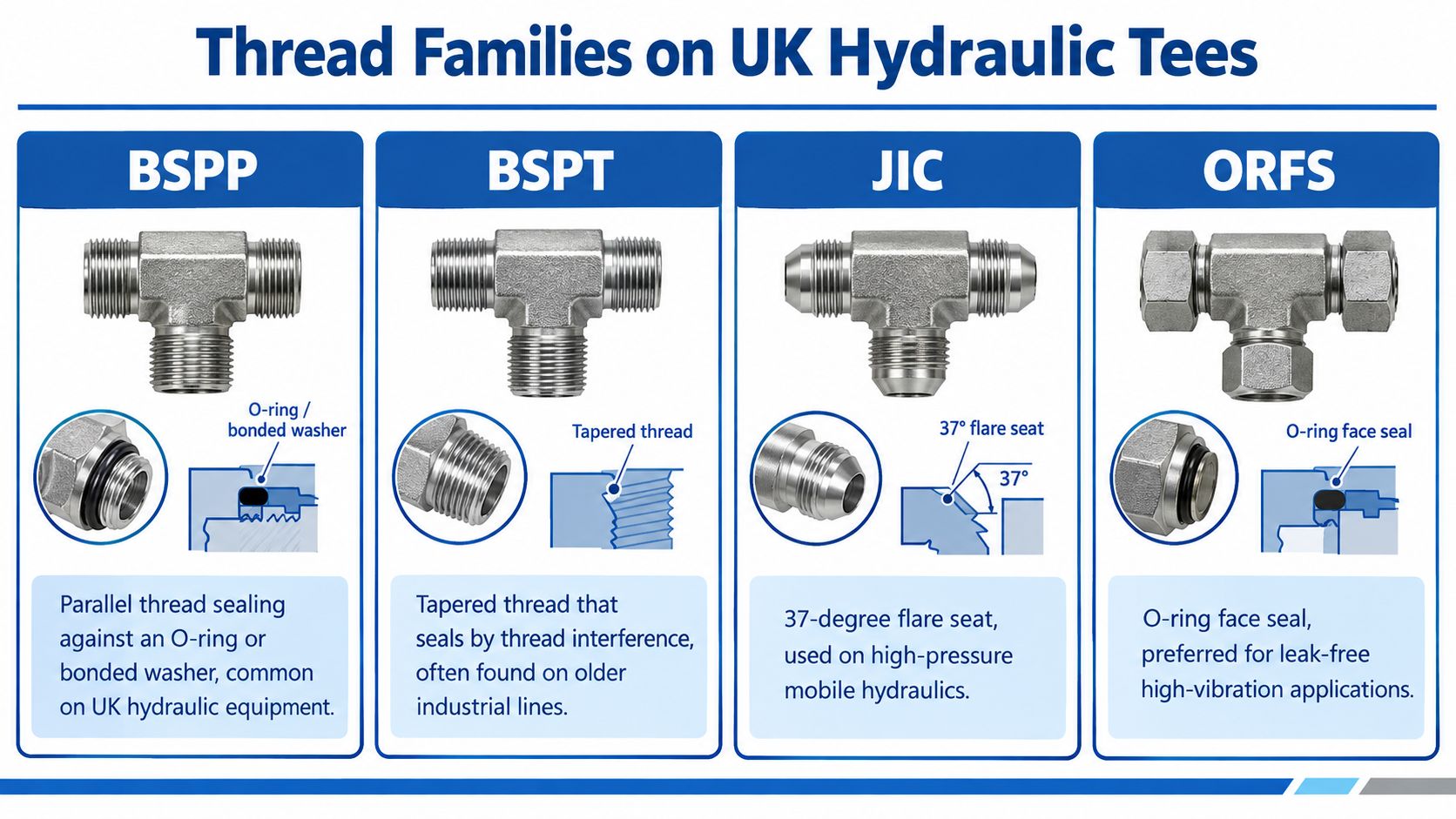
A replacement tee can appear identical to the original and still fail at assembly. The thread family determines the pitch, flank angle, taper and sealing method, so identifying the family must come before ordering by nominal size.
The four families you'll meet
BSPP is the parallel British thread widely used on UK hydraulic equipment. It seals against an O-ring or bonded washer, rather than along the thread flanks. Check the shoulder, sealing face and washer condition as carefully as the thread itself.
BSPT is the tapered British thread. Its seal depends on interference between the mating threads, making correct engagement and suitable sealing practice important. It remains common on older industrial pipework and some lower-pressure adaptors.
NPT is the US tapered thread found on imported machinery and mixed-origin assemblies. Its pitch and taper differ from BSP standards, so an NPT fitting must not be substituted because it screws into the port.
Metric ISO 8434-1 / DIN 2353 compression ends suit metric tube hydraulic systems. They include STAUFF-style male-stud branch tees, which connect two metric tubes to a screw-in port and can be rated up to 630 bar in the manufacturer catalogue.
| Family | Sealing method | Typical use | Visual clues |
|---|---|---|---|
| BSPP | O-ring or bonded washer against a face | UK hydraulics, manifold ports, reusable adaptor work | Parallel thread, clean shoulder, face seal feature |
| BSPT | Thread interference | Older industrial pipework, some adaptors | Tapered thread, progressively tighter engagement |
| NPT | Thread interference with US taper geometry | Imported equipment, mixed-origin assemblies | Tapered thread, not interchangeable with BSP |
| Metric ISO 8434-1 / DIN 2353 | Cone or compression seal | Metric tube hydraulic systems | Compression nut, ferrule, tube-facing end |
A tee can screw together cleanly and still have the wrong seal. That false sense of security often ends with leakage under pressure, heat or vibration. Never force a BSP fitting into an NPT port, or rely on thread engagement alone where the design requires a face, cone or bonded seal.
Use measurement rather than visual matching. Check the root and crest form, measure the pitch, identify any taper, and inspect for a sealing face, cone, ferrule or O-ring groove. Examine the male and female parts together where possible. An unmarked fitting removed from a machine needs this inspection before it is specified as a replacement.
Configurations, Port Layouts and End Connections
A 1 1/2 tee can serve very different jobs. As shown in the overview of hydraulic fitting types, the configuration matters as much as the thread. Equal and reducing tees may look similar on the bench, yet their flow behaviour and installation requirements differ on the machine.
Equal, reducing, stud branch and compression layouts
An equal tee provides three ports with the same nominal bore. Use it for parallel branch circuits, manifold feeds and flow distribution where each downstream leg is intended to remain broadly the same size. A reducing tee steps one branch down to a smaller bore. That suits a sensor connection, pilot line or smaller actuator branch taken from a full-size run.
A male stud branch tee follows the STAUFF-style arrangement. Two metric tube ends connect at the body, while the third port screws into a female thread in a valve block, manifold or other host component. On a mobile loader, this can produce a compact take-off without a separate adaptor stack. Check the stud thread and sealing method carefully, because a metric tube end does not identify the thread used at the block connection.
A compression tee connects three tubes with nuts and olives. It is commonly selected for instrumentation and lower-pressure panels where repeated assembly and disassembly are part of maintenance. Do not substitute it for a hydraulic tube fitting because the tube outside diameter appears to match. The tube material, ferrule system and pressure duty must also agree.
Equal unless there's a reason not to. If the branch does not genuinely need a smaller bore, keep it equal. A reduction introduces restriction, turbulence and additional pressure loss.
| Configuration | What it does best | Typical job |
|---|---|---|
| Equal tee | Splits flow across equal-size ports | Parallel branch circuits, manifold feeds |
| Reducing tee | Steps down one branch without extra adapters | Sensor taps, pilot lines, smaller auxiliaries |
| Male stud branch tee | Screws into a block while accepting tube ends | Mobile equipment, valve blocks, loader circuits |
| Compression tee | Uses a nut and olive on each tube end | Instrumentation, panels, lower-pressure lines |
Port layout also affects installation. A side branch may suit a valve block, while an inline arrangement may reduce hose bends and support points. Forcing a reducing tee into a full-bore circuit creates avoidable pressure loss and complicates fault-finding. Choosing a stud branch where a plain equal tee was specified can leave insufficient clearance for tightening or service access, even if the connection looks tidy during assembly.
Materials, Pressure Ratings and Fluid Compatibility
Body material should be chosen for the actual duty, not for the cheapest catalogue photo. I've seen perfectly decent fittings fail in service because the material was correct for plumbing, but not for hydraulic duty, vibration or the fluid being carried. That mistake usually shows up as staining, seepage or thread damage before the first scheduled service interval is over.
Match the body to the environment
Carbon steel with zinc or zinc nickel plating is the default for general industrial hydraulic tees, because it balances cost and corrosion resistance for indoor plant and mobile under-chassis work. Stainless steel 316 belongs where washdown, food, chemical or marine exposure makes plated steel a weak choice. Brass still appears on lower-pressure plumbing and instrument-air work, but it's rarely the right answer for sustained mineral hydraulic oil pressure. Aluminium saves weight on some mobile and aerospace platforms, but it belongs only where the pressure and medium suit it.
The working-pressure reference for BS EN 10255 steel tube is still useful as a reality check. A UK technical schedule referencing that standard gives indicative working pressures of about 45 bar for 1 1/2 inch medium tube and 40 bar for the heavy-size entry shown in the schedule, when conveying water at -20 to 60 degrees Celsius (SBS schedule). Those values apply to the specified tube and service conditions, not automatically to every tee, seal or assembled system.
Practical rule: the pressure class of the whole assembly is only as strong as the weakest matching part, including the seal, the thread form and the body material.
Fluid compatibility closes the loop. Water glycol, phosphate ester and bio oils each create different demands on seals, plating and body choice, so the same tee body can be acceptable in one circuit and wrong in the next. A fitting that survives mineral oil in a clean indoor line may not survive aggressive fluids or high external corrosion in the same way. If the application is critical, check the manufacturer's pressure-temperature curve before accepting a substitute.
When a Simple Tee Is the Wrong Choice
A tee is often mechanically adequate and architecturally wrong. That sounds harsh, but it's the reality on a lot of field repairs where the branch arrangement is doing a job that needs more than a plain three-way connector can give.
Where the limits show up
A tee does not balance branch flow. If two actuators are fed from a tee and the hose lengths, downstream restrictions or cylinder loads differ, the motion won't stay even. A tee also gives you no load sharing, no contamination isolation and no service isolation, so a small maintenance take-off can force the whole line to be depressurised.
That becomes a problem in instrumentation, pilot circuits and high-flow systems, where pressure spikes, water hammer or thermal expansion can push the installation beyond what the tee was really meant to handle. In those cases, a manifold, flow divider, priority valve or dedicated block is often the safer architecture. ISO 16028 flat-face couplings are a good example of how other components are sold with documented duty envelopes across 100 to 315 bar by size, which is a very different level of clarity from a generic three-way connector (The Hosemaster tee and coupling range).
What to use instead
A flow divider belongs where synchronised motion matters. A priority valve suits steering and load-sense circuits where one function must keep control. A manifold block makes more sense when cleanliness, isolation and service access matter more than simplicity. The key is to treat the tee as a convenience fitting, not a control strategy.
If the branch must simply split or combine and the downstream system can tolerate uneven distribution, a tee is fine. If the job needs balance, isolation or control, choose something built for that function.
The cheapest part is rarely the cheapest outcome. A slightly dearer block or divider often saves the hours that get lost when technicians chase a symptom caused by poor architecture rather than a failed component.
Identification Checklist for an Unmarked Tee
The safest way to turn a physical fitting into an order line is to work from the machine outward, not from the catalogue inward. A photograph helps, but it rarely proves the thread family, the bore relationship or the pressure class. That's why a quick bench inspection should end in measurements, markings and documentation.
A practical order path
-
Measure the outside diameter in millimetres. Use vernier calipers on each port and record the actual OD first, because metric is the primary unit in UK commercial and engineering work. If you later convert to imperial, keep that conversion secondary.
-
Identify the thread family. Check the chamfer, root and crest shape, then confirm pitch with a thread gauge. A parallel BSPP thread behaves differently from a tapered BSPT or NPT thread, and a metric compression end gives itself away by the cone and nut arrangement.
-
Decide whether the tee is equal or reducing. Compare all three ports to each other, then compare the branch to the parent pipe. If one port is smaller, do not assume it's a random wear effect.
-
Look for the seal feature. An O-ring groove or sealing face points to BSPP. A bonded washer or shoulder often points to BSPP or a compression end, depending on the body style.
-
Read the markings. Any stamp or laser mark on the body can be cross-referenced with the manufacturer part number, which is often the quickest way to avoid a false match.
-
Check the host machine data. The original hose, port standard, pressure rating and machine documentation must all agree before you accept a substitute.
Cross-reference metrics and adaptor sizes carefully if the fitting sits between a BSP port and a metric line, because that's exactly where many replacement mistakes start.
A camera shot of the broken part is useful, but it is not enough to order a safe replacement. The drawing, the port standard and the pressure class have to confirm the same answer.
The final habit is simple. Treat every unmarked tee as a specification exercise, not a shape-matching game. If the machine data and the fitting don't line up, stop and re-check before the wrong branch tee ends up on the van.
Cross References and Where to Buy in the UK
Different UK suppliers describe the same general part in different ways, so cross-referencing has to start with the fitting family, not the headline size. That's especially true with a 1 1/2 tee, because nominal size, thread form and pressure class can all shift between catalogues.
Supplier references that engineers actually use
Burnett and Hillman is the natural first stop for BSP female equal and reducing tees in mild steel and stainless, because its listings make the thread family explicit. Flowtech separates hydraulic tees by outside diameter and includes a 1 1/2-inch nominal-bore equal tee, which is useful when you've already confirmed the bore and just need the body style. STAUFF UK is the place to look for male stud branch tees and metric tube fittings to ISO 8434-1 and DIN 2353, with rated pressures up to 630 bar. The Hosemaster is broad enough to cover general hydraulic tees, adaptors and ISO 16028 flat-face couplings for isolation duties.
What to ask before you place the order
Ask for the body material certification, the pressure rating curve and the seal kit details before order acceptance. That protects you from the most common mistake in cross-referencing, where the catalogue code looks right but the material or seal version is different from the part you meant to replace. It's also the fastest way to catch a hidden mismatch between BSPP, BSPT, metric or imported thread families before the part is on the van.
Cross-referencing gets easier when the supplier's language matches the machine's language. If the machine uses DN40, say DN40. If it uses BSPP, say BSPP. If it's a metric compression branch, don't let anyone translate it into a different family just because the overall size sounds similar.
If you need help matching a photo, a worn fitting or a hard-to-read machine port, MA Hydraulics Ltd can help cross-reference the part and build the right assembly. Phone 01724 279508 today, or send a message through MA Hydraulics Ltd and ask for help with the fitting you've got in front of you.
