

Buy the most compact block that fits and you'll save money. That's the popular advice for Hydraulic Manifolds UK buyers, and it's often wrong. A manifold isn't just a tidy way to mount valves. It's the place where your pressure rating, cleanliness target, paperwork and fault-finding time meet for the next decade of service.
I would start from the opposite end. Ask how you'll isolate a fault at 06:00 on a wet morning, how you'll prove the oil was clean on commissioning day, and who holds the compliance evidence if the machine moves between Great Britain and Northern Ireland. The cheapest block rarely answers those questions well. Specify for whole-life maintenance first, then compare price between designs that can be tested, cleaned and repaired.
Define Your Duty Data in Metric Units
Most manifold problems start before metal is cut. A supplier gets a valve list and a rough pressure, guesses the rest, and the quote looks sharp until the machine overheats, creeps or fails a pressure spike. Fix the eight duty parameters first.
| Parameter | Metric unit | Why it matters |
|---|---|---|
| Maximum working pressure | bar | Sets block wall thickness, cartridge ratings and the test pressure |
| Peak pressure from shock loads | bar | Spikes can exceed the steady rating and cause fatigue failure |
| Flow rate | l/min | Sets port size, valve interface and fluid velocity |
| Operating temperature range | °C | Affects seal material, oil viscosity and cold-start behaviour |
| Fluid type and target cleanliness | ISO 4406 code | Drives filtration and the sensitivity of the valves chosen |
| Number of functions and spare stations | count | Sets manifold length and whether spare ports are needed |
| Port size and thread standard | mm and thread standard | Must match hoses and fittings first time |
| Ambient contamination and access | qualitative | Determines sealing, drain points and service access |
Pressure, Flow and Temperature
Don't quote a single pressure figure without separating steady duty from peaks. A loader valve slamming shut or a cylinder hitting an end stop can push peak pressure well past the relief setting for a moment, and repeated spikes fatigue a block that's perfectly happy at steady load. Give both numbers, even if the peak is an estimate from your relief valve response and actuator load.
Flow errors show up as heat. If you size ports and drillings for an average flow rate in l/min but two functions run together, velocity rises, pressure drop rises and oil temperature climbs. Say which functions operate simultaneously and for how long. A duty cycle of short bursts tolerates what a continuous cycle won't.
Temperature range drives seals and oil choice together. A machine that cold starts outdoors in winter and then runs hot beside an engine needs a wider conversation than a factory power unit in a controlled hall. State the minimum start temperature and the highest expected oil temperature, not just the ambient range.
Fluid, Functions and Environment
Name the fluid and your ISO 4406 cleanliness code target at enquiry stage. Proportional and servo valves need cleaner oil than a basic directional valve, so the most sensitive component sets filtration for the whole block. If you don't state a target, you can't fairly blame sticking spools on the manifold later.
Count functions, then decide on spares. A blanked spare station costs little during machining and can save a complete redesign when an OEM adds an auxiliary service. It's less useful on a frozen, high-volume design where every millimetre is packaged, so make it a deliberate choice.
Describe where the manifold lives. Mud, washdown water, fertiliser dust and road salt all change sealing, coating and access needs, and a block you can't reach with a spanner won't get serviced properly.
Write everything in metric from the start. The GOV.UK guidance on units of measurement markings and sales states that UK trade law generally requires metric units for transactions, including the sale of goods in England, Scotland and Wales, and that imperial units may appear alongside metric measurements but the metric indication must be more prominent. So use mm, l/min and bar on drawings and enquiries, not conversions added as an afterthought.
Before you call: Send maximum and peak pressure, simultaneous flow, temperature range, fluid and cleanliness target, function count, port standard, environment and access notes. If one line is blank, say so rather than guessing it.
Standard, Modular or Bespoke Manifolds Compared
The smallest block makes a tidy photograph and a miserable repair job. If a faulty section can't be isolated, if there's no test point to prove where pressure is lost, or if removing one valve means stripping its neighbours, you'll pay for the saving repeatedly in diagnostic hours. That trap matters most where downtime is seasonal or stops a line.
The practical cost of being stopped is shown in the image below, and you should check any wording shown on job sheets or labels in your own records just as carefully as you check the price.
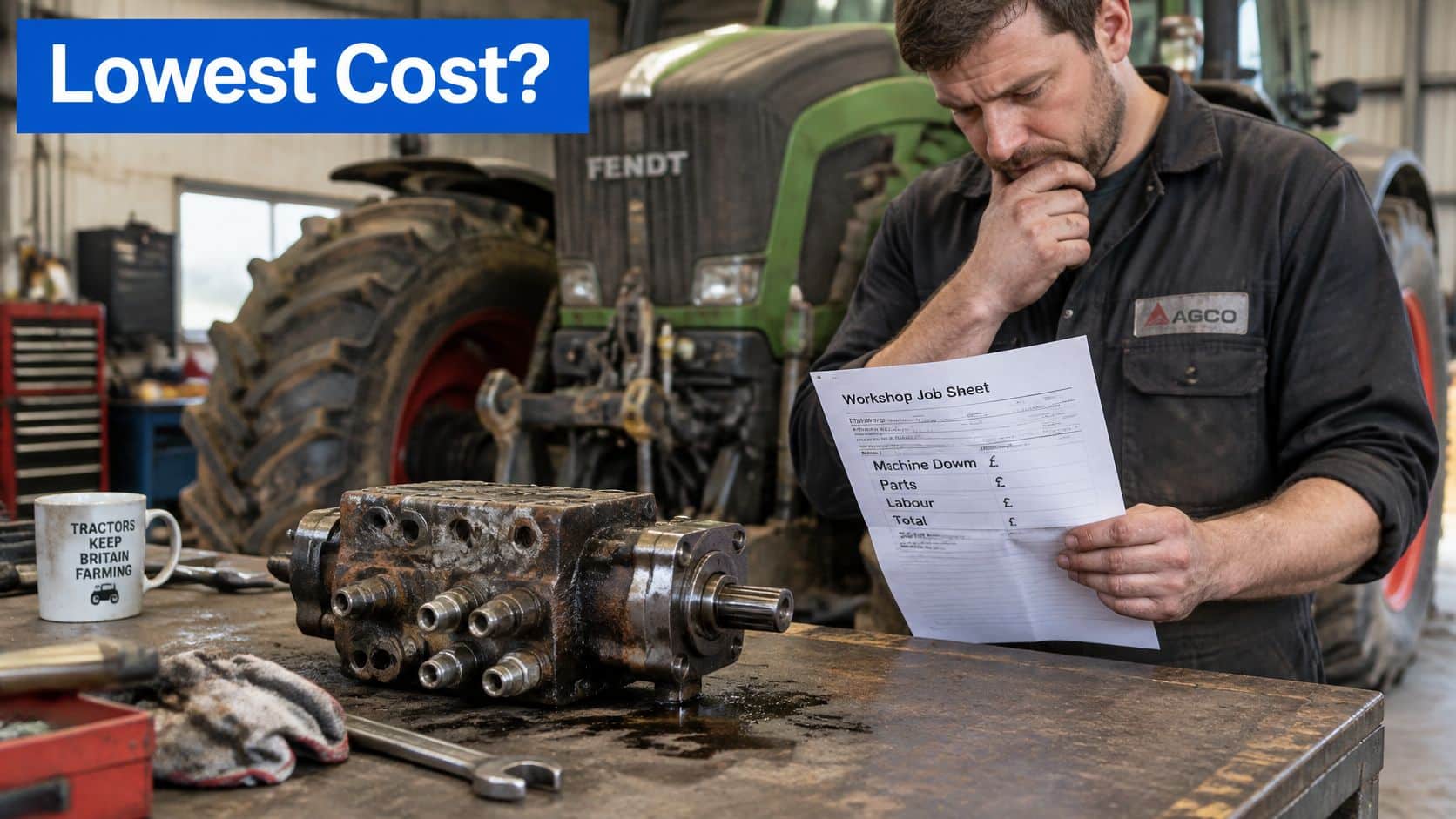
A UK agricultural downtime analysis reports hydraulic-system failures as 35% of unscheduled repairs and describes a single hydraulic pump failure costing £1,800 during a four-day planting window. Treat that as indicative, not as a national official statistic and not as a manifold-specific figure. It still makes the right point for mobile plant. One missed window can dwarf the difference between a basic block and one with proper test points and isolation.
The Four Routes
| Route | Best for | Relative cost | Lead time |
|---|---|---|---|
| Catalogue standard block | Common circuits with standard CETOP interfaces | Lowest | Shortest route, confirm stock in writing |
| Modular stacked sections | Circuits that may change or need spare stations | Middle | Short to middle, confirm section stock in writing |
| Bespoke machined block | Unusual layouts, tight packaging, fewer hoses | Highest | Longest route, confirm machining slot in writing |
| Hybrid standard base with custom plate | OEM retrofits and mixed duty | Middle | Middle route, confirm plate machining in writing |
A catalogue standard block wins when your circuit is common and you won't add functions. It's the honest choice for a straightforward power unit, provided the port positions suit your hose runs. Don't force awkward hose bends to save on the block, because chafed hoses become the next failure.
Modular stacked sections suit machines that evolve. You can add or swap a station, and a damaged section doesn't always condemn the whole assembly. The trade-off is more sealing faces, so torque discipline and clean assembly matter. In muddy field service, that modularity is only an advantage if engineers can keep faces clean while they work.
A bespoke machined block earns its cost when packaging is tight, hoses need eliminating, or drillings can replace a nest of fittings that would otherwise leak. You get exactly the test points, drains and isolation valves you specified, and nothing you forgot to ask for. That's why the duty data has to be complete before machining starts. Changes after cutting are expensive or impossible.
The hybrid route is underrated for retrofits. A standard base keeps cost and availability sensible, while a custom plate adapts porting or adds a function your machine needs. I would choose it when the base circuit is proven but the installation isn't standard.
Questions That Decide the Route
- Can you test it: Are there pressure test points where an engineer can attach a gauge under load?
- Can you isolate it: Can one function be shut off safely while the rest of the machine stays available or safely parked?
- Can you keep it clean: Is filtration accessible, and are spare ports capped against dirt rather than taped over?
- Can you replace it: Does a failed station come off without removing adjacent components?
- Can it survive the site: Will coatings, seals and exposed faces cope with mud, washdown or corrosion?
Watch how these choices work in practice in the demonstration below. Check the player renders at full width in a 16/9 frame on your device, and use the available captions or transcript if you can't follow the audio clearly.
If a fault would stop a planting window or a production line, pay for serviceability before you chase the lowest price. Compactness is a benefit only after testability is secured.
Get lead times in writing for the exact route you're quoted. A standard block on the shelf and a bespoke block awaiting machining aren't comparable promises, and your downtime plan depends on knowing which one you've bought.
CETOP Interfaces, Porting and Materials to Specify
Valves decide the mounting face, not the other way round. Pick your directional and modular valves first, confirm their interface in the maker's catalogue, then draw the block around them. A pattern that's close but not exact won't seal, and you won't fix it with extra torque.
| CETOP interface | Typical use |
|---|---|
| CETOP 3 | Small directional valves and compact power units |
| CETOP 5 | Mid-range flows and general industrial circuits |
| CETOP 7 | Higher flows and larger valve stations |
| CETOP 8 | Heavy-duty mobile and industrial circuits |
These sizes correspond to ISO 4401-03, -05, -07 and -08 respectively. State both designations on your enquiry if your valve supplier uses one and your machinist uses the other. It removes a needless translation error between offices. For background on how valves sit and work on these faces, our guide to how manifold valves work covers the station layout in plain terms.
Porting Comes From Flow, Not Habit
Size ports from your flow in l/min and the velocity you can accept in each line type. Suction lines need gentle velocity to avoid cavitation at the pump, return lines need enough area to keep back pressure down, and pressure lines can run faster within sensible limits. Copying the port size from the last machine is how a new, faster cylinder ends up strangled by an old fitting choice.
State the thread standard in words on every port, whether that's BSP, SAE or ISO 1179 metric. Mixed standards on one block are sometimes unavoidable on retrofits, but they should be a documented decision, not a surprise on installation day. Adaptors stacked to correct a mismatch add leak points and length you may not have.
Allow physical room around ports as well as the correct thread. A port that's correctly sized but too close to its neighbour for a hose nut and spanner will be cross-threaded or left under-tightened in the field. Check hose bend radius against the machine frame before you approve the drawing, while moving a port is still a line on screen.
Aluminium or Steel
Aluminium suits lighter mobile equipment and lower to moderate pressures, and it machines well for compact power units. Steel is usually the choice for higher pressures, shock loads and applications where thread strength and fatigue life dominate. Weight, corrosion environment and repair expectations all feed the decision, so don't select on material price alone.
Machining quality decides whether a good material performs. Intersecting drillings must be properly deburred, because a loose burr that breaks free in service becomes contamination that scores spools and blocks orifices. Surface finish on sealing faces, correct plug selection and clean threads matter as much as the headline pressure rating. Ask how internal passages are finished and inspected, not just what the block is made from.
A Worked Example
Take a hypothetical agricultural circuit at 250 bar and 40 l/min with five valve stations. A CETOP 5 steel block is a plausible starting point, with spare ports machined and capped, a test point per section, and return porting sized for combined flow when two functions run together. The figures are an example to structure your enquiry, not a rating claim for any specific product.
Then check the weakest link. The pressure limit is determined by the lowest-rated cartridge, valve, plug or fitting installed on the block, not by the block material alone. List every fitted component's rating beside the block rating on your specification. If one cartridge is rated below your peak pressure, the assembly is rated below your peak pressure, whatever the sales description says.
Compliance Papers for GB and Northern Ireland Buyers
Most buyers ask about ports and price, then discover the paperwork question at audit time. That's backwards. Where the machine is placed on the market changes which rules apply, and your manifold supplier's evidence needs to match that answer.
The checklist image below summarises the split. Read the text around it for the detail, because the image alone can't carry your compliance decision, and check that any labels or wording inside diagrams you receive from suppliers are spelt correctly and match the drawing revision.

The UK Government machinery safety legislation call for evidence states that CE-marked machinery can still be placed on the Great Britain market under current arrangements, while Northern Ireland continues to apply certain EU product rules, including the EU Machinery Regulation. The same official material notes machinery technical documentation must be prepared in or translated into English and retained for at least 10 years when the relevant amended requirements apply, and that the 2026 machinery-safety amendments are scheduled to come into force on 20 January 2027.
What the Manifold Actually Is
Don't assume the manifold carries its own simple marking answer. It might be supplied as a partly completed assembly, as a safety-related component, or as part of complete machinery, and obligations differ in each case. A bare block, a block fitted with a pressure relief function, and a block built into a finished power unit don't sit in the same position.
That distinction decides who writes what. Your supplier may owe you component data and installation constraints, while the machine builder owns the overall risk assessment and declaration. If nobody states the boundary in writing, both sides tend to assume the other holds it. Confirm responsibility at quotation stage, while you can still choose a different supplier.
Our overview of compliance verification explains how that evidence is checked in practice. Treat everything here as general information to structure questions, not legal advice for your specific machine.
The Evidence Pack to Request
- Circuit drawings: Current revision hydraulic schematic showing every manifold function and test point.
- Component identification: Part numbers for the block, cartridges, valves, plugs and fittings as fitted.
- Pressure ratings: A rating for each item, so the lowest-rated component is visible at a glance.
- Risk assessment inputs: Stored energy, failure behaviour and safe isolation points the machine builder needs.
- Installation and maintenance instructions: Torque values, fluid requirements, filtration and inspection intervals in English.
- Inspection and test records: Pressure test results and cleanliness acceptance for the supplied assembly.
- Change-control notes: What changed between revisions and whether ratings or functions were affected.
A Short Decision Tree
First, confirm whether the machinery is placed on the Great Britain or Northern Ireland market. Second, confirm whether it carries CE or UKCA marking under the arrangements that apply to it. Third, classify the manifold as a partly completed assembly, a safety-related component or part of complete machinery. Finally, request the evidence pack that matches those three answers, and name who retains it for the required period.
Supplier test: Ask for the evidence list before you place the order. A supplier who can produce drawings, ratings and test records on request is telling you something useful about their change control too.
Build the pack as you go. Retrospective paperwork, reconstructed after a machine has shipped, is slower and weaker than records created at build and test.
Testing and Cleanliness Steps Before Commissioning
A manifold that holds pressure on a bench hasn't proved it works. It has proved one thing, under one condition, on one day. Commissioning needs a pressure sequence and a cleanliness acceptance, recorded separately.
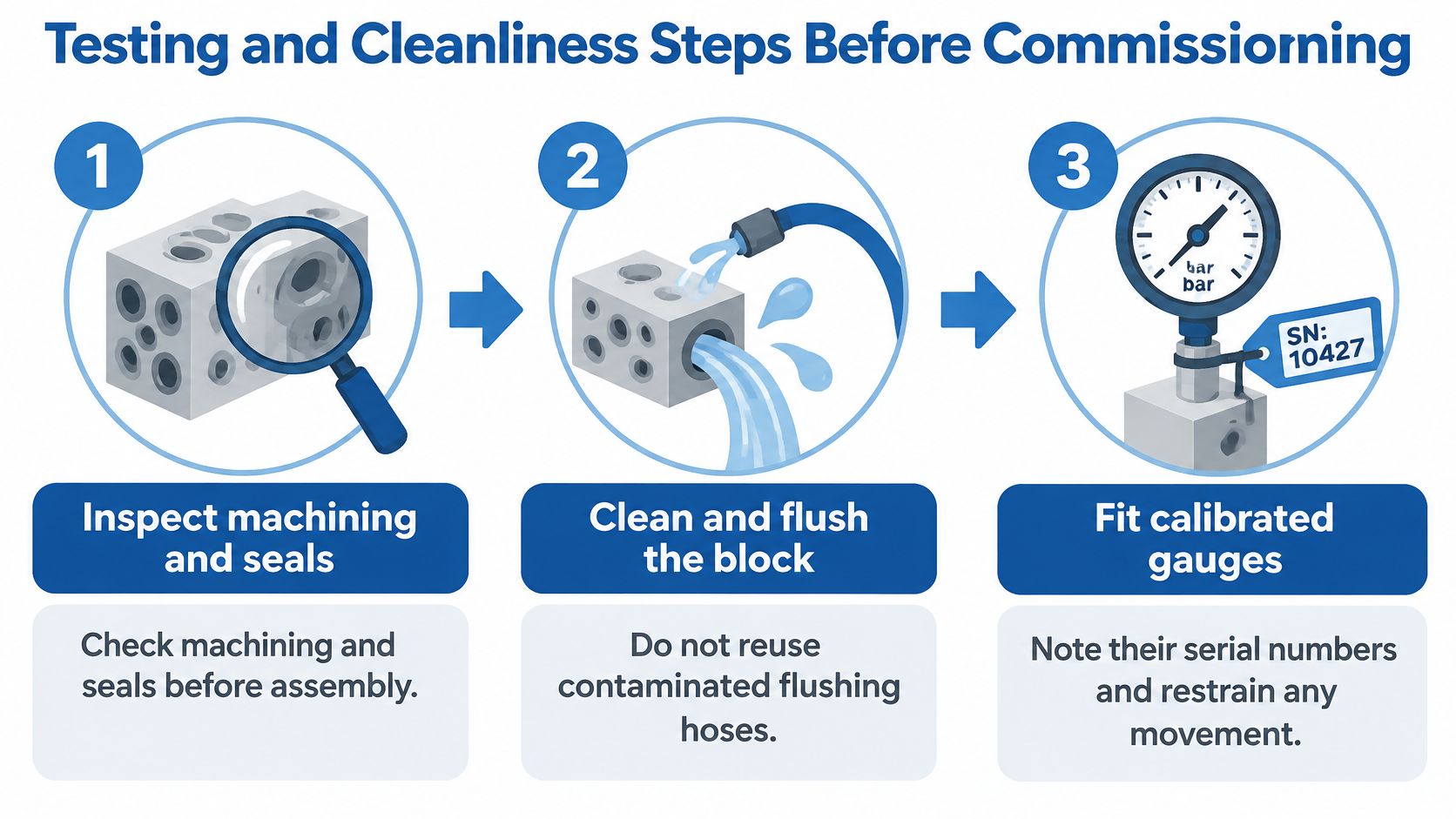
The flow image below sets out the opening steps. The full sequence in the text is what your test record should follow, and any wording inside supplier diagrams should be checked against your drawing revision before you sign acceptance.
The Pressure Test Sequence
- Inspect machining and seals: Check faces, threads, plugs and O-rings before assembly, while defects are still cheap to correct.
- Clean and flush the block: Remove machining debris and loose burrs. Don't reuse contaminated flushing hoses, which carry dirt from the last job into this one.
- Fit calibrated gauges: Note gauge serial numbers on the record and restrain blanked outlets so a plug failure can't become a projectile.
- Leak-test at low pressure: Find assembly errors and damaged seals at a pressure where they're an inconvenience, not a hazard.
- Raise pressure in controlled stages: Pause at each stage. A single jump to full test pressure hides where distortion or leakage begins.
- Hold at test pressure: Check external leakage, pressure decay and abnormal deformation for the specified duration.
- Depressurise and cap: Record the result, then cap every port immediately so a tested block doesn't collect workshop dirt.
Set test pressure from the design code and manufacturer instructions for your assembly. The HSE technical measures guidance on non-destructive testing states that pressure testing is commonly performed at 10–50% above design operating pressure, subject to the applicable design code and manufacturer instructions, and notes that pneumatic testing can release about 200 times more energy than hydraulic testing. That's why hydraulic testing is generally the safer medium. Compressed gas stores energy that a liquid largely doesn't, so a failure releases it violently.
Never exceed the weakest fitted component's rating during the test. If a cartridge must be removed or replaced with a test plug to prove the block, record that substitution clearly, because the assembled machine still needs its own functional checks afterwards. Our notes on testing and commissioning cover how bench results carry into machine commissioning.
Cleanliness Acceptance
Set your cleanliness target from the most contamination-sensitive valve on the block, then verify it by sampling rather than eyesight. Particles that stick a proportional spool are invisible in a jug of oil. The BS ISO 4406:2021 standard is the British adoption of ISO 4406:2021 and supersedes the withdrawn BS ISO 4406:2017, so reference the current edition in your specification.
Sample upstream and downstream of the manifold using clean bottles and controlled procedures, and sample from a representative flowing point rather than a dead leg. Record oil type, operating hours and filter condition with every result. Repeat sampling after flushing, filter replacement or component installation, since each of those events changes what the oil carries.
Write the specification properly. State the required code, sampling point, test method, acceptance limit and corrective action if the limit is missed. "Clean oil" isn't a specification, and it won't settle an argument about whether a sticking valve is a machining fault or dirt from uncapped spare ports and dirty existing pipework.
Mistakes That Invalidate Good Work
Trapped air makes pressure readings unstable and adds stored energy, so bleed the assembly methodically. An uncalibrated gauge turns your hold test into theatre. Treating a successful pressure hold as proof of correct valve function skips the checks that matter to the operator, including relief settings, spool response and actuator behaviour under load.
Close with a test record that stands alone. It should identify the drawing revision, component ratings, test medium, test pressure, duration, gauge serial numbers, defects found and corrective actions taken. File it with the compliance pack, not in a fitter's notebook.
Sourcing and Requesting Your Manifold Quote
The best supplier asks about your duty data before quoting. If the first response is a price with no questions about peak pressure, simultaneous flow or cleanliness, you're probably buying somebody's guess. Use these vetting questions.
- Can they supply to your data: Will they work to your interface, port and pressure figures without substituting assumptions? A quote built on guessed duty can't be compared fairly with one built on your real cycle.
- Can they identify the part: Can they cross-reference a manifold or valve you can't identify, or source hard-to-find items? We can help with cross-references and hard-to-find parts, and if you cannot find a product you need, or need a bespoke solution, you can call us on 01724 279508.
- Are substitutions declared: If an alternative brand is offered, will they state whether it changes flow or pressure rating? Price savings in GBP mean nothing if a substitute lowers the assembly rating, and any USD example should be converted to a GBP UK equivalent before you compare.
- Is cover national: Can they supply across the UK when local stock runs short? We have the resources to operate on a national level in the UK, which also helps you prevent material shortages on the production floor when a line is waiting on one block.
- Can you verify the company: Do they confirm registration details against the public register before you order? Our company number is 03626039.
- Is the quote written and complete: Does it state lead times, drawings, test records in English and after-sales support? A verbal lead time won't protect a build slot.
Send three things with every enquiry: your completed duty-data checklist in metric units, the target CETOP interface and cleanliness code, and whether the machine is for Great Britain or Northern Ireland with the papers you need. Phone 01724 279508 today, send your duty-data sheet via our contact page, or use info@mahydraulics.co.uk for drawings and written quotes.
For standard and bespoke Hydraulic Manifolds UK buyers can specify with confidence, MA Hydraulics Ltd offers application advice, component cross-references and nationwide supply of manifolds, valves and bespoke power packs for mobile and industrial machines. Send us your duty data, CETOP interface and cleanliness target, and we'll help you choose a block that's testable, serviceable and properly documented.
