
You've got a machine down, the replacement hose on the bench looks right, and the port size matches. Then the test rig tells a different story, the assembly won't pass commissioning because the hose that looked like a simple 3/8-inch swap carries a different pressure class, bend radius, or fitting standard. That's the trap with hydraulic hose 3/8 work, the bore is only the first thing to confirm, not the full specification.
Why 3/8 Inch Is Only the Start of the Specification
Two engineers can stand over the same failed line and still order the wrong hose if they stop at the trade size. One sees 3/8 inch, the other sees an assembly problem that also includes pressure, routing, fluid, fittings, and the duty cycle that ended the hose's life. That gap is where downtime and repeat failures begin.
The trade description is not the specification
In UK workshop practice, nominal bore is the reference point for covered hydraulic hose under BS EN 853:2015, and 3/8 inch comes to about 9.5 mm with the dash size -6. The standard covers 1ST, 2ST, 1SN and 2SN wire-braid constructions and sets requirements for materials, dimensions, hydrostatic performance, impulse resistance, leakage, flexibility, adhesion, abrasion and fluid compatibility. A size label on its own never captures that.
A mechanic can strip a hose from a digger or baler, match the bore, and still end up with an assembly that is wrong for the circuit. Pressure class, bend radius, and end fittings can all differ even when the hose looks the same. That is why a “3/8-inch hose” needs a proper check against the machine before anyone reaches for the old sleeve as evidence.
Practical rule: if the hose description stops at bore size, the order is incomplete.
The same habit of reading the name too loosely shows up elsewhere in trade supply, and this 3/8-inch copper tubing reference is a clear example of how size naming can be shorthand rather than a full specification. With hydraulic hose, the margin for error is far tighter.
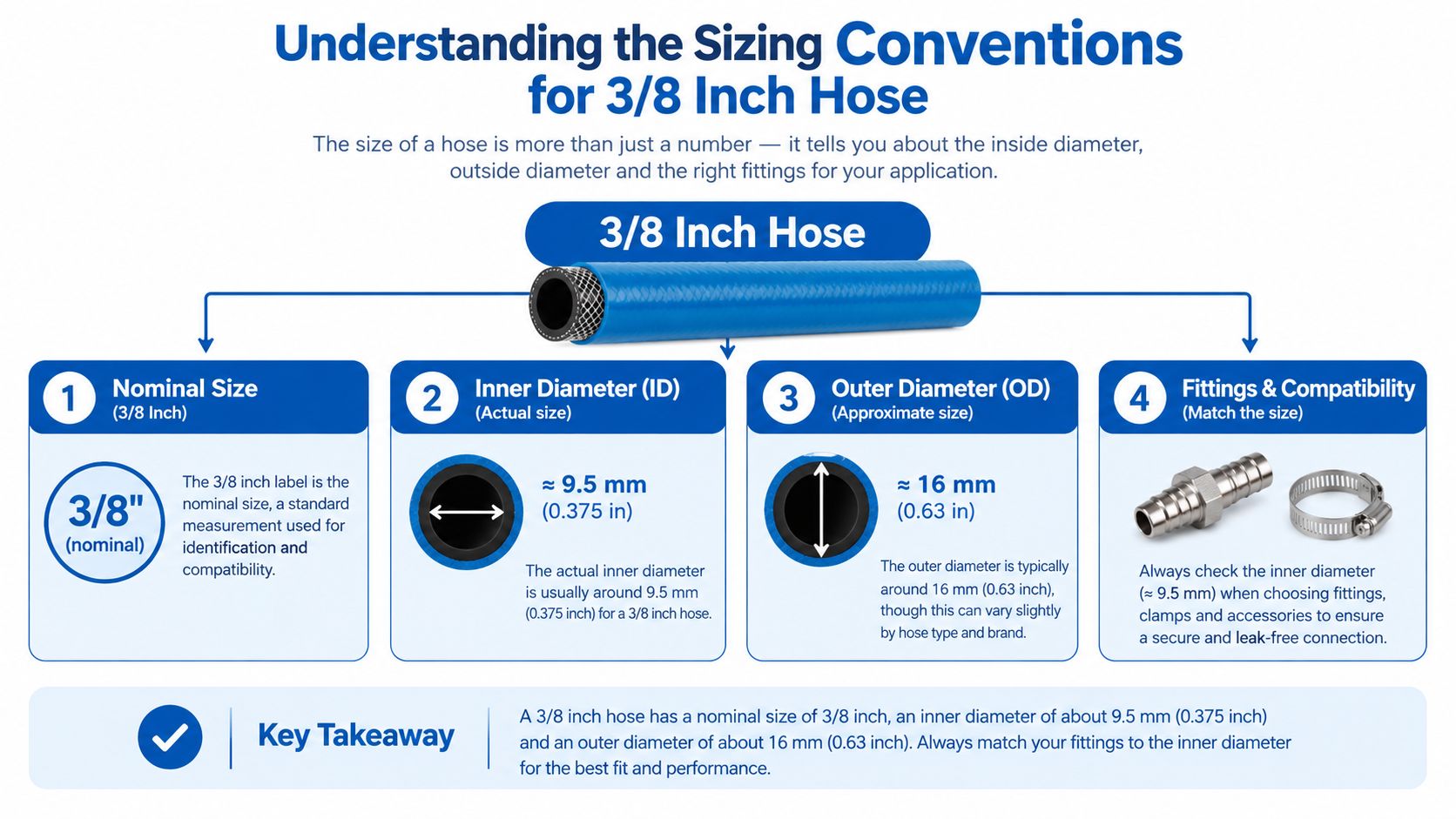
Understanding the Sizing Conventions for 3/8 Inch Hose
On a mobile plant bay, two hoses can look interchangeable on the bench and still be wrong for the circuit. That is why the first check is size notation, then the actual construction, then the assembly details that HSE expects you to verify before the hose goes back into service.
How to read the number properly
3/8 inch is the trade size, -6 is the dash size, and the nominal bore is about 9.5 mm. That label gets you into the right part of the catalogue. It does not tell you whether the hose suits the duty, the routing, or the fittings already fitted to the machine.
Under BS EN 853:2015, covered hydraulic hose is specified by nominal bore, construction, and performance limits, not by size alone. Read the datasheet line by line, the same way you would when sizing a 1-inch hose, and confirm the hose standard before anyone starts crimping. The scope covers the usual wire-braid types and the service conditions that go with them, so the supplier sheet has to match the machine, not just the bore. BS EN 853:2015 details
A mechanic can pull a hose from a digger, match the bore, and still miss a mismatch in cover, reinforcement, or temperature rating. The same trade size is used on other products too, including a professional air hose at Value Tools Co, but hydraulic assemblies need tighter checks because pressure, fluid compatibility, and end-fittings all matter at once.
That is the practical rule in the workshop. Size gets you close, the datasheet closes the gap, and the final assembly check decides whether the replacement is fit for service.
Reading Pressure and Temperature Ratings Correctly
A hose can fit the port and still be wrong for the job. Once the bore is confirmed, pressure rating and temperature range decide whether the assembly belongs on the machine or back on the shelf.
What a 1SN hose tells you
A published EN 853 1SN specification for a 3/8-inch hose lists a 9.5 mm internal diameter, roughly 17.4 mm outside diameter, 180 bar working pressure and 720 bar burst pressure, with a -40°C to +100°C operating range. The burst figure is four times the working pressure, which reflects the 4:1 safety factor stated in that specification. 1SN specification sheet
That set of figures has to be read together. A hose with the right bore but the wrong cover, pressure class, or heat range may install cleanly and still age badly in service. In workshop terms, size gets you to the right family, but the datasheet decides whether the hose can live on that circuit.
Why 2SN changes the picture
A two-wire-braid EN 853 2SN example keeps the same 9.5 mm nominal internal diameter but increases to about 19.0 mm outside diameter, 330 bar working pressure and 1,320 bar burst pressure. That extra capacity comes from the reinforcement package, not from the bore. 2SN example specification
The practical check is simple. If the circuit sees pressure spikes, hot oil, or long runs near exhausts and engines, the assembly must be selected for those conditions, not for the tidy figure on the pump plate.
Select against the highest expected dynamic or shock pressure. The pump's nominal setting is only the starting point.
That approach keeps you honest about the weakest point in the assembly. The hose, fittings, and crimp all have to suit the same duty, because a clean-looking replacement can still fail early if one part of the rating has been assumed rather than checked.
Comparing Wire-Braid Reinforcement Types
A 3/8-inch hose can look identical on the shelf and still behave very differently once it is fitted to a mobile-plant circuit. The reinforcement layer controls how it handles pressure pulses, flexing, and repeated movement, so the braid type matters as much as the bore.
The reinforcement carries the load
For a nominal 3/8-inch hose, the connection size is commonly DN10, with an internal diameter of about 9.5 mm. The outside diameter, bend radius, and pressure capability still depend on the construction and the maker. As noted earlier, the EN 853 2SN/R2AT construction reaches 330 bar working pressure and uses a 130 mm minimum bend radius for 3/8-inch hose.
That bend radius is where many replacements fail in practice. A hose may match the bore and look acceptable on the bench, then be forced into a tighter run once it is on the machine. At that point, the reinforcement works harder than it should, and the fitting often takes the punishment first.
The hidden problem is that two hoses with the same 3/8-inch label can still call for very different routing discipline. A technician needs to check the actual installation space, the movement of the machine, and any heat or abrasion near the route before signing off the swap.
Matching the construction to the duty
The lighter 1ST and 2ST constructions serve different duty levels within the same family. A single-braid hose can be acceptable on a moderate circuit. A stronger braid gives more margin where pressure pulses are harsher, but it usually costs more in size and routing flexibility.
That trade-off matters on UK mobile plant, where space is tight and hoses often run close to guards, joints, engines, and exhausts. The better choice is the one that meets the pressure requirement, fits the route without strain, and leaves enough assembly length for the hose to work normally at the ends. Picking the heaviest hose by default can create a worse installation, not a better one.
HSE-style checks support that approach. Look at the whole assembly, not just the printed size, then verify that the hose, fittings, crimp, and routing all suit the same duty before the machine goes back into service.
Selecting the Right Fittings and Assemblies
Fittings decide whether the hose assembly survives in service, because the assembly is only as strong as its weakest part. A perfect hose with the wrong end, the wrong thread, or a poor crimp spec is still a bad assembly. In the workshop, many "same size" replacements fall apart at this stage.
Start with the circuit, then work outward
Check the circuit pressure first, then the fluid, then the temperature range, then the routing constraints. Only after that should you choose the end fittings and the crimp method. If you reverse the order, you end up adapting fittings to the hose instead of matching the assembly to the machine.
That approach is useful on agricultural kit, materials handling plant, and industrial systems where the port standard can vary even when the hose bore stays the same. A 3/8-inch hose may need different ends for different machines, and the thread standard is often the detail that catches people out. If you want a practical overview of how end hardware differs, see hydraulic fittings types.
Build the assembly as one system
A hose assembly needs the correct length, the correct bend radius, and the correct end compatibility, or it will fail early. Too short, and the hose is pulled at the fitting. Too tight a bend, and the wire fatigue starts before the machine has done meaningful work.
The port and the hose don't care that the bore matches if the crimp, thread, or bend radius is wrong.
That's the rule to keep in mind during ordering and repair. Assembly work should follow the standard, the manufacturer's data, and the actual routing on the machine, not whatever happens to be on the shelf.
Common Mistakes When Replacing Hydraulic Hose
A hose that looks identical in the yard can still be the wrong part for the circuit. That's the dangerous assumption behind most bad replacements, the eye sees the same size, but the system sees the wrong pressure class, wrong fitting, or wrong construction. In mobile plant, that mistake can turn a quick repair into a repeat breakdown or a safety incident.
What to inspect before the hose goes back into service
Before fitting, inspect the hose and ends for cuts, abrasion, exposed reinforcement, kinks, corrosion and damaged covers. If the pressure rating is unknown, UK safety guidance says the hose should not be used. The same guidance warns that you should never search for leaks with bare hands, because even a pinhole can inject fluid under the skin and cause major injury. HSE hydraulic hose safety
The test method matters too. Start with a low pressure below the safe operating limit, then increase in stages and hold each stage. Use suitable pressure relief, remote or protected gauge and control positions, and make sure there's a defined way to exhaust pressure before anyone enters the danger zone. That staged approach reduces the stored-energy release if a component lets go.
Why small bore doesn't mean small risk
A 3/8-inch hose can still whip, split, or jet oil with enough force to injure someone. Bore size doesn't make failure harmless. On mobile machines, repeated flexing and pressure pulses mean the visual condition of the hose often matters as much as its nominal age.
If you're comparing parts for other vehicle systems and need a broader sense of replacement discipline, the same caution applies to DAF braking parts range, where fitment and specification also have to be matched rather than assumed. In hydraulics, that habit isn't optional, it's the difference between a proper repair and a hazard.
Building a Reliable 3/8 Inch Hose Selection Checklist
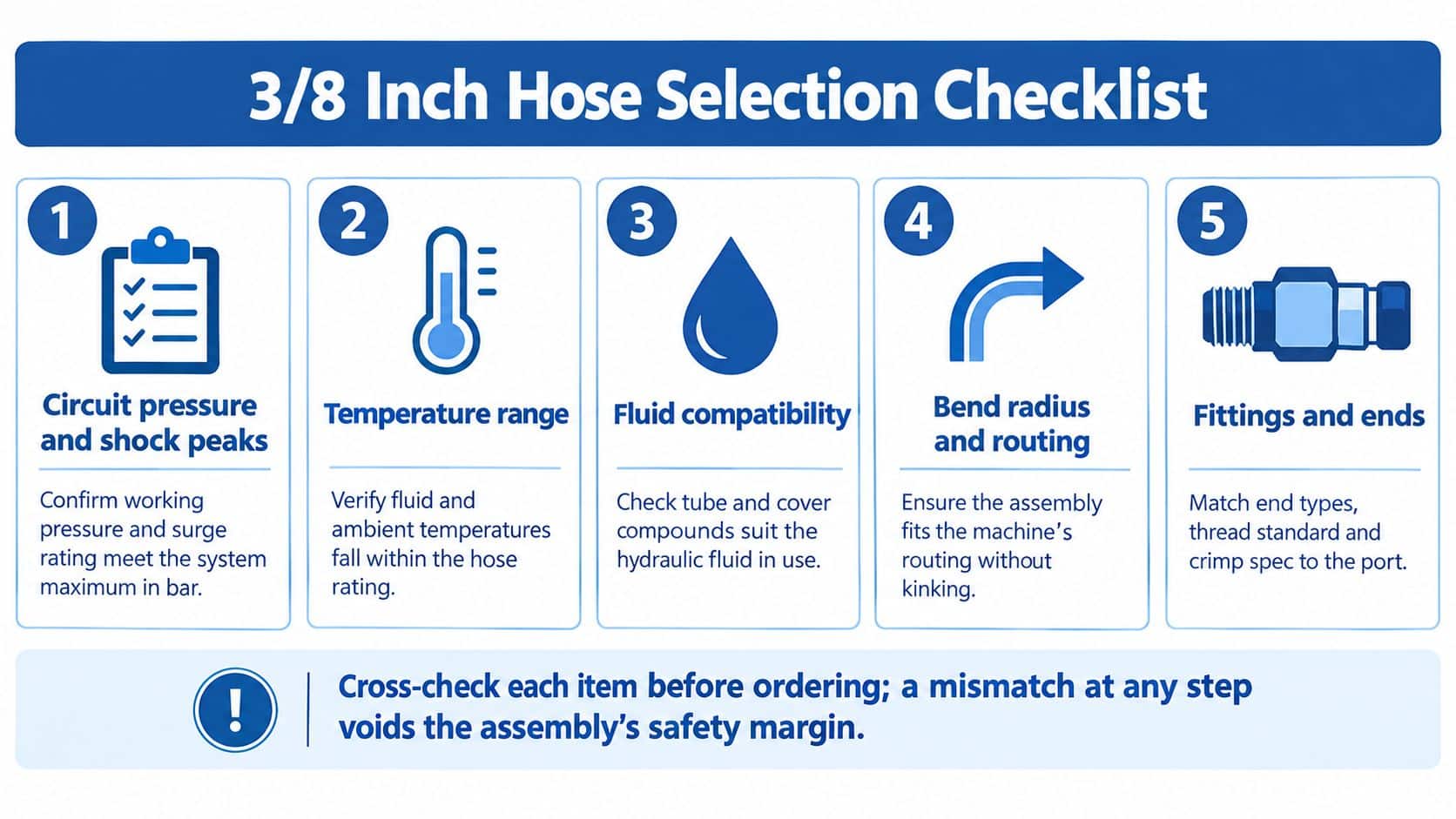
The safest way to order a replacement is to work through the same sequence every time. That stops the “looks right” decision from taking over, and it gives the workshop a repeatable way to confirm what the machine requires. The checklist below is the one I'd want on a wall beside the hose bench.
A practical ordering sequence
- Circuit pressure and shock peaks. Confirm the working pressure and any surge loading, then choose a hose class that matches the highest expected demand, not just the nominal setting.
- Temperature range. Check the fluid and ambient conditions against the hose rating, including whether the system uses petroleum-based fluid, water-based fluid, or water.
- Fluid compatibility. Make sure the tube and cover compounds suit the fluid in use, because compatibility failures often show up later as cover damage or softening.
- Bend radius and routing. Verify the assembly will fit the machine route without kinking or pulling on the fitting.
- Fittings and ends. Match the port thread, end style and crimp specification to the machine, not to a generic catalogue image.
Cross-check each item before ordering. A mismatch at any step voids the assembly's safety margin.
The checklist also answers the bigger question behind the whole topic, why two visually identical 3/8-inch hoses can be dangerous substitutes. The hose's bore is only one part of the decision. The complete replacement has to satisfy the hose standard, the pressure requirement, the temperature window, the fluid, and the route it has to survive.
Frequently Asked Questions About Hydraulic Hose 3/8
Can one 3/8-inch hose replace another 3/8-inch hose? Only if the full specification matches, not just the bore. Check the pressure class, fittings, bend radius, temperature range, and fluid compatibility before you fit it.
What size is a 3/8-inch hydraulic hose in metric terms? In UK practice, the nominal bore is about 9.5 mm and it is commonly identified as DN10 or dash size -6. That size reference still doesn't tell you the outside diameter or the pressure capability.
What temperature range applies to water-based hydraulic fluids? Under BS EN 853:2015, water-based fluids are covered from -40°C to +70°C, while water is covered from 0°C to +70°C. The hose still has to be checked against the actual fluid and application.
How do I confirm the crimping specification? Use the hose manufacturer's data for the exact hose and fitting combination. The assembly's weakest component governs the safe rating, so generic crimp settings aren't enough.
When should I call a specialist supplier? Call when the old hose is unreadable, when the machine has repeated failures, when the pressure pulses are severe, or when the fittings and routing are not obvious. That's the point where application advice saves time and avoids a costly wrong-order.
If you need a replacement hose matched properly, not guessed from the old sleeve, MA Hydraulics Ltd can help you identify the right hose construction, fittings, and assembly details for your machine. Visit MA Hydraulics Ltd to request technical support, or phone 01724 279508 today and speak to someone who can help you order the right hydraulic hose 3/8 assembly first time.
