

Copying a competitor's filter code from the side of a spin-on can be one of the most expensive shortcuts a junior MRO engineer takes on a UK power pack. A thread can fit perfectly while the element delivers the wrong particle capture, opens its bypass at the wrong pressure, swells its seal in the working fluid, or relies on performance data tested to a withdrawn standard.
A proper hydraulic filter cross reference is a performance and standards exercise. You need four things to agree: filtration performance, mechanical fit, fluid compatibility, and documented integrity. Part numbers are useful for starting the search, but they're not evidence that a replacement belongs in the circuit.
Why Part Number Alone Is Not a Cross Reference
A part-number match tells you what another supplier believes is equivalent. It doesn't prove that the element protects your pump, valve or actuator to the required cleanliness target.
The most common trap is a filter that matches the thread, gasket and overall dimensions but carries a different media rating. A nominal 25-micron element may be offered against a genuine 10-micron absolute element. The housing accepts both. The hydraulic circuit doesn't perform the same with both.
The bypass setting creates another hidden difference. A replacement may open at 3.2 bar where the original is set for 5 bar. That changes the point at which contaminated oil bypasses the media. A nitrile seal can also be unsuitable in a phosphate ester system, even though the element screws into the head without resistance.
Practical rule: if the supplier only confirms thread, outside diameter and length, you haven't completed a cross reference.
The test standard matters too. BS ISO 16889:2022 is the current British Standard implementation for hydraulic filter testing and supersedes BS ISO 16889:2008+A1:2018, which is withdrawn. A beta ratio measured under an older method shouldn't be treated as automatically equivalent to a result reported under the current standard. The hydraulic filter element sizing guidance makes the same practical point: size is only one part of a defensible selection.
Use this four-axis check before approving any substitute:
- Performance: Confirm the beta ratio at the relevant particle size under multi-pass testing.
- Mechanical fit: Check thread, endcap geometry, length, outside diameter, inside diameter and flow direction.
- Compatibility: Match the seal compound and media to the hydraulic fluid and temperature range.
- Integrity: Verify collapse, burst, fabrication integrity and fluid compatibility data.
A cheap equivalent can therefore be the costly option. If it causes more bypassing, higher contamination or shorter service intervals, the saving on the element is irrelevant beside pump wear and lost production.
UK Standards That Govern a Cross Reference Decision
The standard-led approach starts with the filter test method, then moves through cleanliness, structural integrity and material compatibility. Don't accept a catalogue line that says “equivalent” until the supplier can show how the claim was established.
BS ISO 16889:2022 is the key reference for multi-pass filter performance and beta-ratio determination. It gives you a test basis for comparing particle capture rather than relying on a loose micron label. The UK hydraulic filter selection guidance also identifies beta values at particle sizes including 2, 10, 75, 100, 200 and 1000.
ISO 4406 expresses oil cleanliness through particle counts per millilitre at 4 µm(c), 6 µm(c) and 14 µm(c). That gives the maintenance team a measurable target instead of descriptions such as “fine filtration” or “high efficiency”.
The supporting standards answer different questions:
- ISO 2941: Can the element withstand collapse and burst conditions?
- ISO 2942: Does the element have fabrication integrity, including an acceptable first bubble point?
- ISO 2943: Are the filter materials compatible with the specified fluid?
A certificate of conformance should identify the element, the test method, the reported beta value, the relevant particle size and the testing organisation. Ask for traceable test data and calibration records where the application is safety-critical or warranty-sensitive. A marketing statement such as “10 micron absolute” isn't a substitute for βx(c) data.
| Standard | Scope | Data You Get | Cross-Reference Question Answered |
|---|---|---|---|
| BS ISO 16889:2022 | Multi-pass filter performance | Beta ratio at stated particle sizes | Does the substitute remove particles as effectively as the original? |
| ISO 4406 | Hydraulic fluid cleanliness coding | Particle counts at 4, 6 and 14 µm(c) | Can the replacement support the machine’s cleanliness target? |
| ISO 2941 | Collapse and burst resistance | Structural pressure performance | Will the element survive system pressure and transients? |
| ISO 2942 | Fabrication integrity | Integrity and bubble-point evidence | Is the element properly constructed and sealed? |
| ISO 2943 | Fluid compatibility | Material and fluid compatibility | Will media, adhesives and seals remain stable in service? |
That evidence gives procurement something it can sign off. A cross-reference then becomes a documented engineering decision, not a guess based on a familiar brand name.
Reading Beta Ratios and Micron Ratings Correctly
Micron ratings cause trouble because suppliers use nominal and absolute in different ways. A nominal rating describes approximate particle capture under a stated test approach. An absolute rating is stronger language, but it still needs a test method and particle-size reference behind it.
The useful figure is the beta ratio. In simple terms:
βx = upstream particle count ÷ downstream particle count at particle size x
The notation βx(c) identifies a beta ratio reported with the particle count normalised under the ISO 16889 method. If a filter records β10 = 200, the upstream count at 10 microns is divided by the downstream count at that size. That represents 99.5% capture at 10 microns, because only one particle in two hundred passes the test condition.
The same logic applies when comparing elements labelled “10 micron absolute”. Two products can carry that description while sitting in different efficiency classes, using different test methods or reporting different beta values. The label alone doesn't settle the matter.
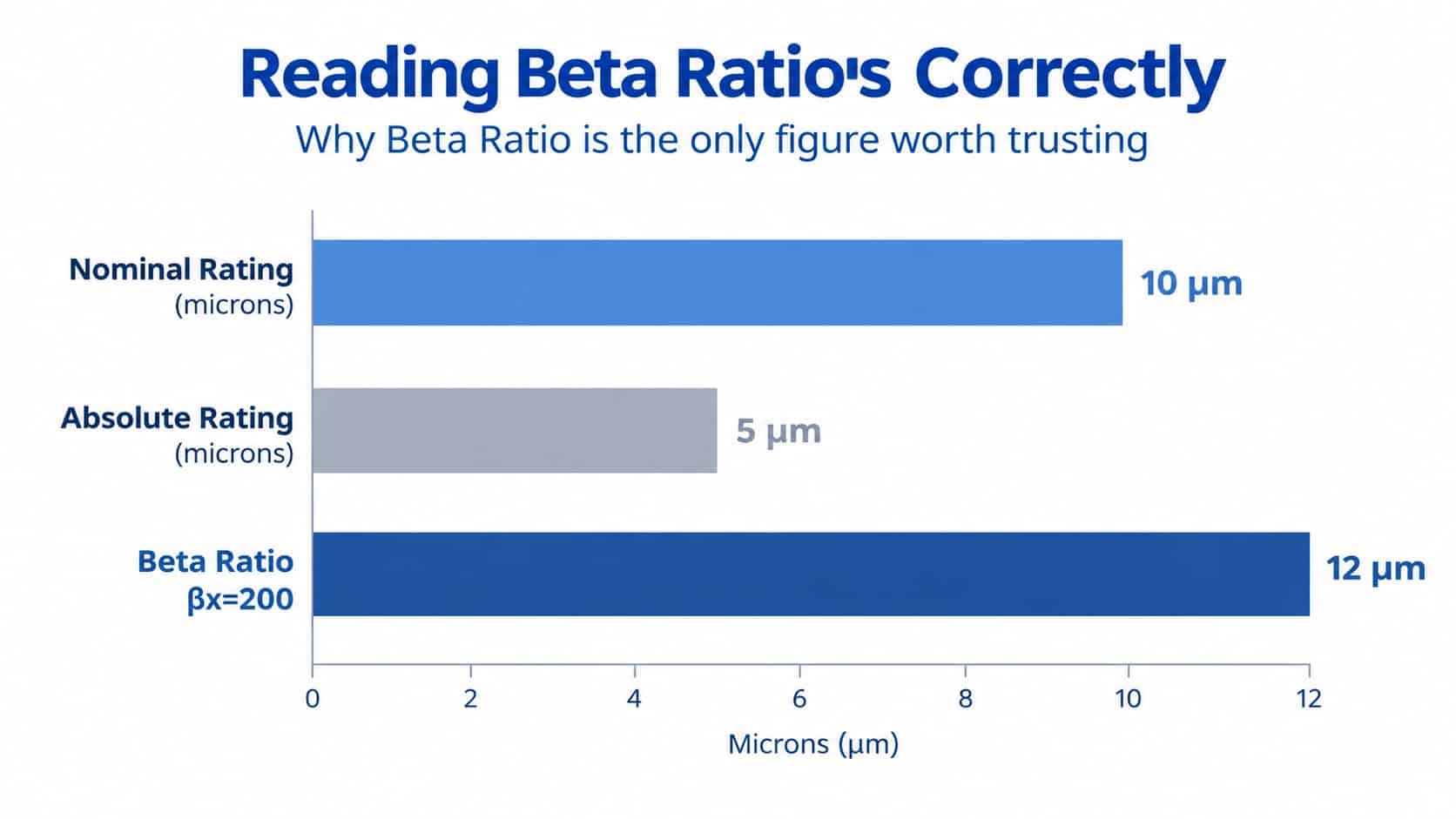
A catalogue row often hides three separate variables:
- Particle size: The beta ratio must be tied to a stated size, such as 10 microns.
- Efficiency class: β10(c) ≥ 200 is materially different from a weaker reported ratio.
- Test basis: The result must be traceable to the applicable multi-pass method.
The ISO cleanliness code reference helps translate filtration performance into the cleanliness language used by hydraulic engineers. Read the data sheet from the beta column first, then check media, pressure drop and capacity. Treat a bare micron claim as an opening question, not an approval.
The following video is useful for engineers who want to visualise how filtration ratings and test conditions affect selection.
Capturing Filter Housing and Spec Data Before You Search
Don't open a cross-reference catalogue with only the old part number. Remove the element safely, clean the label, photograph both ends and build a complete specification block before searching.
Record the original OEM code, media code, nominal and absolute ratings, collapse pressure, beta ratio, seal material and bypass setting. Media markings may identify paper, glass, mesh or an absolute-rated construction, but the manufacturer's data sheet should confirm what the code means.
Photograph the housing head as well as the element. The thread may be BSPP, UNF, SAE O-ring boss or a flange connection such as Code 61 or Code 62. Also record the direction-of-flow arrow, housing part number and serial number. Those details matter when several housings share a similar body shape.
| Field | What to Record | Typical UK Example |
|---|---|---|
| OEM part number | Full code, including suffix | Donaldson P171504 |
| Media | Paper, glass, mesh or other code | Glass |
| Filtration rating | Nominal and absolute claims | 25 micron absolute |
| Beta ratio | Particle size and reported value | β10(c) = 200 |
| Seal | Compound and kit details | NBR |
| Bypass | Opening pressure and tolerance | 3 bar |
| Connection | Thread or flange type | 1-1/2″ BSP |
| Dimensions | Length, OD and ID | Measured from removed element |
| Housing traceability | Housing PN and SN | Recorded from nameplate |
| Flow direction | Arrow on head or element | Pump-to-tank direction |
This record prevents a low-cost element being fitted where a higher-specification glass element was designed. It also gives a responsible supplier enough information to reject a false match before it reaches the workshop.
Matching the Right Filter Type to the Application
The circuit position decides the filter type. Shelf availability doesn't.
A pressure-line filter sits downstream of the pump and sees full system pressure. It needs the correct collapse resistance and is often selected to protect proportional or servo valves from particles that would damage close clearances.
A return-line filter works on the oil returning to the tank. It normally operates at lower pressure than a pressure-line unit, and the housing geometry often gives engineers more replacement options. That doesn't remove the need to match flow capacity, bypass behaviour and cleanliness performance.
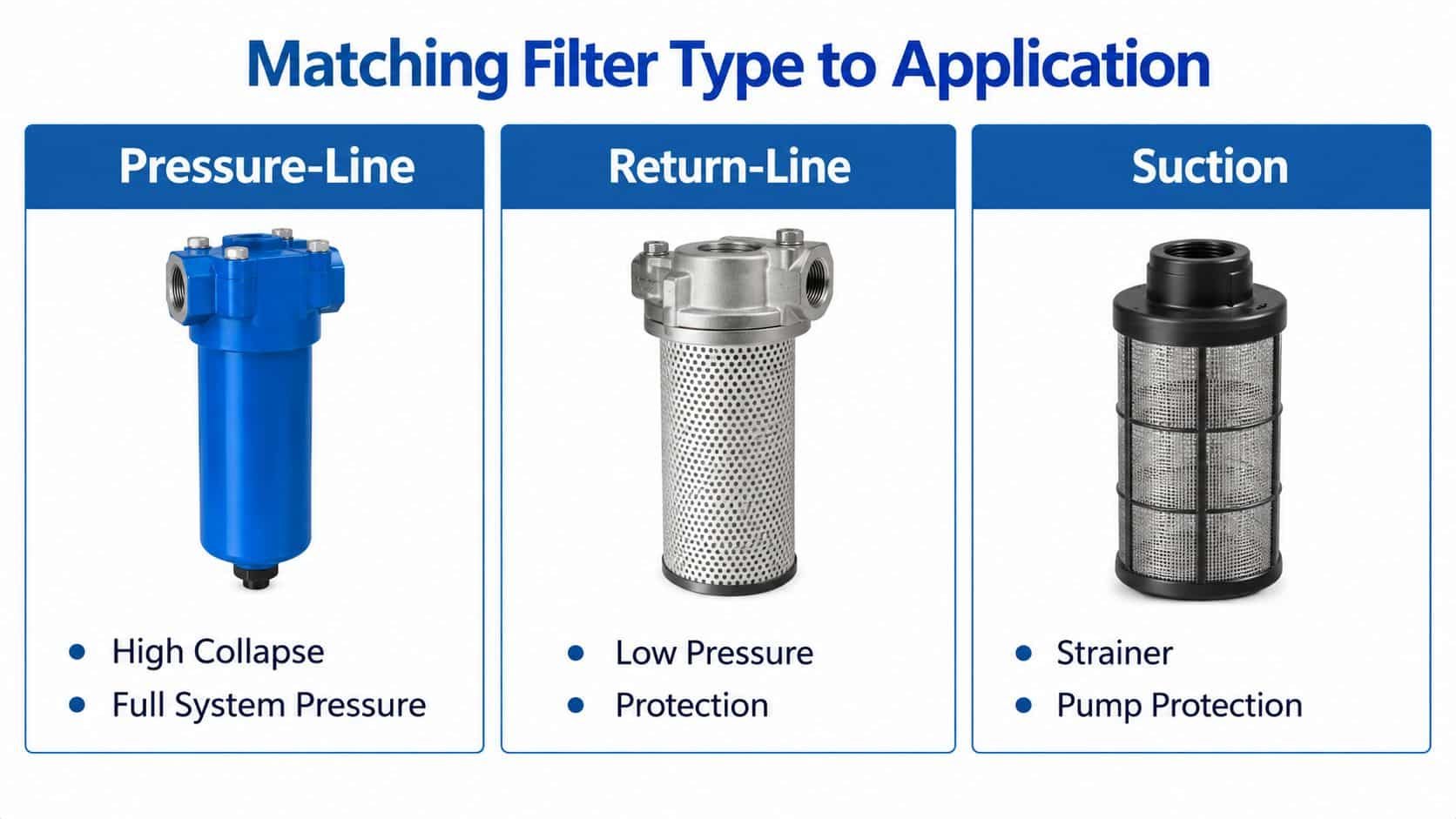
Spin-on canisters are common on mobile plant return circuits, including equipment from JCB, Komatsu and Caterpillar. Engineers often start with thread and gasket checks, but those checks only establish whether the canister can be installed.
Suction strainers protect the pump inlet. This is the category where a tighter element can create trouble, because excessive restriction can starve a gear or piston pump. Match the strainer to inlet flow and allowable pressure loss rather than chasing the smallest particle rating.
Offline kidney-loop and flushing rigs call for a different decision. Select absolute-rated glass elements with documented multi-pass results, then confirm the element can handle the flow and fluid used by the cleaning circuit.
The same disciplined thinking applies beyond oil circuits. An engineer's water filtration advice is useful background when comparing flow, media and contamination objectives, but hydraulic fluid compatibility and pressure conditions must remain the controlling criteria.
Worked Example of a UK Cross Reference
An engineer in Sheffield has a Donaldson P171504 spin-on return-line filter on a 250-litre power pack. The label records β10(c) = 200, 25 µm absolute, an NBR seal, a 1-1/2" BSP thread and a 3 bar bypass. A proportional valve downstream requires ISO 4406 18/16/13 cleanliness.
The engineer doesn't approve the first catalogue match. The decision follows four checks:
- Performance: Confirm that the Donaldson code represents a 25-micron absolute glass element with multi-pass certification to ISO 16889.
- Bypass: Confirm that the replacement retains the 3-bar setting required by the return circuit.
- Fit: Match the BSP thread, gasket outside diameter, element length and endcap geometry.
- Evidence: Require an ISO 16889 test report from the selected brand, not a nominal micron claim.
Potential catalogue candidates include the Mann W1294, Hengst E131H and Filtrec R122G25. They're only candidates until their technical documents demonstrate the same performance and mechanical characteristics. The engineer then logs the chosen brand, report reference and installation details.
| Brand | Part Number | β10(c) @ 25µm | Seal | Bypass (bar) | ISO 16889 Report |
|---|---|---|---|---|---|
| Donaldson | P171504 | 200 | NBR | 3 | Required |
| Mann | W1294 | 200 benchmark to verify | NBR to verify | 3 to verify | Required |
| Hengst | E131H | 200 benchmark to verify | NBR to verify | 3 to verify | Required |
| Filtrec | R122G25 | 200 benchmark to verify | NBR to verify | 3 to verify | Required |
A cleanliness sample is pulled at 40 hours after installation to check whether the target is being maintained. The important point isn't that a table offers four names. It's that the engineer verifies the chosen product against the application before fitting it.
OEM and Aftermarket Equivalents Worth Knowing
British power units, mobile plant and process machinery frequently carry filter brands such as Donaldson, Parker, Bosch Rexroth, Mahle, MP Filtri, Hydac and Mann. Their codes can help identify a family of elements, but brand recognition doesn't remove the need for validation.
OEM elements usually have the clearest application history. A reputable aftermarket element can be suitable when its test evidence, materials and dimensions are documented. An unbranded element may fit the same head while offering no reliable batch traceability or accessible BS ISO 16889 performance data.
| OEM Brand | Common Part Prefix | Aftermarket Equivalent | Validation Note |
|---|---|---|---|
| Donaldson | P | Supplier-specific code | Check beta ratio, seal and bypass |
| Parker | PR or related series | Supplier-specific code | Confirm media and pressure performance |
| Bosch Rexroth | R or housing-family code | Supplier-specific code | Match endcap and collapse rating |
| Mahle | Element-family code | Supplier-specific code | Verify fluid compatibility |
| MP Filtri | Family-specific code | Supplier-specific code | Confirm dimensions and flow |
| Hydac | D or housing-family code | Supplier-specific code | Check test report and bypass |
| Mann | W or family-specific code | Supplier-specific code | Validate against the original data sheet |
Run this five-point approval process:
- Read the multi-pass report: Confirm beta performance at the same particle size.
- Check collapse resistance: Compare the element with pressure transients, not only nominal working pressure.
- Confirm the seal compound: NBR and FKM are not interchangeable by assumption, and EPDM has its own compatibility limits.
- Inspect geometry: Endcaps, centre tubes, length and gasket seating must match.
- Test before commissioning: Pressure-test the housing and check for leakage once installed.
A same-fitting element with lower capture efficiency is not a direct replacement. It's a different component in the same envelope.
Cleanliness Codes and the Real Cost of the Wrong Element
ISO 4406 codes describe particle populations in three size bands, not a vague “clean” or “dirty” condition. Common UK guidance uses 19/17/14 for baseline systems and 16/14/11 where contamination sensitivity is higher. The code 19 corresponds to 2,500 to 5,000 particles per millilitre in its relevant band, while code 11 corresponds to 10 to 20 particles per millilitre. The figures and interpretation are set out in the BS ISO 16889:2022 reference document.
For practical selection, target codes must match the component. Guidance commonly maps gear pumps and gear motors to 20/18/15, fixed-displacement pumps to 19/17/14, and variable vane or piston pumps to 18/16/13. A proportional valve circuit may therefore need a tighter cleanliness strategy than a basic gear pump circuit.
Contamination has a direct engineering cost. UK supplier guidance citing British Fluid Power Association material states that particle contamination above 19/17/14 can raise component wear by 300 to 400%, while maintaining cleanliness below 16/14/11 can extend gear pump and valve life by 25 to 30%. Those figures are why a lower-performing element is not a harmless purchasing choice.
| ISO 4406 Code | Particles per ml >4µm(c) | Pump Wear Reduction | Typical Component Cost Impact |
|---|---|---|---|
| 19/17/14 | 2,500 to 5,000 in the relevant 19 band | Higher wear risk above target | More contamination-related intervention |
| 18/16/13 | Code target for sensitive circuits | Better control required | Protects proportional components |
| 16/14/11 | 10 to 20 in the relevant 11 band | Lower contamination exposure | Supports sensitive equipment life |
The cheaper element may have the wrong beta ratio, causing more particles to reach pump surfaces and valve spools. Treat cleanliness as a budget decision, not a marketing phrase.
Maintenance Intervals and Differential Pressure Triggers
Change elements by differential pressure and operating evidence, not by colour or habit. Oil darkening doesn't tell you whether the media is loaded, and a clean-looking element can still have the wrong performance.
A practical maintenance template uses a 5 bar dirty-filter alarm and an 8 bar collapse margin, provided those values suit the housing and manufacturer's limits. For a 200 bar press, 350 bar mobile rig or 70 bar power pack, the engineer must compare the element's collapse rating with the actual system pressure and transient conditions. A lower-rated aftermarket element can fail during a cold start even when the steady-state gauge reading appears acceptable.
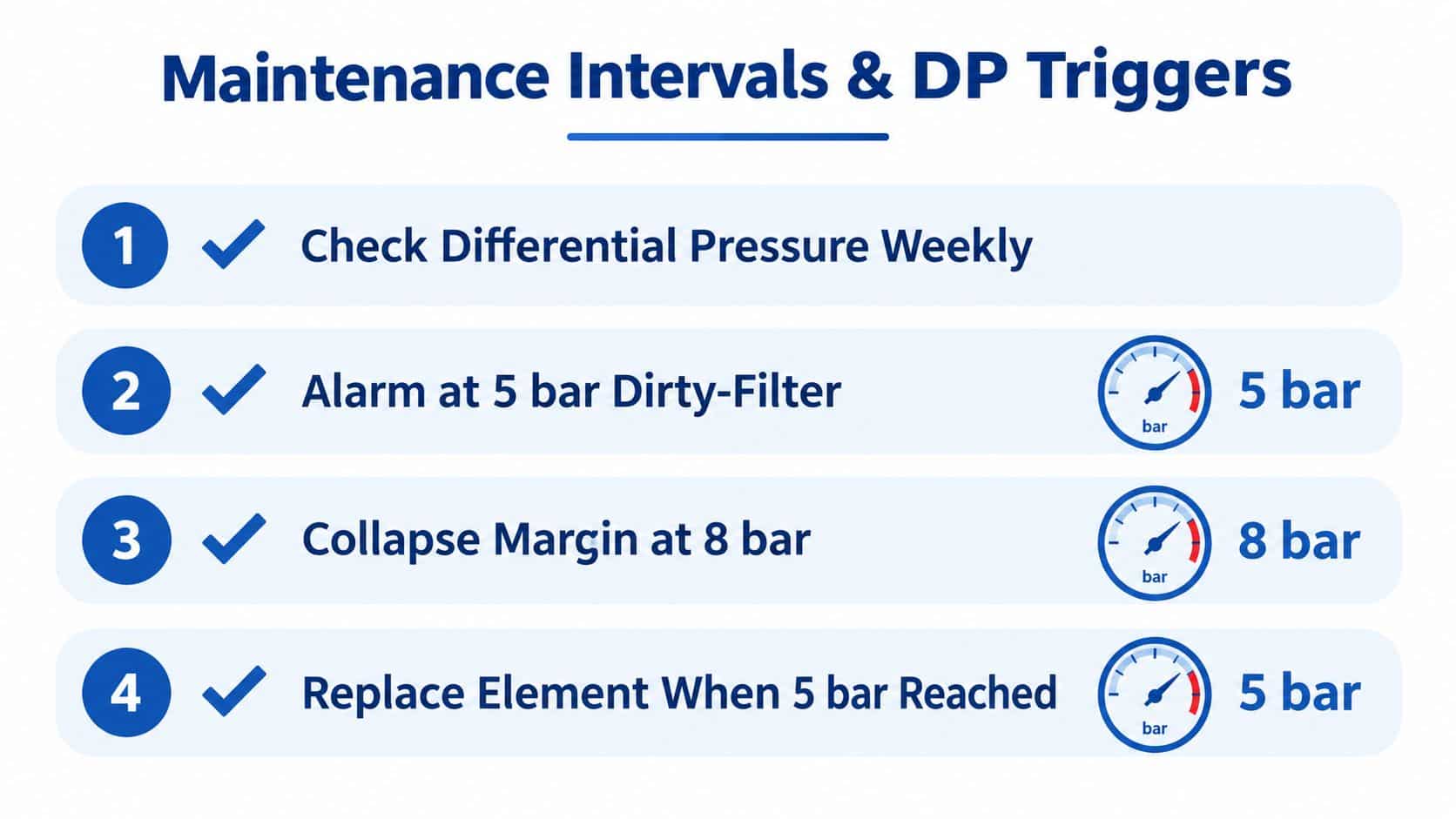
Use the indicator at working temperature and rated flow. A pressure switch, visual indicator or transmitter should be checked under the conditions that load the element, not only with the machine idling.
| Duty cycle | Inspection approach | Change decision |
|---|---|---|
| Factory three-shift running | Frequent indicator checks during planned rounds | Change at the specified differential-pressure trigger |
| Construction mobile plant | Inspect around heavy or dusty work | Investigate rapid loading before fitting another element |
| Marine deck machinery | Check with duty and fluid temperature recorded | Confirm salt, water and seal compatibility |
| Cold-store operation | Inspect after cold starts and warm running | Watch for viscosity-driven pressure spikes |
The maintenance log should record the code at change, the reason for removal and whether the next interval needs adjustment. Teams looking to extend equipment life with preventive care should apply the same discipline to filter indicators as they do to pumps and actuators.
Cross Reference Decisions for Smart and Predictive Systems
A smart hydraulic power pack changes the cross-reference question. The replacement must still fit and filter correctly, but it may also need to work with a differential-pressure transmitter, particulate counter or CAN-bus monitoring system.
The useful model is a closed loop. Sensor data shows how the element behaves in an actual machine, while particulate counts show whether the stated beta performance is delivering the required oil cleanliness. CAN-bus integration can place pressure, temperature and alarm data into the maintenance record, allowing engineers to compare element loading with duty conditions.
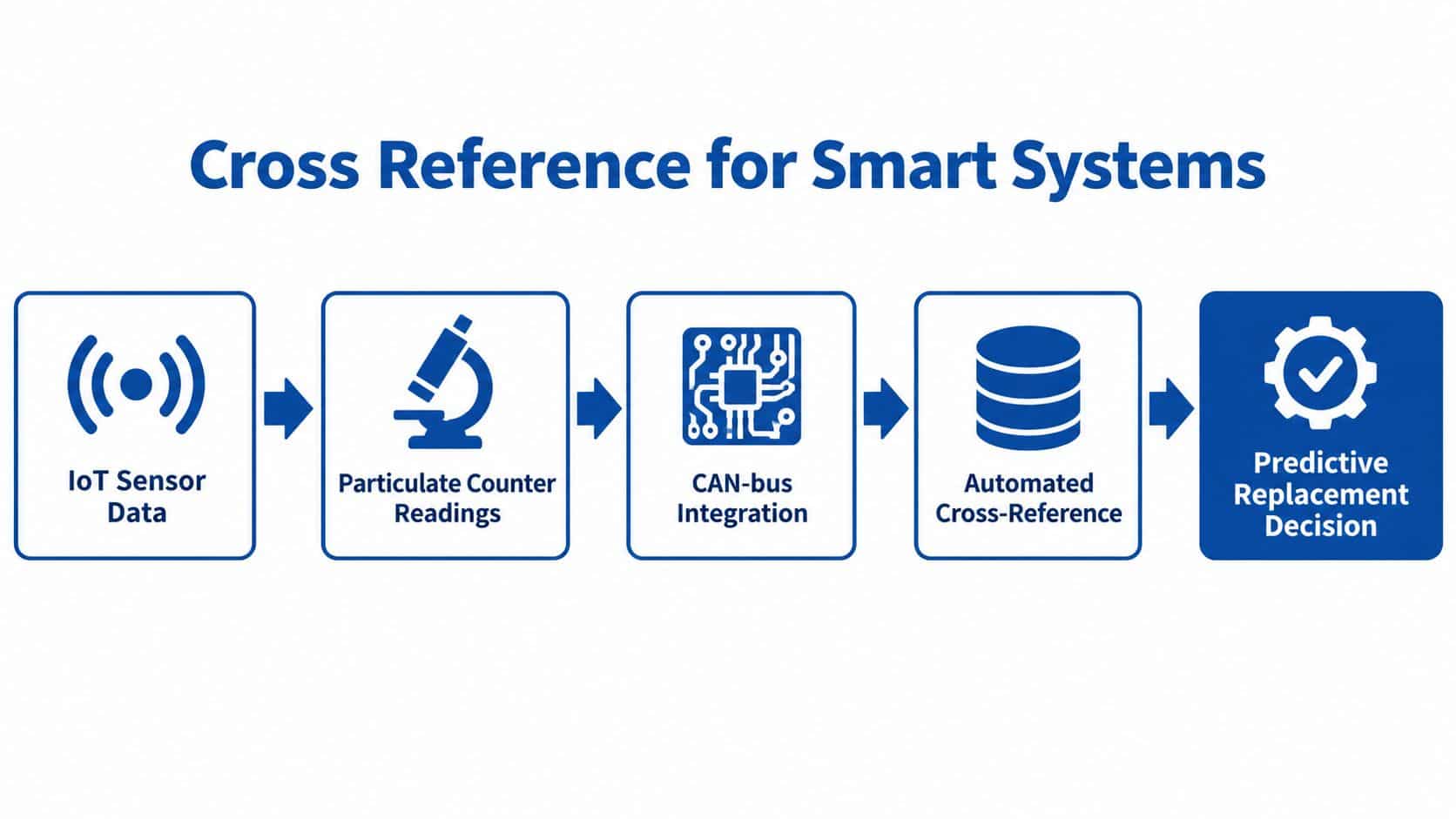
That evidence changes procurement in three ways:
- Media selection: Choose an element whose beta performance remains suitable during the contamination conditions recorded by the machine.
- Pressure stability: Confirm collapse and bypass behaviour when a sensor detects a loading event or cold-start upset.
- Auditability: Keep the report, batch details, alarm history and cleanliness samples together.
A downstream valve failure is a reason to re-examine the cross-reference, not just replace the same low-cost element. The engineer should ask whether the cleanliness target was adequate, whether the element bypassed early and whether the sensor threshold gave enough warning.
Market coverage describes predictive maintenance, IoT-enabled monitoring, smart hydraulic systems and self-cleaning filters as drivers in UK hydraulic filtration. One projection values the UK hydraulic filtration equipment market at USD 0.5 billion in 2024 and projects USD 0.8 billion by 2033, with approximately 4.1% CAGR. These are projections from UK hydraulic filtration equipment market coverage, not a reason to buy a smart filter without checking the fundamentals.
The sound decision ties consumable cost to uptime, pump warranty exposure and the audit trail expected in regulated maintenance. Predictive replacement works only when the element itself is properly identified.
Quick Reference Card for UK Engineers
Keep this beside the spares drawer. It gives you the minimum information needed before a prospective equivalent reaches the requisition stage.
Use the BS ISO 16889:2022 beta scale as the performance language. Report βx(c) at the particle size that matters to the circuit, and check whether the supplier provides a result at βx(c) ≥ 75, 100 or 1000 where that class is specified. Don't accept “absolute” without the corresponding test evidence.
Use the ISO 4406 target for the system, not the filter seller's preferred rating. Common UK guidance includes 18/16/13 for sensitive variable pump circuits, 19/17/14 for fixed-displacement pump applications and 20/18/15 for gear pumps and gear motors. The right target depends on the components, duty and contamination-control plan.
| Spec Field | Acceptable Value / Range | Red Flag to Reject |
|---|---|---|
| Test method | BS ISO 16889:2022 multi-pass data | Unverified beta claim |
| Beta ratio | Reported βx(c) at stated particle size | “Absolute” with no test basis |
| Cleanliness target | Matched to the machine’s ISO 4406 requirement | Generic “fine” or “coarse” label |
| Connection | BSPP, UNF, SAE O-ring boss or specified flange | Thread pattern changed without approval |
| Seal | NBR, FKM, EPDM or other compound verified for fluid | Seal compound substituted silently |
| Collapse rating | Suitable for system pressure and transients | Missing collapse information |
| Bypass | Correct setting, tolerance and flow direction | Unconfirmed bypass valve |
| Geometry | OD, ID, length, endcap and gasket all matched | Thread-only match |
| Integrity | ISO 2941, ISO 2942 and ISO 2943 evidence where required | No structural or compatibility data |
| Change-out | Based on differential pressure and operating evidence | Calendar-only or colour-only change |
Before signing, cross-check the housing code, micron statement, beta ratio, seal kit, bypass setting and pressure data. If any one of those is missing, the part is not yet an approved equivalent.
For a standards-led hydraulic filter cross reference, contact MA Hydraulics Ltd on 01724 279508 with the old element, housing details and machine duty; the team can help identify replacement elements and hard-to-find matches for UK mobile and industrial systems. You can also visit MA Hydraulics Ltd or send a message today for application advice before ordering.
