

You've got a hydraulic machine down, the old element is on the bench, and the catalogue is asking for a “size”. Length, diameter or micron rating? In practice, none of those answers is enough on its own. A replacement can fit the bowl perfectly and still force the system into bypass on a cold Scunthorpe morning, or fail to protect a sensitive valve because its advertised rating is only nominal.
This guide treats hydraulic filter element by size as an engineering decision, not a catalogue search. It covers the metric dimensions, cleanliness targets, media choices, flow capacity and test standards that determine whether an element will work in a UK mobile or industrial circuit.
What Hydraulic Filter Element by Size Really Means
A hydraulic element's size is four decisions joined together. Micron rating determines the particle size it is intended to retain. Physical envelope determines whether it fits the housing. Dirt-holding capacity determines how long it can operate before restriction rises. Test standard determines whether the efficiency claim is meaningful.
Take a typical mobile excavator return loop moving 25 L/min. A 10 µm absolute spin-on element may appear suitable, but the decision changes if the machine starts at -5°C, the bypass valve opens at 2.5 bar, and the cleanliness target is 18/16/13 under ISO 4406. Cold oil creates a much higher initial pressure drop. If the element has too little surface area, the bypass opens before the oil reaches operating temperature.
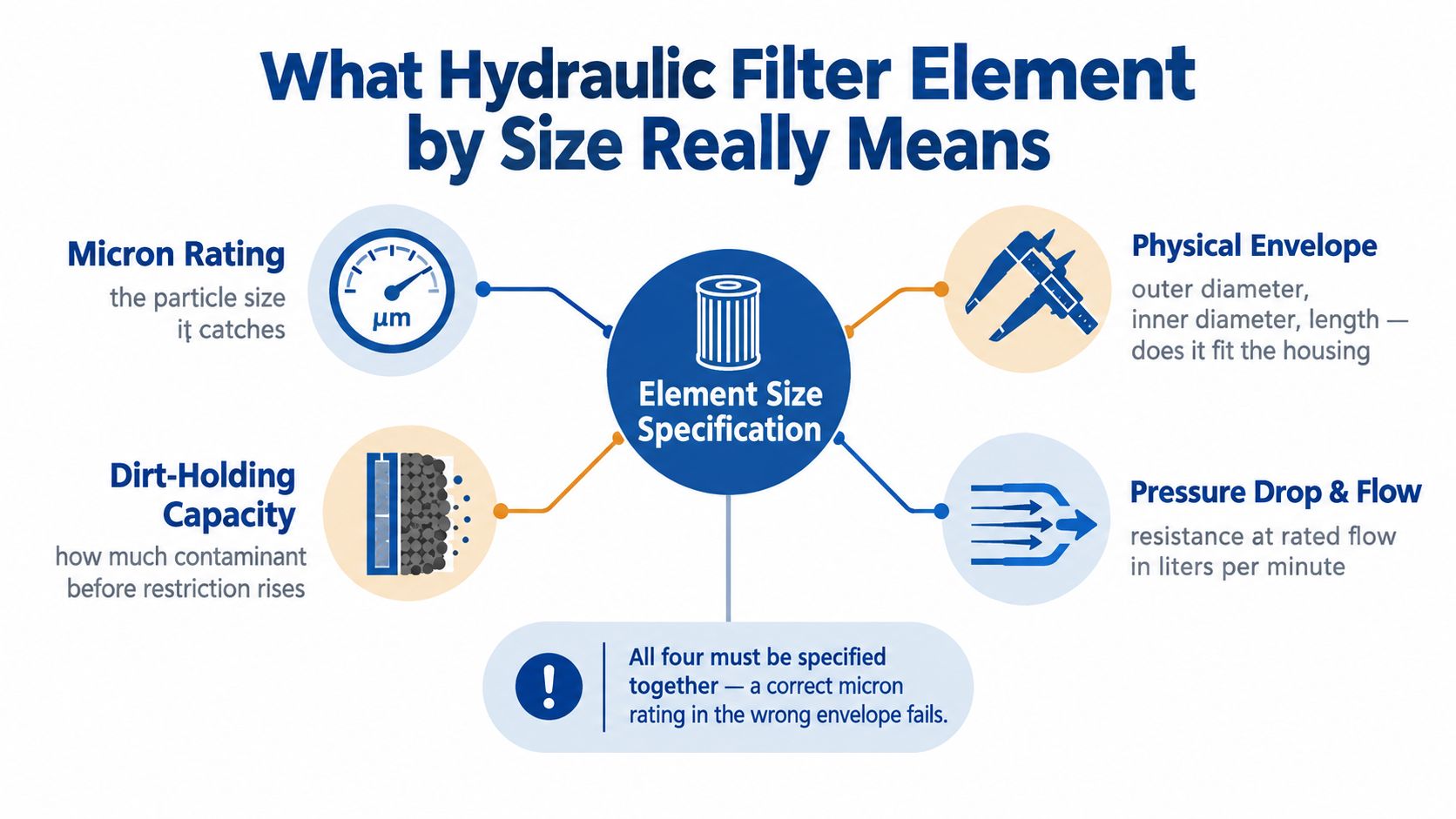
The four checks that matter
-
Choose the cleanliness target first. ISO 4406 uses particle bands larger than 4 µm(c), 6 µm(c) and 14 µm(c) per millilitre. UK technical guidance commonly matches component sensitivity to target codes and filter ratings, rather than selecting a rating from flow alone. (MA Hydraulics' hydraulic filter selection guide)
-
Confirm the envelope. Measure length, outside diameter, inside diameter and end-cap arrangement. A part number normally describes geometry. It doesn't prove that the media, bypass behaviour or collapse resistance suits your circuit.
-
Check capacity at real operating conditions. Compare rated flow, clean pressure drop, loaded pressure drop, cold-start viscosity and bypass setting. The larger element is often the safer choice when the housing allows it.
-
Verify the test method. BS ISO 16889:2022 is the UK implementation used for hydraulic filter testing. ISO 16889:2022 evaluates performance across multiple particle sizes, so a single unqualified micron figure tells you very little. (Atos' ISO 16889 technical document)
Practical rule: A catalogue number tells you what fits. A proper sizing decision tells you what protects the machine.
Core Physical Dimensions Used in the UK Market
Before ordering, take three physical measurements from the old element, then identify the end-cap configuration. Length, outside diameter and inside diameter form the basic metric envelope, but the end cap determines whether the element will seat and seal correctly.
For elements up to 250 mm long, suppliers commonly quote length to the nearest whole millimetre. UK market examples include outside diameters around 44 mm, 64 mm, 78 mm, 95 mm and 130 mm for spin-on cartridge formats. The inside diameter is usually dictated by the centre tube, locating spigot or end-cap design, not by a general user preference.
| Dimension | Typical Metric Range | Notes for UK Buyers |
|---|---|---|
| Length | Up to 250 mm in common replacement formats | Measure tip-to-tip, including end caps. |
| Outside diameter | Around 44 to 130 mm | Confirm clearance inside the bowl and around the centre tube. |
| Inside diameter | Housing-specific | Match the locating post and seal land, not just the nominal bore. |
| End cap | DOE, SOE or skirted | The sealing arrangement must match the housing. |
| Overall envelope | Application-specific | Allow for springs, retainers and bypass components. |
A double-open end, or DOE, has open ends and typically works with flat gaskets or sealing interfaces. A single-open end, or SOE, uses one open end with a threaded boss, plug or locating feature. Skirted versions are used where the housing needs a non-standard guide or sealing arrangement. They aren't interchangeable because the length and diameter look right.
Use the housing model and its installation details alongside the element measurements. MA Hydraulics provides hydraulic filter housing information for buyers checking the relationship between the bowl, element and circuit requirements.
The dangerous measurement is the one taken only once. An element that sits within 1 mm of the housing length can leave little room for thermal movement, end-cap tolerance or spring compression. In cold conditions, 32-grade oil can exceed 180 cSt, increasing restriction and moving the element closer to its bypass setting. Measure the old part, inspect the seating faces and confirm the available internal length before choosing a longer replacement.
Common Size Families and Dimensional Ranges
UK hydraulic workshops tend to encounter a small number of practical size families. The exact part numbers vary, but the physical groupings are familiar across agricultural machinery, construction plant and factory equipment.
| Size Family | Length (mm) | OD (mm) | Typical UK Application |
|---|---|---|---|
| Small inline | Up to 150 | 44 to 64 | Compact mobile circuits and auxiliary lines |
| Mid-range spin-on | 150 to 250 | 64 to 95 | Return-line filtration on tractors and construction plant |
| Large return-line | 250 to 500 | 95 to 130 | Industrial return circuits and higher-capacity mobile systems |
| High-pressure inline | Up to 600 | Housing-specific | Pressure lines with steel end caps and housings rated up to 420 bar |
The 250 mm × 64 mm combination is a common request from UK agricultural and construction workshops because it fits many return-line bowls without an adaptor ring. It still needs checking against the actual centre tube, gasket arrangement, flow direction and bypass assembly. “Standard size” is only useful once those interfaces match.
Longer elements above 400 mm are more often found in fixed industrial skids than mobile machines. They offer more media area and dirt-holding capacity, but transport clearances, vertical access and bowl length become practical constraints.
Brand cross-referencing is usually straightforward when the geometry and performance specification are held constant. Donaldson, Pall, Hydac, Bowman and MP Filtri all offer families that can overlap dimensionally, but the same length and outside diameter don't guarantee identical media or collapse resistance.
Catalogue warning: Treat a size family as a starting point, not proof of interchangeability. The end cap and performance data decide whether the replacement is safe.
Micron Rating by Component Sensitivity
A filter's micron figure is only one part of the sizing decision. Match the rating to the component, then verify the element's physical envelope, housing capacity and test standard. A nominal rating may retain a stated proportion of particles at its quoted size. That can suit a return line with gradual loading, but it is not enough evidence for a pressure line feeding a proportional or servo valve.
For sensitive circuits, specify an absolute rating supported by a multi-pass test and a published beta ratio. Look for performance at the stated particle size under a recognised method such as ISO 16889. Beta 100 and beta 1000 describe different efficiency levels, so catalogue figures carrying those labels must not be compared as equivalent.
ISO 4406 expresses fluid cleanliness across three particle bands. A code value of 11 corresponds to 10 to 20 particles/ml, 14 to 80 to 160 particles/ml, and 19 to 2,500 to 5,000 particles/ml in the relevant band. Use the UK hydraulic filter selection guidance when checking the cleanliness target against the circuit.
| Component / Duty | Recommended ISO 4406 | Nominal Micron | Absolute Micron (β ≥ 1000) |
|---|---|---|---|
| General return line | 17/15/12 | 25 µm | 10 µm |
| Proportional valve circuit | 16/14/11 | 10 µm | 6 µm |
| Closed-loop servo circuit | 15/13/10 or cleaner | 6 µm | 3 µm |
| Gear pump or gear motor protection | 20/18/15 | 20 µm | 10 µm |
| Variable vane or piston pump | 18/16/13 | 10 µm | 5 µm |
Absolute ratings are verified by multi-pass testing to a stated beta ratio. Nominal ratings are manufacturer claims without a published beta value.
Treat these figures as selection benchmarks, then confirm the machine manufacturer's target. Gear pumps and gear motors are commonly associated with 20/18/15 and 20 µm, fixed-displacement pumps and some actuators with 19/17/14 and 10 µm, variable vane and variable piston pumps with 18/16/13 and 5 µm, and servo valves or hydrostatic drives with 16/14/11 and 3 µm.
Cold starts change the result. Fluid viscosity can become two to three times higher, raising pressure drop and temporarily reducing effective filtration performance. For a UK winter yard, select an element with sufficient area and bypass margin, or require cold-viscosity pressure-drop data for the actual flow before accepting the catalogue rating.
Filter Media and How It Shapes Available Sizes
Media choice sets the available micron classes, flow resistance and physical envelope. You can't specify a fine rating first and assume every housing will support it at the required flow.
| Media type | Common micron classes | Dirt-holding and cleanability |
|---|---|---|
| Bonded fibre | 3, 6, 12 and 25 µm | Fine filtration options, with performance tied closely to construction and testing |
| Bonded polyester fibre | 25, 50 and 100 µm | Coarser duties where flow and capacity matter |
| Sintered stainless fibre | 5, 10 and 15 µm | Robust metallic media for demanding applications |
| Stainless steel woven mesh | 5 to 1000 µm | Cleanable and reusable where the housing and fluid permit |
| Wound fibre or yarn | Application-specific depth grades | Low-cost depth filtration, with capacity shaped by winding density |
UK supplier data shows discrete options such as 3, 6, 12 and 25 µm for bonded fibre, 25, 50 and 100 µm for bonded polyester fibre, 5, 10 and 15 µm for sintered stainless fibre, and woven mesh from 5 to 1000 µm. (D&G Filters hydraulic filter element range)
That matters because a finer media normally needs more effective area to carry the same flow without excessive pressure loss. A compact cellulose element might fit physically, but a synthetic fibre replacement at a finer rating may need a longer body or larger diameter. If you force the fine media into a small envelope, the bypass indicator will tell you what the catalogue didn't.
Cellulose remains a practical choice for less demanding return duties where cost and general contaminant retention matter. Synthetic fibre is the usual route when component sensitivity and cleanliness targets demand finer, more consistently tested performance. Stainless mesh earns its place where cleanability, fluid compatibility or repeated service matters, but it isn't a universal substitute for absolute depth media.
Why a Bigger Element at the Same Micron Often Wins
The smallest element that fits isn't automatically the economical choice. It may have a lower purchase price, but a larger element with the same micron rating normally gives the fluid more media area and lowers face velocity. That reduces clean pressure drop and gives the element more room to hold contaminant before the bypass setting becomes relevant.
Cold-start behaviour makes this particularly important in UK mobile plant. ISO VG 32 oil at 200 cSt creates a difficult start-up condition, especially on a Yorkshire morning. A short element can restrict heavily while the fluid is cold, then appear perfectly acceptable once the machine has warmed up. If the bypass opens during those first minutes, unfiltered oil reaches the protected circuit.
A larger element doesn't make the oil “cleaner” merely because it is larger. Keep the micron rating, beta ratio and test method consistent. The gain comes from capacity and lower resistance.
The better upgrade is often more surface area, not a finer rating. Upsize the element before tightening the micron rating, provided the housing, seals and bypass assembly support the change.
Parker's UK filtration guidance stresses the need to consider maximum flow, cold viscosity, clean and loaded pressure drop, bypass setting and collapse resistance, rather than relying on nominal micron rating alone. (Parker filtration guide FDHB200UK)
A physically larger housing can be the right answer when a machine repeatedly trips its indicator, starts sluggishly or spends too much time in bypass. Don't assume that a smaller replacement saves money. The actual cost sits in contaminated oil, damaged pump surfaces, valve sticking and avoidable downtime.
Measuring an Existing Element and Reading Its Code
Remove the old element and measure it before it goes into the waste container. A dirty part still carries useful evidence about restriction, media loading and possible component wear.
Bench measurement procedure
- Clean the reference surfaces: Wipe the end caps and sealing faces with a lint-free cloth. Dirt on the cap can distort the reading.
- Measure length: Place the element vertically and measure tip-to-tip, including both end caps.
- Check outside diameter: Use vernier calipers at the top, middle and bottom. Three readings can reveal swelling or ovality.
- Check inside diameter: Measure the open bore and compare it with the housing centre post or locating spigot.
- Record the end cap: Note DOE, SOE, threaded boss, plug, skirt, gasket land and any spring retainer.
- Photograph the part: Take one image lying flat and another standing upright, with the code visible.
Don't squeeze pleats with the calipers. You're measuring the uncompressed envelope, not the media under hand pressure.
Read the specification, not only the brand
Look for the original part code, media designation, micron rating and collapse rating on the metal can or end cap. Then compare those details with the supplier datasheet. UK replacement listings show that element identification can combine micron ratings such as 10 µm and 20 µm, physical lengths including 94.5 mm, 115 mm and 208.5 mm, diameters such as 35 mm and 80 mm, flow capacities up to 315 L/min and maximum operating pressure up to 420 bar. (RS UK replacement hydraulic filter elements)
Inspect the old part for pleat collapse, glue failure, swelling, metal fatigue or unusual metallic debris. Those signs may point to excessive differential pressure, incompatible fluid, incorrect support or a failing pump. Replacing the element without checking the cause risks repeating the failure.
Cross-Referencing Sizes Across Brands and Legacy Equipment
A safe cross-reference matches five things, not one. Start with the original code, then verify physical geometry, end-cap design, micron rating and performance under the system's pressure and flow conditions.
Donaldson, Pall, Hydac, MP Filtri and Sofima elements can often be compared across overlapping size families. That doesn't make their codes automatically interchangeable. Confirm the collapse pressure, beta ratio, flow direction, seal material and bypass arrangement before approving a substitute.
For older UK plant, BS 4580 size references and earlier Stauff or Vickers identifiers may still appear in service records. Treat those references as search keys. The current element must still match the actual housing and the cleanliness requirement.
| Size Family (L x OD) | Donaldson | Pall | Hydac | MP Filtri | Legacy UK Code |
|---|---|---|---|---|---|
| Small inline | Confirm by housing series | Confirm by housing series | Confirm by housing series | Confirm by housing series | BS 4580 family reference |
| Mid-range spin-on | Match length and end cap | Match length and end cap | Match length and end cap | Match length and end cap | Stauff or Vickers reference |
| Large return-line | Verify bowl and centre post | Verify bowl and centre post | Verify bowl and centre post | Verify bowl and centre post | Original plant code |
| High-pressure inline | Confirm steel end caps and rating | Confirm pressure series | Confirm pressure series | Confirm pressure series | Legacy OEM identifier |
The practical decision matrix should record the circuit location, target ISO 4406 code, micron rating, length, outside and inside diameters, end cap, flow, pressure, clean pressure drop, loaded pressure drop, bypass setting and collapse resistance. That matrix prevents a dimension-only match from being fitted to a servo or proportional system where the media is wrong.
For maintenance teams building a repeatable replacement process, an organised 90-day SEO action plan offers a useful example of how structured information can be turned into a practical workflow. The same principle applies at the filter store. Record the specification once, then make every future cross-reference against the recorded evidence.
Installation and Replacement Practice for UK Sites
Change the element with the system depressurised and cool. Isolate the filter, shut down the power source, relieve stored pressure and drain the housing into a clean tray. Don't rely on a warning light alone, because a trapped accumulator or isolated section can still hold pressure.
A clean change-out sequence
- Isolate the housing: Close isolation valves where fitted and verify zero pressure.
- Drain the bowl: Use the drain point and keep the tray clean enough to inspect the oil.
- Inspect the seal: Replace the bowl O-ring at every change. Lubricate the new seal with clean compatible hydraulic fluid.
- Remove the old element: Lift it straight out without dragging debris across the clean side.
- Clean the housing: Use a lint-free cloth and clean hydraulic fluid. Avoid leaving fibres behind.
- Fit the replacement: Check the end-cap orientation and flow arrows. It should seat without force.
- Tighten correctly: On many spin-on cans, 25 to 35 Nm is a practical range, but the housing stamp or manufacturer specification takes priority.
- Bleed and test: Refill as required, bleed air from the return line, start the machine and check for leaks.
UK service intervals vary with contamination, circuit location and indicator readings. Typical guidance places suction elements at 500 to 1000 hours and return elements at 1000 to 2000 hours, while pressure elements should be changed when indicator trips and inspection confirms loading. (MA Hydraulics' kidney loop filtration guidance)
Log operating hours, element code, bypass events and ISO 4406 samples. A filter store that records only the date of replacement leaves the next engineer guessing. A record that includes differential pressure and cleanliness trend gives you a defensible interval.
A Worked Example From a Mobile Plant Service
A 14-tonne excavator in a West Midlands hire fleet arrived with a warning light and poor pump response. The machine had a compact spin-on housing containing a 10-micron nominal element. On cold mornings, oil viscosity moved past 180 cSt, the internal bypass opened and unfiltered oil reached the gear pump.
A sample taken after 120 hours showed 22/19/16 under ISO 4406. The first instinct was to fit a finer element. That would have been the wrong correction. A finer rating in the same compact envelope would have increased cold-start restriction and caused the bypass to open earlier.
The workshop instead fitted a physically larger cartridge in the same 10-micron nominal class, using a longer element and larger outside diameter within the available bowl arrangement. The technicians confirmed the end-cap geometry, checked the cross-reference data and verified that the housing could accept the increased envelope.
What changed
Cold-start pressure drop fell and the bypass stayed closed. Over a 500-hour cycle, ISO 4406 stabilised at 16/18/14. Those results describe this representative service scenario and should not be treated as a guaranteed outcome for another machine.
The lesson is simple. Start with the housing envelope, but don't stop there. Confirm the end-cap code, check the flow and cold-viscosity pressure drop, then match the micron and beta performance to the component being protected.
Workshop diagnosis: If the warning light appears mainly during cold starts, investigate element capacity and bypass behaviour before choosing a finer rating.
Quick Reference Card for Sizing Decisions
Keep this lookup beside the filter store or in the service van. It turns a vague request for “the same size as last time” into a specification another engineer can verify.
| Sizing Decision | Typical Range or Target | UK Context |
|---|---|---|
| Micron rating | 3 to 25 µm common fine-element classes | Match the component and ISO 4406 target |
| Physical envelope | Length, OD, ID and end cap | Measure the old element and housing |
| Housing capacity | Flow, viscosity, pressure drop and bypass | Check cold starts and transient flow |
| Test standard | BS ISO 16889:2022 / ISO 16889:2022 | Compare multi-size test data |
| Small inline family | Up to 150 mm length, 44 to 64 mm OD | Compact mobile and auxiliary circuits |
| Mid-range spin-on | 150 to 250 mm length, 64 to 95 mm OD | Common agricultural and construction return lines |
| Large return-line | 250 to 500 mm length, 95 to 130 mm OD | Higher-capacity and industrial circuits |
| High-pressure inline | Up to 600 mm length | Verify housing pressure and steel end caps |
| ISO 4406 reference | 20/18/15 to 16/14/11 examples | Use the component manufacturer’s target |
| End-cap | DOE, SOE or skirted | Geometry and seal arrangement must match |
Two-minute bench checklist
- Measure: Length, outside diameter and inside diameter.
- Identify: DOE, SOE, threaded, plugged or skirted end cap.
- Confirm: Micron rating, beta ratio, media and collapse resistance.
- Calculate: Flow, cold viscosity, clean pressure drop and bypass margin.
- Record: Element code, operating hours, indicator events and oil sample result.
A correct hydraulic filter element by size is the one that satisfies all four decisions. If one field is blank, the order isn't ready.
Frequently Asked Questions on Sizing
What does a common UK element cost?
Price depends on whether you need a spin-on cartridge, a standard replacement element or a large industrial housing assembly. Obtain a GBP quotation excluding VAT for the exact code and specification. OEM-branded equivalents often carry a premium, while a verified cross-reference may offer a more practical route.
How often should I change it?
Don't use a fixed interval as the only trigger. Follow the differential pressure indicator, inspect the used media and trend ISO 4406 results. Mobile plant commonly operates between 250 and 1000 hours between changes, depending on duty, contamination and circuit location.
Can I mix brands?
Yes, if the replacement matches the end-cap code, dimensions, media type, micron rating, beta performance, bypass arrangement and collapse resistance. Check OEM service agreements before fitting a non-original element, particularly where warranty or documented maintenance requirements apply.
When should I upsize?
Upsize when cold-start bypass is visible, when the element loads rapidly, or when a finer absolute rating is needed but the existing small envelope produces too much pressure drop. Keep the same physical interface where possible, then verify that the longer or wider element has adequate clearance and compatible seals.
MA Hydraulics Ltd helps UK engineers identify replacement elements by micron rating, dimensions, flow, pressure, cleanliness target and bypass behaviour, including cross-references for legacy equipment. Visit MA Hydraulics Ltd with your original element code or housing measurements, phone 01724 279508 today, or send us a message for sizing support.
