
Preventive maintenance is a planned, scheduled approach to inspecting, servicing and replacing equipment components before they fail, designed to reduce unplanned downtime and extend asset life. The National Audit Office identified a minimum UK government estate maintenance backlog of £49 billion, showing what happens when essential work is repeatedly deferred.
That figure, published in January 2025, represents work that should already have been completed. The lesson applies just as strongly to a hydraulic power pack, press, mobile machine or production line as it does to a public building: a small, controlled intervention is usually easier to manage than a failure that arrives during production, damages connected components and creates an urgent hunt for parts and labour. Preventive maintenance gives plant managers and MRO teams a repeatable way to control that risk.
Understanding Preventive Maintenance in Industrial Settings
In practical terms, preventive maintenance means doing known maintenance work before failure, using a calendar, operating hours, cycle count or observed equipment condition to decide when action is due. Typical work includes inspection, cleaning, lubrication, fluid checks, filter replacement, seal inspection and functional testing.
Take a hydraulic power pack serving a production line. A reactive team might wait until the pump loses pressure, the oil overheats or a valve sticks. By then, contamination may have damaged the pump, degraded seals and carried debris into the manifold. A preventive programme takes a different route:
- Inspect the system routinely. Check hoses, fittings, mounting points, gauges and visible seals for leakage, damage or movement.
- Control the fluid. Confirm level and condition, investigate abnormal colour or odour, and use analysis where contamination or wear needs closer attention.
- Replace filtration at a justified interval. A blocked filter can raise restriction and starve a pump, while an overdue filter can allow damaging particles to circulate.
- Verify performance. Record pressure, temperature, flow and operating behaviour so a gradual change doesn't become a sudden stoppage.
- Record the work. The completed task, findings, parts used and follow-up action should remain available to the next technician.
This is the difference between a maintenance activity and a maintenance system. A technician changing a filter once has completed a job. A team that knows which filter belongs to which power pack, why it is changed, what condition it was found in and when the next inspection is due has created control.
Preventive maintenance versus run-to-failure
Run-to-failure can be sensible for a low-cost, non-critical item whose failure creates little disruption and presents no safety concern. It becomes a poor default for a hydraulic component that can stop a line, damage a more expensive assembly or create stored-energy hazards.
Preventive maintenance doesn't mean replacing every part as early as possible. That approach wastes usable life and can introduce faults during unnecessary intervention. It means identifying credible failure modes, then planning the inspection or replacement that gives the team the best balance between risk, labour, parts and production access.
UK maintenance practice also sits within public accountability and safety responsibilities. The Highways Act 1980 duty described in UK road-maintenance guidance frames highway upkeep as a responsibility to keep roads from being dangerous, while Department for Transport maintenance ratings provide an example of ongoing condition management rather than occasional repair. Teams developing wider industrial maintenance strategies guide material can apply the same discipline to hydraulic assets: define the risk, set the task, assign ownership and retain evidence.
The Three Types of Preventive Maintenance Explained
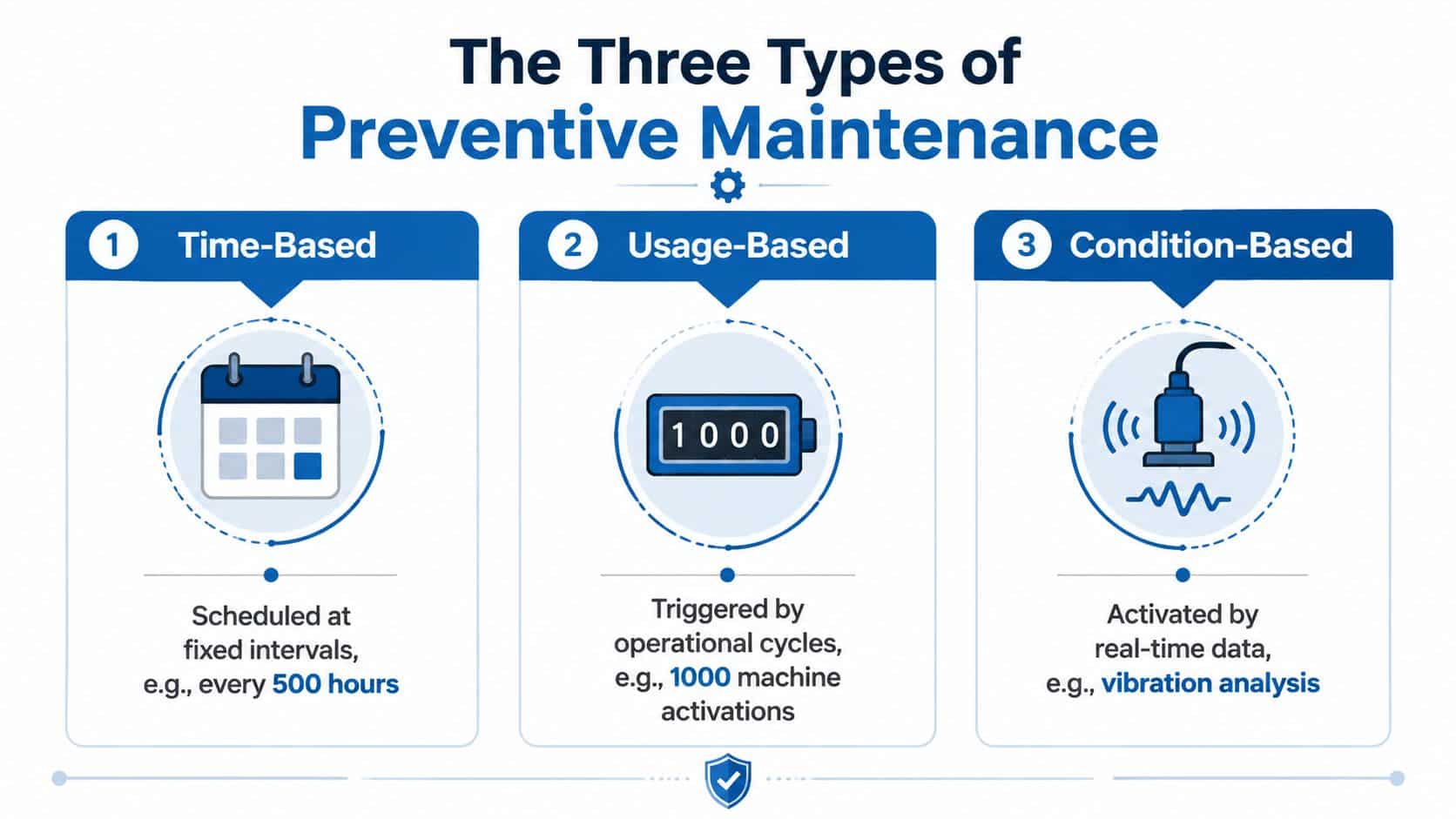
Hydraulic maintenance programmes usually combine time-based, usage-based and condition-based maintenance. The right choice depends on how the asset fails, how heavily it runs and how easily the team can observe deterioration.
Time-based maintenance
Time-based maintenance follows a fixed calendar. A standby power unit may receive a visual inspection each month, a filter inspection at a planned service interval and a documented annual examination. The asset may have seen little use, but time can still affect seals, fluid condition, corrosion protection and stored equipment.
This method is easy to administer and audit. It works particularly well where the manufacturer specifies calendar intervals or where the equipment's exposure to the environment matters more than its operating hours. Its weakness is that it can lead to over-maintenance if the schedule ignores actual duty.
Usage-based maintenance
Usage-based maintenance responds to operating hours, cycle counts, throughput or mileage. A hydraulic press that runs continuously will accumulate wear faster than an identical press used occasionally. A pump, gear motor or directional valve may therefore need attention after a measured amount of work rather than just at a calendar date.
The trigger must relate to the failure mode. Operating hours may suit pump wear and oil ageing. Cycle count may better suit a valve or actuator that repeatedly changes direction. If the team can't measure the relevant usage, the schedule won't be reliable.
Condition-based maintenance
Condition-based maintenance starts work when inspection or monitoring identifies deterioration. A technician may find rising leakage, unusual noise, increasing temperature, pressure instability or evidence of contamination. Basic condition checks can be manual, while more advanced systems use sensors and analysis.
Condition-based maintenance still requires planning. The finding should create a controlled work order, a risk decision and a completion deadline. It isn't an excuse to leave the issue on a whiteboard until the component fails.
| Maintenance Type | Trigger | Hydraulic Example | Typical Interval |
|---|---|---|---|
| Time-Based | Calendar date | Inspect a standby power pack and replace service items | Monthly, quarterly or annually, according to risk and OEM guidance |
| Usage-Based | Operating hours, cycles or mileage | Service a pump after a defined operating-hour threshold | At the agreed hours or cycle count |
| Condition-Based | Inspection or measured condition | Investigate rising temperature, leakage or contamination before loss of function | When the condition threshold or inspection finding requires action |
A mature programme doesn't force every asset into one category. It uses a simple calendar for low-risk equipment, operating data for hard-working machinery and condition checks where early warning provides enough value to justify the effort.
The Real Cost of Skipping Preventive Maintenance
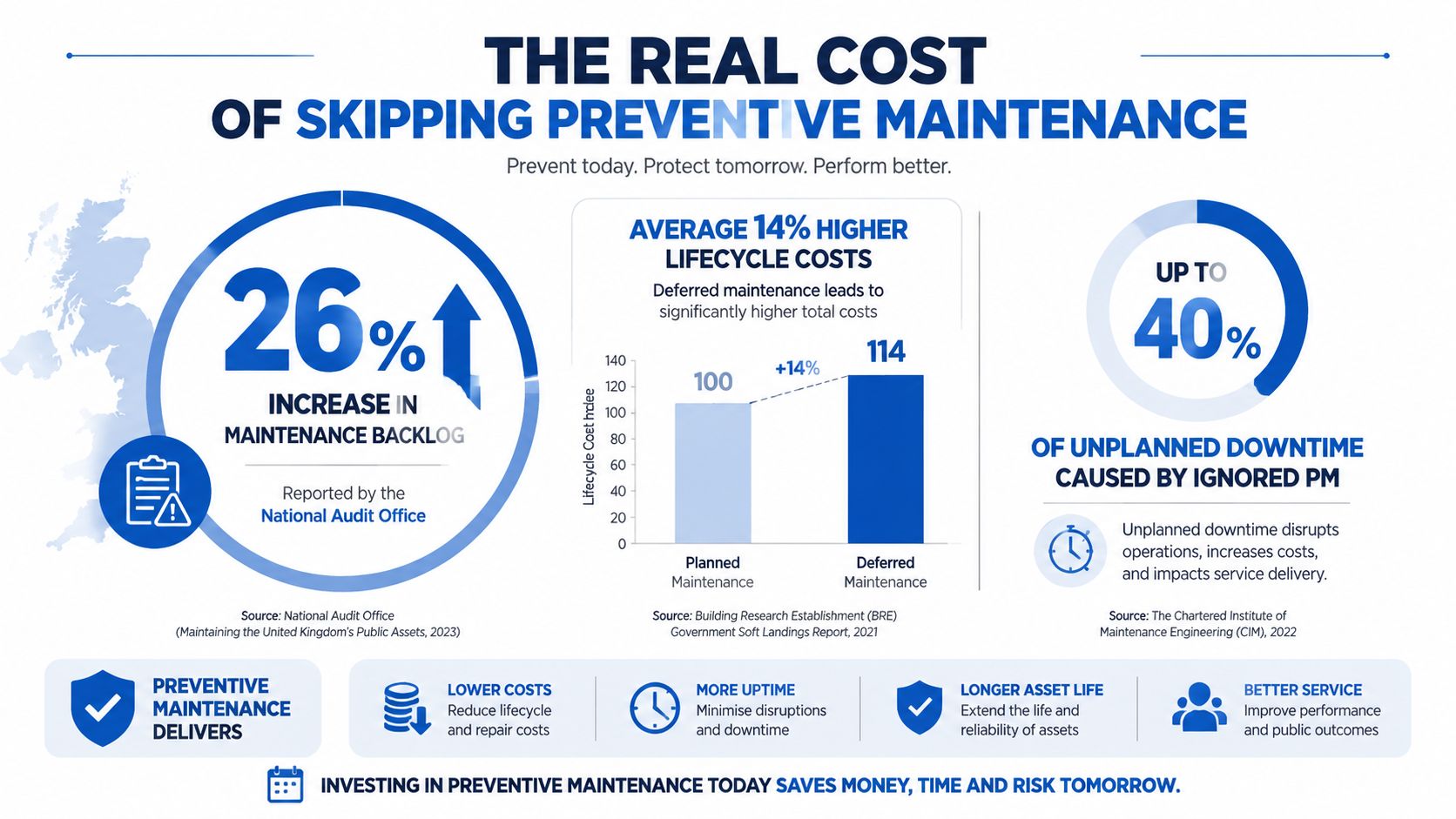
Deferred maintenance is not the same as cancelled maintenance. The task remains open, the asset continues to age and the exposure grows while the organisation waits for labour, budget or production access.
The National Audit Office estimated the UK government estate backlog at a minimum of £49 billion in January 2025. The NAO also described that amount as about 4% of total government expenditure in 2023–24 and around £710 per person in the UK. That isn't an industrial plant calculation, but it provides a powerful UK benchmark for the national financial effect of allowing maintenance to accumulate.
A hydraulic failure rarely affects only the failed part. A damaged pump can spread debris through valves and actuators. A leaking hose can lower pressure, contaminate the work area and create a safety risk. An overheated power pack can damage seals, degrade fluid and force production to stop while engineers diagnose several symptoms at once.
Cost is more than the repair invoice
A plant manager should account for:
- Emergency labour: Technicians may need to work outside the planned maintenance window.
- Expedited parts: The correct pump, seal kit, filter or valve may not be available through normal purchasing routes.
- Secondary damage: Contamination, overheating or misalignment can affect components beyond the original fault.
- Production disruption: Operators, materials and downstream processes may all be affected.
- Safety exposure: Stored hydraulic energy and uncontrolled movement make poor maintenance control unacceptable.
Recent reporting estimated that unplanned downtime could cost UK and European manufacturers over £80 billion in 2025 (DMA Group coverage of maintenance developments). Treat that as an estimate, not a universal plant cost. Its value is in showing the scale of the issue when many individual stoppages combine.
The financial case also includes sustainability. A 2025 academic bridge-maintenance study found planned preventive maintenance produced 7.7% lower discounted maintenance costs and 7% lower carbon emissions than an unplanned reactive strategy (published study). Bridges aren't hydraulic power packs, so the result shouldn't be copied directly into an industrial budget. It does, however, support a broader engineering point: planned intervention can reduce both lifecycle burden and environmental impact when compared with unmanaged reaction.
For OEMs reviewing their own designs, maintainability, accessible service points and sensible consumables can help reduces operating costs for OEMs over the equipment's working life.
Check that embedded video frames render correctly on both desktop and mobile. Incorrect sizing can make otherwise useful maintenance content difficult to use.
Setting Maintenance Intervals and Tracking KPIs
A maintenance interval should reflect duty, environment, criticality and failure history, rather than convenience. Begin with the OEM manual, then adjust the schedule only when operating evidence supports a change. A dusty agricultural machine, continuously running press and infrequently used emergency power unit should not automatically share one inspection calendar.
Transport guidance shows how to set intervals around risk. The UK DVSA Guide to Maintaining Roadworthiness places safety inspections within a 4 to 13 week range, with the exact timing influenced by vehicle age, mileage and operating conditions. High-mileage or harsh-duty vehicles generally need 4 to 6 week intervals, while newer or lightly used vehicles may operate on 6 to 13 week intervals (DVSA guidance summary). For vehicles and trailers aged 12 years and older, UK fleet guidance commonly uses a 6-week minimum, within that wider framework. See safety inspection intervals for UK fleets and the RHA guidance.
Build the interval logically
For a hydraulic system, set the interval by answering five practical questions:
- How hard does it work? Record operating hours, cycles, load and temperature where these factors drive wear.
- What happens if it fails? Prioritise equipment affecting safety, compliance or production, particularly where replacement parts have long lead times.
- What condition can the team observe? Use leakage, noise, pressure, temperature, filter restriction and fluid condition as working indicators.
- What does the manufacturer require? Treat OEM instructions as the starting control, especially for warranty and safety-critical equipment.
- What does the history show? Repeated failures before a scheduled task indicate an interval that may be too long. Consistently clean findings may support a controlled review.
Record the decision and its basis. A schedule that cannot explain why a task occurs at a particular frequency is difficult to defend when production pressure leads to deferral.
Your maintenance scheduling system should identify the asset, task, frequency, responsible person, isolation requirements, parts and completion evidence. A spreadsheet can support a small operation. A CMMS becomes more useful when missed tasks, multiple technicians and several production areas make manual control unreliable.
Track useful measures
Collect only measures that change maintenance decisions:
- Planned maintenance percentage: Shows how much work is planned rather than received as an emergency.
- Schedule compliance: Shows whether planned tasks are completed within the agreed window.
- Mean time between failures: Helps assess reliability for a defined asset group.
- Mean time to repair: Reveals delays caused by diagnosis, access, parts or skills.
- Maintenance cost per operating hour: Allows comparison between assets with different duty patterns.
- Repeat failures: Shows where the team may be treating symptoms instead of removing causes.
Document readings, photographs, defects, parts and follow-up actions. The official UK practitioner guide for apparatus inspections specifies visual, close and detailed inspections on 100% of apparatus at 12-monthly intervals (government inspection guide). A hydraulic schedule may use different timings, but the control principle is the same: define the scope, complete the inspection and retain evidence.
Implementing Preventive Maintenance for Hydraulic Equipment
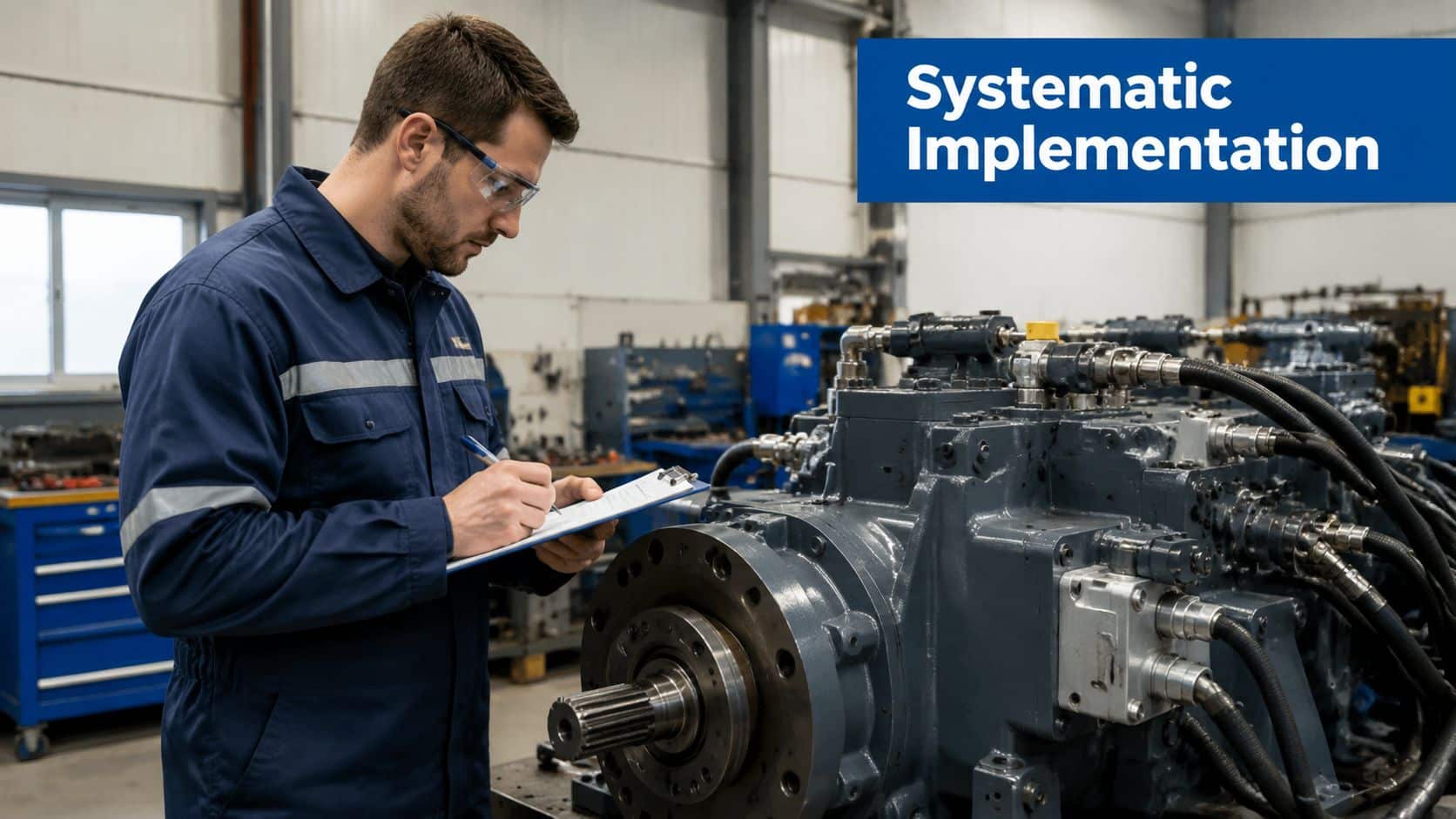
A workable hydraulic PM programme starts with an asset register, not a pile of generic checklists. Record each power pack, pump, motor, manifold, valve bank, filter assembly, cooler, hose run and actuator, then rank the assets by the consequence of failure.
A main production power pack usually deserves more attention than a low-duty auxiliary unit. A mobile machine working through a demanding agricultural season may need a different plan from a materials-handling system that runs inside a controlled factory environment. In both cases, the maintenance team should know which components can stop the operation and which parts have realistic replacement lead times.
Create tasks technicians can actually complete
A useful power-pack checklist might include:
- Visual condition: Look for oil leaks, loose fittings, damaged hoses, cracked mounts and unusual vibration.
- Fluid control: Check level and condition, keep fill points clean and investigate contamination rather than topping up.
- Filtration: Inspect filter indicators and replace elements according to the agreed trigger.
- Pressure and temperature: Record operating readings under comparable conditions and investigate drift.
- Seals and connections: Examine pump, motor, valve and cylinder areas for early leakage.
- Function test: Confirm controlled movement, response, noise and repeatability.
Write the isolation and stored-energy procedure into the task. A checklist that tells someone to inspect a hose but says nothing about safe depressurisation isn't complete.
For contamination-sensitive equipment, oil analysis for hydraulic systems can add evidence to visual inspection. It shouldn't replace basic housekeeping, correct filtration or clean fluid handling. It helps the team distinguish an isolated observation from a developing wear or contamination pattern.
Schedule work around production rather than against it. Use planned stoppages for intrusive tasks, prepare seals and filters before isolation, and agree a restart test with operations. MA Hydraulics Ltd supplies hydraulic components and bespoke power solutions, including gear pumps, valves, filters, manifolds and power packs, so a maintenance plan can be linked to practical component identification and replacement support. Keep ownership clear, store critical spares sensibly and close every work order with findings, not just a tick.
Preventive Maintenance Versus Predictive Maintenance
Predictive maintenance is not preventive maintenance with a sensor added. It uses condition data and analysis to identify developing failure risk, while scheduled PM uses known intervals and defined tasks. The two methods can operate together, but predictive systems require sensors, data management and people who can interpret the results.
A May 2026 UK manufacturing survey reported predictive maintenance adoption rising from 9% to 22%, while reactive maintenance fell from 42% to 26% and proactive maintenance remained at 50% (survey coverage). Skills shortages were reported as a major barrier by 77% of respondents. The figures show a shift in UK manufacturing, not a universal case for replacing scheduled PM.
When scheduled PM remains the right choice
Scheduled preventive maintenance is usually the sounder option when:
- The asset has a clear, repeatable service requirement.
- Failure consequences are understood and manageable.
- The equipment lacks suitable sensor access or connectivity.
- Technicians can inspect, test and document condition manually.
- Monitoring costs more than the value of earlier warning.
- Engineers do not yet have the skills to interpret data consistently.
A filter change, hose inspection, fluid check or pressure verification often needs no advanced analytics. It needs a well-written task, a defensible interval and safe execution. For hydraulic equipment, disciplined inspections can identify leakage, contamination or pressure drift before a sensor programme would justify its cost.
When predictive tools earn consideration
Predictive monitoring has a stronger case when failure is expensive, intermittent or difficult to detect during routine rounds. Examples include vibration monitoring on rotating equipment, temperature trends on heavily loaded systems, and continuous pressure or flow observation where performance drift precedes failure.
The UK predictive maintenance market was estimated at about USD 873.1 million in 2025 and forecast to reach USD 5.5 billion by 2033, according to cited market coverage. Those figures indicate market momentum, not a requirement for every plant to purchase a predictive platform. A UK commercial document should pair USD values with a current GBP conversion rather than present a fixed equivalent, because exchange rates change.
Start with one critical asset and a defined failure mode. Specify the warning threshold, the required response, the responsible reviewer and the method for validating the result. Without that workflow, sensors create more information without improving maintenance decisions. Scheduled PM remains the baseline, while predictive tools should earn their place through a clear reduction in risk, downtime or unnecessary intervention.
Your Preventive Maintenance Checklist and Next Steps
A useful programme can start with one critical hydraulic power pack and expand after the team has learned from the records. Use this checklist to turn the idea into controlled work:
- Create the asset register: Capture identification, location, function, operating conditions and maintenance history.
- Rank criticality: Separate equipment that affects safety or production from items that can reasonably run to failure.
- Choose the trigger: Use calendar time, operating hours, cycles or observed condition according to the failure mode.
- Write the task: Include isolation, inspection points, measurements, parts, acceptance criteria and restart checks.
- Prepare resources: Keep suitable filters, seal kits, hoses, fittings and other agreed spares available.
- Assign ownership: Give each task a responsible person and a completion window.
- Record findings: Log readings and defects, not only task completion.
- Review the KPIs: Look for overdue work, repeat failures, changing conditions and unnecessary interventions.
- Improve gradually: Adjust intervals when evidence supports the change, and update procedures after component or process changes.
The preventive maintenance checklist should remain a living document. Seasonal demand, contamination events, production changes and repeated component failures can all justify a review. Predictive technology may become useful later, but disciplined scheduled maintenance is the foundation that makes any advanced system worthwhile.
MA Hydraulics Ltd can help with hydraulic component selection, cross-references, spare parts and bespoke power-pack solutions for industrial, agricultural and mobile equipment. Call 01724 279508 today or visit MA Hydraulics Ltd to discuss a practical maintenance approach for your system.
