
A returned hydraulic power pack often tells the story before anyone opens the oil-analysis report. The reservoir is dark, the filter has blocked again, and a CETOP valve carries a sticky varnish film that makes a previously reliable circuit sluggish. The failure may be blamed on the pump, the oil or contamination in isolation, but oxidation resistance is rarely a single-component problem.
In a working hydraulic system, fluid chemistry, temperature, air, water, filtration, seals, metals and maintenance practices interact. This matters to OEMs building mobile machinery, MRO teams maintaining industrial plant and agricultural operators working through seasonal temperature changes. The practical question is not only which oil has the highest laboratory rating. It is whether the complete system keeps oxidation under control.
What Oxidation Resistance Looks Like on Your Shop Floor
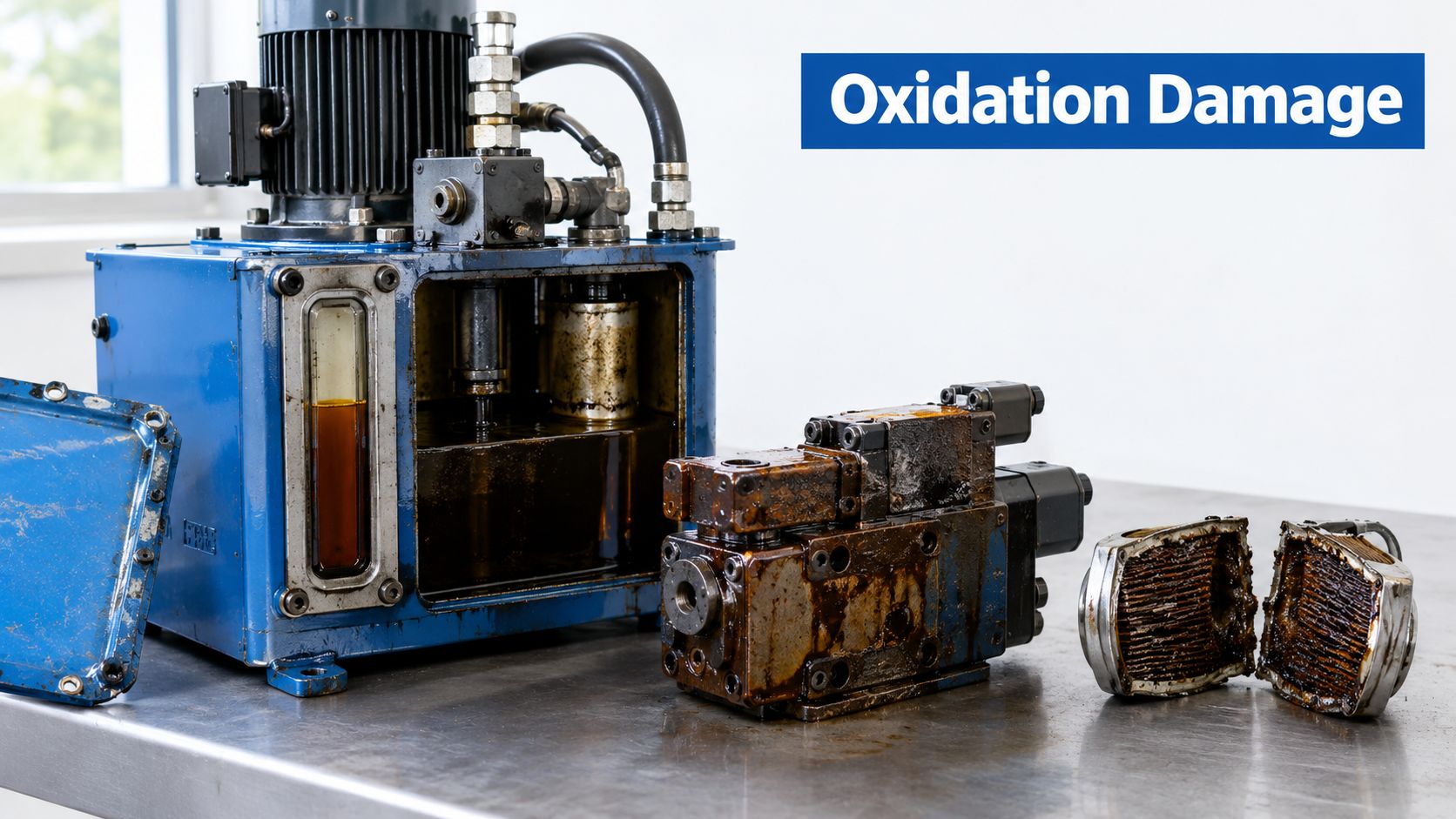
The first sign is often familiar. A power pack comes back with blackened oil, a filter element is loaded with sticky residue and a valve spool no longer moves as freely as it should. The reservoir may carry a burnt smell, while the pump and motor appear mechanically sound. Operators replace the filter, change the oil and return the machine to service, only to see the same symptoms return.
That pattern points towards a system condition rather than a bad batch of oil. Heat, oxygen, water and catalytic metals can push the fluid towards acids, sludge and varnish. Once deposits enter tight valve clearances or restrict a suction strainer, the original oxidation problem becomes a flow, wear and reliability problem.
The cost is operational, not theoretical
Oxidation can shorten the useful life of gear pumps, gear motors, directional valves, manifolds, filters and complete power packs. Sludge can block filters and foul valve clearances. Acids can attack seals and copper-containing components. Rust and oxide debris can circulate through bearings, gears and control orifices.
A foundational UK assessment shows why corrosion and oxidation deserve engineering attention. A committee established by the Minister of Technology in 1969 estimated annual UK corrosion costs at £1.635 billion in contemporary currency, equivalent to approximately 3.5% of UK gross national product in 1969–70. The estimate excluded agriculture and domestic dwellings, so it was considered conservative. The committee also estimated that £310 million, about 19% of the stated total, could have been avoided through better application of existing corrosion-control knowledge, without new research or technology. The Royal Society paper records this historical assessment.
That lesson still applies to hydraulic design. Good fluid selection helps, but so do cooler sizing, clean filling, appropriate filtration, sound sealing and planned inspection. MA Hydraulics supports these decisions through component supply, fluid-selection advice and bespoke power-pack work for mobile and industrial applications.
Practical rule: Treat dark oil and repeated filter blockage as evidence to investigate, not as routine signs of hard use.
The Core Concept of Oxidation Resistance in Hydraulic Systems
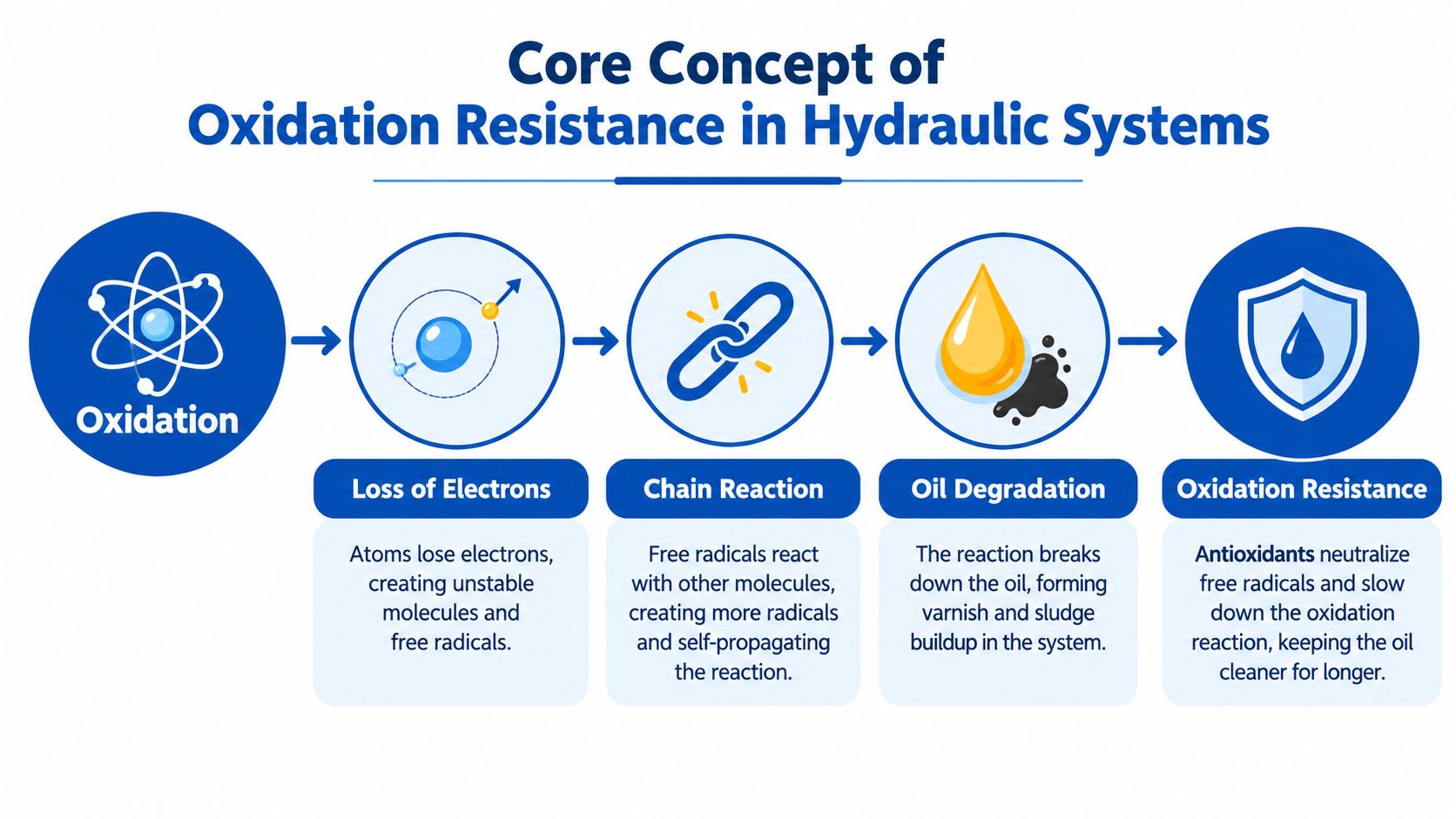
Oxidation is a chemical reaction in which a material loses electrons, commonly through interaction with oxygen. A sliced apple browns after exposure to air. A wet nail develops rust. Hydraulic oil follows a less visible version of the same process when heat, oxygen, water and catalytic surfaces promote molecular breakdown.
Oxidation resistance is the ability of a fluid, metal, coating or other material to slow that reaction. In hydraulic equipment, the term has two related meanings.
First, the oil must resist breakdown. Oxidised oil can form acids, sludge and varnish. Antioxidant additives interrupt or slow the reaction, but those additives are consumed during service. Base-fluid chemistry, aeration, heat and contamination determine how quickly the available protection is used.
Second, the hardware must resist oxidation and corrosion. Steel pump housings, valve bodies, shafts and fasteners can form rust or other corrosion products where water and oxygen reach the surface. The UK soil corrosivity map for buried iron assets evaluates soil pH, general moisture, saturation and anaerobic conditions, sulphides and sulphates, and soil resistivity. It classifies ground conditions as unlikely to cause corrosion, potentially corrosive or likely to cause corrosion. The message for designers is clear: material performance depends on the environment, not just the material name.
Where the reaction affects a power pack
Inside a power pack, oil contacts pump gears, bearings, valves, seals, hoses and reservoir surfaces. A gear pump may continue to deliver flow while the oil gradually loses its reserve against oxidation. Later, deposits restrict a valve spool or cause a filter to load quickly. The failure appears sudden, but the chemical deterioration started earlier.
Metals also behave differently at high temperature. UK research at the University of Birmingham identifies chromia, alumina and silica as typical protective oxides for high-temperature steels and alloys. These scales can limit oxygen movement, but thermal cycling may crack or spall them, exposing fresh metal. Imperial College London and Cranfield University similarly emphasise mechanism-based evaluation in realistic industrial environments, rather than relying only on nominal material datasheets. Imperial's metals and electrochemistry research provides relevant background.
The same principle applies to coatings, seals and surface treatments. A material selected for oxidation resistance may involve trade-offs with strength, creep resistance, manufacturability, cost or compatibility. That's why gear pumps, gear motors, CETOP valves, filters, manifolds, bellhousings and couplings need to be assessed as parts of a working circuit.
Key Drivers of Oxidation in Hydraulic Equipment
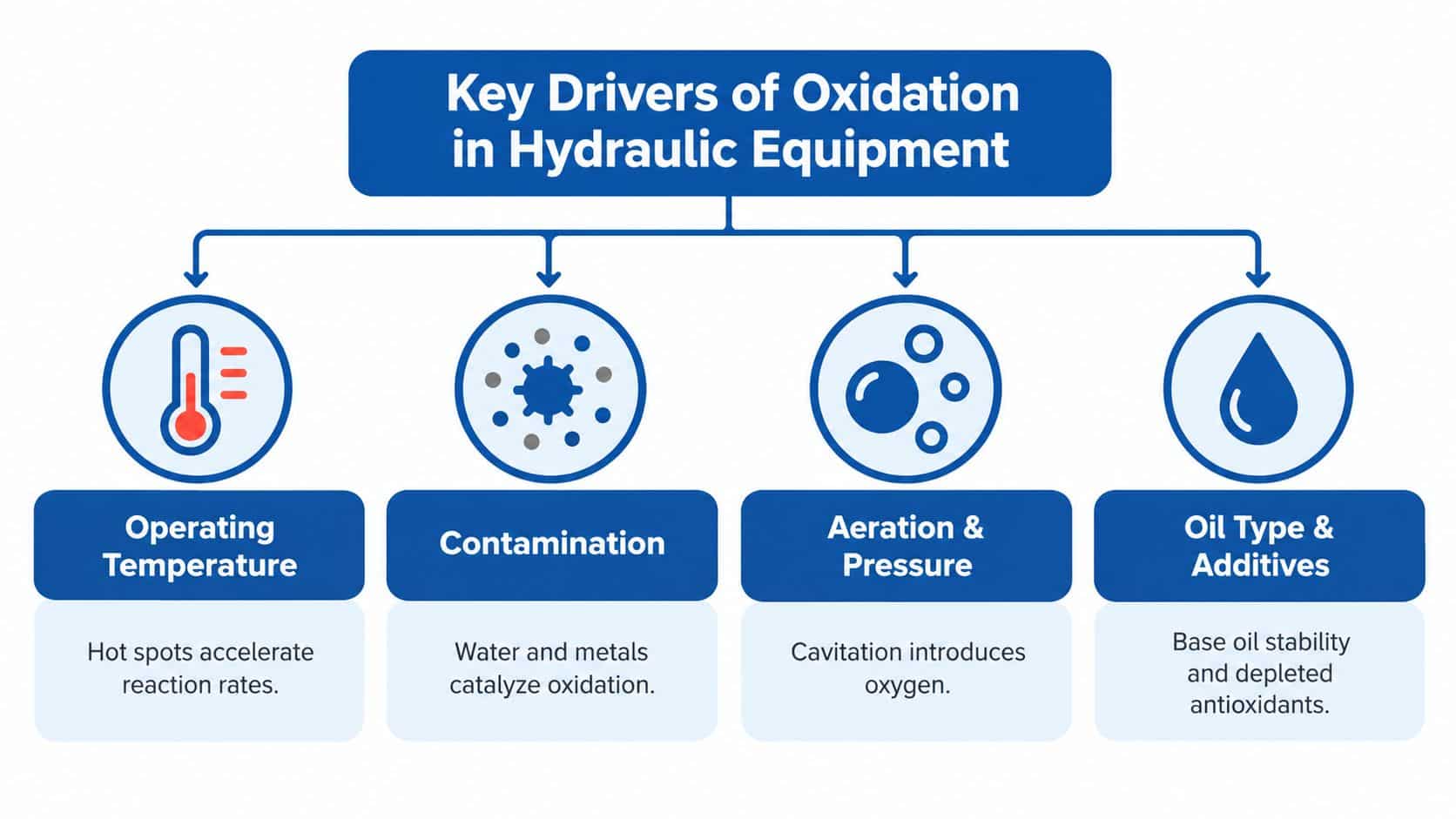
Oxidation accelerates when the system gives the reaction what it needs. The main variables are temperature, air, water, catalytic metals and additive condition. Duty cycle and environment decide how often those variables appear.
Temperature creates the first warning
Heat is often the most useful starting point because it can be measured and mapped. A reservoir may look acceptable while a pump outlet, bearing zone, relief valve or restricted return line creates a local hot spot. A machine that cycles between cool starts and high-load operation can stress the oil differently from a continuously operating unit.
Don't focus only on the average reservoir reading. Record temperature at the reservoir, near the pump and around known heat sources. Review the duty cycle, cooler performance and reservoir layout. If a mobile machine works outdoors, seasonal temperature changes can also alter viscosity, warm-up time and condensation behaviour.
Air and water change the chemistry
A suction line that draws air past a worn seal can introduce oxygen and cause foaming or cavitation. Low reservoir levels, poor return-line placement and inadequate deaeration make the situation worse. Air entrainment also reduces the stability of the fluid film protecting pump and motor surfaces.
Water enters through condensation, damaged breathers, washdown, rain exposure or cooler faults. It can promote corrosion, alter additive behaviour and damage protective oxide films. Intermittently operated agricultural and construction machinery deserves particular attention because long idle periods can leave humid air in the reservoir before the next cold start.
Metal wear can act as a catalyst
Copper and iron wear particles aren't merely evidence of component damage. They can also promote oxidation reactions. Bronze or copper-containing surfaces, worn bearings and corroding steel can introduce catalytic material into the oil. The resulting debris then circulates through pumps, valves and filters, creating a feedback loop between chemical and mechanical degradation.
A practical inspection list is more useful than a generic warning:
- Temperature: Trend operating heat and investigate local hot spots.
- Aeration: Check suction joints, seals, reservoir level and return-line design.
- Water: Inspect breathers, coolers, tank covers and condensation controls.
- Metals: Use wear-metal analysis and inspect filters for copper, iron and bronze debris.
- Additives: Check whether the selected fluid remains compatible with the application and whether antioxidant reserve is being depleted.
Test Methods and Standards Used to Measure Oxidation Resistance
A laboratory oxidation result is useful only when the test matches the decision being made. RPVOT and RBOT accelerate lubricant oxidation with heat, pressurised oxygen, water and a copper catalyst. They can compare formulations, but they compress service conditions into a controlled test and don't reproduce every reservoir, duty cycle or contamination pattern.
ASTM D4310 is particularly relevant to hydraulic-fluid selection. It exposes inhibited oil to oxygen, water, heat and a metal catalyst for 1,000 hours. Sludge is measured because oxidation products can increase viscosity, block filters, foul valve clearances and promote abrasive wear in pumps and motors. A UK-market technical benchmark reports 21 mg of insoluble sludge after 1,000 hours at 95°C for a zinc-free hydraulic formulation, compared with a cited OEM limit of 100 mg. That is approximately 79% lower sludge, but it isn't a direct field-life multiplier. Shell's Tellus hydraulic-fluid information provides the cited technical context.
Read the result alongside field evidence
TAN, or Total Acid Number, tracks acid development. FT-IR can follow chemical changes and oxidation-related peaks. ISO 6886 is used for thermo-oxidation assessment, while research from the University of Leeds repository demonstrates combining it with FT-IR to track chemical change rather than relying on colour alone. The Leeds thesis describes this analytical approach.
| Test | What it measures | Typical use |
|---|---|---|
| RPVOT or RBOT | Resistance to accelerated oxidation under pressurised oxygen, heat, water and a copper catalyst | Comparing lubricant formulations |
| ASTM D4310 | Insoluble sludge formed under oxygen, water, heat and a metal catalyst | Assessing deposit-forming tendency in hydraulic oils |
| TAN | Development of acidic products | Trending oil ageing and possible additive depletion |
| FT-IR | Chemical changes associated with oxidation and degradation | Confirming chemical change in used-oil samples |
| ISO 6886 | Thermo-oxidation behaviour | Supporting controlled laboratory comparison |
For engineers working around aggressive industrial environments, material selection matters too. Information on corrosion-resistant snorkels for environmental testing illustrates the broader principle that exposed equipment needs protection suited to its atmosphere, temperature and contaminants.
For a hydraulic installation, ask for the exact test method, fluid approval and test conditions. Then compare the result with temperature, water content, viscosity, TAN, wear metals and filter condition from the actual machine. MA Hydraulics also provides hydraulic oil analysis support for this type of evidence-led assessment.
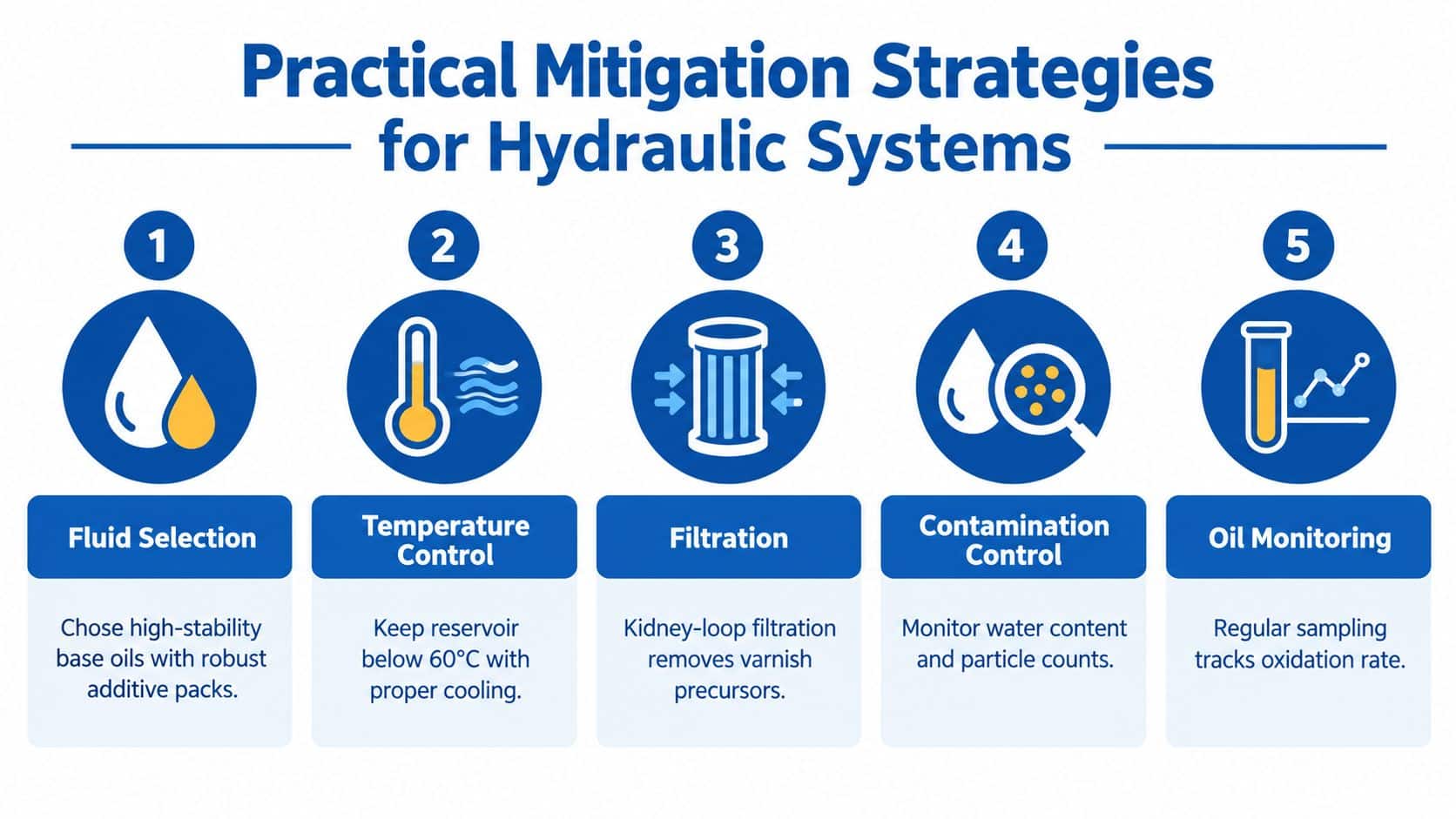
Practical Mitigation Strategies for Hydraulic Systems
The strongest oxidation-control programme uses several modest controls rather than relying on one premium fluid. Start with the conditions that cause the damage, then specify the fluid, hardware and maintenance routine together.
Choose the fluid for the circuit
Select an oxidation-stable base fluid and an additive package suited to the pump, valves, seals, temperature and duty cycle. Zinc-free formulations can be appropriate in some systems, but the choice still needs confirmation against manufacturer approvals, seal materials, paint compatibility and contamination controls.
Don't switch to a biodegradable or lower-impact fluid on oxidation claims alone. Check compatibility with hoses, seals, pumps, valves and residual oil. Establish a fresh-oil baseline so later samples can distinguish normal chemistry from degradation.
Control heat at the source
Use suitable reservoir capacity, correctly sized coolers and sensible component placement. Keep pumps away from avoidable heat sources and investigate throttling losses, relief-valve operation and restricted returns. A temperature trend is more valuable than a one-off reading because it shows how the machine behaves across its duty cycle.
Filter contamination before it becomes chemistry
Use the correct filter location, micron rating and beta-ratio requirement for the circuit. Protect the return path, suction side and sensitive valve sections as the design demands. Water control needs equal attention, including suitable breathers, tank sealing and inspection of coolers.
MA Hydraulics' hydraulic filter selection guide can help structure the filter decision around flow, pressure, contamination risk and component sensitivity.
Design the reservoir and seals properly
A well-designed reservoir gives the oil time to release entrained air and helps separate heat from the fluid. Keep suction connections tight, maintain the correct oil level and position return lines so they don't churn the surface. Inspect breathers and seals when outdoor equipment shows foaming or water contamination.
Monitor instead of guessing
Take representative samples from a consistent point. Trend viscosity, TAN, water, particle count, wear metals, additive condition and filter debris. An offline filtration or flushing circuit may remove varnish precursors more effectively than repeated changes to the main filter alone.
For new builds, apply these controls during design. Hydronit mini power packs, bespoke industrial power packs up to 11 kW, and stocked filters, valves and couplings all need to be matched to the actual operating environment. A resilient circuit is one where the fluid and component choices support each other.
Why a High Oxidation Rating Does Not Guarantee Long Service Life
A high RPVOT or RBOT result is not a drain-interval certificate. The test uses aggressive, controlled conditions, and modern additive packages can suppress the copper catalyst long enough for oils to exceed 1,000 minutes in some laboratory results. Once the protective additives are depleted, the oil may deteriorate rapidly. UK oil-analysis guidance supports using maintenance records and condition-monitoring evidence rather than assumptions about ageing industrial assets.
The same caution applies to a low sludge result in ASTM D4310. It tells you how the formulation behaved under that test, not how your reservoir will behave after water ingress, aeration, contamination, thermal cycling or long periods of intermittent operation.
Use the machine as the reference
A useful service decision follows a simple sequence:
- Sample: Take a representative oil sample and record operating temperature, duty cycle and recent maintenance.
- Trend: Compare viscosity, TAN, water, wear metals, particle count, additive condition and filter state with earlier results.
- Escalate: Investigate abnormal trends, increase sampling, change the oil or inspect the circuit according to the evidence.
This approach suits UK machinery exposed to outdoor moisture, seasonal temperature changes and variable agricultural or construction loads. A fixed drain interval may be convenient, but it can discard serviceable fluid or leave deteriorated fluid in service.
Lower-carbon and biodegradable fluids introduce a further trade-off. Oxidation stability, energy efficiency, biodegradability, additive depletion and seal compatibility must be considered together. A fluid that looks attractive environmentally still needs to start reliably at low temperature, pass through the filtration system, protect pumps and valves, and remain compatible with hoses and seals.
The right question isn't “What is the highest oxidation number?” It is “What evidence shows that this oil is still serviceable in this machine?”
Troubleshooting Symptoms of Oxidation-Related Failure
When a machine arrives with oxidation symptoms, start with the evidence that can be gathered during the shift. Don't wait for a laboratory report before checking temperature, filter debris, reservoir condition and the component that first showed abnormal behaviour.
Dark or blackened oil
Dark colour can indicate oxidation, contamination or wear, but colour alone doesn't establish the cause. Check the reservoir, sample the oil, inspect the filter and review operating temperature. Order viscosity, TAN, water, particle count, wear metals and FT-IR where the service decision depends on chemical confirmation.
If iron or copper is present, inspect the gear pump, gear motor, bearings and other contact surfaces. If deposits are concentrated around the return path or filter, look for heat and flow restrictions before replacing components.
Varnish on a CETOP valve
Sticky valve spools, sluggish proportional response and lacquer around clearances suggest deposit formation. Inspect the valve, filter element, reservoir walls and oil sample. Confirm whether the fluid has experienced high temperature or additive depletion, then decide whether filtration, flushing, valve replacement or a broader power-pack repair is appropriate.
Filters blocking repeatedly
A filter that loads twice in a short period may be capturing oxidation sludge, rust, wear metal or dirt introduced during maintenance. Cut open the element if safe, classify the debris and check the breathers, tank cleanliness, hose interiors and upstream components. Repeated replacement without finding the source only moves the failure downstream.
Acidic smell, foaming or rust-coloured deposits
A burnt or acidic smell warrants a TAN and viscosity check. Foaming points towards aeration, low oil level, poor return-line arrangement or suction leakage, while rust-coloured deposits call for water-ingress checks and inspection of steel surfaces.
MA Hydraulics can help identify whether the practical remedy lies in filters, valves, gear pumps, gear motors, manifolds or a complete power pack. The component should follow the diagnosis, not replace it.
Specifying Oxidation Resistance for New Builds and Refurbishments
A useful specification joins four documents into one engineering decision.
Fluid requirements should name the approved fluid class, test methods, additive type, temperature range, seal compatibility and paint compatibility. Avoid writing “high oxidation resistance” without stating how the supplier must demonstrate it.
Component requirements should identify pump, motor, valve, filter, manifold, bellhousing and coupling materials, coatings and environmental exposure. For buried or exposed steelwork, assess local moisture, salts and soil chemistry. Guidance on truck bumper corrosion protection tips is a useful reminder that corrosion protection must match the environment and surface design.
Monitoring requirements should define sample points, oil-analysis tests, filter inspection, breather checks, temperature records and escalation criteria. Use the hydraulic oil cross-reference when reviewing an alternative fluid, but confirm the final choice with the equipment and fluid manufacturers.
For an OEM or refurbishment team, MA Hydraulics Ltd can support component selection, fluid matching, Hydronit mini power-pack assembly and in-house industrial power-pack manufacture up to 11 kW. Its stocked portfolio includes Vivoil, Hydronit, OMT, Luen, Orta, Borelli and Hoyea, allowing the specification to cover individual replacements or a complete hydraulic assembly.
When publishing diagrams, test results or component comparisons, repeat essential wording in normal HTML text and provide accurate alternative text. UK accessibility guidance recommends a minimum colour contrast of 4.5:1 for normal text and 3:1 for large text, and advises against placing meaningful wording only inside raster images. The UK Government accessibility check explains these requirements. Check every label, chemical symbol, decimal point, temperature and metric unit before publication. Non-decorative images need meaningful alternative text, while decorative images should use an empty alternative-text attribute, as set out in UK accessibility guidance for perceivable content.
Speak to MA Hydraulics Ltd on 01724 279508 today for practical advice on oxidation resistance, hydraulic oil analysis, filtration and component selection. You can also send us a message for help diagnosing a struggling power pack or specifying a new hydraulic system.
