
A failed non-return valve rarely announces itself politely. One week the pump is holding pressure, the next the line drains back, the accumulator loses position, or a washdown circuit starts showing corrosion around the body and seat. The replacement request often arrives with only three words, “stainless check valve”, but that description leaves the decisions that determine service life unresolved.
The UK buying decision comes down to more than stainless steel. You need the right grade, connection, pressure class, cracking pressure, flow capacity, seal package and installation orientation. British standards also matter, particularly where the valve protects potable water, process equipment or a documented hydraulic assembly.
What a Stainless Check Valve Does in a Real Circuit
On a food-grade washdown line near Manchester, a brass swing check valve has failed after repeated exposure to water and cleaning chemicals. The replacement is a 1-inch 316 stainless unit between the pump and the rinse tank. Its job is straightforward, but its position is critical. It must let liquid travel towards the tank and stop the tank or a parallel branch from driving liquid backwards through the pump.
A stainless check valve, also called a non-return valve, opens when upstream pressure exceeds downstream pressure. When that differential falls or reverses, the internal disc, ball or poppet returns to its seat automatically. There's no actuator and no operator intervention, so the closing mechanism and the pressure conditions around it determine how well it protects the circuit.
That matters particularly where pumps run in parallel. A higher-pressure branch can push flow backwards through a stopped pump unless each discharge line has a correctly selected check valve. For a broader explanation of one-way valve operation, the MA Hydraulics guide to what a check valve is provides useful background before you move into detailed specification.
The two designs seen most often
The first is the spring-loaded poppet or lift check. A spring holds the poppet shut until the available differential exceeds the spring force. This design suits compact hydraulic and process assemblies, especially where the valve may be installed in more than one orientation and where quick closure matters.
The second is the disc, swing or wafer check. A hinged disc or paired wafer discs move out of the flow path and close when flow decays. Wafer arrangements are common in larger lines, including the DN50 to DN300 range described in industry product guidance, but the actual manufacturer's size and pressure data must control the purchase decision.
Stainless earns its place where washdown, chloride exposure, chemicals or marine air would attack brass or carbon steel. It can also support a cleaner audit trail in food, pharmaceutical and water-related applications, provided the complete valve, including seals and finishes, meets the required hygiene specification. For compact reverse-osmosis assemblies, buyers may also find it useful to compare specialist options such as Ring Hot Water's reverse-osmosis check valve.
The rest of the selection comes down to material grade, pressure and temperature limits, cracking pressure, connections, standards, flow and maintainability.
Stainless Grades Explained for UK Buyers
Stainless grade selection should follow the fluid and environment, not the word “stainless” on a catalogue page. 304 stainless is a sensible general-purpose choice for indoor plant, clean water and compressed air where chloride exposure is limited. 316 stainless is the safer starting point for coastal sites, road-salt exposure, mobile equipment, pharmaceutical washdown and brewery cleaning circuits.
The difference is the molybdenum content. 316 commonly contains 0.1 to 0.5 per cent molybdenum, which improves resistance to chloride-driven pitting. That doesn't make 316 universally compatible, and it won't compensate for an unsuitable seal, spring or seat. The fluid, concentration, temperature and cleaning regime still need checking against the manufacturer's data.
Cast valves use a different naming system from forged bodies. CF8 is the cast equivalent commonly associated with 304, while CF8M corresponds to cast 316. European castings often carry EN designations such as 1.4408, a grade found on commonly stocked UK stainless valves. Forged bodies may be marked with AISI designations, whereas cast bodies are commonly identified by ASTM casting grades.
A practical grade comparison
| Grade / Cast | Key property | Typical use | Relative cost |
|---|---|---|---|
| 304 | General corrosion resistance | Indoor plant, clean water and compressed air | Lower than 316 |
| 316 | Better chloride and pitting resistance | Coastal, washdown, chemical and marine-adjacent service | Higher than 304 |
| CF8 | Cast equivalent of 304 | General industrial cast valves | Comparable with cast 304 |
| CF8M | Cast equivalent of 316 | Corrosive process and hygienic service | Comparable with cast 316 |
| 1.4408 | European cast designation associated with 316 stainless valves | UK and European process installations | Product and specification dependent |
Current catalogue guidance places the step from 304 to 316 at roughly 25 to 40 per cent in British catalogues, but that figure should be treated as a buying indication rather than a universal rule. The actual price changes with bore, connection, pressure class, seal material, certification and whether the valve is forged or cast.
Practical rule: Choose 316 because the environment needs its resistance, not because the label sounds more industrial.
Food-grade suitability also depends on the complete construction. Ask for material traceability and, where your quality system requires it, an EN 10204 3.1 certificate. A 1.4408 body with an unsuitable elastomer or undocumented internal finish isn't automatically a hygienic valve.
Cracking Pressure, Flow and Cv in Plain Numbers
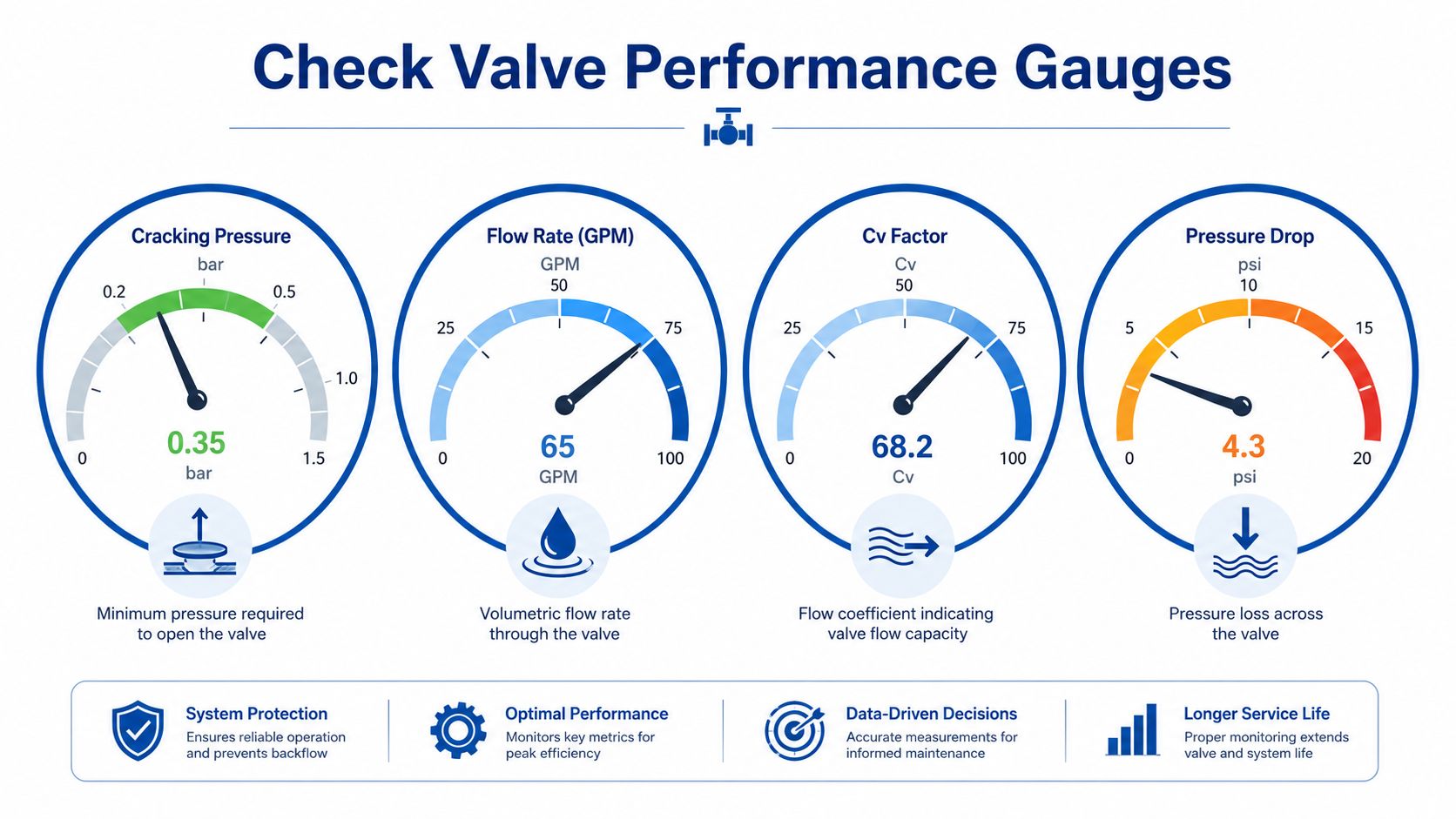
Cracking pressure is the minimum differential pressure needed to lift a spring-loaded disc or poppet from its seat. Typical spring-loaded units may sit around 0.2 to 0.5 bar, while a swing check can approach zero because it relies mainly on disc movement and differential pressure. The exact figure must come from the valve data sheet, not from the body material or nominal bore.
Lower cracking pressure generally reduces the opening resistance, which helps a low-head pump or a small hydraulic circuit. It can also leave the disc more vulnerable to chatter if the flow repeatedly crosses the opening threshold. UK miniature stainless valves are available with a 100 bar maximum allowable pressure, a -40 to +200°C range and a leak rate of 1 x 10⁻⁴ mbar x l/s, according to the WEH miniature stainless check valve specification. Other high-pressure stainless lines reach 10,000 PSI, with 7 PSI cracking pressure and temperature capability up to 200 to 240°C, so the range of available behaviour is wide.
Read Cv without losing the plot
Cv is the flow in US gallons per minute that produces a 1 psi pressure drop across the valve under defined test conditions. UK engineers often work with Kv instead, and a useful approximate conversion is Kv = Cv divided by 1.16. A published Cv of 12 therefore corresponds to roughly Kv 10.
A worked catalogue example can look like this:
- A 1-inch 316 poppet check with Cv 16 passes 95 litres per minute at a 3 bar drop.
- A 2-inch wafer disc check with Cv 85 handles 300 litres per minute with a loss of only 0.4 bar.
Those examples show why nominal pipe size alone is inadequate. A larger valve can still perform poorly if the flow is too low to stabilise its disc, while a smaller high-Cv design may offer a better pressure-loss result if its pressure and connection ratings are suitable.
Specific gravity also matters with viscous fluids, and the effective cracking behaviour can change as fluid density and viscosity change. Check the manufacturer's orientation guidance rather than assuming a vertical installation will preserve the same Cv or opening behaviour.
Pin these figures to the procurement sheet:
- Fluid and specific gravity
- Minimum, normal and maximum flow
- Cracking pressure
- Cv or Kv
- Pressure drop at duty flow
- Maximum working pressure
- Temperature and seal material
The gauge below gives a visual companion to the figures, but the valve's certified data sheet remains the controlling document.
End Connections and Standards That Matter in the UK
Connection selection is where many otherwise sound valve choices fail. A BSP thread fitted to NPT pipe may look close enough during assembly, but the thread form and sealing method aren't interchangeable. Confirm the pipe standard, the mating component and the pressure class before ordering.
BSP parallel connections, associated with BS 2779 and ISO 228, remain common in UK process pipework and smaller hydraulic assemblies. NPT, governed by ANSI/ASME B1.20.1, usually appears on imported skids or equipment built around North American components. Flanged valves use standards such as BS EN 1092-1, with PN16 and PN40 classes providing the pressure designation. Hydraulic tube and hose assemblies commonly use the 24-degree cone-seat system to ISO 8434-1, with Light and Heavy Series following DIN 2353.
| Connection | Standard | Typical size range | Indicative pressure ceiling |
|---|---|---|---|
| BSP parallel | BS 2779 / ISO 228 | Small to medium threaded pipework | Catalogue dependent, with some stainless valves rated to 40 bar at 1/2 inch |
| NPT | ANSI/ASME B1.20.1 | Imported skids and North American equipment | Manufacturer and size dependent |
| Flanged PN16 | BS EN 1092-1 | Process and larger-bore pipework | 16 bar class |
| Flanged PN40 | BS EN 1092-1 | Higher-pressure process pipework | 40 bar class |
| 24-degree cone | ISO 8434-1 / DIN 2353 | Hydraulic tube and hose assemblies | Light and Heavy Series, manufacturer dependent |
British catalogues show stainless threaded check valves at 63 bar in 1/4-inch and 3/8-inch sizes, while 1/2-inch and 1-inch examples are rated at 25 bar. Those ratings and prices are visible in the RS PRO UK check-valve catalogue, but they're product-specific and shouldn't be applied to another bore or connection.
For larger installations, a UK swing check datasheet lists PN16, DN15 to DN200 and 1.4408 stainless steel construction. Another British supplier lists a flanged BS4504 DIN PN16 swing check in ASTM A351 CF8M, with a 16 bar pressure rating and a -20 to +200°C temperature range, as shown in the Johnson Valves check-valve datasheet.
Before replacing a domestic or external-water assembly, it also helps to understand how to install a double check valve. For hydraulic connection terminology, use the MA Hydraulics guide to hydraulic fittings and match the fitting to the valve, tube and hose system rather than relying on appearance.
How to Choose the Right Stainless Check Valve
Treat procurement as a sequence of decisions. The body grade is only one line in the specification, and it won't rescue a valve with the wrong spring, connection or pressure class.
Start with duty and fluid
Write down whether the valve handles water, inhibited glycol, oil, mild chemicals, compressed air or steam. Then record minimum and maximum pressure, temperature, flow, cycling frequency and installation orientation. Steam duty deserves particular care because the seat, gasket and body rating all have to remain suitable at operating temperature.
For the material decision, use 316 or 1.4408 where chlorides, washdown chemicals, coastal air or process contamination create a credible corrosion risk. Choose 304 or its cast equivalent CF8 for general indoor service where the environment is controlled. A stainless body doesn't make every fluid safe. The seat, spring and seal package may be the limiting components.
Lock down the pressure and opening behaviour
Use the catalogue pressure figure and apply your company's engineering margin. A common internal design approach is a 25 per cent margin, but the final requirement must account for surges, temperature derating and the manufacturer's terms. For flanged valves, ensure the PN designation on the valve matches the mating flange standard under BS EN 1092-1.
Cracking pressure should follow the circuit, not habit:
- 0.05 bar suits a low-head pump discharge where available differential is limited.
- 0.3 to 0.5 bar may suit a gravity return line that needs positive closure.
- 1 bar or more can be appropriate for a small dosing pump where reverse flow must be resisted.
These figures are selection targets, not substitutes for a tested product specification. UK high-pressure stainless valves demonstrate why the range needs checking carefully. The STAUFF UK stainless check-valve range includes Light and Heavy Series valves to ISO 8434-1 / DIN 2353, rated up to 400 bar.
Compare the premium honestly
A 1/2-inch 316 BSP stainless check valve may sit around £40 to £70 in UK stock, compared with £15 to £25 for brass. Those figures should be verified against the selected product, but they illustrate the trade-off. If the fluid is clean water in a protected indoor plant room, brass may be adequate. If corrosion would contaminate a product or stop a mobile machine, the stainless premium can be the more economical risk decision.
MA Hydraulics supplies hydraulic check valves, including an Oleoweb 1/2-inch BSP VUR120, and can help cross-reference hydraulic requirements before an order is placed.
Installation Best Practices That Prevent Early Failures
The first hour after installation often determines whether a check valve gives dependable service or becomes another repeat-failure item. Start with the arrow cast or stamped on the body. Confirm it against actual pump discharge direction before tightening the fittings, then verify that the valve's rated orientation matches the pipe run.
Spring checks usually offer more installation flexibility, but the manufacturer still controls the permitted position. A swing or disc valve may work well in a horizontal line, while a vertical arrangement can change how the disc closes. Never assume that a valve suitable for vertical up-flow is also suitable for vertical down-flow.
Control the transient, not just the steady pressure
Water hammer occurs when a moving fluid column decelerates quickly. A worked hydraulic example using a 4-inch column travelling at 5 m/s and decelerating in 0.1 seconds produces a calculated surge of 5 bar when assessed with the Joukowsky relationship. That figure comes from the stated scenario, and actual results depend on pipe material, fluid properties, wave speed, valve closure and system geometry.
Installation note: A pressure gauge showing normal running pressure doesn't prove that the valve survives the shutdown transient.
Where surge risk is credible, consider a slow-closing check, a relief path or a properly engineered damping arrangement. Don't use a low-cracking spring as a universal cure. It may reduce opening resistance, but closure characteristics and system dynamics still need assessment.
Keep upstream pipework clean and flush it before commissioning. Weld spatter, swarf and fragments of PTFE tape can mark the seat during the first cycle. Use the correct sealant for the fluid and avoid allowing tape to protrude into the bore.
For threaded work, follow the applicable BS 2779 assembly guidance and the valve manufacturer's torque information instead of tightening by feel. Complete the installation record with valve grade, bore, connection, cracking pressure and commissioning date. The MA Hydraulics inline valve installation guidance can support that final check, particularly on compact hydraulic assemblies.
Maintenance, Troubleshooting and Cross-Reference Tips
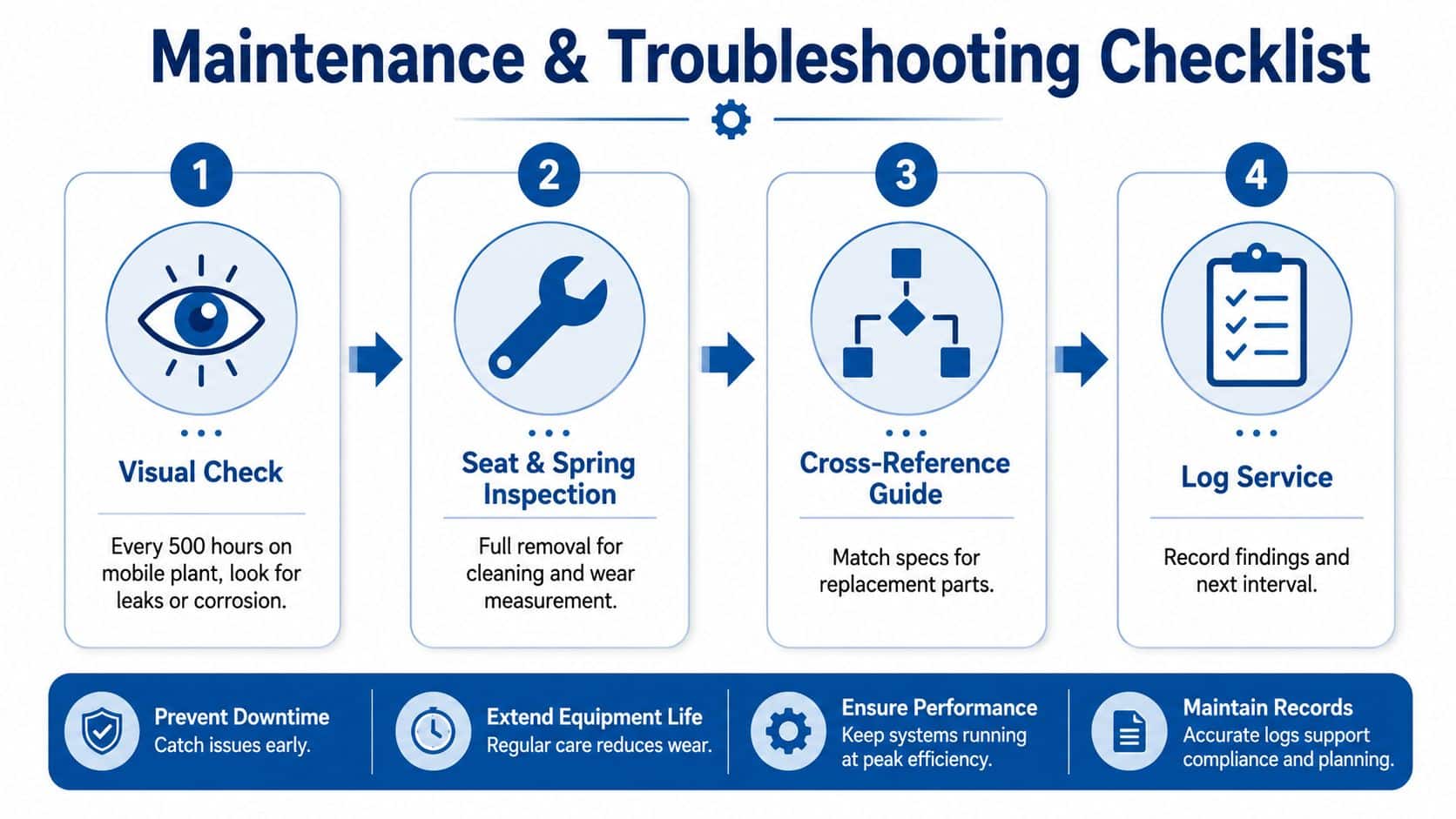
Maintenance should follow duty severity. A mobile machine working through dirt, vibration and weather needs a different inspection routine from a protected process skid. Visual inspection every 500 hours on mobile plant is a practical interval for checking leaks, external corrosion, loose fittings and abnormal noise, while process lines may need full seat and spring removal annually where the risk assessment and manufacturer's instructions support it.
Match the symptom to the cause
A chattering valve at low flow is often oversized or operating too close to its opening threshold. Check the actual flow, cracking pressure and orientation before replacing it with another valve of the same nominal bore.
Leakage past the seat usually points to debris, scoring, worn elastomer or corrosion damage. Isolate and depressurise the circuit, remove the internals if the design permits, clean the seat and inspect it under good light. A pitted 304 body or seat in a chloride-rich washdown area may need replacement with a suitably specified 316 assembly rather than another cleaning cycle.
A sticking poppet can result from contamination, damaged guides or seal swelling. Confirm media compatibility, especially where the body is sound but the elastomer has softened or cracked. Product guidance identifies seal choices including EPDM, Viton, silicone and FEP-silicone, and the safe temperature and chemical range can differ sharply between them.
Test before you cross-reference
A hand pump and calibrated gauge can help establish the pressure at which the poppet first lifts. Compare the measured cracking pressure with the original data sheet, then check shut-off performance under the permitted test conditions. UK supplier documentation includes sealing tests at 50 psi, or 3.5 bar, plus high-pressure shell tests at 4,500 psi, or 310 bar, and another listing records 9,000 psi, or 620 bar, as shown in the Waverley Brownall check-valve documentation.
Replacement is usually preferable to repair when the seat is permanently scored, the spring has lost calibration, the body has pitted or the original materials can't be verified. For cross-referencing, record the bore, thread or flange, pressure class, grade and seal material. Map hydraulic parts to ISO 7241-1 dash sizes where relevant, keep genuine seals and springs available, and photograph the old valve before disposal.
Stainless Check Valve FAQs and Next Steps
Is 316 worth paying for over 304 on domestic water?
Often, no, if the installation is indoors, the water is clean and chloride exposure is controlled. Choose 316 when coastal air, salt, washdown chemicals or contamination risk makes pitting a credible failure mode. The grade decision should also include the seat and seal materials, not just the body marking.
What cracking pressure suits a 12 VDC pump feeding an accumulator?
Start with the pump's available differential and the required anti-drain behaviour. A low-head circuit may need a target around 0.05 bar, while a small dosing arrangement may need 1 bar or more to resist reverse flow. Confirm the pump curve and the valve's tested cracking-pressure tolerance before ordering.
Do BSP or NPT threads hold better under vibration?
Neither thread is automatically superior when the system is assembled correctly. BSP parallel must mate with the correct BSP component and sealing arrangement, while NPT belongs with NPT equipment built to ANSI/ASME B1.20.1. Under vibration, support the pipework, control movement and use the specified sealing method. Don't mix the thread forms because they appear visually similar.
How should I size a check valve for a 40 litres per minute hydraulic circuit?
Use the actual flow, pressure drop and Cv or Kv data rather than selecting solely by pipe bore. Check that the valve remains stable at the minimum flow, opens within the available differential and stays below the circuit's maximum pressure. A low-cracking spring check may suit a compact circuit, but the final choice depends on the pump, actuator and return-flow conditions.
Does stainless help if the fluid is inhibited glycol?
It may help with external corrosion and some fluid environments, but inhibited glycol doesn't make the complete valve universally compatible. Check concentration, temperature, body grade, seat, spring and elastomer against the manufacturer's chemical-resistance information. The seal package may limit service before the stainless body does.
For British installations, standards such as BS EN 13959:2004 now supersede the withdrawn BS 6282-1:1982 for anti-pollution check valves. The earlier specification covered check valves up to DN54, pressures below 10 bar and temperatures below 90°C, while the later UK implementation covers DN6 to DN250 inclusive, as recorded in the BS 6282-1 publication information and the BS EN 13959 sample document. For flanged replacements, confirm face-to-face dimensions too. A UK product page identifies EN 558-1 / DIN 3202-K3 compliance and distinguishes DIN 3202/F1 as the long-pattern form, which can decide whether a replacement fits without pipework changes.
If you're checking a 1.4408 swing valve, a low-cracking hydraulic valve or a bespoke spring setting, MA Hydraulics can help with cross-references and application details without treating “stainless” as a complete specification.
MA Hydraulics Ltd supplies hydraulic check valves and supports buyers with material, connection, pressure and application matching for mobile and industrial systems. Visit MA Hydraulics Ltd, phone 01724 279508 today, or send us a message with your valve details and operating conditions.
