

A crew has the pump running, the field is wet underfoot, and a line of hose needs to get water moving now. In that moment, lay flat hose earns its place because it can be carried, unrolled, pressurised and packed away without fighting the bulk of rigid pipe. It's the practical answer when the job is temporary, the route is awkward, or the storage space on the truck is already full.
What Lay Flat Hose Is and Where It Excels
A typical UK site deployment tells you more about lay flat hose than any catalogue ever will. A contractor is dealing with a flooded field edge, a dewatering run across broken ground, or a short-term water transfer between tanks, and the crew needs a line that comes off the reel quickly, lies flat when empty, then opens into a round flow path once the pump comes on. That flat-to-round behaviour is the entire point of the product.
Lay flat hose is built to be flat when empty and to expand under positive pressure. That makes it easy to store in long lengths, simple to move by hand, and practical for rapid deployment over distance. The historical shift toward lightweight, flexible hose construction is also part of why it looks the way it does today, with the move from sewn leather tubes in 1673 to more durable woven and rubber-lined hoses by the 19th century, then a major step in 1821 when James Boyd patented rubber-lined, woven-jacketed fire hose, and improved rubber-reinforced hose in major fire services by 1871 history of fire hose development.
Where it earns its keep
On UK farms, it's used for temporary water transfer where a line needs to be moved and stowed again quickly. On construction sites, it fits dewatering and discharge tasks where speed matters more than permanent installation. Firefighting support and industrial pumping also suit the format, because the hose can be laid out rapidly and recovered just as fast lay-flat hose operational use.
Practical rule: if the line has to be deployed fast, stored compactly and pressurised in discharge service, lay flat hose is a strong fit.
The limitation needs to be clear from the start. Lay flat hose is designed for discharge or positive-pressure transfer only, and it should not be used for suction because it has no helical wire reinforcement to help the hose retain shape under vacuum suction misuse warning. If the pump inlet needs vacuum support, the right comparison is a proper suction hose, not a lay flat line, and this suction hose guide is the place to start.
Construction Materials and Pressure Ratings Explained
The material choice changes how a lay flat hose behaves on site more than most buyers expect. A light PVC line, a woven rubber-lined hose, and a reinforced synthetic fabric hose can all look similar on a reel, yet they won't tolerate the same abrasion, folding, sunlight exposure or temperature swings. The reinforcement package, not just the outer appearance, decides whether the hose feels forgiving in the hand or resilient under pump pressure.
PVC, rubber and reinforced fabric
Extruded PVC is common where cost, handling and compact storage matter. It stays flexible, packs down neatly, and suits short-term transfer work, but it's the first to show its age when it's dragged over rough ground or left in hard frost. Rubber-lined woven jackets are the older, tougher pattern, with a textile jacket carrying the load and the liner handling water contact, which gives better resistance in harsher duty. Reinforced polyurethane or synthetic fabric constructions sit between those two, usually aiming for a better balance of abrasion resistance, flexibility and service life.
The physical reason diameter matters is simple. As hose size grows, hoop stress rises for the same reinforcement architecture, so manufacturers either lower the allowable working pressure or build in stronger reinforcement and heavier covers. That is why bigger hose is not automatically “better”, it's often just better for a different flow and pressure envelope.
Typical diameter, pressure and flow relationships
| Hose ID (inch) | Working Pressure (PSI) | Flow Capacity (GPH) | Flow Capacity (GPM) |
|---|---|---|---|
| 2 | 100 | 3,000 | 50 |
| 8 | 40 | 48,000 | 800 |
Those figures show the practical trade-off clearly. A technical buying guide gives 2 inch hose a capability of up to 100 PSI and up to 3,000 GPH (50 GPM), while 8 inch hose is shown at up to 40 PSI and up to 48,000 GPH (800 GPM) layflat buying guide. A separate product family lists working pressure falling with diameter, from about 65 psi at 1 inch and 1.5 inch ID to 60 psi at 4 to 8 inch ID, while heavier-duty reinforced versions in the same family can reach 150 psi at 4 inch and 6 inch ID pressure by diameter example.
Bigger bore helps flow, but it doesn’t rescue a weak system. If the pump, couplings and hose jacket aren’t matched, the first failure will usually show up at the weakest connection.
For UK users, the takeaway is that hose selection is a system decision. The pump’s outlet, the expected pressure at the far end, and the length of run all shape whether a light PVC hose is enough or whether a reinforced product is the safer choice.
Selection Checklist for Pumps and Fittings
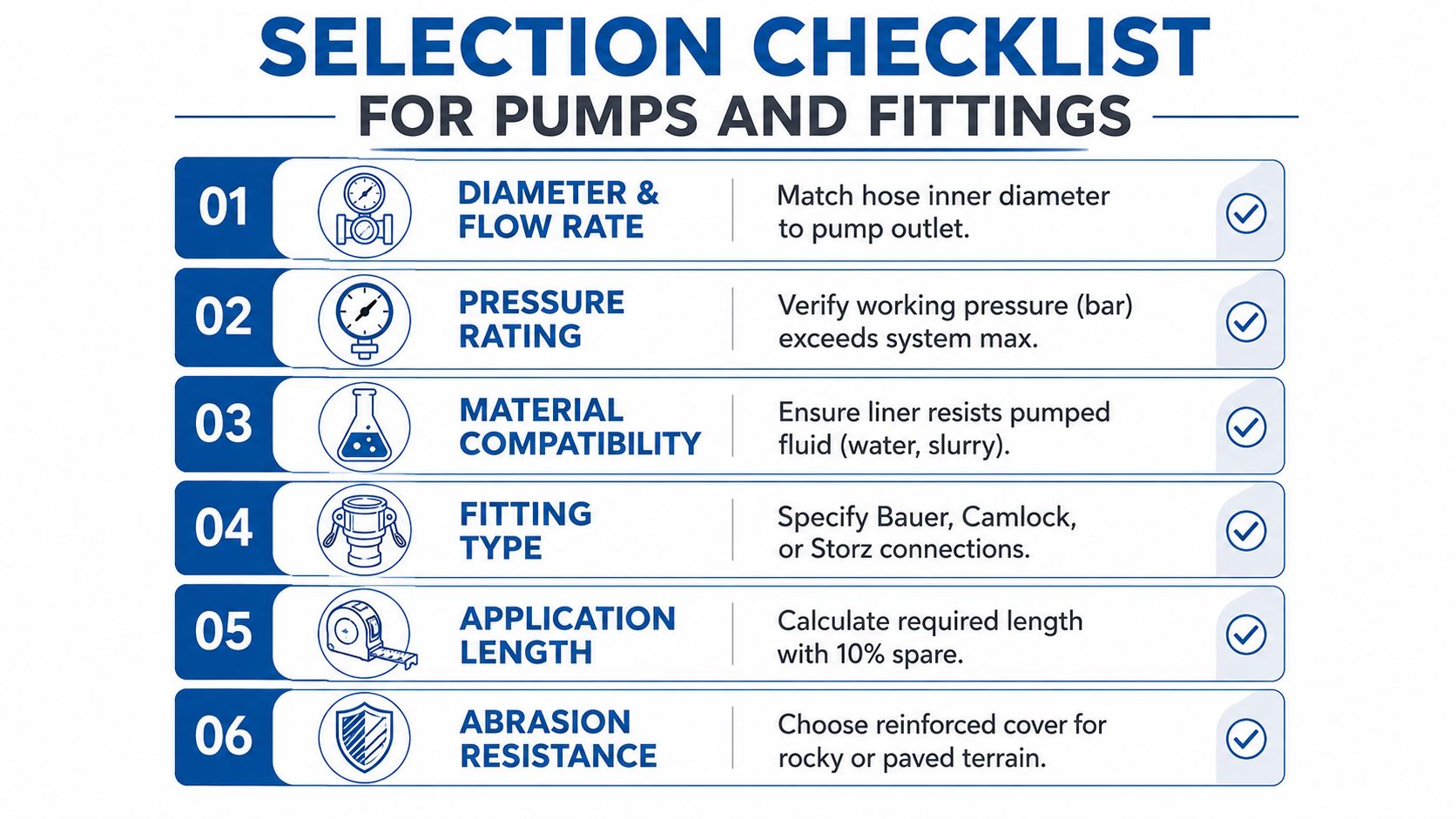
Buying lay flat hose as a standalone item is how mismatched systems happen. Site engineers need to start with the pump and the route, then work backwards to the hose size, fittings and materials that can survive the job. The right hose on the wrong coupler still leaks, and the right coupler on the wrong diameter still underperforms.
Match the hose to the duty, not the brochure
Start with the required flow rate, then check the total dynamic head and the pump’s discharge pressure. From there, confirm the fluid temperature range, liner compatibility and whether the run will sit in direct sun, on abrasive ground or near traffic. If the hose will cross concrete, hardcore or road edges, build abrasion protection into the specification from day one.
The hose diameter must suit the pump outlet, but oversizing and undersizing fail in different ways. Too small, and friction loss rises, flow drops and the pump works harder than it should. Too large, and the line can be awkward to manage, with more water retained in the hose and more material to handle every time the crew breaks the system down.
Get the fittings right first time
For UK hydraulic and agricultural systems, the common connection types are Bauer-type quick-release couplings, camlock fittings and threaded BSP adapters. The choice is usually about speed, compatibility and what the rest of the site already uses. If you’re trying to integrate with existing hose tails and pump outlets, the coupling standard matters as much as the hose material.
Coupling material should follow the environment. Aluminium is a sensible lightweight option for general agricultural handling, stainless steel belongs in corrosive or demanding environments, and brass remains a practical general-purpose choice for water transfer. A good specification lists the hose ID, coupling type, coupling material, and the liner material together, because those parts fail as a system, not in isolation.
Good ordering habit: specify the hose, the fittings and the seals together. A partial order creates delays, and on site delays turn into bodged connections.
Installation Best Practices and Coupling Methods
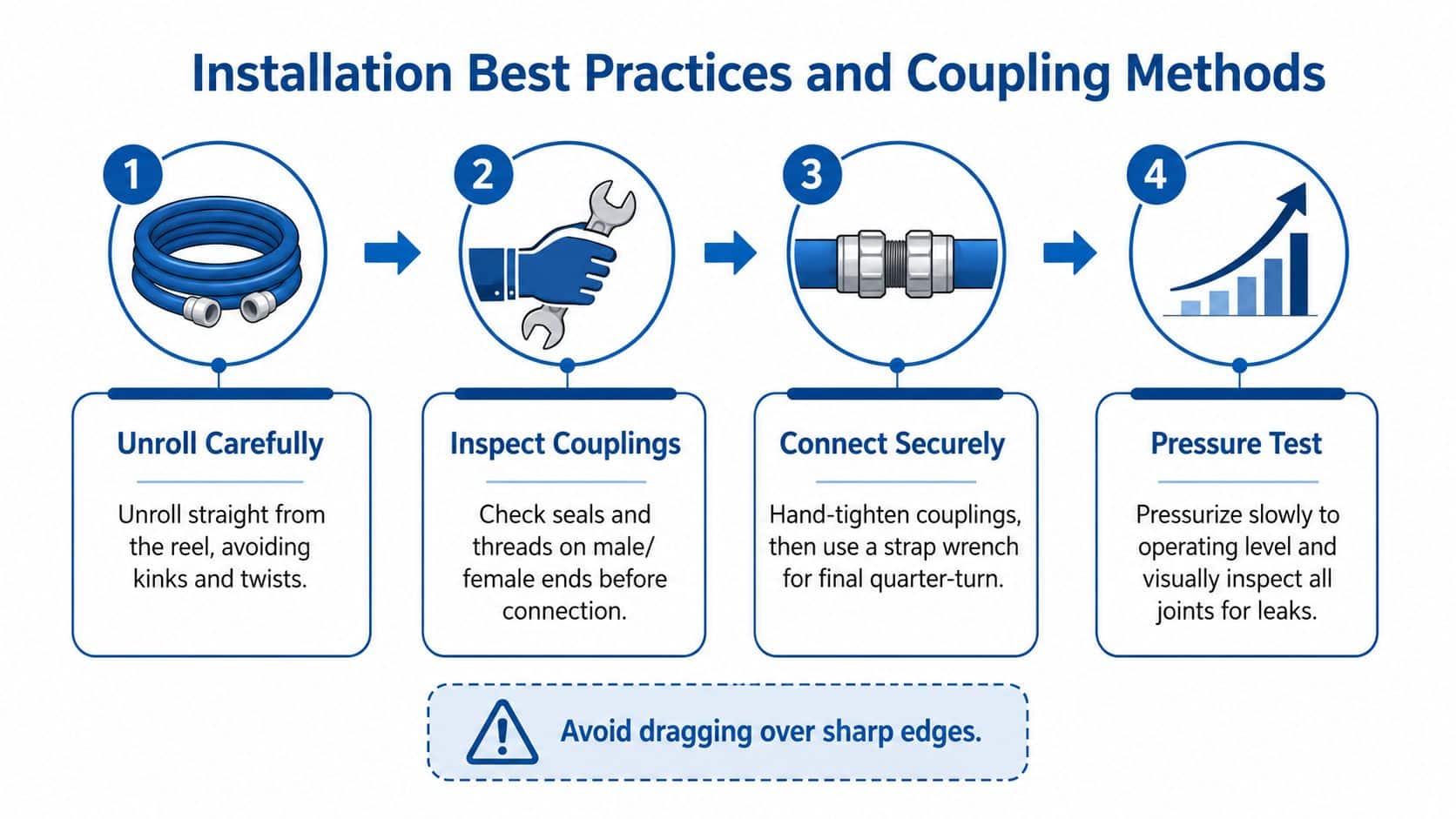
A lot of hose failures start before the pump even sees pressure. Someone drags the coil across grit, twists the reinforcement, or forces a coupling on at an angle, and the line pays for it later in leaks or jacket damage. Clean installation matters because the hose is flexible enough to make a mistake look harmless right up until the system is pressurised.
Unroll straight, then keep the run honest
Unroll the hose so the jacket lies straight and the reinforcement doesn’t carry a twist. Gentle curves are fine, sharp bends are not, because bends create local restriction and invite kinks when the line warms, cools or moves under flow. If the route needs to snake around obstructions, the better answer is usually to change the layout rather than to force the hose into a bad path.
The coupling types used in practice fall into three main patterns. External hose clamps with serrated tail fittings are common for straightforward water transfer, crimped ferrule couplings suit more controlled assembly, and quick-release Bauer or camlock connections speed up connect and disconnect work where frequent redeployment is expected. The joint must be fully seated, and the hose tail must be the right size for the bore, otherwise pressure finds the weak spot very quickly.
Protect the line where the site is rough
Road crossings need protection. Use hose ramps or bridging plates where vehicles or fork trucks may pass, because even short traffic exposure can crush or abrade the cover. At level changes, secure the hose so it doesn’t drag on edges or tension itself over a lip, since that repeated movement scuffs the jacket and eventually works into the reinforcement.
The practical note on clamps is simple. Tighten enough to seal, not enough to cut into the jacket. Overtightening damages the hose cover and makes the failure you were trying to prevent more likely.
Cam-lock fittings for hose systems are worth matching carefully when a job uses frequent make-and-break cycles, because speed is only useful if the seal survives the next pressure run.
Storage Inspection and Winter Protection
The longest-lasting hoses are not the fanciest ones, they’re the ones that get drained, cleaned and stored properly after each run. In the UK, the weak point is often winter. Water left trapped in the bore expands when it freezes, and that’s when liners split, fittings crack and jackets show damage that wasn’t visible the day before.
Drain it completely, then inspect the whole length
The right drainage routine is basic but effective. Raise one end, then walk the hose so residual water is pushed out of the line. That matters because trapped water is the main source of freeze-thaw damage in British winter conditions, especially where the hose was left with low spots or coils that hold pockets of water. UK winter weather remains variable, and freezing spells still recur, so a hose that survives summer abuse can still fail in cold storage if it’s not fully drained freeze-thaw and winter protection angle.
Inspection should focus on the failure signs that shorten service life. Look for liner delamination, abrasion at coupling joints, UV cracking on PVC surfaces and corrosion on metal fittings. If a hose shows repeated jacket scuffing at the same point, that usually means the installation method is the problem, not the material.
Store it so the next job starts clean
Roll the hose on a reel or fold it in a figure-eight pattern to avoid a hard set. Keep it in a dry, shaded environment, and don’t stack heavy items on top of it, because compression creates flat spots and permanent bends. A retractable hose reel solution also helps keep long runs tidy and more ready for the next deployment.
PVC and rubber do not age the same way in cold weather. PVC is the more brittle option in low temperatures, so if it’s flexed while frozen it’s more likely to crack. Rubber is generally more forgiving in winter storage, but it still needs proper drainage and shelter.
Best maintenance habit: treat hose storage as part of the job, not a separate task. Most winter damage starts with one skipped drain-down.
Common Failure Modes and When to Consider Alternatives
Lay flat hose is convenient, but convenience can hide costs. On farms and construction sites, the question isn’t whether it works, it’s whether it’s still the right answer once the ground gets rough, the route gets longer, or the line has to stay in service for weeks instead of hours.
What usually kills it
The common failure modes are predictable. Abrasion comes from dragging over rough ground, kinking cuts flow and stresses the wall, coupling blow-off follows poor assembly or pressure surges, liner blistering can appear when the fluid chemistry is wrong, and burst failure happens when the hose is pushed beyond its working pressure. Those are not exotic faults, they’re the usual result of mismatch between duty and design.
The road-crossing issue is the one many guides gloss over. A hose that would be fine on soft ground can fail quickly when fork trucks, trailers or plant traffic cross the line. At that point, the “cheap temporary hose” starts to look expensive because downtime, replacement and cleanup all land on the same job ticket.
When another option is the better buy
Rigid HDPE pipe makes more sense for longer-term installations where the route is fixed and the line is expected to stay put. Steel-reinforced suction hose belongs on vacuum duties, because lay flat hose is not built for suction service. Armoured hose is the better answer in high-traffic crossing zones where cover protection matters more than pack-down convenience.
The trade-off is real. Lay flat hose gives fast deployment and compact storage, but the lifetime cost can rise if you’re replacing it more often, losing water through joints, or patching damage from ground contact. There’s no virtue in using the easiest hose if the site conditions keep beating it up.
If the run is temporary and protected, lay flat hose is efficient. If it’s permanent, abrasive or vacuum duty, it’s usually the wrong tool.
Procurement Specifications and Standards
Good procurement language prevents most of the problems described above. A purchase order should state the internal diameter, minimum working pressure, burst pressure safety factor, liner material, jacket construction, coupling type and coupling material. For water service, a 3:1 burst pressure safety factor is the conventional reference point to ask suppliers about, and certification or test evidence should be part of the order rather than an afterthought.
Standards and approvals to ask for
For hydraulic hose references, BS EN ISO 1436 is relevant, and BS 3212 is commonly cited for flexible rubber tubing. If the application involves potable water contact, ask whether WRAS approval applies to the exact hose and fitting combination being proposed. That matters because a hose body and a fitting set are not automatically compliant just because one component is.
What to request before you sign off
Ask for test certificates and batch traceability, especially where the hose will support firefighting, critical pumping or potable transfer. That way, when a line arrives on site, you know what was supplied, what it was tested against, and how to trace it if the job later needs a warranty review or a replacement matching order.
The short version is straightforward.
- Specify the duty first: pressure, flow, temperature and fluid type.
- Match the coupling system: Bauer, camlock or BSP as the site standard demands.
- Confirm the material: PVC, rubber-lined or reinforced synthetic based on wear and weather.
- Ask for traceability: test evidence and batch records for critical jobs.
- Plan for the site: traffic, frost, storage and replacement cycles all affect value.
Phone 01724 279508 today, or send us a message through the MA Hydraulics contact page
