
A maintenance team can lose hours because a replacement fitting looks right in the catalogue but belongs to a different pipe system. The label says 16mm compression fitting, the tube appears to be the same diameter, and the connection may even assemble cleanly. Yet an irrigation fitting, a potable-water fitting, a heating-system component and a hydraulic fitting can have different materials, sealing methods, pressure limits and approval requirements.
That distinction matters in UK installations. The correct choice depends on the tube's actual outside diameter, the fluid being carried, the operating temperature, pressure cycles, water chemistry and whether the connection is subject to potable-water regulations. A fitting that works well on an irrigation line isn't automatically suitable for a domestic water supply or high-pressure fluid transfer.
Understanding the 16mm Compression Fitting in UK Systems
A 16mm compression fitting joins tube mechanically. Unlike a soldered copper joint, it doesn't require heat, flux or a permanent bonded connection. That makes it useful for maintenance work, modular assemblies and repairs where draining, isolating or removing nearby components must be straightforward.
The basic joint consists of a fitting body, compression nut and olive. The tube passes into the body, while the nut drives the olive against the tube and the internal shoulder of the fitting. As the nut tightens, the olive grips the tube and forms the seal. The result depends on the tube remaining round and undamaged, rather than on the nut being tightened as hard as possible.
What 16mm actually identifies
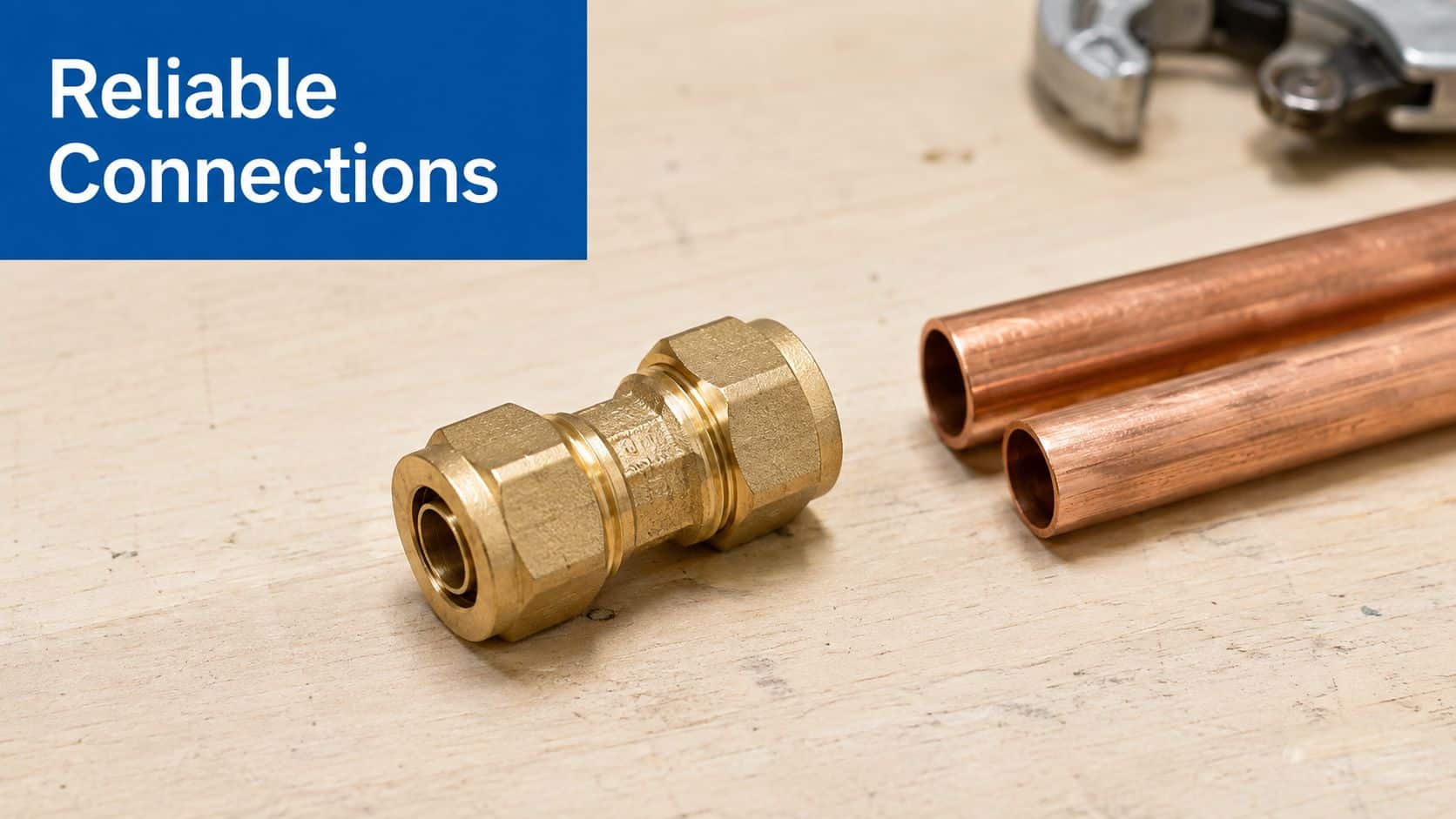
In most UK product descriptions, 16mm refers to the tube outside diameter, but that assumption still needs checking. A 16mm copper tube, 16mm plastic tube, PE tube, PEX, MLCP and hard tube for a specialist application may not use the same olive, insert, seal or fitting body. A product described as 16mm may also refer to a connection that transitions to a separate thread size, rather than a fitting with 16mm tube ends on both sides.
That's why procurement should start with the tube specification, not the product title. Confirm the material, outside diameter, wall construction and intended service before comparing price or delivery.
Practical rule: Treat “16mm” as a dimensional starting point, not proof of interchangeability.
Why the fitting remains useful
Compression joints are valuable where engineers need a serviceable connection without welding or soldering. Straight couplers can repair or extend a run, elbows can change direction in a confined enclosure, and tees can feed a branch to an actuator, manifold or auxiliary circuit. Their mechanical construction also makes inspection and replacement more accessible than many permanently joined alternatives.
That convenience has limits. A compression fitting won't correct an oval tube, compensate for the wrong material or make a non-approved component legal for potable water. It also shouldn't be selected for hydraulic duty merely because the tube enters the fitting and the thread appears compatible.
The reliable approach is to match tube outside diameter, material class, seal design and application approval as one specification. If any of those details remains uncertain, the fitting should be held back from installation until the manufacturer's data sheet or an experienced technical supplier confirms the connection.
Navigating UK Standards and Material Compliance
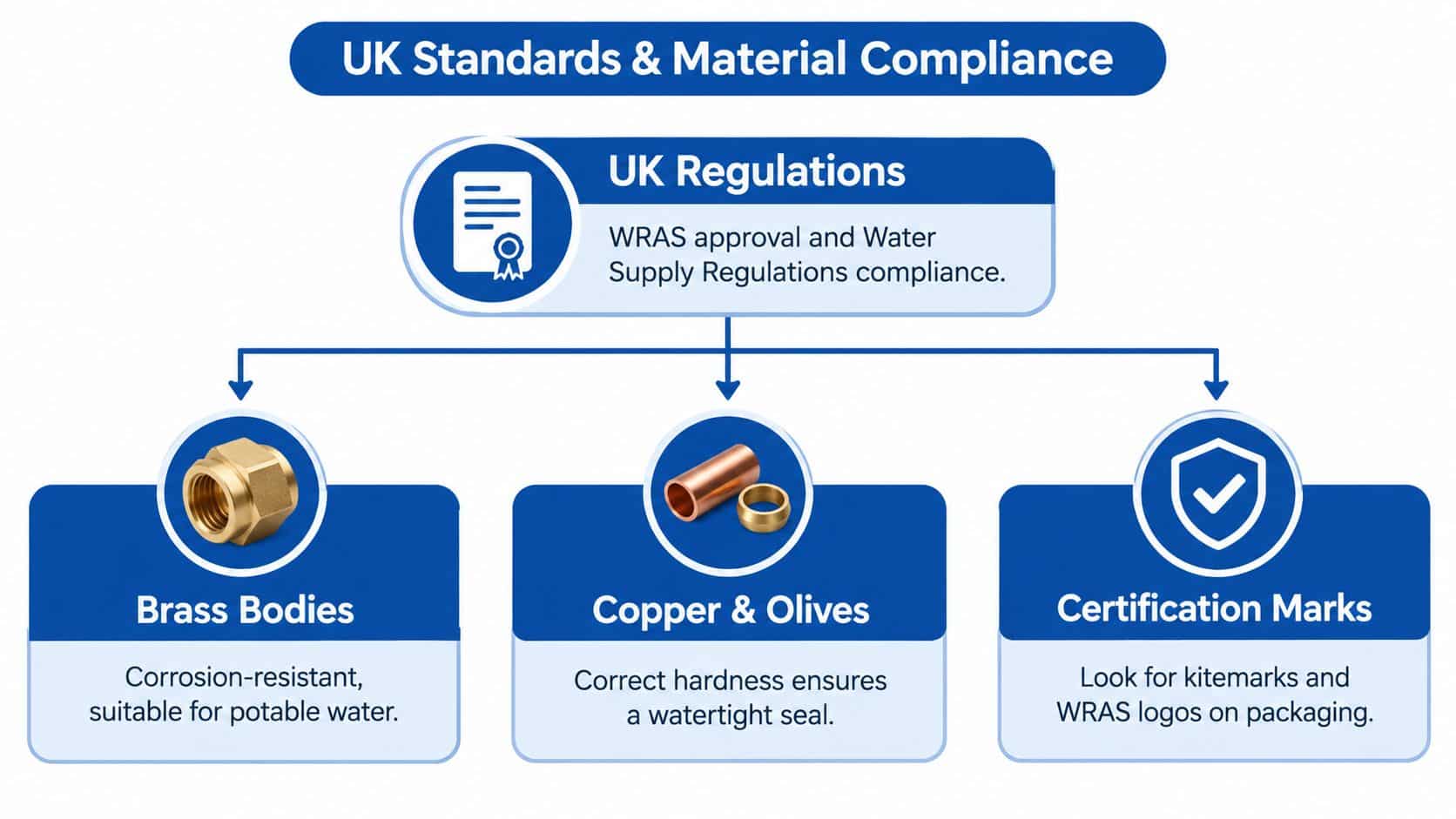
For UK engineers, compliance begins with identifying what the fitting is intended to join. BS EN 1254-2 covers copper alloy compression fittings for copper tube, and its fitting ends range from 6mm to 108mm, placing 16mm comfortably within the recognised copper plumbing size range. The standard is described through the EN 1254-2 requirements for copper alloy compression fittings.
The wider UK compression-fittings framework also relates to the former BS 864 Part 2 specification. These fittings are designed to join copper or stainless-steel tube without heat, and the bore must avoid internal fins or irregularities that restrict flow. The 1999 revision addressed service temperature, screwed-end thread requirements, materials, minimum bore dimensions and marking on fittings 12mm and larger, which makes identification and traceability particularly relevant for 16mm components. The BS 864 Part 2 standard document provides the technical background.
Type A and Type B construction
The sealing method changes the way the fitting behaves during assembly. The EN 1254 family distinguishes:
- Type A, which uses sealing elements and is classed as non-manipulative.
- Type B, which has no sealing elements and is classed as manipulative.
That distinction affects how the fitting grips and seals the tube. A buyer who orders only by diameter can receive the wrong construction for the intended pipe material or installation method. The EN 1254 information on Type A and Type B compression constructions is useful when reviewing technical documentation.
WRAS and regulated water installations
The Water Supply (Water Fittings) Regulations 1999 govern water fittings in England and Wales. UK guidance restricts concealed mechanical joints unless they remain accessible, so a fitting's installation location matters as much as its material. The UK compression-fitting compliance guidance also distinguishes fitting types by pipe material and use case, including metal compression on plastic tube and plastic compression on plastic tube.
For a potable-water installation, look for a relevant WRAS approval and confirmation that the product is manufactured for the required standard and pipe material. A component sold for irrigation or general mechanical service can be unsuitable for drinking-water systems even if its dimensions appear correct. Procurement records should retain the approval information, product code and application limits rather than relying on a catalogue description alone.
If the fitting transitions between metric tube and a threaded port, verify the thread separately. A useful example is this 1/4 BSP to metric connection range, but the thread size must still be checked against the valve, manifold or equipment port.
Comparing Fitting Types and Material Options
The geometry should follow the layout and service conditions, while the material should follow the fluid, environment and compliance requirements. A straight coupler suits a direct repair or extension. An elbow helps route tube around a machine frame, enclosure or manifold, while a tee creates a branch for an instrument, actuator or secondary circuit.
A bulkhead connector is different. It passes through a panel or tank wall and needs correct access, sealing and mechanical support on both sides. In mobile plant, the connector must also tolerate movement and vibration without transferring excessive load into the tube.
Choosing the shape
Straight couplers are usually the simplest choice for joining two aligned lengths of compatible tube. They're easy to inspect, but they don't solve poor routing or side loading.
Elbows can improve hose and tube routing, although an unnecessary change of direction adds another joint and another potential maintenance point. Use one where it prevents a tighter bend or protects the tube from chafing.
Tees are practical for branches, but the branch should be supported where vibration or equipment movement could load the fitting. A tee fitted directly to a vibrating component can fail because of mechanical stress even when the compression seal was assembled correctly.
Bulkhead connectors work well for panels, reservoirs and fabricated manifolds. Confirm panel thickness, access for tightening and the sealing arrangement before ordering.
Selecting brass, DZR brass or stainless steel
Standard brass is widely used for compatible water and general service applications. DZR brass is the safer choice where water chemistry creates a dezincification risk, including soft water, low pH or raised chloride conditions. Stainless steel offers stronger corrosion resistance for demanding environments, although the tube, olive, thread and connected equipment must still be compatible.
| Material | Corrosion resistance | Ideal application | WRAS / potable suitability |
|---|---|---|---|
| Standard brass | Suitable for compatible general service, subject to water chemistry | Static plumbing, utility circuits and suitable mechanical assemblies | Use for potable water only where the specific product has the required approval |
| DZR brass | Better protection where aggressive water chemistry increases dezincification risk | Potable-water installations and challenging water conditions | Appropriate only when the individual fitting carries the required approval |
| Stainless steel | Strong resistance in corrosive or demanding environments | Mobile equipment, exposed plant and applications where vibration or contamination is a concern | Confirm the product’s approval and tube compatibility before potable-water use |
The key procurement mistake is treating material names as complete specifications. A DZR label doesn’t confirm the correct olive for plastic tube, and stainless steel doesn’t remove the need to check pressure, temperature or sealing design.
For hydraulic applications, review port configuration, tube material and sealing method alongside the circuit duty. The hydraulic fittings types guide can help organise that selection, but the component manufacturer’s data remains the final authority for a particular assembly.
Irrigation products deserve separate treatment. Many are designed around PE or other plastic tube and may use different gripping arrangements from copper plumbing fittings. They shouldn’t be substituted into potable or high-pressure systems just because the outside diameter is described as 16mm.
Precision Measurement and Installation Best Practices
Most failed compression joints begin before the spanner is picked up. The installer has selected a fitting for the wrong tube, cut the end at an angle, left a burr inside the bore or tightened the nut without checking whether the tube has remained round.
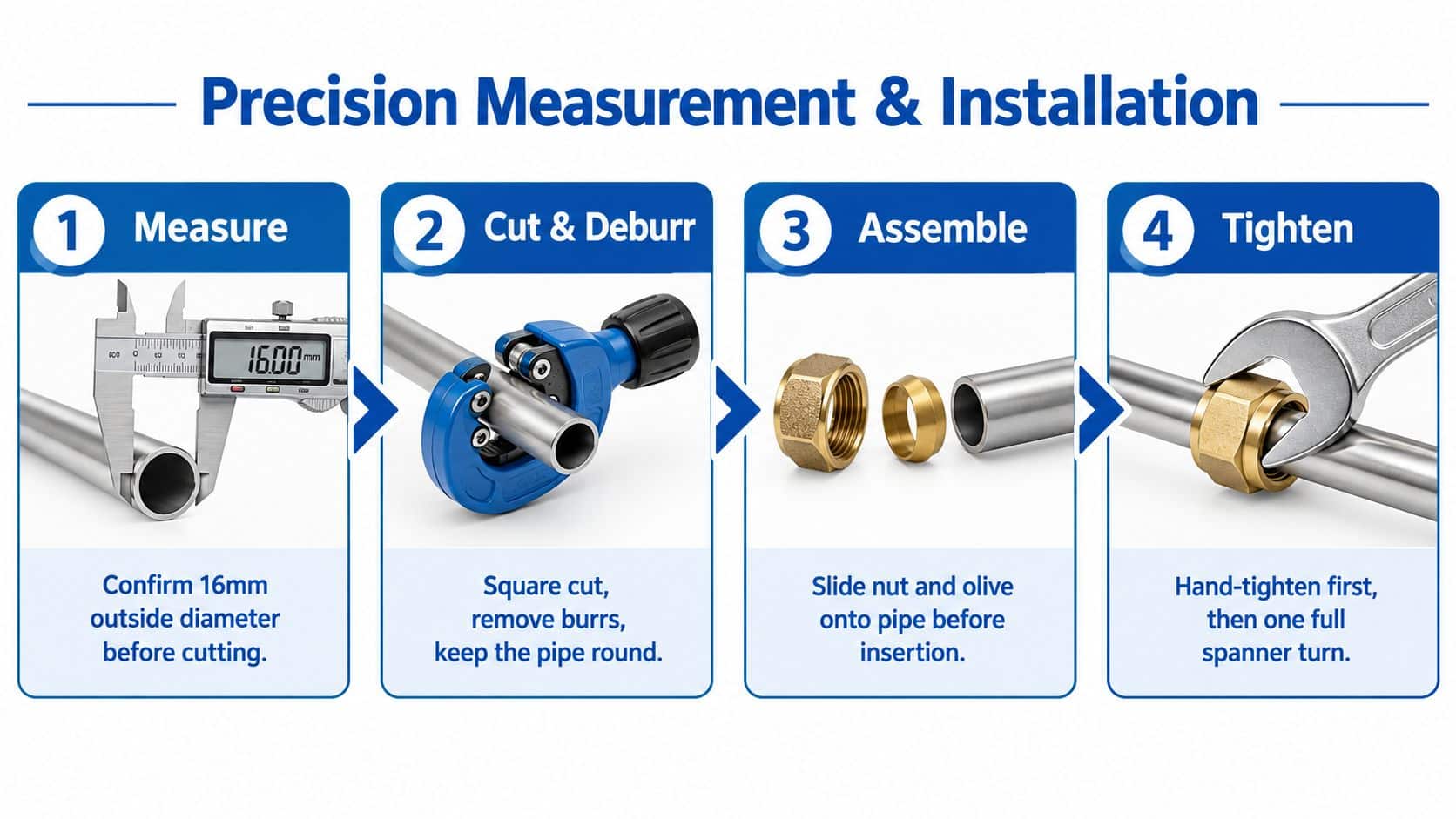
Start by measuring the tube itself. Use vernier callipers to confirm the outside diameter, then check the pipe material and wall construction. Don’t confuse a 16mm tube connection with a 16mm thread. Thread designation, tube diameter and fitting-end size are separate pieces of information.
Prepare the tube properly
-
Measure the undamaged tube. Take the measurement away from crushed, scratched or previously compressed sections. If the tube is visibly oval, cut back to sound material or replace it.
-
Cut squarely. Use a suitable pipe cutter or sharp tube cutter. An angled cut reduces the contact area and can prevent the tube from seating fully inside the fitting body.
-
Deburr the end. Remove internal and external burrs without removing excessive material. A clean edge protects seals and lets the tube enter without shaving material from the olive or insert.
-
Clean the surface. Remove dirt, swarf, paint and oxidation from the sealing area. Don’t use an abrasive method that scores the tube where the olive must grip.
Assemble without damaging the seal
Slide the nut onto the tube first, followed by the olive in the correct orientation. Push the tube fully into the fitting body, then bring the nut forward by hand. If the tube doesn’t enter smoothly, stop and investigate rather than forcing it.
The olive must deform onto the tube under controlled tightening. Under-tightening can leave a joint that seeps during pressure cycling, while over-tightening can crush soft copper or deform plastic tube. Excessive force can also damage the thread or distort the olive, leaving the joint less reliable than one tightened to the manufacturer’s specified method.
Installation check: After assembly, hold the fitting body with one spanner and tighten the nut with another. Don’t use the connected tube as a lever.
Where copper tube is required, confirm that the product and tube are matched before installation. The 3/8 copper tubing range illustrates why tube specification must be checked independently from the fitting description.
Test the finished joint before closing access panels or burying the connection. Inspect for movement, weeping and tube distortion, then retest after the system reaches its normal operating condition. A dry joint during static assembly isn’t proof that it will remain sound under vibration, thermal movement or pressure cycling.
Troubleshooting Pressure Limits and Environmental Failures
A PN16 marking isn’t a universal guarantee for every 16mm installation. It describes a pressure class for a particular product and application, but the actual limit can be controlled by the tube material, temperature, seal design, connection method and pressure transients.
UK WRAS listings show that 16mm compression fittings for plastic tube are commonly rated at a maximum working pressure of 10.0 bar at 95°C, while BS EN 1254-based brass water fittings are commonly rated at around 25 bar. These values come from different product and material classes, so they demonstrate why nominal size alone doesn’t determine the pressure envelope. The WRAS approvals directory for 16mm compression fittings should be checked against the exact product rather than used as a blanket rating.
Product literature can also show different limits for apparently similar fittings. Neutral UK supplier information identifies PN16 as common for PE, irrigation and many mechanical fittings, while brass compression fittings based on BS EN 1254 are commonly rated around 25 bar at 0 to 95°C for 8 to 15mm sizes. The 16mm brass compression elbow specification provides an example of why material and product construction must be read together.
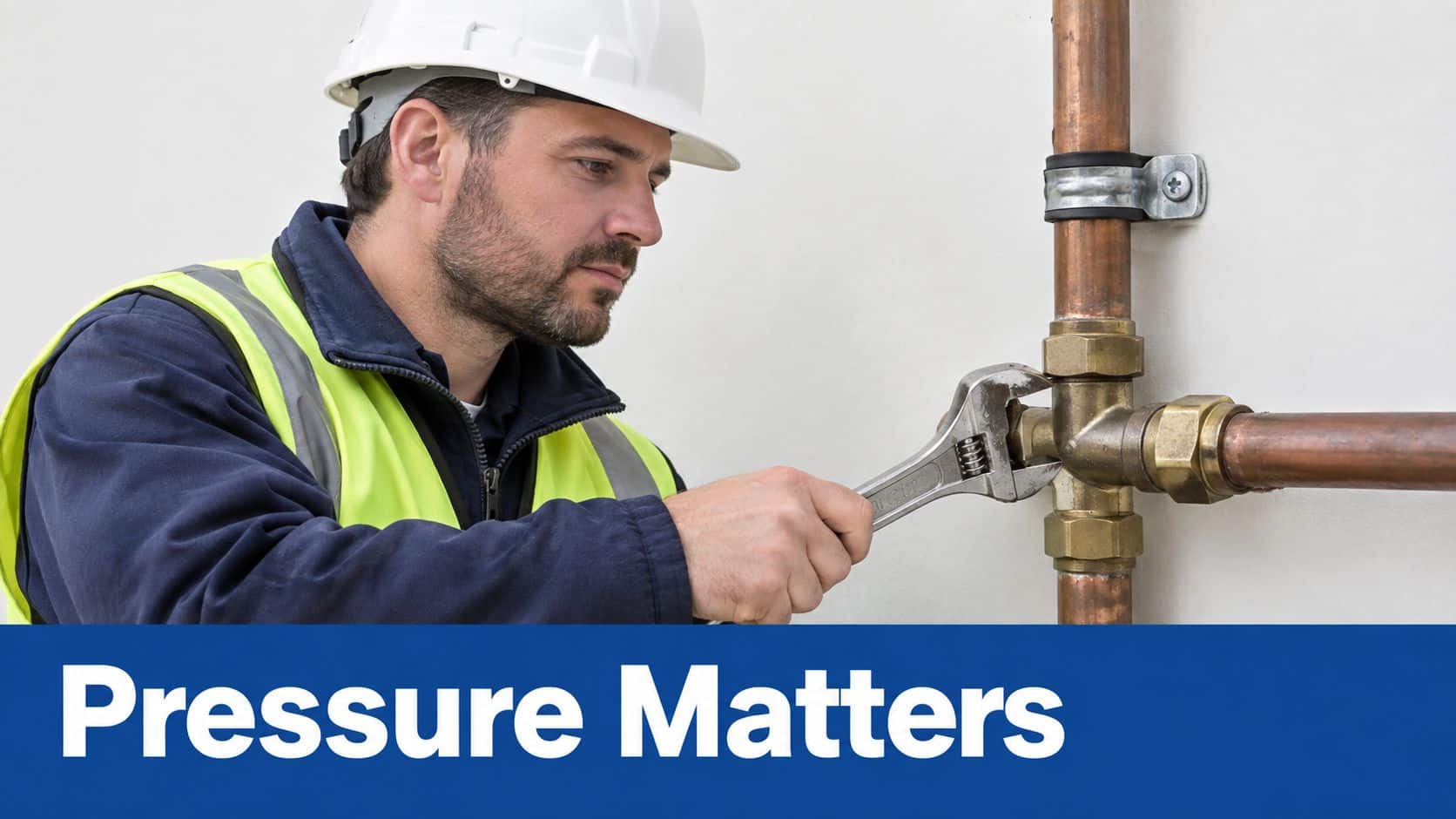
Diagnose the actual failure mode
A leak at the nut often points to poor tube preparation, an incorrectly positioned olive or insufficient tightening. If tightening doesn’t stop the leak, repeatedly adding force can make the problem worse. Isolate the circuit, dismantle the joint and inspect the tube for scratches, ovality, crushing and an incomplete insertion mark.
A fitting that slips under vibration may have the wrong olive or may be installed on tube outside the manufacturer’s permitted material range. Mobile and agricultural equipment can also impose side loads that a static plumbing assembly never experiences. Support the tube, reduce movement and consider whether a flexible section is needed before the compression joint.
Water hammer creates short pressure surges that can damage an otherwise acceptable connection. Fast valve closure, pump cycling and actuator movement can transmit shock through a compact circuit. The fitting’s nominal pressure class won’t remove the need to control those transients.
Consider temperature and water chemistry
Underfloor-heating circuits and other heated systems subject tube and fittings to repeated expansion and contraction. The joint needs a compatible tube, olive and fitting design, with routing that avoids loading the connection as the system moves.
Aggressive water chemistry introduces a different failure path. Soft water, low pH and high chloride levels can increase dezincification risk in vulnerable brass. DZR brass may be the appropriate material choice, but only when the complete fitting is specified for the application and any potable-water approval requirement is satisfied.
Galvanic effects can also appear where dissimilar metals are combined in damp or contaminated environments. Review the complete assembly, including tube, fitting, brackets, threaded adapters and connected equipment, rather than judging the compression body in isolation.
Sourcing Reliable Components and Expert Assembly Support
A sound purchase order should describe more than “16mm compression fitting”. It should identify the tube outside diameter, tube material, fitting geometry, thread or port arrangement, fluid, pressure and temperature conditions, approval requirement and installation environment.
Use a procurement checklist
Before releasing an order, confirm:
- Tube identity: Is the tube copper, stainless steel, PE, PEX, MLCP or another material?
- Actual dimension: Has the outside diameter been measured rather than assumed from a nominal description?
- Application boundary: Is the fitting for potable water, heating, irrigation, mobile hydraulics or another service?
- Approval status: Does the exact product have the required WRAS approval where regulated water service demands it?
- Material choice: Is standard brass adequate, or does the water chemistry justify DZR brass or stainless steel?
- Pressure and temperature: Do the product limits cover normal operation, cycling and foreseeable surges?
- Joint construction: Is the olive, seal or insert intended for the selected tube?
- Installation access: Can the joint be assembled, inspected and maintained where it will be installed?
- Traceability: Will the supplier provide a clear part number and technical data for future replacement?
The cheapest component can become the expensive option if the team has to drain a system, replace damaged tube, investigate repeated leaks or remove a non-compliant fitting from an inaccessible location. Procurement should compare total service risk, not just the unit cost.
Specialist support is particularly useful when a replacement has an unfamiliar metric dimension, a mixed thread arrangement or a discontinued part number. A supplier with hydraulic and fluid-system experience can cross-reference the connection, identify whether the original component was intended for copper or plastic tube, and advise whether a direct replacement is sensible.
That support also matters for assemblies rather than individual fittings. Manifolds, power packs and mobile circuits may need coordinated choices for valves, pumps, filters, gearboxes, couplings and connection hardware. A fitting that looks correct in isolation can still create a restriction, maintenance problem or compatibility issue once installed in the complete system.
Use the same discipline for stock control. Keep approved plumbing components separate from irrigation and hydraulic items, record the tube standard against each part number and avoid mixing olives or nuts from different systems unless the manufacturer confirms compatibility. Clear labelling prevents a familiar-looking 16mm component from entering the wrong maintenance kit.
MA Hydraulics Ltd supports component selection, hard-to-find part identification, cross-referencing and bespoke hydraulic assemblies for mobile and industrial applications. That type of technical conversation is useful when a standard catalogue part doesn’t fully match the tube, pressure regime or equipment connection.
Call 01724 279508 today to discuss a 16mm compression fitting, replacement connection or bespoke fluid-system requirement with the MA Hydraulics Ltd team. You can also visit MA Hydraulics Ltd or send a message for help matching the component to your application.
