
The tractor's oil level is low, there's work waiting, and the drum on the workshop shelf says hydraulic oil. It's tempting to top up and get moving. Before you remove the filler cap, though, you need to know which circuit you're filling and what the tractor manufacturer requires.
Choosing hydraulic transmission oil for a tractor isn't just a matter of finding a familiar viscosity. The safe choice starts with the machine's design, then its specification, and finally the condition of the oil already inside.
Why the Wrong Tractor Oil Causes Problems
Consider a workshop scenario: an operator tops up a tractor with a product intended for hydraulic use because the label looks close to the oil previously bought. The filler serves a combined gearbox, hydraulic and wet-brake system. The operator has matched a broad description, not the complete requirement.
The tractor might still lift an implement, but that doesn't establish compatibility. An unsuitable fluid can cause wet-brake squeal or chatter, clutch engagement problems, gear wear or inadequate hydraulic-pump protection. These are different operating demands, not interchangeable measures of whether an oil is slippery enough.

Start with the circuit, not the drum
A separate hydraulic reservoir presents a different decision from a shared transmission sump. Buying the same oil for both may simplify stock control, but workshop convenience isn't evidence that the formulations are interchangeable.
Practical rule: Identify the reservoir and find its handbook requirement before comparing viscosity labels or prices.
That discipline matters when operators are maintaining existing machines rather than replacing them. UK tractor registrations above 50 hp fell to 8,791 units in 2025, down 14.2% from 2024, which the Agricultural Engineers Association described as its lowest recorded annual total since monitoring began, according to Agriland's report on AEA registration figures.
Slower fleet renewal makes careful maintenance of established equipment particularly relevant. However, neither age nor appearance tells you which oil belongs inside a tractor. If the handbook is missing, obtain the requirement from the manufacturer or a competent technical adviser rather than treating the nearest available drum as a substitute.
Understanding Tractor Oil Functions
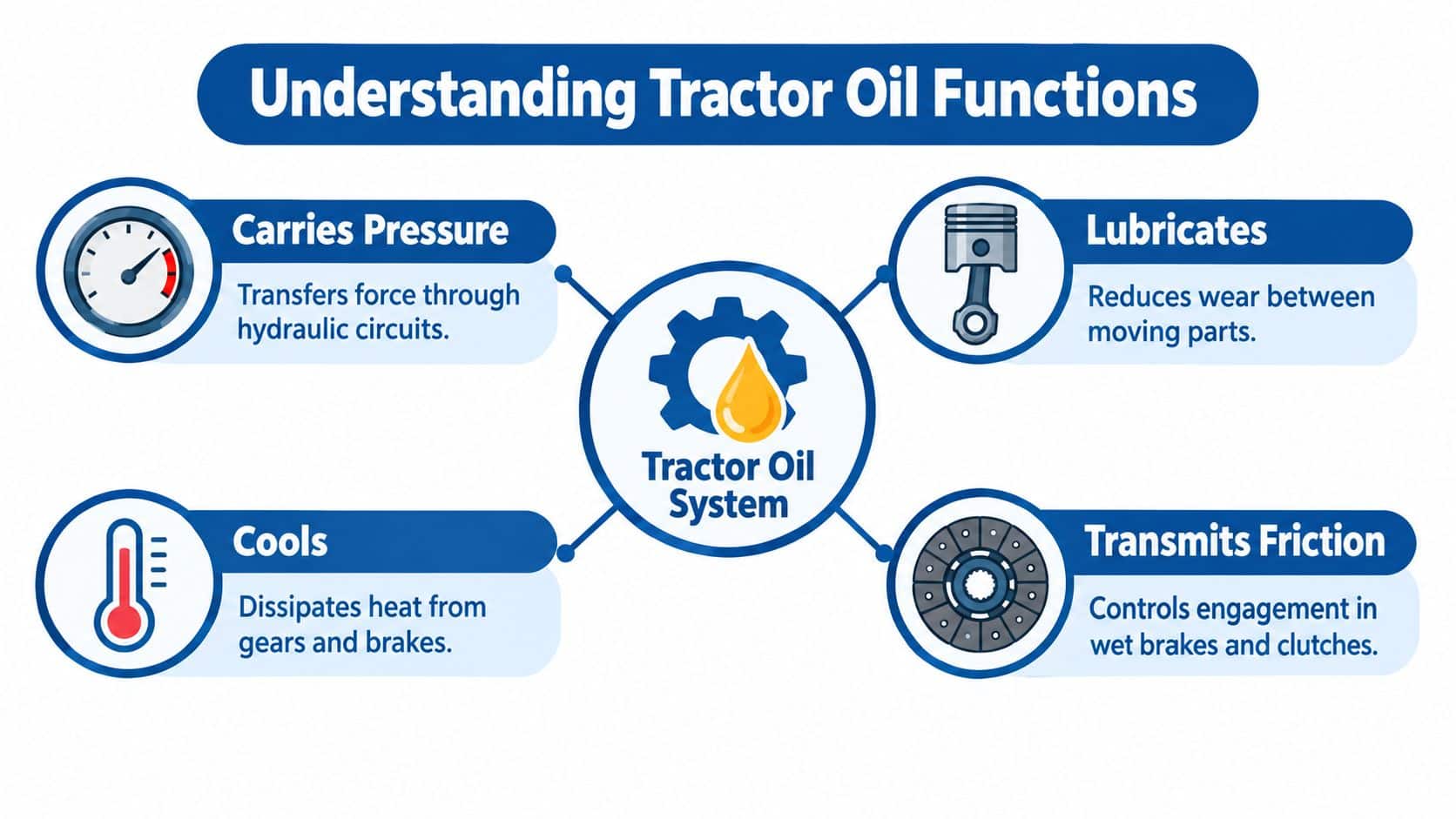
Think of the oil circuit as a delivery network. The pump sends fluid where force is needed, while that same fluid may pass through components requiring lubrication, cooling and controlled engagement. In a combined system, the oil must perform those jobs together.
The functions are related, but they aren't identical. Reducing wear at a pump doesn't automatically demonstrate suitability for gears, and lubricating gears doesn't prove that an oil has the hydraulic protection or brake-friction behaviour a particular machine needs.
Understand the jobs behind the names
Hydraulic oil describes a fluid selected principally for a hydraulic circuit. Tractor transmission oil is a broader description that needs further qualification. Neither phrase, by itself, identifies every performance requirement of a specific tractor.
Universal Tractor Transmission Oil, usually shortened to UTTO, is the relevant family for many combined agricultural systems. In a tractor sharing a sump between the gearbox, hydraulics, final drives, wet brakes and PTO clutch, the correct choice is generally manufacturer-approved UTTO rather than generic anti-wear hydraulic oil. A UK UTTO technical data sheet describes these combined applications and representative manufacturer specifications.
- Pressure transfer: The fluid carries force through the hydraulic circuit.
- Lubrication: It protects moving components, including pumps and gears where specified.
- Cooling: It carries heat away from working components.
- Controlled friction: It supports the intended engagement of oil-immersed brakes and clutches.
Wet brakes make the last function especially important. They need not only the lowest possible friction. They need the friction behaviour their designer intended.
Treat specialist terminology carefully
You may also encounter TDTO, meaning Tractor Drive Train Oil, and TO-4-style performance descriptions in specialist drivetrain discussions. Treat these as prompts to investigate a product's intended application, not as alternative spellings of UTTO.
Terminology varies between manufacturers and markets. The useful question isn't whether a container says tractor oil, but whether its documented performance covers the jobs required by the particular circuit you're servicing.
Comparing UTTO TDTO and Hydraulic Oils
A sensible comparison starts with the components the oil must serve. Does the circuit contain only hydraulic equipment, or must the fluid also protect loaded gears and control brake or clutch engagement?
The following table is a screening tool, not an approval list. Use it to decide which product documentation to request, then compare that documentation with the machine requirement.
Tractor oil families compared
| Oil family | Typical circuit role | Hydraulic and gear needs | Wet-brake and clutch relevance | Selection warning |
|---|---|---|---|---|
| UTTO | Combined agricultural transmission and hydraulic duties where specified | Intended to combine hydraulic protection with transmission duties | Controlled friction is central to the intended application | Universal doesn’t mean suitable for every machine |
| TDTO | Specialist tractor drivetrain applications identified by the manufacturer | Check the individual product’s stated drivetrain and hydraulic capabilities | Confirm suitability for the particular brake or clutch arrangement | Don’t assume equivalence to agricultural UTTO |
| TO-4-style products | Applications calling for the stated specialist drivetrain performance | Assess the documented performance against the equipment requirement | Application-specific friction requirements still govern | A classification claim isn’t blanket OEM approval |
| Anti-wear hydraulic oil | Dedicated hydraulic reservoirs where specified | Hydraulic protection doesn’t establish transmission gear suitability | Don’t infer wet-brake compatibility from hydraulic suitability | Match the complete hydraulic specification, not just viscosity |
| Other transmission oils | Particular gearbox or transmission applications | Gear performance must be assessed separately from hydraulic needs | Compatibility depends on the specified formulation | Transmission oil is too broad a description for purchase |
Compare evidence rather than marketing breadth
A label listing many applications can be useful, but it isn't the end of the assessment. Ask whether the manufacturer's required specification appears in the current technical data sheet and whether the supplier can explain the basis of that claim.
For background on the broader categories, the guide to hydraulic fluid types can help you distinguish fluid families before checking a specific application.
A shorter product list is useful only when every circuit on that list has been checked.
Standardising stock can be a reasonable workshop objective. Make it the result of a compatibility review, not the starting assumption. Keep exceptions clearly labelled so that a dedicated hydraulic circuit or specialist transmission doesn't receive the fleet's usual oil by habit.
Price belongs at the end of this comparison. Compare prices between products that demonstrably meet the requirement, rather than using a cheaper product's broad description to justify an unsupported substitution.
Matching Viscosity and OEM Approvals
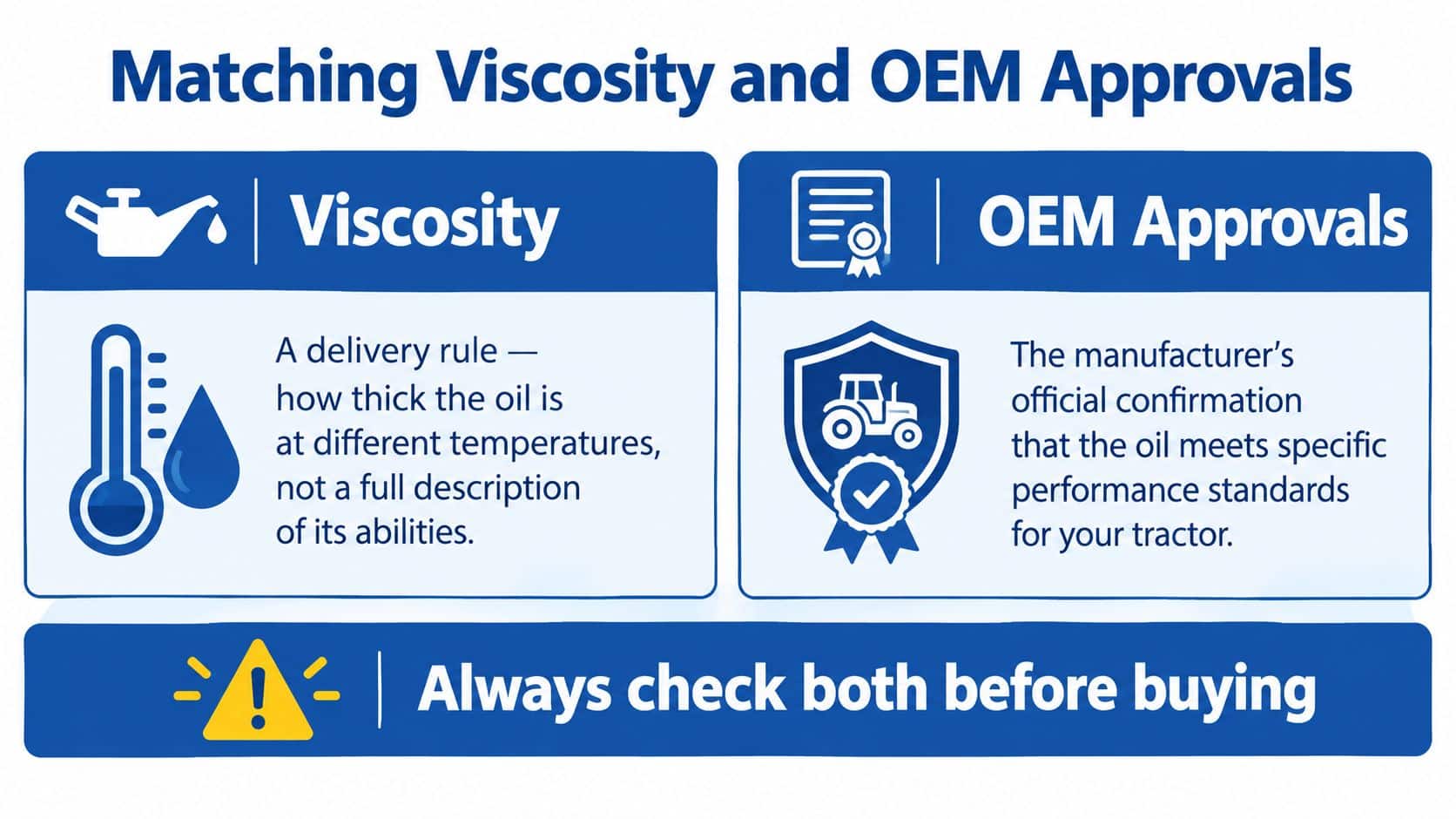
Viscosity describes how an oil flows, not everything it can do. Think of it as a delivery rule: it affects how the fluid reaches working components, but doesn't describe the full protective and frictional performance of what arrives.
This distinction explains why apparently similar labels can lead to different choices. A viscosity designation and a manufacturer specification answer different questions.
The visual guide separates those checks.
Read each label statement for its own purpose
An example tractor-fluid specification combines SAE 10W-30, John Deere J20C approval and API GL-4 performance, illustrating why viscosity alone doesn't define compatibility, as outlined in this agricultural equipment fluid-selection guide.
Those statements aren't substitutes for one another. The SAE designation concerns viscosity, the API designation concerns gear performance, and the OEM specification identifies an equipment-related performance requirement.
- Viscosity grade: Check the handbook's grade and operating-temperature guidance.
- Performance classification: Identify the required hydraulic or gear-performance standard.
- Friction requirements: Confirm suitability for the specified wet brakes and clutches.
- OEM approval or specification: Match the exact requirement and verify the supplier's supporting documentation.
An ISO VG 46 label mustn't be treated as an interchangeable approval standard for a tractor fluid carrying an SAE viscosity designation. Matching a number, or finding a conversion chart, doesn't establish the additive performance required by the transmission.
Verify substitutions in writing
Temperature, duty cycle and machine age all belong in the application discussion. A mixed fleet may contain equipment designed around different requirements, so don't infer that the newest product is automatically the correct replacement for an older specification.
Use a hydraulic oil cross-reference as a starting point for checking alternatives, not as permission to overlook a missing approval. Ask the supplier to identify the current product and confirm its suitability against the handbook requirement.
For supplementary viewing alongside the written specification checks:
Keep that confirmation with the service record. It's more useful at the next oil change than a note saying only hydraulic oil added.
Choosing Oil by Tractor Circuit
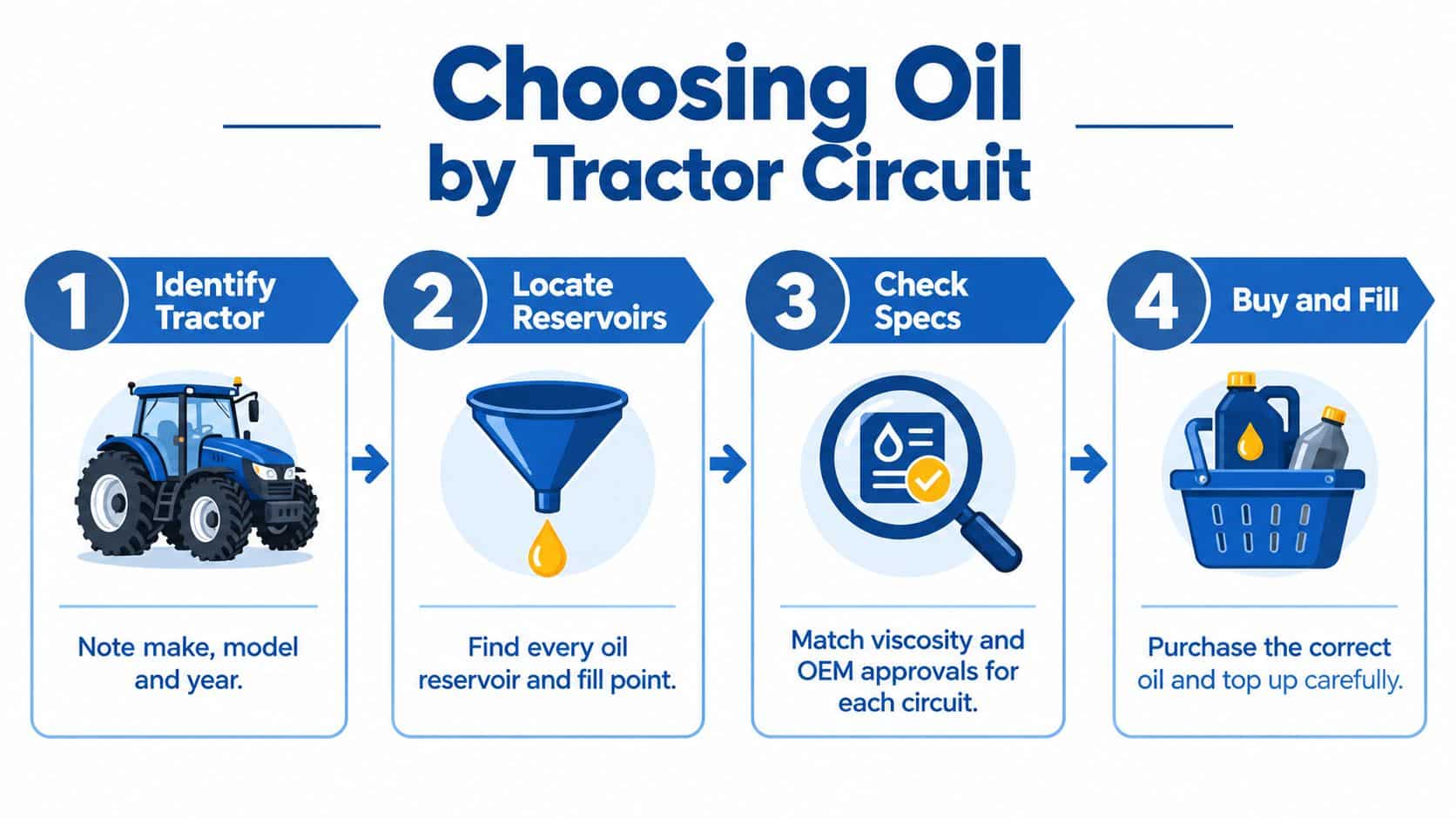
Start at the machine rather than the stock cupboard. Record the tractor's make, model, year and identifying details, then obtain the relevant operator's handbook and any documentation for modified equipment.
Walk around the tractor and locate the reservoirs, filler points, level indicators and service points. Don't assume that nearby components share oil, or that similar-looking filler caps serve the same system.
Build a reservoir-by-reservoir record
Write down which components each reservoir serves. For the main tractor system, establish whether the gearbox, hydraulic services, PTO clutch, final drives and wet brakes draw from a common sump.
Then check the exceptions. A loader, steerable axle system or retrofitted hydraulic installation needs its own documentation check. A familiar tractor badge doesn't identify the requirements of equipment fitted later.
- Trace the supply: Establish where the pump draws oil from and where return oil goes.
- Identify connected components: Record any brakes, clutches or gears within that circuit.
- Copy the requirement: Capture the handbook's fluid specification, viscosity and service instructions.
- Resolve uncertainty: Ask the equipment manufacturer or installer about undocumented modifications.
A dedicated hydraulic reservoir should be assessed against its own stated anti-wear hydraulic requirement. Don't move the main transmission recommendation across to it without confirming that the same product is acceptable.
Make purchasing traceable
Create a simple circuit record that stays with the machine. Include the selected product name, required specification, relevant handbook reference and the supplier's compatibility confirmation where a substitution has been proposed.
Before ordering, check:
- Correct destination: The order identifies the reservoir or circuit being serviced.
- Documented match: The current product data supports the required specification.
- Existing fill: You know what's already installed, or have a plan to resolve that uncertainty.
- Service materials: The correct filters and clean handling equipment are available.
Label workshop dispensing equipment to match the approved circuit record. This gives the person topping up a practical instruction, rather than expecting them to repeat the whole selection exercise while a machine is waiting outside.
Applying the Choice to Real Tractor Fleets
Consider a modern tractor whose handbook identifies a combined transmission, hydraulic and wet-brake system. The operator's job is to find a documented match for that requirement, not to choose whichever container carries the widest compatibility claim.
Contrast that with a tractor using a dedicated hydraulic reservoir. Here, the separate circuit record governs the purchase. The fact that another tractor on the farm uses UTTO doesn't settle this machine's requirement.
Mixed ages need separate decisions
An older loader adds another complication: its previous service history may be incomplete. Treat the missing information as something to resolve, not as evidence that any agricultural oil will do.
UK registrations above 50 hp numbered 10,241 in 2024, 13% fewer than in 2023 and 12% below the 2019–2023 five-year average, according to AEA industry facts. That supports keeping attention on the installed fleet, where operators may be servicing machines with different histories and specifications.
Stock-control lesson: Standardise products only after checking machines individually. Keep a clear exception list.
Suppose the operator finds oil of a different colour during a top-up. Colour isn't an approval, and it doesn't establish either compatibility or incompatibility. Check product identities and records before mixing.
- Known products: Compare their specifications and obtain compatibility advice.
- Unknown existing oil: Establish a controlled service plan rather than guessing.
- Wrong oil already added: Record what went in and seek advice before further operation, particularly if braking, clutch behaviour or hydraulic response has changed.
Follow the implement's oil path
An auxiliary implement deserves the same scrutiny. Establish whether it exchanges oil with the tractor or uses a self-contained reservoir, then check the relevant documentation.
These are illustrative workshop situations, not reports of measured outcomes. Their common lesson is practical: classify the circuit first, then identify the information still missing before you order or fill.
Diagnosing Contamination Before Replacement
A low level or overdue service isn't the only reason to investigate tractor oil. Repeated topping-up can leave an unresolved leak or contamination route in place, while a fresh fill alone won't repair the source of the problem.
Use symptoms to guide inspection, not to make a diagnosis from appearance alone. Foam, cloudiness, sluggish lift response, filter restriction, overheating and unusual noise all justify investigation, but none identifies a single cause with certainty.
Connect symptoms with inspection
- Foam or cloudy oil: Investigate aeration and possible water entry. Appearance alone can't establish which is present.
- Restricted filters: Examine contamination sources and follow the prescribed filter-service procedure.
- Slow hydraulic response: Check fluid level, condition and the wider system rather than assuming viscosity is the cause.
- Heat or abnormal noise: Stop treating repeated top-ups as routine maintenance and arrange a competent assessment.
Inspect damaged breather seals, dirty filler areas, open containers and funnels. Consider dusty work, pressure washing, heavy loading and previous component failure when reviewing how contamination might have entered.
Where uncertainty remains, oil analysis can help clarify fluid condition. Follow the laboratory's sampling procedure and record the machine, operating history, oil identity and symptoms so the sample has useful context.
Diagnose safely and plan the waste route
Hydraulic servicing requires precautions beyond switching off the engine. Follow the machine's isolation and pressure-release procedure, secure components and maintain cleanliness when opening the circuit; the HSE's agricultural machinery guidance highlights high-pressure hydraulic hazards.
If incompatible fluid has been added, don't assume either a simple drain or a full flush is always necessary. Obtain an application-specific plan covering residual oil, filters, sampling and any manufacturer-prescribed changeover procedure.
Plan storage before draining. NetRegs pollution-prevention guidance classifies used mineral oil from commercial and industrial sources as hazardous or special waste, advises secure storage for collection by a registered waste carrier, and favours recovery or reuse where practicable.
Verify Fit Service and Disposal
Before returning the tractor to work, ask:
- Correct circuit? Confirm the fill point against the machine record.
- Correct specification? Check the product documentation against the handbook.
- Suitable condition? Resolve unexplained contamination or operating symptoms.
- Safe handling? Confirm isolation, pressure release, clean servicing and waste arrangements.
A UK agricultural lubrication guide reports that many manufacturers suggest hydraulic-oil changes between 2,000 and 4,000 operating hours, but the tractor handbook controls the interval and fluid requirement. Treat that range as background, not a replacement for the machine's schedule; condition and operating circumstances may justify earlier intervention.
Finish the service properly
Record the oil product, specification, operating hours and filter-change details. Check the level using the handbook procedure and investigate leaks rather than normalising repeated losses.
For a separate workshop housekeeping perspective, Farm & Country Insurance provides a resource on NY farm oily rag disposal. It concerns New York, so don't treat it as UK regulatory guidance. Keep used oil within the appropriate UK waste route, never discharge it onto land or into drains.
MA Hydraulics Ltd offers hydraulic application advice, component-selection support, filters and PTO-driven pump solutions for agricultural equipment. If you're checking a tractor circuit or planning hydraulic maintenance, phone 01724 279508 today or send us a message with the machine details, handbook specification and symptoms so the team can help assess your application.
