
You’re usually looking at a diesel hydraulic power pack because something else won’t do the job.
The machine has to work away from mains power. It has to run in a yard, on a farm, beside a road closure, on a service vehicle, or on a site where extension leads and generators only add more failure points. The tool demand is known, but the duty cycle isn’t kind. It may sit for periods, then work hard for long stretches. That’s where people either specify a unit properly, or spend the next year chasing heat, slow cycle times, leaking hoses, and premature pump wear.
A good hydraulic power pack diesel setup isn’t just an engine bolted to a pump. It’s a matched system. Engine speed, pump displacement, reservoir design, filtration, return-line velocity, cooler capacity, valve selection, and emissions compliance all affect whether the pack is dependable or troublesome. In UK applications, that matters even more because site conditions, mobile use, and regulatory pressure often pull in opposite directions.
Why Diesel Power is Essential for UK Industry
A lot of buying decisions start with a simple reality. The work is mobile, the load is serious, and there’s no practical fixed electrical supply.
That’s why diesel units have remained so common across agriculture, construction, plant maintenance, marine support equipment, and mobile service work. In the UK, diesel-powered hydraulic power packs accounted for approximately 45% of total hydraulic power pack installations in the industrial and agricultural sectors as of 2023, according to UK hydraulic power pack market data.
Where diesel still earns its place
Diesel suits applications where the hydraulic demand is high and the operating environment is awkward. That includes:
- Remote agricultural work where a pack must run implements or support field repairs without depending on site power
- Construction and civil jobs where machinery needs a self-contained hydraulic source for attachments, tools, or temporary systems
- Mobile service vehicles that need dependable power for winches, lifting functions, or test rigs
- Marine and quay-side equipment where portability and independence matter more than quiet running
- Emergency and utility work where the unit may sit ready for long periods, then need to start and work immediately
Electric packs are excellent in the right place. Indoors, in fixed plant, and where noise and ventilation matter most, they’re often the better answer. But once you move into off-grid work, diesel still solves problems cleanly.
Practical rule: If the job depends on mobility, long unattended running, and predictable hydraulic output in rough conditions, diesel is usually the first serious option.
The real value isn’t just power
People often reduce diesel to “more powerful than electric”. That’s too simplistic. A key advantage is usable hydraulic power without infrastructure.
That changes the economics of a project. You’re not waiting for site power. You’re not designing around battery limitations. You’re not relying on an operator to manage charging or cable routing. You fuel it, maintain it properly, and it goes where the work is.
That’s why diesel remains the backbone of many heavy-duty hydraulic jobs in the UK. It isn’t fashionable. It’s practical.
Anatomy of a Diesel Hydraulic Power Pack
If you want a unit that lasts, you need to understand what each part is doing and where problems normally begin.
The engine and pump
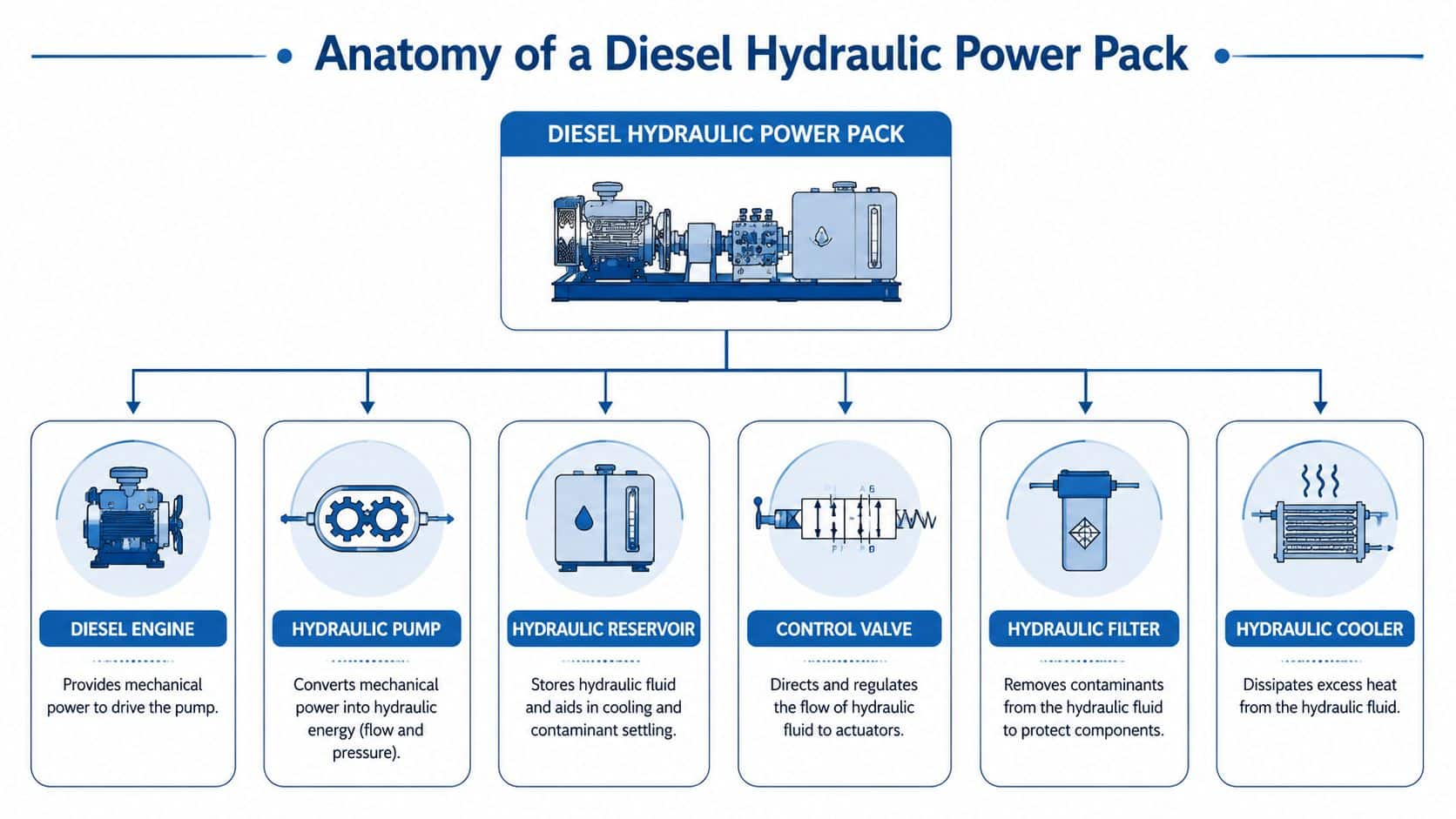
The diesel engine is the prime mover. Its job is straightforward. It provides mechanical input torque to drive the hydraulic pump at a controlled speed. What matters in practice is not just engine rating, but how well the engine’s torque characteristics match the pump and the intended duty.
The hydraulic pump converts that mechanical input into hydraulic flow. In mobile and general industrial packs, gear pumps are common because they’re durable, simple, and economical. The pump doesn’t create pressure by itself. It creates flow. Pressure appears when the system resists that flow.
That distinction matters when people complain that a pack is “down on pressure”. Often the fault is elsewhere. Relief valve setting, internal leakage, heat-thinned oil, suction restriction, or engine speed drop can all be the cause.
Reservoir, valves, and filtration
The reservoir does more than store oil. It gives the oil time to de-aerate, shed heat, and let contamination settle out before it re-enters the suction side. Poor tank design causes recurring trouble. If the return oil dumps straight near the suction pickup, or if the oil volume is too tight for the duty cycle, the pack will run hot and noisy.
The control valves decide what the power pack does. Directional valves route flow. Pressure control valves protect the system. Flow controls manage actuator speed. If the valve specification is wrong, even a strong engine and sound pump won’t make the machine behave properly.
The filters are there to protect every expensive component downstream. Dirty oil destroys pumps, valves, and motors far faster than most operators realise. Good filtration design means looking at suction strainers, return filtration, and, where needed, off-line conditioning rather than assuming one filter can solve everything.
Cooling and the supporting hardware
The cooler becomes critical once the pack is expected to run under sustained load. Heat isn’t a side issue. It changes viscosity, seal life, leakage rate, and overall efficiency.
The rest of the supporting parts matter as well:
- Bellhousing and coupling keep engine and pump aligned
- Relief valve protects the circuit from overload
- Breather and level indication help tank health and routine checks
- Hoses and pipework must be sized for pressure and return conditions, not just made to fit
- Mounting frame and anti-vibration setup protect the assembly from fatigue and cracking
A diesel hydraulic power pack should be read as one working system, not a collection of parts. Most failures happen where one component was chosen without considering the rest.
Sizing and Performance How to Get It Right
Undersize the pack and the machine feels weak, hot, and inconsistent. Oversize it and you waste fuel, budget, and space while still not fixing the control issues. Good sizing starts with the function, not the engine catalogue.
Start with flow and pressure
The first questions are always these:
- How much flow does the actuator or tool need?
- What working pressure does the job require?
- How long does it need to do that for?
Flow determines speed. Pressure determines force or torque. Engine power has to support both.
For design work, many engineers begin with the hydraulic power relationship between flow and pressure, then apply allowance for mechanical and volumetric losses. In practice, you don’t size to the theoretical minimum. You size to what the machine will see in service, including warm oil, operator behaviour, and short overload periods.
The mistake people make
They size to peak pressure only.
That sounds cautious, but it often creates a poor specification. A machine may only hit relief pressure briefly. If you build the whole pack around a worst-case pressure event and ignore normal flow demand, duty cycle, and thermal behaviour, the result can be expensive and badly balanced.
A better approach is:
- Define normal working flow
- Define normal working pressure
- Identify peak pressure events
- Check engine power margin
- Check heat rejection requirements
- Check tank and filtration suitability
If you’re working through a bespoke build, this is exactly the stage where proper hydraulic power pack design support saves rework later.
Heat is usually the hidden sizing error
For UK construction and agricultural mobile machinery, diesel hydraulic power packs need proper heat rejection in high ambient conditions above 40°C. According to the HPP10D diesel hydraulic power pack specification, oversized oil coolers that keep oil temperature below 60°C can prevent 30% power loss and cavitation, and can extend service intervals by up to 25% in materials handling applications.
That’s the part many buyers miss. A pack can look perfect on paper at startup and then become sluggish once the oil temperature climbs. Hot oil gets thinner. Internal leakage rises. Pump efficiency falls. Seals harden. Operators compensate by pushing harder, which adds more heat.
If a diesel pack will work hard outdoors, don’t treat the cooler as an accessory. Treat it as part of the core specification.
A practical sizing checklist
Before signing off a build, check these points:
- Tool or actuator demand. Confirm required flow in LPM and working pressure in bar from the actual equipment data.
- Real duty cycle. Decide whether the pack runs intermittently, continuously, or in repeated high-load bursts.
- Engine operating speed. Keep the pump in a stable operating range rather than chasing maximum output all the time.
- Thermal load. Size cooling for summer conditions, not just a cool workshop test.
- Control method. Fast cycle time without proper flow control often means excess heat and harsh operation.
- Service access. Filters, drains, and test points must be reachable, otherwise maintenance gets skipped.
Diesel vs Electric and Other Drive Options
Diesel isn’t automatically right. It’s right when the application justifies it.
The best buying decisions come from comparing drive options against the job, not against habit. Some buyers stick with diesel because that’s what they’ve always used. Others push electric because it looks cleaner on paper. Both approaches can be wrong.
Diesel versus electric in real use
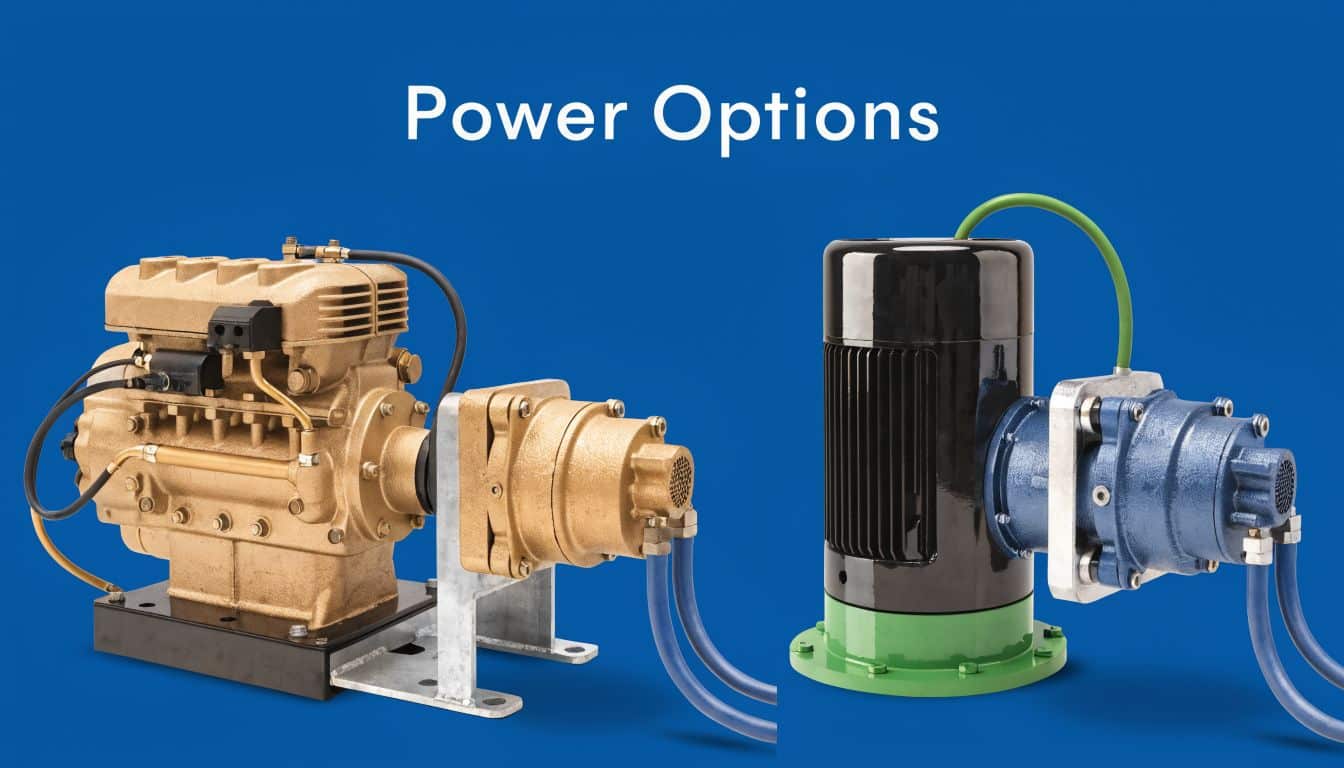
In the UK hydraulic components market, the diesel segment still holds a 38% share of the £450 million market, particularly in MRO for mobile plant. The same market view notes that 65% of agricultural operators in areas such as North Lincolnshire rely on diesel for replacements because of field independence and dependable performance, according to UK hydraulic power unit market analysis.
That tells you where diesel still wins. It wins where mobility and independence carry more weight than low noise or zero local exhaust.
Electric wins elsewhere:
- Indoor operation where exhaust gases are unacceptable
- Fixed plant with dependable mains supply
- Noise-sensitive sites where engine sound creates operational issues
- Applications needing simple start-stop duty with less daily servicing
Diesel remains stronger for mobile and harsh-environment work because it’s self-contained and serviceable in the field. If a hose bursts, a filter blocks, or a coupling fails, most service teams already understand the package.
Where petrol fits, and where it doesn’t
Petrol-powered hydraulic packs still appear on smaller portable tool systems, but for industrial buyers they’re usually a narrower fit. They can suit compact, lower-duty applications where weight and portability matter. They’re less convincing where long-running torque, fuel handling policy, or fleet standardisation are the deciding factors.
For OEM buyers reviewing prime mover options more broadly, this comparison on selecting power solutions for OEMs is useful because it frames the engine choice around operating conditions rather than brand preference.
A decision table that actually helps
| Drive option | Best fit | Weak point | Typical buying reason |
|---|---|---|---|
| Diesel | Mobile, off-grid, heavy-duty outdoor work | Noise, emissions compliance, servicing | Reliable hydraulic power where no mains supply exists |
| Electric | Indoor plant, fixed installations, clean environments | Needs electrical infrastructure | Quiet operation and simpler local compliance |
| Petrol | Small portable packs and occasional-use equipment | Less attractive for industrial fleet standardisation | Compact standalone power in lighter-duty roles |
For a broader view of available UK hydraulic power pack options, it helps to compare the hydraulic duty first and the drive type second. That keeps the discussion practical.
Buy the drive type that suits the site, not the one that suits the sales brochure.
Customisation for Specialist UK Applications
Off-the-shelf packs are fine until the application stops being ordinary.
That happens quickly in UK industry. Offshore lifting equipment, confined plant areas, mobile service rigs, high-duty agricultural machinery, and regulated construction environments all place demands on the pack that a standard catalogue unit often won’t meet.
ATEX and hazardous areas
For UK offshore and ATEX Zone 2 applications, diesel hydraulic power packs need specific explosion-protection features such as flame arrestors and specialised cooling arrangements. The ATEX open-loop diesel power pack datasheet makes the point clearly. Failure to comply with standards such as EN1834-1 can lead to immediate operational shutdown and severe regulatory penalties under HSE guidelines.
That’s not paperwork for its own sake. In a hazardous atmosphere, the wrong engine protection strategy can stop a job, fail an inspection, or create a genuine ignition risk.
A specialist specification may need:
- Exhaust flame arrestors
- Protected air intake arrangements
- Engine shutdown logic linked to temperature or fault conditions
- Certified lifting and transport provisions
- Cooling arrangements that prevent excessive surface temperatures
Stage V and legal risk
Emissions compliance is now part of the specification discussion, not an afterthought. If the diesel engine falls into the wrong category or the machine is poorly maintained, the commercial impact can be worse than the repair bill.
That affects buying decisions in a very practical way. A cheaper non-compliant unit can become the expensive option once site access, inspection, or enforcement enters the picture. Buyers need to ask for the engine standard, supporting documentation, and application suitability at quotation stage, not after delivery.
Bespoke details that actually improve service life
Not every customisation is about legislation. Much of it is about making the pack survive real work.
The most worthwhile changes are often unglamorous:
- Larger reservoir volume to improve deaeration and cooling
- Better return-line filtration for dirty environments
- Remote test points so pressure checks happen without dismantling guards
- Properly mounted coolers with clean airflow
- Valve layouts matched to the operator’s sequence
- Noise control through enclosure design and anti-vibration mounts
Standard packs are built to be saleable. Bespoke packs are built to survive the job.
A customised hydraulic power pack diesel unit should reflect the application, the environment, and the people who have to maintain it. If those three things aren’t considered, you usually end up modifying the pack on site anyway, which is the expensive way to do it.
Commissioning and Maintenance Checklist
Most diesel power pack failures don’t start with a dramatic breakdown. They start with poor commissioning, dirty oil, neglected cooling, loose fittings, and missed routine checks.
That’s why maintenance has to be structured. Not complicated. Structured.

Before first start
A new or rebuilt unit should never be started on assumption alone.
Check the basics properly:
- Oil grade and fill level are correct for the system and environment
- Engine fluids are at the right levels
- Suction and return connections are correctly installed and tightened
- Hoses and fittings are supported and free from twist or chafe
- Relief valve settings match the intended application
- Rotation direction is confirmed before loading the system
- Controls move freely and return as intended
- Breathers, filters, and guards are fitted
If test points are available, this is also the time to connect proper instrumentation. A good hydraulic pressure tester kit removes a lot of guesswork when commissioning and fault-finding.
Diesel Hydraulic Power Pack Maintenance Schedule
| Frequency | Check/Task | Purpose |
|---|---|---|
| Daily | Visual inspection for leaks, loose fittings, hose damage, abnormal noise | Catch faults early before they damage pumps or create safety risks |
| Daily | Check fuel, engine oil, and hydraulic oil levels | Prevent starvation, overheating, and avoidable wear |
| Weekly | Clean cooler surfaces and inspect airflow path | Maintain heat rejection and reduce overheating risk |
| Weekly | Inspect filters, breathers, mounts, and battery connections | Preserve reliability of the hydraulic and engine systems |
| Monthly | Check operating pressure, flow behaviour, and relief performance | Identify drift, internal leakage, and emerging component wear |
| Monthly | Review hose condition, clamps, and vibration points | Prevent fatigue failure and uncontrolled leaks |
| Periodic service | Replace filters and service engine items to schedule | Protect pump, valves, and engine from contamination and deterioration |
| Periodic service | Sample or inspect hydraulic oil condition | Detect contamination, water ingress, and oil degradation before failure |
Compliance and housekeeping matter
Maintenance isn’t only about uptime. It also protects you from legal and site access problems.
Failure to comply with UK NRMM Stage V emissions rules for engines above 37kW can result in daily fines exceeding £1,000. Post-2025 Environment Agency data cited in the NRMM compliance discussion showed diesel power packs accounted for 18% of violations, which underlines the risk of running non-compliant or poorly maintained equipment.
That means engine servicing records, emissions-related maintenance, and machine condition aren’t optional admin. They’re part of the operating cost.
Cleaning parts properly
Contamination control is one of the few maintenance disciplines that pays back every time. If you’re cleaning reusable metal parts such as valve blocks, fittings, or small hard components during overhaul work, this guide for machinists' cleaning needs is worth a look because it shows where more controlled cleaning methods fit better than rough workshop washing.
Dirty oil is expensive. Dirty components fitted into clean oil are just a delayed failure.
A diesel pack will usually tell you something is wrong before it stops completely. Rising temperature, slower actuator speed, harsher noise, fuel use changes, and repeated filter issues all point somewhere. The teams that log those changes get longer service life. The teams that wait for failure buy more pumps.
Get Expert Advice on Your Power Pack Project
A hydraulic power pack diesel unit is never just an engine size decision. The right choice depends on the work, the duty cycle, the environment, the controls, the cooling demand, and the compliance burden attached to the machine.
Get the specification right and the pack becomes a dependable tool. Get it wrong and you spend money twice. First on the purchase, then on the fixes. That’s especially true when the unit has to work off-grid, deal with sustained load, or meet site-specific requirements around emissions or hazardous areas.
The practical route is to define the hydraulic demand clearly, choose the correct drive type for the site, build in the right cooling and filtration, and set up a maintenance routine that operators will follow. That’s what keeps a diesel pack useful over the long term.
If you need help specifying, replacing, or custom-building a unit, MA Hydraulics Ltd can help you work through the practical details. Phone 01724 279508 today, or send us a message.
