
A hydraulic circuit that was fine in August can look broken by November. The oil is colder, the pump sounds harsher, the return line behaves differently, and the first instinct is usually to blame the pump, the valve, or the operator. Too often, the problem is simpler: the flow meter for oil was chosen from a catalogue instead of from the oil's actual behaviour at the temperature it runs at in the UK.
That mistake gives you numbers that look credible and lead you in the wrong direction. A bad meter choice doesn't always fail loudly, it often under-reads, drifts, or responds sluggishly just enough to waste hours of fault-finding. In a mature offshore and industrial market, that is exactly how engineers end up chasing the wrong fault.
Why the Right Flow Meter Changes Everything
A service engineer gets called to a machine that's slow on cold mornings. The pump is running, the valve bank is energised, but the actuator is lazy and the gauge trace doesn't look right. If the meter on that line is the wrong type for the oil, the diagnosis gets distorted from the start.
The UK Continental Shelf produced 564.2 million barrels of oil equivalent in 2023, and accurate flow measurement still sits inside allocation, custody transfer, and production control across offshore fields and terminals, according to the North Sea Transition Authority cited in the historical review of flow metering (industrial dynamics history of flowmeters). That scale matters because the meter is not a decorative instrument. It is part of the measurement chain that affects revenue, reporting, and plant control.
The wrong meter tells a believable lie
A meter can appear healthy while still being the wrong choice for the duty. A turbine meter on thick oil may still turn, but it can lose responsiveness as viscosity climbs. A positive-displacement meter can be excellent on viscous oil, then start punishing the system with pressure loss if the pump head and filtration are poor.
Practical rule: if the meter choice ignores viscosity and operating temperature, the reading can look neat while the decision behind it is rotten.
That is why the question isn't, “Which meter is best?” It's, “Which meter stays truthful on this oil, at this temperature, in this pipe, under this control system?” The historical roots of flow measurement go back long before petroleum, with early devices such as the Roman clepsydra often cited as an early flowmeter concept. Modern oil work just makes the consequences more expensive.
Volumetric Flow Versus Mass Flow in Plain Terms
A fuel pump at a forecourt measures volume. Customers buy litres, not kilograms. A refinery ticket, batch-blending record, or custody-transfer application may care about mass, because the same litre of warm diesel does not weigh the same as the same litre of cold diesel.
A flow meter measures linear or nonlinear mass or volumetric flow of a liquid, gas, or vapour, which is why different technologies are chosen depending on whether the user needs one form of measurement or the other. That distinction sets the direction for the whole selection process. For a quick refresher on how the numbers are built from pipe size and flow rate, use the flow-rate calculations for hydraulic systems guide alongside your sizing work.
Start with what the job needs
If the task is a hydraulic return line, the team usually wants volumetric flow. Litres per minute is enough to confirm pump health, actuator demand, or circuit balance. If the task is blending, billing, or tracking delivered fuel quality, mass flow is often the better answer because density matters.
A positive-displacement meter and a turbine meter are volumetric devices. They can do that job well when the oil is suitable. A Coriolis meter measures mass directly and gives density as a useful extra. That makes it the stronger choice when the reading must hold value across temperature shifts or changes in composition.
Use the readout the way the plant uses the oil
A lubricant skid, fuel transfer package, and mobile hydraulic test rig do not need the same number from the same sensor. The operator may only need litres per minute on a local display. A controls engineer may need pulse output into a PLC. A maintenance team may want density and mass for trend work.
Choose the output to suit the duty, not the brochure. If the site is only checking pump delivery on a mobile-plant test bay, a clear volumetric indication is enough. If the job is proving delivered fuel, tracking blend consistency, or reconciling stock, mass is the safer number because temperature swings change density and volume together. For a broad explanation of what different meters are measuring, see Baker Hughes on what flow meters measure.
If the control room needs mass and the plant only has a volumetric meter, do not pretend the two are interchangeable. You will only create an argument later when the totals do not reconcile.
The Six Main Meter Technologies for Oil
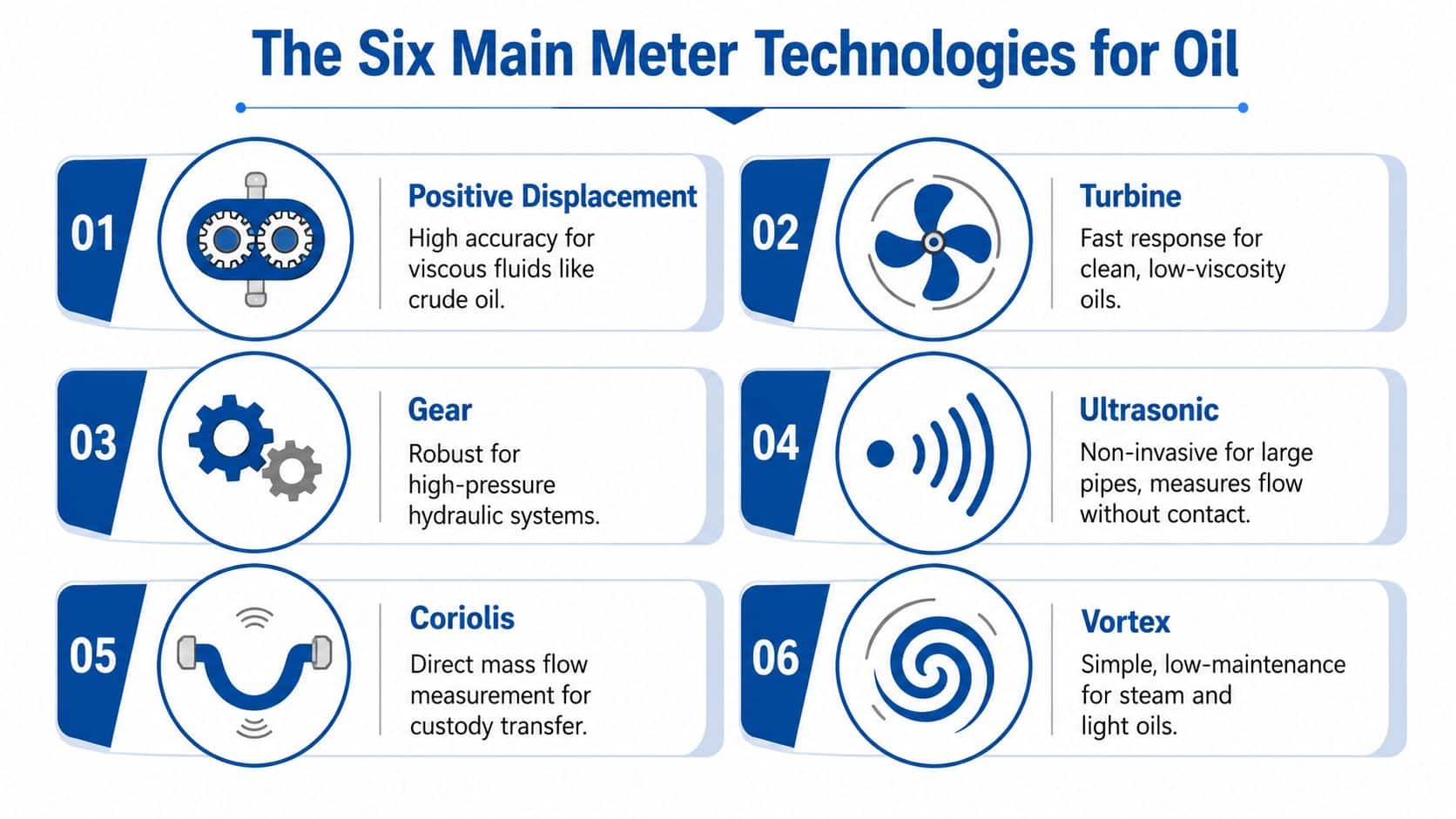
The right meter is the one that suits the oil in service, not the one with the neatest brochure copy. Heavy resid, clean diesel, aerated hydraulic return, and dirty transfer lines each push you to a different technology. Once you look at how the oil behaves, the wrong choice becomes obvious very quickly.
Compare the six options against the duty
| Technology | Best Suited Oil | Typical Accuracy | Key Limitation |
|---|---|---|---|
| Positive Displacement | Heavy oil, resid, clean lubricating oils, fuel oil | High, especially on stable viscous duty | More pressure drop, vulnerable to poor filtration |
| Turbine | Clean light oils such as diesel or gasoline | Good on stable, clean flow | Sensitive to viscosity changes and flow profile |
| Gear | Hydraulic oils and high-pressure duties | Strong repeatability on clean systems | Internal wear if contamination is present |
| Ultrasonic | Oil with entrained gas, large-bore lines, non-invasive duties | Strong when installed correctly | Needs good profile and stable conditions |
| Coriolis | Oil with entrained gas or particulates, mass-flow duties | Direct mass-flow reading, high confidence | Higher cost and heavier installation burden |
| Electromagnetic | Special cases only, when the fluid can be treated as conductive | Reliable on suitable conductive liquids | Not the default choice for oil |
Thick oil and resid usually suit positive displacement meters such as oval-gear or rotary-piston designs. Clean diesel and gasoline suit turbine meters. Oil with entrained gas or particulates pushes you towards ultrasonic or Coriolis meters, and for hydraulic reading duties a hydraulic flow gauge gives a useful benchmark for how clean, stable system measurements should look in practice.
What each technology is really good at
Positive displacement meters physically trap and count fixed volumes. That is why they stay strong on viscous oil, fuel oil, and clean lubricating liquids. They are the blunt instrument of oil metering, and in the right line they are hard to beat.
Turbine meters rely on the fluid spinning a rotor. They suit cleaner, lighter oils better than thick ones. They become a poor choice when viscosity rises, because the rotor stops responding cleanly.
Gear meters are a sensible choice for hydraulic systems and mobile plant where the oil is clean enough and the duty rewards repeatability. Ultrasonic meters suit larger pipes and non-invasive installation, especially where you want to avoid cutting into a service line or disturbing the run. Coriolis is the strongest technical answer when mass flow really matters or when the oil condition is messy enough to make simpler meters unstable.
Practical rule: if the oil is thick, variable, or contaminated, stop looking at turbine first. That is how buyers end up specifying trouble.
The shortlist gets even shorter if you look at the line conditions properly. Straight-pipe expectations, contamination, and signal needs all matter. For a broader buying guide on oil meter selection, see the industrial oil flow meter guide.
Selection Criteria That Decide the Order
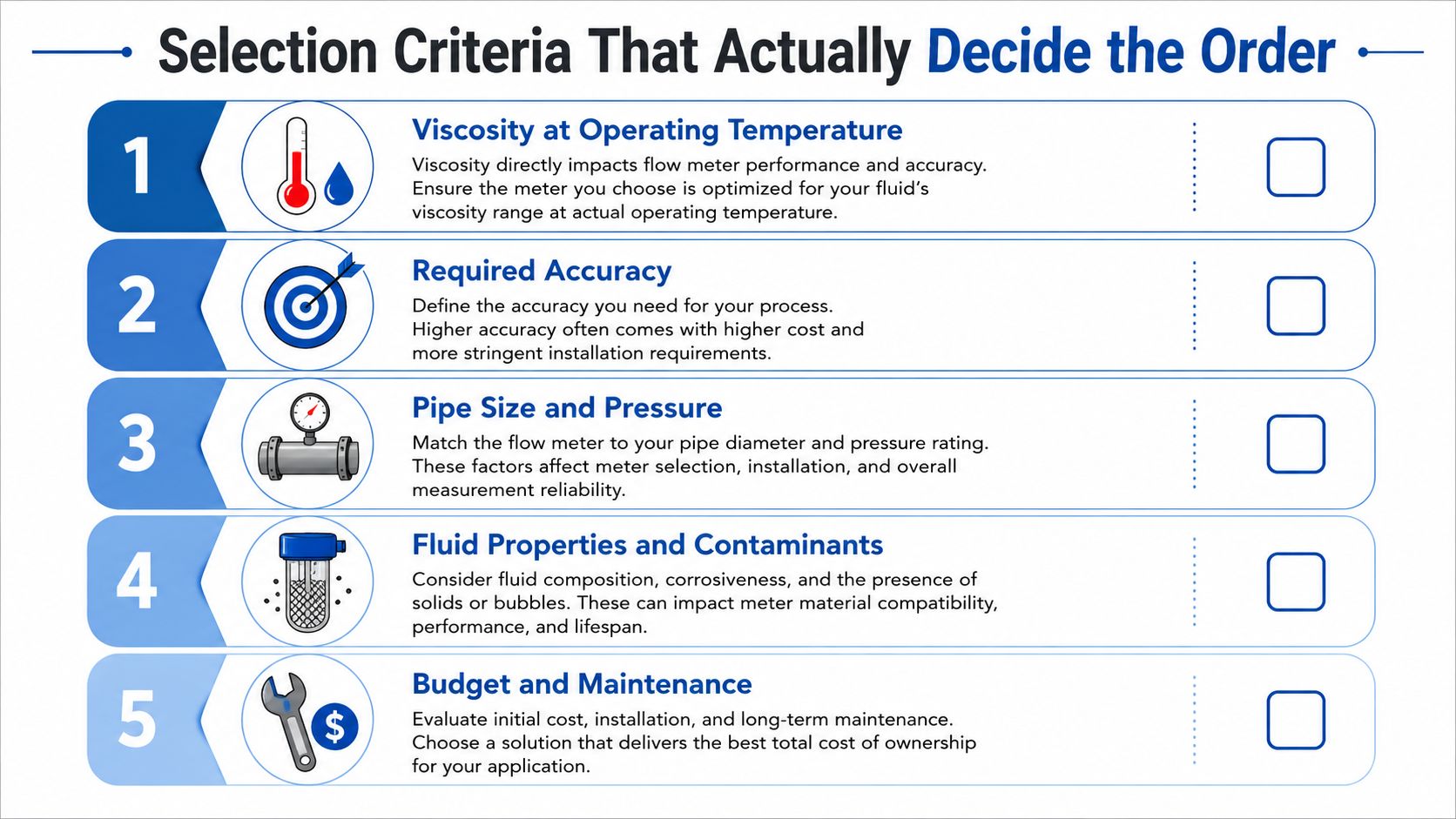
Start with the oil in the line, not the brochure. A meter that looks tidy on paper can fall apart the moment temperature shifts and the viscosity moves with it.
Check the oil at operating temperature first
Choose on the actual operating viscosity at UK ambient and process temperatures, not on the nominal grade printed on the drum. Oil viscosity changes materially with temperature, and that change drives meter performance and pressure loss. High-viscosity duty pushes some meters out of their comfort zone very quickly, which is why a meter that suits warm shed conditions can become a poor fit on a cold start line.
That is the first filter. If viscosity swings through the season or across the process, you need a meter that stays honest across that range, not one that only behaves at one convenient condition.
Then look at the pipe and the working range
Check pipe diameter and the minimum and maximum flow next. The meter has to suit the duty the plant sees, not the figure copied into a procurement sheet. If the system spends long periods near the bottom of range, a meter that relies on a stable mid-range flow will disappoint.
Line size also changes the practical answer. A meter that is perfectly acceptable in a smaller hydraulic return line may be the wrong choice for a larger transfer line, because the flow profile, residence time and pressure loss are different. Match the meter to the pipe and the actual duty, or you will buy accuracy you cannot hold in service.
Then match accuracy to the job
A fuel bill, custody-transfer skid, or blending duty needs tighter confidence than a return-line monitor. Buy the level of accuracy the job justifies, and stop there. Pay for more than the plant can use and you waste money. Fit a cheap meter where an under-read becomes a finance dispute, and you create a problem that will come back through operations.
Make the output fit the controls
Selection also depends on the fluid's viscosity, the required volumetric or mass flow measurement, the maximum and minimum pressure, temperature and flowrate, pipe size, and whether the installation needs local display, electronic outputs, or protocols such as RS232/RS485, Ethernet, HART or MODBUS (AZoM flow meter selection criteria). If the panel expects a pulse and you order only a local register, you have built in avoidable rework. If the control system needs remote totalising or trend data, pick a meter that can talk properly to it from day one.
Price last, lifecycle cost second
Budget matters, but the cheapest meter often becomes the most expensive once you add spares, recalibration, access time, and downtime. A correct selection reduces maintenance friction and keeps service calls sensible. A flashy selection that needs constant babysitting does the opposite.
For a broader buying guide on oil meter selection, see the industrial oil flow meter guide.
Installation and Mounting Best Practice
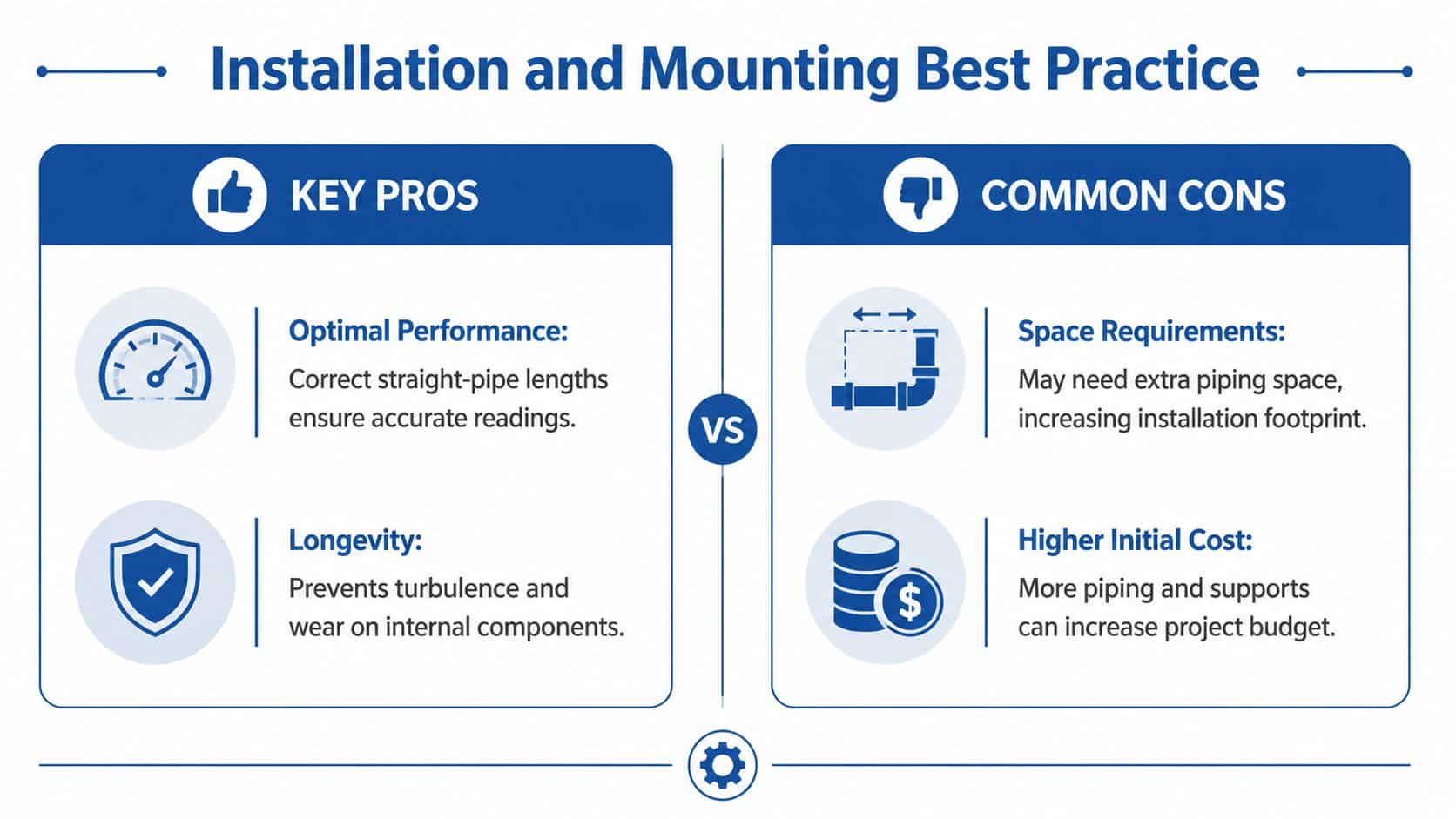
A lot of bad metering has nothing to do with the meter itself. It comes from poor mounting, weak filtration, or a fitter being forced to work around a bad pipe layout. If the line is badly arranged, even a good meter will look suspect.
Mount it where the oil stays full and calm
Turbine and ultrasonic meters need a stable flow profile, so straight-pipe lengths matter more for them than for a positive-displacement unit. Coriolis is more forgiving of profile issues, but that does not make pipework irrelevant. If the line is air-prone, keep the meter out of the highest point and fit an air bleed on vertical runs.
Protect the meter from pressure loss and contamination
Mechanical contact meters such as positive-displacement oval-gear designs typically impose more pressure drop than non-mechanical designs, so available pump head, line size and filtration quality must be confirmed before selection to avoid cavitation, wear and systematic under-reading at higher flow or viscosity (oil flow meter installation note). That is not an academic detail. It is the difference between a meter that lasts and one that starts lying.
Support the body and keep access practical
The meter body should be supported independently of the pipework. That matters everywhere, but it becomes essential on mobile plant where vibration is constant. If the display head is buried behind guards or trapped against a wall, servicing becomes a nuisance and calibration gets delayed.
A good fitter will also keep the meter away from the suction side of a pump if the device is pressure-drop heavy. That avoids cavitation and the kind of wear that degrades the reading over time. Put the service access where a technician can easily reach it.
Do fit filtration upstream.
Do leave room for the display head and wiring.
Do not mount the meter at a high point where air collects.
Do not assume the pipe will support the meter just because the bolts are tight.
Where These Meters Earn Their Keep in Practice
A tractor tipping-ram circuit is a good example of why I like a gear meter on the pump delivery line when the job is checking actual flow to the valve. It gives the service engineer a hard reading on a hydraulic duty that should be predictable. If the actuator is lazy, the meter helps separate pump wear from valve leakage and line restriction.
On a factory power-pack return line, a Coriolis meter earns its place when the team wants to catch pump wear before it turns into failure. It is not the cheapest answer, and it's not the first meter I'd fit on every skid. It is the right one when the maintenance strategy values dependable diagnosis over cheap procurement.
For fuel handling, a positive-displacement oval-gear meter remains the plain sensible choice on clean, lubricating liquids where accuracy matters. UK industrial users often specify fuel-oil and boiler-feed applications with positive-displacement or oval-gear meters when they need high accuracy on clean, lubricating liquids, valued for their ability to meter viscous oils with strong repeatability and long service life in transfer and dosing duties (oil flow meter guide). That is the kind of duty where a good mechanical meter still makes perfect sense.
Match the duty to the meter, not the other way round
A mobile-plant line sees vibration, temperature swings, and awkward access. A transfer skid sees billing pressure and repeatability. A return line sees diagnostics. Those are different jobs, so they deserve different meter logic. The mistake is trying to force one product family to cover all three.
The right choice shows up quickly when you ask what failure would cost more, a small measurement error or a plant complaint. In the first case, a rugged volumetric meter is often enough. In the second, you need a more disciplined solution, sometimes Coriolis, sometimes not, but always chosen with the duty in mind.
Troubleshooting the Most Common Reading Problems
A meter that reads low in winter is usually telling you something about viscosity, not electronics. Oil viscosity changes materially with temperature and directly affects meter performance and pressure loss, so a turbine meter or similar volumetric design can under-register when the oil thickens in cold ambient conditions (Kobold on high-viscosity oil flow meters).
Readings low, drifting, or missing
If the reading is consistently lower than expected, check whether the oil is colder than the commissioning condition, whether the meter is undersized, or whether the flow profile has changed. If the reading drifts over months, suspect wear in a mechanical meter or a slow contamination issue upstream. If there's no output at all, look at the loop, power supply, cabling, and grounding before condemning the meter.
A noisy 4–20 mA signal usually points to wiring or interference, not a dead sensor. Don't rip the meter out first and diagnose later. That habit wastes time and creates a second fault while you're fixing the first.
Start with the simplest mechanical checks
- Check the filters first: debris, sludge, or poor upstream strainers often create symptoms that look like calibration drift.
- Check the temperature condition: a meter set up on warm oil can behave differently on a cold start.
- Check for air: entrained air and partially full pipes confuse the reading and make a good meter look unreliable.
- Check the installation direction: a meter can be perfectly healthy and still be mounted badly.
If the duty includes mobile plant, vibration deserves special attention. Fasteners loosen, support points move, and wiring flexes. That is why troubleshooting on trucks, tractors, and skids should start with the mounting, not just the display.
Calibration, Standards and Integration with Controls
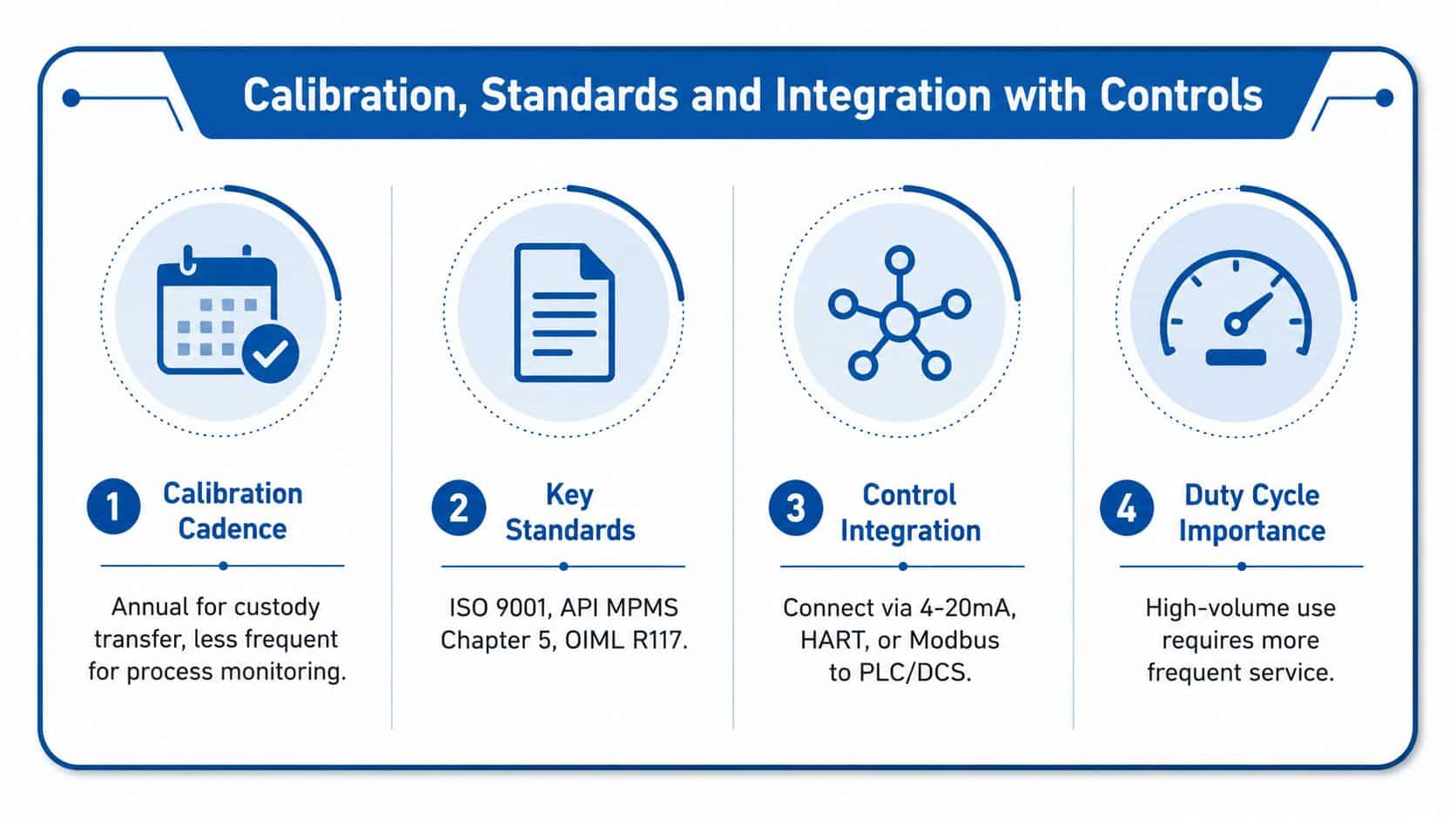
A meter only earns trust when calibration, signal handling, and control integration all hold up in a plant environment. On an offshore asset, a fuel skid, or a hydraulic test stand, the reading has to stay believable long after commissioning is finished.
Oil flow measurement has a long history of precision work in industry, and that is the point. Calibration is not paperwork for the file, it is part of the measurement chain, and if you treat it as an afterthought the numbers will drift away from the process they are meant to represent (industrial dynamics history of flowmeters).
Put calibration on duty, not on autopilot
A custody-transfer meter needs a tighter discipline than a return-line monitor. Set the calibration interval from the severity of duty, the contamination risk, and the cost of getting the reading wrong. A meter sitting in a hard-running system needs more attention than one on a clean, steady circuit.
Do the same for high-viscosity oil duties. The wrong calibration interval on thick oil at UK operating temperatures gives you a false sense of certainty, especially where warm commissioning conditions never match the colder months in service.
Specify the control output before the order goes in
If the control panel expects HART, Modbus, or pulse output, lock that down at procurement. Retrofitting the wrong signal protocol after the meter is plumbed in wastes time, adds cost, and usually creates a second round of commissioning work you did not need.
The control side should suit the duty as well as the meter does. A clean bulk transfer line can tolerate a straightforward signal path, while a live hydraulic circuit may need tighter monitoring, faster fault recognition, and a clearer link between flow, pressure, and alarm logic. The MA Hydraulics pressure monitoring systems page sits naturally alongside this sort of integration work.
Keep the handover simple
- Confirm the signal format: match the meter to the PLC, telemetry unit, or display before delivery.
- Document the calibration basis: keep the commissioning record with the asset file.
- Plan the service route: make sure access, isolation, and removal can happen without dismantling half the line.
- Treat uncertainty seriously: if the meter underpins allocation or billing, the reading needs proper control, not optimistic guessing.
On mobile plant and skid-mounted equipment, the integration problem is rarely the electronics alone. Vibration, flexing cables, loose fixings, and poor earthing all spoil the result, so the installer should check the mounting and the wiring as part of the same job. If the measurement also supports pressure-related protection or condition monitoring, tie it back to the wider pressure monitoring systems arrangement rather than treating each instrument as a separate island.