
Blue 20mm water pipe in the UK is MDPE made to BS EN 12201 for below-ground potable water use, and in practice it suits short branch runs and low-demand feeds rather than long, high-flow services. On most domestic jobs, 20mm is the smallest standard blue MDPE outside diameter, typically with a 20mm OD, a wall thickness around 2.0 to 2.3mm, and common coil lengths of 25m, 50m and 100m.
That's the point many buyers need clearing up before they order. A roll of 20mm blue pipe looks like an easy default because it's compact, familiar and usually straightforward to handle on site. The trouble starts when it's used where a 25mm service should have gone in the first place.
If you're pricing a short boundary run, feeding a garden tap, or extending a supply to a small outbuilding, blue 20mm water pipe can be exactly the right choice. If you're trying to serve a full house, a combi boiler and a couple of outlets at the same time, it often isn't. The mistake isn't buying 20mm. The mistake is using it as if bore size doesn't matter.
What Blue 20mm Water Pipe Is and Where You See It
On a UK site, this usually comes up when someone needs a modest buried water run and wants a coil that's easy to transport, pull into trench, and terminate with standard service fittings. Blue 20mm water pipe is a medium-density polyethylene pipe, normally supplied in coils, and the blue colour identifies it as potable water pipe in UK utility practice under BS EN 12201. The standard itself notes blue pipes as the recognised identifier for buried water pipelines in line with UK colour coding, as shown by published product guidance from JDP's 20mm blue MDPE range.
What the 20mm actually refers to
The first practical point for a new buyer is this. 20mm refers to the outside diameter, not the clear bore.
That matters because people often look at the nominal size and assume the waterway is generous enough for anything domestic. It isn't. For typical UK product lines, the working inside diameter is much smaller than the outside figure suggests, and on some variants it sits in the mid-teen range rather than anywhere near the full nominal size.
Published UK technical data for one common PE80 SDR11 product lists 20mm outside diameter, 2.0mm wall thickness and 16mm internal diameter, which tells you straight away why its flow capacity is limited compared with larger service pipe options, as shown on BES's 20mm blue mains water pipe specification.
Where it tends to be used
On real jobs, 20mm turns up where demand is simple and predictable:
- A single external tap off an existing service
- A short garden or irrigation take-off
- An outbuilding feed with light use
- A trough or standpipe connection
- A short final section between buried service and internal entry point
Practical rule: If the run serves one outlet at a time and the route is short, 20mm is often fine. If the run serves a house, assume you need to justify 20mm rather than assume it.
The key is to treat it as a situational branch-run product, not a general-purpose answer for every domestic supply. That distinction saves a lot of callbacks later.
Materials, Standards and SDR Ratings Explained
If you read the print on the coil rather than just the price label, most of the important decisions are already there. UK 20mm blue MDPE for potable supply is generally manufactured to BS EN 12201, which is the standard covering plastics piping systems for water supply. In plain terms, that tells you the pipe is intended for buried water service rather than improvised use on some unrelated duty.
MDPE, PE grades and what you're buying
You'll usually see blue MDPE sold as PE80 or PE100 variants depending on the product line and wall class. For a site manager, the useful point isn't the polymer chemistry lecture. It's whether the pipe matches the duty, the fittings, and the pressure class required by the job.
Blue potable-water pipe in the UK is standardised for underground use across a wide size range, and in the service-size band the listed Range 1 diameters include 20mm, 25mm, 32mm, 40mm, 50mm and 63mm, with PN 12.5 identified as the preferred pressure rating in the guidance summarised by Kalsi Plastics' MDPE pipe sizes guide.
SDR in plain English
SDR means Standard Dimension Ratio. It's the relationship between the outside diameter and the wall thickness. On site, you don't need to recite the formula. You just need to understand what it means for performance.
A lower SDR generally means a thicker wall for the same outside diameter. That affects pressure class and, because more wall means less bore, it also affects available flow.
| Property | SDR 9 (PN 12.5) | SDR 11 (PN 10) |
|---|---|---|
| Wall section | Thicker for the same OD | Thinner than SDR 9 for the same OD |
| Pressure class | Higher | Lower |
| Internal bore effect | Slightly less flow area | Slightly more flow area |
| Typical buying logic | Chosen where pressure class matters more | Common for general domestic service work |
Pressure isn't the usual problem
With 20mm blue pipe, people often worry about whether the pressure rating is enough. In many domestic and light commercial buried-water situations, the bigger limitation is not pressure class but friction loss through a small bore over distance.
Independent UK technical literature and product guidance for 20mm PE80 blue pipe show nominal pressure ratings up to 16 bar under BS EN 12201, with common coil lengths supplied in 25m, 50m, 100m or 150m, and the practical implication given in that guidance is clear: pressure capability usually isn't what catches you out. Flow loss over a long small-bore run does, as outlined on BES's 20mm x 100m MDPE listing.
If a service underperforms, don't blame the blue pipe colour, the manufacturer, or the stop tap first. Check whether someone tried to push too much water through too little bore over too much distance.
You'll also usually see the pipe printed with manufacturer details, SDR class and approval markings on the outer surface. That printed line is worth checking before the coil goes into the trench.
Typical UK Applications and Use Cases
A lot of problems disappear once you stop asking, “Will 20mm work?” and start asking, “Work for what?” That's the right frame for blue 20mm water pipe.
Where 20mm earns its place
For short, modest-demand duties, 20mm is a sensible and tidy option. It's commonly used for:
- Short external tap feeds where only one point is likely to run at a time
- Garden irrigation branches on small layouts
- Outbuilding or shed supplies with occasional draw-off
- Livestock troughs and standpipes
- Temporary or mobile welfare connections where demand is limited
- Short boundary runs where the supply duty is light
If the site also uses temporary fluid transfer equipment elsewhere, it's worth keeping the distinction clear between buried potable service pipe and flexible transfer products such as lay flat hose for site and agricultural water handling. They solve different problems.
Where 20mm starts to cost you flow
The trouble with 20mm isn't that it fails dramatically. It usually fails. The pipe goes in, the test passes, the water comes through, and everyone assumes the choice was sound. Then the occupier opens a second outlet and notices the weakness.
That's why 25mm is more often treated as the standard domestic service size for a house, and 32mm is the safer starting point when the run is longer or the dwelling is larger. The smaller bore in 20mm means the losses build quickly once distance and simultaneous demand increase.
The right answer for a garden tap can be the wrong answer for a house. Those are not the same duty, even if both are called “water supply”.
A simple side-by-side view
Think of the trade-off like this:
- 20mm keeps material compact and manageable, and it suits short low-demand branches.
- 25mm is the more typical domestic service choice when normal household draw-off is expected.
- 32mm gives more margin for longer routes, larger homes, or heavier simultaneous use.
Use 20mm where the duty is narrow and predictable. Don't use it to save a little on pipe if the result is a starved service.
How to Choose the Right Spec for Your Job
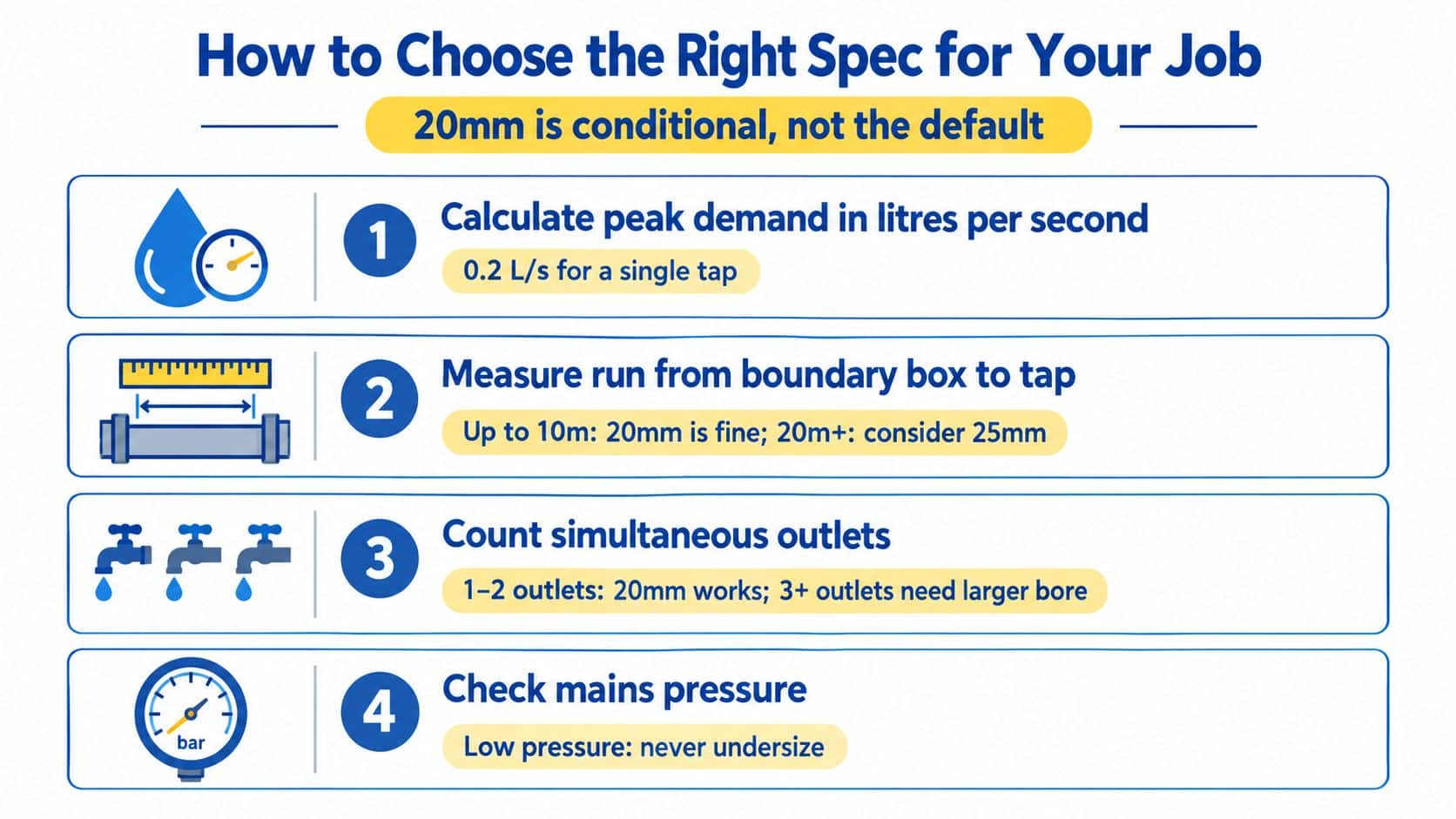
You don't choose 20mm by habit. You choose it after looking at demand, route length, simultaneous use and site conditions. If any one of those points starts stretching the duty, you move up a size.
A simple checklist helps.
Start with peak demand
The first number that matters is the water demand at the busiest likely moment, not the average over the day. A single tap on a short branch is one thing. A shower, basin mixer and appliance calling together is another.
As a practical guide, a single kitchen cold feed over 10 to 15m usually copes, but a bath and mixer running together on a long 20mm run will starve. If the expected peak simultaneous draw goes above about 0.6 l/s, treat that as a clear signal to look hard at 25mm or larger instead of persisting with 20mm.
Then look at the route, not just the endpoint
Installers sometimes focus on what the pipe serves and ignore how far the water has to travel to get there. Long buried runs punish small bore.
Use 20mm confidently when the branch is short and isolated. Be cautious once the route moves beyond roughly 15m, especially if the service is expected to feel like a normal domestic main rather than a secondary take-off.
Sizing cue: If the customer says, “The shower goes tepid when the tap runs,” that's usually a pipe-sizing clue before it's a boiler fault.
A short visual explainer can help when you're briefing a junior buyer or site supervisor.
Count outlets and check site conditions
A 20mm line serving one or two occasional outlets is very different from a line serving a dwelling where several draw-off points may open within moments of each other.
Use these prompts:
- One outlet only: 20mm is often a practical fit.
- Two outlets with little overlap: It may still be acceptable on a short run.
- More than two outlets in regular use: Upsize.
- Combi boiler mains connection: Don't undersize. Adequate incoming flow matters.
- Poor mains pressure or awkward route conditions: Never choose the smallest size just because it's easier to handle.
Ground conditions matter too. Traffic loading, burial depth and entry arrangements can all affect what class of pipe and protection detail you should specify, even when the diameter stays the same.
Fittings, Valves and Compatibility Basics
On most UK jobs, 20mm blue MDPE is joined with mechanical fittings rather than heat fusion. That keeps installation fast, serviceable and realistic for the size involved. The catch is that small-bore MDPE is unforgiving if the fitting system is mixed casually.
The three fitting families you'll see most
| Fitting Type | Typical Use | Key Caveat |
|---|---|---|
| Push-fit MDPE mechanical fittings | Buried service joints, repairs, straightforward site assembly | Use the correct liner and follow the maker’s pipe compatibility |
| Brass compression fittings to BS EN 1254 | Transitions and above-ground termination points | Not every brass fitting grips every MDPE profile equally well |
| Valves and threaded gunmetal or brass components | Isolation, stop valves, check valves and entry assemblies | Threads still need correct sealing practice and suitable materials |
For threaded metal joints, site teams often still rely on traditional compounds and tapes. If you're reviewing sealing products for compatible assembly work, Boss White jointing compound is the sort of familiar trade item many engineers already know from threaded plumbing applications. It isn't a substitute for the right MDPE fitting system, though.
The leak point people create themselves
The most common avoidable issue on 20mm MDPE is simple. Someone mixes inserts or fitting parts across brands because the pipe is “only 20mm” and assumes it'll all pull up the same.
It won't.
A brass-bodied fitting from one system doesn't guarantee the same grip or seal on another manufacturer's pipe. On small-bore MDPE, manufacturer-matched liners and inserts matter because creep and deformation under compression can show up later, not always during the first pressure test.
Don't treat the insert as an optional extra. On 20mm MDPE it's part of the joint design.
Typical in-line components
You'll often see these fitted into a 20mm service arrangement:
- MDPE-to-copper adaptors at building entry
- Isolating ball valves for local shut-off
- Stopcocks at service transitions
- Double-check valves where the risk assessment calls for them
- Entry details for trace heating or frost protection measures where exposed sections need it
Good jointing on 20mm is mostly about discipline. Clean cut ends, correct liner, correct fitting family, and no improvising because the van stock “looks near enough”.
Installation Notes for Below-Ground Runs
A neat installation starts before the trench is opened. The route wants marking out properly, and the team needs to check for existing services before anyone puts a bucket or spade in the ground. On live sites, that means proper service avoidance practice rather than educated guesswork.
Trench depth and bedding
For buried potable water service, depth and support matter as much as the pipe itself. The run should sit at an approved depth and on a bed that won't leave hard points under the pipe.
Use a stable sequence:
- Mark the route clearly before excavation starts
- Check for other buried services with appropriate locating practice
- Prepare a clean trench base so the pipe isn't laid on sharp debris
- Bed the pipe evenly in suitable fine material
- Keep bends gentle rather than forcing the coil into a tight direction change
20mm MDPE is flexible enough for gradual curves, but don't abuse that flexibility. If the route needs a real turn, fit a proper fitting and keep the joint accessible during testing.
Building entry is not the place to cut corners
Where a supply pipe enters a building, the detail is specific. UK water industry guidance says that where supply pipes are within the approved depth range of 750 mm to 1,350 mm, they should pass through a duct, and the duct ends must be sealed to prevent the ingress of gas or vermin, as set out in Water UK guidance note IGN 4-32-18C.
That isn't just tidy workmanship. It's a concrete installation requirement.
Blue MDPE should pass through a duct at the building entry. It should not be cast directly into the wall and forgotten.
If you want a broader homeowner-facing explanation of why buried water line replacement details matter, it's worth a quick visit to Pipeline On's guide to plumbing water line replacement. It's useful context when you need to explain disruption and routing choices to non-technical stakeholders.
For support and organisation around entry points and ancillary runs, practical site consumables also matter. Even something as basic as pipe clips in 10 mm sizes helps keep associated small-bore sections tidy where the service transitions above ground.
Before backfill, prove the job
On small-bore services, poor workmanship often hides until after reinstatement. That's why the sequence matters.
Make sure the team:
- Cleans and squares pipe ends
- Fits inserts properly
- Tightens compression joints to the maker's method
- Flushes the line
- Pressure tests before full backfill
- Places warning tape and finishes the trench properly
The expensive part of a bad 20mm install usually isn't the pipe. It's digging it back up.
Maintenance Tips and Common Misconceptions
Once buried and commissioned, blue 20mm water pipe doesn't need fussing over, but it does need respecting for what it is. Most long-term problems come from misidentification, poor joint matching, or using 20mm on duties that were too ambitious from day one.
What to check after installation
Routine attention is mostly simple visual and access control:
- Traceability of the route: Keep records of where the run goes
- Surface condition above trench: Watch for settlement or local subsidence
- Access to valves and boundary fittings: Don't let boxes disappear under landscaping or site clutter
- Condition of above-ground transition fittings: Check exposed metalwork and supports
Above ground, use suitable brass or gunmetal components for the environment and duty. Buried pipe may tolerate ground movement well, but exposed transition points are often where neglect shows up first.
The myths that lead to bad decisions
One misconception is that blue plastic pipe is a general utility tube for anything vaguely fluid-related. It isn't. In UK practice, blue identifies potable water service. It should not be repurposed for gas, fuel or compressed air.
Another common mistake is assuming 20mm is a “domestic main” size because it's sold everywhere. It's better thought of as a service-size branch option that works well within its lane. Outside that lane, the installation may still function, but not well.
A leak-free 20mm installation can still be the wrong installation if the service feels weak every day.
What good buying discipline looks like
Good results usually come from a few plain habits:
- Match pipe and fittings by system, not by guesswork
- Keep potable-water identification clear
- Don't undersize just to save a small amount on material
- Protect the building entry properly
- Leave access to isolation points
That's the practical way to buy and install 20mm blue MDPE. It's a useful product when the job is a short branch, a garden feed, or another low-demand underground connection. It's not the pipe to default to when the service needs to behave like a full domestic main.
If you need matched components for a buried water service job, MA Hydraulics Ltd can help with practical product support and UK supply on the fittings and ancillary items that make these installations go together properly. For advice on what suits your application, phone 01724 279508 today or send a message through the contact page.
