

You're standing in front of an older power pack, a forklift attachment, or a bit of mobile plant that's been running faithfully for years. The plate or manual says ATF Dexron II. The stores shelf now holds newer fluids, different labels, and plenty of confident claims. That's where mistakes get made.
With legacy equipment, the wrong oil choice doesn't usually fail in a dramatic way on day one. It shows up as slower cold starts, noisy pumps, awkward seal behaviour, or clutch and valve response that never feels quite right again. That matters even more when the same fluid is doing hydraulic work rather than living only inside an automatic gearbox.
This guide deals with ATF Dexron II from a hydraulic engineer's point of view. The focus isn't nostalgia or catalogue history. It's what the spec means, where it still makes sense, where it doesn't, and how to make a sensible choice in a UK workshop or plant room.
An Engineer's Guide to ATF Dexron II
If a machine calls for Dexron II, the first job isn't to assume any red ATF will do. The first job is to work out why that fluid was specified in the first place.
On older equipment, Dexron II often appeared because it gave a useful mix of viscosity, anti-wear behaviour, oxidation control, and cold-start usability for the systems of its time. That could be an automatic transmission, but it could also be a power steering circuit, a compact hydraulic pack, or a mobile machine sub-system built around components that were designed with ATF in mind.
That's why the label matters. A fluid spec is really a shorthand for performance expectations. It tells you what the designer wanted the oil to do in service, not just what colour bottle to buy.
What usually catches technicians out
The confusion usually comes from three places:
- Legacy wording in manuals. Older documents often specify Dexron II with no alternative listed.
- Modern product ranges. Suppliers stock newer ATFs and ISO hydraulic oils, but not always a direct “Dexron II” bottle.
- Mixed-use hydraulic systems. Some circuits tolerate a substitute. Others really don't.
Practical rule: If the machine was designed around ATF, don't switch to a standard hydraulic oil just because the viscosity looks roughly similar on paper.
Aged plant also carries history. Hoses may have been changed, seals may have been upgraded, and somebody may already have topped up with a different fluid years ago. So before changing anything, check the machine's service records, identify the duty cycle, and inspect what's already in the reservoir.
What matters in practice
For UK hydraulic work, the questions are straightforward:
- Is Dexron II still available?
- Is it still the best choice for this system?
- If not, what's the safest substitute?
- What risks come with changing over?
Those are the questions worth answering. Everything else is background.
What Exactly Is ATF Dexron II Specification
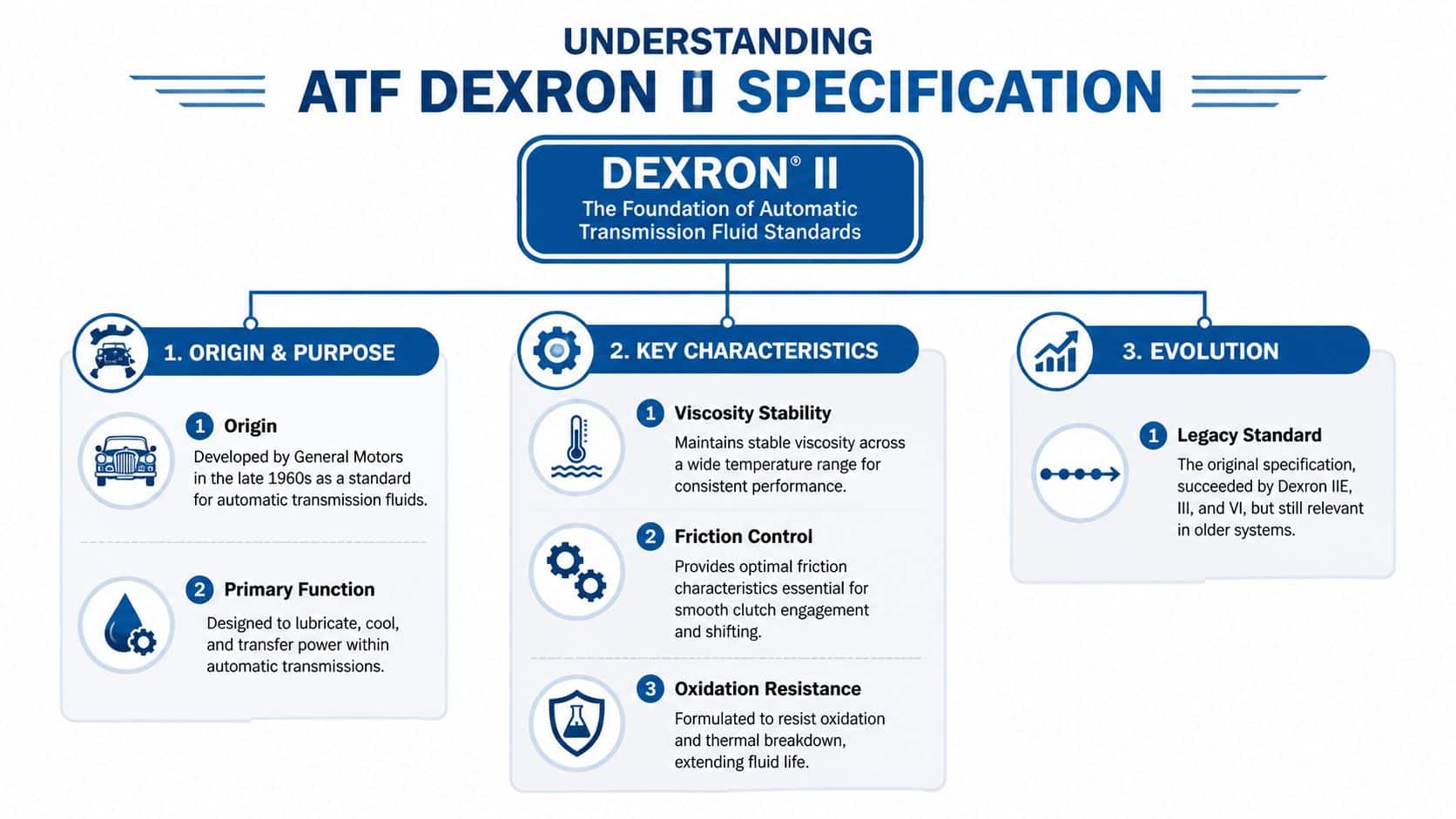
ATF Dexron II is a legacy automatic transmission fluid specification that General Motors originally introduced in 1968, and it was formulated around the needs of the transmissions and hydraulic controls of that era. It isn't a single brand or one exact bottle recipe. It's a performance standard that multiple lubricant manufacturers formulated products to meet.
The core numbers that define it
The useful technical reference points are these. According to the Premier Lubricants product data reference, Dexron II was engineered to operate within a viscosity range of 6.5 to 7.5 mm²/s at 100°C, with a kinematic viscosity of approximately 40 mm²/s at 40°C, and a minimum flash point of 180°C. The same reference notes that 1-litre containers retail at £4.50 to £6.00 in 2026 for legacy fleet maintenance.
Those numbers matter because they tell you how the fluid behaves at working temperature and how resistant it is to heat. In hydraulic service, viscosity affects leakage across clearances, pump lubrication, internal efficiency, and valve response. Flash point isn't a service recommendation by itself, but it helps frame the fluid's thermal margin.
Dexron II is best understood as a performance specification, not a universal fluid for every hydraulic system.
What those properties mean on the workshop floor
A fluid around this viscosity range can suit older hydraulic circuits that were built with relatively modest pressures, straightforward valve blocks, and pump tolerances that were happy with ATF-type oil. That's one reason ATF turned up in power steering units, light mobile hydraulics, and auxiliary systems.
The additive package also matters. Fluids built to this type of spec were intended to lubricate, cool, resist oxidation, and provide controlled friction behaviour. In a transmission, that friction behaviour is essential. In a hydraulic circuit, it may be less important than anti-wear performance and air release, but it's still part of the fluid's character.
Why it's called a legacy fluid
Dexron II didn't disappear because it stopped working overnight. It became a legacy specification because transmission and control systems moved on. Tighter tolerances, newer materials, improved shift control, and broader temperature demands pushed manufacturers towards later specifications.
For a technician, the practical takeaway is simple:
- If the machine was designed for Dexron II, the spec still has meaning.
- If the machine is modern, Dexron II usually isn't the right starting point.
- If the manual is vague, don't guess from colour or label alone.
Dexron II vs Modern ATF Specifications
The biggest mistake in fluid selection is thinking that “newer” always means “drop-in better”. Sometimes it does. Sometimes it creates side effects in old equipment that were never tested by the original builder.
With Dexron II, the common comparison is Dexron III. Dexron VI also enters the conversation, but in older hydraulic and mixed-function plant, the gap between the original design intent and the newest ATF chemistry can be too wide for blanket advice.
Dexron specification comparison
| Specification | Typical Viscosity @ 100°C (mm²/s) | Low-Temp Performance | Oxidation Resistance | Primary Application |
|---|---|---|---|---|
| Dexron II | 6.5 to 7.5 | Adequate for many legacy systems, but older cold-flow behaviour | Legacy standard | Older automatic transmissions and some legacy hydraulic applications |
| Dexron III | Qualitatively newer than Dexron II | Better on paper than Dexron II in low temperatures | Improved over older specs | Later automatic transmissions and some replacement use where approved |
| Dexron VI | Qualitatively newer fluid family | Typically aimed at broader modern operating demands | Higher modern-performance intent | Modern automatic transmissions designed around later specifications |
Where Dexron III improves on Dexron II
Dexron III was introduced to improve performance in areas that matter in both transmissions and some cold-weather hydraulic duties. The usual reasons for moving forward were better low-temperature behaviour, improved oxidation resistance, and stronger overall stability in service.
That sounds like an easy upgrade path, but machinery doesn't read marketing copy. It runs on tolerances, seal materials, valve design, and real duty cycles.
A useful example comes from agriculture in colder UK regions. The OptimOil Dexron III technical reference and cited UK Farming and Machinery Federation 2026 note states that 62% of tractors in northern UK regions experienced hydraulic sluggishness in winter due to fluid thickening, while only 15% of maintenance guidelines specifically recommend Dexron III over Dexron II for low-temperature resilience. That gap tells you something important. Operators face cold-flow problems, but guidance on whether Dexron III is the right answer for older equipment is often incomplete.
Better low-temperature performance on paper doesn't automatically mean a better field result in an older machine.
What works and what doesn't
A later ATF can work well when:
- The OEM or a fluid manufacturer explicitly approves it as a replacement.
- The system has known cold-start issues and the rest of the component stack is compatible.
- The machine has already been migrated successfully and monitored over time.
It doesn't work well as a casual substitution when:
- The original unit relies on the frictional character of the older fluid.
- Seal compatibility is uncertain.
- The reservoir still contains unknown fluid and someone plans to “top up and hope”.
Backward compatibility needs caution
Technicians often hear that a newer ATF is backward compatible. Treat that phrase carefully. It may be true for some transmission applications, or for some fluid manufacturer recommendations, but it isn't a universal hydraulic rule.
In old hydraulic circuits, a fluid change can alter leakage behaviour, air release, noise, and seal swell. None of those changes may show up immediately. If the machine matters, convert deliberately, not casually.
Suitability of Dexron II for Hydraulic Systems
ATF shows up in hydraulic systems because some circuits need a fluid that is relatively light, flows well across a broad temperature range, and offers decent anti-wear and corrosion protection. In older mobile and auxiliary systems, that made good practical sense.

That still doesn't make Dexron II a universal hydraulic oil. It means it can be appropriate in the right type of hydraulic circuit, usually one that was designed around ATF from day one.
Where Dexron II can perform adequately
Dexron II can still be a sensible choice in legacy systems such as:
- Power steering units on older vehicles and plant where ATF was the intended medium.
- Light-duty mobile power packs built around ATF-compatible pumps, seals, and valve blocks.
- Auxiliary hydraulic circuits where the manufacturer clearly specifies Dexron II or equivalent ATF.
In these cases, the fluid's viscosity and additive behaviour often align reasonably well with the original design assumptions. The key phrase is original design assumptions. That's the anchor point.
Where it starts to fall down
Problems appear when people stretch Dexron II into jobs better suited to a dedicated hydraulic oil.
High-load industrial hydraulics, systems with demanding proportional control, high-speed vane or piston pump duty, or circuits sensitive to aeration and shear can expose the limits of an older ATF specification. The fluid may still lubricate, but “works” and “works properly for long service life” are not the same thing.
A hydraulic system also lives or dies on contamination control. If you're assessing a legacy ATF-filled circuit, fluid condition often matters more than the brand on the drum. Good hydraulic fluid cleanliness standards will tell you more about likely component life than any label alone.
In hydraulic service, the cleanest suitable fluid nearly always outperforms the perfect fluid that's full of debris, water, or air.
Practical risks in hydraulic use
Three risk areas deserve attention.
Seal and hose behaviour
Older systems often used materials that were perfectly comfortable with ATF-type oils. Modern rebuild kits may not behave the same way if the component has been updated over time. A fluid swap can trigger leaks that look like a seal failure, but the underlying cause is chemical mismatch or changed swell characteristics.
Shear stability and film strength
Dedicated hydraulic oils are usually selected around hydraulic duty first. ATF balances hydraulic behaviour with transmission needs. In modest service, that can be fine. In harder service, especially where clearances, load, and heat are unforgiving, the compromise may stop being helpful.
Aeration and response quality
Some hydraulic circuits are sensitive to foaming and entrained air. If the machine becomes noisy, jerky, or slow after a fluid change, don't assume a pump fault first. Check whether the fluid type suits the reservoir design, return arrangement, and operating conditions.
A short visual explanation is useful here:
A sensible engineering position
If the machine was built for Dexron II, using a correct legacy-equivalent fluid can be entirely reasonable. If the system is an industrial hydraulic design that merely happens to have ATF in it because somebody once had a drum available, that's a different story. In that case, stop and reassess the whole application.
How to Select the Right Fluid and Ensure Compatibility
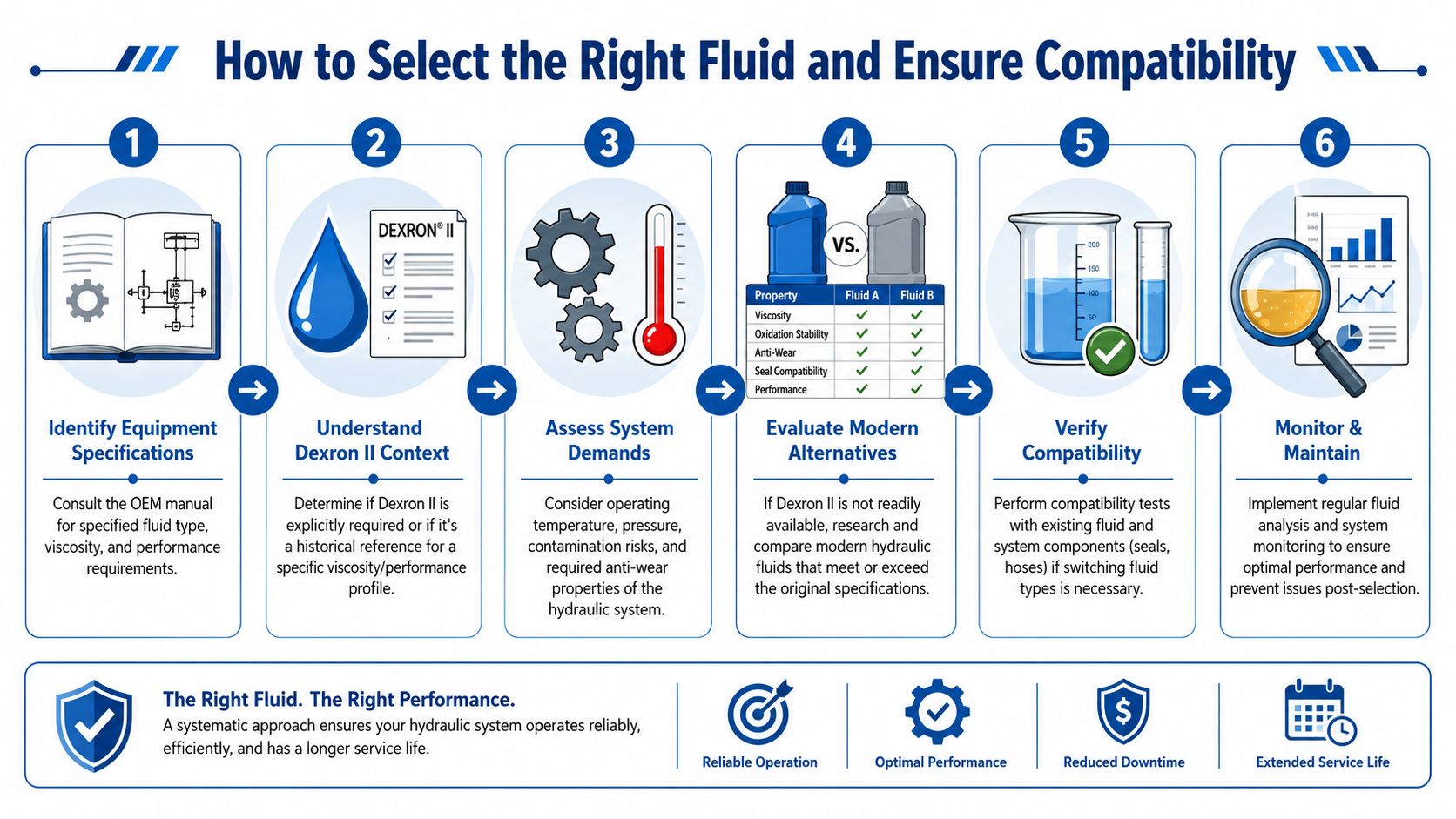
Fluid selection starts with discipline, not guesswork. The plate on the machine, the OEM manual, and the service history matter more than workshop folklore.
Start with the original requirement
If the manual says Dexron II, read the surrounding wording carefully. Some manuals name a fluid family because that was the common market product at the time. Others mean that exact performance profile. There's a big difference.
Look for clues such as operating temperature notes, remarks about power steering or transmission use, and any mention of approved alternatives. If the machine builder gave a modern replacement bulletin later, use that. If not, treat the original wording as technically significant.
Use a step-by-step check, not a shortcut
-
Identify the system type
Is this a transmission, steering circuit, hydrostatic auxiliary, tail-lift pack, or industrial power unit? Don't choose a fluid until you know what the oil is doing. -
Inspect what is already in the machine
Check colour, smell, contamination, and service records. If the fluid history is unknown, assume nothing. -
Match the performance need
Don't focus only on viscosity. Consider cold starts, thermal load, seal material, and whether friction behaviour matters in the unit. -
Check replacement guidance from lubricant suppliers
Cross-reference charts can be useful, but they are guidance tools, not engineering proof. If the recommendation looks broad or vague, dig deeper. -
Verify materials compatibility
If the machine has been rebuilt over the years, the elastomers in it today may not match the original spec. -
Plan the changeover properly
If you're switching fluid family, drain thoroughly, clean screens and filters, and avoid mixed-fluid uncertainty.
Seals, hoses, and mixed histories
Seal compatibility is where many “simple” fluid changes become expensive. Older nitrile seals often behaved predictably with legacy ATF. Modern elastomers may behave differently, especially if the component manufacturer expects a dedicated hydraulic oil or a later ATF chemistry.
That doesn't mean Dexron II is automatically harmful. It means you need evidence before changing over or topping up. If you can't confirm compatibility from the component maker, test cautiously and monitor closely.
Workshop advice: A new leak after a fluid change is often a compatibility issue or a pre-existing hardened seal that the old fluid was no longer exposing.
Know when analysis is worth it
If the machine is valuable, hard to replace, or running critical duty, use oil analysis rather than judgement by eye alone. A proper hydraulic oil analysis service helps separate fluid condition problems from component wear, water ingress, or contamination issues.
That's especially useful when you're deciding whether to stay with Dexron II, move to a modern equivalent, or flush and convert to a different approved fluid entirely.
The safest decision path
If the OEM clearly specifies Dexron II and the system is healthy, staying with a suitable legacy-equivalent fluid is often the least risky route.
If the OEM approves a later fluid, or the fluid manufacturer offers a clearly stated replacement backed by the application, then conversion may make sense.
If nobody can confirm suitability, the right answer is caution. “Probably fine” is not a fluid specification.
Maintenance Disposal and Troubleshooting Guide
Once Dexron II is in service, condition matters more than label loyalty. A healthy fluid supports the machine. A degraded fluid announces itself through smell, sluggish response, heat, noise, and wear.
What to monitor in service
Don't rely on calendar habits alone. Monitor the fluid and the machine together.
- Colour change. Darkening can indicate oxidation, heat stress, or suspended contamination.
- Burnt smell. That usually points to overheating or severe fluid breakdown.
- Cloudiness or haze. That can suggest water contamination or air entrainment.
- Debris in filters or strainers. That may indicate normal wear, but it may also point to a component starting to fail.
- Cold sluggishness. If actuators hesitate or pumps complain during start-up, investigate viscosity behaviour and system condition together.
Common faults and what they usually mean
A few symptoms come up repeatedly in legacy ATF-filled hydraulic systems.
Slow response in cold weather
This can be fluid thickening, but don't stop there. Check suction strainers, intake hose condition, reservoir location, and whether the machine is using the fluid the builder intended.
New leaks after a fluid change
Look first at seal compatibility and pre-existing seal hardness. The fluid change may not have “caused” the damage so much as revealed it.
Whining or erratic operation
That often points to aeration, low fluid level, suction-side restriction, or contamination. Use a proper hydraulic troubleshooting methodology rather than changing parts one by one.
If a pump gets noisy straight after a fluid change, inspect suction conditions and fluid suitability before condemning the pump.
Maintenance discipline
For legacy hydraulic systems, the best practice is simple:
- Keep records of what fluid went in and when.
- Label the machine if it uses ATF rather than standard hydraulic oil.
- Change filters and clean breathers whenever contamination is suspected.
- Sample before draining if you need to understand the failure mode.
Avoid topping up blindly from whatever container is nearest. Mixed fluids make diagnosis harder and can leave you with neither the old performance nor the new one.
Disposal and handling in the UK
Used ATF should be handled as waste oil and collected through the proper waste stream. Don't pour it into drains, general waste, or mixed workshop waste containers. Store used fluid in suitable labelled containers, keep it segregated where possible, and use an authorised waste handler in line with UK environmental obligations.
Good disposal practice isn't paperwork for its own sake. It keeps the workshop safe, protects the site, and preserves traceability if a machine problem later needs investigating.
Your Dexron II Questions Answered
Can I mix ATF Dexron II with Dexron III
Sometimes people do it in an emergency, but it's not good practice. The additive packages and friction characteristics differ, so mixing can change the way the fluid behaves. If you have to do it to get a machine safe, treat it as temporary and correct it properly.
Will Dexron II damage the seals in my modern equipment
It might, or it might not. That depends on the seal material, component design, and what the OEM approves. Dexron II is generally associated with seal materials common in older equipment, but modern systems should always be checked against current component recommendations.
Where can I still purchase Dexron II fluid in the UK
Specialist industrial, agricultural, and legacy lubricant suppliers are the usual route. In practice, you'll often find legacy-equivalent products rather than a mainstream retail shelf full of them.
The short version is this. ATF Dexron II still has a place, but only where the machine design justifies it. In old hydraulic and mobile systems, staying with the original specification can be the lowest-risk option. In other cases, a deliberate move to a later approved fluid is the better engineering decision. The key is to base that choice on the system, not on convenience.
If you need application advice, cross-references, or help matching components for a legacy hydraulic system, contact MA Hydraulics Ltd. Phone 01724 279508 today, or send us a message.
