

You're often in the same spot when a hydraulic project starts. The machine concept is approved, the mechanical layout is already tight, procurement wants cost certainty, and someone needs an answer on flow, pressure, reservoir space, duty cycle, controls and service access before the frame is even frozen.
That's where mistakes usually begin.
A younger design engineer will often look at a hydraulic power pack as a shopping list. Pump, motor, tank, valve block, relief valve, hoses. In practice, that mindset causes most of the expensive problems. The issue is rarely that one part was “wrong” in isolation. The issue is that the whole system wasn't matched to the job, the environment and the operator.
Introduction The Hidden Cost of Getting Hydraulics Wrong
A familiar example is a compact mobile machine that needs enough hydraulic force to do useful work, but also has to fit inside a cramped body envelope, survive weather, start reliably in winter and stay easy to repair in the field. On paper, the specification can look straightforward. In service, the trouble starts quickly if the design team guesses at duty cycle, undersizes cooling, ignores contamination risk or chooses components around catalogue convenience rather than application fit.
When that happens, the cost doesn't show up in one neat line. It appears as rework in the build shop, extra hose changes, nuisance overheating, noisy operation, warranty friction and machine downtime at the customer's site. If the machine is used in agriculture or materials handling, the operator usually doesn't care whether the root cause was poor valve selection, a badly judged reservoir arrangement or a mismatched gear pump. They only see a machine that stops earning.
That's why application engineering matters. It's the discipline of translating a real operating need into a hydraulic system that will survive the work. In the UK, approximately 6.3 million people, or 19.2% of the total workforce, were employed in engineering and technology occupations as of 2023, according to EngineeringUK's workforce update. That scale tells you something useful. There are a lot of engineers involved in specifying and supporting equipment, but not every project gets the hydraulic thinking it needs early enough.
A good contrast comes from outside power pack design. In barrier applications, the move away from traditional hydraulic arrangements can cut maintenance sharply when the duty and mechanism suit it, as shown in the RSSI Vehicle Barrier maintenance savings case study. The lesson isn't “hydraulics are bad”. The lesson is that the right engineering approach starts with the application, not the preferred component family.
Get the application wrong and even premium components become expensive ways to fail.
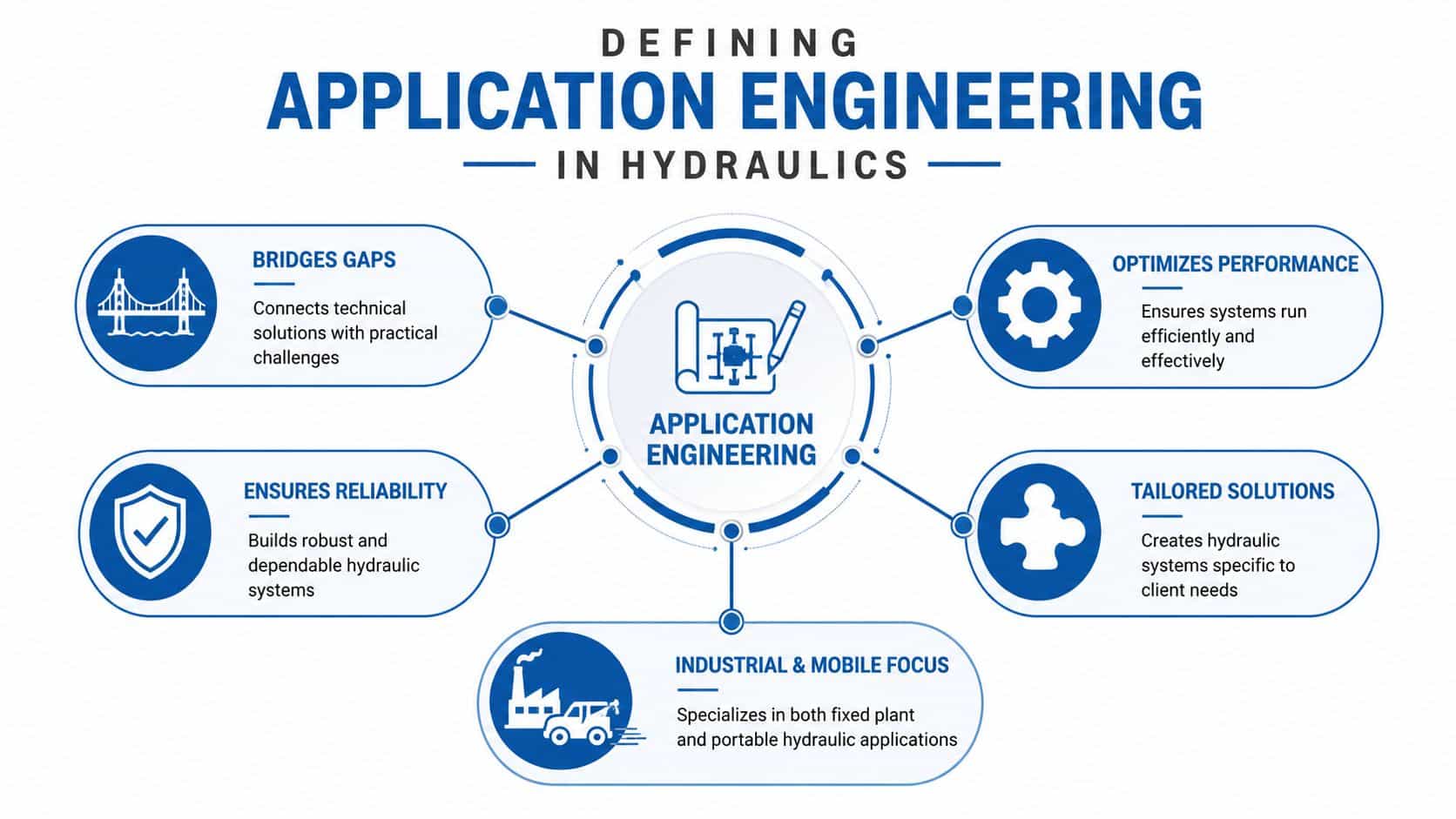
What Is Application Engineering in Industrial Hydraulics
Application engineering in hydraulics is best understood as technical translation. A customer says, “I need this machine to lift, clamp, steer, tilt or hold under these conditions.” The application engineer turns that into pressures, flows, heat loads, control logic, manifold requirements, filtration strategy and service access.
That's very different from just supplying parts.
More than component selection
A parts seller can tell you whether a pump is in stock. An application engineer needs to ask whether that pump should be there at all. If the duty is intermittent, a compact mini power pack may be ideal. If the machine sees long loaded cycles, awkward ambient conditions or repeated starts under load, the same compact arrangement might run too hot or become difficult to maintain.
That difference matters because hydraulic systems fail in combinations. A gear pump might be perfectly sound, yet fail early because suction conditions were poor. A valve may chatter not because the valve is defective, but because the control philosophy and flow path were badly judged. A reservoir can be “large enough” on paper and still be wrong if deaeration, return line placement and contamination control were ignored.
A useful way to think about the role is as a bespoke tailor. Standard sizes exist, but a proper fit still depends on who will wear it, how they move and where they'll use it.
Why the role carries weight
Good application engineers sit between commercial pressure and technical reality. They need enough product knowledge to compare pumps, motors, CETOP valves, inline valves, manifolds, filters and couplings, but also enough practical judgement to reject bad assumptions before they become hardware.
That's one reason the role is valued. In the UK, the median annual salary for an Applications Engineer is £52,500, based on vacancies posted over the six months leading to 13 July 2026, according to IT Jobs Watch. If you want a broader market comparison, this overview of 2026 hydraulic engineer pay is useful context, even though role definitions vary across employers.
Practical rule: If nobody in the project owns the translation from machine behaviour to hydraulic behaviour, the machine will teach the lesson later, at a higher price.
What application engineering should produce
At its best, the process gives you:
- A system that matches duty. Not just peak output, but the work pattern.
- Stable operation. Predictable movement, sensible temperature behaviour and clean pressure control.
- Serviceability. Filters, valves and test points that a technician can reach.
- Commercial realism. Components chosen with availability, replacement and lifecycle in mind.
That's the definition. Not paperwork. Not jargon. A hydraulic system that works in the field for the reasons you intended.
The Five Stages of the Application Engineering Process
A structured process prevents the most common hydraulic mistakes. It also stops projects drifting into guesswork once deadlines tighten. The UK hydraulics market is projected to expand from USD 1,627.4 million in 2024 to USD 2,143.8 million by 2035, with a projected CAGR of 2.54% for 2025 to 2035, according to Spherical Insights. For UK readers, that's roughly £1,278.5 million rising to about £1,683.8 million, using a simple like-for-like GBP equivalent for orientation rather than a live exchange quote.
That growth projection matters because as more equipment enters service, poor engineering discipline scales into more support calls, more downtime and more avoidable redesign.
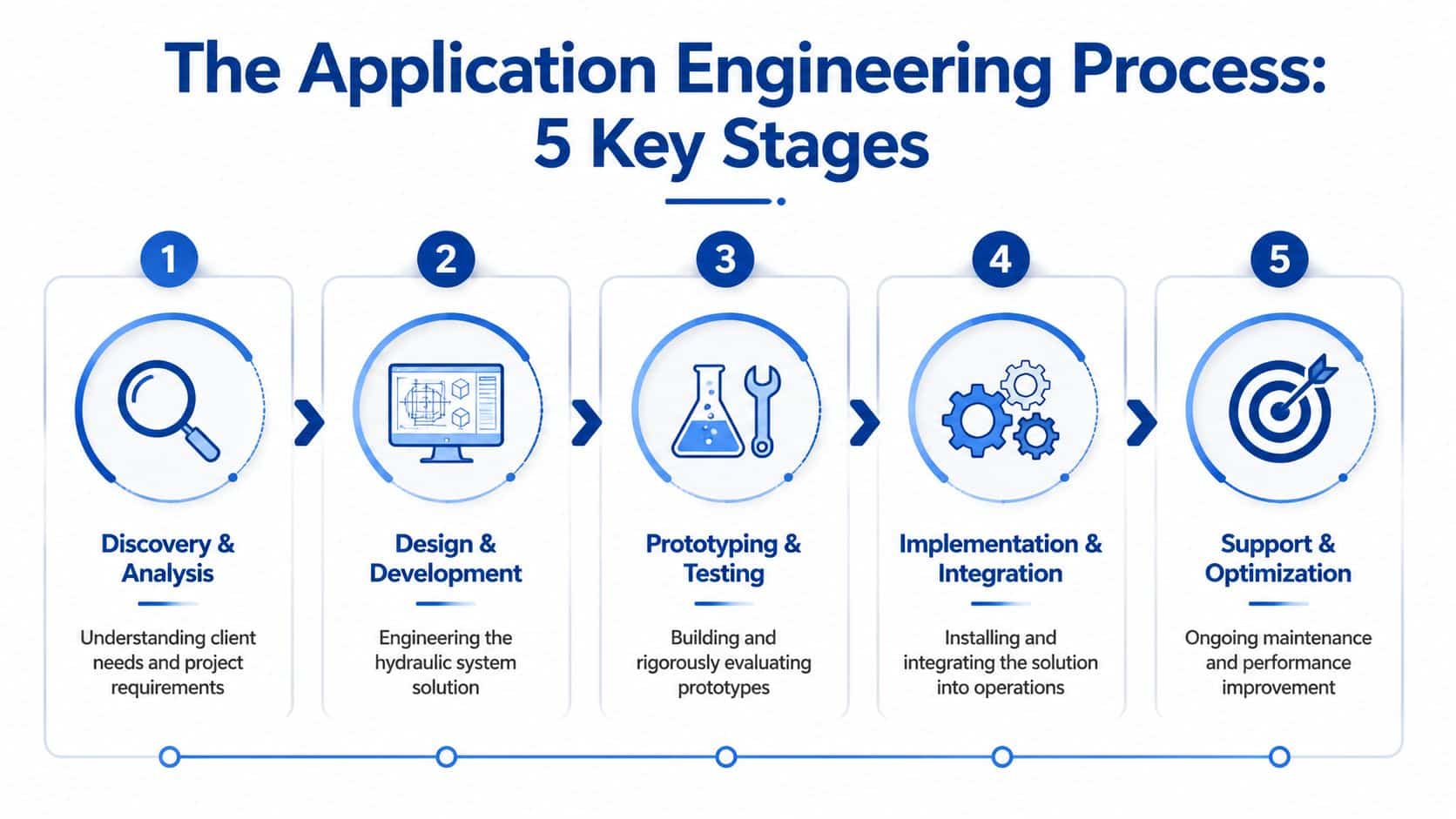
Stage one requirements capture
The first job is to understand what the machine has to do. Not what someone copied from the last project, and not what a rough purchasing spec says.
Capture these points early:
- Load case. What force or torque is needed, and when?
- Duty pattern. Short bursts, continuous operation, repeated holding, reversing, shock loading.
- Environment. Outdoor exposure, washdown, dust, low temperatures, corrosive surroundings.
- Physical constraints. Envelope, mounting orientation, access for hose routing and maintenance.
- Control expectation. Manual, solenoid, proportional, remote or integrated logic.
A lot of bad systems start because one of those assumptions was never pinned down.
Stage two sizing and calculation
Now the maths has to reflect actual duty, not ideal conditions. When dealing with this, younger engineers often make one of two errors. They either size everything on a theoretical peak and make the pack expensive and inefficient, or they size too tightly and leave no margin for warm oil, wear, leakage or operator abuse.
A sound sizing exercise covers actuator demand, pressure losses, motor power requirement, reservoir practicality and expected heat behaviour. If multiple functions can run together, that has to be included. If they can't, the control philosophy should make that explicit.
For teams trying to align engineering decisions with build planning and purchasing, a practical manufacturing resource planning guide can help clarify how specification choices affect lead times and assembly flow.
A short visual summary helps before moving to hardware selection.
Stage three component selection
Catalogue familiarity can become a trap. You're balancing hydraulic performance, physical fit, durability, maintainability and availability.
A practical selection review often looks like this:
| Decision area | What works | What causes trouble |
|---|---|---|
| Pump choice | Matching displacement and directionality to duty | Choosing on price alone |
| Valve strategy | Keeping the circuit simple and serviceable | Layering functions without checking pressure drop |
| Reservoir arrangement | Allowing clean return, breathability and access | Treating the tank as dead space |
| Filtration | Putting contamination control where it helps most | Assuming one filter solves everything |
For bespoke power packs, this is also where brands and architectures come into play. Vivoil gear pumps and motors, Hydronit mini power pack assemblies, inline valves from Luen, CETOP valves, bellhousings, couplings and manifolds all have valid places. The point isn't brand preference. The point is fit for application.
Stage four system integration and assembly
This stage decides whether a sensible design stays sensible once built. Hose routing, manifold layout, return line placement, suction arrangement, mounting stiffness and electrical integration all matter.
I've seen technically correct component selections become awkward, fragile systems because the build was forced into a bad layout. A valve that's ideal on the schematic may be a poor choice if it can only be mounted where no technician can reach it.
Testing strategy should already be planned at this point. A proper testing and commissioning approach is part of application engineering, not a last-minute sign-off exercise.
Stage five testing and commissioning
Bench testing should confirm more than “it runs”. You want to verify pressure control, leaks, temperature behaviour, function sequencing, noise, response and basic service access.
If commissioning is the first time the full duty cycle is considered, the process is already late.
The final output should be a hydraulic system that the installer understands, the operator can use, and the maintenance team can support without reverse-engineering your intent.
Key Principles for Successful Hydraulic System Design
You can follow a formal process and still produce a poor hydraulic system if the design principles are weak. The strongest systems usually come from a few disciplined habits rather than clever complexity.
Design for the real duty, not the showroom moment
Machines aren't judged on how they perform for a short demonstration. They're judged on whether they keep working after long shifts, cold starts, dirty conditions and rushed maintenance. Design around the actual duty cycle and the expected abuse margin.
That means asking uncomfortable questions early. Will the operator hold a function against relief more often than intended? Will the machine sit outside in winter? Will a service team have proper flushing discipline? If the answer is “probably not”, the hydraulic design needs to be tolerant.
Prioritise efficiency and heat control
Peak power gets attention because it looks decisive. In service, wasted power and excess heat usually do more damage. A circuit with unnecessary restrictions, overactive relief flow or a poor control strategy can create chronic oil temperature problems that shorten seal life and increase leakage.
A better approach is to simplify flow paths, avoid needless pressure loss, and match component sizes to the actual duty window. If a manifold is part of the solution, a well-considered hydraulic manifold design can reduce leak points and improve packaging, but only if the internal logic stays clear and serviceable.
A compact hydraulic system isn't a success if it saves space but creates heat, noise and awkward maintenance.
Make serviceability part of the design
Serviceability is often treated as somebody else's problem. Then the first filter change needs half the guarding removed, or a failed valve can't be accessed without draining the system. That's avoidable.
Good design for service usually includes:
- Reachable components. Filters, test points and common service items where a technician can get to them.
- Clear replacement logic. Parts that can be identified and cross-referenced without guesswork.
- Sensible hose and pipe runs. Enough room to remove and refit without damaging adjacent components.
- Useful documentation. A schematic that reflects the built system, not an early draft.
Leave room for change
Machines evolve. Customers add functions, revise controls or ask for a different operating sequence. The best application engineering leaves some space for that reality. Not unlimited scope. Just enough flexibility that a small change doesn't force a complete redesign.
A hydraulic system should be optimised, but not painted into a corner.
Common Pitfalls in Hydraulic Application Engineering
Most hydraulic failures blamed on “poor parts” begin earlier, in poor assumptions. The same mistakes show up repeatedly because they often save time in the short term. They also create the most expensive support work later.
In UK agriculture, 78% of firms report hydraulic system downtime as a top operational risk, according to SmartDev. That makes the cost of sloppy specification very practical, especially in mobile and seasonal equipment where lost time is hard to recover.
Under-specifying and over-specifying
Under-specifying is easy to recognise once the machine is in service. Slow functions, repeated relief operation, overheating, pressure instability and short component life. The more subtle error is over-specifying. Bigger isn't always safer.
A pump with excessive flow can make control harder and increase heat. An oversized motor can push cost and packaging in the wrong direction. A larger reservoir may solve one issue while creating another if the machine can't accommodate it properly.
Use this test:
- If the component was chosen for margin, define what margin it protects against.
- If the component was chosen “just in case”, challenge it.
- If the component was copied from another machine, verify that the duty is comparable.
Ignoring the environment
Indoor factory duty and exposed mobile duty are not the same job. Yet systems still get specified as if temperature swing, water ingress, dirt and vibration are minor details.
Common misses include poor breather protection, unsuitable sealing assumptions, inadequate hose protection and electrical layouts that don't age well outdoors. In agriculture and mobile plant, contamination and weather rarely arrive as isolated events. They compound each other.
The environment is part of the circuit. Treat it that way.
Choosing on purchase price alone
There's nothing wrong with cost discipline. The problem starts when initial price becomes the only filter. A cheaper valve with awkward availability, poor interchangeability or uncertain service support can become more expensive than a stronger option by the first failure.
The same applies to fittings, couplings and hose assemblies. If the selected parts make field replacement slower or create repeat leaks, the saving disappears quickly.
Weak documentation and handover
A hydraulic pack can be built neatly and still become a maintenance headache if the records are poor. Missing part references, unclear valve settings, absent test data and outdated schematics all waste hours when a fault appears.
Avoid that by making documentation part of the deliverable, not an afterthought. The fitter, the commissioning engineer and the maintenance team should all be able to follow the same story from specification to service.
How MA Hydraulics Delivers Bespoke Solutions
The value of application engineering becomes clearer when you look at the kinds of jobs that need more than a standard catalogue answer. In the UK, the hydraulic fitting market is projected to grow at a 4.8% CAGR between 2025 and 2033, according to this United Kingdom hydraulic fitting market analysis. As component options expand, selection discipline matters more, not less.
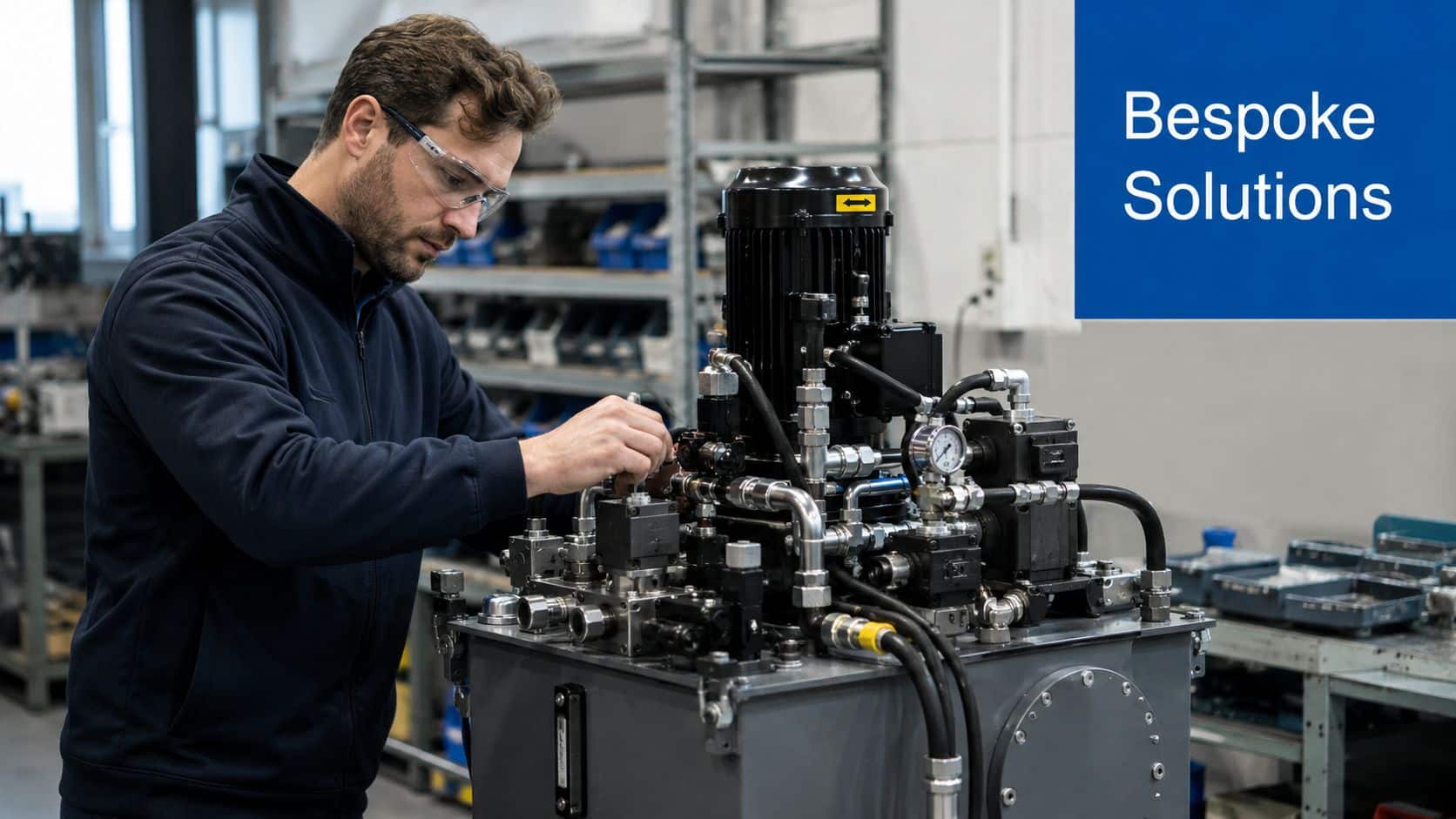
A compact power pack for mobile agricultural duty
One common requirement is a bespoke hydraulic power pack for a mobile machine where space is restricted and the operating environment is harsh. The job involves more than making the pack smaller. It's to package a system that can start reliably, resist weather exposure, deliver the required function and still be maintainable.
For this type of project, the practical decisions usually centre on motor and pump matching, reservoir arrangement, valve protection, mounting orientation and wiring integrity. A Hydronit mini power pack can be the right base where compactness and integrated assembly are priorities, but only if the actual duty supports that architecture. If repeated loaded operation or poor ventilation will challenge oil temperature, the design needs to reflect that before the unit is built.
The strongest outcome comes when assembly, component matching and test checks are treated as one continuous process rather than separate commercial transactions. That's where specialist fluid power services become valuable.
Sorting a recurring motor failure in a plant setting
A different kind of application engineering job starts with failure. A plant maintenance team keeps replacing a hydraulic motor, but the replacement interval stays poor. In many cases the motor itself isn't the whole problem. The issue sits in the surrounding circuit.
A sound review would look at pressure spikes, return conditions, valve behaviour, contamination path, load reversals and whether the motor was correctly matched for the operating pattern. In a case like that, moving to a more suitable Vivoil gear motor and pairing it with a better judged inline valve arrangement from Luen can solve the underlying mismatch rather than just repeating the same replacement exercise.
What these jobs have in common
These examples differ in starting point, but the engineering logic is the same:
- Translate the duty accurately. Don't let convenience rewrite the job.
- Select components as a system. Pump, valve, motor and manifold choices interact.
- Build for supportability. Service access and replacement logic matter from day one.
- Test what the machine will really do. Not just the easiest bench sequence.
That's the practical value of structured application engineering. It turns “Can you supply this part?” into “What will keep this machine working?”
Engaging an Expert Partner for Your Next Project
If you're about to involve a hydraulic specialist, gather the right information first. Good application engineering starts faster when the basics are clear, and it avoids days of back-and-forth over missing details.
What to prepare before you make contact
Bring the facts that affect design decisions most:
- Required function. Lift, clamp, rotate, tip, steer, hold or a combination.
- Pressure and flow targets. Even provisional figures are better than none.
- Duty pattern. Intermittent, continuous, repeated cycling, holding under load.
- Space and mounting limits. Envelope, orientation and service access restrictions.
- Environment. Indoor, outdoor, dirty, wet, cold, corrosive or vibration-prone.
- Control preference. Manual, electrical, proportional or integrated manifold logic.
- Commercial limits. Budget expectations, lead time and preferred component strategy.
What a good supplier should return
You should expect a response that helps you make decisions, not just a price. That often includes a quotation, component specification details, practical comments on the proposed arrangement and, where relevant, assembly or layout information.
If the conversation is good, you'll also get challenge where it's needed. That's useful. The supplier who agrees with every assumption may be easier to brief, but won't necessarily protect the project.
For practical support with bespoke power packs, hydraulic component selection and application engineering advice, contact MA Hydraulics Ltd. Phone 01724 279508 today, or send us a message.
