
UK hydraulic valve prices are approximately £20–£80 for standard industrial valves, £150–£600 or more for precision instrumentation-grade valves, and £2,000–£10,000 for electronically actuated multi-valve manifolds with diagnostics. These are indicative bands, not quotations.
You're probably looking at a replacement valve, an unfamiliar part number or a supplier's quotation and asking whether the price makes sense. The difficulty is that matching the photograph and connection size won't tell you whether you're buying the right component.
Start with the application, then compare the price. A sensible purchase needs to satisfy the hydraulic duty, fit the machine and arrive with the support and documentation your installation requires.
Why Hydraulic Valve Prices Differ
A UK maintenance buyer opens two catalogue listings. Both show compact metal-bodied valves with threaded connections and manual controls, yet one is a steel needle valve and the other is a stainless-steel ball valve.
They aren't interchangeable purchasing options. The needle valve is intended for fine adjustment, while the ball-valve listing describes a different control function, construction and sealing arrangement. Choosing whichever looks cheaper skips the engineering question.
Similar appearance, different duties
The following image illustrates why appearance alone is a poor purchasing guide.
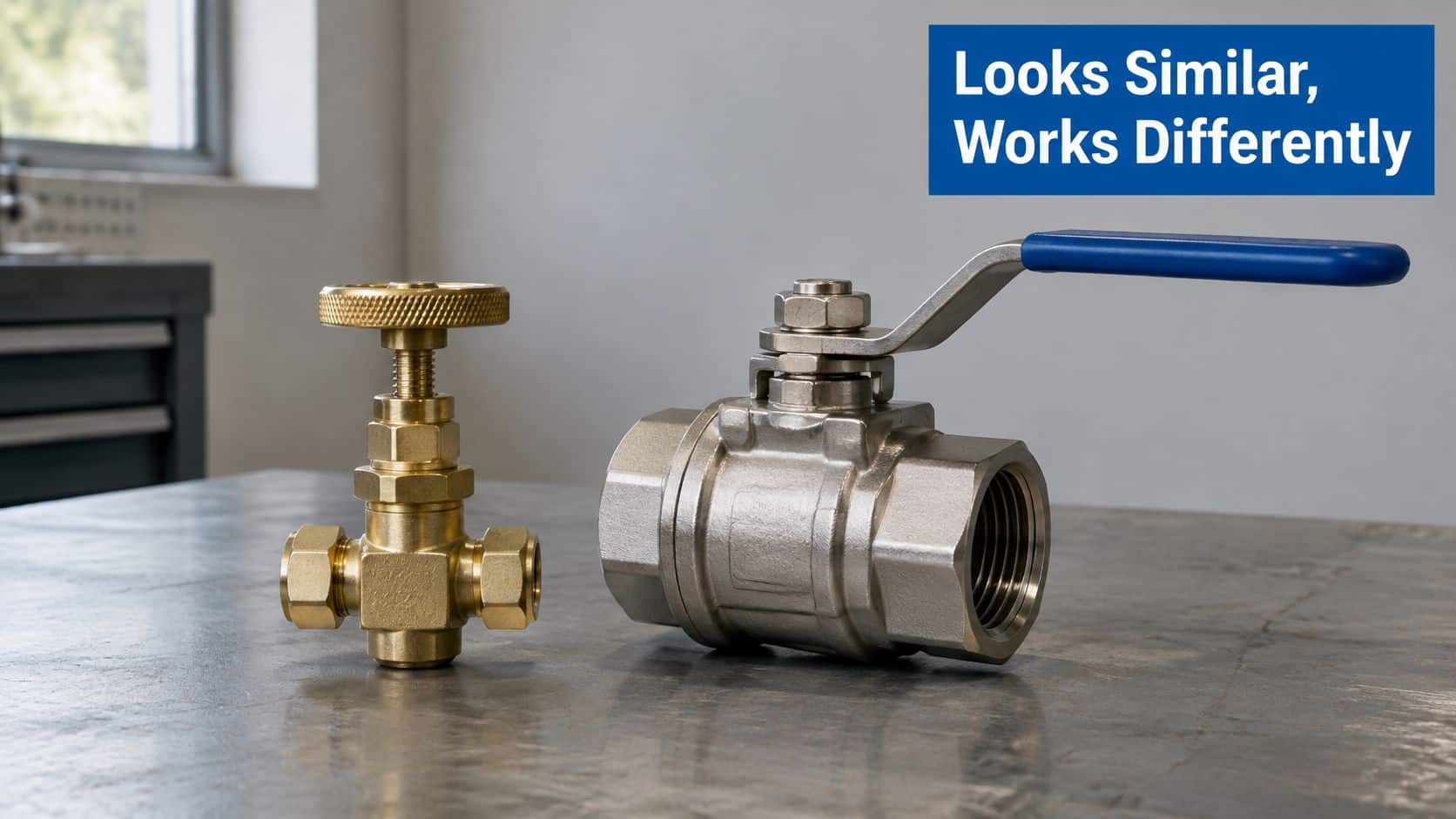
Compare what the machine needs the valve to do, not the body shape. Isolation, metering and pressure control are different purchasing requirements, even where the components occupy similar space.
The same applies to construction. A stainless-steel body, specialist seals or a defined operating-temperature envelope can make a visually similar valve a different proposition. Those features must answer an application requirement, rather than serve as an automatic justification for buying the dearer item.
Practical rule: A cheaper valve is an alternative only after you've established technical equivalence.
Separate product differences from market movement
There's also a commercial background to any hydraulic valve price. The ONS producer-price series for UK-manufactured other taps and valves recorded an annual index of 114.5 in 2023, against 2015=100, indicating approximately 14.5% higher producer prices across that broader category.
That's useful when reviewing an old replacement budget. It isn't a catalogue-price calculator, and it doesn't establish what a particular hydraulic valve should cost.
Use the index to challenge an explanation based purely on general manufacturing inflation. Then ask the supplier to identify the product-specific differences:
- Hydraulic duty: What function and operating conditions does the quoted valve satisfy?
- Construction: Which material, seal or manufacturing requirements distinguish it?
- Supply scope: Does the quotation include accessories, testing or documentation absent from the cheaper listing?
A useful quotation starts with a valve brief. A product name and a photograph are supporting information, not a complete specification.
The Main Factors That Set Hydraulic Valve Price
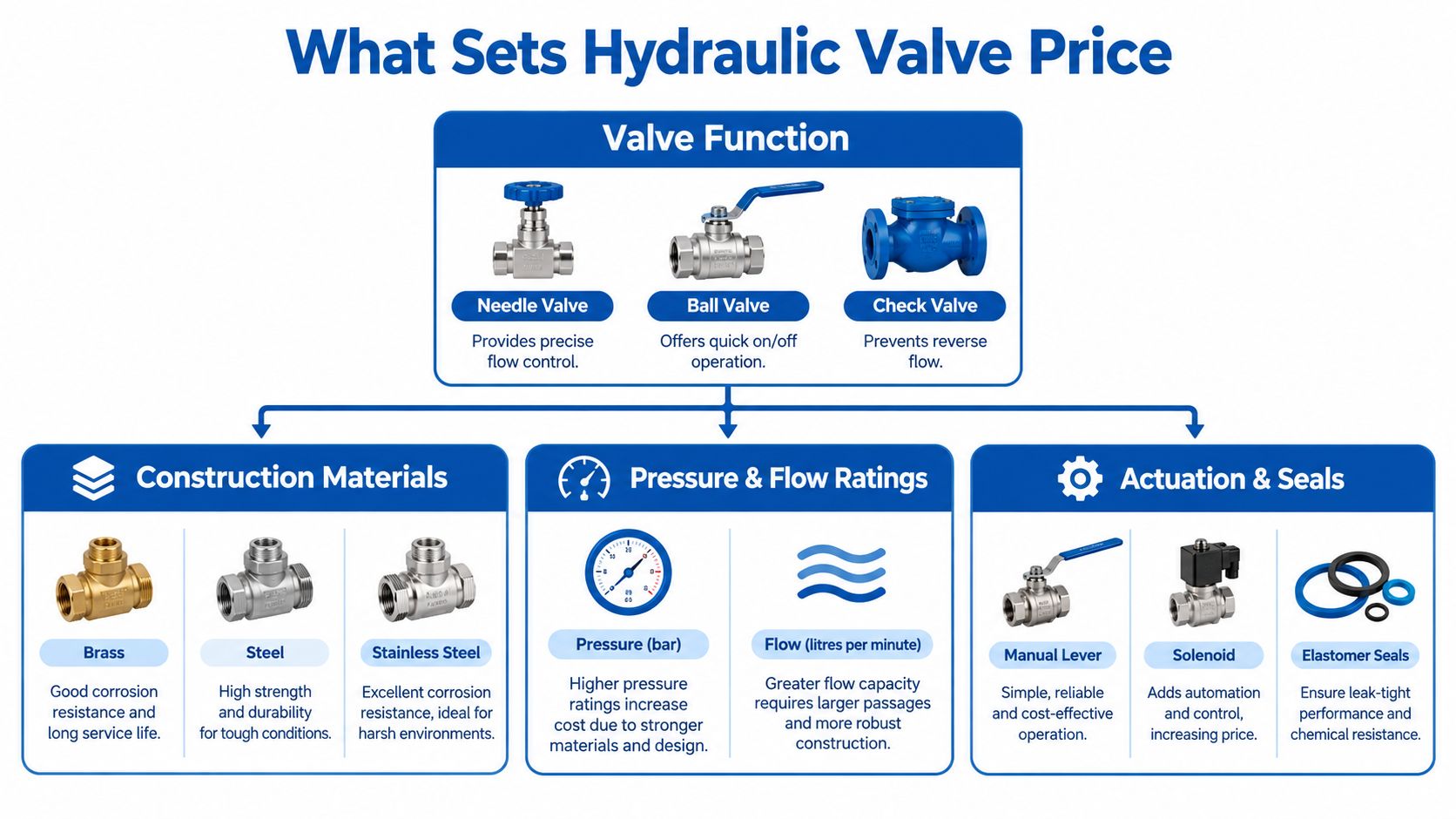
Specify a valve as you would a pump or gearbox. Begin with the job it must perform, establish the operating envelope, then select the construction and control options.
This hierarchy is a useful way to organise the discussion.
Function and operating envelope come first
Don't compare an isolation valve with a proportional control product because both fit the pipework. Establish whether you need isolation, directional control, pressure regulation or adjustable flow, then evaluate suitable constructions.
Pressure and flow belong together in that decision. Ask suppliers to confirm suitability at the intended flow, not merely to point to the maximum pressure on the product sheet.
The principal commercial drivers are:
- Body and internal materials: Specify materials appropriate to the fluid and environment. Don't pay for specialist alloys without a reason, but don't substitute cheaper material without checking suitability.
- Control method: Manual operation, solenoid switching and proportional control require different components and integration.
- Seals and temperature: State the fluid and operating conditions so suppliers can select the sealing arrangement.
- Precision and evidence: Tighter control tolerances, traceability, certification and specialist testing change what the supplier must manufacture and document.
Buy the required performance, not the longest options list. Unnecessary feedback electronics and certification add scope without necessarily improving the machine's intended operation.
The surrounding system matters too
Some options affect the valve itself. Others create work elsewhere: a different connector can require wiring changes, while a different mounting arrangement can require a manifold alteration.
Ask suppliers to distinguish these costs. A component quotation shouldn't conceal the engineering needed to make it usable.
The embedded video provides additional hydraulic-valve context alongside the specification discussion.
Wider manufacturing conditions also matter. The ONS December 2024 producer-price release reported input prices 1.5% lower year on year, while output prices were 0.1% higher; its contribution table recorded a 1.4% annual increase for basic metals, fabricated metal products and machinery.
Don't assume falling headline input costs mean every valve quotation should fall equally. Ask what changed in the actual supply scope, material requirement or commercial terms.
UK Price Bands for Common Valve Classes
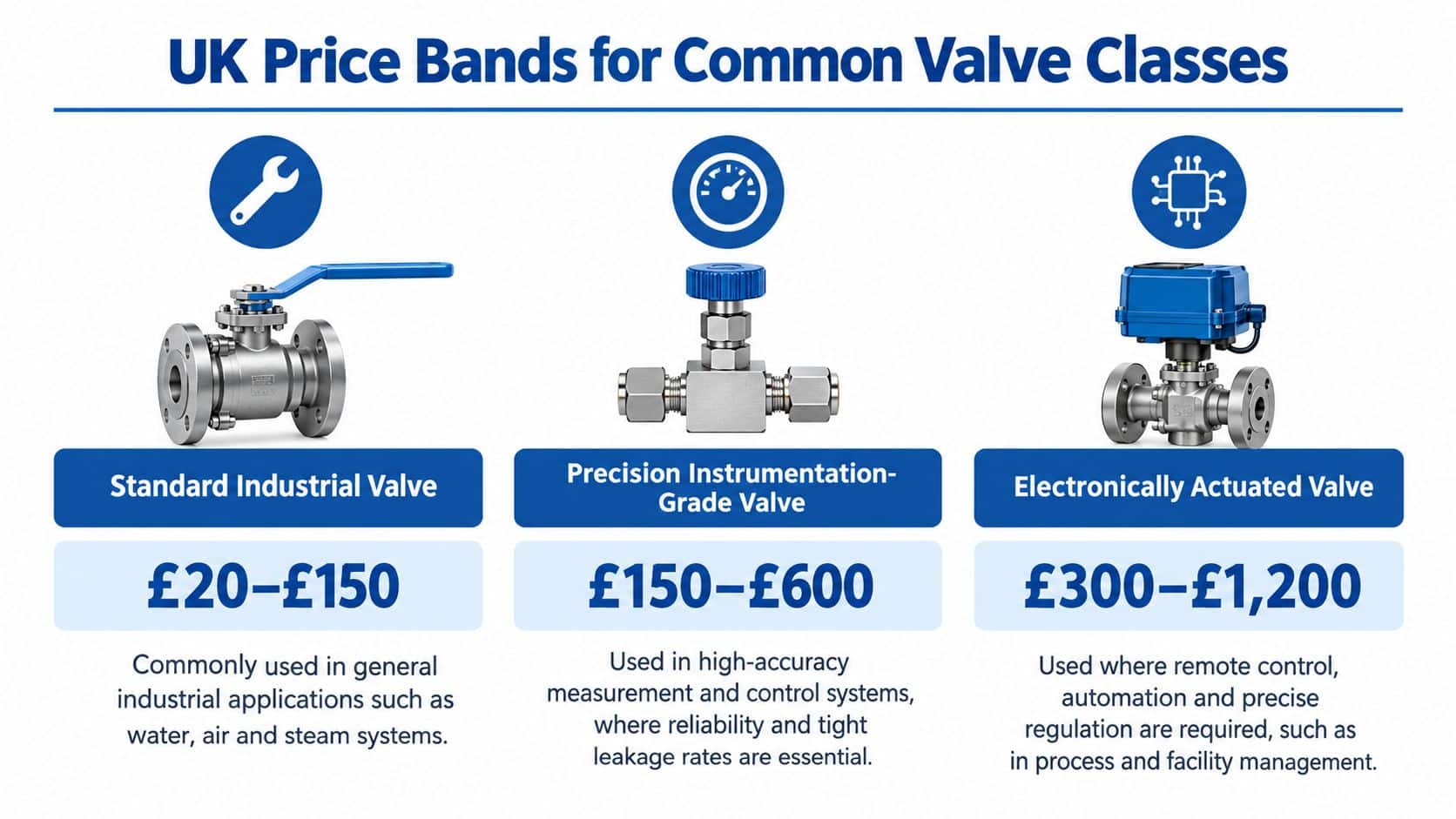
Choose the comparison group before collecting prices. A standalone industrial valve, a precision instrumentation product and a diagnostic manifold assembly aren't competing versions of the same purchase.
The broad ranges below come from a UK valves and flow-control market analysis: standard industrial valves at approximately £20–£80, precision instrumentation-grade valves at £150–£600+, and electronically actuated multi-valve manifolds with diagnostics at roughly £2,000–£10,000. The same analysis reports a 30–60% premium for precision products associated with tighter tolerances, higher-grade alloys, traceability and certification.
Compare equivalent levels of engineering
| Comparison group | What to establish before comparing |
|---|---|
| Standard industrial valve | Whether the basic function and operating envelope satisfy the duty |
| Precision instrumentation-grade valve | Whether the application requires tighter control, specialist construction or documented traceability |
| Electronically actuated diagnostic manifold | What the assembly includes, how it interfaces with the machine and which commissioning tasks remain |
Treat the premium percentage as contextual information, not a formula for converting a basic valve into a precision product. The category ranges overlap imperfectly because the products and their supply scopes differ.
The accompanying graphic is a broad category illustration. Its displayed bands differ from the market ranges above, and its electronically actuated valve category mustn't be confused with a complete diagnostic multi-valve manifold.
Set the right purchasing boundary
For an OEM buyer, the important question is whether the quotation covers a component or an engineered subsystem. Electronic feedback, assembled manifolds and specialist documentation should be identified explicitly, rather than assumed from a category label.
For an MRO buyer, the useful comparison is often the approved replacement against a properly assessed alternative. Don't compare an assembled replacement with a bare valve unless you've allowed for everything needed to complete the installation.
Use the guide to types of hydraulic valves to establish the appropriate functional category before treating a price band as relevant. A budget estimate helps you plan expenditure; it doesn't confirm suitability or availability.
How Specification Changes the Quoted Price
Connection size can materially change a quotation, but it isn't a reliable shortcut to value. A smaller valve isn't automatically the economical choice if it doesn't satisfy the application.
The following example UK valve pricing benchmarks use the UK retail valve benchmark. Prices are exclusive of VAT; inch designations identify the BSP connection sizes used in the listings, rather than metric bore measurements.
| Valve example | Specification | UK price | Procurement reading |
|---|---|---|---|
| Steel needle valve | 400 bar, 1/4-inch BSP | £33.20 exc. VAT | Basic manual metering benchmark |
| Steel needle valve | 400 bar, 1/2-inch BSP | £40.92 exc. VAT | Match the required connection and flow duty |
| Steel needle valve | 400 bar, 3/4-inch BSP | £71.28 exc. VAT | Don’t extrapolate price directly from connection size |
| Steel needle valve | 400 bar, 1-inch BSP | £115.10 exc. VAT | Larger connection, materially different purchase cost |
| Stainless-steel hydraulic ball valve | 1/2-inch connection, PTFE/Kel-F sealing, −40°C to 120°C | £105.75 exc. VAT | Different function, construction and operating envelope |
Read the specification, not just the price column
The needle-valve examples show that price doesn't increase in a simple proportion to the connection designation. Don't select the smallest available connection to reduce the invoice, then assume fittings will resolve the engineering consequences.
The stainless-steel ball-valve example requires a different comparison. Its material and sealing specification matter, but so does its intended function. Before accepting any substitute, obtain a product datasheet confirming the required pressure rating in bar and suitability throughout the operating-temperature range.
Compare the cheapest technically acceptable option with the alternatives. Exclude unsuitable products before discussing savings.
Challenge incomplete alternatives
A lower quote is worth investigating when the supplier can demonstrate equivalence. It isn't worth accepting on the strength of matching threads alone.
Ask these questions when reviewing an alternative:
- Connection: Is the thread standard correct, and does the sealing interface match?
- Operating limits: Has the supplier confirmed pressure and temperature suitability together?
- Fluid compatibility: Are the body and seals appropriate for the actual hydraulic fluid?
- Control behaviour: Will the replacement perform the required function throughout the machine's duty?
Reject answers based solely on appearance or nominal connection size. The quotation should identify the exact product offered and the technical basis for substitution.
Preparing a Specification for Accurate Quotes
Send suppliers a quotation-ready brief rather than asking for their cheapest hydraulic valve. You'll get a more useful response and avoid discovering missing requirements after the order is placed.
Use the checklist below as a starting point, then add the machine-specific details that determine compatibility.
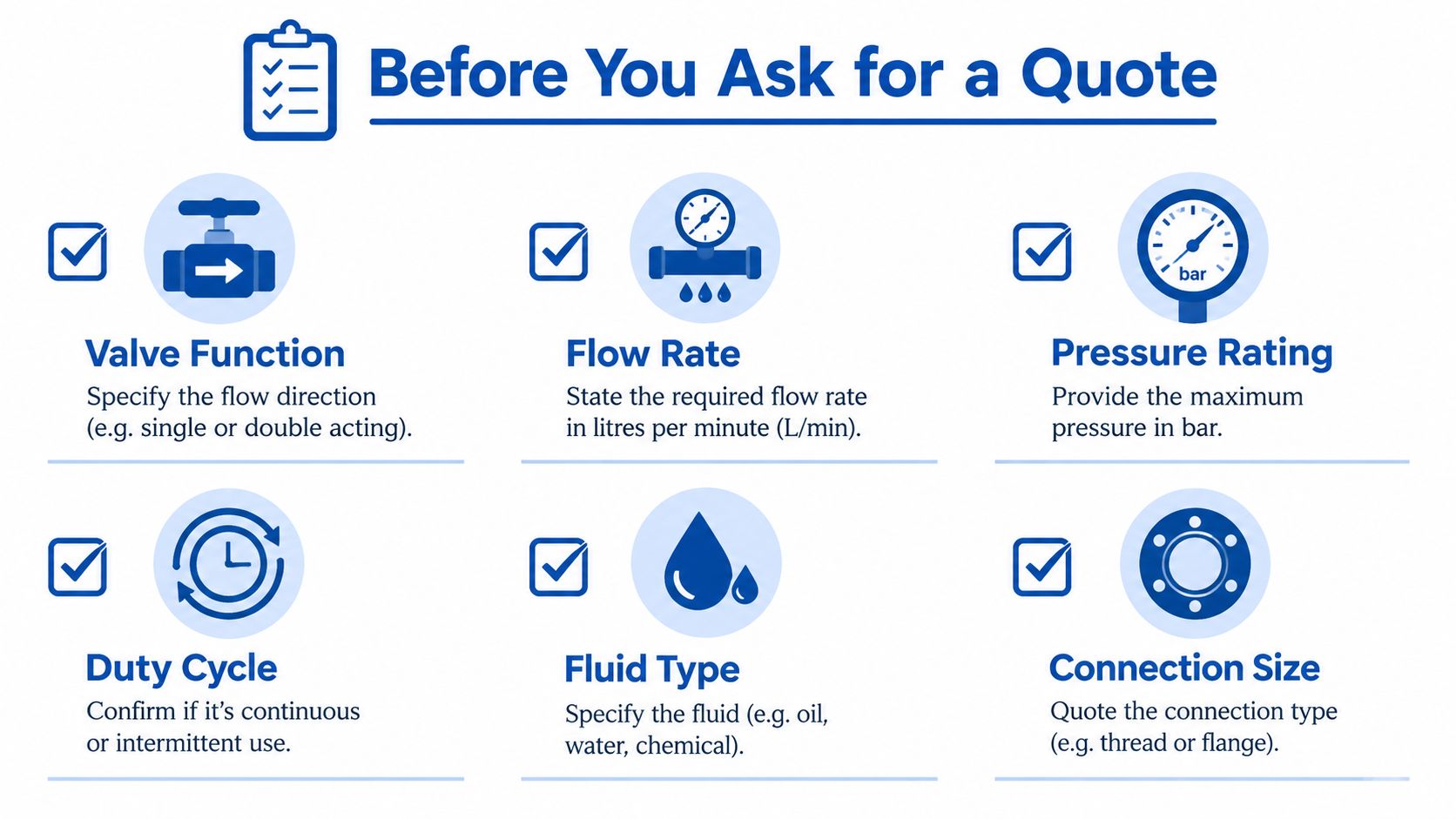
Describe the application before the part
Start with the machine, the valve's role and the reason for purchase. A planned OEM build, emergency replacement and redesign call for different conversations about availability and engineering responsibility.
Include the existing manufacturer's reference, photographs of markings and the hydraulic schematic where available. Don't assume a readable part number removes the need to explain the operating conditions.
Your technical brief should cover:
- Hydraulic duty: Required function, flow in litres per minute, operating pressure in bar, peak conditions and continuous or intermittent duty.
- Fluid and environment: Fluid type, seal requirements, operating-temperature range in °C and relevant exposure conditions.
- Mechanical interface: Connection standard, mounting arrangement, manifold details and available installation space.
- Electrical interface: Actuation method, supply voltage, connector, control signal and feedback requirements.
- Commercial scope: Quantity, required delivery date, documentation, testing and any acceptance requirements.
Where you don't know a value, say so. Ask the supplier to help establish it rather than inserting an assumption that could later become an incorrect purchase specification.
Define what counts as a replacement
A direct drop-in replacement should be assessed against the existing hydraulic, mechanical and electrical interfaces. If the proposed valve requires manifold changes, rewiring or system revalidation, treat that work as an engineering change, not an incidental fitting task.
Ask the supplier to record deviations clearly. That lets your maintenance or design team approve the alternative before procurement commits to it.
Use application engineering support where the original part is obsolete, its markings are incomplete or the machine has already been modified. Cross-referencing a product is useful, but confirming its role in the circuit is more important.
Request separate quotation lines for the base valve, actuator options, conformity documentation, testing, commissioning and replacement parts where relevant. This gives procurement a fair comparison and lets engineers see which requirements account for the difference.
Keep the accepted specification with the order. The purchase record should show what was approved, which exceptions were accepted and what evidence the supplier agreed to provide.
Comparing Purchase Price with Delivered Value
The lowest catalogue price can still produce the highest project cost. Your accounts team pays for the valve, but your maintenance and production teams deal with installation, recovery and ongoing operation.
Build a comparison around the work each option requires. Don't assume that either a recognised brand or an unfamiliar alternative automatically delivers the better result.
Build a cost model without invented savings
Use the same cost headings for every technically acceptable option:
| Cost element | What to include |
|---|---|
| Delivered purchase | Valve, fittings, delivery and any applicable import-related costs |
| Installation | Labour, access, pipework changes and electrical work |
| Start-up | Commissioning, adjustment, testing and required records |
| Maintenance | Service access, replacement seals, contamination investigation and planned work |
| Recovery | Replacement lead time, expedited freight and production interruption |
| Operation | Any substantiated difference in pressure losses, heat generation or pump loading |
Don't fill unknown cells with optimistic estimates. Get installation input from the engineer doing the work and downtime costs from the production team.
A published UK manufacturing downtime benchmark reports an average of £5,121 per hour, alongside a manufacturing electricity figure of 17.4 pence per kWh in Q2 2026, 4.0% higher year on year. Treat these as dated contextual benchmarks, not as your plant's measured costs or a prediction of valve-related savings.
Buying judgement: Pay a premium when you can identify the cost or risk it addresses. Don't pay it merely because the component is described as higher quality.
Assess energy effects at circuit level
A valve's operating cost depends on how it behaves in the circuit. Ask for evidence before accepting claims that a replacement will reduce pump loading or heat generation.
Use your electricity tariff, operating hours and measured or justified hydraulic conditions. A valve that spends little time controlling flow presents a different energy question from one operating continuously under restriction.
Availability belongs in the same calculation. Ask whether the proposed product is stocked, what replacement support exists and how quickly maintenance staff can restore service after a failure.
The total cost of ownership approach helps organise these comparisons. It doesn't mean choosing the most expensive valve; it means recording enough evidence to justify the purchase beyond its initial invoice.
Make the Next UK Valve Purchase Smarter
Optimise for acceptable performance, recoverability and complete cost, in that order. A low price won't rescue an unsuitable component, and an expensive component won't compensate for an installation nobody can maintain.
A standard valve is sufficient when it meets the confirmed duty and purchasing requirements. A premium product needs an identifiable reason, such as necessary control performance, material compatibility, documented conformity or a service arrangement that addresses a genuine operational risk.
Use a repeatable purchasing sequence
Keep the decision process short enough that engineers and buyers will use it:
- Approve the application requirement: Agree what the valve must do and which conditions it must tolerate.
- Define the supply boundary: Record whether you're buying a bare component, an assembly or an engineered change.
- Request comparable offers: Give suppliers the same specification and require them to identify exceptions.
- Confirm availability: Obtain a delivery commitment and establish how future replacements will be supported.
- Review evidence and cost: Check documentation, installation implications and ownership costs before authorising the order.
For an obsolete or imported valve, ask the supplier to state whether the proposed alternative is interchangeable. Keep any required modifications visible in the approval record instead of allowing them to emerge during installation.
Check the applicable pressure-equipment requirements
Compliance must follow the equipment and application, not a blanket assumption about every hydraulic valve. The HSE guidance on the Pressure Equipment (Safety) Regulations explains their application to qualifying pressure equipment and assemblies above 0.5 bar, including pressure accessories and safety accessories; qualifying new equipment placed on the Great Britain market must be UKCA- or CE-marked and supplied with instructions in English.
Separately, HSE guidance for pressure-system users sets out responsibilities for suitable equipment, safe operating limits, protective devices, training and examinations where required. Establish whether those requirements apply to your installation rather than assuming the valve's purchase documentation settles the whole system's obligations.
The smarter purchase is the one your engineer can approve, your buyer can compare fairly and your maintenance team can support. Make suppliers explain deviations, retain the supporting documents and reject savings that depend on overlooking necessary work.
For hydraulic valve selection, application advice and bespoke power-pack discussions, visit MA Hydraulics Ltd for support with component sourcing and matching options to your machine. Phone 01724 279508 today, or send us a message with your part reference, operating requirements and required delivery date so we can help establish an appropriate specification and quotation.
