
A full bore valve has an internal passage about equal to the connected pipe bore, so fully open it adds far less restriction than a reduced port. That label alone doesn't prove negligible pressure loss, because only the tested Kv, true internal diameter in millimetres and pressure and temperature rating tell you what happens at your flow in litres per minute.
That's the opposite of the popular advice you'll hear in a stores counter queue. You're often told to pick full bore every time and you'll never go wrong. Pick it blindly and you can end up with a valve that's too big for the bracket, wrong for metering, missing the approval you need, or still restrictive because the actual port isn't what the end stamp suggests. A valve full bore choice earns its place when the measured flow performance matches the duty, not when the catalogue heading sounds reassuring.
Think of it as an engineer would on a live machine. What fluid is passing, at what bar, at what temperature, and how much pressure can you afford to lose before a ram slows or a motor stalls? Answer those questions and the bore decision usually becomes straightforward.
What Full Bore Means on a Live Circuit
A full-bore valve, also called a full-port valve, has an internal passage the same diameter as the pipe, tube, or hose it connects. Fully open, it behaves like a short piece of pipe with a shutoff inside, not like a bottleneck. On a mobile machine coming in for a hose change, that's the isolator you close, work downstream, then reopen without leaving a permanent throttle in the circuit.
In mobile and industrial hydraulics, that isolator is commonly a ball valve. On some water and process lines it's a gate or plug valve whose opening matches the nominal bore. The construction differs, but the idea doesn't. The open passage stays close to line size from inlet to outlet.
The Quick Physical Check
Look through the open valve before you fit it. You should see a round passage close to the stated DN, not a visibly smaller hole in the middle of a larger body. If you can see a clear step down, you're looking at a reduced port whatever the box says, and you should ask for the actual bore figure.
People search for this type of valve for three practical reasons. They want low pressure loss on a main line. They need room for a cleaning pig on a suitable process line, which only works if the pig can pass every valve. Or they want full flow toward cylinders and motors so actuators keep their force and speed.
The words cast on the body aren't a tested flow coefficient. Treat them as a description of shape, then ask for numbers.
You should expect those numbers in metric first. Under the UK Government guidance on units of measurement markings and sales, UK trading law requires metric units for trade purposes, and any imperial figure shown voluntarily must sit alongside the metric measurement, be less prominent and be no larger than the metric indication. That's why a sound UK data sheet leads with millimetres, bar and litres per minute.
Don't stop at the definition. Judge the valve against the job it has to do, because a full passage helps some duties and hinders others.
Full Bore Against Reduced Bore Verdict
| Feature | Full bore | Reduced bore |
|---|---|---|
| Internal passage | About equal to the connected pipe bore | Often about one nominal size smaller |
| Open-valve pressure loss | Lowest for that line size | Higher because velocity rises in the port |
| Flow coefficient Kv | Highest for the end connection | Lower; use the published figure |
| Body size and mass | Often larger and heavier | More compact and easier to fit |
| Relative cost | Usually higher | Usually lower |
| Best duty | Isolation, suction, pigging, high flow | Modest flow, tight space, regulation |
| Part-open control | Poor if a ball is cracked open | Often more accurate as a control valve |
| Pressure and seals | Set by the product rating, not the bore | Set by the product rating, not the bore |
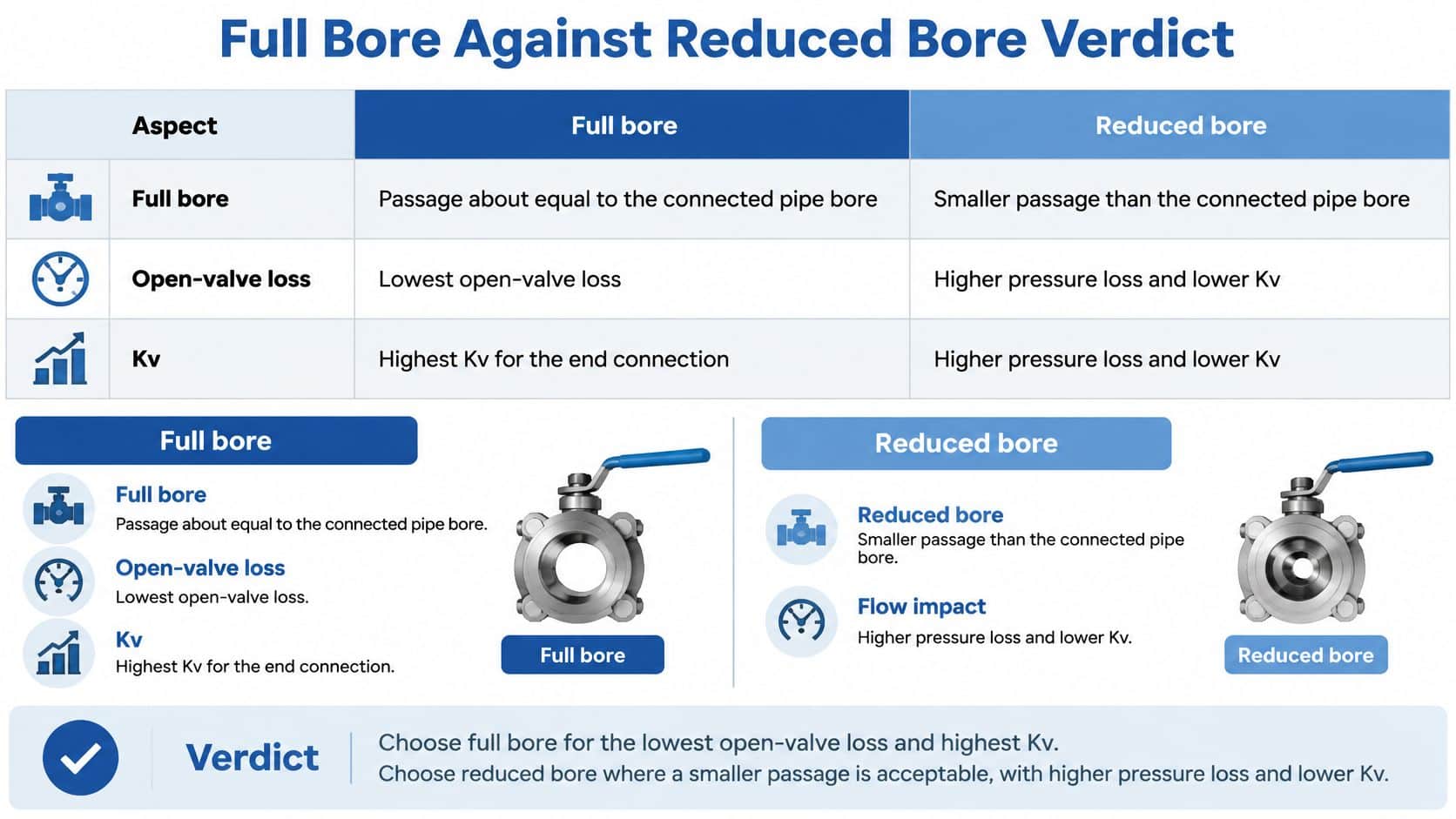
Start with the passage itself. Full bore means the hole through the open valve is about equal to the connected pipe bore, so fluid doesn't have to squeeze through a smaller throat and then expand again. A reduced bore valve fitted to the same ends has a passage that's often about one nominal size smaller. Both may screw onto identical pipework, which is where buyers get caught out.
That difference in area drives the next two rows. The full passage gives the lowest open-valve loss and the highest Kv for the end connection, because velocity stays close to the velocity in the pipe. Shrink the port and velocity rises in the throat, so pressure loss climbs and Kv falls. You can't guess by how much from the thread size. You need the maker's published figure for that exact body.
Size, mass and money run the other way. A ball large enough to carry a true line-size hole needs a larger body, larger seats and more material around the pressure envelope. It's usually heavier, bulkier and dearer, in GBP terms as in any currency. The reduced version fits tighter envelopes on a compact power pack or inside a machine frame, and it normally costs less because there's less valve there.
Where Each One Wins
Best duty splits cleanly once you think about what the valve does all day. Choose full bore for isolation, suction and pump feed lines, piggable runs and high-flow circuits, where every bar you lose steals actuator force, motor speed or pump inlet condition. A service isolator should disappear hydraulically when it's open. A pig must physically pass, so a reduced throat that stops it defeats the whole cleaning method.
Choose reduced bore where flow is modest, space is tight, or the valve's real job is regulation rather than disappearing. A smaller port gives the controlling element more authority over the flow for a given movement. On a pilot line, a gauge point or a small bleed, paying for a line-size passage buys you nothing you can measure at the actuator.
Practical rule: if the valve spends its life either fully open or fully shut, favour full bore. If it spends its life part open, favour a valve built to control.
How the Wrong Choice Fails
Crack a full-bore ball valve partly open to throttle a cylinder and you'll create a narrow crescent opening with a high-velocity jet through it. You get noise, heat in the oil, wire drawing across the seat edge and control that jumps with small handle movements. The seats weren't shaped for continuous metering. A reduced-bore design built for regulation, or a dedicated flow control valve, holds a steadier restriction and survives the duty.
Space causes a quieter failure. A mobile machine may have room for a compact reduced-bore spool, diverter or inline relief valve that limits pressure, but not for a bulky full-port ball and its handle swing. Forcing the larger body in can mean sharp hose bends, a handle nobody can reach, or a lever that fouls the frame at half travel. A valve you can't operate safely isn't an upgrade.
Certification doesn't follow from the bore description either. WRAS approval may be relevant on a potable-water installation, and the WRAS approvals directory shows a permitted working pressure of 25 bar for a particular copper-pipe application, proving that approval and pressure capability are product-specific. Check the actual listing, seal material and temperature limit for the item in your hand. Don't infer any of them from nominal class or from the words full bore.
Plan for trapped pressure before you praise any isolator. Close a full-bore valve on a loaded cylinder or a hose in the sun and pressure can stay locked downstream, ready to spit oil when a fitting cracks open. Ask how you'll vent that section, whether cold oil will change the picture, and whether seals suit the fluid at working temperature. Ask also whether the rating covers pressure spikes, not just steady running pressure.
The verdict is situational, not tribal. Pick full bore when high Kv matters most. Pick reduced bore when control, space, approval or cost matter more than the last fraction of pressure loss.
How Bore Size Changes Flow and Pressure Drop
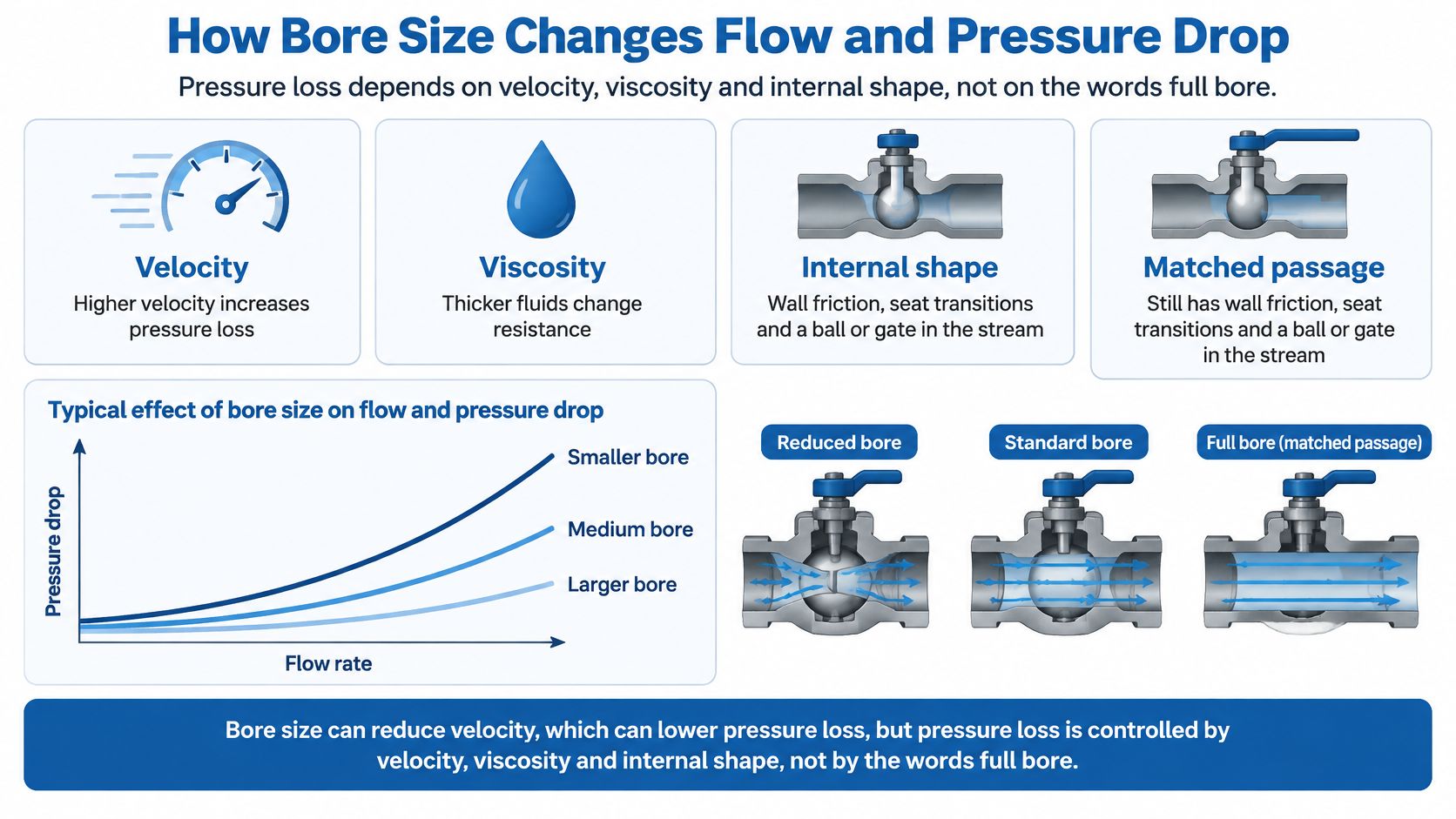
Pressure loss doesn't read the label. It depends on velocity, viscosity and internal shape, so even a valve whose passage matches the pipe still creates resistance through wall friction, seat transitions, seals and the ball or gate sitting in the stream. You've removed the big step down. You haven't removed physics.
Ask for three published figures before you compare two valves. You want Kv, expressed for water as cubic metres per hour at 1 bar pressure drop, or the maker's hydraulic flow curve for oil. You want the loss coefficient K where it's given. And you want the actual internal diameter in millimetres, because that can differ from the DN or dash size printed on the ends.
The Velocity Squared Problem
Halve the open area and velocity roughly doubles for the same flow. Dynamic loss rises with the square of velocity, so a modest reduction in port diameter can multiply the drop rather than nudge it. That's why two valves with identical threads can behave very differently once oil moves.
Work one example through and the point sticks. Say you're passing 60 litres per minute, which is 0.001 cubic metres per second. Through a 25 mm internal bore, velocity is about 2.0 metres per second. Squeeze the same flow through a 20 mm reduced port and velocity climbs to about 3.2 metres per second. Square that ratio and the same fitting loss rises by roughly 2.4 times. It's an illustration, not a catalogue claim, so confirm the actual Kv and bore on the data sheet before you rely on either figure. If you're converting pump output and line sizes while you check, our guide to hydraulic flow rate calculations walks through the arithmetic in metric units.
| Duty case | Passage | What changes | Evidence to demand |
|---|---|---|---|
| Baseline isolation | Full bore near DN25 | Lowest velocity for that flow | Internal diameter and Kv |
| Same ends, reduced port | Bore nearer DN20 | Higher velocity and pressure drop | Measured Kv, not the DN stamp |
| Cylinder or motor feed | Full bore if loss eats force or speed | Less pressure left at the actuator | Pressure at the load at stated L/min |
| Pump suction | Full bore preferred | Extra loss risks cavitation | Suction vacuum and oil temperature |
| Continuous metering | Reduced or a proper control valve | A cracked ball valve controls badly | Duty cycle and heat rise |
Now put that loss where it hurts. On a cylinder or motor feed, pressure dropped across the valve is pressure the actuator never sees, so force or speed falls and the pump works harder for the same job. On a suction line, the same drop pulls the pump inlet toward cavitation, with noise, aeration and rapid wear. The question is never whether loss is zero. It's whether enough pressure remains at the load, at your stated flow, to do the work.
Temperature changes the answer again. Cold-start ISO VG 46 hydraulic oil is far thicker than warm oil, so start-up loss through any restriction can dwarf the warm open-valve figure quoted in a catalogue. A machine that behaves on a summer afternoon may crawl on a frosty morning if you've sized everything on warm oil alone.
Water engineers already work this way. UK water-industry specifications require head loss to be determined at defined velocities including 0.5 and 1.25 m/s, according to the DrainBoss glossary entry on full bore valves, but they don't prescribe the performance level, so buyers must compare tested results themselves. Apply the same approach to the oil viscosity you run. Reject any valve whose data sheet gives a nominal size but no Kv, no internal bore and no pressure and temperature rating.
Where Full Bore Valves Earn Their Place
Start on a telehandler or tractor in the yard with a burst hose to change. A full-bore isolator in the pump outlet or a return leg lets the fitter shut that circuit, swap the hose, and reopen the valve without leaving a permanent throttle that slows the boom rams for the rest of the machine's life. The valve earns its bulk during maintenance, then disappears during work.
Move to an industrial power pack driving a press or a conveyor motor. Full bore on the main pressure and return isolation points keeps line loss small, so the motor still reaches speed at the design litres per minute and the cylinder still develops its rated force. Metering belongs to a separate flow control valve with a shaped restriction. It does not belong to a ball valve handle tied at half travel.
Suction Lines and Piggable Runs
A pump suction or charge line gives you the least room for error, because the pump can only draw what the tank and pipework will feed it. An isolator that matches the line bore leaves inlet conditions as the designer intended, which matters most when cold oil at start-up turns every restriction into extra vacuum.
A piggable process line or a washout run makes the choice for you. The pig, scraper or flushing flow must pass through every open valve, so the passage has to stay at line size with no ledge to catch on. A reduced port stops the device or leaves a ring of debris the pig never reaches.
The Water Network Contrast
You will meet the same words on UK water networks, but do not import their numbers into an oil circuit. The Water UK design and construction standards template identifies BS EN 805 for water-supply systems outside buildings and BS EN 806 for potable-water installations inside buildings, and states that maximum design pressure including surge must not exceed the rating of the lowest-rated component.
Those are water rules for water duties. Your hydraulic line inherits neither a ceiling pressure nor a head loss allowance from a water main. The shared lesson still transfers. Pair the bore with pressure class, surge allowance and an isolation plan, because the lowest-rated component sets what the whole system may see.
Some jobs stay reduced bore without apology. Pilot lines carry small flows where a compact port is plenty. Gauge points need a small, safe bleed rather than a line-size hole. Fine metering needs a controlling edge built for the job. Full bore earns its place where the open valve must get out of the way, and the label alone never proves that it does. Judge the claim on measured Kv, the actual internal bore in millimetres, and the pressure and temperature rating at the flow you intend to run.
How to Specify Bore Pressure and Seals
A valve marked "full bore" earns that name only when its measured Kv, its true internal bore and its pressure-temperature rating all hold at your required flow. The words on the box prove nothing on their own, so write the enquiry so a supplier can't guess wrong. Work through these checks in order and put the answers on one page.
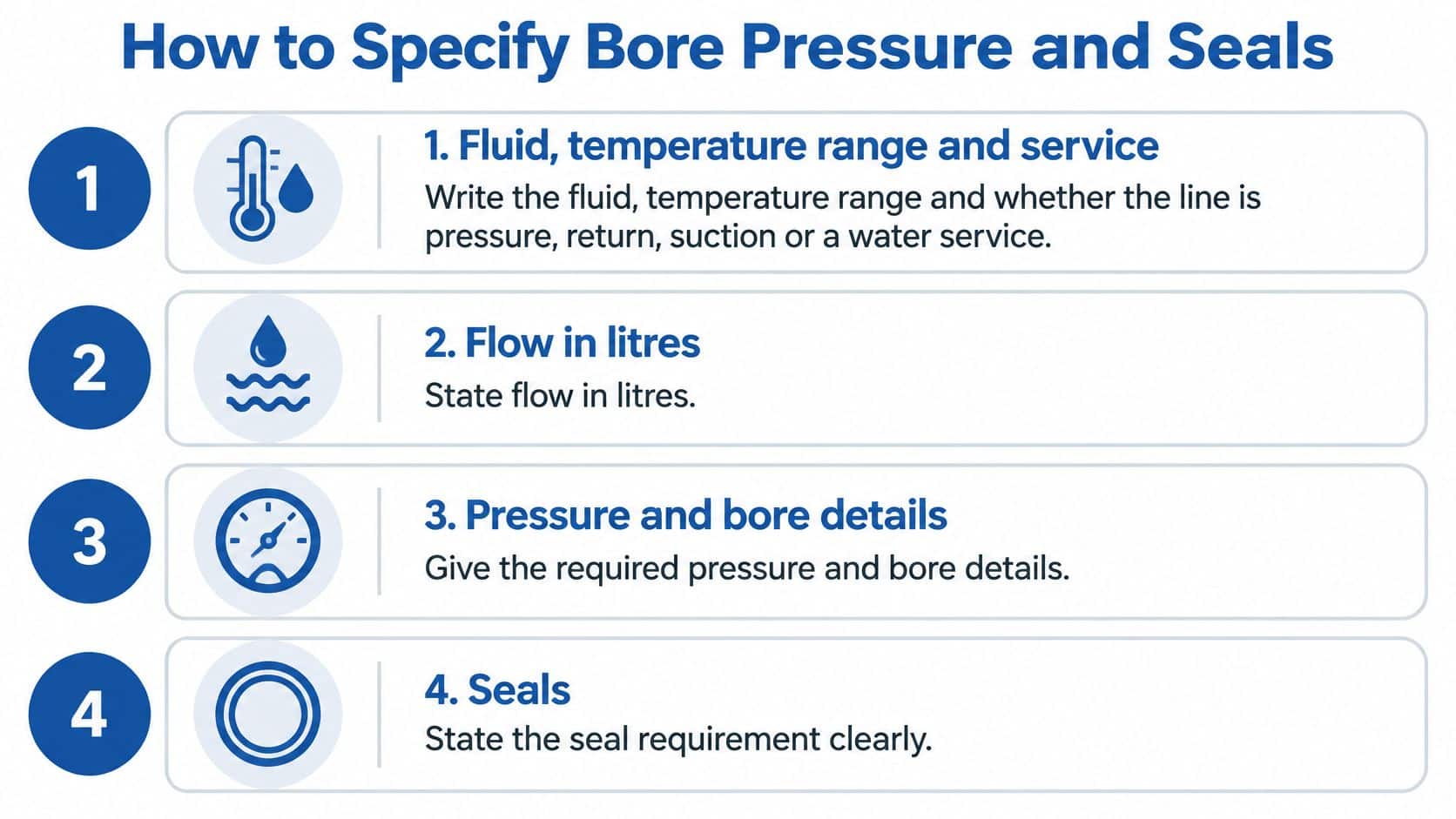
- Name the fluid and service. State the fluid, temperature range, and whether the line is pressure, return, suction or a water service, because each one punishes restriction and seals differently.
- State flow and allowable drop. Give flow in litres per minute and the pressure drop you can accept in bar at that flow, warm and at cold start.
- Give ends then demand true bore. State the end connection and nominal size in millimetres, then require the actual internal bore, not only the DN stamp. A DN25 valve does not guarantee a 25 mm hole through the ball.
- Declare the duty. Choose full bore or reduced bore from the job, and say plainly whether the valve isolates or meters.
- Set pressure with a shock allowance. State working pressure plus the spike allowance above it, and size everything against the lowest-rated component in the circuit, because that item sets what the whole system may see. Then ask the supplier for the hydraulic proof and burst ratings, since the nameplate working pressure alone won't reveal how much headroom the body really has.
- Match materials to the fluid. Confirm body and seal materials against oil, water or chemicals at temperature, and note any WRAS or equivalent approval needed on potable water.
- Plan the venting. Decide how trapped pressure will be released before anyone opens a hose or fitting downstream.
- Check the paperwork against itself. Look for Kv, a port diagram and pressure and temperature limits, and check that wording inside any diagram matches the text, because a wrong label on a schematic changes what gets fitted. A supplier's page for high pressure ball valves gives you a worked example of the port and rating data you should expect to compare.
- Confirm it fits and can be serviced. Check mounting space, handle or actuator clearance through full travel, and whether spare seals are available in the UK.
A complete enquiry names fluid, flow, allowable drop, true bore, pressure including spikes, and seal material. Anything less invites a guess dressed up as a recommendation.
That one page lets a supplier cross-reference a like-for-like replacement or flag that your circuit needs a different bore altogether. You'll get a price in GBP for a valve that fits the duty, not a cheap body that throttles the machine.
Match the Bore Before You Order
Keep the decision to three lines. Use full bore when the open passage must stay close to the pipe so Kv stays high. Use reduced bore when space, cost or control matters more than the last bit of pressure loss. Never use a full-bore ball as a continuous throttle.
One caution before the figures. A full-bore label on the box is a description, and it isn't a performance guarantee. Two valves can carry the same label and still differ on measured Kv, true internal bore and pressure-temperature rating at your required flow, so judge the valve on those numbers rather than the name.
Then gather the figures that settle it. Send the fluid, flow in litres per minute, allowable pressure drop in bar, line size and nominal bore, any true internal bore requirement, and working pressure including spikes. Add the end connections too, because a correct bore on the wrong thread still won't fit, and our guide to identifying hydraulic fitting types helps you name what you've already got.
We can help you choose between full-port and reduced-port valves, supply catalogue downloads, and cross-reference a one-off replacement or valves for a manifold build. Stock includes the OMT Group inline circuit valve range, Hoyea Cetop directional and proportional solenoid valves, Cetop modular valves and a range of Orta valves, covering cross relief, overcentre, pilot operated check, pressure reducing, relief, sequence and solenoid valves alongside manual spool and diverter options. That range doesn't remove your part of the job. You still need to match bore and Kv to your circuit rather than assume every valve is full port.
Tell us the duty and we'll quote the right valve in GBP. Send your flow, pressure and bore figures through our contact page and we'll come back with a specific recommendation.
If you're specifying a valve full bore isolator or replacing a reduced-port valve that's starving a cylinder, MA Hydraulics Ltd can match bore, Kv, pressure rating and seals to your mobile or industrial circuit, supplied as a one-off or as part of a wider build. Send your flow in litres per minute, allowable drop in bar and true bore requirement, and get a recommendation based on measured performance rather than a catalogue label.
