
'1 2 Tees' most commonly means a 1/2-inch tee, a three-port fitting with a 12.7 mm tube connection and a G1/2 BSP thread of about 20.955 mm outside diameter, and that label alone doesn't confirm compatibility. If the size is printed on the box, why do so many replacement tees still leak, bind, or refuse to seal?
Because the label is only one of three sizes you're trying to match. The tube, the pipe, and the thread all have their own measured diameters, and they are not the same number. I would start with a calliper and a thread gauge, not with the nominal wording, because that routine turns a vague search for 1 2 Tees into a fitting you can order with confidence.
Tee Sizes at a Glance in Metric
In UK hydraulic and plumbing listings, 1 2 Tees almost always means a 1/2-inch tee, a three-port fitting that branches or joins a line. The 1/2 is a nominal connection size, not a measurement you'll reproduce with callipers. The Hot Tub Parts UK listing for a 1/2-inch tee pipe fitting identifies a 1/2-inch equal tee as a three-way fitting with product code HTP182, priced at £2.11 excluding VAT or £2.53 including VAT.
That low unit price explains why people guess. It's also why guessing is poor value when a wrong thread puts a machine out of work.
Other Meanings to Rule Out First
The phrase can also mean a range of 1 to 2 inch tees, which the chart below covers, or a brand, a product bundle, or an address search. For example, the Companies House record for TWENTY2 RECS LTD lists its registered office at 12 Tees Gardens, Barrow-in-Furness, Cumbria, LA14 3LY, which is an address rather than a fitting. This guide covers the fitting reading, so check the listing or address first if you meant something else.
Common Tee Sizes in Metric
| Nominal size | Tube outside diameter | Pipe outside diameter (DN) | BSP thread outside diameter | Threads per inch |
|---|---|---|---|---|
| 1/4 inch | 6.35 mm | 13.5 mm (DN8) | 13.157 mm | 19 |
| 3/8 inch | 9.525 mm | 17.2 mm (DN10) | 16.662 mm | 19 |
| 1/2 inch | 12.7 mm | 21.3 mm (DN15) | 20.955 mm | 14 |
| 3/4 inch | 19.05 mm | 26.9 mm (DN20) | 26.441 mm | 14 |
| 1 inch | 25.4 mm | 33.7 mm (DN25) | 33.249 mm | 11 |
| 1 1/4 inch | 31.75 mm | 42.4 mm (DN32) | 41.910 mm | 11 |
| 1 1/2 inch | 38.1 mm | 48.3 mm (DN40) | 47.803 mm | 11 |
| 2 inch | 50.8 mm | 60.3 mm (DN50) | 59.614 mm | 11 |
Read the chart from the hardware in front of you. If you're matching a hose tail or compression end, start in the tube column. If you're matching steel pipe, start with DN and pipe outside diameter. A 1/2-inch tee usually pairs with a 12.7 mm tube, a DN15 pipe of 21.3 mm outside diameter, and a 14 TPI thread.
Practical rule: Measure the thread or tube before ordering whenever your size isn't in the chart, because the nominal label won't tell you which column the old fitting was made to.
Threaded, Flanged and Welded Connections Compared
Once the size is confirmed, the connection type decides how the tee joins the system, how it seals, and whether you can remove it later. Five options cover most UK mobile and industrial work, and they aren't interchangeable even when the nominal size matches.
BSPP parallel threads to ISO 1179 suit hydraulic ports and adaptors. The thread provides clamping force, while a bonded washer or O-ring at the port face makes the seal. BSPT tapered threads are common on water and air runs, and they seal on the taper itself with sealant or PTFE tape. Screwing a tapered male into a parallel port can crack the port or leave a spiral leak path, so don't treat them as near enough.
Tee Connection Types and What to Check
| Connection type | Typical use | How it seals | Main check before fitting |
|---|---|---|---|
| BSPP parallel thread | Hydraulic ports and adaptors | Bonded washer or O-ring in the port | Seal type matches the port face |
| BSPT tapered thread | Water, air and older pipe runs | Taper with sealant or PTFE tape | Never fit into a parallel BSPP port |
| Flanged to ISO 6162 | High-pressure mains and larger sizes | O-ring or gasket compressed by bolts | Code 61 or 62 pattern and bolt torque |
| Compression, 24-degree cone to ISO 8434-1 | Mobile machinery tube runs | Cutting ring biting the tube | Tube cut square, deburred, correct outside diameter |
| Welded | Fabricated pipework and manifolds | Fused weld joint | Qualified welder; not removable without cutting |
Flanged tees, to ISO 6162 Code 61 or Code 62, suit high-pressure mains and larger sizes where a threaded joint would need excessive torque. They need the correct bolt torque and an O-ring or gasket matched to the flange face. A scratched groove or a pinched O-ring will weep under pressure even when the bolts feel tight.
Compression or 24-degree cone fittings to ISO 8434-1 dominate mobile machinery tube runs. Cut the tube square with a tube cutter or fine saw, deburr inside and out, and push it fully home against the stop before tightening. Follow the manufacturer's assembly instructions for turns past finger tight, because under-tightening lets the ring slip and over-tightening distorts the cone. The guide to hydraulic fitting types is worth checking if you are unsure which cone or thread family you have.
Welded tees suit fabricated pipework and manifolds that won't need dismantling. You cannot remove one without cutting, so they belong on fixed pipework only.
If the machine already has a port, copy its connection type exactly. If you're designing new pipework, choose the connection that suits how often the joint will be opened.
Reading Nominal, Tube and Thread Sizes Correctly
One tee carries three sizes at once. Think of a shoe size. The label is the nominal size, but your foot length in millimetres is what determines whether it fits. A tee label works the same way.
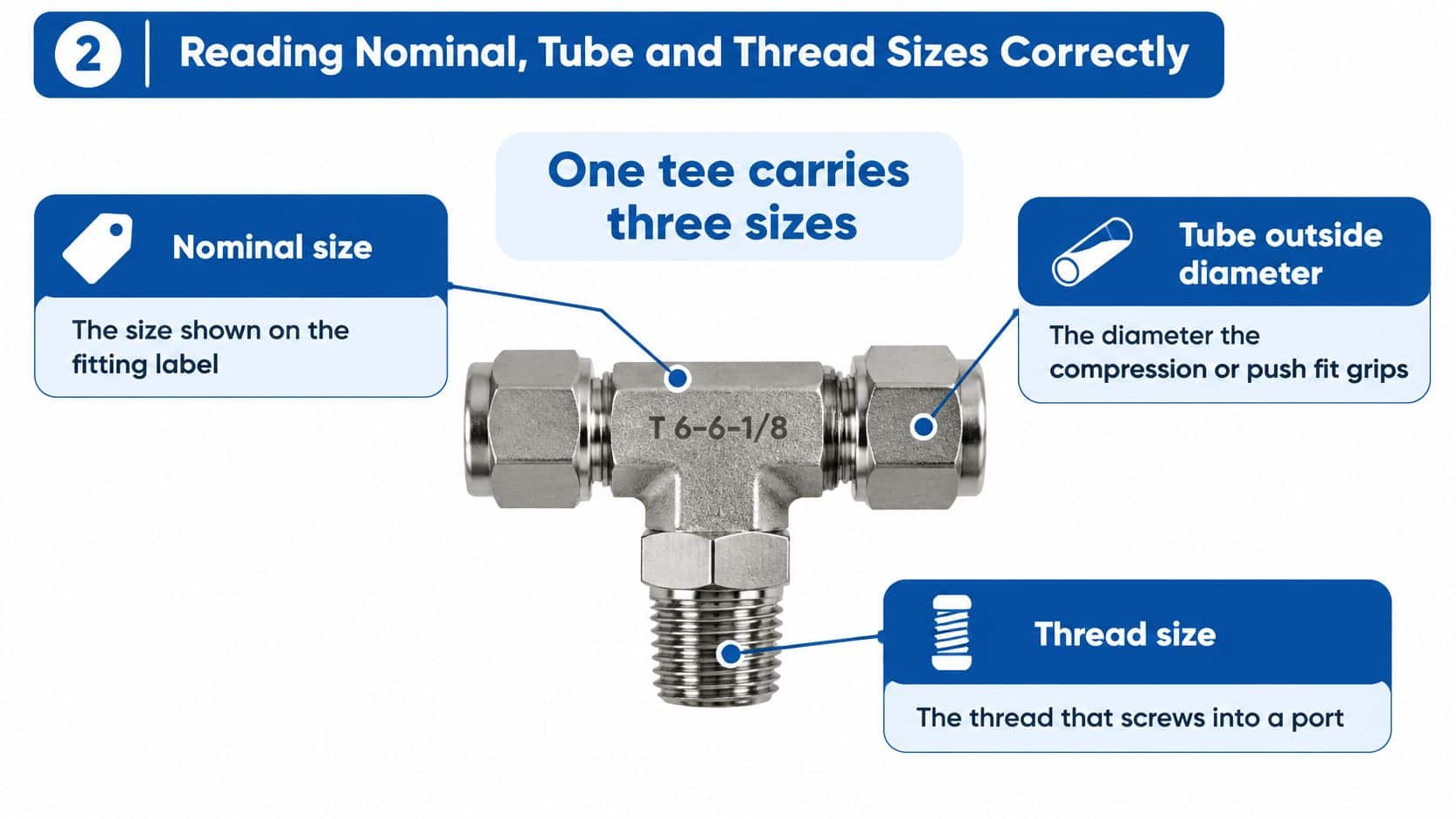
The nominal size is the name on the label. The tube outside diameter is what a compression or push fit grips. The thread size is what screws into a port, and its measured outside diameter is always larger than the nominal wording suggests.
Parallel and Tapered Threads
BSPP is parallel and seals through a bonded washer or O-ring in the port. BSPT is tapered and seals on the thread flanks with sealant. Mixing them can damage threads or leak, because the tapered male wedges into the parallel female before any seal face meets.
The MA Hydraulics guide to 1 1/2 tees explains that a 1 1/2-inch nominal-bore steel tee under BS EN 10255 corresponds approximately to DN40 pipe with an outside diameter around 48.3 to 48.8 mm, not 38.1 mm. That's the whole trap in one example. The same wording describes a BSP connection in one catalogue and a pipe bore in another, and the two parts won't meet.
Where a branch steps down, a dedicated adaptor such as a 1/2 to 1/4 reducer keeps the thread forms correct on both sides.
A Four-Step Routine
- Identify the existing port or hose end: Photograph it and note any markings before you remove anything.
- Check the thread form and seal type: Parallel threads measure the same diameter along their length, tapered threads narrow towards the end.
- Measure the tube or pipe outside diameter: Use callipers across a clean, unpainted section and record the figure in millimetres.
- Confirm the nominal size: Match your measurements against the drawing or parts list before ordering.
Equal or Reducing Tee for Each Branch
An equal tee suits any point where all three ports must carry the same nominal flow, such as a common feed or a distribution point. A reducing tee suits a small pilot, sensor, or actuator branch taken from a full-size line. The choice is a flow decision, not a packaging decision.
The physics is plain continuity. For the same flow rate, velocity rises as flow area falls. Halve the area and the oil has to move faster through the restriction, which increases turbulence and pressure loss at the tee. That loss shows up as heat, sluggish actuator response, or a gauge reading that drops whenever the branch operates.
Justify a reducing tee by the downstream flow requirement, not because the branch happens to be physically smaller. The Flowtech range of high-pressure compression tees distinguishes tees by nominal bore and tube outside diameter, including 1/2-inch equal tees and 1 1/2-inch nominal-bore equal tees, so check the product page for the branch dimension rather than the headline size.
Choosing Equal or Reducing Tees by Situation
| Situation | Tee to choose | Reason | Check before fitting |
|---|---|---|---|
| Common feed or distribution with full flow on all three ports | Equal tee | Flow area stays the same at every port | All three ports the same nominal size |
| Small pilot, sensor or actuator branch off a full-size line | Reducing tee | Smaller branch suits the instrument or cylinder | Branch flow and pressure drop |
| Branch needs more flow than a 1/2-inch port can pass | Larger equal tee or split the line | Reducing lowers branch capacity | Calculate branch flow first |
| Circuit with high peak or transient pressure | Either, rated above circuit maximum | Nominal size is not a pressure rating | Rated working pressure against peak pressure |
Before substituting one type for the other, check four things. Confirm the branch flow, the allowable pressure drop, the connection standard, and the pressure rating.
Nominal size is not a pressure rating. Validate the fitting against the circuit's maximum working pressure and its transient loads, because a tee that's correct in millimetres can still be wrong in bar.
Materials and Pressure Ratings to Check
Material decides which fluid a tee can carry and how long it survives. Group your choice by fluid first, then by pressure.
- Zinc-plated steel: The default for hydraulic oil circuits and mobile plant, where strength and cost matter.
- Stainless steel, typically grade 316: Suits washdown areas, food settings, and corrosive environments.
- Brass: Suits water and compressed air at lower pressures.
- Copper and plastic or PEX-type fittings: Suits water pipework only, and must never be used in hydraulic oil.
The rated working pressure, not the burst pressure, must exceed the circuit's maximum operating pressure plus an allowance for shock and transient spikes. For example, a tee rated at 250 bar is unsuitable for a 210 bar circuit that spikes to 300 bar, even though it looks adequate on the steady figure. Check the seal material too. Nitrile suits mineral oil, while FKM suits higher temperatures.
Quote every figure in metric when you order. Pressures in bar, temperatures in degrees Celsius, and sizes in millimetres. The GOV.UK guidance on packaged goods weights and measures states that metric units must be used when selling packaged or loose goods in England, Scotland and Wales, with imperial figures no more prominent than the metric indicator. The same discipline applies when you're comparing a tee against adjacent components such as high-pressure ball valves, where a mismatched rating creates the weak point.
Ask the supplier for three values. Working pressure in bar, material and seal compatibility with your fluid, and the connection standard, such as BSPP to ISO 1179.
Where Tees Work in Mobile and Hydraulic Machines
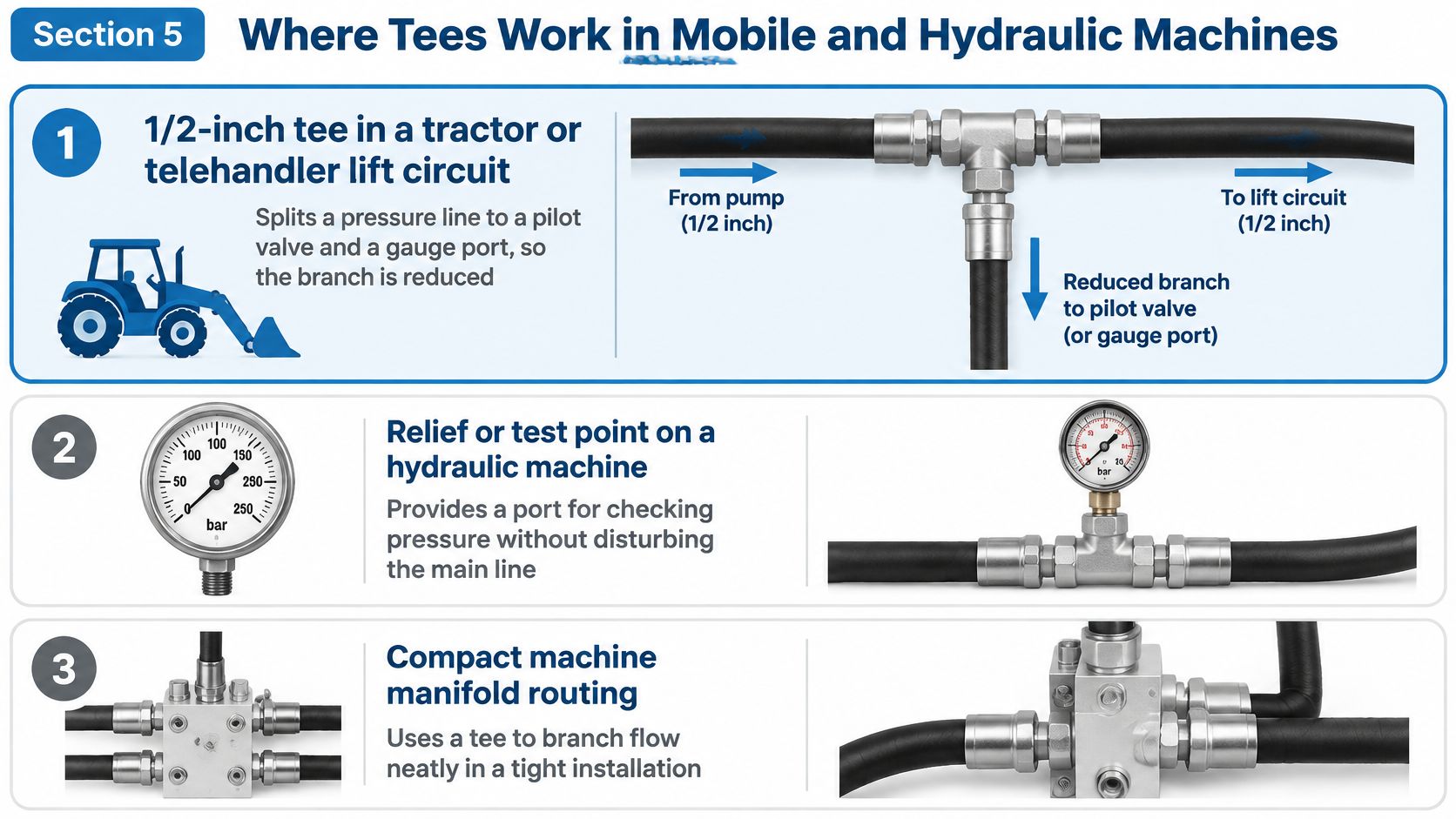
Say a tractor or telehandler lift circuit needs a pilot feed and a test point. A 1/2-inch tee in the pressure line splits flow to the pilot valve and a gauge port. Neither branch takes full pump flow, so the branch is reduced and the main run stays full size.
Now take a power pack feeding two directional valves from one pump outlet. A 3/4-inch equal tee keeps both branches at full flow area, so one valve doesn't starve when the other operates. On the same machine, a mobile washdown line might use a 1/2-inch BSPT tee to take a water branch. That tapered fitting belongs on the water run only, and it must never be mixed into the hydraulic ports beside it.
Trailer work makes the same point about matching capacity to the job. If you're specifying tipping gear alongside the hydraulics, the ANTS Trailers side dump capacity guide helps you sense check payload figures before you size the circuit that has to lift them.
Installation Checklist
- Support the tee and both lines: Clamp close to the fitting so vibration doesn't fatigue the joint.
- Keep bending loads off the tee: Route hoses with a natural curve and enough slack for movement.
- Fit the correct seal first: Renew bonded washers and O-rings rather than reusing flattened ones.
- Tighten as specified: Use the manufacturer's torque or turns, and keep thread dope off hydraulic ports.
- Pressure test afterwards: Run the circuit up slowly and watch every face of the tee for leaks.
MA Hydraulics in Scunthorpe supplies hydraulic fittings, gear pumps, valves, and bespoke power packs up to 11 kW, and the team can help cross-reference a tee that's hard to identify.
Confirm the Size Before You Order
Send your supplier four facts rather than a part name alone. First, the nominal size and the tube or pipe outside diameter in millimetres, measured with callipers. Second, the thread form, BSPP or BSPT, confirmed with a thread gauge or by matching the port face. Third, the connection type and seal, such as an O-ring, bonded washer, or compression cone. Fourth, the maximum working pressure in bar and the fluid, whether hydraulic oil, water, or compressed air.
If the existing part won't identify itself, send clear photographs of the port, the fitting, and any markings with your measurements. A supplier cross-reference is quicker than guessing. A low unit price is no saving if the wrong thread causes a leak, because downtime costs more than the part.
Phone 01724 279508 today, or send a message through the contact page. The team is based in Scunthorpe, North Lincolnshire, and supports hard-to-find parts, gear pumps, valves, and complete assemblies.
If your tee won't match the chart, MA Hydraulics Ltd can cross-reference it from your measurements and photographs, and supply the correct fitting alongside gear pumps, valves, and complete power pack assemblies. Send the four facts listed above and you'll get a part that seals first time, rather than another nominal guess.
