
A service engineer is standing beside a tractor or telehandler with a filter in hand, a machine manual open on the bench and a replacement needed before the equipment can return to work. The housing marking may be unreadable, the old invoice may show only a part number, and nobody is certain which valves or operating conditions the filter has to protect.
That's when a cross-reference can go wrong. A filter that fits the housing isn't automatically a filter that suits the system. Before approving an equivalent, confirm where the filter sits, what the circuit requires and whether the candidate's performance evidence matches the duty.
When a UFI Filter Part Number Is Not Enough
The engineer starts with the available clues: the manual, the marking on the filter housing and the last purchase record. Each may help identify a model, but none necessarily describes the current system's flow, pressure, oil or contamination requirement. Even a clearly matching part number doesn't, by itself, establish filtration performance, bypass behaviour, fluid compatibility or suitability for the least-tolerant component.
UFI began producing hydraulic filtration solutions in Bergamo, Italy, in 1992. The company was founded in 1971, so its hydraulic filtration experience has a distinct start date from its overall corporate history (UFI's corporate brochure).
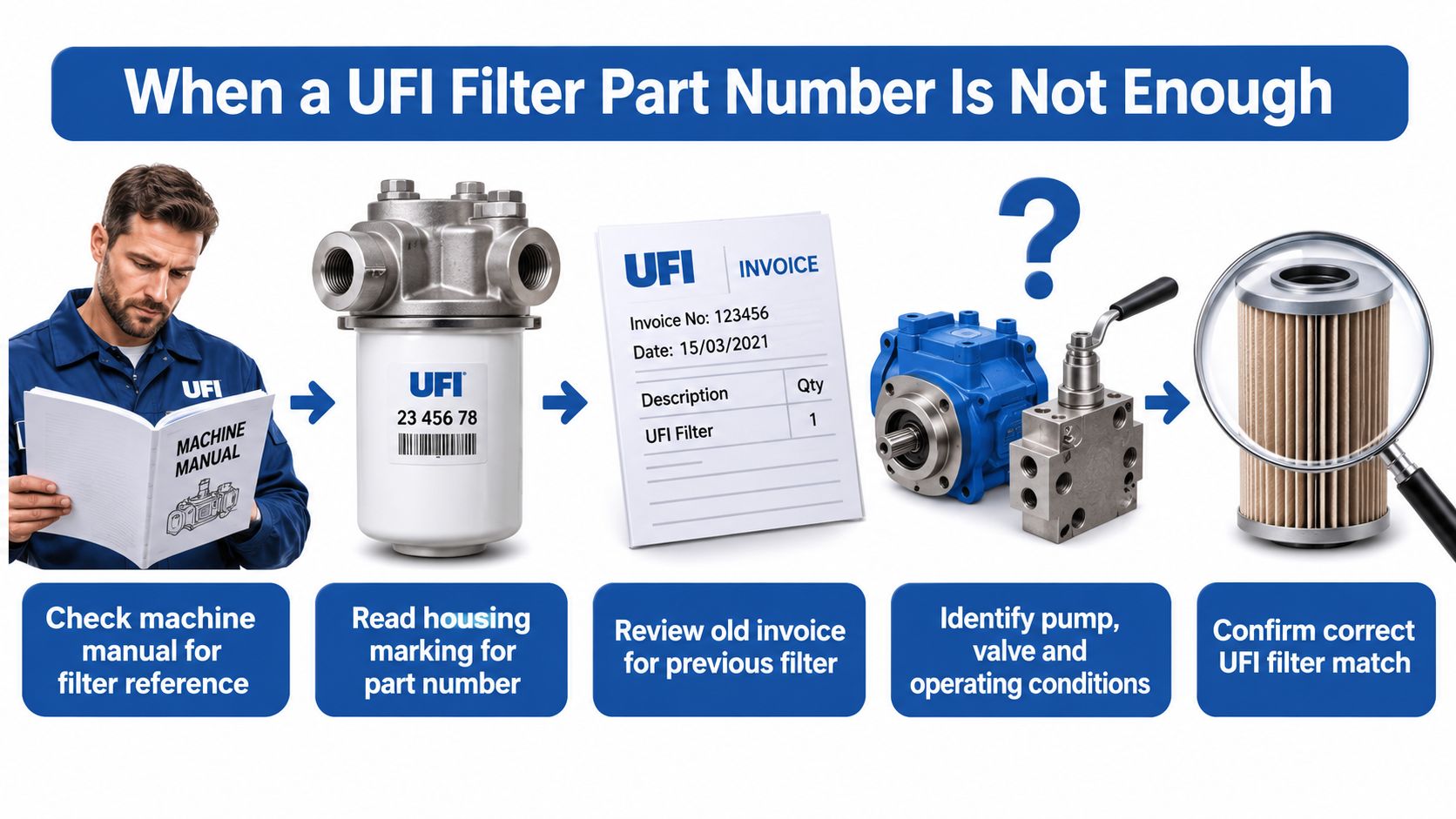
Before asking a supplier to identify a replacement, record what the system can tell you. Photograph the housing and removed element, note the filter's circuit position and capture the machine application. Then gather dimensions, flow, pressure, oil type and the required cleanliness target from reliable records or measurements.
| Information needed before identifying a replacement filter | Why it matters |
|---|---|
| Filter position and category | Establishes which part of the circuit the filter serves |
| Housing and element dimensions | Helps confirm physical fit, without proving performance equivalence |
| Flow and pressure conditions | Lets the supplier assess whether the candidate suits the duty |
| Oil type and operating conditions | Supports checks on fluid compatibility and viscosity behaviour |
| Cleanliness target and protected component | Ties filtration choice to the system’s actual contamination-control requirement |
| Machine application and service evidence | Gives context for operating duty, previous replacements and recurring issues |
The useful question isn't, "What number replaces this one?" It's, "What evidence shows this candidate will perform the same job in this circuit?"
Understanding UFI Hydraulic Filter Identification
Read a UFI filter reference as the start of an identification process, not as a complete specification. Buyers need to establish four things: the filter category, the model or element fitted, the element's performance evidence and the machine's requirements. A label may answer the first two questions clearly while leaving the others for the datasheet, housing records or supplier confirmation.
UFI's hydraulic range covers suction, return, pressure, off-line, transmission and air filtration. These categories have different duties, so a model from one category can't be treated as interchangeable with a superficially similar part from another. Start by locating the filter in the circuit, then establish which element or housing reference applies.
A micron description needs careful interpretation. It identifies a particle size, but a nominal rating alone doesn't tell you the filter's measured retention performance under defined test conditions. For a comparison, ask for the filtration ratio at the relevant particle size, alongside test flow, pressure-drop behaviour and contaminant capacity. Those details help distinguish a documented performance claim from a bare rating.
The operating conditions matter as well. An element may be the right physical size yet be unsuitable for the actual oil viscosity, flow demand or cold-start conditions. Similarly, a model reference can identify a product without confirming that its bypass arrangement or mounting details suit the installed housing.
Keep the records separate: one entry for what the part is, another for what the system needs, and a third for the evidence that connects them. That discipline makes supplier records and future replacements more useful, especially when an older machine's manual or invoice doesn't capture its current configuration.
Choosing the Right UFI Filter Category
Choose the category by tracing the oil path and identifying what needs protection. Don't start with a photograph of an old element and assume that a similar-looking filter belongs in the same position.
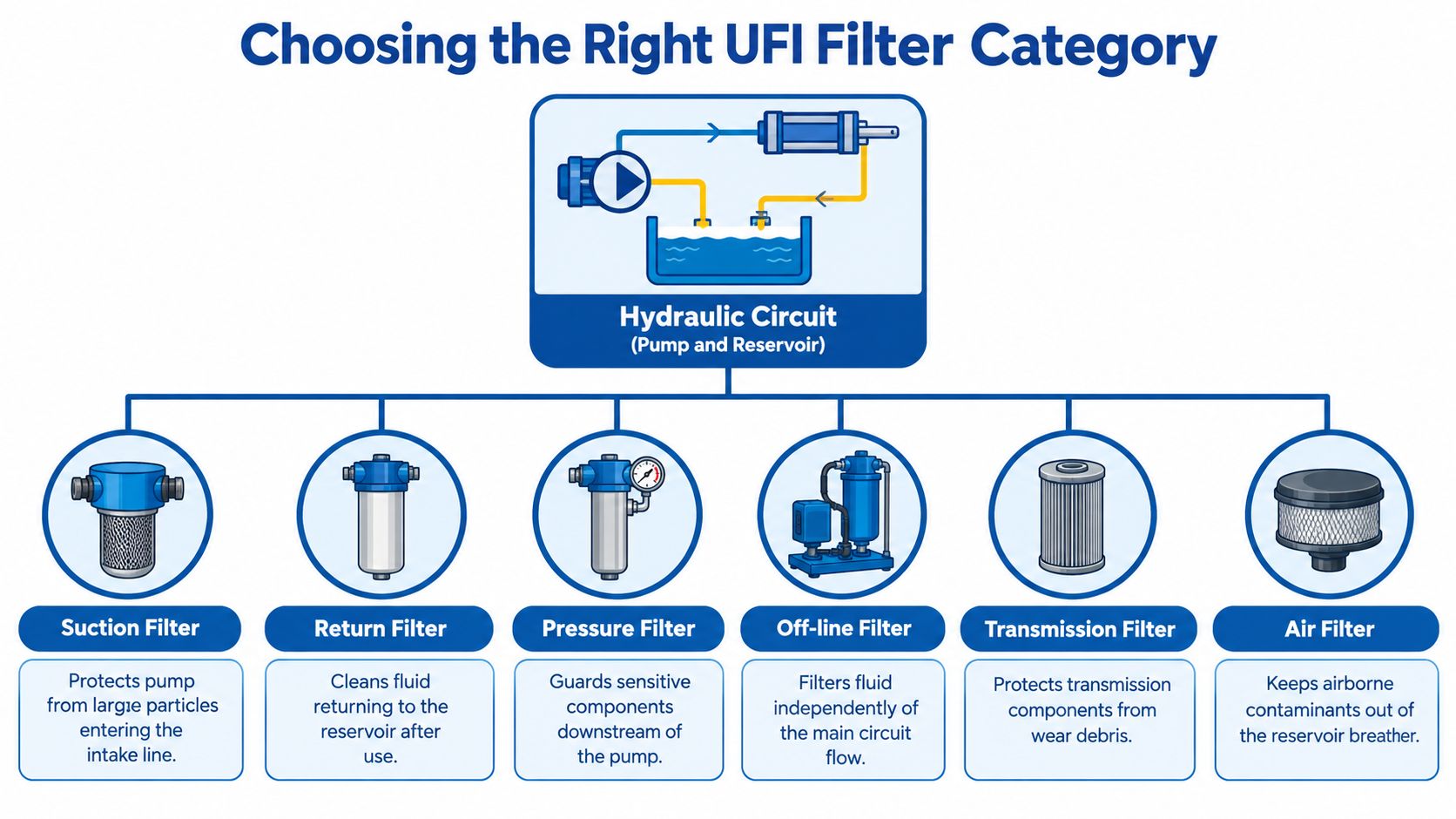
A suction filter sits on the pump intake side. It addresses contamination entering with oil from the reservoir, but selection must account for the pump's intake requirements and the conditions the element will encounter. Treating it as equivalent to a return filter ignores where it operates and what it protects.
A return filter handles oil returning from the circuit before it enters the reservoir. It can capture wear debris before that oil re-enters the tank. A pressure filter, by contrast, protects downstream valves and actuators, where the pressure and performance requirements may differ. These are distinct jobs, not alternative names for the same replacement (MA Hydraulics' contamination-control guidance).
An off-line filter, sometimes called a kidney-loop filter, cleans reservoir oil independently of the main circuit flow. That can support whole-reservoir cleanup without routing all system flow through the main circuit. Consider it as part of the contamination-control arrangement, rather than as a direct replacement for a pressure or return filter.
Transmission filtration serves transmission components, so use the application and manufacturer documentation to identify its specific duty. Air filtration helps control contamination entering through the reservoir breather. Neither should be selected by borrowing assumptions from a hydraulic line filter.
For UK tractors, telehandlers, refuse vehicles and manufacturing equipment, first mark the filter's position on the circuit diagram or confirm it at the machine. Then check the duty and conditions for that location. Only after that should you narrow down the housing and element.
Practical rule: Select the filter's job first, then identify the UFI part that can do it.
Reading UFI Model Numbers and Micron Ratings
Use the model reference to find the relevant technical record, but don't assume you can decode every character without UFI documentation. A reliable lookup follows the fields that establish the product and its application, rather than relying on an unverified model-number pattern.
Start with the manufacturer and range, then record the model reference and filter position. Compare the element and housing dimensions in millimetres, the mounting and sealing details, and the specified flow and pressure information. Check how the datasheet describes filtration performance, including particle size and test conditions. A model number alone won't answer all of these questions.
The word “micron” is particularly easy to overread. A nominal micron figure isn't a universal measure of protection and doesn't prove that two elements retain particles in the same way. Ask for performance data at the particle size relevant to the system, rather than accepting a similar-sounding rating as proof of equivalence.
For qualifying elements, BS ISO 16889:2022 is the UK implementation of the ISO multi-pass test. It provides reproducible data on contaminant removal, particle retention, contaminant capacity and differential-pressure behaviour (the BSI standard record). In practice, request the element's beta ratio at the relevant particle size, test-flow conditions, pressure-drop curve and dirt-holding capacity. Confirm that those results apply to the oil viscosity and flow conditions in the machine.
For an initial dimensional search, use a dedicated hydraulic filter element lookup by size. Treat a dimensional match as a way to find candidates, not as approval to install one. The final check still needs technical confirmation of performance, bypass behaviour, fluid compatibility and the machine's operating duty.
Compare Filter Performance and System Requirements
Compare candidates against the duty of the installed filter, not just against each other's size or micron label. The table below is a prompt for the information to verify; it isn't a declaration that any listed category or candidate is interchangeable.
| Filter category | Circuit position | Check before selection | Performance evidence |
|---|---|---|---|
| Suction | Pump intake side | Pump intake requirements, oil viscosity and installation details | Element specification and suitability for the intake duty |
| Return | Return path to reservoir | Peak flow, pressure conditions, oil viscosity and bypass behaviour | Filtration data, pressure-drop behaviour and contaminant capacity |
| Pressure | Downstream protection in a pressure line | Working and maximum pressure, flow and protected components | Test data at the relevant particle size and applicable operating conditions |
| Off-line | Independent reservoir-cleanup loop | Loop flow, oil compatibility and how the loop operates alongside the circuit | Filtration performance and evidence relevant to reservoir cleanliness |
| Transmission | Transmission circuit | Equipment application, installation and fluid requirements | Applicable element data and confirmation against equipment requirements |
| Air | Reservoir breather or air path | Breather arrangement and exposure to airborne contamination | Evidence that the proposed part suits the housing and air-filtration duty |
Use the comparison in sequence. First confirm the category and position. Next check the candidate's peak flow and pressure requirements, then consider oil viscosity and cold starts. Finally compare the filtration evidence and bypass or differential-pressure behaviour against the actual system. If any field is unknown, mark it for confirmation rather than treating it as a match.
Cleanliness targets provide context for the selection. ISO 4406 reports particle populations greater than 4, 6 and 14 µm(c) per millilitre. A cited practical baseline for general hydraulic circuits is 19/17/14; contamination-sensitive proportional or servo-control systems may require approximately 16/14/11 (MA Hydraulics' hydraulic filter selection guide). These are application-dependent reference points, not universal targets for every machine.
Use representative oil sampling and particle counting to check cleanliness. Visual inspection can't establish an ISO 4406 code, and a table entry can't certify an interchange. The result should be a technically useful enquiry backed by the machine's requirements and the candidate's documented performance.
Select a Filter for UK Machines and Equipment
A replacement for a tractor, telehandler or production machine is a cross-reference problem, not a part-number lookup. Start with the component that tolerates the least contamination, then confirm the filter's position and duty. A proportional or servo-control valve may set the cleanliness target even when its filter sits elsewhere in the circuit.
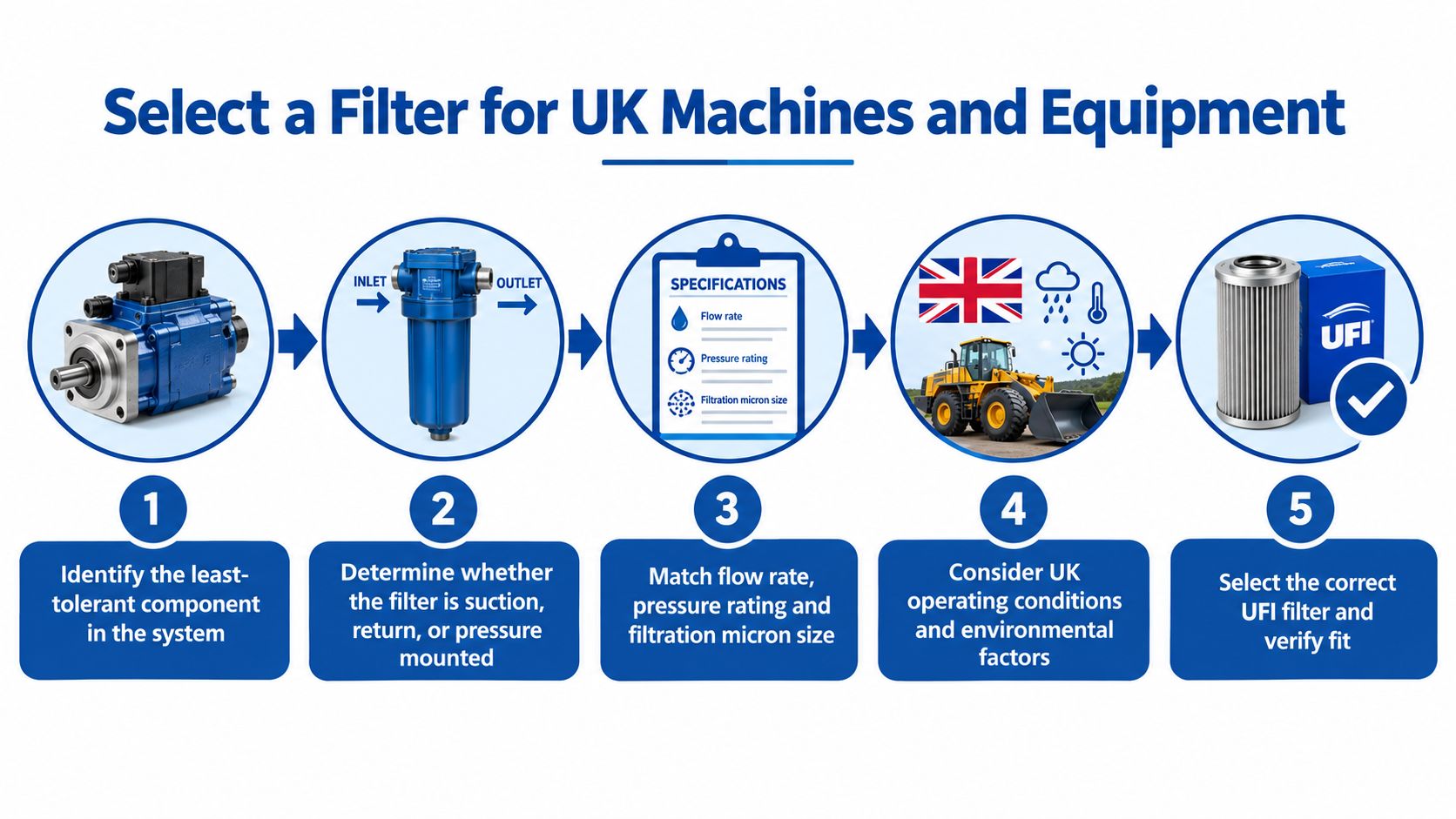
Record the duty, not just the machine name. Identify whether the filter serves the suction, return, pressure or off-line path. Its position determines the conditions the element must handle, so the equipment label alone cannot establish an interchange.
Collect the operating details in metric units: flow in litres per minute, dimensions in millimetres and pressure in bar. Record peak flow, working and maximum pressure, oil type and viscosity, and cold-start conditions. Confirm the bypass setting, clogging indication, fluid compatibility and installation orientation against the equipment documentation.
Then compare documented filtration performance under relevant test conditions with the system's ISO 4406 cleanliness target. Check that the candidate's evidence, including testing to BS ISO 16889 where available, supports the required particle capture. Compare bypass behaviour and differential-pressure limits with the machine's operating conditions. A matching connection or similar-looking element does not establish equivalent performance.
The least-tolerant component sets the practical cleanliness requirement. If its target is tighter than the general circuit's, require evidence that the proposed element can meet it. Record any missing performance or bypass information as a point for supplier confirmation, not as an assumed match.
Control contamination before installation, too. Filter bulk or drum oil before filling the reservoir when the system's cleanliness requirement calls for it. Delivered oil may not meet the target for precision components, so pouring it straight into the machine can introduce contamination before the replacement element has worked.
The video below shows filter element inspection and replacement on a typical mobile machine. Watch it if you have not opened a hydraulic filter housing before, then use the machine documentation to confirm the correct element and service procedure.
Why a Matching Replacement Can Still Fail
Replacing a dirty element doesn't necessarily remove the cause of recurring contamination. Dirt can enter during oil transfer, hose disconnection, component replacement and routine servicing. New hydraulic oil should be filtered before it enters the reservoir, and the reservoir may need an effective or desiccant breather to limit airborne dirt and moisture ingress (hydraulic lubrication and contamination guidance).
A replacement can also fail the application even when it fits. If its bypass arrangement or differential-pressure behaviour doesn't suit cold starts or abnormal loading, the element may not protect the system as intended. A higher nominal micron figure doesn't prove better protection either. Compare performance evidence at the relevant particle size, and check how the candidate behaves under the machine's actual conditions.
When a removed element is loaded, investigate what that tells you. It may indicate successful capture, a contamination source, internal wear or an undersized filter. Don't decide which explanation is correct by sight alone. Compare representative particle-count results over time with differential-pressure records and maintenance history.
Review the surrounding contamination controls before fitting another element. Check oil-storage and top-up practices, breather condition, exposed ports and hose connections. If a component has failed, establish whether post-failure flushing is needed under the equipment maker's instructions. A clean replacement can't compensate for debris left in the circuit or introduced during repair.
The workshop record matters. Note when and why the element was changed, the oil used, any observed damage and the available differential-pressure or sampling evidence. If particle counts remain above the target after replacement, investigate the system rather than assuming that a new filter has solved the problem.
Cross-Reference UFI Filters Without Guessing
A cross-reference should show why the candidate is suitable, not merely that its dimensions look familiar. Begin with the available reference, whether it's a UFI number, a competing part number or a description from an invoice. Then compare the candidate against the installed housing and the machine's requirements.
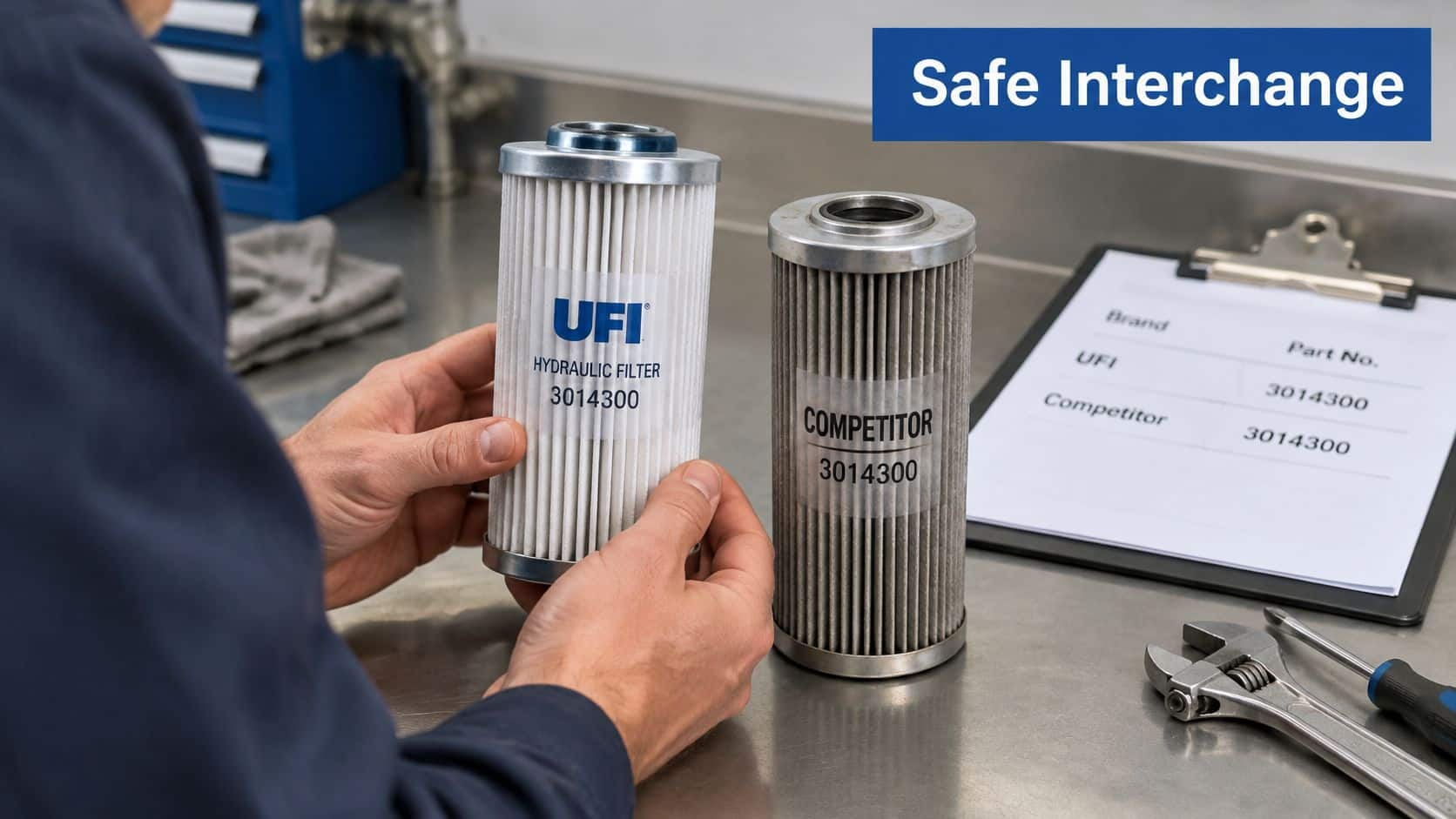
Build a cross-reference record that covers:
- Category and position: Confirm whether the part serves suction, return, pressure, off-line, transmission or air filtration.
- Physical fit: Compare element and housing dimensions in millimetres, mounting arrangement, seals and installation orientation.
- Operating duty: Check rated flow, working and maximum pressure, oil viscosity and fluid compatibility.
- Protection and control: Compare filtration performance, bypass arrangement, clogging indication and differential-pressure behaviour.
- Evidence and context: Include the machine application, oil used, housing markings and service observations.
Treat any difference in seals, bypass behaviour, flow or pressure as a question for technical confirmation. This is especially important where the machine faces cold starts, high peak flow or abnormal loading. Don't infer equivalent performance from an element that fits the housing or from a similar model description.
Give the supplier useful evidence. Photograph the housing marking before removal, label the old element, note the oil type and record where it was installed. If a number is missing, include the measurements and a description of the circuit position. The more clearly the system duty is documented, the easier it is to assess whether the proposed part is an interchange or a physical fit.
Local availability is also worth checking. UFI's UK and Ireland branch opened in 2017; by July 2023, the company reported that UK results had quadrupled over the branch's first six years. A 2021 announcement had described UK business as more than doubling since the warehouse opened (UFI's UK and Ireland heavy-duty range announcement). Ask suppliers about current stock and lead times rather than assuming a global catalogue reference guarantees local availability.
Maintain and Replace UFI Filters Safely
Plan replacement work around the equipment manual and the correct technical documentation. Isolate the system using the machine maker's procedure before opening a housing, and make sure the replacement reference has been checked against the installed circuit. Don't assume an old invoice proves that the previous element was correctly specified.
Before fitting, inspect the removed element and housing for damage or signs of abnormal loading. Confirm the replacement's seals, mounting details and installation orientation against the housing and documentation. Don't apply an assumed torque, interval or procedure where the equipment maker or UFI technical information should govern the work.
Keep useful evidence during service. Record differential pressure where the system provides an indication, the element reference and the reason for replacement. Replace a loaded element before bypass activation, following the applicable machine instructions. A filter that has opened its bypass may allow contaminated oil back into service.
Sampling is more informative when it's consistent. Take representative oil samples at useful service points and compare particle-count trends with the cleanliness target. Visual inspection of oil or an element can help prompt an investigation, but it can't replace particle counting.
Check the contamination routes while the system is open. Inspect breathers, top-up oil practices, hoses and exposed ports, and consider whether dirt may have entered during the repair. If a replacement appears ineffective, look for a continuing ingress or wear issue before fitting another element.
For a practical workshop sequence, follow this guide to changing a hydraulic filter, then complete the machine-specific checks in the relevant equipment manual. Keep the service record with the filter reference, oil information, observations and any test results so the next cross-reference starts with evidence.
Use a UFI Hydraulic Filter Quick Reference
When a replacement is uncertain, make the enquiry in a fixed order:
- Identify the category and position in the circuit.
- Record the model reference, housing markings and available datasheet.
- Confirm dimensions and mounting in millimetres, including seals and orientation.
- Check flow and pressure against the machine duty, using litres per minute and bar.
- Compare filtration evidence at the relevant particle size and test conditions.
- Assess bypass and viscosity behaviour, including cold-start conditions.
- Verify fluid compatibility against the oil in service.
- State the cleanliness target and identify the least-tolerant component.
- Attach application and service details, including photographs and any sampling or differential-pressure records.
This gives a supplier enough context to assess an interchange rather than guess from a part number. If a specification is missing, flag it for confirmation instead of treating an unverified assumption as a match.
For a dated UK price reference, model 80.003.00 was listed from £34.78 in October 2026, including VAT and excluding delivery charges (UK price listing for UFI model 80.003.00). Treat that as a market snapshot: seller, availability, delivery cost and specification can change. Check the current UK listing and confirm the part's application before ordering.
Answer Common UFI Filter Questions
Does a nominal micron rating prove two filters are interchangeable?
No. A nominal rating alone doesn't establish equivalent particle-retention performance, contaminant capacity or differential-pressure behaviour. Compare documented test data at the relevant particle size and confirm that the candidate suits the machine's conditions.
What information should I provide for a reliable cross-reference?
Send the available part number, housing markings, photographs, filter position, dimensions, machine application and oil type. Add flow and pressure requirements, the cleanliness target, bypass or clogging details and any service or sampling evidence you have. See the cross-reference checklist above if you're preparing a supplier enquiry.
Will replacing the filter fix recurring contamination?
Not necessarily. Contamination can keep entering through oil transfer, servicing, open connections or the reservoir breather. If particle counts don't improve, investigate the contamination source and the system's operating condition rather than repeatedly replacing the element.
How should I interpret an ISO 4406 code?
It describes particle populations at specified size thresholds per millilitre. Treat the required code as an application-specific target and verify it through representative particle counting, not visual inspection. The comparison section gives reference targets and explains why the least-tolerant component should guide the decision.
The embedded instructional video should display responsively, include a meaningful iframe title and provide closed captions covering dialogue and sound effects, in line with accessible video guidance.
For help checking a UFI cross-reference against your machine's filter position, flow, pressure and cleanliness requirements, contact MA Hydraulics Ltd. Call 01724 279508 today for practical component advice, or send us a message with the part reference and application details.
