
The machine is ready for work, but the operator reports that first gear is difficult to select and reverse grinds after the clutch has been replaced. The pedal may feel heavy, spongy or inconsistent, while the friction plate and cover appear new. In this situation, the problem often sits in the hydraulic clutch kit, its dimensions, installation or bleeding, not in the friction components alone.
That distinction matters in agricultural machinery, mobile plant, commercial vehicles and industrial equipment. A replacement actuator can be inexpensive compared with the labour needed to access a bellhousing, remove a transmission or repeat a clutch overhaul. The correct decision therefore involves more than asking whether a kit is available. You need to match hydraulic geometry, operating conditions and replacement strategy before the machine returns to service.
Understanding the Hydraulic Clutch Kit
A hydraulic clutch kit transfers pedal input to the clutch release mechanism through fluid pressure. The driver or operator moves the pedal, the master cylinder pressurises the fluid, and the slave cylinder turns that pressure into release movement at the clutch cover. When the system is correctly sized and free from air, the operator gets predictable pedal effort and complete disengagement.
A practical example is a telehandler or mobile machine that selects gears cleanly when cold but begins dragging after repeated manoeuvres. The operator may compensate by forcing the lever, holding the clutch pedal down or increasing engine speed. Those actions can worsen wear and create a misleading impression that the gearbox or friction clutch has failed. Before dismantling the transmission, check the hydraulic circuit, fluid condition, leaks and available release travel.
Why the UK background still matters
Hydraulic clutch technology has deep British automotive roots. AP, known as Automotive Products, acquired the rights to manufacture Lockheed hydraulic brakes in 1928 and Borg & Beck clutch rights in 1931, helping establish British-made clutch and hydraulic transmission components for the domestic motor industry, as recorded in this UK automotive clutch market history. The same history records that the company supplied 85% of UK-made clutches by 1956 and produced its ten millionth clutch by 1958.
That heritage helps explain why UK maintenance teams still encounter a broad aftermarket for clutch hydraulics, conversion parts and related transmission components. The wider fluid-power sector also remains industrially relevant. The British Fluid Power Association reports that UK manufacturers' total fluid-power sales, including exports, fell by around 10% to £1.4 billion in 2024, showing that hydraulic components remain part of a substantial manufacturing and trade ecosystem.
Practical rule: Treat the hydraulic actuator as a working component of the clutch system, not as an accessory that can be selected by appearance alone.
A complete kit may include a master cylinder, slave cylinder, concentric slave cylinder, release bearing, hydraulic line, seals, fittings, mounting hardware or a combination of these, depending on the application. Always confirm the supplied scope against the machine's original architecture. Teams responsible for lifting equipment can also benefit from understanding adjacent fluid-power requirements, including the maintenance needs for hydraulic elevators, where fluid condition, leakage control and safe servicing are equally important.
Core Components and Mechanical Operation
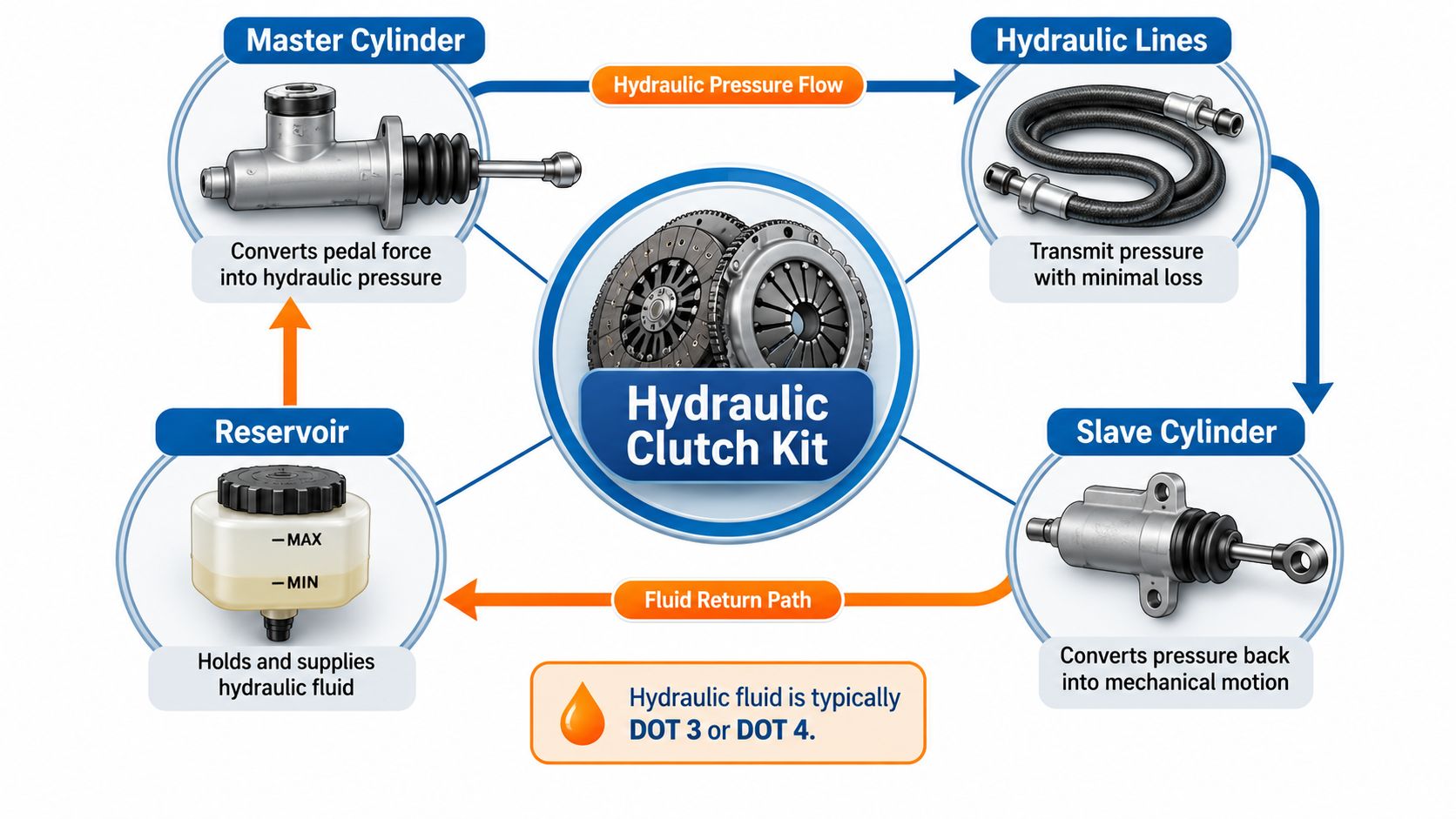
The hydraulic clutch works through a two-stage conversion. The master cylinder changes pedal movement into hydraulic pressure. The slave cylinder receives that pressure and changes it back into mechanical movement, pushing against the release mechanism so the clutch cover lifts away from the friction plate.
Master cylinder and fluid circuit
The master cylinder connects to the pedal through a pushrod. As the operator depresses the pedal, the piston moves through its bore and displaces fluid. Because hydraulic fluid is effectively incompressible under normal operating conditions, that displacement travels through the hydraulic line towards the slave cylinder.
The reservoir supplies fluid and allows for volume changes as seals and pistons move. A low level, damaged seal or loose connection can introduce air. Air compresses, unlike the fluid, so the pedal may feel soft and the slave cylinder may fail to achieve the movement required to release the clutch fully.
Hydraulic lines and connectors must be routed securely, away from heat, abrasion and moving components. A line that looks serviceable can still restrict movement internally or allow air ingress through a connection that doesn't visibly leak fluid.
Slave cylinder and release movement
The slave cylinder converts fluid pressure into pushrod movement. External slave cylinders sit outside the transmission housing and act through a lever or release arm. They're usually easier to inspect and replace, but the lever arrangement introduces additional geometry that must remain correctly adjusted.
A concentric slave cylinder, often called a CSC, sits inside the transmission housing and contacts the clutch cover diaphragm directly. Valeo's explanation of concentric clutch slave cylinders describes this arrangement as eliminating the conventional release bearing and lever arrangement. The release bearing is integrated into the hydraulic unit, which improves packaging but means an actuator failure can require transmission access.
When reviewing transmission assemblies, don't confuse a hydraulic clutch actuator with other transmission hardware. For example, a specialist component such as an 8hp45 8hp50 8hp51 clutch drum belongs to a different transmission application and shouldn't be treated as a substitute for a clutch hydraulic component.
The key engineering relationship is simple. A larger slave-cylinder bore can produce greater release force for a given pressure, but the required fluid volume and pedal travel also change. Master-cylinder stroke, slave-cylinder bore and clutch-cover load must work together. A kit that bolts into place but has the wrong hydraulic ratio can still produce a heavy pedal or incomplete release.
Evaluating Off-The-Shelf Versus Bespoke Solutions
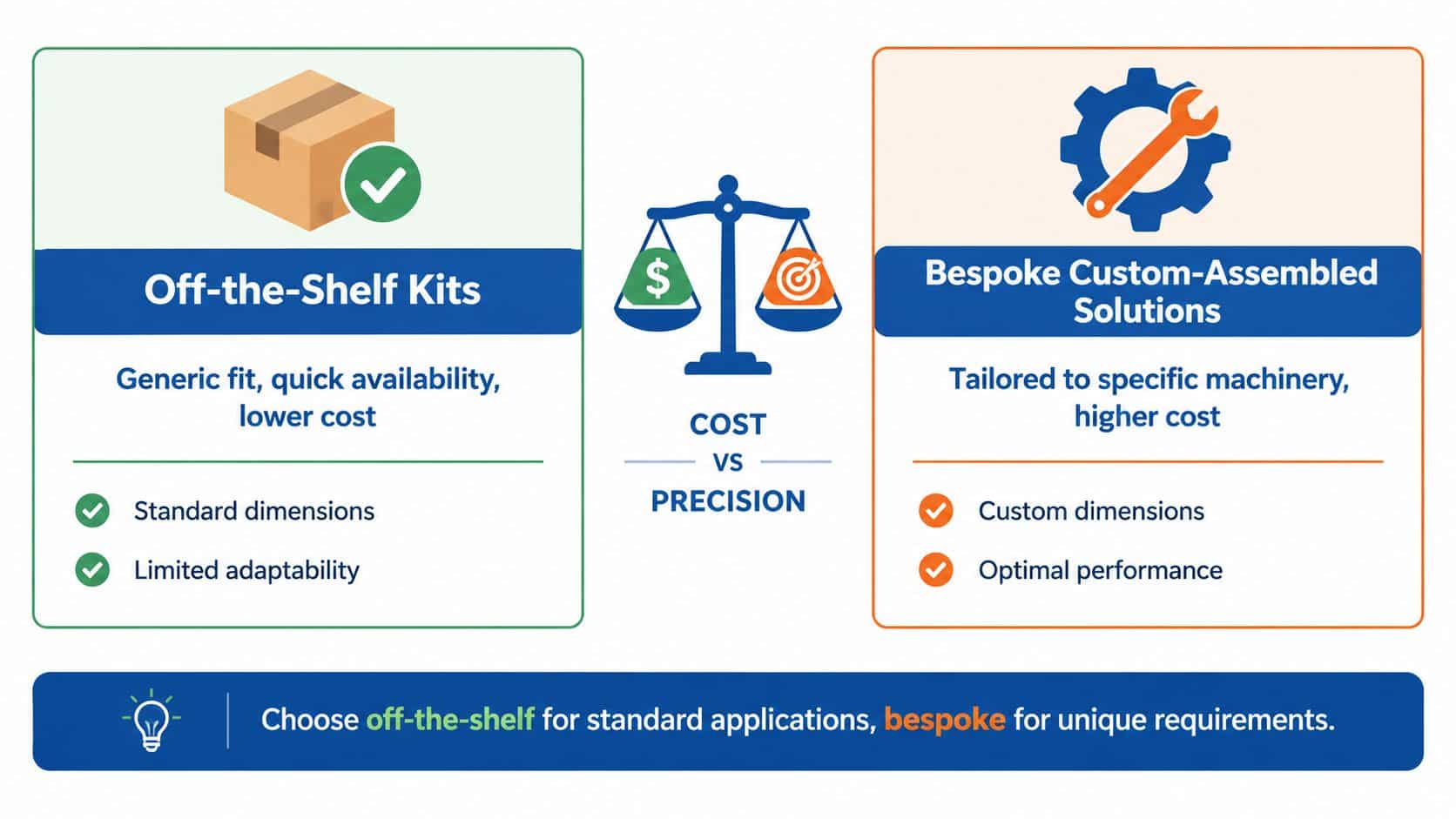
A standard hydraulic clutch kit is usually the sensible choice when the machine retains its original clutch, mounting pattern and hydraulic connections. It can shorten procurement and installation time when the part number, bore size and stroke are confirmed. Future servicing is also simpler because replacement components are easier to identify.
The hidden cost appears when an apparently suitable kit gives poor clutch feel after installation. Repeated bleeding, adjustment, fault finding and machine downtime can outweigh any saving on the initial purchase. Confirm the hydraulic ratio and available travel before fitting, rather than treating a catalogue match as proof of compatibility.
A catalogue kit becomes less suitable where geometry is unusual or the duty cycle is demanding. Agricultural machines may work in mud, dust, stop-start conditions and high-load manoeuvres. Industrial equipment may have limited installation space, a modified bellhousing or a control manifold that does not match automotive connections. Forcing a standard kit into that arrangement can create more labour and reliability risk than commissioning a correctly engineered assembly.
Compare the trade-offs that decide the job
| Off-the-shelf kit | Bespoke hydraulic assembly |
|---|---|
| Standard dimensions and known fitment | Custom dimensions, ports and mounting |
| Faster selection where records are reliable | More engineering input before manufacture |
| Usually lower purchase complexity | Better control of unusual stroke and force requirements |
| Limited adaptability | Suited to restricted spaces and modified machinery |
The correct choice depends on the duty, not only the purchase price. Record the clutch-cover type, master-cylinder stroke, slave-cylinder travel, mounting arrangement, connector dimensions and available space. Assess heat exposure, operating frequency, contamination risk and access for future maintenance. These checks also provide a diagnostic baseline if pedal effort, engagement point or release quality changes after fitting.
Selection principle: Use a standard kit when the application is standard. Specify a bespoke assembly when the machine has been modified, packaging is tight or operating loads exceed the original design intent.
The UK fluid-power supply base supports both approaches. The BFPA tracks sector output and trade through ONS and HMRC codes, while specialist suppliers maintain broad component coverage for repair work. One specialist supplier lists more than 700 clutch master and slave cylinders, including Lucas, Bendix, Bremtech, AP Lockheed, Bosch, Nipparts and Sachs, in its UK clutch hydraulics range. That breadth supports standard replacement, but dimensions still require verification.
Critical Selection Criteria and Dimensional Specs
Most incorrect hydraulic clutch kits don't fail dramatically. They fail by providing insufficient release travel, excessive pedal effort or poor engagement control. The purchase order should therefore include dimensional checks, not only a vehicle registration or a visual description.
UK parts listings show hydraulic connector diameters around 12.2 to 13.3 mm, slave-cylinder bore diameters around 34 mm, and up to three mounting bores at the central slave cylinder, as shown in this UK concentric slave-cylinder specification. A 34 mm bore has an approximate piston area of 907 mm². That area affects the relationship between line pressure, release force and fluid displacement.
The measurements that govern fitment
| Component | Typical UK specification | Impact of mismatch |
|---|---|---|
| Hydraulic connector | 12.2 to 13.3 mm | Incorrect connection, leakage or restricted flow |
| Slave-cylinder bore | Around 34 mm | Changed force, pedal effort and release behaviour |
| Slave piston area | About 907 mm² for a 34 mm bore | Different pressure-to-force relationship |
| Central slave mounting | Up to three mounting bores | Misalignment or insecure installation |
Master-cylinder stroke must match the volume required by the slave cylinder. If the master piston moves too little, the slave won't travel far enough. If the hydraulic ratio produces too much force for the available pedal movement, the pedal can become heavy and the system may over-stress the clutch cover or actuator.
The clutch-cover design matters just as much as the actuator. Diaphragm spring load, release-bearing contact height and the permitted operating position determine whether the selected slave cylinder can work through its usable range. A correct bore with the wrong spacer length is still an incorrect installation.
For hydraulic connection terminology and port identification, use this reference on hydraulic fittings types before ordering adapters. Don't rely on thread appearance alone. Confirm thread form, sealing method, hose end, connector diameter and orientation.
Verify before authorising the job
Ask the supplier to confirm the part number against the original unit, then compare the physical component when it arrives. Measure mounting centres, connector dimensions, piston position and overall height. Check that the release bearing face will contact the diaphragm correctly without running out of travel.
Keep the removed part until the replacement has passed these checks. That simple control prevents a familiar failure mode, where the technician discovers a dimensional mismatch only after the machine has been dismantled.
Installation Realities and Post-Fitment Diagnostics
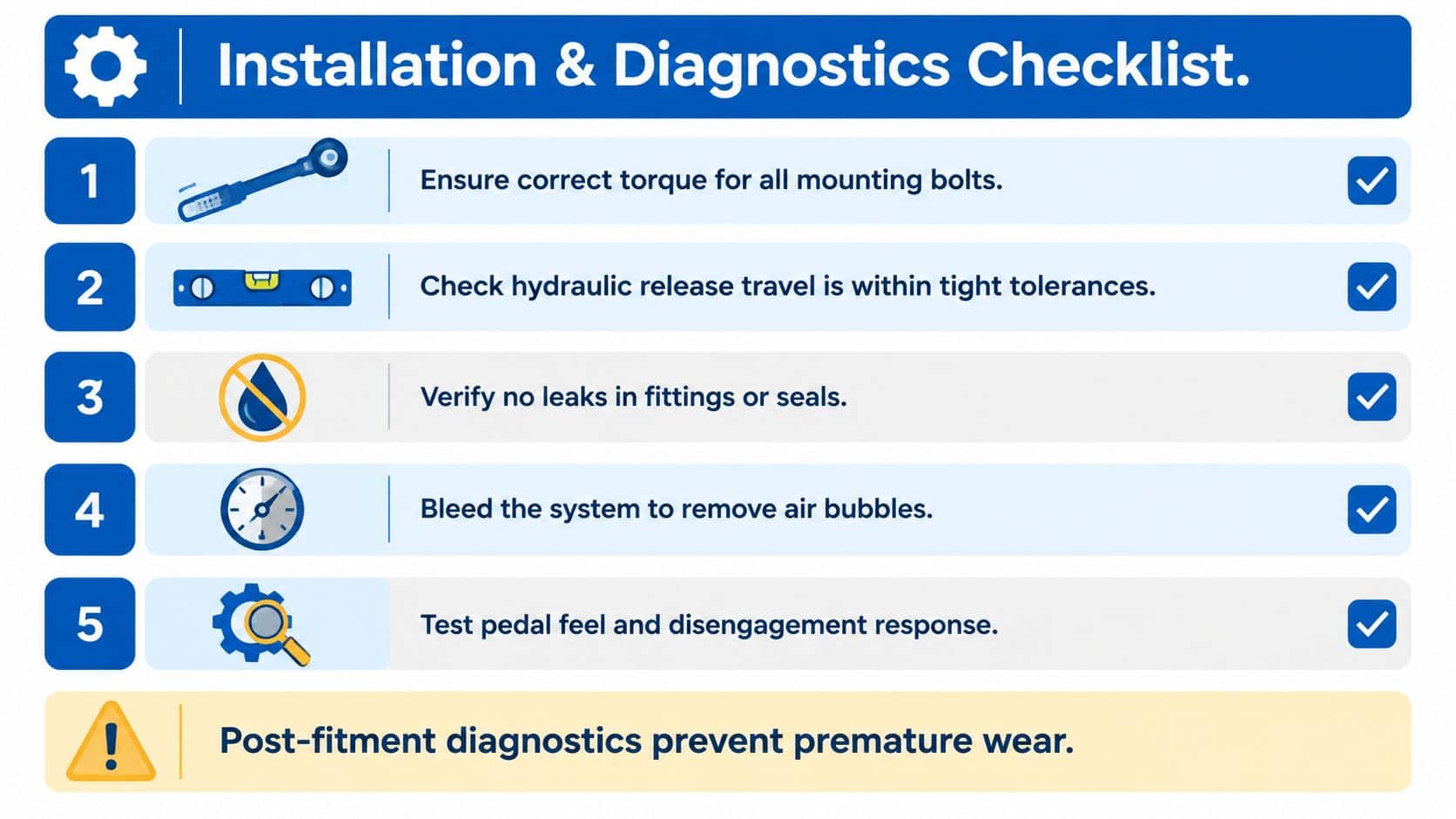
A machine can leave the workshop with a new hydraulic clutch kit and still return with a heavy pedal, poor engagement or gear selection faults. The hidden cost is often labour: repeated bleeding, access to the transmission, troubleshooting time and a second strip-down. Control installation quality first, then diagnose clutch feel in a fixed order.
A practical post-fitment sequence
-
Inspect the mechanical installation. Confirm mounting bolts are torqued correctly, the actuator is square and the release bearing contacts the clutch cover at the intended position. Check spacer length and orientation before assuming the hydraulic circuit is at fault.
-
Use the specified fluid. Do not mix fluids unless the manufacturer permits it. Contaminated or incorrect fluid can damage seals and affect valve operation. Keep dirt out of the reservoir, hose ends and bleed point.
-
Bleed methodically. Maintain the reservoir level and follow the approved bleed procedure until discharged fluid is free from visible air. Some concentric systems retain air because the bleed point is not at the circuit's highest point. Repeatedly pumping the pedal is not a substitute for the machine or component procedure.
-
Check for leakage. Inspect the master-cylinder connection, line, fittings, slave-cylinder body and bellhousing. An internal concentric slave cylinder can leak inside the housing, leaving no obvious fluid at the actuator.
-
Verify operation safely. With the machine secured, check pedal return, engagement point, gear selection and reverse engagement. Then assess clutch release at operating temperature, because a static pedal check may not reveal drag under load.
Available release travel is limited. One UK engineering guide states that a slave cylinder has about 17 mm of usable travel, while a separate example records 11.5 mm of slave push-rod travel as sufficient to disengage the clutch, as shown in this UK clutch travel measurement guide. Pedal free play, trapped air and an incorrect spacer can therefore consume a substantial part of the working range.
Diagnostic rule: A soft pedal points first to air, low fluid or leakage. A firm pedal with clutch drag points toward release travel, actuator geometry or mechanical alignment. Measure before replacing the friction assembly.
Use this clutch hydraulics symptoms guide to organise checks for low fluid, leaks, bleeding faults and inconsistent pedal response. If bleeding does not restore movement, compare master-cylinder stroke with slave-cylinder travel. Use a hydraulic pressure tester kit where controlled pressure testing is appropriate, and record the result before dismantling the transmission.
Strategic Maintenance and Component Replacement
A hydraulic clutch failure often creates more labour than parts cost. An external slave cylinder can usually be inspected and changed without removing the transmission. An internal concentric slave cylinder sits inside the transmission housing, so a leak, seal failure or worn release bearing may require the same major access operation as a clutch replacement. The lost machine time, lifting equipment and technician hours can outweigh the actuator price.
That access difference should drive the replacement decision. If an internal CSC is exposed during a clutch overhaul, renewing it at the same time usually avoids paying for the same transmission removal twice. The release bearing is integrated into the internal hydraulic unit and is generally changed with the clutch, as explained in this standard clutch kit replacement guidance.
Decide by architecture and access
Renew the internal actuator during a clutch overhaul when:
- The transmission is already removed: The extra component cost is usually easier to justify than repeating the access labour.
- The actuator shows wear or contamination: A damp bellhousing, damaged seal or rough release-bearing action indicates that reuse carries risk.
- The machine works under high demand: Stop-start operation, towing and heavy loads increase thermal and control demands.
- The history is unknown: An unverified actuator can compromise an otherwise complete clutch repair.
External slave cylinders need a different decision process. Inspect the body, seals, pushrod, mounting and hydraulic connection. Replace the unit if it leaks, binds or has excessive wear. A sound external actuator does not need automatic replacement because the friction plate is being changed.
Service life depends on duty cycle rather than mileage alone. UK aftermarket guidance places heavy-load or towing applications at roughly 50,000 to 80,000 km, while highway use may reach 150,000 km. Treat those figures as planning references, then adjust inspection timing for heat, contamination, loading and operator behaviour. A shorter inspection interval can be cheaper than an unplanned actuator failure during production or field work.
UK component pricing shows why labour planning matters. A fitted master/slave replacement set can appear from about £120 to £325, individual slave cylinders from roughly £8 to £525, and complete master-and-slave sets typically around £130 to £350, according to this UK slave-cylinder pricing range. Part prices vary widely, but repeated transmission access can dominate the final cost.
For scheduled servicing, use a documented preventive maintenance checklist covering fluid condition, leaks, pedal feel, release travel and operating hours or mileage. Record the baseline after installation. A later change in engagement point, pedal effort or release behaviour then becomes a maintenance signal, not a vague operator complaint.
Securing Expert Hydraulic Support and Supply
A reliable hydraulic clutch kit decision rests on three checks. First, confirm the mechanical and hydraulic dimensions. Second, decide whether the actuator should be renewed during the clutch overhaul, based on whether it is internal or external and how difficult access will be. Third, prove the installation through bleeding, leak inspection and release-travel checks before returning the machine to work.
Standard catalogue parts suit established applications with known geometry. Bespoke hydraulic assemblies become more appropriate where the machine has unusual mounting, restricted space, modified controls or a duty cycle that demands a different release arrangement. Cross-referencing obsolete components also requires more than matching an approximate visual shape.
MA Hydraulics Ltd supplies hydraulic components and bespoke power solutions for mobile and industrial applications, including clutch-related components, hydraulic testing support, component selection and custom assemblies. That support is relevant where a maintenance team needs to identify a replacement, verify a difficult fitment or develop a complete solution for agriculture, materials handling or manufacturing.
Speak to MA Hydraulics Ltd for help selecting a correctly matched hydraulic clutch kit, checking hard-to-find components or developing a bespoke hydraulic assembly for your machinery. Visit MA Hydraulics Ltd or phone 01724 279508 today, or send us a message with your application details.
