
You press the clutch on a cold Monday morning and the pedal feels different. It drops further than usual, first gear resists, and reverse crunches before the car finally moves. That change is easy to blame on a worn clutch, but clutch hydraulics symptoms often point somewhere else entirely.
A worn friction clutch can produce a high or changing bite point, but hydraulic faults more often change the pedal itself. The pedal may feel soft, become difficult to return, sink while you hold it at a queue, or leave you unable to select a gear. UK guidance links a soft or spongy pedal with air in the system or internal leaks that reduce fluid pressure, which can stop the clutch fully disengaging when selecting first or reverse (RAC Drive’s clutch guidance).
The useful question isn’t, “Is my clutch failing?” It’s, “What exactly did the pedal do, and what happened to the fluid?” That distinction tells you whether bleeding may help, whether a leak needs repairing, or whether a master or slave cylinder must be replaced.
When the Clutch First Starts Telling You Something
The first warning often arrives during an ordinary gear change. You push the pedal for first gear and notice that it travels further before offering resistance. The bite point feels vague, the gear teeth complain, or the pedal returns more slowly than it did on the previous journey.
That experience feels different from a friction plate wearing down. A worn plate can give a fairly consistent pedal feel while the engagement point moves higher or the clutch slips under load. A hydraulic fault is less predictable. The pedal may become spongy, sink as you hold it at traffic lights, or drop towards the floor after several shifts.
Workshop rule: describe the pedal movement before describing the clutch. “It went soft after braking” is useful. “The clutch is worn” is only a guess.
The hydraulic system has no electronic warning strategy to explain what has happened. It relies on fluid, seals, pipework and mechanical movement between the pedal and release mechanism, so the driver often notices a change before any warning light appears. A small loss of pressure can be enough to prevent full release, even when the vehicle still drives.
Start recording the sequence. Did the pedal feel soft from the first press, or did it deteriorate while held down? Did pumping it make it firmer? Did the reservoir level fall? Did fluid appear below the pedal box, around the bellhousing or at a hose connection?
For a useful explanation of the wider pedal assembly and related warning signs, see this guide to symptoms of a failing clutch pedal. It helps separate pedal mechanism problems from faults in the hydraulic circuit.
How a Hydraulic Clutch System Actually Works
A hydraulic clutch is a sealed pressure circuit. The pedal doesn’t pull the release fork directly. It pushes fluid pressure through a chain of components, and a fault at any point can alter pedal travel or clutch release.
The pressure path
- Pedal and master cylinder: The pedal pushes a piston inside the master cylinder. That piston pressurises the clutch fluid.
- Reservoir: The reservoir supplies fluid to the master cylinder and provides a visible level check. On some vehicles, it shares fluid with the brake system.
- Pipework and hose: Rigid pipe or flexible hose carries pressure towards the gearbox. Corroded pipes, damaged hoses and loose connections can allow fluid out or air in.
- Slave cylinder: The slave piston receives the pressure and pushes the release fork, or acts directly on the release mechanism.
- Release mechanism: The fork moves the release bearing against the pressure plate fingers, separating the clutch disc from the flywheel so the gearbox can select another gear.
- Bleed nipple: The bleed nipple provides the controlled exit point for air and old fluid during bleeding.
The easiest analogy is a sealed water pistol. With clean fluid and no air, pressing the trigger transfers movement immediately. Add an air bubble and the pressure becomes vague because the air compresses. Add a leaking seal and the system can’t maintain pressure.
UK product documentation identifies DOT 4 brake and clutch fluid for hydraulic clutch systems that require that specification (MANNOL DOT 4 product documentation). Check the vehicle handbook or manufacturer specification before adding anything. Fluid type isn’t an area for guesswork.
For a broader explanation of hydraulic principles, MA Hydraulics provides an overview of how hydraulics work. In clutch diagnosis, the key point is simple: pressure must travel through a sealed circuit and reach the release mechanism with enough force and movement.
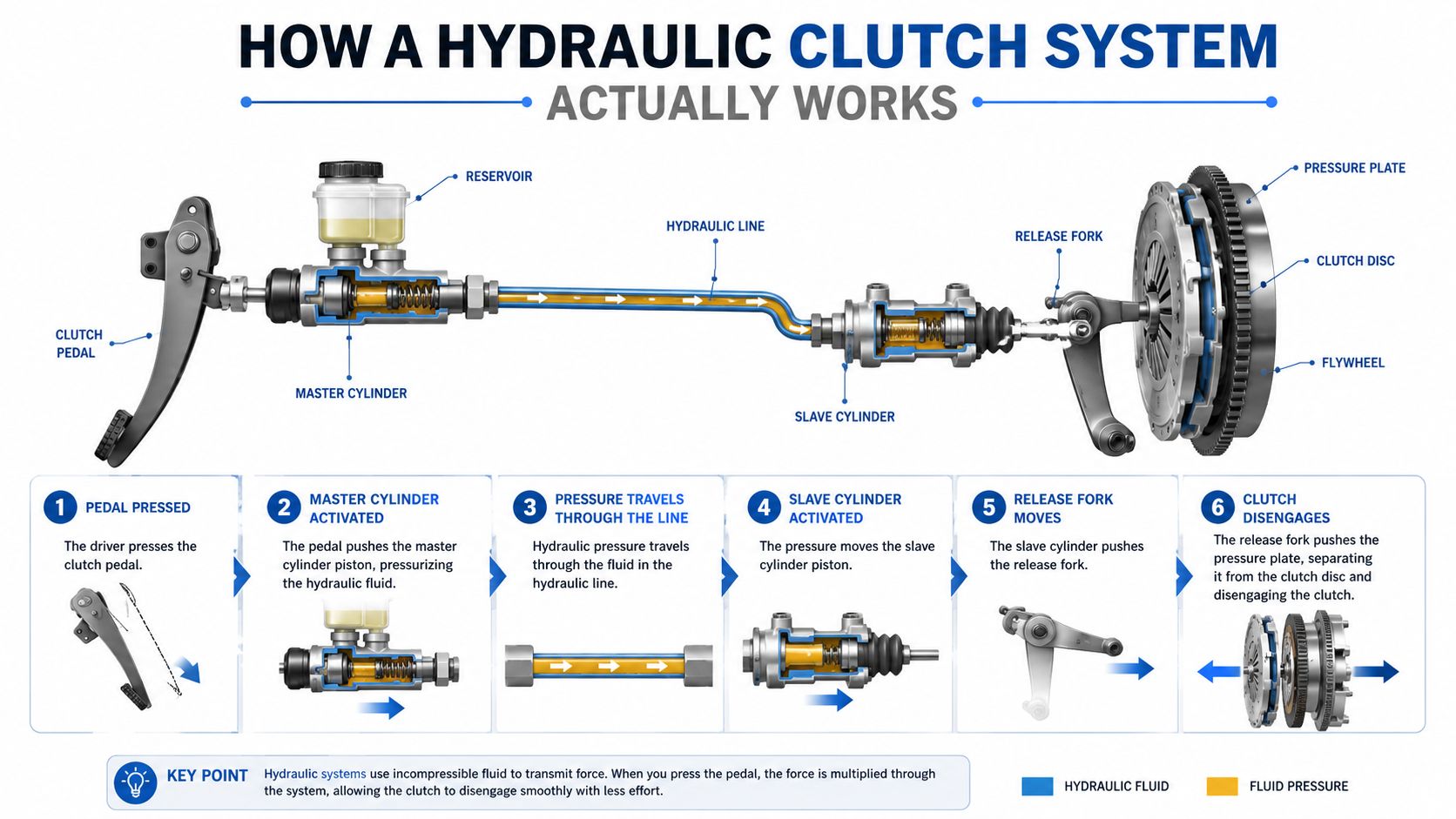
Because the circuit is sealed and unpowered, most clutch hydraulics symptoms trace back to the reservoir, master cylinder, pipework, slave cylinder or bleed nipple. The difficult part is identifying which one has lost control of the pressure.
The Six Symptoms UK Drivers Notice First
Drivers tend to report the same group of complaints, but each one carries different diagnostic weight. UK repair guidance commonly associates stiff or crunchy gear changes, a pedal that sticks or fails to return, and a high or inconsistent bite point with hydraulic faults as well as clutch wear (Gumtree’s slave-cylinder guidance).
| Symptom | Most Likely Hydraulic Cause |
|---|---|
| Spongy or soft pedal | Air ingress, low fluid or a hydraulic leak |
| Pedal slowly sinks while held | Internal master-cylinder bypass or another seal failing to hold pressure |
| Bite point suddenly moves high or becomes inconsistent | Pressure loss, pipework seepage or slave-cylinder trouble |
| Grinding into first or reverse | Slave cylinder not providing enough movement for full clutch release |
| Fluid loss around the bulkhead, hose or bellhousing | External leak from the master cylinder, pipework or slave cylinder |
| Fluid inside the bellhousing | Internal slave-cylinder leakage, with possible clutch contamination |
Soft pedal that improves after pumping
A soft pedal that becomes firmer after repeated presses usually means the system contains compressible air or isn't maintaining pressure. Trapped air reduces the force reaching the slave cylinder, so the clutch may release late or incompletely. Bleeding can restore the pedal only if the system is otherwise sound and the source of air ingress has been dealt with.
Pedal sinking under steady pressure
Hold the pedal down at a stationary vehicle. If it gradually moves towards the floor while your foot pressure stays steady, suspect internal bypass rather than a simple worn friction plate. UK technical guidance links this pattern with master-cylinder bypass, hose or pipe leakage, and concentric slave-cylinder seal failure (Gumtree's master and slave-cylinder diagnosis).
High or wandering bite point
A high bite point alone isn't proof of a hydraulic fault. However, a sudden change or an engagement point that varies from one press to the next suggests inconsistent hydraulic movement. A leaking slave cylinder or weeping pipe can reduce the stroke available at the release mechanism.
Crunching first or reverse
If the clutch doesn't fully disengage, first and reverse are often the gears that expose it. The transmission input continues to rotate, so selection becomes stiff or produces a crunch. Don't keep forcing the lever. That treats the symptom as a gearbox problem and can create unnecessary damage.
Fluid outside the circuit
Look below the pedal box, around the reservoir-to-master connection, along the pipework and near the slave cylinder. A falling reservoir level, repeated topping-up or a pedal going to the floor are concrete indications of fluid loss or pressure failure, not vague “old clutch” complaints (Buycarparts.co.uk's master-cylinder symptoms).
Fluid inside the bellhousing
A slave cylinder mounted inside the bellhousing can leak where you can't see the component directly. Fluid may reach the clutch assembly and contaminate the friction surfaces, turning a hydraulic repair into a larger clutch job. Don't assume that adding fluid solves it.
Reading the Pedal to Tell Air, Leaks and Bypass Apart
Three observations give the most useful first diagnosis: what pumping does, what the reservoir does, and where the fluid appears. No single observation proves the failed part, but the combination usually narrows the fault quickly.
Begin with a pump-and-hold check in a safe stationary position. Press the clutch several times, then hold it down with steady pressure. If the pedal becomes firmer after pumping but loses that firmness again, air or leakage is likely. If it sinks despite a normal fluid level, internal seal bypass becomes more suspicious.
The reservoir supplies another clue. A level that drops points towards fluid leaving the system, although a normal level doesn't clear the cylinders. Internal bypass can move fluid past a seal without producing an obvious external loss.
Match the three signals
| Pedal Behaviour | Reservoir After 24h | Leak Point Visible | Most Likely Cause |
|---|---|---|---|
| Soft, improves with pumping | Lower | Damp pipe or hose | Air entering through an external leak |
| Sinks under steady pressure | Normal | None obvious | Internal master-cylinder bypass |
| Soft and stays low | Lower | Master or bulkhead area | Master-cylinder or feed connection leak |
| Soft with bellhousing dampness | Lower | Slave or bellhousing area | Slave-cylinder leak |
| Firm initially, then fades in use | Normal | None obvious | Internal seal failure or intermittent air ingress |
| Pedal sticks or fails to return | Variable | Fork or slave area | Slave-cylinder restriction, seal failure or release mechanism fault |
Inspect with a torch rather than relying on a quick glance. A small wet patch at the pedal box matters. So does a crusted deposit around the slave cylinder, dampness at rubber hose joins or fluid near the clutch fork.
A useful additional reference is this AutoProv clutch pedal guide, particularly when the pedal sticks low or returns inconsistently. Use it to compare symptoms, but don't replace a leak inspection with internet diagnosis.
A hydraulic pressure tester can help confirm pressure behaviour when the symptom remains unclear. MA Hydraulics lists a hydraulic pressure tester kit as a tool for controlled hydraulic checks. On a vehicle, testing must follow the manufacturer's procedure and safe pressure limits.
DIY Checks You Can Safely Run in the Yard
You can carry out useful checks without dismantling the gearbox. Work on level ground, keep the engine cool for the visual inspection, and don't crawl beneath an unsupported vehicle.
Start with the reservoir
Find the clutch reservoir, or the shared brake and clutch reservoir where the vehicle uses one. Check the level against its markings and inspect the fluid for obvious contamination, cloudiness or debris. Confirm the required specification in the handbook. DOT 4 is commonly specified for UK hydraulic clutch systems, but the vehicle's own requirement takes priority.
Next, pump the pedal and hold it down. A pedal that firms up temporarily but then loses pressure needs investigation. If it drops towards the floor, do not continue driving because pumping restores it for a short time.
Use a torch to inspect the master cylinder, feed hose, rigid pipe, flexible hose and slave-cylinder area. Check inside the footwell around the pedal box and the underside of the bellhousing. Never taste or handle fluid unnecessarily, and keep DOT 4 away from painted surfaces because it can damage paint.
Bleed only when the system is otherwise sound
A basic two-person bleed can remove air. One person operates the pedal, while the other opens and closes the bleed nipple in the correct sequence. Use fresh fluid from a sealed container, keep the reservoir from running dry, and follow the vehicle-specific bleeding procedure.
The common mistakes are avoidable:
- Don't overtighten the bleed nipple: It can damage the seat or make future bleeding difficult.
- Don't release the pedal with the nipple open: The system can draw air back through the nipple.
- Don't use an unconfirmed fluid specification: The wrong fluid can damage seals or compromise operation.
- Don't overextend the slave piston: Excessive movement can push a worn seal beyond its normal travel.
- Don't ignore a falling level: Bleeding won't repair the leak that keeps introducing air.
The MA Hydraulics fault-finding techniques resource provides a useful framework for checking symptoms, likely causes and first inspection points.
Stop and book the vehicle in if the slave area is wet, the fluid looks milky, the reservoir won't hold its level, or the pedal remains soft after a correct bleed. Also stop if the vehicle creeps with the clutch fully depressed or you can't select first and reverse safely. Clutch dust can irritate the lungs, so avoid blowing around the bellhousing with compressed air.
When to Stop and Call a Hydraulic Specialist
A bleed is a remedy for air, not a cure for a failed seal. If the pedal keeps losing pressure, the reservoir level changes, or fluid appears at the slave-cylinder end, repeated bleeding only resets the symptom temporarily. The fault remains in the circuit.
Some slave cylinders sit inside the bellhousing, particularly on transverse-engine vehicles. Access can require gearbox removal, so a correct diagnosis matters before anyone starts replacing parts. If the cylinder is leaking internally, the fluid may contaminate the clutch and damage the friction material.
A master-cylinder bypass failure creates a different problem. The system may look dry because fluid is moving past the internal seal rather than escaping outside. Repeated bleeding won't restore a seal that can't hold pressure, and continued driving can leave the clutch unable to disengage at a junction or during a gear change.
Questions worth asking before booking
- Fluid specification: Ask the technician to confirm the correct fluid for the vehicle, rather than assuming every clutch uses the same product.
- Pressure diagnosis: Ask whether the system has been tested for pressure loss and whether the result distinguishes air, external leakage and internal bypass.
- Parts strategy: Ask whether the master and slave cylinders should be assessed together, especially where one failed component may have contaminated the circuit.
- Access and downtime: Confirm whether the slave cylinder is external or concentric, and whether gearbox removal is likely.
- Clutch condition: Ask whether fluid has reached the friction plate, release bearing or pressure plate.
For operators managing several vehicles, planned inspections and documented maintenance reduce the chance of a hydraulic fault becoming a roadside failure. Peak Transport's guidance on fleet equipment maintenance planning is relevant to scheduling checks around vehicle use, service access and known wear points.
A vehicle with a sinking pedal, persistent air or a slave-cylinder leak should be treated as a repair priority. Arrange professional inspection before the pedal reaches the floor completely.
Clutch Hydraulics Questions UK Operators Still Ask
Why can the pedal feel firm on the drive but fail during a journey?
A short stationary test doesn't always reproduce a seal bypass that appears once the system is held under pressure or warmed through use. If the pedal fades after repeated operation, record when it happens and whether pumping restores it. That pattern points towards pressure retention, air or leakage rather than proving the friction clutch itself has failed.
Can I top up with DOT 4.5 or DOT 5.1?
Don't choose fluid by a higher-sounding number. Use the specification stated by the vehicle manufacturer. UK product documentation identifies DOT 4 for systems requiring DOT 4, while another specification may only be suitable where the vehicle explicitly permits it. If the level is dropping, topping up is only temporary protection. Find the leak.
How often should clutch fluid be changed?
There isn't a universal interval that applies to every road car, van and commercial vehicle. Follow the manufacturer's service schedule and consider the vehicle's workload, storage conditions and operating environment. A sudden colour or level change, soft pedal or repeated need to top up calls for diagnosis rather than waiting for a routine service.
Can a hydraulic fault damage the release bearing or pressure plate?
Yes, incomplete release can make the clutch drag and force difficult gear selection. Continued operation with fluid inside the bellhousing can also contaminate friction components. The hydraulic fault may begin as a cylinder repair, but delay can increase the parts involved.
Should a new master or slave cylinder be bled professionally?
A competent home mechanic can bleed some systems with the correct equipment and procedure. Professional bleeding is sensible when the cylinder is difficult to access, the circuit is shared with the brakes, air keeps returning, or the pedal won't stabilise after bleeding. A firm pedal immediately after fitting a part doesn't prove the repair is complete.
If your vehicle has a soft pedal, a sinking pedal, a changing bite point or difficult first and reverse selection, stop guessing from the clutch plate alone. Phone MA Hydraulics Ltd on 01724 279508 today for practical hydraulic guidance, or send us a message with the vehicle symptoms and what you've found during inspection.
MA Hydraulics Ltd supports hydraulic fault finding and component selection for mobile and industrial applications, including awkward replacement units and bespoke hydraulic solutions. Contact MA Hydraulics Ltd to discuss the symptoms, identify the likely pressure-loss point and arrange the right next step.
