
A 28mm Speedfit joint rarely fails because the bore is large. It fails because the pipe never reached the stop. The collet can grip a pipe that still sits short of the O-ring, and the joint looks finished until the system is filled.
Insertion, support and a pressure test decide whether 28mm Speedfit pipe is a sound main or a concealed weep. The price per metre only makes sense beside those limits.
28mm Speedfit Pipe Specifications and Pressure Limits
28mm Speedfit pipe is John Guest push-fit PEX barrier pipe for domestic plumbing and heating, and light-commercial water services. It is one of the larger sizes in the Speedfit range.
Before buying, match the product listing to the job: 28mm diameter, 3m white PEX barrier pipe. Primaflow F&P lists JG Speedfit white PEX barrier pipe in that specification. The page was last updated on 11 October 2023.
Use 28mm where a 15mm or 22mm line may not deliver the required flow, such as a cold main feeding several outlets, a heating flow serving a large emitter group, or a light-commercial riser. The larger bore reduces velocity and pressure loss. It does not increase the pipe's permitted working pressure.
John Guest Speedfit has a long history in plumbing and heating. Grace's Guide to John Guest) records the company's founding in 1961, its first push-in connector for compressed air in 1974, and the launch of the Speedfit Plumbing and Heating System in 1987. It also records a purpose-built factory of about 61,000 square feet in 1989 and a Maidenhead extrusion factory in 1998.
Working pressure and temperature
The Wickes JG Speedfit sheet gives separate limits for cold water, hot water and central heating. Keep each circuit within its stated pressure and temperature limits.
| Service | Maximum working pressure | Typical maximum temperature |
|---|---|---|
| Cold water | 12.5 bar | 20°C |
| Hot water | 6 bar | 92°C |
| Central heating | 3 bar | 95°C |
| Central heating malfunction (short duration only) | No pressure value published | 114°C |
The lowest-rated component sets the limit for the whole circuit. A radiator valve rated to 3 bar, for example, limits a circuit that could otherwise hold more pressure. Working pressure must also be reduced as temperature rises. Treat the cold-water rating as a cold-water limit, not as a pressure target for a hot circuit. These ratings do not cover gas, fuel oil, compressed air or uncontrolled heat sources.
Fittings and Inserts That Work With 28mm Pipe
The mistake that ruins a compression joint is a missing insert. The olive bites the PEX and ovalises it, and the joint weeps as soon as it is hot. Fit the standard 28mm pipe insert first, because that insert is what stops the olive deforming the pipe.
Compression fittings need a square cut, a clean deburr, the insert, then the olive and nut. The insert has to suit this pipe, not a leftover from a smaller size. A 16mm compression fitting belongs on a 16mm branch. Don't neck a 28mm main down with the wrong insert and hope the olive seals.
Speedfit push-fit fittings use the same insert to support the wall. Push the pipe past the collet and the O-ring until it reaches the internal pipe stop. John Guest installation instructions require that full insertion, then a pull to confirm the pipe is secure, and a test before use. A short push can grip without sealing.
Mixed brands and the wrong duty
Nominal 28mm does not prove the collet and O-ring match your pipe. Check the maker's data for the specific pipe material and the application before you assemble anything.
Tees and branches should come from the same 28mm system so the grip and the seal match the pipe. A 28mm equal tee is the usual splitter on a main. Don't drop in a tee from a compressed-air acetal kit and treat it as part of this PEX barrier system.
Practical rule: If the insert and the fitting are not both specified for this pipe and this duty, leave the joint apart.
Fittings and kits sold for gas, fuel oil or compressed-air duty are outside the rating of this pipe. The insert and the fitting have to suit the pipe in your hand, not a similar-looking one on the van shelf.
What 28mm Speedfit Pipe Costs per Metre in GBP
Compare the per-metre cost alongside pack size and VAT. A 3m JG Speedfit PEX barrier length listed by Melbros is £13.78, or about £4.59 per metre. The listing does not establish the VAT basis, so treat that as a listed-price calculation, not a VAT-inclusive comparison. Travis Perkins lists the same 3m length at £16.87 including VAT, or £14.06 excluding VAT. That works out at about £5.62 per metre including VAT.
MJ Plastics lists a 3m length at £16.87 including VAT, about £5.62 per metre, a 6m length at £36.26, about £6.04 per metre, and a 1m length at £7.01 including VAT. Check the listing's VAT basis before comparing its 6m price with VAT-inclusive prices.
How volume changes the rate
Electrical & Plumbing Supplies lists a 6m straight length at £32.27 excluding VAT, or £27.43 excluding VAT for orders of 20 or more. That is about £5.38 per metre, dropping to about £4.57 per metre. Its 50m layflat coil costs £293.69 excluding VAT, or £249.64 for five or more, equivalent to about £5.87 and £4.99 per metre. Kent Plumbing Supplies lists a 3m length at £20.39 without stating the VAT status.
| Pack and supplier | Listed price (GBP) |
|---|---|
| 1m single length, MJ Plastics | £7.01 including VAT |
| 3m JG Speedfit PEX barrier, Melbros | £13.78, VAT basis not stated |
| 3m JG Speedfit PEX barrier, Travis Perkins | £16.87 including VAT (£14.06 excluding VAT) |
| 3m JG Speedfit PEX barrier, Kent Plumbing Supplies | £20.39, VAT status not stated |
| 6m straight barrier pipe, MJ Plastics | £36.26, VAT status not stated |
| 6m straight barrier pipe, Electrical & Plumbing Supplies | £32.27 excluding VAT |
| 6m straight barrier pipe, 20 or more packs, Electrical & Plumbing Supplies | £27.43 excluding VAT |
| 50m layflat coil, Electrical & Plumbing Supplies | £293.69 excluding VAT |
| 50m layflat coil, five or more packs, Electrical & Plumbing Supplies | £249.64 excluding VAT |
Compare prices on the same VAT basis, then account for delivery, stock and waste. A lower per-metre rate only helps if the pack suits the run. A 50m coil is poor value for an 8m job if most of the remainder sits unused.
For a labour-and-materials estimate, Exayard plumbing estimating software can keep pack prices and waste together. Check the product's pressure and regulatory limits as well as its price before ordering, then include the cost of any fittings and inserts the installation requires.
How to Cut, Prepare and Insert 28mm Speedfit Pipe
Cut square, deburr, insert, mark, push to the stop, then pull. Skip one of those and the joint is already a leak.
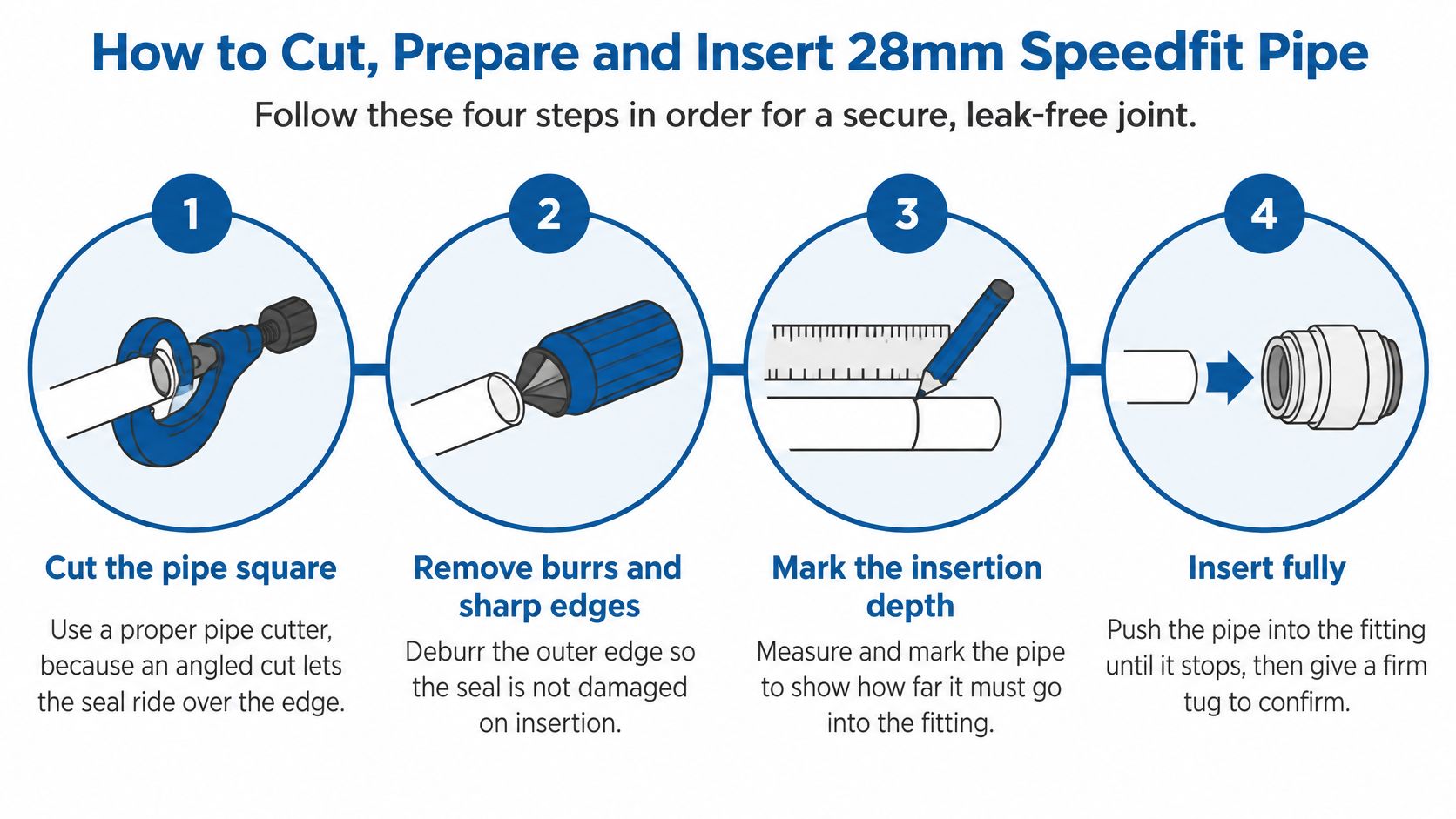
The sequence
- Cut the pipe square with a proper pipe cutter. An angled cut lets the seal ride over the edge, so the O-ring never sits on a round, full face. A hacksaw cut is rarely square enough on 28mm, and the extra length you think you've saved comes back as a weep.
- Remove burrs and sharp edges with a deburring tool. Take the outer edge only. A gouge in the outside of the pipe becomes a leak path under the O-ring, and you can't polish that out once the pipe is in the fitting.
- Check the pipe, the fitting, the O-ring and the grab-ring area. They need to be clean and undamaged. Grit, flux residue and a nicked O-ring all stop the seal. If the collet looks distorted from a previous release, bin the fitting.
- Fit the correct 28mm pipe insert where the connection needs one. That is every Speedfit-to-Speedfit joint and every compression joint on this pipe. A loose or undersized insert lets the wall collapse as you push.
- Mark the insertion depth on the pipe before assembly, measured against the fitting face. The mark is your only proof after the pipe disappears into the collet. Put it where you can still see it once the pipe is home.
- Push the pipe fully home until it reaches the internal pipe stop, passing both the collet and the O-ring. You should feel the stop, not just resistance from the grip ring. A twist or a partial stroke looks seated and isn't.
- Pull the pipe to confirm it is secure. A pipe that creeps out was never past the grab ring. Don't tap it home with a hammer. Withdraw it, check the end, and start again.
- Leave joints uncovered until the pressure test is passed. Boxing in a 28mm main before the test turns a five-minute repair into a ceiling job.
What not to do on site
Don't use lubricants or sealants the manufacturer hasn't specified. Oil and PTFE on the pipe end stop the O-ring doing its job and can swell the seal. Keep the cutter blade sharp, because a blunt wheel crushes 28mm PEX instead of parting it. Never force a pipe that stops short. If it won't go, the insert is proud, the pipe is oval, or debris is in the collet.
A pipe pushed in with a twist, or with a partial stroke, looks seated and has not reached the stop.
Mark every joint before you walk away from it. On a long 28mm run you will not remember which end you only pushed once.
How to Support and Test 28mm Speedfit Pipe Runs
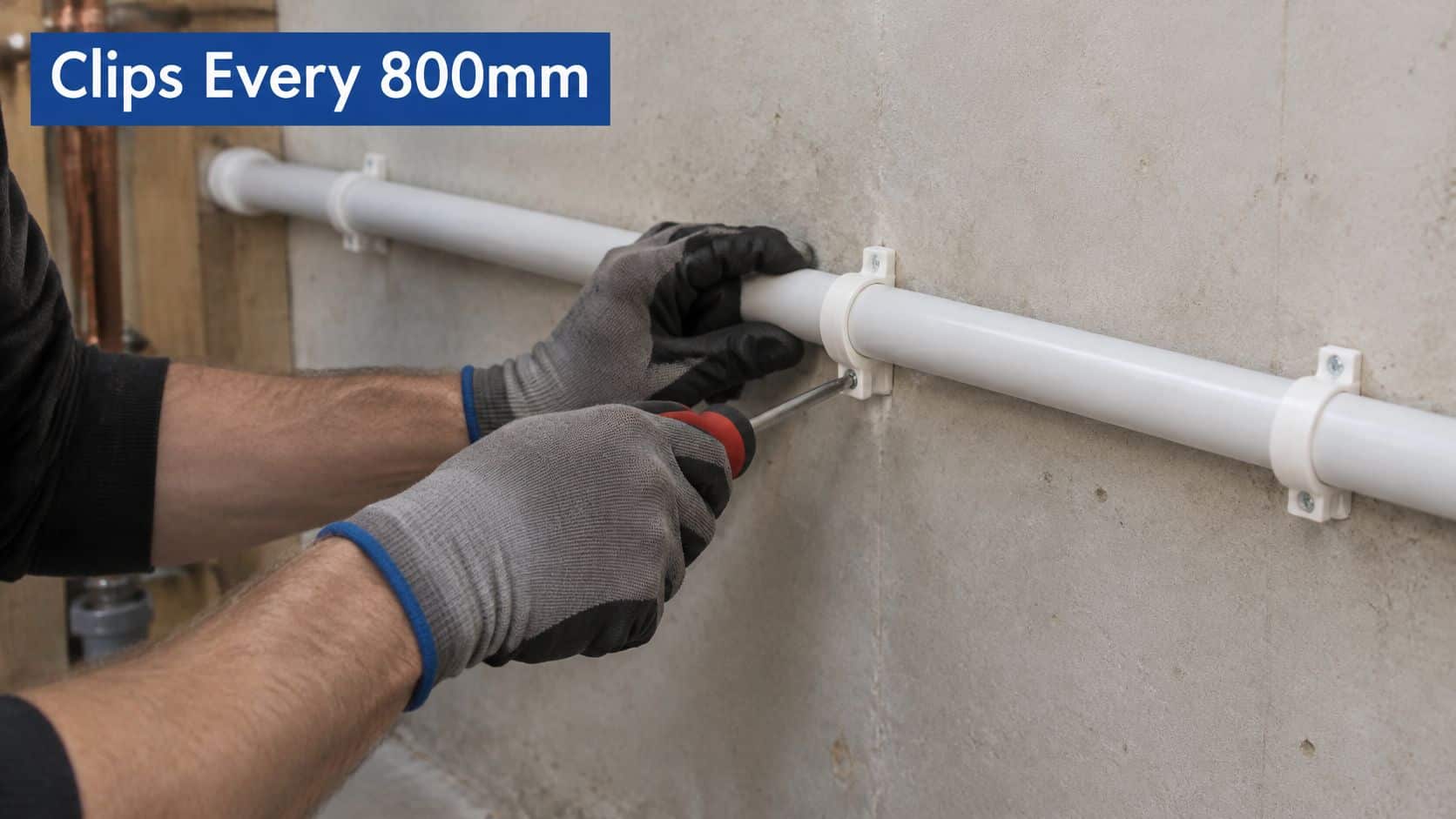
Support spacing, movement and joint loading all affect how a 28mm run performs. Keep horizontal surface clips no more than 800mm apart and vertical clips no more than 1,000mm apart, as specified in the JG Speedfit technical specifications guide. Wider gaps can let a hot, water-filled pipe sag and transfer strain to a fitting.
For a bend formed with clips, use a minimum radius of 300mm. A properly cold-formed bend can use a minimum radius of 110mm. Do not force a tight hand bend to avoid installing a fitting.
| Run or bend | Limit | Note |
|---|---|---|
| Horizontal surface run | Maximum 800mm between clips | Controls sag and movement |
| Vertical surface run | Maximum 1,000mm between clips | Supports the pipe |
| Bend formed with clips | Minimum radius 300mm | Standard formed bend |
| Cold-formed bend | Minimum radius 110mm | Requires the cold-forming method |
| Concealed run | Clip only where necessary | Leaves room for pipe movement |
Concealed runs need support where necessary, not tight strapping along their length. The guidance gives PEX expansion as about 1% of length between 20°C and 82°C. A 10m run therefore needs about 100mm of movement. Allow for that expansion; restraining the pipe can load the joints sideways.
Plant, test and the record
On mobile or vibrating plant, restrain the pipe near each joint so the fitting body does not carry side load. Fit a clip sized for 28mm pipe on either side of the fitting, not on the fitting itself. The clips should hold the pipe while leaving the joint unloaded. A 10mm pipe clip is for smaller pipe, not this 28mm run.
Pressure-test the completed system to the manufacturer's current leaflet. Record the specified test pressure and duration, then inspect every joint while the system is under pressure. Keep joints accessible until the test passes, before adding insulation or boxing.
Record the test pressure, duration, date and name of the person who carried it out. Without that record, a later leak is harder to trace.
Common 28mm Speedfit Faults and How to Fix Them
Most push-fit leaks come from three faults: the pipe is not fully inserted, debris is on the seal, or the O-ring is damaged. Treat each joint as a checklist: insert to the required depth, keep the sealing surfaces clean, and check the joint under pressure before covering it.
| Symptom | Likely cause | Fix |
|---|---|---|
| Weeps at a new joint within days | Pipe not fully inserted or its end is damaged | Depressurise, withdraw the pipe, recut it square and reinsert past the stop |
| Drips only once pressurised | Debris on the sealing surface | Clean the pipe end and fitting, reinsert and re-test |
| Leaks after a sound joint is dismantled and remade | O-ring damaged during insertion | Replace the O-ring, check the grab-ring area and recut if the pipe is scored |
| Pipe pulls out under pull test | Insert missing or pipe short of the stop | Fit the correct insert, cut back any damaged end and insert to the depth mark |
| Weeps only when the system is hot | Temperature or pressure exceeds the system's rating | Check the operating limits and lower the pressure to suit the lowest-rated part of the circuit |
What to do for each fault
Depressurise before touching a joint. A 28mm main can release a substantial amount of water, so pulling a collet while the pipe is live risks a sudden leak.
A new joint that weeps within days usually needs a fresh pipe end. If it is scarred, cleaning it and pushing it back in can leave the seal compromised. Cut it square, remove any damaged section and insert the pipe fully.
A drip that appears only under pressure often points to grit or other debris on the sealing surface. Clean the pipe end and fitting, then reinsert and test again. You do not necessarily need a new fitting if the O-ring remains intact.
If a joint leaks after it has been released and remade, inspect the O-ring for damage. Replace it if torn, check the grab ring, and recut the pipe if its surface is scored. A new O-ring cannot seal reliably against a chewed pipe end.
A pipe that pulls out has failed to grip. Check that the correct insert is fitted and that the pipe has passed the collet. Cut back damaged pipe, mark the required depth and insert to the mark.
A joint that leaks only when hot may be operating beyond the pipe or fitting's temperature rating, or at a pressure not suitable for that temperature. Check the circuit against the stated limits, including the 92°C hot water and 95°C heating ceilings, and reduce pressure to suit its lowest-rated component.
On vibrating plant, a marginal insertion can leak as the pipe moves. Support the pipe without loading the fitting body.
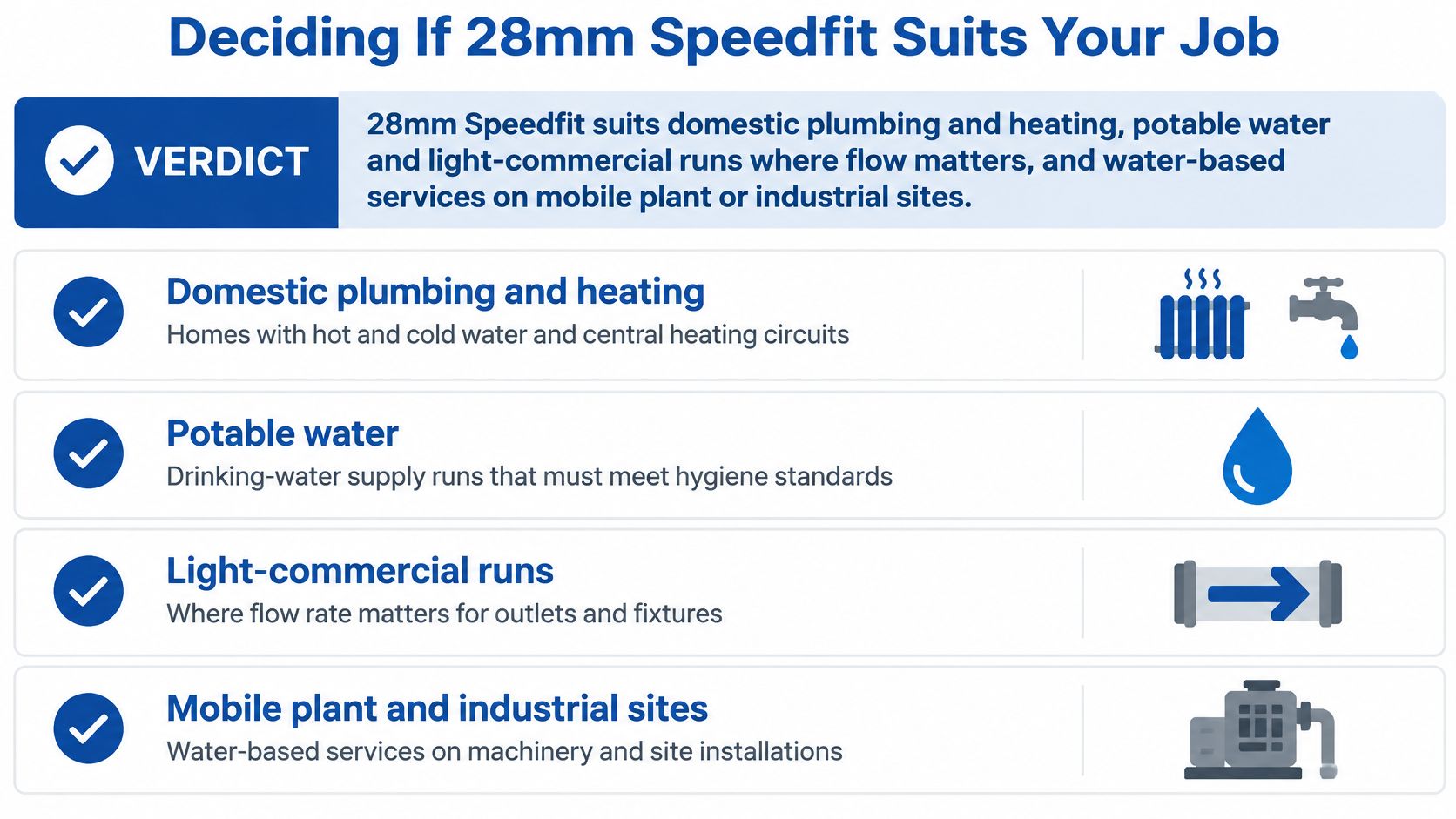
Deciding If 28mm Speedfit Suits Your Job
28mm Speedfit pipe suits water-based domestic plumbing, heating and light-commercial runs where flow matters. It can also serve mobile plant and industrial sites if the pipe is restrained. Do not use it for gas, fuel oil, compressed air or uncontrolled heat.
Nominal size alone does not establish suitability. The Water Supply (Water Fittings) Regulations 1999 require materials used for domestic or food-production water to avoid contamination, and fittings to be suitable for their circumstances. The regulations also address external loads, vibration, stress, settlement, pressure surges and temperature changes, and require work to be carried out in a workmanlike manner. Northern Ireland has its own water fittings regulations, so check the rules that apply to the job's location.
A larger bore can reduce flow resistance on a high-demand circuit, but it does not remove the need to check system limits and support the run correctly. Compare pipe cost with the circuit's actual demand: a 20mm water pipe may suit a branch where 28mm would add cost without useful capacity.
Before you commit
- System and duty: Confirm the fittings are made for this pipe and the service carries water, not fuel or air.
- Lowest-rated part: Identify the lowest-rated valve, radiator or fitting. Set working pressure to that limit and account for temperature derating.
- Support and restraint: Check clip spacing on surface runs. Add restraint near joints on runs exposed to vibration.
- Test and record: Agree the test pressure and duration, then record the result, date and name.
After it is in service
Inspect each run during planned servicing. Check for weeping, staining, sagging clips and scored pipe ends. Re-test any joint that has been released and remade, even if it appears dry. Treat a disturbed joint as a new joint and check it under test.
Do not exceed the published water or heating limits to save on fittings. A small saving per metre is poor value if the main fails.
For help matching a fitting to the pipe on the job, phone 01724 279508 or use the contact form. MA Hydraulics supplies and cross-references fittings, inserts and clips for 28mm water mains on mobile and industrial plant, and can advise when a push-fit joint is unsuitable for the duty. For a replacement or a water circuit on a machine, contact MA Hydraulics Ltd.
