
A workshop line stops, a machine waits, and the only thing everyone can agree on is that the hose “looked right” until it didn't. That's usually how the wrong spec shows up in practice, not as a neat catalogue mistake, but as downtime, leaks, awkward rerouting, or a hose that's heavier and stiffer than the job really needs. For UK OEMs, MRO teams and mobile-equipment operators, high pressure hoses are not just consumables, they're a fit-for-purpose decision that affects safety, service life and the total cost of the assembly.
The tricky part is that pressure rating alone doesn't tell the whole story. A hose has to suit the fluid, the temperature, the bend radius, the duty cycle, the fittings and the maintenance plan, not just the headline number on the sleeve. If you get that balance right, you usually get easier handling, fewer replacements and less overspend on unnecessary pressure margin.
Introduction to High Pressure Hoses
A workshop line stops, a machine waits, and the hose that “looked right” suddenly becomes the problem everyone has to trace. In practice, the wrong specification shows up as downtime, leaks, awkward rerouting, or a hose that is heavier and stiffer than the job really needs. For UK OEMs, MRO teams and mobile-equipment operators, high pressure hoses are a fit-for-purpose decision that affects safety, service life and the total cost of the assembly.
The first check is always the duty cycle. A hose on a mobile machine that flexes with each boom movement faces a different life from a hose fixed in a plant room, even when the pressure number on the sleeve looks similar. Static rating alone does not show how the hose will cope with pressure spikes, vibration, heat build-up and repeated bending, and those are often the conditions that shorten life first.
For UK users, that point is easy to miss in agriculture, construction and manufacturing, where reliability pressure is high and every replacement carries a cost. Over-specification is a common trap, especially when a team buys extra pressure capacity just to feel safe. The result can be higher purchase cost and a hose that is harder to route or maintain, without any real gain in fit for purpose, which is why the selection process needs evidence rather than guesswork, as noted in the UK-focused discussion on over-specifying hose ratings.
What this guide focuses on
This guide keeps the selection process practical. It covers construction materials, pressure and temperature ratings, fittings, assemblies, installation, inspection and bespoke support, so you can match the hose to the job instead of paying for margin the circuit never uses. The trade-off is pressure capacity versus weight, flexibility and service life, and maintenance teams see it every time a line has to be routed through a tight machine envelope or replaced under time pressure.
A quick example makes the point clearer. A circuit that only needs steady working pressure can become expensive if the hose is chosen for the highest number on the page rather than for how the machine moves, heats up and gets serviced. A better spec is often the one that lasts longer in real use, handles more easily and avoids hidden cost over the life of the assembly.
Practical rule: if the hose spec does not reflect the way the machine moves, heats up and gets serviced, the rating on the datasheet will not save you.
Hose Construction Materials Explained
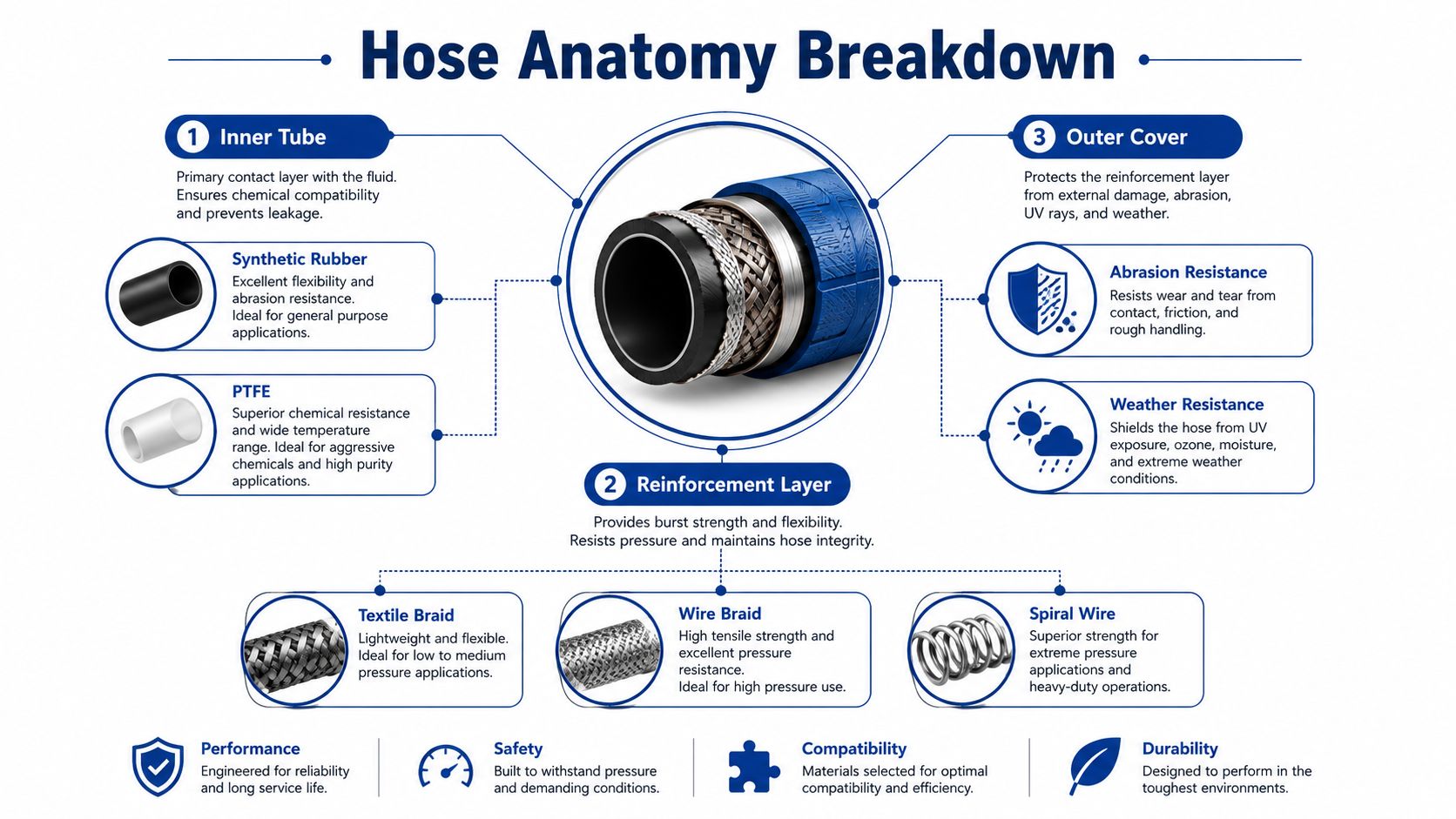
Think of a hose like a sandwich built for punishment. The inner layer carries the fluid, the middle layers hold back pressure, and the outer cover takes the knocks from abrasion, weather and handling. If one layer is wrong, the whole assembly suffers, even if the outside looks fine.
Inner tube, reinforcement and cover
The inner tube is the part that touches the conveyed fluid. Depending on the application, that tube may be made from synthetic rubber, thermoplastic materials or PTFE, each chosen for chemical compatibility, temperature behaviour and permeability characteristics. For a maintenance team, the point is simple, the tube has to survive the fluid, not just contain it.
The reinforcement layer is where pressure resistance comes from. Textile braid suits lighter-duty service, wire braid adds stronger pressure containment, and spiral wire reinforcement is used where high pressure and tougher duty cycles demand more structural support. Muncie Power groups hoses as low pressure below 250 PSI, medium pressure up to 3,000 PSI, and high pressure at 3,000 to 6,000 PSI, with the high-pressure versions commonly using wire braid and spiral braid reinforcement Muncie Power's hydraulic hose basics.
The outer cover protects the assembly from wear, sunlight, fluid splash and grime. If the cover fails early, the reinforcement is exposed and the hose moves from serviceable to risky far too quickly. That's why abrasion resistance matters just as much as pressure rating in real plant conditions.
Weight and handling still matter
UK hose history shows why weight has always been part of the engineering trade-off. The first practical hosepipe patent in 1817 weighed 36 kg for 50 metres, even before water was added, which makes the point very clearly, hose performance has long been about balancing strength with handling burden The Garden History blog. A hose that's too heavy or stiff can be a nuisance during installation and can also add bending stress that shortens service life.
A hose that's awkward to route often ends up being routed badly. That's where fatigue starts.
If you want to compare material options in the wider plumbing and hose world, the discussion of braided stainless hose options shows how reinforcement style changes flexibility, appearance and application suitability. The principle is the same in industrial hydraulics, the construction has to match the job, not just the label.
Pressure Temperature Ratings and Standards
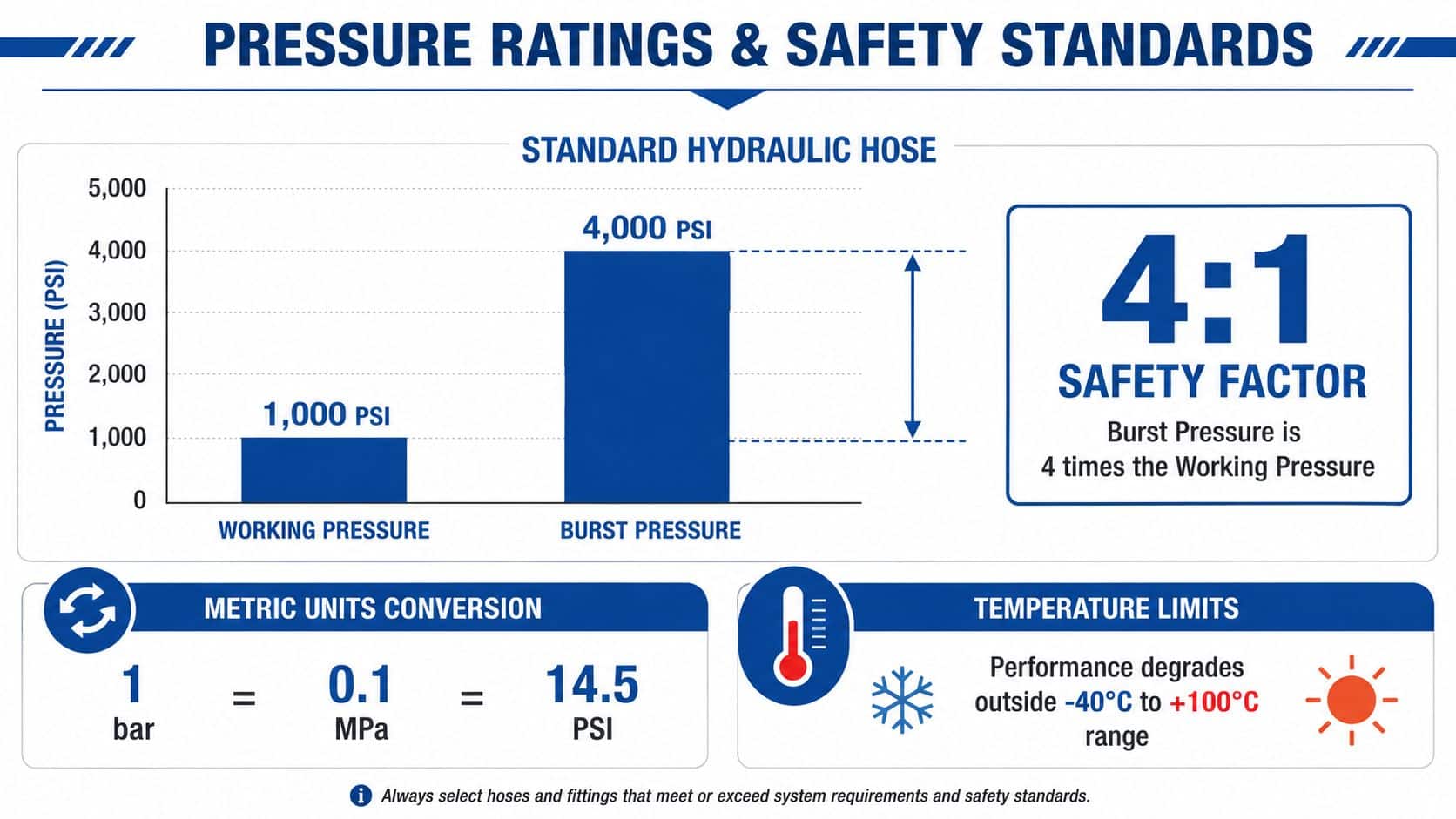
The first number to check is the working pressure, not the burst figure. In UK hydraulic practice, Parker's handbook guidance states that the minimum burst pressure is typically at least four times the maximum working pressure, and that burst pressure is a manufacturing test limit, not a usable operating target Parker UK hydraulic hose catalogue. That 4:1 safety factor is the baseline you want in your mental model before you compare any hose options.
Working pressure is the operating limit
Working pressure is the maximum pressure the hose is meant to handle in service. Burst pressure is the point where failure occurs during testing, so it tells you about margin, not daily operating comfort. If a circuit sees pressure spikes or repeated flexing, the margin gets used up faster than people expect, which is why selecting by static pressure alone can be misleading.
Temperature matters just as much. Heat changes rubber behaviour, affects flexibility and can reduce the useful life of the reinforcement package and cover. A hose that performs well on a cool workshop floor may behave differently in a hot engine bay, near a compressor line or in outdoor service where temperature swings are part of the job.
Standards help, but they don't replace judgement
ISO and EN standards exist to make testing and comparison more consistent, but they don't choose the hose for you. They tell you how products are tested, classified and verified, while your job is to decide whether the hose matches the actual duty. That's where over-specification creeps in, because a bigger number on paper can hide a mismatch in routing, service conditions or fluid exposure.
Use metric units first, then convert only when you need to compare legacy data. If a hose listing gives you pressure in bar and temperature limits in °C, that's usually enough for a UK procurement decision. The critical point is to relate the published limit to the actual circuit, not to the most demanding possible scenario that never happens.
For practical verification steps, the pressure-testing workflow at MA Hydraulics' pressure testing procedures is a useful internal reference point for teams that need a repeatable check rather than a guess.
Fittings Assemblies and Testing Procedures
A hose assembly is only as strong as its weakest part. Dixon Valve's example makes that plain, a 21 bar hose, 34.5 bar fitting and 14 bar adapter are only rated to 14 bar because the lowest-rated component governs the safe working pressure Dixon Valve hose assembly pressure ratings. That rule catches a lot of mistakes, especially when buyers focus on the hose body and overlook the ends.
The lowest-rated component sets the limit
Fittings, couplings and adapters are not accessories, they're load-bearing parts of the assembly. If one end component is under-rated, the whole line is under-rated, no matter how impressive the hose sleeve looks. That's why a correct spec sheet should always list the hose, the ends and the adapter path together.
Crimped and swaged ends are common because they create a permanent mechanical lock between hose and fitting. Reusable fittings can be useful in some maintenance contexts, but they still have to match the hose type and the pressure duty. The selection logic is the same, the assembly must be rated as a system.
| Component Pressure Ratings | Example Rating (bar) |
|---|---|
| Hose | 21 |
| Fitting | 34.5 |
| Adapter | 14 |
Verification matters as much as selection
Testing isn't a formality. Factory burst tests prove the assembly reaches its designed limit, while impulse fatigue tests check how it behaves under repeated pressure cycling. Those tests matter because real machines don't just sit at one number, they pulse, vibrate and flex.
For fitting selection and end-style choices, the internal guide on hydraulic fittings types is a practical place to compare connector styles before you finalise an assembly. Getting that right avoids a common maintenance headache, the right hose with the wrong end.
Assembly rule: never assume a hose's rating carries the fittings with it. Check every component, every time.
Selecting High Pressure Hoses for Mobile and Industrial Applications
The strongest procurement mistake is not under-specifying. It's paying for a pressure class the system never needs, then still ending up with a hose that routes badly or fails too early because the rest of the duty cycle was ignored. A 2024 industry discussion highlighted exactly that problem, over-specifying pressure ratings can inflate purchase cost without improving fit for purpose in maintenance-heavy UK sectors Titan Fittings on over-specifying hose ratings.
Start with the actual duty cycle
Begin with four questions, not one. What pressure does the circuit really see, how often does it cycle, how much movement does the hose have to absorb, and what fluid is inside it? If you answer those questions, the spec usually becomes much clearer.
A mobile machine needs a hose that tolerates vibration, articulation and frequent re-routing during service. A fixed industrial system often cares more about chemical compatibility, stable routing and neat installation. The pressure number matters in both cases, but it isn't the whole buying decision.
Use a simple specification check
Field check: document the working pressure, the expected pressure spikes, the fluid type, the hose length, the bend radius and the temperature range before you order.
That record gives maintenance, purchasing and engineering the same target. It also helps you avoid one of the most common errors, replacing a failed hose with a cosmetically similar one that doesn't suit the application. If you can show the actual duty, you can justify a lower rating when it's appropriate, or a higher one when the risk profile demands it.
Match the hose to the system, not the other way round
Agriculture, construction and manufacturing often share the same procurement tension, downtime is expensive, but so is overbuying. The better answer is to specify only the margin the system needs, then verify the ends, the routing and the temperature exposure. That's the method that keeps assemblies practical instead of merely impressive on paper.
If your maintenance team has high-pressure cleaning or drain work on the list, it can help to compare the hose requirement with the browse hydro jetting services approach used in cleaning applications, because the same ideas about pressure, flexibility and wear apply in a different setting.
A practical buying sequence
- Define the operating pressure. Use the duty cycle, not the highest theoretical value.
- Check pressure spikes. Transient loads can matter more than average pressure.
- Match the bend radius. A hose that's forced into a tight route is living on borrowed time.
- Confirm fluid compatibility. The inner tube has to suit the medium.
- Verify the ends. The assembly rating is only as good as the weakest component.
That sequence doesn't just reduce failures, it also stops unnecessary overspecification from creeping into the bill of materials. In a cost-sensitive maintenance environment, that's often the difference between a sensible replacement and an expensive guess.
Installation Maintenance and Troubleshooting
A hose can be correctly specified and still fail early if it's installed badly. Routing, securing and tightening all affect how long the assembly lasts, especially on mobile plant where movement never really stops. The first install should be treated as part of the design, not as a final assembly task.
Install it so the hose can move safely
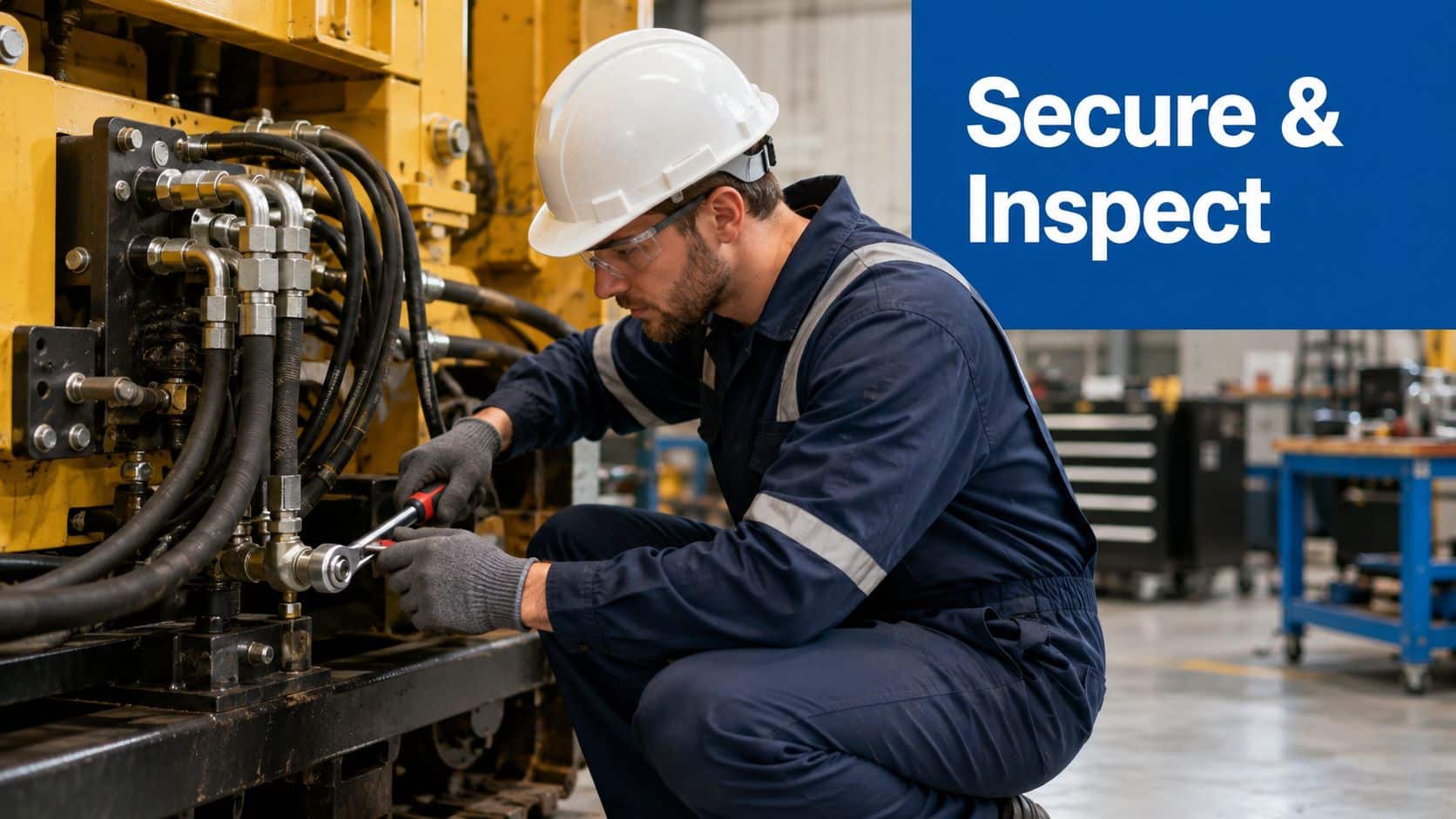
Keep the hose away from sharp edges, pinch points and hot surfaces. Use proper clips and supports so the line doesn't rub against moving parts, and don't force a hose into a tighter bend than its construction will tolerate. Torque on fittings matters too, because under-tightening invites leaks and over-tightening can damage the sealing surfaces.
Recent UK safety guidance recommends tracking hose length, operating pressure and inspection date, with replacement if wires are exposed or the cover shows abrasion wear-through Parker safety guidance on water blast hose management. That's a better model than waiting for visible failure, because the damage that matters often starts before the outer appearance changes much.
Build an inspection routine
Record the serial number if it's available, the installed length, the pressure it runs at, and the date it was put into service. Then check for abrasion, kinks, leaks, soft spots, stiff sections and any visible reinforcement. If you're building a maintenance log, keep each hose tied to the machine it serves, not just the store room part number.
The internal guide on hydraulic hose failure causes is a useful reference when a hose fails repeatedly and the pattern isn't obvious. Repeated failures usually point to routing stress, contamination, heat, wrong fitting selection or poor installation practice.
If the cover is wearing through, the hose is already telling you the system needs attention.
Troubleshoot by symptom, not by guess
A leak at the fitting often points to assembly or torque issues. A hose that's twisted in service usually reflects poor installation routing. Stiff or cracked sections can suggest age, heat exposure or incompatible fluid conditions, while repeated whip or vibration damage usually means the line needs better support.
Discard immediately if you see exposed wires, severe abrasion wear-through, crushing, kinking or flattening. Those signs are not cosmetic, they're structural. In service work, the safest decision is often the simplest one, replace the damaged hose and correct the root cause at the same time.
Bespoke Assembly Options and Supplier Support
A machine rarely fails in a neat, catalogue-friendly way. One hose may need a specific length, a tighter bend radius, or an end fitting that clears a guard, bracket or moving arm. Bespoke assembly work answers those awkward requirements by matching the hose to the machine, instead of asking the machine to adapt to the hose. MA Hydraulics Ltd supplies hydraulic components and assembles bespoke power solutions for mobile and industrial applications, including custom hose assemblies and related system parts.
When custom assembly earns its place
A good bespoke assembly makes the system more usable rather than just more expensive. Agricultural quick-disconnects, high-flex hose packs for mobile handling equipment and compact assemblies for tight plant layouts all benefit from an exact fit. If the routing is cleaner and the ends are correct, maintenance time usually gets easier too. In practice, that can mean fewer awkward bends, less strain at the fittings and fewer return visits to correct a poor first fit.
In-house assembly support also helps when the job needs advice on pressure class, fitting style or compatibility before anyone orders parts. Procurement teams often feel that pain later, when the wrong end style or hose length has already stalled the job and tied up budget in spare stock. A supplier who can cross-reference components and build to spec reduces that risk, especially on machines where the hose sees heavy cycling in service rather than a single peak load on paper.
Practical advantage: bespoke assemblies help you buy what the machine needs, not the nearest catalogue compromise.
For teams balancing speed, cost and reliability, the key is matching the build to the duty cycle. A hose that looks oversized on a maximum rating sheet can still be a poor fit if it is too stiff, too long or awkward to route through the machine's real movement path. That is where supplier support adds value, because it helps maintenance teams choose assemblies that suit the way the equipment works day to day, rather than paying for a specification that only looks right in theory.
Conclusion and Call to Action
The right high pressure hoses are chosen by construction, pressure, fittings and maintenance reality, not by headline numbers alone. If you match the hose to the duty cycle, check the lowest-rated component in the assembly and keep a formal inspection record, you cut hidden cost and reduce the chance of avoidable failure. That's the benefit of disciplined hose selection: safer operation, longer service life and less overspecification.
MA Hydraulics Ltd can supply bespoke hose assemblies, fittings and hydraulic components for mobile and industrial systems across the UK. If you need help matching a hose spec to the duty cycle, visit MA Hydraulics Ltd to discuss your requirements, or phone 01724 279508 today, or send us a message at https://www.mahydraulics.co.uk/contact-us/ to get started.
