
Most hydraulic contamination failures start with a single weak point, and 99.97% compliance in the UK's public water supply system shows why layered prevention matters more than one clever fix. The strongest approach combines source protection, point-of-use filtration, and continuous monitoring, because a single control point rarely holds up once water gets into the system.
I've seen too many pumps blamed for “bad luck” when the actual issue was a system that invited water in, then relied on a filter to clean up the mess. The UK drinking-water framework is a useful analogy here, because it doesn't trust one barrier either. It uses continuous oversight, treatment barriers, and network monitoring, and the same logic applies to hydraulic systems that need to stay reliable under real-world conditions. The Drinking Water Inspectorate's compliance record, with public water supplies in England at 99.97% compliant in 2023, is a good reminder that prevention works best when it is built into the whole chain, not bolted on after failure (WHO fact sheet on drinking water).
For industrial equipment, that means thinking like an operator, not a brochure writer. A filter helps, but it can't compensate for poor breathers, degraded seals, contaminated top-ups, or maintenance shortcuts. The practical question is never “Which product removes water?”, it's “Where can water enter, how will we detect it, and what stops it from spreading once it's there?”
How Water Gets Into Your Hydraulic System
The hidden pathways that show up in the workshop
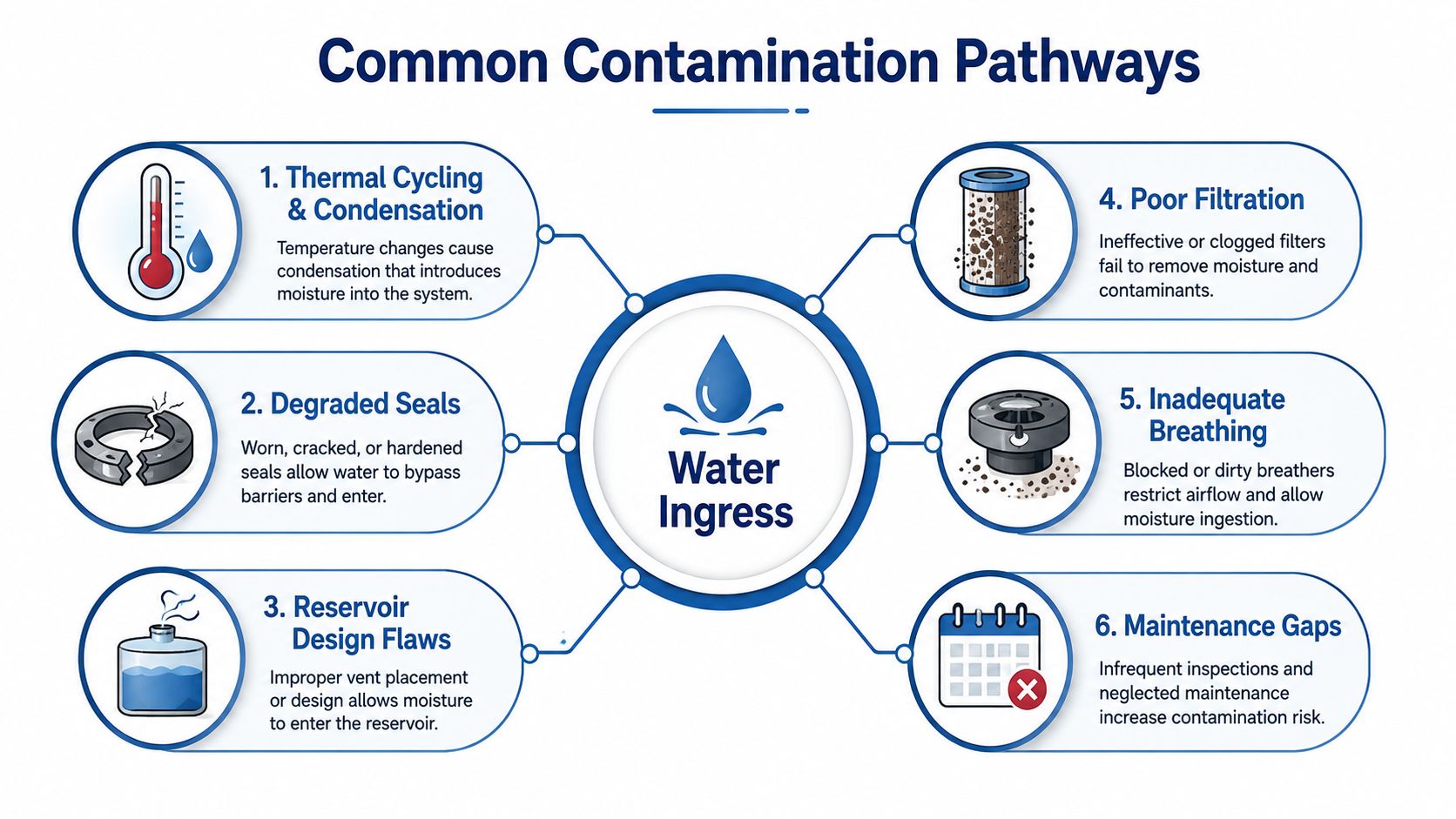
Water doesn't need a dramatic failure to reach your oil. Thermal cycling pulls humid air into reservoirs as systems cool, then condensation forms inside the tank and lines. That shows up as cloudy oil, rust staining, or a system that starts acting inconsistent after temperature swings.
Seal and gasket degradation is the next obvious path. A worn rod wiper on a cylinder, a flattened O-ring, or a tired flange gasket can let moisture in slowly, which is why the symptoms are often subtle at first, then expensive later. You'll usually see sticky spools, corrosion on exposed parts, or emulsified oil that won't settle.
Practical rule: if a machine only “gets wet” when it is off, the cause is often breathing and condensation, not a dramatic leak.
Reservoirs, top-ups, and maintenance mistakes
Poor reservoir and breather design makes the problem worse. A tank that breathes through a dirty vent in dusty conditions doesn't just inhale dirt, it can also carry moisture straight into the fluid. Cross-connections during maintenance are another avoidable issue, especially when hoses, containers, or fill tools are shared between systems.
Contaminated top-ups are a classic failure mode because the cleanest-looking drum can still contain moisture or residue from storage. If the oil goes in dirty, the system starts at a disadvantage. Once that water is mixed through the circuit, the long-term damage includes corrosion, additive depletion, faster oxidation, and accelerated wear on pumps and valves.
Mobile plant in high-humidity environments is especially exposed because it breathes harder through daily temperature shifts. Reservoirs on farms, in quarries, and on outdoor machinery often take moisture in before anyone sees a fault. A system that looks dry on the outside can still be steadily collecting water inside.
Detecting and Testing for Water Contamination
Accurate detection starts with the right test for the right fault. Karl Fischer titration is the most reliable way to measure water content in hydraulic oil when you need precision, while visual checks and laboratory particle counting help identify the damage pattern rather than the water itself. Conductivity testing is useful when dissolved ionic contamination is suspected, especially where moisture and dissolved salts may both be present.
On-line sensors are the best option when you need continuous warning rather than a periodic snapshot. They are most valuable on critical systems, because water levels can change quickly after rain ingress, maintenance errors, or a cooling issue. For operators who need a practical starting point, sample from a live, representative point in the circuit, not from the bottom of a dirty drum or a dead-leg where debris has settled.
If you want a field-focused reference point, MA Hydraulics' guidance on water contamination detection is useful when you're deciding how to structure a testing programme around real equipment rather than laboratory ideals.
Sampling habit that saves time: take the sample before shutdown, from the same point each time, and log the operating condition. Changing the method changes the reading.
The biggest mistake is treating one reading as the whole story. A single result can be skewed by recent top-up, poor container handling, or a non-representative sample point. Trend data tells you whether the system is stable, drifting, or heading towards intervention, and that is what matters when you're trying to stop a pump failure rather than explain one after the fact.
Filtration and Dehydration Solutions
Different water problems need different tools. Conventional filter elements are good at removing particles, and they're the first line of defence in many hydraulic circuits, but they do very little for dissolved moisture. Coalescing filters are better when you're dealing with free water, because they encourage droplets to join together so they can be separated out. Vacuum dehydration units go further, and they're the right choice when the fluid contains dissolved water or a persistent emulsion that won't clear with simple filtration.
If you're evaluating options across a broader lab or process environment, the operating logic is similar to the equipment in Labs USA water purification systems. The key idea is the same, match the removal method to the contaminant state, not just the visible symptom.
| Scenario | Best-fit technology | What it handles well | Watch-outs |
|---|---|---|---|
| Particulate contamination with limited moisture | Conventional filters | Solid debris, wear particles | Won’t remove dissolved water |
| Free water after ingress | Coalescing filters | Droplets and separated moisture | Needs correct flow and regular element checks |
| Persistent dissolved moisture or emulsified water | Vacuum dehydration | Deep moisture removal | Higher complexity, needs routine maintenance |
Flow rate matters because a unit that is undersized for the system will either bypass contamination or create unacceptable downtime. Maintenance matters too, since saturated elements and neglected bowls can undo the benefit of good equipment quickly. In practice, the best result usually comes from combining filtration with dehydration rather than expecting one device to solve every case.
For hydraulic circuits, MA Hydraulics stocks and supports component choices across Vivoil, Hydronit, OMT, Luen, Orta, Borelli and Hoyea products, including filters and valves, and that selection affects how well a system copes with contamination over time. If the wrong element rating, housing, or valve arrangement is chosen, the system may run fine for a while and then fall apart under moisture load. For deeper inspection at the circuit level, the inline hydraulic oil filter page is a practical reference point when you're matching filtration to an actual installation.
System Design and Material Choices for Contamination Resistance
Design the tank and breathing system to resist moisture
Reservoir design decides how hard the system has to work against contamination. A well-baffled tank slows fluid movement, separates return flow from suction, and gives entrained water and air less opportunity to stay mixed through the circuit. Add proper drainage points, and you make routine housekeeping possible instead of optional.
Breathers matter more than many buyers expect. A hydrophobic breather element helps limit moisture ingress while still allowing the tank to breathe, which is far better than leaving an open vent or relying on a poorly protected cap. If the machine lives outdoors or in a wet plant room, temperature management is part of contamination control too, because a tank that swings hard in temperature will keep drawing humid air inside.
Match seals, hoses, and components to the environment
Material selection is not a paperwork exercise. Seals that perform well in dry conditions can harden, swell, or leak in wet service, and hose routes that trap condensation will keep feeding water back into the oil. Routing should avoid low points where moisture collects, and pipework should be arranged so drainage is predictable rather than accidental.
For external surfaces and exposed assemblies, a corrosion-resistant coating can improve durability where the machine sees spray, washdown, or persistent damp. A useful example is the APEX NANO Titan Coatings solution, which shows the kind of environmental protection specifiers should be thinking about alongside the fluid side. Inside the hydraulic circuit, gear pumps, flow dividers, directional valves, and manifolds all need to be selected with contamination tolerance in mind, because a weak component can become the first place water causes trouble.
MA Hydraulics supports engineers with bespoke power-pack design, including application advice and component selection for systems that need to stay clean from the outset. The hydraulic oil tank page is especially relevant when you're thinking about reservoir layout, breather position, and the practical details that determine how much moisture the system will inhale over time.
Maintenance Schedules and Sampling Procedures
Maintenance works only when it is disciplined. Critical systems deserve monthly fluid sampling, while standard systems can often be checked quarterly if the operating environment is stable and the duty cycle is predictable. Filter changes should follow differential pressure, contamination history, and operating hours, not a fixed calendar alone.
A field procedure that avoids bad data
Use a calibrated sample port on live equipment, and purge any stagnant oil before collecting the sample. Containers must be clean, sealed, and handled with gloved hands, because contaminated bottles are a common reason for confusing results. Never sample straight after a top-up if you want a trend you can trust, since fresh oil can mask the problem you are trying to measure.
Interpret results by trend, not ego. If water content or cleanliness begins drifting in the wrong direction over repeated samples, that tells you the system is changing even if it still “runs fine”. A good maintenance calendar tracks the sample date, operating condition, filter change date, and any top-up or repair activity beside the result.
Field note: most bad maintenance programmes fail because the record is inconsistent, not because the equipment is impossible to manage.
Dehydration units also need routine checks. Inspect seals, drains, differential indicators, and pre-filters before they clog or bypass. A system that is only serviced when symptoms become obvious is already behind the failure curve.
Conclusion and Next Steps
Water contamination prevention works best as a layered process with documented monitoring, not as a one-time filtration upgrade. The systems that stay healthy stop moisture at the source, test it before it spreads, remove it with the right technology, and keep the hardware suited to the environment it lives in. That approach matches the wider drinking-water principle that protection depends on several barriers working together, as set out in WHO drinking water guidance.
The practical takeaway is straightforward. Find where the water is entering, sample correctly, choose the right dehydration or filtration method, and design reservoirs, seals, and breathers so the machine is not fighting itself. Then keep the maintenance schedule tight enough that a slow drift does not become a pump replacement.
Core principle: if you can only defend the system with one control point, you have not designed prevention yet.
For engineers and buyers, the next step is a proper review of the circuit, the reservoir, the component list, and the maintenance routine together. That is where contamination problems usually become visible, and it is where a specialist can help you avoid choosing a fix that only treats one symptom.
If you need help matching filters, valves, reservoirs, or a bespoke power pack to a contaminated or moisture-sensitive application, contact MA Hydraulics Ltd for practical component selection support and build advice. Visit MA Hydraulics Ltd, phone 01724 279508 today, or send a message through the contact page at https://www.mahydraulics.co.uk/contact-us/ for direct help with the right hydraulic contamination-control solution.
