
A jubilee clip 150mm usually gets attention only when it fails. This is often true on plant, in workshops, and out in the field. A machine can run for months without anyone thinking about a hose clip, then a loose connection, a rusted band, or an over-tightened screw turns a routine job into downtime, oil loss, and a repair that should never have happened.
In UK industrial and hydraulic work, that matters more than people sometimes admit. A clip this size often sits on larger suction hoses, ducting, return lines, protective sleeves, and general containment duties. It looks simple. It isn’t unimportant. If you specify the wrong material, use it on the wrong duty, or tighten it by feel instead of by torque, you build failure in from the start.
Why a Simple Hose Clip Is a Critical Component
A large hose connection rarely fails because the clip looked dramatic on the day it was fitted. It fails later, after vibration, weather, washdown, temperature change, and maintenance shortcuts have all had their turn. The clip is often the last thing somebody blames, but it’s frequently the first thing that should have been checked.
On agricultural equipment and industrial plant, the problem is usually cumulative. A return hose starts to sweat. A suction line begins pulling air. A protective cover shifts. The machine still runs, so the issue gets ignored until performance drops or the hose moves enough to create a larger leak. That’s why small fastening details belong in the same reliability conversation as pumps, valves, filters, and manifolds.
Good maintenance teams already understand this. The same mindset behind a proper guide to facility pipe maintenance applies here as well. You don’t wait for visible failure if the part sits in a damp, vibrating, contaminated environment. You specify, inspect, and replace with the duty in mind.
Practical rule: If the clip is the cheapest part on the assembly, it’s often the easiest place to make an expensive mistake.
The jubilee clip 150mm sits in that category. Used properly, it’s a dependable fastening component. Used carelessly, it becomes a weak point that drags the rest of the system down.
Deconstructing the 150mm Jubilee Clip Specification
Before ordering or fitting one, it helps to read the specification properly. “150mm” doesn’t mean every hose near that size will suit it. It refers to the upper end of the clip’s working range, and that range matters in practice.
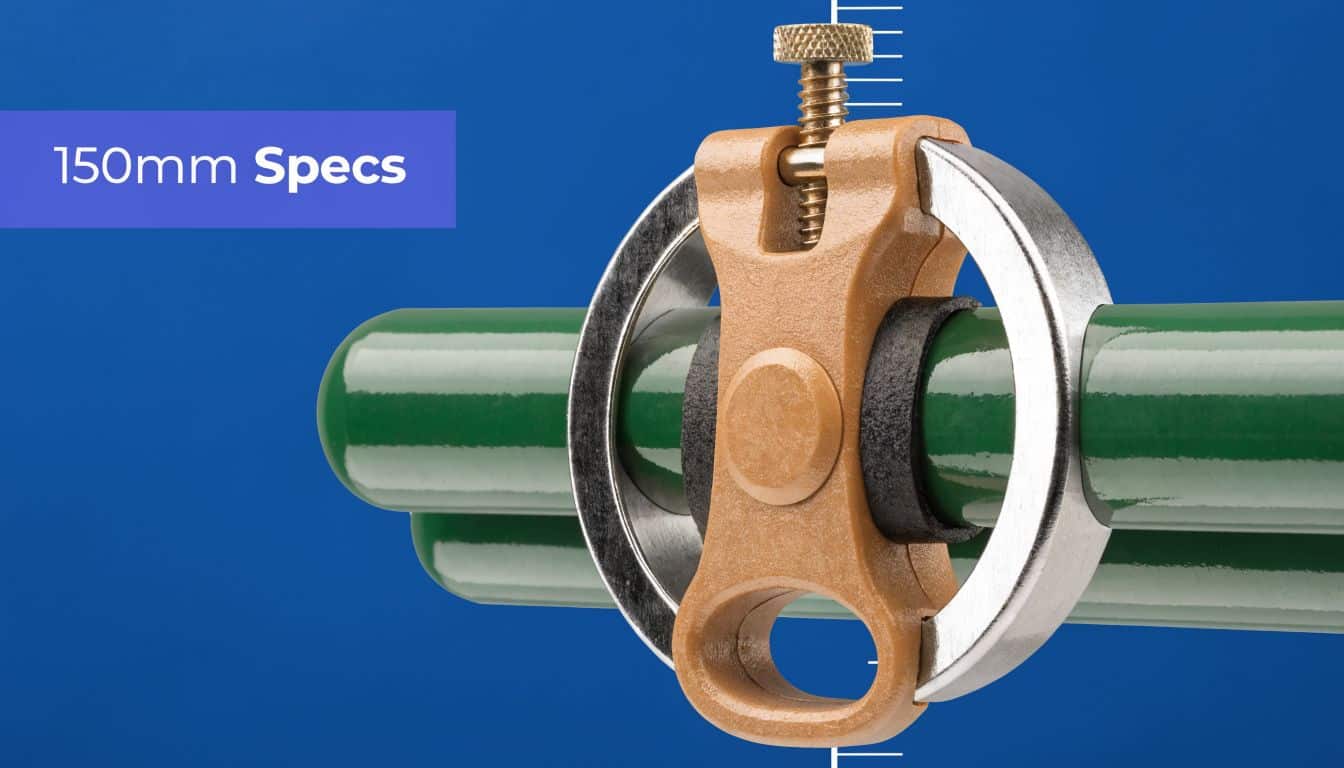
According to the UK product specification for the Jubilee size 6X clip, the Jubilee Clip 150mm has an adjustment range of 120mm to 150mm, a 12.7mm band width, and a 0.9mm band thickness. It’s manufactured in the UK to BS 5315 (1991), is kite-marked for quality assurance, and licensed under ISO 9001.
What the size range actually means
That 120mm to 150mm span gives you flexibility, but it doesn’t remove the need to measure the outside diameter of the fitted hose assembly. If a clip is sitting at the extreme end of its adjustment, you’ve got less room for correction later. Hoses relax, harden, and change slightly in service, especially where temperature and vibration are involved.
For procurement, this matters because “close enough” is where bad stock habits begin. If the workshop keeps one large clip on the shelf and tries to make it suit several diameters, fit quality becomes inconsistent.
Why width and thickness matter
A 12.7mm band and 0.9mm thickness tell you the clip is built to spread load across the hose more effectively than a narrower, lighter-duty fastening option. That doesn’t make it a high-pressure seal. It does mean the load is applied with better stability around larger hose diameters.
In practical terms:
- Band width: Wider bands help distribute clamping force across more hose surface.
- Band thickness: The band resists distortion better during tightening and in vibration.
- Controlled adjustment: The worm-drive layout allows incremental tightening rather than crude step changes.
Why the standard matters in buying decisions
The BS 5315 (1991) and kite-mark detail is more than catalogue language. It gives buyers and engineers a reference point for consistent manufacture. If you’re sourcing clips for repeat maintenance work, predictable dimensions and build quality save time on the bench and reduce fitting problems in the field.
Buy by specification, not by appearance. Two clips can look similar in a stores bin and behave very differently once the machine starts moving.
Material Selection Mild Steel vs Stainless Steel
Most premature clip problems come back to material choice. Not because the installer was careless, but because the environment was judged badly at purchase stage. Indoors, dry, and protected is one thing. Outdoor washdown, fertiliser, salt air, standing moisture, and chemical exposure are another.
The useful comparison isn’t “which is best in theory”. It’s “which survives where this machine works in practice”.
Where mild steel still makes sense
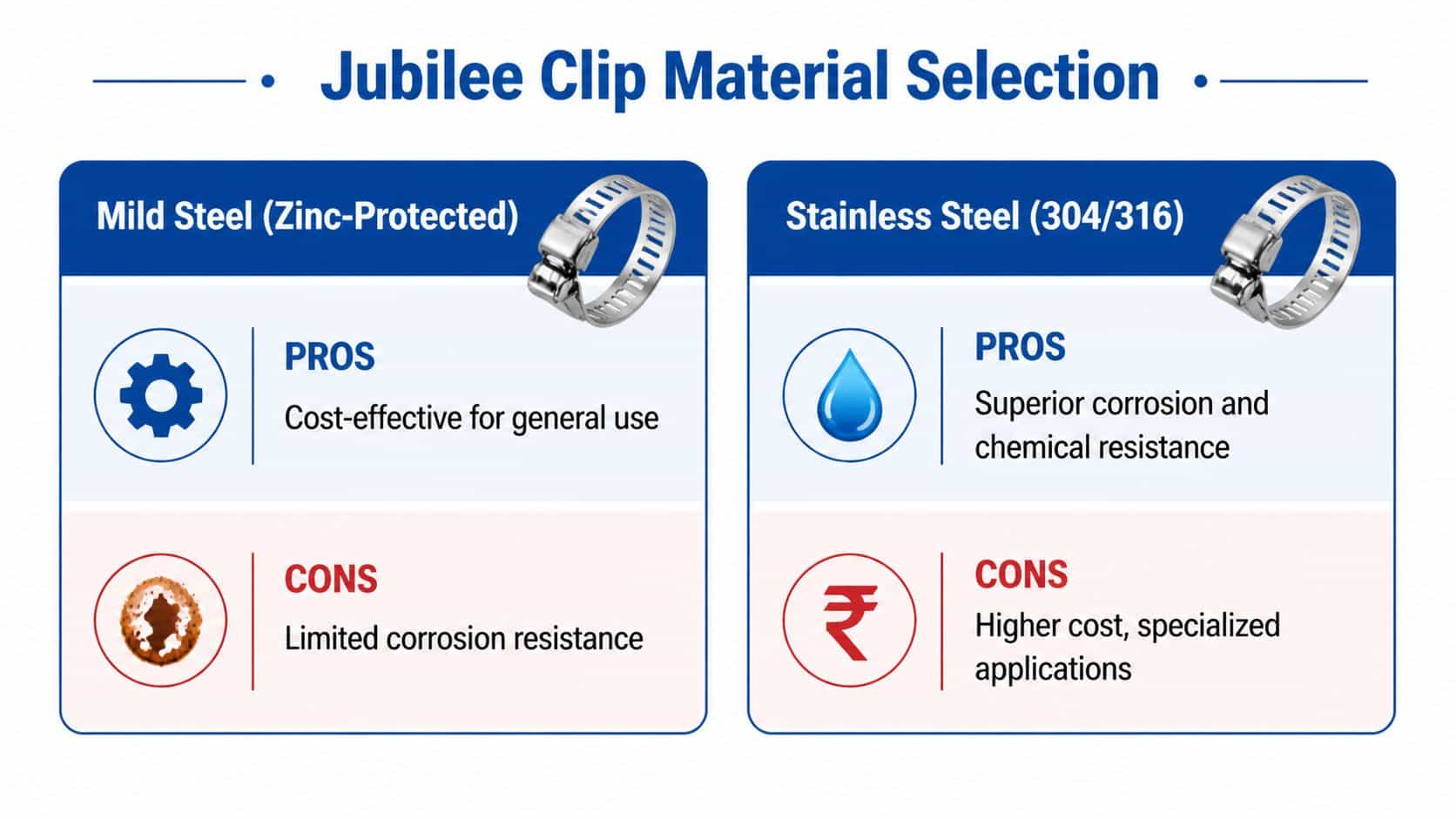
In the 304 stainless steel Jubilee 6X range details, the stainless option is noted for 1000-hour neutral salt spray resistance to BS EN ISO 9227:2006, while the zinc-protected mild steel option is presented as the more economical choice, with mild steel versions often seen around £5.89 for less demanding environments.
That tells you something practical. Mild steel isn’t automatically wrong. It’s just the wrong choice when people expect it to survive conditions it was never selected for.
Use zinc-protected mild steel where the clip is:
- Installed indoors, away from regular wetting or chemical exposure
- Fitted in sheltered equipment spaces, where corrosion risk is limited
- Used for routine fastening duties, not exposed constantly to aggressive contamination
If that sounds like a controlled environment, mild steel can be reasonable from a cost point of view.
Where stainless steel stops being optional
If the machine works outside, goes through washdown, sits near coastlines, handles corrosive residue, or spends its life in damp agricultural conditions, stainless stops being an upgrade and becomes the sensible baseline.
The main reason is straightforward. The material holds up far better where corrosion is the primary threat to service life. In those environments, replacing failed clips, cleaning rusted fittings, and dealing with recurring leaks costs more than specifying the better material at the start.
A good overview of available stainless steel worm clamps also helps when you need to standardise stock for harsher operating conditions.
A practical comparison
| Material | Best fit | Main trade-off |
|---|---|---|
| Zinc-protected mild steel | General indoor use and less aggressive environments | Lower corrosion resistance |
| 304 stainless steel | Marine, agricultural, manufacturing, and damp service conditions | Higher purchase cost |
If a machine lives outdoors, the clip is part of the corrosion strategy, not just the fastening strategy.
What procurement managers should ask
The buying question isn’t “what’s cheapest today”. It’s usually one of these:
- Will the clip see moisture regularly
- Will the plant be washed down
- Does this equipment operate near salt, slurry, fertiliser, or chemicals
- Is access awkward enough that a premature change-out is expensive
If the answer is yes to any of those, stainless is usually the safer decision. That’s especially true when the clip sits on equipment that can’t be stopped easily during peak operating periods.
Matching the Clip to Your Hydraulic Application
A jubilee clip 150mm has a proper place in hydraulic systems. It also has clear limits. Confusing those two is where people get into trouble.
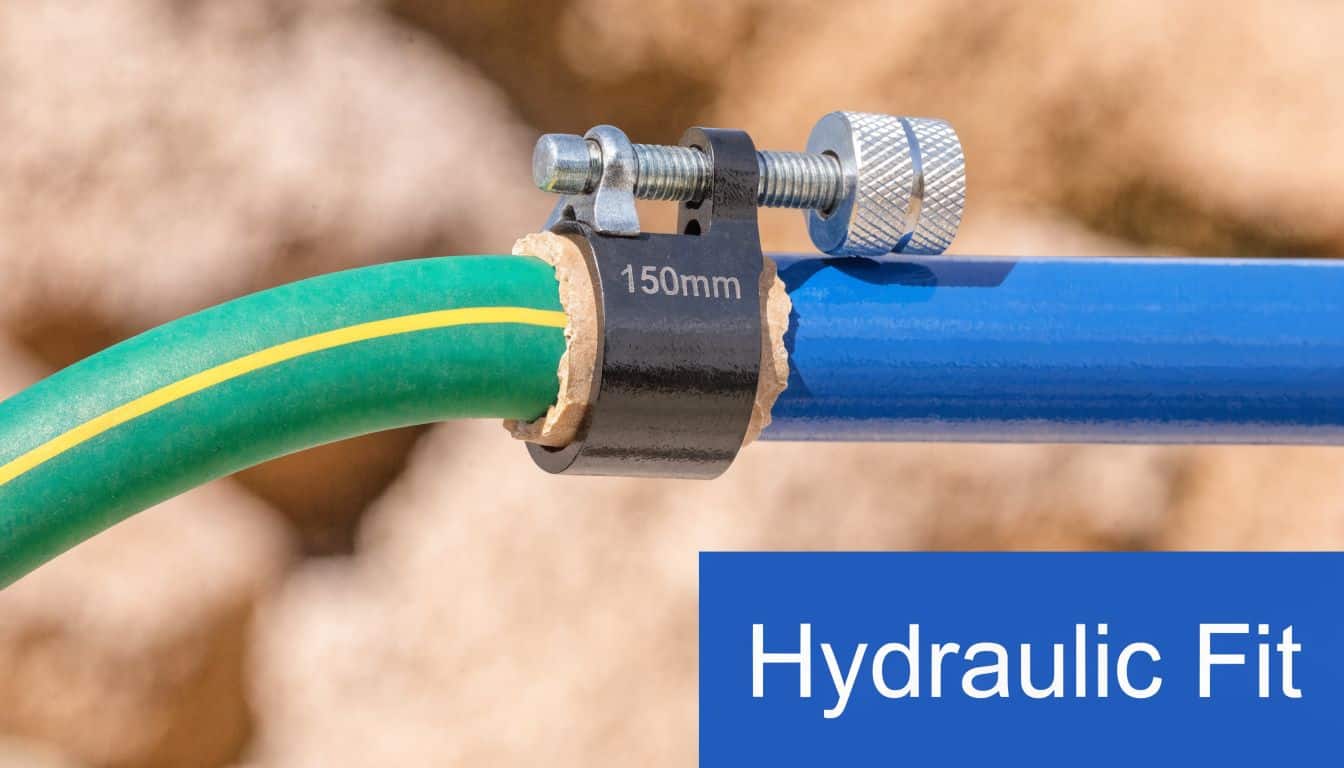
The critical point is pressure duty. The operating guidance for a 120mm to 150mm hose clip states that the clip is engineered for a maximum operating pressure of 18 PSI. It’s effective for vacuum-retention and low-pressure containment, but it’s unsuitable as a primary seal in high-pressure hydraulic circuits, which often operate above 210 bar.
Where it works well
In hydraulic service, this size of clip is typically useful on larger-diameter low-pressure duties and support roles. Think containment rather than primary pressure sealing.
Suitable uses include:
- Suction and return hose retention, where the assembly needs firm, adjustable clamping
- Vacuum or low-pressure lines, where the clip helps maintain hose position and seal integrity
- Protective coverings and routing duties, where the clip secures outer sleeves or shields
- General mounting and restraint, where vibration control matters more than pressure sealing
Where a more rigid mechanical restraint is needed on pipework or supported assemblies, alternatives such as U-bolt clamps for industrial fastening are often a better fit than tightening a worm-drive clip harder.
Where it does not work
Problems start when someone treats the clip as a substitute for a proper hydraulic end connection. It isn’t one.
Do not rely on it as the primary sealing method for:
- pressure lines from pumps
- high-pressure manifold connections
- critical hydraulic outlets where hose blow-off would create a safety risk
- assemblies that need crimped or flanged retention by design
The quick decision test
A practical workshop test is simple. Ask what the clip is being asked to do.
If the answer is “hold a hose in place on a low-pressure or suction-side duty”, it may be a good fit. If the answer is “seal a live pressure line”, you’re using the wrong component.
A worm-drive clip is a fastening device with containment value. It is not a replacement for a proper hydraulic pressure connection.
That distinction saves a lot of breakdowns.
Correct Installation and Torque Guidance
Good clips fail early when they’re fitted badly. In most workshops, the damage happens in one of two ways. Somebody leaves the clip too loose because they don’t want to mark the hose, or somebody leans on it until the band, housing, or hose starts suffering.
The published torque figures matter because they give you a repeatable method instead of guesswork. For standard 150mm Jubilee clips, the recommended tightening torque is 6.7 Nm, while High Torque variants are specified at 11.9 Nm. Over-tightening is a recognised installation error that can lead to band failure, as outlined in the high torque clamp guidance.
Start with the hose and joint condition
Before you even reach for the driver, check the basics. A perfect torque setting won’t rescue a damaged hose tail, an out-of-round spigot, or a hose that has gone hard with age.
Look for:
- Clean mating surfaces. Dirt under the band creates uneven loading.
- Correct hose position. The band should sit squarely over the clamping zone, not half on and half off the spigot.
- No cuts or flattening. If the hose carcass is already damaged, tightening more will only hide the problem briefly.
Tightening method that works in practice
Use a consistent sequence, especially on repeat maintenance work. If your team writes job instructions, a concise resource on how to write a procedure is useful for turning workshop know-how into something apprentices and service engineers can follow properly.
A reliable fitting routine looks like this:
-
Position the clip correctly
Set it square to the hose and behind the bead or retaining feature where applicable. -
Run it down evenly
Don’t jump straight to full tightness. Bring the band up steadily so the hose settles uniformly. -
Use the right tool
A hex socket gives better control than attacking it with an ill-fitting screwdriver. Consistency matters more than speed. -
Tighten to the recommended figure
For a standard clip, stop at 6.7 Nm rather than tightening by feel. -
Inspect the hose face
You want firm compression, not obvious cutting, puckering, or band distortion.
For general line support on smaller routing jobs, teams often also keep items like 10 mm pipe clips for tidy retention work in stock, but those are doing a different job from a large hose clamp.
A visual demonstration helps when training newer fitters on hand position and tool control:
What over-tightening actually does
People often think more torque means more safety margin. On hose clips, that isn’t how failure behaves.
Over-tightening can:
- deform the band
- damage the hose outer layer
- concentrate load under the housing
- reduce long-term clamping reliability rather than improve it
Under-tightening creates a different pattern. The hose may weep, shift under vibration, or pull air on the suction side.
Tight enough to seal is the target. Tighter than necessary is usually damage in progress.
Troubleshooting Common Clip Failures
When a clip assembly starts leaking or corroding, replacing the part without reading the evidence is how repeat failures happen. The clip, hose, and fitting usually tell you what went wrong if you look closely.
If the problem is leakage
Start with the leak pattern. A uniform weep around the circumference often points to poor compression, a mismatched size, or a hose that hasn’t seated properly on the spigot. A localised issue near the housing can suggest distortion from installation error.
Check these points in order:
- Clip position. Has it moved off the proper clamping area?
- Band condition. Is the housing sitting square, or has the band twisted?
- Hose surface. Is the rubber cut, hardened, or permanently flattened?
- Application duty. Is the clip being asked to do a pressure-sealing job it shouldn’t be doing?
If the problem is rust or surface breakdown
Corrosion failure is often straightforward to diagnose. If a clip fitted in marine, outdoor agricultural, or similarly harsh service starts rusting early, material selection is the first suspect.
As noted earlier, 304 stainless steel variants provide 1000-hour NSS corrosion resistance. If you see premature rusting in those environments, the practical conclusion is usually that the wrong material was fitted in the first place, typically a mild steel clip.
Rust on an outdoor clip is rarely “bad luck”. It’s usually a specification decision showing up in service.
If the problem is fatigue or repeated loosening
Band fatigue and recurring loss of clamp load usually trace back to one of three things:
- Vibration beyond the duty expected
- Repeated over-tightening during maintenance
- Poor application choice, where a different retention method should have been used
If the same location keeps failing, stop treating it as a consumable issue. Review the hose movement, support arrangement, and whether the clip is only acting as a clamp when it’s really being asked to restrain the whole assembly.
Procurement Storage and Getting Expert Advice
A good buying decision doesn’t stop at size and material. It also includes supplier quality, storage, and whether the clip will still be fit for service when it finally comes out of stores.
For procurement teams, the main discipline is simple. Buy clips against an actual application requirement, not just a familiar part description. A genuine, correctly specified clip with clear manufacturing standards is easier to trust than an unverified substitute that only looks similar in the box.
Storage matters as well, especially for mild steel options. Keep clips dry, clean, and in original packaging where possible. If they’re left loose in damp stores, mixed with damaged fittings, or exposed to contamination before installation, you reduce reliability before the clip ever reaches the machine.
A practical maintenance culture also means understanding the wider isolation and shutdown side of repair work. Even on non-hydraulic services, guidance on topics such as how to use water shut off valves reinforces the same principle. Isolate properly first, then inspect and repair methodically.
When you’re choosing a jubilee clip 150mm for real industrial work, the decision usually comes down to four questions:
- Is the size range right for the installed outside diameter
- Is the material right for the environment
- Is the duty low-pressure containment rather than primary pressure sealing
- Will the installer tighten it correctly
If any one of those is wrong, the clip becomes the weak link. If all four are right, it does exactly what it’s supposed to do and then gets ignored for the right reasons.
If you need help choosing the right hose clamp, matching materials to the environment, or sourcing hydraulic components for a repair or new build, contact MA Hydraulics Ltd. Phone 01724 279508 today, or send us a message.
