
You're standing in a workshop with a compressor running, a gun in one hand, and a loose airline looping across the floor again. Someone's already clipped it with a trolley once this week, the hose has taken a set near the bay door, and every move around the bench feels slower than it should. That's the point where retractable air hoses stop being a nice-to-have and become a proper workshop control measure, because they tidy the floor, protect the line, and keep air where the job is.
Why Retractable Air Hoses Matter in Modern UK Workshops
A loose airline looks harmless until the first near miss. In a busy bay, it catches under a boot, kinks around a wheel arch, or drags across a sharp edge, and every one of those moments adds wear, downtime, and avoidable risk. A retractable reel changes that by giving operators a controlled path in and out, so the hose lives on a drum instead of across the walkway.
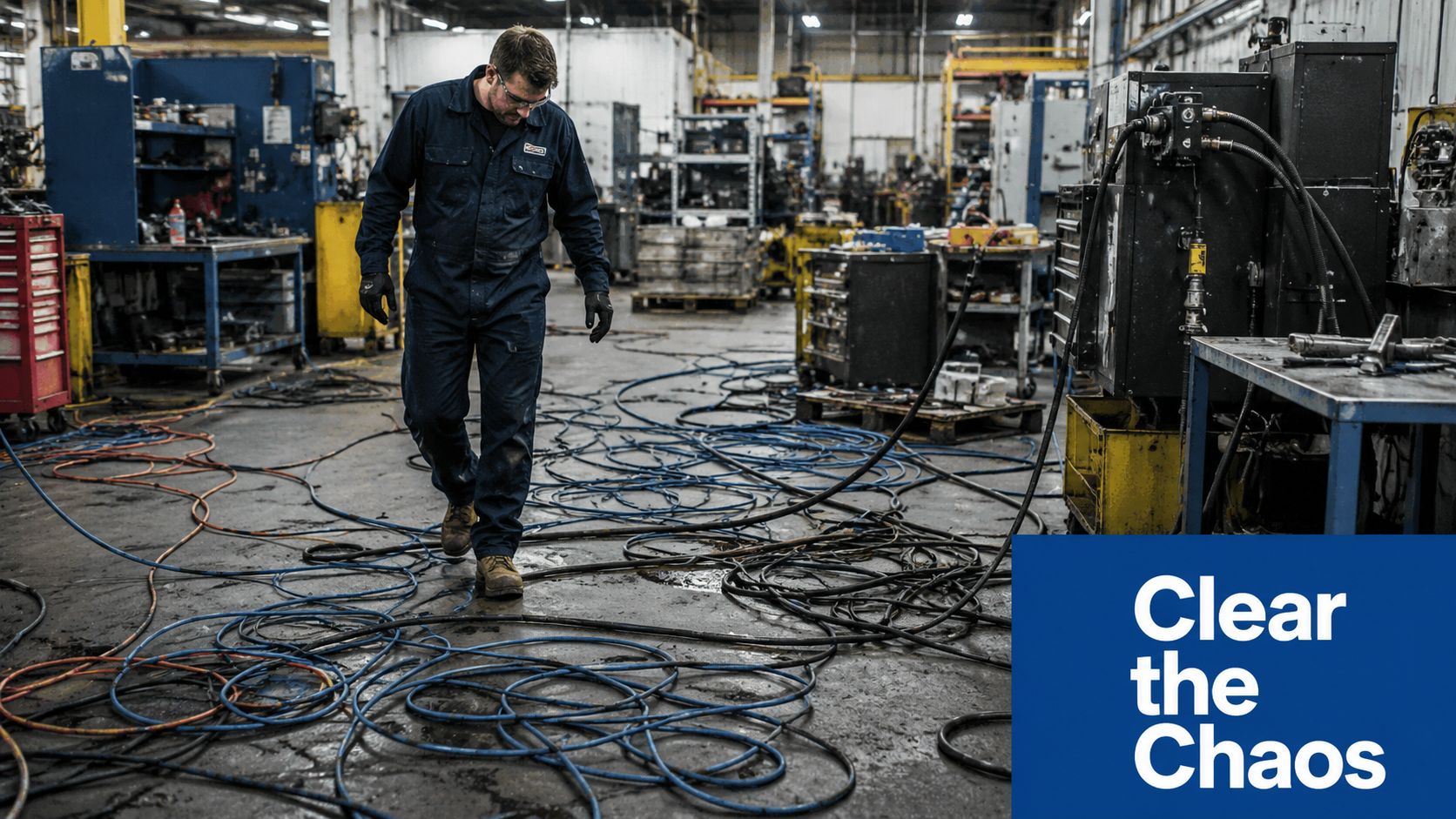
A cleaner floor is only part of the gain
The bigger benefit is discipline. When the hose retracts after use, operators are less likely to leave it stretched across a bay or coiled in a pile that gets run over, pinched, or contaminated. That matters in MRO areas where the same line may feed impact tools, blow guns, or light cleaning tasks all day long.
Practical rule: if a hose is awkward to store, it will be stored badly. A reel removes that decision from the operator.
Retractable systems also make the workshop look organised in a way customers and auditors notice. That's not cosmetic. A tidy line layout usually means better housekeeping, fewer trip points, and less hose damage from forklifts, pallet trucks, and moving kit. It also supports better tool availability, because the operator can pull the hose to the job and let it rewind once the task is done.
Why this is an engineering choice, not just convenience
In compressed-air spaces, hose management is part of system performance. The reel protects the hose from abuse, but it also helps preserve consistency by reducing the sort of twisting and flattening that happens when a line is dragged and folded by hand. Patent literature shows this isn't a casual add-on. US3391875A, “Retractable hose and storage device,” was filed on 1966-11-09, and US3520725A, “Retractable hose-type vacuum cleaning system and method,” shows a priority date of 1966-08-19 and a publication date of 1970-07-14 (patent record), which is a useful reminder that retractable hose management was being formalised decades ago.
That history sits on top of a much older UK compressed-air tradition. London's pneumatic infrastructure was already operating in 1861 with services from Euston railway station to the General Post Office and Holborn, and the broader British engineering timeline reaches back to 1762 and 1776 with early air-blowing machinery (UK compressed-air history). For modern workshops, the lesson is simple. The reel isn't a gimmick, it's a practical way to manage air in a working environment that still depends on compressed-air discipline.
How Retractable Air Hose Reels Work
A retractable reel is a controlled storage mechanism. You pull the hose to the length you need, the drum pays out line with managed tension, and when you release it, the reel rewinds the hose onto the spool. It's similar to a tape measure with a stronger spring and a much more serious job.
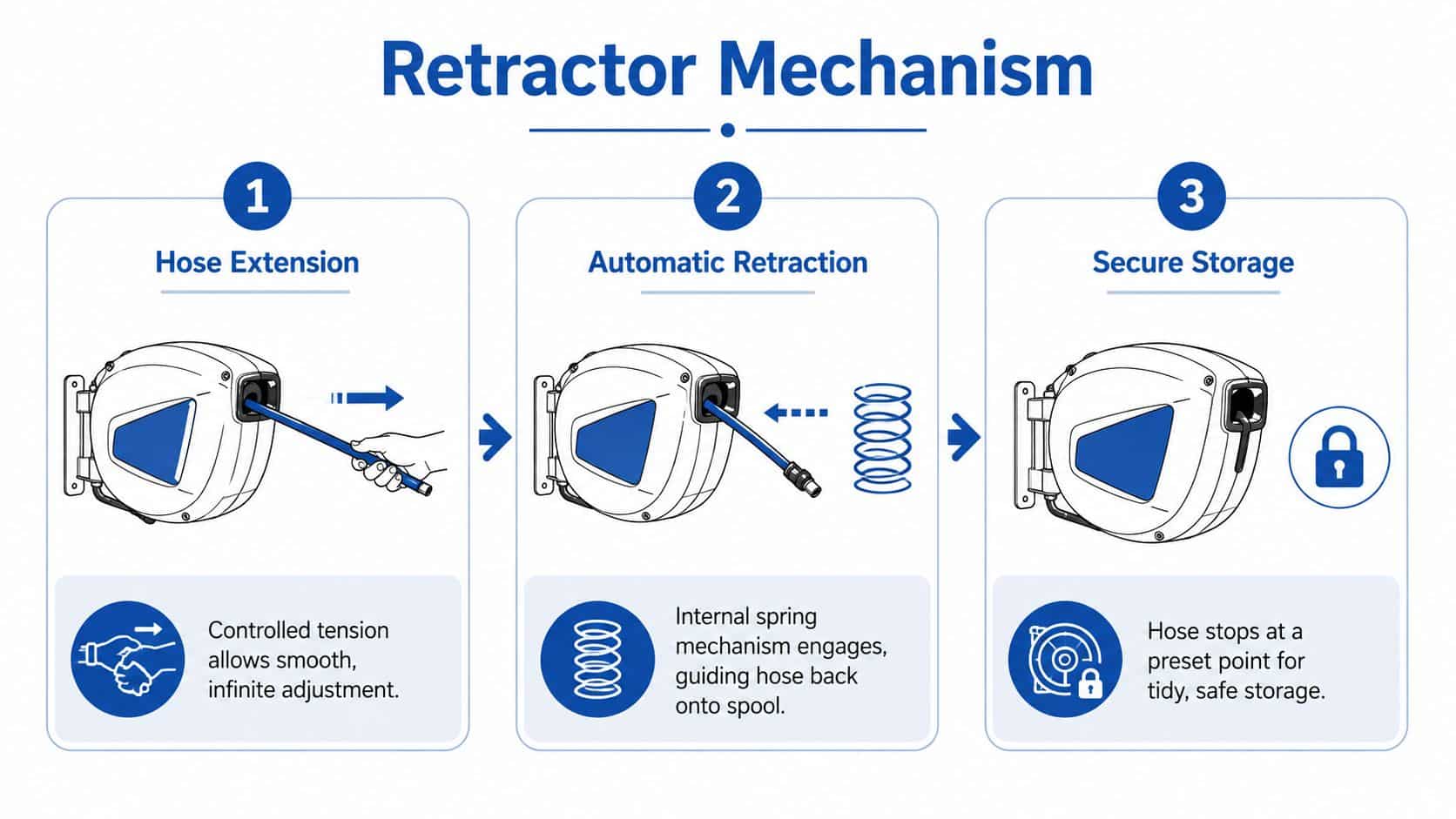
The spool, spring, and swivel do the real work
Inside the reel, the hose sits on a drum and the rewind mechanism keeps tension on it. On better units, that tension stays predictable across repeated use, so the hose doesn't slam back, snatch, or wind unevenly. The swivel joint at the inlet lets the hose turn as it feeds out and back in, which reduces twisting at the connection point.
That matters more than people think. A twisted airline is harder to pull, more tiring to use, and more likely to wear at the fittings. A good reel keeps the hose aligned so the force goes into extension and retraction, not into fighting the hose path.
Locking and rewind behaviour
Most workshop reels let the hose stop at an intermediate point, then lock it there while the tool is in use. That is useful when the job moves around a vehicle, bench, or assembly station, because the operator can choose the working length instead of being forced to use the full extension every time. After use, the hose releases and retracts into storage, usually with a spring-assisted return.
A manual rewind system can work well where use is light and operators are disciplined. Fully automatic systems suit busier bays because they reduce the chance that a hose gets left out all day. Either way, what matters is smooth rewind, stable locking, and a drum that doesn't fight the user.
What quality feels like in service
You can usually tell a poor reel by the way it behaves under load. It jerks on payout, loses tension, or retracts unevenly, and those faults become obvious when the hose is used at full reach. The better units feel controlled rather than aggressive. That's the difference between a reel that helps the workflow and one that gets ignored because it's annoying to use.
For workshop managers comparing product pages, one useful reference point is a heavy-duty 3/8 inch by 50 ft reel rated to a maximum air pressure of 300 PSI with a 1/4 inch NPT inlet (manufacturer manual). The dimensions and inlet standard both matter. Hose reels are a mechanical system, not just a storage box with a spring inside.
Understanding UK Specifications and Pressure Ratings
UK buyers often start with bore size and finish with price. That's backwards. A reel that looks suitable on paper can still underperform if the hose construction, pressure rating, and fittings don't suit the compressor and the tool at the far end of the line.
Read the bore size and pressure together
Metric bores such as 6.5 mm, 8 mm, and 9 mm are common in the UK market, but bore alone doesn't tell the whole story. A 6.5 mm reel can be perfectly usable for lighter workshop duties, while a reinforced 8 x 12 mm hybrid reel gives a very different operating window because construction affects both pressure capability and reel behaviour. Draper's UK-listed 6.5 mm bore reel is rated at 10 bar working / 24 bar burst, while its 8 x 12 mm hybrid/PVC reel is rated at 18 bar working / 54 bar burst (UK product listing).
| Common UK Retractable Air Hose Specifications | Bore Size | Working Pressure | Burst Pressure | Best Applications |
|---|---|---|---|---|
| Light-duty reel | 6.5 mm | 10 bar | 24 bar | Short runs, light blow-off, occasional hand tools |
| Reinforced hybrid reel | 8 x 12 mm | 18 bar | 54 bar | Busier workshops, repeated tool use, higher outlet pressure |
| Higher-capacity general workshop reel | 9 mm | Varies by build | Varies by build | Longer reach where airflow demand needs closer checking |
The table is deliberately simple, because the key point is the relationship between size, structure, and duty. A larger bore doesn't automatically solve everything, but a hose with a stronger wall structure usually handles compressor pressure better and resists flattening during rewind.
Match the material to the job, not the catalogue
PVC is common because it's familiar and cost-conscious, but it's not always the best fit where the reel is used hard or frequently. Hybrid and reinforced constructions tend to behave better on repeated extension, especially where the line must rewind neatly after every shift. Rubber hoses usually bring better flexibility and resilience, but the reel still has to be designed for that hose's mass and bend behaviour.
A reel that works in a calm demo bay can behave very differently after a week in a real workshop, where the hose is pulled at an angle, dropped, and rewound hundreds of times.
Connection standards matter just as much. The inlet and outlet fittings need to match the compressor and downstream accessories, or you end up with leaks, adapters, and avoidable pressure loss. If you're checking the maths behind compressor feed and line demand, this pressure calculation guide is worth using before you sign off a reel specification.
Selecting the Right Hose Length and Diameter for Your Tools
The longest hose on the page is rarely the right answer. What matters is whether the hose can deliver enough air to the tool when it's fully extended, because that's when pressure drop and flow restriction become visible in the hand.
Start with the worst case, not the easiest one
List the most demanding pneumatic tool in the bay first. That might be an impact wrench on stubborn fasteners, a grinder that runs for long periods, or a spray gun that needs steady delivery. Then compare that demand with the compressor output and the hose you're considering, because a reel that feels fine near the compressor can feel weak at the far end of the line.
Hose length increases the opportunity for pressure loss, and smaller internal diameter increases restriction. That's why two reels that look similar can behave differently under the same load. A neat installation with the wrong diameter still leaves the operator chasing poor performance, especially on jobs that need sustained air rather than short bursts.
Use practical sizing logic
A sensible way to choose is straightforward.
- Check the farthest working point: Measure where the tool will be used, not where the reel will be mounted.
- Identify the peak tool demand: Pick the tool that needs the most air, then size for that use rather than for a light blow gun.
- Avoid overselling reach: If one long hose forces a performance compromise, two shorter reels can be the better workshop layout.
- Keep fittings consistent: Mismatched quick couplers, bore reducers, and connector styles add restriction and confusion.
For smaller connectors and adaptation points, a product reference such as this 6 mm push-fit connector page helps illustrate how easily bore choices can become part of the pressure-drop conversation.
Balance convenience with delivery
Workshop layouts vary, but the pattern is the same. Operators like reach, and tools like airflow. If you stretch the hose length too far without adjusting diameter or compressor capacity, the tool at the far end becomes the one that suffers. If you optimise the diameter and length together, the reel becomes part of the system instead of a bottleneck.
Rule of thumb: choose the shortest hose that still reaches the job comfortably, then verify the diameter can support the tool at full extension.
That principle is especially useful in fixed UK workshops where benches, bays, and compressor rooms don't move. It keeps the reel useful without sacrificing the pressure your tools need.
Installation Best Practices and Safety Considerations
A badly mounted reel becomes a hazard fast. It swings, snags, drags the hose across sharp steel, or puts the line exactly where a vehicle track, door edge, or moving trolley will find it first. The install has to suit the building, the workflow, and the direction the hose will travel under load.
Mount the reel where the hose path stays clean
A solid structural wall, beam, or ceiling point is the right place, not a lining board or an improvised bracket. The mount needs to handle the reel's static weight and the dynamic force created when the hose is pulled out and snapped back. In practice, that means choosing fixings that suit the substrate, then checking alignment so the hose pays out without rubbing.
Keep the reel clear of walkways where possible, and keep the hose route away from sharp corners and hot surfaces. That helps the hose last longer and keeps the floor free of another trip point. The reel should also sit where the operator can reach it without climbing over equipment or stretching awkwardly.
Build in inspection and isolation
UK compressed-air systems need sensible storage and handling discipline, and that applies to hose reels too. Keep an isolation valve where maintenance staff can shut the line down before working on the reel, and inspect the hose path for rubbing, kinks, and uneven rewind. The UK Health and Safety Executive's guidance on compressed gas handling is relevant here, because hose failure is not just an inconvenience when the line is pressurised.
A useful reference for broader air distribution planning is this compressor air piping guide, especially if the reel is part of a wider workshop network rather than a standalone feed.
Watch for the signs of a bad installation
If the hose tracks to one side of the drum, the reel may be misaligned. If it retracts with a jerk, the spring tension or payout path may be wrong. If the outer cover or hose jacket shows wear in one spot, the line is probably rubbing where it shouldn't.
For more specialised environments, people also look at resource material such as explosion-proof lift solutions warehouse from Material Handling USA, which is a useful reminder that compressed-air equipment has to be chosen with the surrounding environment in mind. In any workshop, the same rule holds. Don't let a convenient mount create a maintenance problem later.
Real-World Applications Across UK Industries
On an arable farm, the reel often lives in a machinery shed where tyres get topped up, blow guns clear dust from guards, and hand tools do the rough work around maintenance bays. A weather-resistant reel with a sensible bore and a clean wall mount keeps the line off the floor, which matters when you've got mud, machinery, and people moving through the same space. The gain is not the reel itself, it's the fact that the hose is ready when the technician walks in.
Manufacturing and mobile plant need different habits
In manufacturing, multiple reels along a line let operators stay close to the task without dragging hoses across stations. That helps torque tools, air-driven fixtures, and cleaning guns stay connected without cluttering the aisle. On mobile plant repairs, service engineers need the hose to travel with the job, which is where a heavier-duty reel earns its keep because the line is being pulled, rewound, and re-positioned constantly.
Automotive workshops face a different balance. They often need a hose that reaches around lifts and across bays, but they also need enough airflow for impact tools and trim equipment to perform properly. That makes sizing and mounting decisions more important than choosing the longest model in the brochure.
Special environments need care with fittings and housekeeping
Paint spray booths, food-processing areas, and washdown zones all bring extra expectations around cleanliness and air quality. The hose reel doesn't solve those requirements by itself, but it can support them by keeping the line off the floor and reducing contamination from dirty hose storage. In food or finishing work, the fittings, hose surface, and maintenance routine matter as much as the reel body.
For teams that also manage packaging or strapping operations, a practical pairing is to think about air delivery and handling equipment together, just as you would when specifying a combination strapping tool by The Box Warehouse. Different processes need different support gear, and a tidy air system is part of that wider workflow.
The best installations I've seen don't just store hose neatly. They make the air point feel like part of the station, not an obstacle in the middle of it.
That's the value across sectors. Whether the site is a farm, fabrication shop, or service yard, the reel keeps the hose where the work is and out of the way when it isn't.
Making Your Purchase Decision and Next Steps
The right reel starts with four questions. What is the most demanding tool in the workshop? How far does the hose need to reach? Where can the reel be mounted safely? How often will the hose be extended and rewound each day? If those answers aren't clear, the purchase usually becomes guesswork.
Choose the specification in the right order
First, match airflow and pressure to the tool. Then check the hose diameter, because the hose only helps if it can carry enough air without choking the line. After that, pick the length that reaches the actual working point with a little margin, not a lot of waste. Finally, choose the material and reel mechanism that suit the duty cycle.
If budget forces a compromise, don't sacrifice the diameter or the build quality first. A slightly shorter hose that delivers the tool properly is usually a better outcome than extra reach with poor performance. The same logic applies to inlet fittings, because cheap adapters often become the weak point in an otherwise decent setup.
Think beyond the reel itself
A good compressed-air point is a system. Filters, regulators, lubricators, and appropriate connectors all support air quality and reduce wear on tools and hoses. So do proper storage, sensible routing, and regular checks for abrasion or leaks.
For procurement teams, supplier support matters as much as the product spec. Look for replacement parts, clear pressure and fitting data, and advice that answers the sizing question rather than just the catalogue question. MA Hydraulics Ltd supplies hydraulic components and bespoke power solutions in the UK, and it can also support engineers who need component selection advice for compressed-air and workshop systems.
If you're planning a new reel installation or replacing a hose that's been causing pressure loss and shop-floor clutter, speak to MA Hydraulics Ltd about the specification that fits your tools, mounting space, and duty cycle. Phone 01724 279508 today, or send a message through the contact page if you want practical help matching the reel to the job.
