
A lot of readers land on this problem the same way. The washer still runs, the gun still opens, but cleaning performance has fallen off, the spray pattern looks wrong, or a new lance has just failed after what should have been routine service. In most cases, the lance wasn't the isolated problem. It was the first part in the circuit to show that the whole system had been specified badly.
That's why a jet wash lance deserves the same engineering attention you'd give a pump, valve block or coupling. If the pressure rating, flow capacity, temperature tolerance and connection geometry don't match the power source and duty, the rest of the system pays for it in leaks, erratic performance, operator fatigue and downtime.
Why Your Jet Wash Lance Is More Than Just a Pipe
A failed lance often looks minor until it stops a job. One cracked tube, one distorted nozzle seat or one badly matched assembly can halt washdown on a machine line, delay vehicle turnaround, or leave an operator trying to compensate by standing closer, increasing risk and reducing consistency.
That's the mistake generic buying guides make. They treat the jet wash lance as an accessory. In practice, it's a working hydraulic component at the user end of a high-pressure circuit, and its limits define what the operator can safely ask the system to do.
The scale of that matters. The UK pressure washing industry is valued at over £450 million annually and is growing at 5 to 7% per year, within a broader UK cleaning industry valued at £66.9 billion in the British Cleaning Council's 2025 Industry Overview, as summarised by UK pressure washing statistics. When a component sits inside an industry of that size, poor specification isn't a small technical detail. It becomes a recurring operating cost.
Teams that document maintenance standards well usually explain this clearly. Good examples of technical communication in industrial sectors can be seen in Machine Marketing industrial content, where system behaviour is described in a way non-specialists can still act on.
A lance doesn't just pass water through. It controls how the whole machine's available pressure and flow are translated into usable cleaning force.
If you need a refresher on the wider circuit logic behind that, the basics of how hydraulics work are worth revisiting before you start changing end-of-line components.
The Anatomy of a High-Pressure Lance
A high-pressure lance looks simple because most of its important decisions are hidden in the interfaces. Get those interfaces right and the tool feels predictable. Get them wrong and you end up chasing leaks, heat, poor spray shape and premature wear.
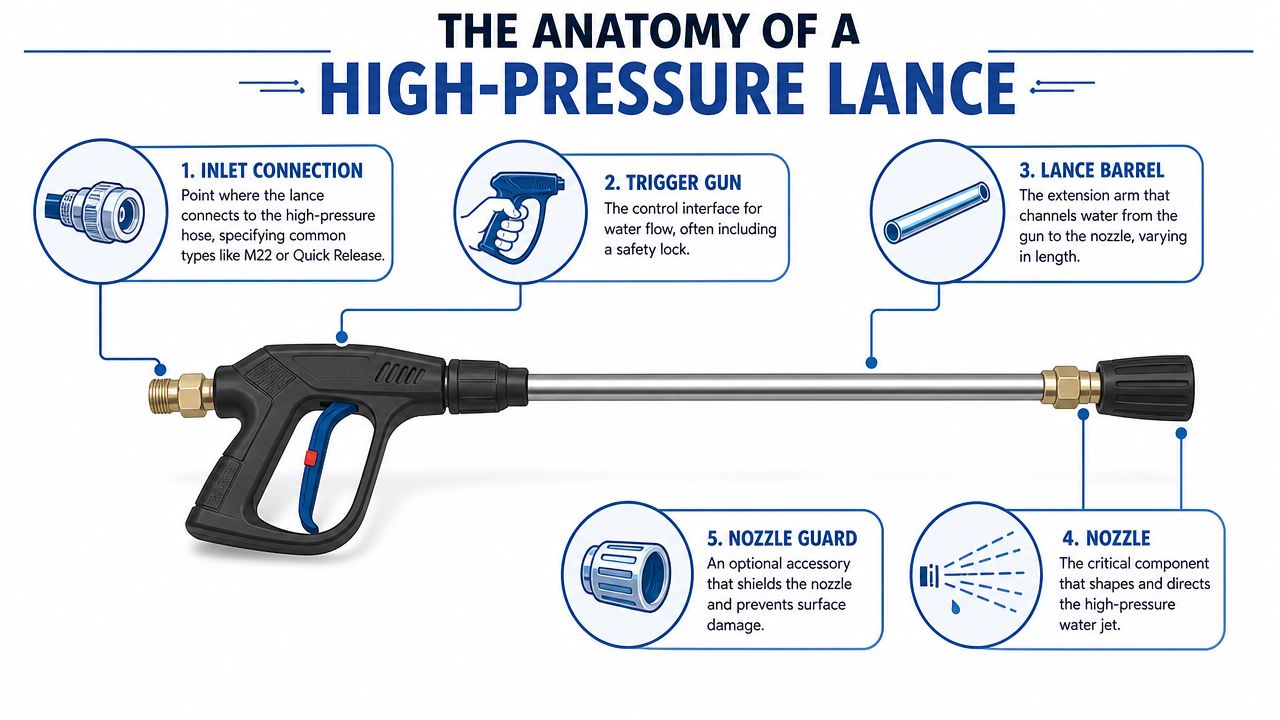
Inlet connection
The inlet connection is where the lance joins the gun or hose assembly. In workshop terms, this is one of the most common failure points because people focus on thread fit and ignore sealing method, swivel behaviour and pressure pulse loading.
Common formats include M22 and quick-release styles, but the important question isn't just whether it screws on. It's whether the connection stays stable under the actual pump output, hose whip, thermal cycling and operator movement.
Watch for these issues:
- Thread mismatch: A fitting that seems to catch can still damage threads or create a false seal.
- Poor support at the joint: Long barrels put more stress on the inlet, especially when operators work overhead.
- Wrong seal material: Heat and detergent exposure can harden seals fast.
Trigger gun
The trigger gun is the operator control point. It opens and closes flow, but from an engineering perspective it also manages pressure transitions. A sloppy or sticky trigger changes how pressure is applied to the lance tube and nozzle, and that can exaggerate shock loading.
The gun body also affects ergonomics. If the handle angle or trigger force is poor, operators compensate with wrist position and body stance. On a short task that's annoying. Across repeated daily use, it becomes a fatigue and safety issue.
Practical rule: Never judge a gun and lance assembly on static feel alone. Hold it as if you're cleaning a chassis rail, a wheel arch and an overhead panel. The weak point usually shows up in the third position, not the first.
Lance barrel
The barrel is the pressure-containing extension arm that carries fluid from gun to nozzle. Length changes more than reach. It changes balance, reaction force, bend risk and pressure drop behaviour.
A short rigid barrel is easier to control in confined equipment cleaning. A longer barrel improves access but places more stress on the inlet end and increases operator fatigue if wall thickness and material choice aren't sensible.
Nozzle and guard
The nozzle does the actual work of shaping the jet. The lance only performs as well as the nozzle fitted to it. If the orifice is wrong for the pump's delivered flow, pressure either won't build properly or the system will run too aggressively.
A guard is optional on some setups, but it's useful where operators work close to painted panels, polished metal or awkward contours. It reduces accidental contact damage and helps maintain consistent stand-off distance.
Key Performance Metrics Decoded
Most poor selections happen because buyers look at one number and ignore the rest. They chase maximum bar rating, or they only check hose fit, or they assume any industrial lance will tolerate hot washdown. Real performance comes from the relationship between pressure, flow and temperature, not from any one figure in isolation.
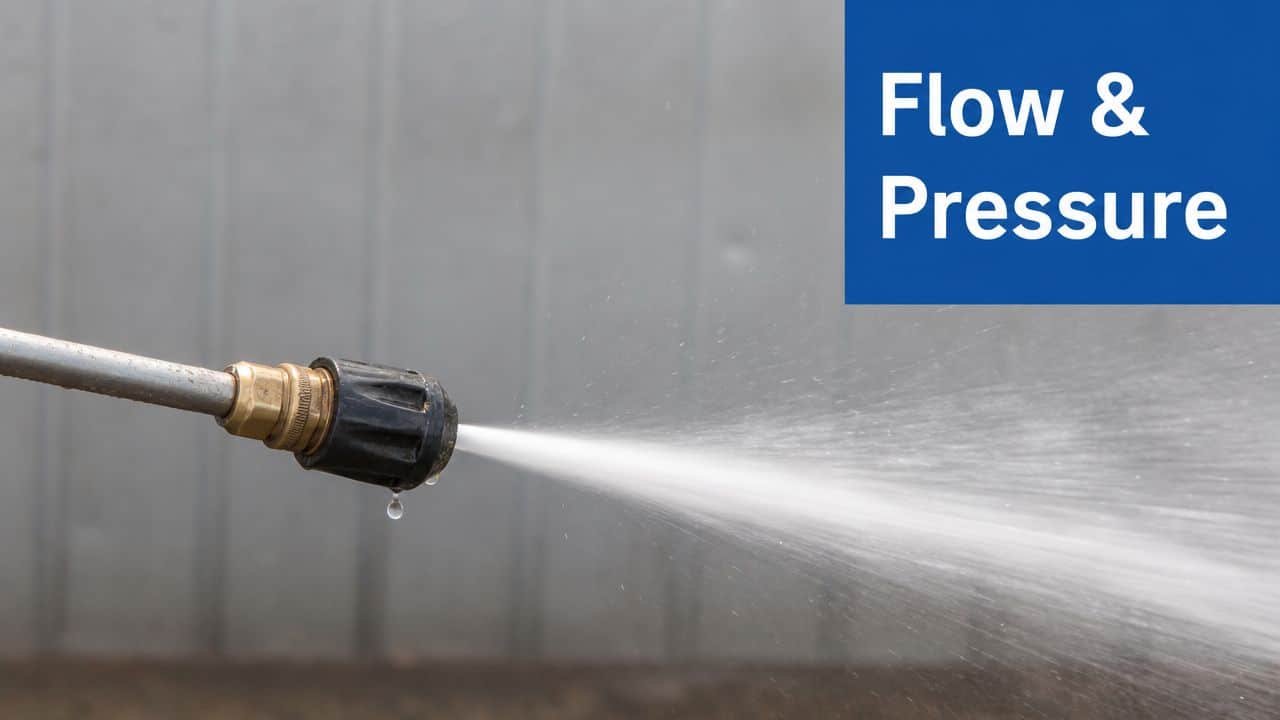
A professional-grade jet wash lance for heavy-duty systems typically operates at a peak pressure of 344 bar (5,000 PSI) with a water flow rate of 45 L/min (12 Gal/min) and a maximum water temperature of 150°C (300°F), according to this professional pressure washer lance specification. Those figures only make sense when the rest of the system can support them cleanly.
Pressure breaks the bond
Pressure is what attacks the contamination layer. It helps break the bond between surface and dirt, grease, caked soil or residue. If pressure is too low for the job, operators compensate by moving closer, slowing down or using a more aggressive nozzle than they should.
That said, chasing pressure alone is how surfaces get damaged and components get overstressed. A lance rated for high pressure doesn't automatically make the machine better if the pump, unloader and nozzle sizing aren't aligned.
Flow carries contamination away
Flow does the clearing. Once pressure has disrupted the bond, flow moves the material off the surface and out of the work area. Systems with reasonable pressure but weak flow often seem forceful at first contact yet leave slurry, redeposit grime and take longer overall.
That's why proper flow rate calculations matter. The pump output, nozzle selection and lance passage size have to support one another. If they don't, the spray may look sharp while the actual cleaning result stays poor.
Temperature changes the duty
Hot water changes fluid behaviour, detergent performance and seal stress. A lance that works acceptably on cold washdown can fail early when moved onto a hot-water machine if the tube finish, seals, grip material and gun internals weren't selected for thermal service.
For industrial cleaning, temperature rating isn't a secondary line on the datasheet. It's part of the durability rating.
What goes wrong when the system is mismatched
A jet wash lance sits at the end of the line, but the problem often starts upstream. Typical failure patterns include:
- Undersized flow path: The pump tries to deliver more than the lance and nozzle combination can pass. Pressure spikes follow.
- Wrong nozzle orifice: The machine either never reaches useful working pressure or continually hammers the circuit.
- Thermal mismatch: Hot water hardens seals and weakens grips or insulators.
- Poor transient control: Rapid trigger cycling shocks the assembly and shortens service life.
High pressure without enough flow gives you impact without washout. High flow without enough pressure gives you movement without cut. Reliable cleaning needs both.
In mobile and plant applications, these errors don't just affect wash quality. They can increase wear on pumps, unloaders, hoses and valve components, because the operator keeps compensating for an end-of-line setup that was wrong from the start.
Types of Jet Wash Lances and Their Applications
Not every lance belongs on every machine. The best choice depends on access, contamination type, operator position and how often the tool is used in a shift. A lance that's excellent for cladding washdown can be awkward and inefficient on plant underbodies.
The market's demand for long-reach equipment is clear. Modern lance assemblies can reach up to 7.3 metres, and high-quality assemblies are available at around £30.00 to £36.00, according to these UK pressure washer lance listings. That price makes basic procurement easy. Correct application still needs engineering judgement.
Straight lances
The straight lance is the default format for a reason. It gives direct alignment between operator, barrel and nozzle, so reaction force feels predictable and line-of-sight is good.
Use it where access is open and the target surface is mostly in front of the user, such as:
- Vehicle side panels and chassis members
- Workshop floors and fabricated steelwork
- General machinery washdown
What works well is its simplicity. What doesn't is forcing it into underguards, wheel arches or recessed equipment where the operator has to twist wrists and shoulders to achieve the spray angle.
Angled lances
An angled lance solves access problems that operators otherwise try to solve with bad posture. It's useful when the surface sits underneath, behind or above a normal line of approach.
Typical uses include:
- Undercarriage cleaning on agricultural and construction equipment
- Wheel arch and suspension area washdown
- Degreasing around guards, brackets and frame recesses
The trade-off is control. An angled outlet can feel less intuitive at first, especially on higher-pressure systems. Operators need time to adapt or they'll overcorrect.
Telescopic and long-reach lances
These are the right answer when physical access is the main problem. High-sided vehicles, facades, gutter lines and raised machine housings all benefit from added reach.
Their advantage is obvious. Their weakness is just as obvious to anyone who's used them for more than a few minutes. Extended reach increases strain and fatigue. If the barrel is too heavy or the balance point is poor, cleaning quality drops because the operator can't hold steady stand-off distance.
Long reach is valuable, but only if the operator can still control nozzle position accurately. Reach without control usually wastes water, time and effort.
Vario and dual-function lances
A vario or dual-function lance is useful where the task changes during the same cleaning cycle. One mode can support concentrated cleaning, while another supports lower-pressure application of detergent or rinse function.
These suit mixed-duty environments where operators move between heavy contamination and broad washdown. They reduce tool changes, but they also add moving parts and internal complexity. If maintenance standards are poor, that convenience can turn into sticking adjustments and inconsistent spray behaviour.
Material Science and Lance Construction
Material choice decides whether a lance survives the environment it's used in, not whether it looks good on delivery day. If the job involves hot water, detergents, outdoor storage, winter road film, fertiliser residue or food-grade washdown, the construction material matters as much as the pressure rating.
Too many buyers treat material as a procurement afterthought. That usually means buying on initial price, then replacing assemblies early because corrosion starts at threads, spring seats, nozzle retainers or welded transitions.
What the main material options mean in practice
The usual choices are plated steel, stainless steel and composite-heavy assemblies. Each has a place.
| Material | Corrosion Resistance | Weight | Typical Cost | Best For |
|---|---|---|---|---|
| Zinc-plated steel | Moderate | Higher | Lower | General workshop use, dry indoor duty |
| Stainless steel | High | Moderate to higher | Higher | Wet, chemical, outdoor and hygiene-sensitive environments |
| Composite and mixed-material assemblies | Variable | Lower | Variable | Operator comfort, lighter-duty repetitive use |
Plated steel works when the environment is controlled and maintenance is disciplined. It's often perfectly acceptable on indoor wash stations with limited chemical exposure. It stops making sense when the lance lives on a mobile machine, sits wet between jobs or sees repeated detergent contact.
Why stainless usually wins on total ownership cost
Stainless steel costs more upfront, but it usually pays back in service life and reliability. Corrosion doesn't just affect appearance. It attacks threads, weakens joints, creates rough surfaces where seals sit, and makes nozzle changes harder.
Where the lance is washed down regularly, stored on a vehicle, or exposed to aggressive residues, stainless is usually the safer specification. For teams comparing grades and fabrication implications, this overview of stainless steel for CNC machining is useful background, particularly when the assembly includes machined adaptors or custom fittings.
Weight and fatigue are engineering issues
Material choice also affects handling. A heavier lance may feel solid, but weight at the far end of a long barrel increases wrist and shoulder loading fast. That matters on repetitive work such as fleet cleaning, agricultural kit washdown and processing-area sanitation.
If you want the assembly to last in real use, ask two questions together:
- Will it resist the environment?
- Can the operator hold it correctly for the required duration?
A very durable lance that nobody can comfortably control isn't a good specification.
The best construction material is the one that survives your actual duty cycle without making the operator fight the tool.
Match the build to the environment
A practical way to specify construction is to think by environment, not by catalogue category:
- Indoor engineering workshop: plated steel may be sufficient if water chemistry and storage conditions are mild.
- Agricultural and mobile plant use: stainless usually makes more sense because mud, slurry, road salts and outdoor exposure are hard on finishes.
- Food or hygiene-sensitive areas: stainless is generally the cleaner and more maintainable option.
- Frequent overhead or extended-reach work: lighter mixed-material designs may reduce fatigue, provided pressure and temperature ratings still fit the duty.
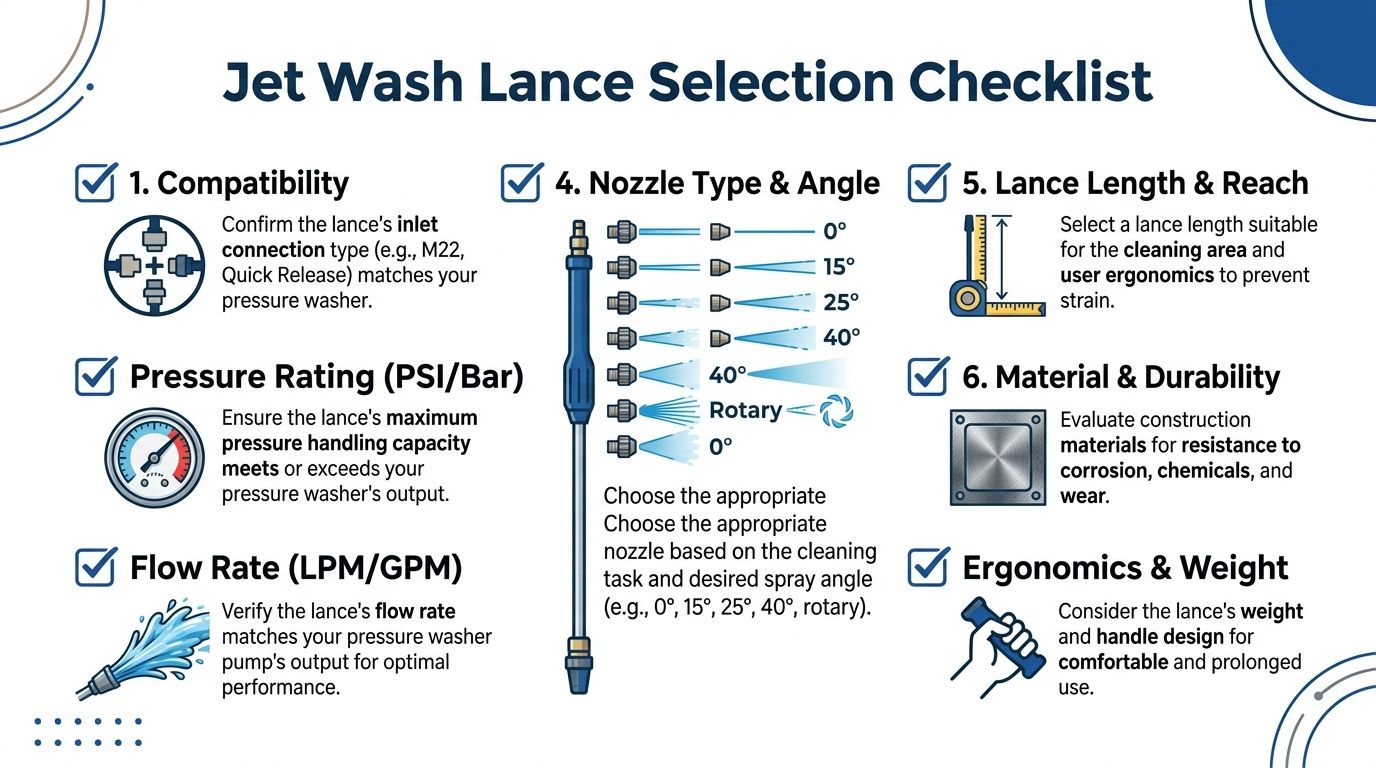
System Integration and Selection Checklist
Most lance problems aren't product defects. They're integration defects. The pressure washer may be capable, the pump may be sound, and the hose may be correctly rated, yet the end tool still fails because nobody matched the assembly as a system.
That gap shows up clearly in the field. Some industry surveys report that 68% of UK agricultural contractors have experienced lance failures due to mismatched pump-pressure specifications, as noted in this guide on pressure washer lance compatibility. That's exactly what happens when pressure, flow, nozzle and pump characteristics are treated as separate purchasing decisions.
Start with the power source
Before you look at barrels, grips or nozzle guards, identify what the power unit delivers. On mobile and industrial systems, that means the pump's real operating pressure and flow, not the optimistic number repeated from old paperwork.
If the cleaning system is driven from a hydraulic source, the matching exercise has to include the pump group, available flow and the behaviour of the control hardware. A jet wash lance used in high-pressure cleaning systems typically operates in the 150 to 300 bar range, with critical performance thresholds linked to compatibility expectations in the CETOP directional valve standard, as described in this UK hydraulic pump market overview.
Check the whole chain, not just the lance
A good specification review works through the line in order:
-
Pump output
Confirm delivered pressure and flow under normal operating conditions. Don't rely on nominal figures if the machine runs hot, shares circuits, or has noticeable wear. -
Valve behaviour
Check how the directional and relief components behave during trigger cycling. Fast transitions can create shock loads that a nominally suitable lance still won't enjoy. -
Hose and connection geometry
Make sure the hose bore, fitting type and routing support the required flow without awkward loading at the gun inlet. -
Lance rating
The lance must comfortably tolerate the pressure, temperature and handling conditions of the job. -
Nozzle selection
The nozzle has to suit both the cleaning task and the pump output. Wrong orifice sizing is one of the fastest ways to make a good machine perform badly.
A practical selection sequence
When I'm reviewing a setup for reliability, I use a simple shortlist process:
- Confirm compatibility first: Thread form, coupling style and sealing arrangement must all match.
- Specify for the actual duty: Hot washdown, detergent exposure and overhead use all change the correct choice.
- Leave room for transient loads: A setup that only survives steady-state conditions is not a durable setup.
- Consider the operator: Length, balance and grip insulation matter because poor handling creates misuse.
If an operator has to fight the lance to keep it on target, the system is already underperforming, even if every component is technically “within rating”.
Don't ignore actuated or specialised assemblies
Some cleaning systems use actuated or integrated mechanisms rather than simple manual barrels. Where pin-mounted double-acting systems are involved, pricing in the UK hydraulic cylinder market sits around £218.75 for float-level switch-compatible cylinders, and lance systems require a minimum bore diameter of 32 mm and rod diameter of 20 mm to sustain 250 bar operational pressure, according to these UK hydraulic component listings. Those figures matter when a wash system is being integrated into bespoke plant or automated cleaning hardware.
A good checklist doesn't stop at “will it fit”. It asks whether the lance, nozzle, pump, valve and operator form one stable working system. If the answer is uncertain, the assembly hasn't been specified yet. It's only been purchased.
Installation Safety and Maintenance Procedures
A good lance can still fail quickly if it's installed badly. Most workshop problems come from simple errors. Cross-threaded fittings, damaged seals, contaminated nozzles, overtightened adaptors and poor storage cause more trouble than expected.
Installation starts with isolation. Depressurise the system fully, inspect threads and sealing faces, and only then assemble the connection. If the fitting relies on an O-ring face seal, make sure the O-ring is clean, undamaged and correctly seated. If the joint uses a threaded sealing method, apply the correct sealing practice for that fitting type rather than treating every thread the same.
Safe installation habits
These habits prevent most immediate issues:
- Inspect before assembly: Look for thread damage, nozzle wear, cracked grips and bent barrels.
- Align the fitting squarely: If resistance appears too early, back off and start again.
- Tighten to a controlled standard: Overtightening can distort seats and crush seals.
- Pressure test cautiously: Bring the system up in a controlled way and check for leaks before normal use.
The FT Pro 3/8" washdown gun lance is a useful benchmark for operating limits in industrial service. It features a 15° nozzle angle, supports a maximum working pressure of 280 bar, handles 25 L/min, and works from 0°C to +150°C, according to this FT Pro washdown lance specification. If your system conditions approach component limits, installation quality matters even more.
Operating safety that operators must treat seriously
High-pressure cleaning systems are not forgiving. A jet from a damaged nozzle or leaking connection can injure skin and drive contamination into tissue. Operators need proper PPE, stable footing and a clear rule that no one checks leaks with a hand.
Use these operating rules every time:
- Wear the right PPE: Eye protection, gloves, suitable boots and task-appropriate clothing are basic requirements.
- Never point the lance at people: Not during testing, not during shutdown, not for “just a second”.
- Keep hose management under control: A tidy setup reduces trip hazards and protects fittings. A retractable hose reel also helps prevent kinks and drag damage in regular wash bays.
- Respect hot-water service: A system running near upper temperature limits can burn even when the spray pattern looks normal.
Treat every leak as a pressure hazard first and a maintenance task second.
Maintenance checks that actually matter
Routine maintenance doesn't need to be complicated, but it does need to be consistent. Focus on the wear points that change performance before they create obvious failure.
Check these items regularly:
- Nozzle condition: Wear enlarges the orifice and changes spray behaviour.
- Seals and O-rings: Heat and chemicals harden them over time.
- Barrel straightness: A bent lance is harder to control and may indicate overload or impact damage.
- Grip and insulation: Especially important on hot-water applications.
- Connection wear: Look for looseness, corrosion and thread damage.
If the spray becomes erratic, don't assume the pump is failing. Start with the simple causes. A partially blocked nozzle, worn nozzle seat, damaged seal or air ingress at a connection can all mimic larger system faults.
Good maintenance keeps the lance boring. That's exactly what you want from a pressure component.
If you need help matching a jet wash lance to a hydraulic power source, checking pump and valve compatibility, or sourcing dependable components for a mobile or industrial cleaning system, speak to MA Hydraulics Ltd. Phone 01724 279508 today, or send us a message through the contact page.
