
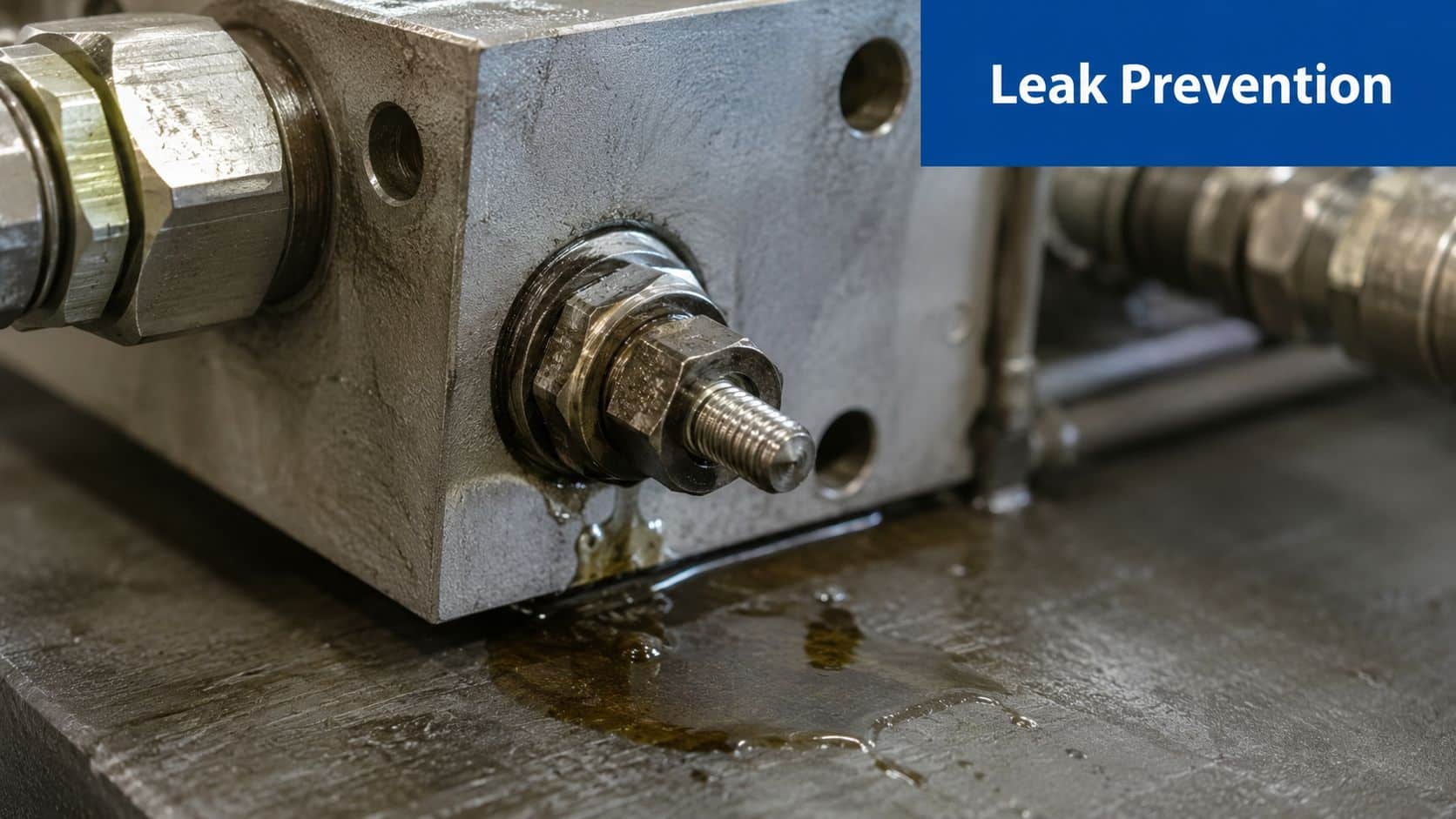
A hydraulic manifold stud backs out during a shift. Oil starts weeping past the joint, clamp load falls away and the machine is taken out of service for a failure that looked minor during the last inspection. The same pattern appears on PTO mounting bolts, pump brackets, gearbox fasteners and other joints exposed to vibration, shock, temperature changes and contamination.
High strength threadlocker can stop that loosening by locking the engaged threads, but it isn't automatically the right answer for every repair. Red compound may provide the permanent security a vibrating assembly needs, yet it can turn a routine service job into a heat-assisted removal operation years later. The practical decision is to match holding power with serviceability, temperature exposure, fastener size and the removal plan.
Why Threaded Joints Fail and What a Threadlocker Really Does
A threaded joint works because tightening creates preload, which clamps the connected parts together. In hydraulic and mobile equipment, repeated vibration or shock can gradually reduce that clamp condition. Once the joint starts moving, the fastener may rotate, the preload drops further and the connection can develop leakage, fretting or structural movement.
A loose PTO mounting bolt is a familiar example. The bolt may still be present, but it no longer maintains the force needed to keep the assembly stable. On a hydraulic manifold, even slight movement around a stud or fitting can damage sealing surfaces or allow fluid to track along the thread interface.
The chemical lock inside the thread
Threadlocker is a liquid adhesive applied to a metal threaded joint before assembly. A UK supplier describes high-strength threadlocker as a liquid plastic that cures in the absence of oxygen when it contacts metal, forming a solid material within the thread engagement. That principle is why the compound can resist vibration while also helping seal the small clearances between mating threads, as explained in the Würth UK high-strength threadlocker specification.
The compound doesn't replace correct tightening. It supports the joint by occupying the microscopic gaps where movement can begin. If the bolt is under-torqued, the surfaces are contaminated or the wrong grade is selected, adhesive alone won't correct the underlying assembly problem.
Practical rule: Treat threadlocker as part of a controlled joint specification, not as a substitute for clean threads, correct torque or sound mechanical design.
What this guide helps you decide
The useful question isn't whether red threadlocker is “strong”. It is whether the joint needs to remain secure until the next planned overhaul, whether technicians must remove it with ordinary tools, and whether nearby components can tolerate heat during future disassembly.
A failure-mode review can help separate vibration loosening from damaged threads, incorrect preload, corrosion or a sealing defect. For teams developing a more systematic review process, how AI improves failure mode analysis offers useful context on analysing recurring failure patterns without reducing every failure to a product-selection issue.
For practical information on the adhesive category and suitable applications, see this guide to thread locking adhesive. The decision should be made before assembly, while the fastener, housing, access and future service route are still visible.
Understanding Anaerobic Chemistry and Strength Grades
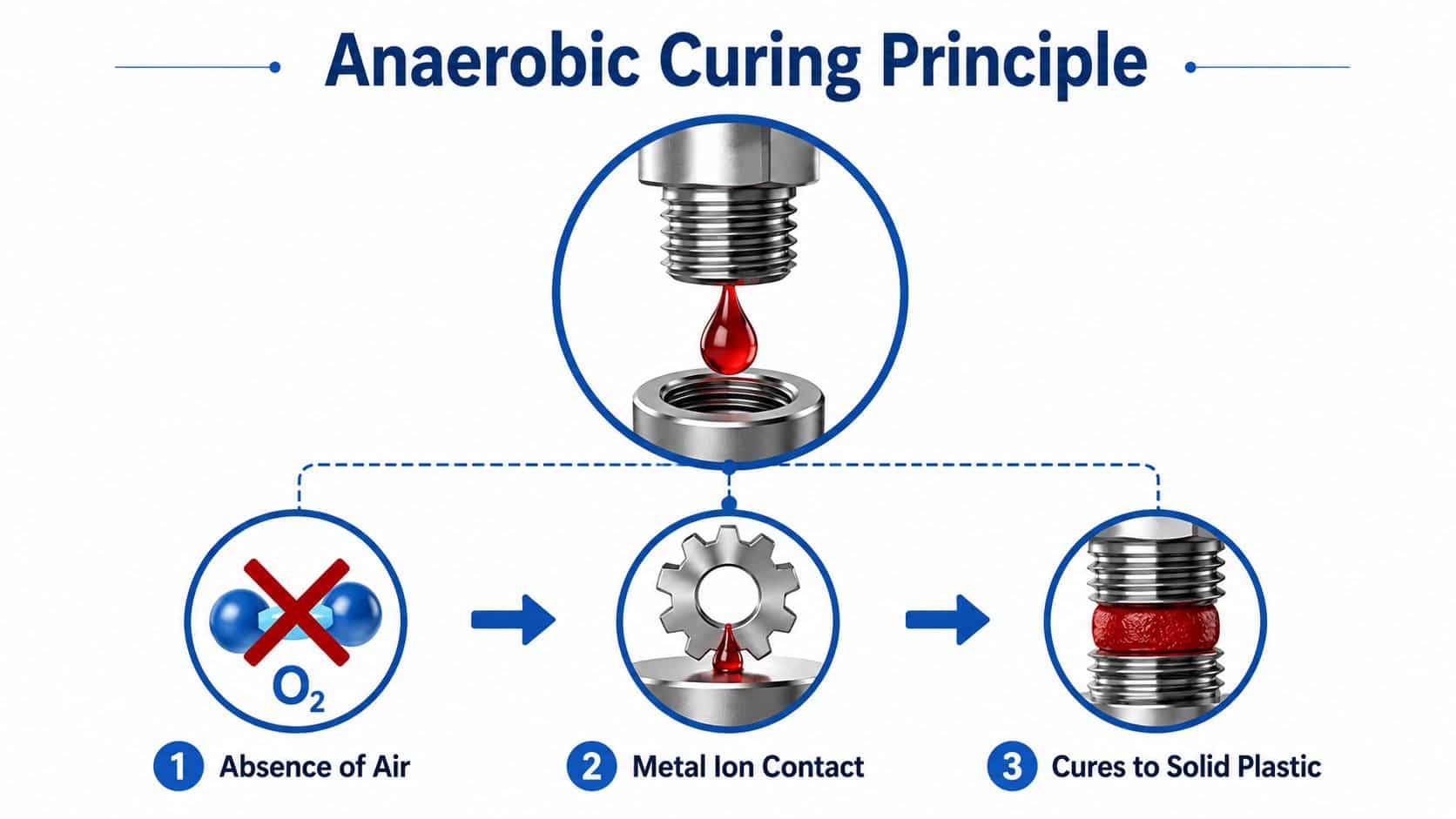
Anaerobic threadlocker behaves differently from an ordinary glue. In the bottle, oxygen helps keep the material liquid. Once the compound is enclosed between close-fitting metal threads, contact with the metal and the absence of air allow it to cure into a hard plastic material.
A useful analogy is a cast that sets only where it is enclosed. A film left exposed around the outside may remain liquid, while the material trapped between the bolt and nut hardens inside the joint. That hardened plug increases resistance to movement across the engaged threads.
Strength is a service decision
Low-strength products suit small fasteners and adjustment points where technicians expect frequent alteration. Medium-strength blue grades are the usual choice for serviceable machinery joints because they resist vibration while remaining removable with suitable hand tools.
High-strength red grades are intended for permanent locking. They make sense where loosening creates a serious operational risk and the fastener isn't expected to come apart during normal maintenance. The trade-off is straightforward. You gain stronger long-term retention, but future removal generally requires heat and careful work.
High-temperature variants occupy a separate part of the selection decision. Independent UK engineering guidance identifies Loctite 243 and Loctite 271 as common shelf products and states that both meet ASTM 1782 thread-locking standards. The same comparison identifies Loctite 272 as a high-temperature option rated to 230°C continuous, compared with 150°C for Loctite 271. These figures are documented in the UK comparison of Loctite 243 and 271.
Why British threads still matter
The UK has a long technical relationship with standardised threaded fasteners. British engineer Joseph Whitworth specified the British Standard Whitworth thread form in 1841, making it the world's first national screw-thread standard. Its 55° thread angle became the basis of a standardised system adopted across British industry and railways, creating a consistent mechanical platform for threaded joints.
Metric ISO threads are now widespread, but imperial and British threads still appear in older machinery, maintenance work and legacy equipment. That history matters to today's engineer because a high-strength threadlocker may be applied to a modern metric pump mounting bolt one day and a BSW or other imperial fastener on an older agricultural or industrial machine the next. The background to that continuing legacy is outlined in this account of historical threads and their continuing use.
When to Choose High Strength Over Alternatives
The best grade is the one that matches the machine's future, not just its present vibration level. A permanently installed frame bolt and a hydraulic cover bolt may experience similar movement, yet only one may justify heat-assisted removal.
Blue medium-strength compound is usually more practical for pump covers, inspection plates, guards and assemblies that technicians will revisit. Red high-strength compound suits permanent studs, critical mounting points and joints where loosening would cause damage or an unplanned shutdown. Mechanical devices such as lock washers, nyloc nuts and locking wire can still be appropriate, particularly where visual inspection, immediate removal or a specified mechanical retention method is required.
A comparison for maintenance planning
| Grade | Removability | Temperature rating | Typical application |
|---|---|---|---|
| Medium strength, blue | Generally removable with hand tools | Suited to ordinary service temperatures, subject to the product data sheet | Serviceable covers, housings, pumps and general machinery fasteners |
| High strength, red | Intended for permanent locking and commonly needs heat for removal | Standard products vary, with Loctite 271 documented at 150°C | Permanent studs, high-vibration mounts and critical industrial joints |
| High-temperature high strength | Removal planning remains essential | Loctite 272 is rated to 230°C continuous | Hot-section fasteners and assemblies exposed to sustained elevated temperature |
| Mechanical locking device | Usually physically removable, though corrosion or access may complicate removal | Depends on the device and surrounding assembly | Joints requiring visible or mechanical retention |
The temperature figures in this table come from the UK Loctite 243 and 271 engineering comparison. They shouldn’t be treated as universal ratings for every product sold in the same colour family.
Where red compound goes wrong
A common mistake is fitting high-strength threadlocker to a joint that must be stripped during every planned service. The bolt holds securely, but the technician later applies excessive force, damages a stud or pulls threads from an aluminium housing. A blue grade, a mechanical locking method or a revised maintenance procedure may have delivered adequate security with less risk.
High-strength threadlocker is a sound choice when permanent locking matters more than routine serviceability. It is a poor choice when the removal method hasn’t been agreed, the joint contains heat-sensitive seals or the fastener is likely to need adjustment.
Selection Criteria for Hydraulic and Industrial Applications
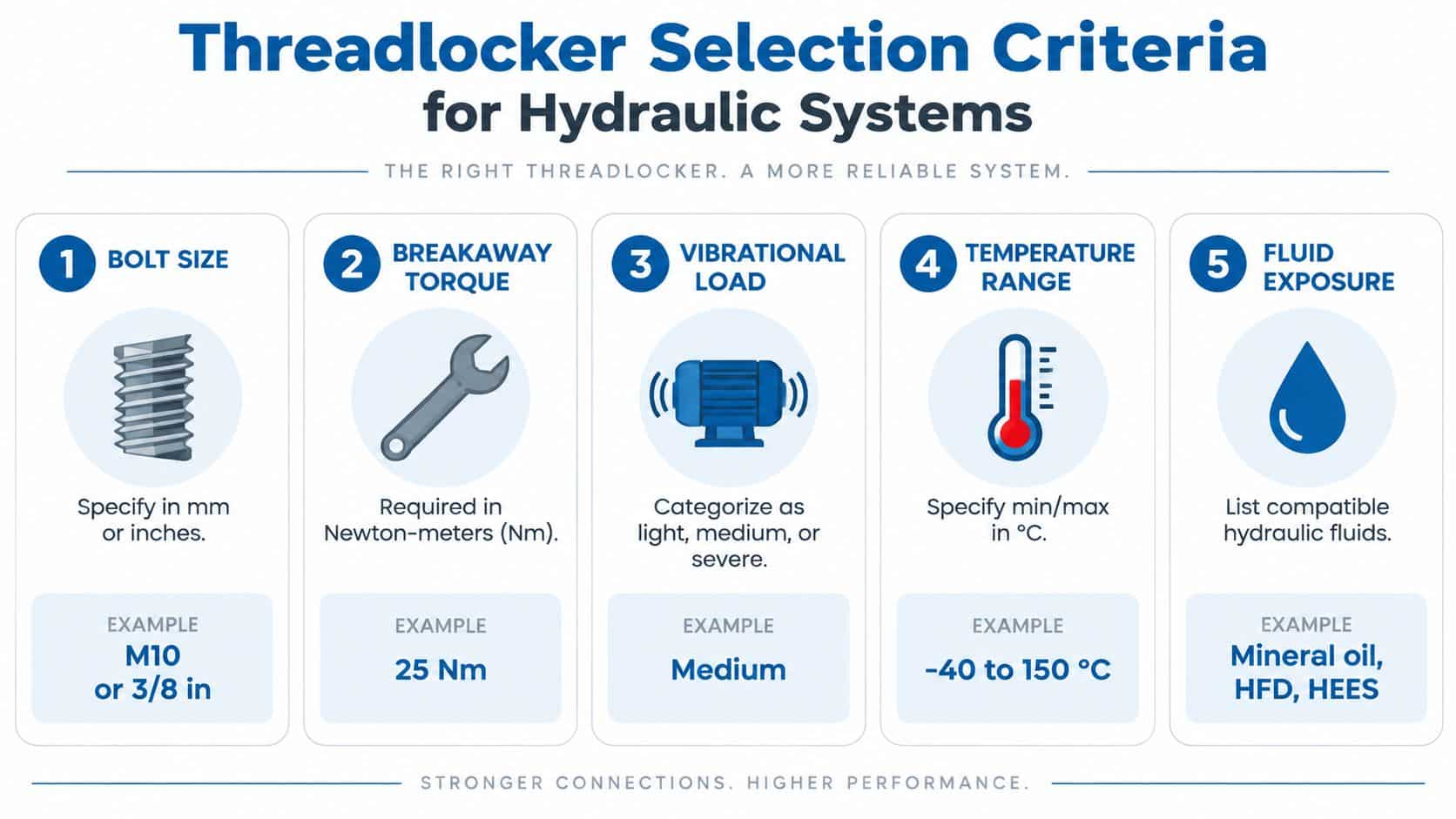
A tractor hydraulic manifold, pump mount or gearbox stud can look routine until it loosens in service. Choose the threadlocker from the joint’s maintenance requirement, not from the colour alone. Record fastener diameter, thread form, material, engagement length, operating temperature, fluid exposure and the consequence of losing preload. Legacy BSW and other imperial threads also need confirmation before selecting a product or torque value.
Torque data needs a defined test condition
LOCTITE 270 gives a useful UK reference point. Henkel documents 33.0 N·m breakaway torque and 33.0 N·m prevailing torque on M10 steel nuts and bolts, with a fixture time of 10 minutes and a service temperature range of -55°C to 180°C. Those values come from the UK LOCTITE 270 product data.
Treat those figures as test data, not a universal tightening instruction. An M10 steel joint does not represent a larger stud, a plated fastener, an imperial thread or an oily assembly. Use the manufacturer’s test basis to compare products, then set installation torque from the fastener or equipment specification. Threadlocker torque and tightening torque are different controls.
Four checks before approval
- Fastener size: High-strength grades suit permanent fasteners up to 1 inch in diameter, while medium-strength grades are generally used up to three-quarters of an inch. The industrial threadlocking guide provides a useful starting point, but the selected product’s data sheet takes priority.
- Joint duty: Manifold studs, pump mounting bolts and PTO gearbox fasteners may face vibration and shock. Assess movement, load direction and the likely damage after preload is lost. If planned adjustment or strip-down is routine, specify a removable grade or mechanical retention instead.
- Temperature: Compare minimum and maximum joint temperatures with the adhesive’s rated range. Include heat from exhausts, braking systems, hydraulic oil and enclosed gearboxes. A product suitable at ambient temperature may not suit sustained high temperature.
- Fluid and material exposure: Hydraulic fluid, protective coatings, corrosion and dissimilar metals can affect contact and compatibility. Confirm the product data rather than assuming all anaerobic compounds behave alike.
The equipment record should state whether the joint is permanent, which product is approved, the cure requirement and how removal will be carried out. For component identification and common connection differences, consult this reference on hydraulic fittings types.
Applying and Curing Threadlocker the Right Way
Most application failures start before the bottle is opened. Oil, old compound, rust scale and workshop debris prevent the adhesive from making consistent contact with the metal threads. A joint may feel tight after assembly, yet cure unevenly and provide less reliable retention than the technician expected.
Prepare the joint properly
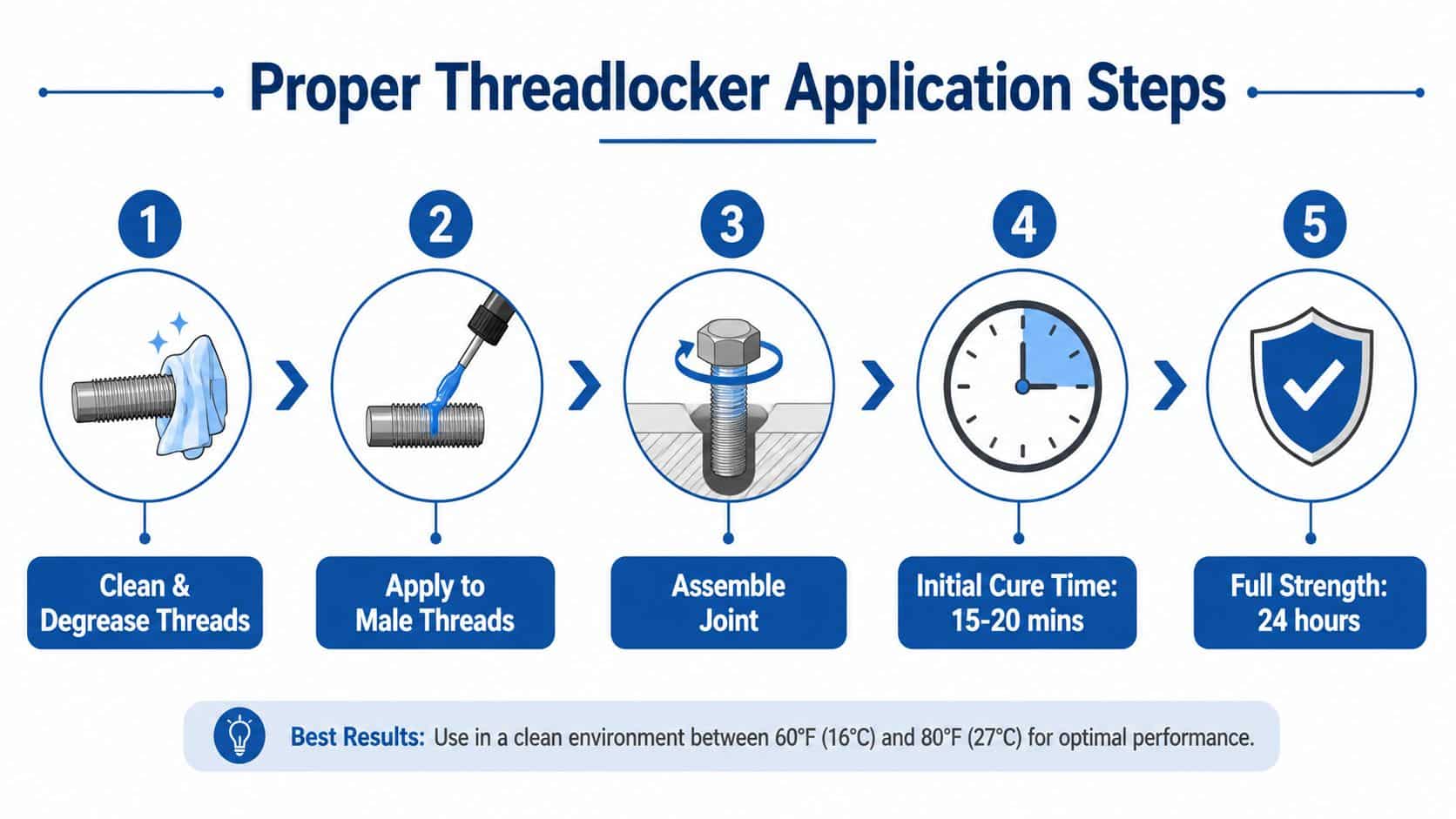
Remove the fastener where possible and clean both mating threads. A suitable degreasing cleaner should remove oil and residue without leaving a film, and old cured compound may need mechanical removal with a thread brush or an appropriate tool. Dry the parts before application.
Surface preparation deserves the same attention as the adhesive itself. For a broader overview of cleaning methods and preparation choices, the Evright Industrial prep guide is a useful reference.
Apply enough compound to cover the engaged thread area without flooding the joint. The aim is complete contact through the working engagement, not a large external bead. Assemble the parts promptly so the material remains where it is needed, then tighten to the specified mechanical torque.
Manage the cure window
Henkel’s UK threadlocking guidance gives a typical fixture time of 10 to 30 minutes at room temperature, with full cure in 24 hours on active metals such as steel. The figures are set out in the UK threadlocking guidance.
Fixture means the assembly can generally be handled carefully. It doesn’t mean the joint has reached final strength. Don’t torque-test, load-test or return a critical hydraulic assembly to full duty because it no longer moves by hand. Schedule the full cure into the repair plan.
Inactive surfaces, low temperatures and contamination can slow curing. An activator may be justified where the product data sheet identifies a difficult substrate or a demanding production schedule, but it shouldn’t be used to compensate for dirty threads or poor fit.
Removing High Strength Threadlocker Safely
“Permanent” doesn’t mean unbreakable, but it does mean the maintenance team must plan removal before applying the compound. High-strength products are designed to keep fasteners secure under demanding conditions, and ordinary hand tools may not provide a safe or controlled way to release a fully cured joint.
Henkel guidance recommends high-strength threadlockers for fasteners exposed to temperatures up to 340°C. The same guidance states that removal typically requires localised heat above 260°C, followed by disassembly while the joint is still hot. These requirements are set out in the Henkel MRO threadlocking guide.
Heat the joint, not the whole assembly
Apply heat evenly to the female threaded component where practical. The objective is to soften the cured compound at the thread interface, not to heat the entire manifold, pump body or gearbox indiscriminately. Use suitable tools while the joint remains hot, and avoid sudden shock loads that can twist a seized stud or damage a housing.
Hydraulic assemblies demand extra care. Protect hoses, seals, cartridges, painted surfaces and nearby fluid from flame or excessive radiant heat. Isolate and depressurise the system before work, remove vulnerable components where necessary and make sure the work area supports safe hot disassembly.
Corrosion changes the risk. A threadlocked fastener in a clean indoor assembly may release predictably, while a corroded stud in wet agricultural plant can bind mechanically even after the adhesive has softened. If the housing is expensive or difficult to replace, use controlled heat, penetrating treatment where compatible, correct-size sockets and a documented escalation route rather than extending a breaker bar.
Removal rule: If you can’t describe where the heat will go, what it may damage and how the hot fastener will be supported, don’t specify a permanent-grade adhesive yet.
Retaining compounds and threadlockers have different purposes. Review the intended joint function before selecting a product, and use guidance on bearing Loctite retainer only where the application calls for retaining rather than threadlocking.
Inspection, Troubleshooting and Long-Term Maintenance
A locked joint still requires inspection. Check for rotation marks, fretting, damaged heads, oil weeping through the thread interface and movement between connected parts. After the specified full-cure period, a controlled torque check can confirm that the assembly remains within its maintenance specification.
Failure patterns often expose a process problem. Contaminated threads can stop the adhesive curing. An excessive grade can make a serviceable joint difficult to strip, whereas a medium-strength product may not retain a fastener in severe vibration. Record the failure, cleaning method, selected grade, tightening torque and removal plan in the maintenance procedure.
Include fastener size in that decision. High-strength grades generally suit permanent assemblies with fasteners up to 1 inch. Medium-strength grades are generally used up to three-quarters of an inch. Confirm the individual product data sheet before approval, particularly where legacy BSW or imperial threads remain in UK hydraulic, agricultural or industrial equipment.
Use a maintenance-first rule: match strength to serviceability, temperature rating to exposure and adhesive to the fastener and substrate. Plan removal before assembly, especially on corrosion-prone plant.
MA Hydraulics Ltd can help match hydraulic components, fasteners and threadlocking requirements to equipment duty, access and maintenance schedules. Visit MA Hydraulics Ltd for application support, phone 01724 279508, or use our contact page.
