
A customer's press is down, the maintenance supervisor is chasing a delivery, and someone is searching three different spreadsheets for a proportional valve that may or may not be on the shelf. Meanwhile, a gear pump worth hundreds of pounds has been sitting untouched because nobody has tied it to a usable demand pattern, an asset, or a replenishment rule.
That is the practical problem behind best inventory management for hydraulic components. The answer isn't more automation or leaner stock. It is a controlled balance between availability, traceability, working capital and the consequence of failure. A missing filter element is inconvenient. A missing pump, valve or seal kit can stop production, delay a power-pack build and expose the business to an avoidable emergency purchase.
Why Hydraulic MRO Stock Is Its Own Problem
A Midlands food processor loses twelve hours because a 5-micron return filter and its matching seal kit aren't available. The maintenance team has checked the obvious bins, called the usual suppliers and eventually finds that the filter housing is in stock, but the correct element isn't. On the same shelf sits a £300 gear pump that hasn't moved for months.
That contrast is normal in hydraulic MRO. Value alone doesn't tell you what deserves shelf space. The part that costs less may carry the greater operational risk because it fits a machine that can't run without it.
Hydraulic components also behave differently from predictable production materials. Demand often arrives through breakdowns rather than a smooth forecast. A customer may need several common filters during routine servicing, then suddenly require a replacement pump or CETOP valve after contamination, overload or a failed actuator. Lead times can stretch when a component comes from an Italian manufacturer, requires configuration, or must be sourced from a domestic supplier with limited availability.
The part has to be technically right
A hydraulic spare isn't interchangeable just because the description looks similar. Port size, displacement, rotation, mounting, shaft profile, pressure rating, seal material, voltage and valve configuration can all determine whether the replacement works.
Traceability adds another layer. Lot and serial records may be needed for warranty handling, customer records and pressure-related documentation. If goods-in staff book a valve under a vague description, the business may later know that something was received, but not which exact item went into a particular assembly.
Practical rule: classify a component by the consequence of not having it, not only by its purchase price or annual usage.
The UK Ministry of Defence provides a useful warning about scale. The National Audit Office report on defence inventory management says the MoD holds around 520,000 inventory types and about 460 million individual items, with a net book value of £11.8 billion and £1.5 billion spent on inventory purchases in 2022–23. The report also describes a long-running problem of buying more inventory than was being used and not consistently disposing of items no longer needed.
A hydraulic supplier doesn't need a defence-sized warehouse to face the same basic failure. Poor visibility locks cash into slow-moving adapters, coils and seal kits while a critical component remains unavailable. Start with an honest view of what is physically available, including current hydraulic stock availability, then set policies around downtime risk, technical compatibility and supplier reliability.
Auditing Your Current Hydraulic Stockroom
Don't start by buying software. Start by establishing whether the system reflects the stockroom.
A baseline audit should be controlled enough that the numbers mean something, but practical enough for a working UK warehouse. The first count should include pumps, valves, hoses, fittings, seal kits, filters, electrical accessories and consumables. Overflow shelves and engineer vehicles count too if the business treats them as available stock.
Freeze the movement before counting
Freeze new receipts for 48 hours and record any urgent issues that must still be issued. The pause prevents goods-in activity from changing the quantity while the team is counting. If a critical part has to leave during the freeze, record the transaction immediately and mark the bin.
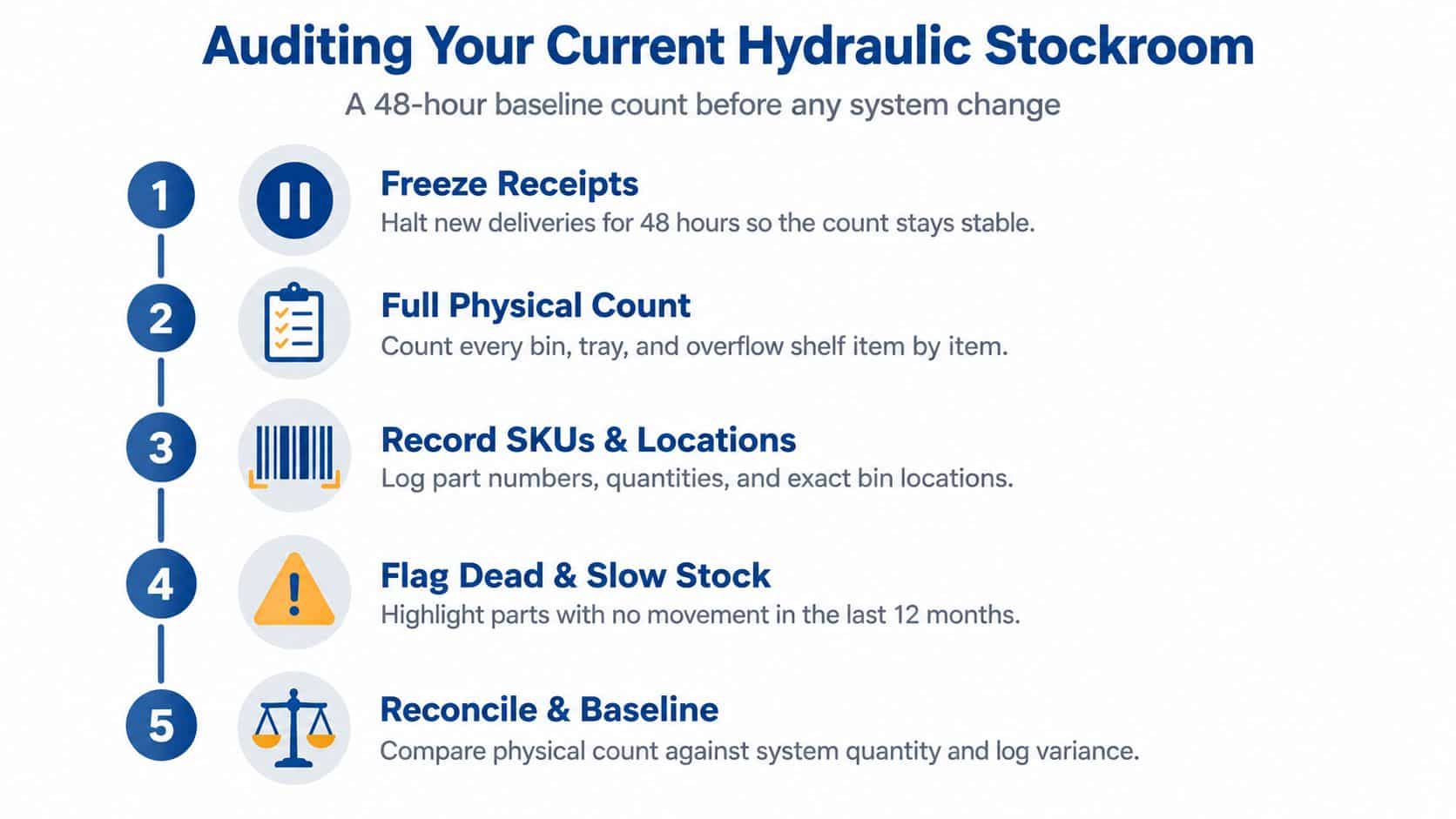
Count item by item rather than accepting a box label. Separate visually similar parts, especially metric and BSP fittings, left-hand and right-hand pump rotations, and filter elements with different micron ratings. Record the part number, manufacturer, quantity, unit of measure and exact location.
Reconcile the physical count
Compare the count with the CMMS or ERP file and produce a variance report. A useful report doesn't only show a number mismatch. It flags duplicate part numbers, missing suppliers, incorrect units of measure and stock records with no bin location.
Look for data defects that will corrupt every later calculation:
- Duplicate identities: The same CETOP valve coil may exist under a manufacturer code, an internal code and an old superseded number.
- Wrong units: A seal kit may be recorded as one unit in the system but received as a pack.
- Missing technical fields: Shaft size, port configuration, displacement or seal material may be absent.
- Unclear locations: “Workshop” isn't a picking location. Use a defined rack, bay, shelf or bin reference.
Finish with a physical exception list. Common findings include orphaned accessories, mixed metric and BSP fittings, filter elements stored without a cross-reference to their housings, and obsolete lines that remain orderable because nobody has closed the old record. Quarantine uncertain items until an engineer confirms their identity. A clean baseline is more valuable than a complex reorder calculation built on unreliable master data.
Applying ABC and XYZ to Pumps Valves and Filters
ABC and XYZ work well together because they answer different questions.
ABC ranks stock by annual consumption value. A high-value pump or power-pack sub-assembly deserves closer financial control than a low-cost fitting. XYZ describes demand behaviour. X items move steadily, Y items fluctuate, and Z items have intermittent or almost no predictable demand.
The combined matrix stops the stockroom from treating every hydraulic SKU in the same way. A high-value, steady-demand valve needs a different policy from a low-value, sporadic flange adapter.
Score the item, then apply engineering judgement
A 32 cc/rev aluminium gear pump might be A-Y. It has meaningful annual spend, but demand varies with quotations, replacements and project work. Review it regularly with min-max levels and check open customer requirements before buying.
CETOP D03 directional valves could be A-X where demand is steady and the cost of a line stoppage is high. That combination supports continuous review, a defined reorder point and tighter safety stock. Replacement filter elements may be B-Y, suitable for periodic min-max review, provided the team links each element to the correct housing and micron rating.
Obsolete hydraulic flange adapters may be C-Z. They shouldn't keep receiving automatic replenishment signals. Review them before quotation, check whether an approved cross-reference exists and consider clearance or controlled disposal where they no longer support an active machine.
| Cell | Typical hydraulic SKU | Replenishment policy |
|---|---|---|
| AX | CETOP D03 directional valve | Continuous review with reorder point, close supplier monitoring |
| AY | 32 cc/rev aluminium gear pump | Periodic min-max review, validate demand and open quotations |
| AZ | Bespoke replacement power-unit pump | Engineer approval before purchase, protect against long lead time |
| BX | Replacement filter element | Min-max review, cross-reference housing and micron rating |
| BY | Common seal kit | Periodic review, use compatible kit families |
| BZ | Intermittent hose assembly | Review demand pattern and supplier response before setting stock |
| CX | Standard fitting with steady use | Simple reorder trigger and cycle count |
| CY | Occasional valve accessory | Batch purchase only where the carrying cost is justified |
| CZ | Obsolete flange adapter | Review before quotation, clearance or controlled disposal |
The matrix should influence attention, not replace technical knowledge. A C-Z item can still be critical if it is the only approved component for an old press. Conversely, an A item may be easy to source and need less physical safety stock than its value suggests.
The UK context reinforces the need for discipline. One UK inventory-management summary reports average accuracy of 63% for warehouses relying on manual processes, compared with accuracy above 99% for businesses using real-time tracking and automation. The same source says UK businesses commonly hold 25% to 35% of working capital in inventory, while storage, insurance and handling can add 20% to 40% of inventory value each year. Those figures make clean categorisation more than a warehouse exercise. It determines where cash and attention go.
Setting Reorder Points and Safety Stock for Spare Parts
A reorder point should tell the buyer when to act, not merely confirm that a shortage has already happened.
The basic formula is:
Reorder point = average daily demand × lead time + safety stock
Use demand history that reflects the item's real use. For a common CETOP valve with a lead time of 5 to 10 days, the calculation can be relatively direct. A bespoke gear pump with a lead time of 3 to 5 weeks needs a more cautious review because one supplier delay can consume the available protection.
Work the calculation from the component backwards
Take a 10 cc/rev pump selling 30 units a month. If the business uses a 30-day planning month, average demand is one unit per day. With a 21-day lead time, lead-time demand is 21 units. If the agreed safety stock is 6 units, the reorder point is 27 units.
That result is only useful if the assumptions are sound. Check whether the 30-unit figure includes project demand, emergency replacements or internal transfers. Smooth one-off spikes rather than allowing one unusual order to set a permanent replenishment level. Then review supplier reliability and whether the pump has a genuine approved substitute.
Safety stock should reflect both demand variability and service consequence. An AX valve linked to a production line may warrant a 95% service-level target. An AY pump may use 90%, while a BX item may use 85%, provided the maintenance team accepts the resulting exposure.
| Category | Service Level | Safety Stock Approach | Review Frequency |
|---|---|---|---|
| AX | 95% | Protect against demand and lead-time variation, with continuous review | Weekly or event-driven |
| AY | 90% | Use demand history, open work and supplier reliability | Fortnightly |
| BX | 85% | Hold practical cover without allowing routine overstock | Monthly |
| BY | Qualitative target | Use min-max levels and review seasonal or project variation | Monthly or quarterly |
| CZ | Qualitative target | No automatic safety stock unless engineering criticality justifies it | Before quotation or planned work |
For a deeper explanation of the calculations and assumptions, this guide to safety stock with Hinawi ERP is useful when building a formal policy. Apply the same logic to hydraulic parts, but add engineering criticality. A valve that stops a press deserves different protection from a similar-priced valve used on a non-essential auxiliary circuit.
Keep EOQ subordinate to downtime risk
Economic order quantity helps balance ordering cost against the carrying cost of holding stock. It can suggest a sensible batch size for standard filter elements or seal kits. It shouldn’t force a business to buy a large batch of expensive pumps just because the mathematical order size looks efficient.
For MRO, the better question is often whether the item can be pooled, sourced quickly, or covered through an agreed supplier arrangement. A supplier-managed replenishment signal may suit predictable repeat demand. A consignment arrangement may reduce the buyer’s immediate ownership burden, but only if ownership, inspection, traceability and availability rules are written clearly.
Choosing CMMS ERP and Stock Control Practices
Software should follow the maintenance problem, not lead it.
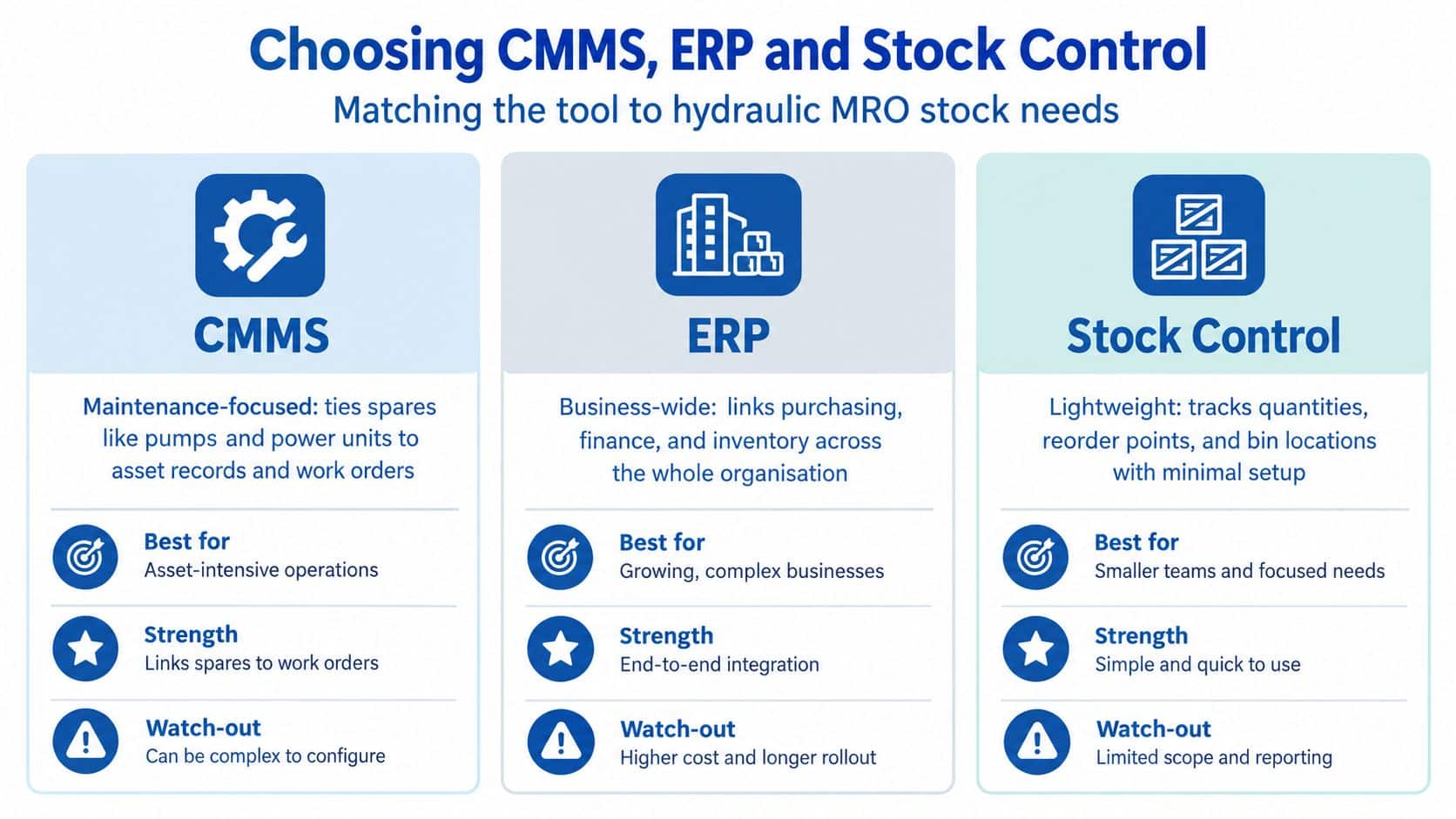
A CMMS is strongest when engineers need to connect spares to assets, planned maintenance and work orders. It can show that a pump belongs to a particular power unit and help reserve parts for a job. Stock functions may be less mature, especially around purchasing, supplier terms and financial valuation.
An ERP inventory module normally handles procurement, finance and multi-site stock more effectively. The weakness is often hydraulic specificity. Fields such as seal-kit compatibility, shaft size, port size, displacement and rotation may need customisation, and users can lose technical clarity if the item description remains generic.
A standalone stock-control tool offers a lighter route for bins, quantities, barcode scanning and reorder points. It can suit a smaller operation, but it may not connect properly to work orders, asset history or a power-pack bill of materials.
Choose the minimum system that preserves control
Whatever platform you choose, insist on these capabilities:
- Barcode scanning: Receive, issue and transfer stock without retyping part numbers.
- Lot and serial tracking: Preserve supplier and warranty records for traceable components.
- BOM integration: Link pumps, motors, valve blocks and ancillaries to a power-pack assembly.
- Min-max triggers: Create replenishment signals without allowing every old item to reorder automatically.
- Technical cross-references: Store manufacturer numbers, approved alternatives and fitment notes.
- Location control: Show the exact bin, quarantine area or assembly job allocation.
A spreadsheet or light stock tool can be a sensible starting point when the range is small and one person owns the data. Move to a CMMS when work orders and asset records drive spare consumption. Move towards ERP when purchasing, finance and multiple locations need one controlled view.
A practical guide to stock control for small businesses can help teams structure the basics before choosing a larger platform. The important point is that software won’t repair duplicate part numbers or untrained receiving staff. Clean master data, defined transaction rules and cycle counting still matter.
For suppliers and customers with repeat demand, vendor relationship management can support agreed replenishment signals, realistic lead times and better communication around hard-to-source hydraulic parts.
Spare Parts Procurement and Assembly Workflows
A bespoke power pack exposes weak inventory control quickly. If the quotation changes after the purchase order is raised, or the kitting team picks from memory, the assembly bay becomes the place where data errors turn into physical rework.
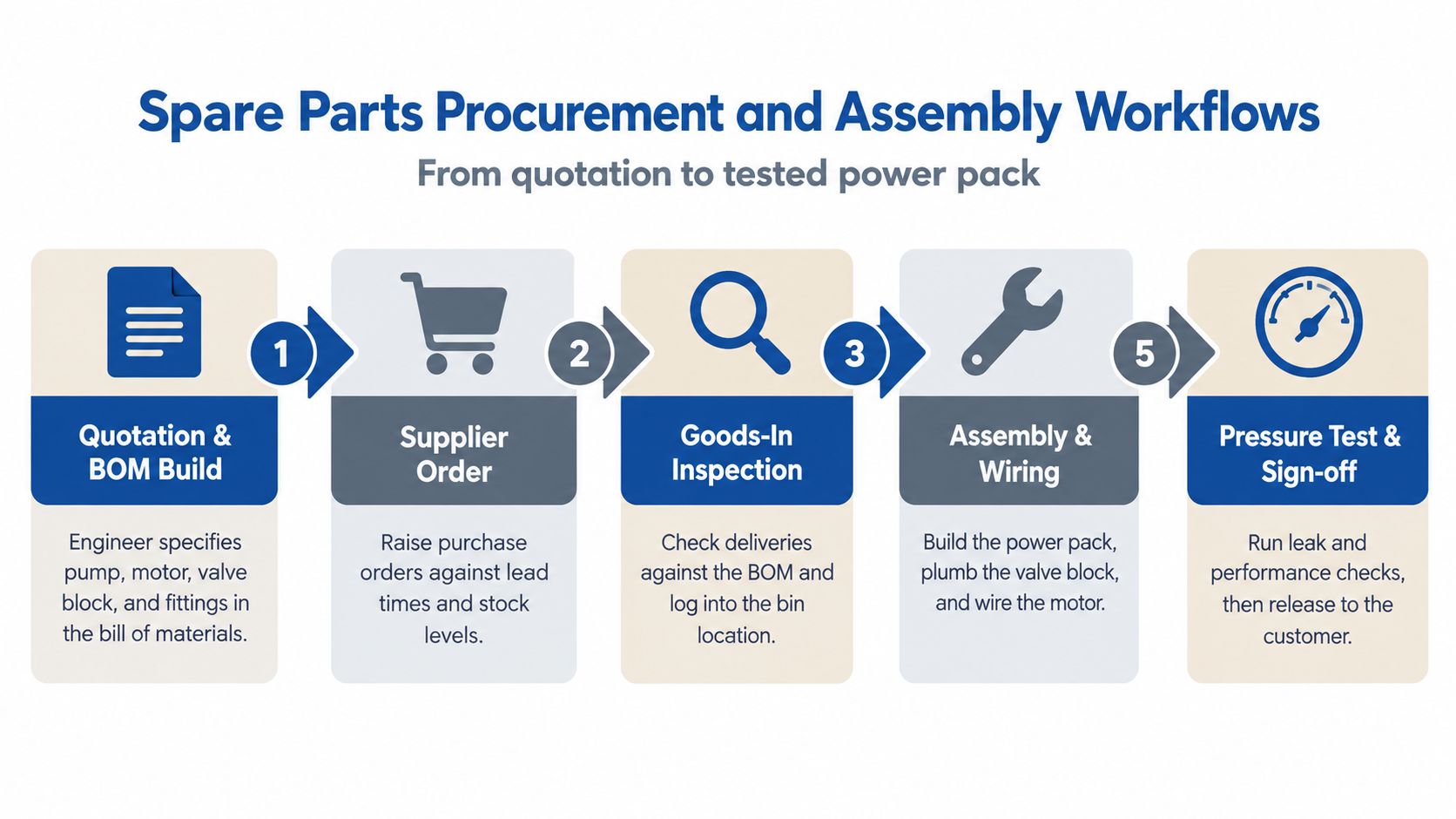
The process should begin when the engineer builds the quotation and BOM. The pump, motor, valve block, manifolds, fittings, filtration and electrical ancillaries need defined part numbers and quantities. Freeze that BOM before ordering, or record a controlled revision that shows exactly what changed and why.
Control the handovers
The purchase order should reference the BOM and the planned assembly slot. That gives procurement a reason to chase a late component before the build date, rather than discovering the problem when the assembler is waiting for a valve block or coupling.
Goods-in staff should check deliveries against the BOM, inspect packaging and quarantine anything missing certificates or traceability information. Don’t book an unidentified substitute into available stock just because the dimensions appear similar.
At kitting, pick all parts against the job number. Label them clearly and move them to the assembly bay as one controlled kit. A two-person verification catches wrong pump rotation, incorrect motor voltage and missing seal kits before assembly begins.
A kit is not complete because every box is present. It is complete when every part is verified against the current BOM.
During the build, record serial numbers and any approved substitutions. The final sign-off should include torque checks, a leak test, oil-fill confirmation and a pre-despatch inspection. That record supports warranty conversations and gives the customer confidence that the assembly matches the agreed specification.
This supply-chain resilience guidance is relevant when a preferred supplier is delayed or a component becomes unavailable. The answer isn’t uncontrolled substitution. It is an approved alternative process, with the engineer confirming fit, pressure, performance and documentation before procurement changes the BOM.
The most common failure is a silent BOM change. Someone swaps a valve to meet availability, the drawing isn’t updated, the warehouse picks the original ancillary, and the finished unit reaches test with incompatible connections. A controlled revision, visible job allocation and final inspection prevent that chain of errors.
KPIs That Tell You If It Is Working
Hydraulic MRO KPIs need to be read together. High turnover can look efficient while a missing pump or valve stops production. Low dead stock can reflect disciplined disposal, or it can show that the team has removed a part still needed for an older machine.
Track inventory turns, stockout rate, carrying cost as a percentage of stock value and dead stock percentage. Add service level for engineering-critical components, because a finance metric should not outweigh the cost of maintenance downtime.
| KPI | Healthy Range | Warning Threshold | What it Signals |
|---|---|---|---|
| Inventory turns | Around 10 to 12 turns annually for manufacturing-style stock, as a commonly cited benchmark in the UK supply-chain planning report | Falling turns with rising value | Capital is tied up in slow-moving stock |
| Stockout rate | Qualitatively low for AX items | Repeated shortages of production-critical parts | Reorder points, safety stock or supplier plans are inadequate |
| Carrying cost | Controlled against stock value and business margin | Rising storage, insurance and handling burden | Excess stock is consuming cash and space |
| Dead stock percentage | Review against the business threshold and item criticality | Persistent growth or unreviewed ageing | ABC/XYZ categories, technical data or disposal discipline need attention |
A solenoid valve that has sat untouched for 18 months can expose a weakness in an otherwise acceptable stockroom report. If it is the only approved replacement for a critical machine, retaining it may be the right decision. If the machine has been retired and no compatible application remains, the valve is dead stock and needs an engineering review before disposal.
Read each measure by category and criticality. The UK inventory-management software market coverage describes the move towards connected stock management and live visibility. Visibility only helps when the team acts on exceptions. A rising dead-stock percentage should prompt a master-data review, a search for superseded part numbers and a discussion with engineering about active assets.
Review stockout records against the audit, ABC/XYZ classification and reorder-point settings. If a pump repeatedly runs out, check actual demand, supplier lead time and any approved alternatives. If a filter element remains on the shelf while its matching housing is no longer used, correct the cross-reference and set an approved disposal route.
The ONS inventories dataset provides an official UK source for analysing inventory trends across 1997 to 2025, but national figures cannot measure a hydraulics stockroom's response to a breakdown. Bin-level accuracy, traceability and service performance decide whether an engineer gets the right component while a line is down.
MA Hydraulics Ltd can review hydraulic stockrooms, identify critical pumps, valves, filters and seal kits, and optimise spares for bespoke power-pack builds. Visit MA Hydraulics Ltd, phone 01724 279508, or send us a message to discuss stock and application requirements.
