
A six-week delay on a critical gear pump can put a hydraulic component supplier under immediate pressure. The customer's machine may be ready for assembly, but production stops while procurement teams search for an alternative, maintenance engineers check compatibility and managers weigh emergency freight against extended downtime. One delayed component can quickly become a service problem, a scheduling problem and a relationship problem.
That scenario is familiar to UK OEMs, MRO teams and industrial suppliers. Brexit and COVID-19 exposed how quickly cross-border dependencies, transport restrictions and supplier bottlenecks can disrupt equipment availability. The response has moved beyond mere reaction to the next shortage. The UK now treats supply chain resilience as a strategic economic capability, supported by structured policy and national risk monitoring.
The Government Office for Science's 2026 Foresight report marked a significant milestone by defining resilience as the ability to prepare for, absorb, adapt to and recover from disruption while continuing to function. The report on global supply chains and risk gives procurement, maintenance and operations leaders a useful standard for judging whether their supply network can keep working under pressure.
For hydraulic businesses, that means looking beyond the purchase order. You need to understand which pumps, motors, valves, filters and seals are critical, where dependencies sit and which alternatives can be approved before a failure occurs. Reliable hydraulic equipment supply depends on that preparation.
Introduction
A hydraulic OEM receives confirmation that a shipment of gear pumps has slipped by six weeks. The pumps were allocated to a production run, the customer's assembly slot is approaching and the original supplier can't offer an earlier date. Procurement starts calling distributors, engineering checks whether another displacement or mounting pattern could work, and logistics calculates the cost of moving replacement stock by urgent freight.
The problem isn't limited to the pump itself. A missing pump can hold up a complete power unit, delay factory acceptance testing and leave a maintenance team unable to return a machine to service. If the replacement isn't technically equivalent, engineers may also need to review pressure ratings, shaft dimensions, port arrangements, rotation and compatibility with the existing hydraulic circuit.
This is why supply chain resilience has become a board-level concern for UK industrial firms. The issue affects revenue, customer service, working capital, engineering capacity and reputation, not just purchasing. A resilient supplier doesn't assume that every component can always be sourced from the cheapest or most familiar route.
The Government Office for Science's 2026 Foresight report defined supply chain resilience as the ability to prepare for, absorb, adapt to and recover from disruption while continuing to function. That definition changes the question from “How do we fix the shortage?” to “How do we keep operating while the shortage is managed?”
For hydraulic component suppliers, OEMs and MRO teams, the practical work starts with critical-part identification, supplier mapping, approved alternatives, sensible stock policies and clear ownership. The aim isn't to eliminate every risk. It's to create enough options and visibility to protect service when a gear pump, valve, filter or power-pack component becomes difficult to obtain.
Understanding Core Concepts
Supply chain resilience means keeping the hydraulic system moving when one part of the supply network fails. The system may need to continue through existing stock, an alternative supplier, a substitute component, a local repair route or a revised production sequence.
The Government Office for Science's 2026 Foresight report defines supply chain resilience as the capacity of a supply chain to continue to function and recover when things go wrong. Its full supply chain resilience definition is especially useful because it includes both continuity and recovery.
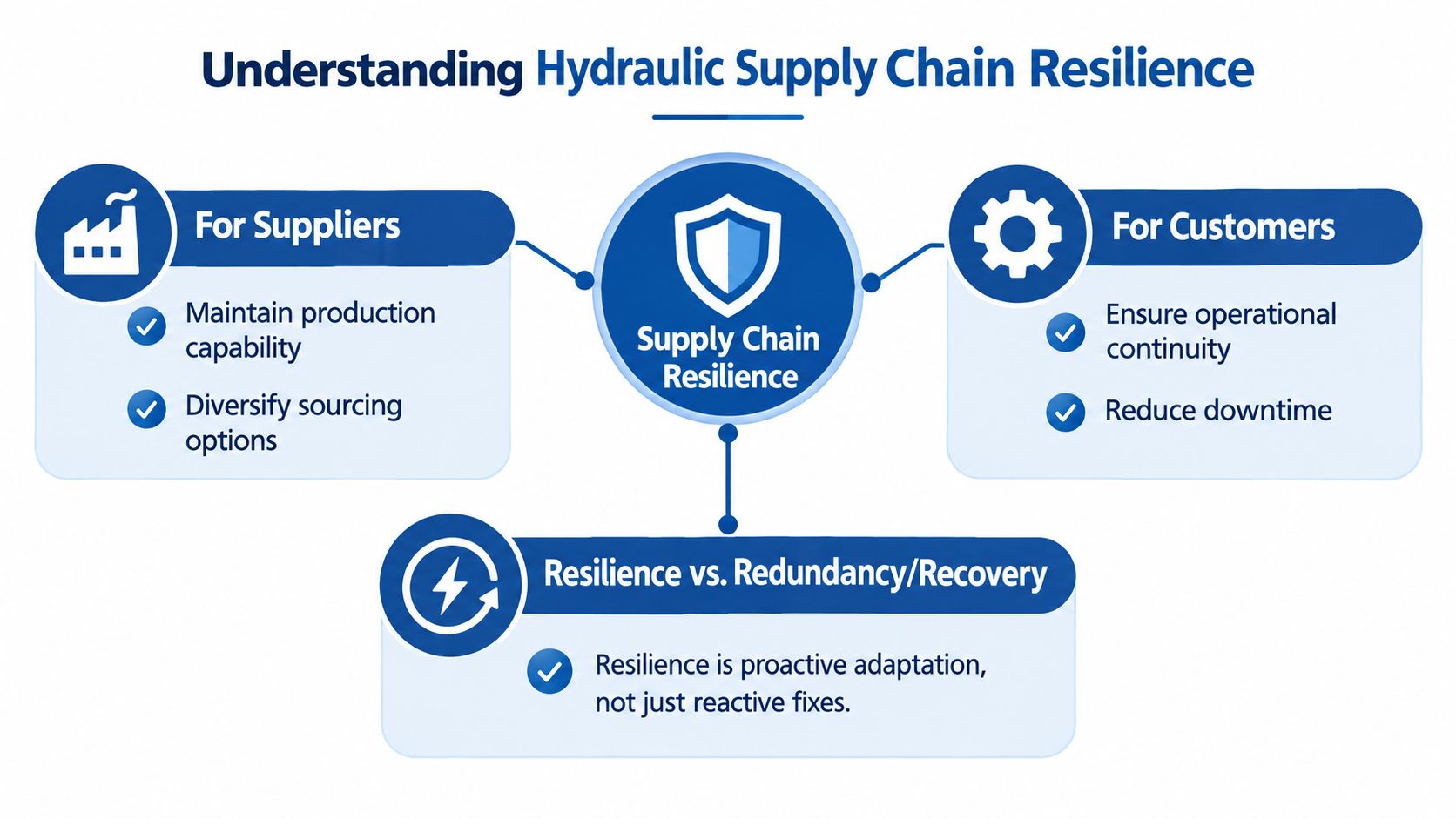
Four properties of a resilient chain
Strength is the ability to withstand pressure without immediate failure. For a supplier, that might mean holding essential seals or filters, using dependable processes and maintaining reliable production capability.
Redundancy means having another route available. A dual-sourced gear pump, a second approved valve manufacturer or an alternative transport route can reduce dependence on one point of failure. Redundancy still has a cost, so it should be reserved for components where interruption would cause serious operational consequences.
Agility is the ability to respond quickly. An MRO team with accurate drawings, cross-reference records and pre-approved alternatives can make a decision faster than a team starting technical checks from scratch.
Adaptability goes further. It means changing the network when conditions change, perhaps by qualifying a new supplier, redesigning a manifold or shifting from imported finished components to local rebuilding capacity.
A hydraulic relief valve provides a useful analogy. It doesn't prevent pressure from rising, but it gives the circuit a controlled response when pressure exceeds a safe level. A resilient supply chain works similarly. It absorbs the initial shock, then redirects flow through a planned alternative rather than allowing the whole system to stall.
For wider context on how packaging dependencies can affect industrial continuity, MSP Packaging insights on supply chains provide a useful adjacent perspective. The same principle applies to hydraulic procurement: visibility of connected dependencies matters as much as visibility of the immediate supplier.
Real World Examples
An OEM had designed a hydraulic drive system around a single source of hydraulic motors. The supplier's factory was affected by a fire, and deliveries stopped. Because the OEM had no approved second source, procurement couldn't readily place the order elsewhere. Engineering reviewed motor specifications, checked mounting and torque requirements, and worked with an alternative manufacturer to validate a compatible unit.
The recovery depended on preparation during the disruption. The team shared drawings and application data, arranged sample evaluation and changed the production sequence so other assemblies could progress while the motor approval was completed. The avoided cost wasn't only the purchase price of the replacement motor. The main benefit came from limiting idle assembly time and protecting the customer's delivery commitment.
A different example involved an MRO team supporting agricultural machinery during a port strike. Several imported hydraulic parts were delayed, including components needed for urgent repairs. The team used local sourcing for compatible items and drew on safety stock held for high-consequence failures. Technicians confirmed pressure, flow, connection and dimensional requirements before fitting the alternatives.
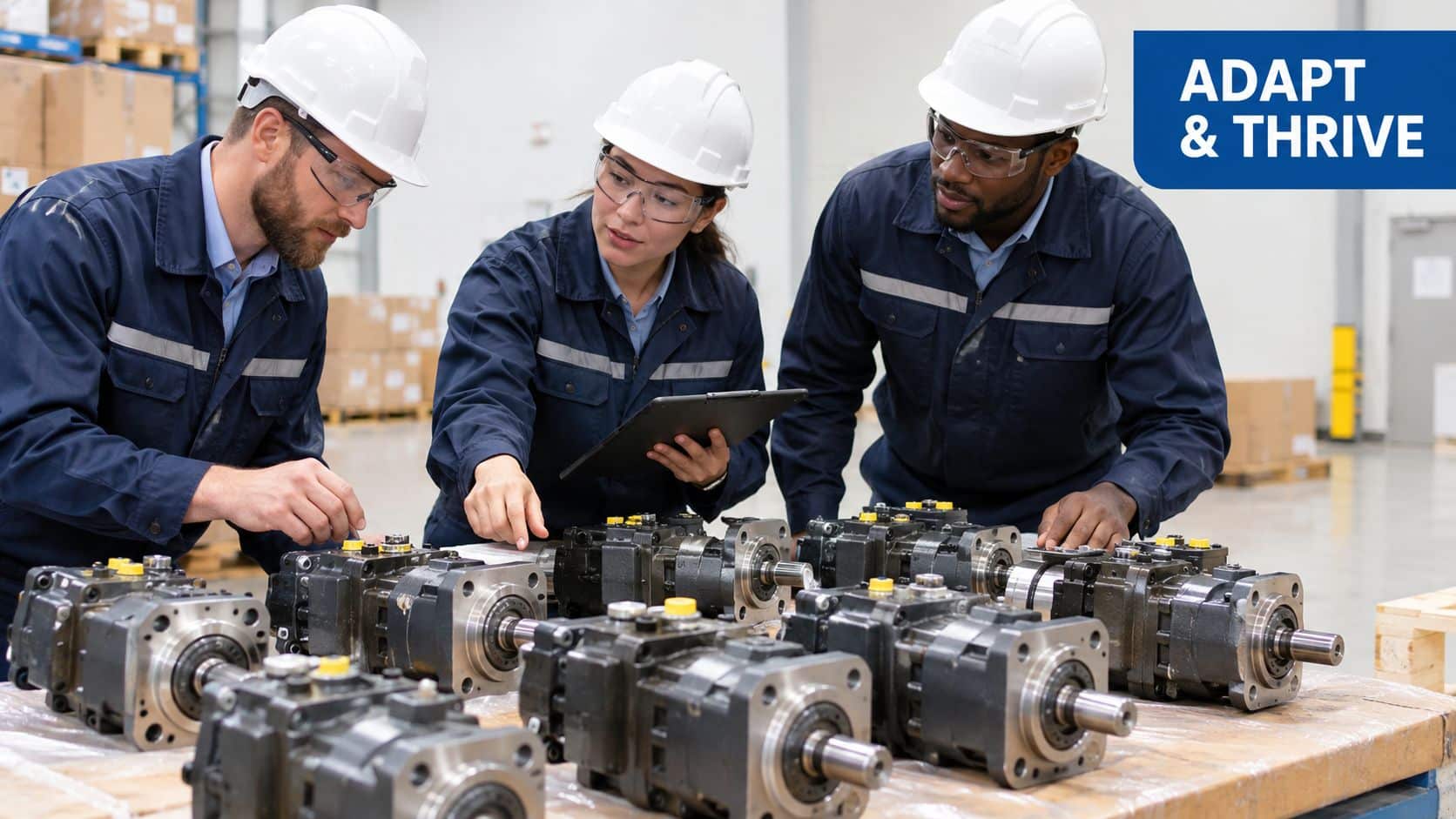
The MRO team restored equipment without waiting for the original shipping route to reopen. Its resilience came from combining local access with carefully selected stock, not from storing every possible part.
Practical rule: A backup supplier is only useful when the replacement has been technically checked, commercially understood and operationally available.
These examples also show why resilience projects need business discipline. Teams assessing successful business scaling projects can find useful parallels in how organisations structure capacity, ownership and decision-making as they grow.
Common Risks
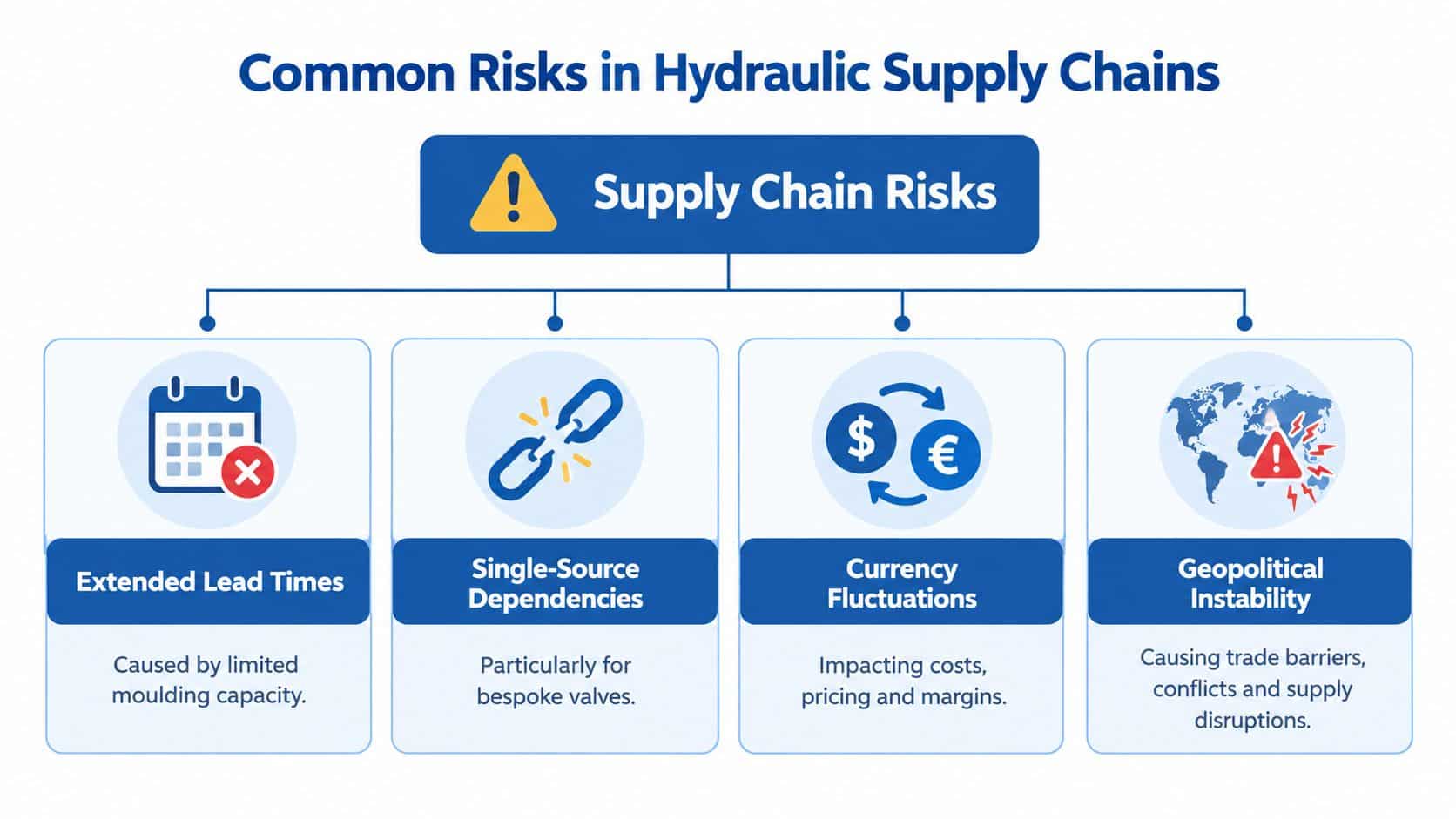
Hydraulic supply chains often fail at predictable pressure points. The challenge is to identify which vulnerabilities could stop a customer's machine, production line or service operation, then match each risk with a proportionate response.
Limited moulding or machining capacity can create extended lead times for components that appear straightforward but require dedicated tooling, specialist materials or a particular production slot. The delay may affect a gear pump, motor housing, valve body or sealing component. Procurement then faces emergency freight, production resequencing or an urgent search for compatible stock.
A single-source dependency is more serious when the part is bespoke. A standard inline valve may have several technically suitable options, while a custom manifold or unusual valve configuration may depend on one manufacturer's drawings, tooling and approval history. If that supplier experiences a factory interruption, raw-material shortage or quality issue, the customer may have no immediate substitute.
Currency movements can also change the landed cost of imported components. Even when the supplier delivers on time, the purchasing team may face a margin squeeze or need to reprice an assembly. That makes total-cost visibility important. Unit price alone doesn't show the financial exposure created by long routes, urgent delivery or exchange-rate movement.
Ports and transport routes introduce another layer of uncertainty. A delayed container can hold up several component families at once, while a congested route can make planned lead times unreliable. The operational effect is often cumulative, with maintenance windows missed and customer communications becoming harder.
The UK evidence shows that disruption has been material rather than hypothetical. Office for National Statistics data found that 16% of UK businesses reported global supply chain disruption in January 2022. The figure rose to 30% in manufacturing and wholesale and retail trade, and 58% of businesses that changed their supply chains used more UK suppliers.
How to prioritise exposure
Start with the parts that can stop an operation, not the parts with the highest purchase value. Record the supplier, manufacturing location, normal lead time, approved alternatives, technical approval status and the consequence of a stockout.
Then separate risks that need immediate action from risks that need monitoring. A bespoke valve with no substitute may justify design review and contingency stock. A common filter element may need better reorder points rather than a second supplier. The right response depends on consequence, substitution difficulty and recovery time.
Mitigation Strategies
The UK Government's 2024 Critical Imports and Supply Chains Strategy identifies five practical levers for reducing dependency and improving continuity: diversification, international partnerships, stockpiling and surge capacity, onshoring and demand management. The official Critical Imports and Supply Chains Strategy gives hydraulic businesses a practical structure for turning resilience into decisions.
| Resilience Lever | Example Action |
|---|---|
| Diversification | Approve dual sources for gear pumps, motors, seals or filters where technical substitution is realistic. |
| International partnerships | Agree forecasts, allocation rules, escalation contacts and disruption communication with overseas suppliers. |
| Stockpiling and surge capacity | Hold safety stock for critical seals, valves or pump variants, and identify repair or rebuild capacity. |
| Onshoring | Use UK machining, assembly, rebuilding or distribution routes where they improve recovery options. |
| Demand management | Forecast seasonal agricultural demand, prioritise critical orders and smooth releases to suppliers. |
Diversification
Avoid treating diversification as a target to apply to every part. For a standard gear motor, a second approved source may be straightforward. For a bespoke valve, the better first step may be to document the design, retain configuration data and qualify an alternative before a crisis.
Review technical equivalence rather than relying on catalogue descriptions. Check displacement, pressure, flow, rotation, mounting, shaft, porting, control method and material compatibility.
Partnerships
International suppliers can remain valuable when the relationship includes more than purchase orders. Share realistic forecasts, discuss capacity constraints and agree how urgent requirements will be escalated. A supplier that understands which component supports a critical customer application can make better decisions when capacity becomes tight.
Local partnerships matter too. A UK pump rebuilder, machinist or hydraulic repair specialist may provide a recovery route when a new imported unit isn't available. The aim is not to abandon global sourcing. It's to create more than one practical route to service.
Stock and surge capacity
Safety stock should protect the components that are difficult to replace and costly to lose, not merely accumulate slow-moving inventory. Set a documented minimum level for critical seals, filters, valves and pump variants, then review it against consumption, lead-time variability and failure consequences.
Surge capacity can include a repair partner, flexible assembly capability or a supplier willing to prioritise urgent production. The contingency should identify who makes the call and what technical evidence is needed.
Onshoring and demand management
Near-shoring or onshoring can shorten routes, but it may introduce higher unit costs or limited local capacity. Compare the cost of that option with the operational effect of a prolonged outage. Demand management can be less expensive, using forecast sharing, planned releases, order prioritisation and seasonal purchasing to reduce sudden pressure.
Teams looking at agile production for product developers can apply the same thinking to hydraulic assemblies, particularly where product configurations or production volumes change.
For practical support in reducing avoidable delays, review lead-time reduction guidance alongside your internal purchasing and engineering processes.
The embedded video provides another visual explanation of the resilience approach. Its responsive frame should be checked during page rendering so the aspect ratio remains suitable on desktop and mobile.
Action Plan and KPIs
A resilience programme becomes useful when a named team owns the work and measures the result. The July 2025 survey of UK supply chain leaders found that only 33% had fully implemented disruption-response strategies, while 52% had implemented them partially. The survey findings on UK supply chain exposure point to a practical gap between understanding resilience and embedding it.
A workable sequence
- List critical components. Start with the pumps, motors, valves, filters and seals that can stop production or extend a repair.
- Map dependencies. Record suppliers, manufacturing locations, transport routes, tooling, technical approvals and substitute options.
- Qualify two sourcing partners. Select alternatives for the most exposed components, then confirm specifications, documentation, pricing and availability.
- Set minimum stock levels. Use operational consequence and replenishment difficulty to decide which items need a buffer.
- Add demand forecasting to annual planning. Include seasonal agricultural demand, planned shutdowns, new projects and known customer programmes.
- Assign response ownership. Procurement, engineering, maintenance and operations should know who approves substitutions and who communicates with customers.
Track on-time delivery rate, supplier lead-time variance, stockout frequency and emergency procurement spend. These measures show whether the network is becoming more dependable, not merely whether a policy document exists.
Review operational indicators regularly, with a deeper cross-functional review during annual planning or after a significant disruption. Supplier conversations should cover capacity, quality, forecast changes and recovery options. Strong vendor relationship management helps turn those conversations into an organised operating practice.
Measure the escape route, not only the normal route. A supplier that performs well in ordinary conditions may still leave the business exposed when demand, transport or production conditions change.
Conclusion and Next Steps
Hydraulic supply chain resilience means more than carrying extra stock. It combines early risk identification, approved alternatives, supplier relationships, local recovery options, sensible inventory and demand visibility. The UK Government's five levers provide a practical structure, but each OEM and MRO team must apply them according to its components, customers and failure consequences.
Start with a resilience audit of critical pumps, motors, valves and filters. Assign owners, set KPIs and improve the plan after every disruption or near miss. Phone 01724 279508 today or send MA Hydraulics a message to discuss bespoke power-pack sourcing and resilience support.
MA Hydraulics Ltd supplies hydraulic components and bespoke power solutions for OEM, MRO, agricultural, mobile and industrial applications. Visit MA Hydraulics Ltd to discuss hard-to-find parts, cross-references, complete assemblies or a more resilient sourcing plan for your equipment.
