
The pump is off the machine and on the bench, and the label tells you half a story. A mower deck has stopped lifting, a telehandler has lost its drive, and the workshop needs a part number today rather than a lecture on identification.
That pressure is exactly what produces the wrong order. A machine model gets rung through to a supplier, three units come back as possibilities, and the one that arrives has the wrong rotation or a port face that doesn't line up with the hose ends.
The scale of the UK fluid power market explains why so many near-identical units circulate. The British Fluid Power Association puts the UK fluid power market at approximately £1.1 billion in 2024, with hydraulics accounting for about 80% of the total (BFPA industry facts). Farm businesses in England spent £2.3 billion on machinery in 2023/24, and the median tractor spend across all farms reached £62,800, up 14% on the year before, according to the Farm Business Survey machinery investment statistics. Machines carrying that kind of capital don't get parked because a pump is hard to identify.
Identification Fields to Record Before You Search
A model name is a starting point, not an answer. The same Hydro-Gear family can pass through several revisions, and a revision can change rotation, port layout, charge-pump arrangement or seal set while the model number stays put. Search on the name alone and the catalogue will happily return a parts list built for a different machine.
Volume makes that worse. The UK consumed approximately 1.2 million hydraulic pumps, including gear, vane and other rotary positive-displacement types, in 2024, according to IndexBox. Plenty of those are close cousins that share a mounting pattern and nothing else that matters.
A complete record turns a search into a match. That's the whole discipline of a Hydro-Gear pumps parts lookup: gather the evidence first, then let the numbers pick the part.
Pump identification fields to record
| Field | Where to find it | Why it matters |
|---|---|---|
| Manufacturer and model | Label on the housing or service manual | Confirms which parts list applies |
| Serial number | Label, often beside the model | Separates revisions of the same model |
| Displacement or group size | Label, manual or measured in cm³ per revolution | Sets theoretical flow |
| Rotation | Viewed from the shaft end | Wrong rotation damages gears and seals |
| Shaft and mounting pattern | Measured in mm | Decides whether the unit fits the drive |
| Port configuration and thread | Port faces and thread size, in mm | Prevents leaks and mismatched fittings |
| Pressure rating and relief setting | Manual or system data, in bar | Stops over-pressure failures |
| Unidirectional or reversible | Label, manual or circuit diagram | Changes the internal parts required |
Filling the record so a stranger can use it
Fill every field or write unknown against it. A blank is ambiguous: it could mean the field was never checked or that it doesn't apply, and the next person to open the record can't tell which. Marking unknowns is honest and still useful, because it tells a supplier which question to ask first.
Keep the units metric throughout. Dimensions such as shaft diameter, bolt spacing and port size in millimetres, displacement in cubic centimetres per revolution, flow in litres per minute, pressure in bar. If a legacy part number quotes an imperial shaft or port, write the metric equivalent beside it rather than leaving the conversion to whoever reads it next.
Date the record in full, in the form 6 August 2025. Catalogue revisions and superseded part numbers move, and a date tells a later reader whether the evidence is fresh or five years old.
Record standard: every field filled or marked unknown, all dimensions in millimetres, pressure in bar, flow in litres per minute, and the record dated in full.
Where to Find Model and Serial Numbers on Your Unit
The identifiers live on the pump or transaxle housing, usually on a flat machined face that was never designed to be read from underneath a machine. Work through the locations from easiest to hardest before you clean anything.
- Main housing label. The primary plate, often a foil or etched tag on a flat face of the body. Photograph it before you touch it, because a wipe with the wrong cloth can take the printing off.
- Mounting flange. Some units carry a second plate or stamped number close to the bolt holes, particularly where a housing casting is shared across several builds.
- End cap or cover. The end plate is another common site for a small tag, and it often survives when the main label has been scuffed by a belt or a guard.
- Pulley or control-arm side. Worth checking on transaxles, where the plate can sit behind the pulley or beside the control linkage and gets overlooked.
- Machine data plate. This identifies the vehicle or mower, not the pump. Record it separately and label it as the machine plate so nobody later mistakes it for the pump serial.
Reading the label is its own skill. Copy every character exactly, dashes included, and keep the letter O separate from zero and the number 1 separate from the letter I. Photograph each label in raking light, with a steel rule held beside it, so the frame carries both the characters and the scale.
Once the identification is confirmed, a durable engraved tag on the unit or the asset it belongs to saves the next engineer the same job. The serial number plate engraving guidance from Evright Industrial covers the practical side of marking a replacement plate that will survive another decade of washdowns and dust.
When the text has been painted over
Clean gently with a dry cloth or a soft brush. Solvents lift printing along with the dirt, and a wire brush removes the very surface that held the number. If the printed details won't come back, record any casting numbers from the housing as a fallback and photograph them in place with the scale rule visible.
A clear label photograph and a confirmed serial number remove most of the guesswork from everything that follows.
Identifying a Unit With a Missing or Damaged Label
Labels fail in ordinary ways. Paint, oil, a pressure washer, twenty seasons of dust, or a workshop rag with the wrong fluid on it. The question that matters then isn't where the number was, but what evidence is enough to order safely.
The workflow that works is photographic, taken in the order a fitter would look at the unit.
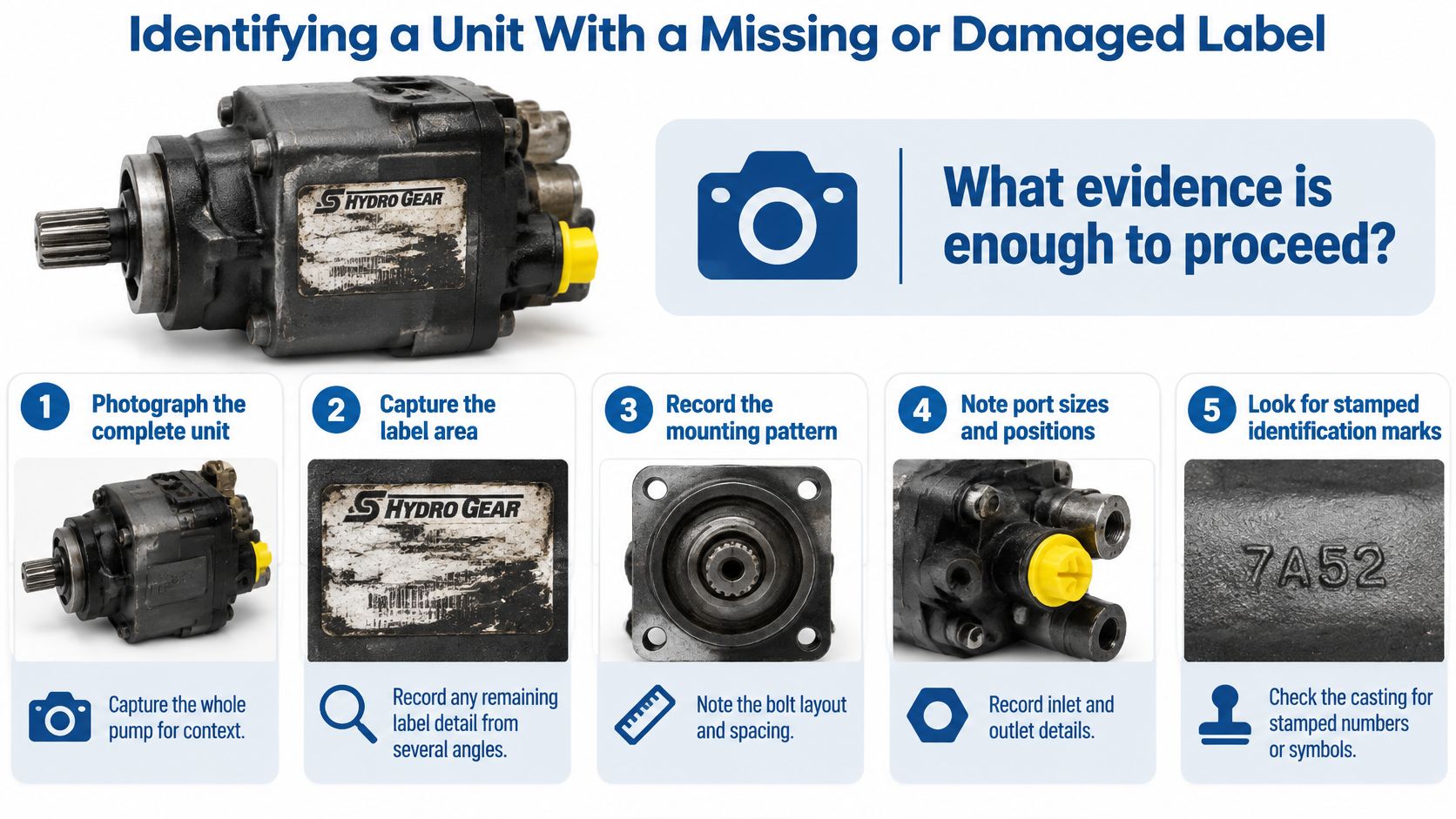
Six photographs cover most cases:
- Complete unit from four sides. Context matters, because cable routing, guard clearance and hose runs tell a supplier which build you have.
- Shaft end, square on. Shaft diameter, key or spline form and length from the mounting face to the shaft shoulder, all in millimetres.
- Port face. Number, position and size of ports, plus enough thread detail to identify metric, BSP or SAE.
- Mounting face. Bolt count, bolt spacing and bolt circle measurement.
- Casting marks. Any numbers or symbols cast or stamped into the housing.
- Machine plate. Make, model and serial of the vehicle, labelled as machine data rather than pump data.
What the photographs can and cannot prove
The images narrow the family and a likely revision range. They don't produce a single part number. Hydro-Gear's own support guidance is clear that the model and serial numbers on the product label are needed for specific assistance, and that service manuals carry the identification information, diagrams, parts lists, specifications and troubleshooting guidance for the model (Hydro-Gear support). Without those numbers, you're working from evidence toward a shortlist.
Three conditions make the serial number mandatory. You're ordering an assembly-level unit. The family has several revisions with different seals or charge-pump arrangements. The photographs fit more than one candidate. In each case, ordering on appearance is how a workshop ends up with a unit that bolts up and behaves differently.
Visual evidence is enough to shortlist only when a single family matches the ports, shaft and mounting pattern, and even then the measured dimensions have to be confirmed before anything is ordered.
The most expensive mistake in this work isn't a part that won't fit. It's a part that fits, runs, and quietly delivers the wrong flow or turns the wrong way.
The error to avoid is assuming the machine model identifies the Hydro-Gear unit. Mower and utility vehicle manufacturers change their own specifications between build years, and inconsistent part numbering and descriptions across the trade mean two suppliers can describe the same item differently. Send photographs and measurements, not a machine name and a hopeful tone.
Assembly Parts Versus Internal Repair Parts
The level of the part decides how much identification it needs. A complete transaxle needs the full record; a shaft seal needs the housing revision and the shaft diameter. Sorting the failure into the right level before you search saves you ordering something with the right shape and the wrong clearance.
Assembly-level and internal parts compared
| Level | Typical parts | What to identify before ordering | Main risk |
|---|---|---|---|
| Complete pump or transaxle | Whole unit with mounting and shaft | Model, serial number, mounting pattern and port layout | A near-match that changes flow, rotation or fitting |
| Shaft seals and O-rings | Seal kits | Revision, housing and shaft diameter in mm | Leaks from a kit made for another housing |
| Gear set and bearings | Gears, bushings and bearings | Displacement, gear count and bore size | Parts that look alike but differ in clearance |
| End cover and thrust plates | Covers, plates and fasteners | Port face, plate material and bolt pattern | Wrong thrust plate causing early wear |
| Charge pump or control components | Charge gears, control arm and linkage | Control-arm arrangement and charge-pump configuration | Functional incompatibility despite a matching appearance |
Complete pumps carry the whole identification burden, and the risk isn't a unit that refuses to bolt up. It's a unit that fits the bolt pattern and then turns the wrong way, or delivers a flow rate the circuit was never sized for.
Seals are the opposite case. A kit is cheap to hold and easy to get wrong, which is why a set made for the wrong housing revision can sit on a shelf for years. What decides it isn't the model number, it's the shaft diameter in millimetres and the housing it was moulded to fit.
The middle levels, where appearance misleads
Gear sets and bearings need displacement, gear count and bore size to match. Two gears that look identical on a bench can differ in clearance by enough to change how the pump behaves from cold, and clearance isn't something you can eyeball.
Thrust plates and end covers are where port face, plate material and bolt pattern converge. Fit the wrong plate and the unit may run, briefly, before wear starts exactly where you don't want it.
Charge-pump and control components are the level where appearance is least trustworthy. Control-arm arrangement and charge-pump configuration differ between units that share a housing casting, and the mismatch shows up as a function that doesn't work rather than a part that doesn't fit. When the failure sits at complete-unit level, matching group size, displacement and port options against our external gear pumps range is quicker than working back from a machine model.
Decide which row the failure sits in before you search. That choice sets whether you need the full serial record or a single dimension check.
Reading Service Manuals and Exploded Diagrams
A service manual is the nearest thing to a factory witness statement: identification information, diagrams, parts lists, specifications and troubleshooting guidance for one model. It's only worth anything if the edition matches the unit on the bench.
Work in this order.
- Check the edition and serial range first. A manual printed before a revision won't carry the later part numbers, and the diagrams will look almost right.
- Find the exploded view for the exact model. Not the nearest model, not the one with the same housing shape.
- Match each item number to the parts list. Read across the row, not just the number, because the same item position can carry different parts.
- Note quantity per assembly. Ordering one seal when the unit takes two is a second delivery and a second strip-down.
- Read the footnotes. Superseded part numbers, revision markers and parts sold only as assemblies all hide in small print under the list.
Say item 14 appears under two part numbers, one up to a serial break and one after. Choosing without checking the serial is a coin toss, and the diagram won't warn you.
A diagram that looks right and a diagram that is right are two different documents. Only the serial range tells you which one you're holding.
Resist the urge to use the closest diagram from a nearby model. Housings get reused, internals don't. Record the manual edition and its date in full, such as 6 August 2025, next to the part list, so the next person knows which document the numbers came from.
Cross-reference by function and fit, never by appearance. A part that sits in the same position in a similar drawing is not evidence of anything.
Checking Cross-References Against Dimensions and Ports
Rotation is the mismatch that costs the most returns. A candidate with the right displacement, the right shaft and the right port size will still destroy itself if it's built to turn the other way, and the photograph won't show you.
Take the measurements in the order a fitter would, with the original and the candidate side by side.
Cross-reference acceptance checks
| Check | Unit |
|---|---|
| Shaft diameter and key or spline form | mm |
| Bolt circle and mounting spacing | mm |
| Port size and thread standard (metric, BSP or SAE) | mm or thread form |
| Displacement | cm³ per revolution |
| Maximum rated speed | rpm |
| Maximum working pressure | bar |
| Rotation as seen from the shaft end | clockwise or anticlockwise |
| Unidirectional or reversible | type |
Legacy imperial dimensions need converting on the record, not in your head at the bench. A 3/4 inch port measures 19.05 mm, so write the metric figure alongside the imperial one and let both travel with the order.
Ports and thread forms cause the second commonest failure. Matching the shaft but not the port face gives you a unit that fits the drive and leaks at the hose end, or needs an adaptor that wasn't in the plan. Our hydraulic fittings types reference is useful when you're identifying a thread form from a hose tail rather than a drawing.
Why the speed and pressure rows matter more than they used to
Machines have grown more demanding even as volumes have fallen. The Agricultural Engineers Association reports 10,241 UK registrations of tractors above 50 horsepower in 2024, down 13% on 2023, while average tractor power rose to 179.7 horsepower from 173.9 (AEA tractor statistics). Fewer, more powerful machines mean higher flow and pressure demands on the same pump envelope, so a candidate that met the original specification twenty years ago may not meet the machine in front of you.
A candidate passes only when every measured dimension matches within tolerance and its rated speed and pressure meet or exceed the original. Anything less is a proposal, not a match, and it stays unproven until it runs on the machine under load, warm, with filter differential pressure holding steady.
Symptoms That Point to a System Fault
The assumption most engineers arrive with is that the pump has failed. Often the pump is only the messenger. Noise, heat and lost output frequently start in the circuit feeding the pump, and a new unit dropped into a restricted or contaminated system will reproduce the fault within days.
Symptoms, likely system causes and checks
| Symptom | Likely system cause | Check before ordering |
|---|---|---|
| Whining or rattling noise | Cavitation or aeration from low inlet supply | Inlet restriction, fluid level and air in the line |
| Overheating | Low fluid, blocked filtration or wrong viscosity | Oil level, filter differential pressure and fluid specification |
| Loss of output or slow response | Worn gears, internal bypass or relief setting | Pressure at test ports, relief setting and leakage path |
| Metal debris on magnet or filter | Contamination or internal wear | Oil sample against the ISO 4406 target and filter media inspection |
| Leaking shaft seal | Shaft wear, misalignment or over-pressure | Shaft runout, alignment and pressure rating |
| Repeated failure after a new unit | Shared system fault rather than the part | Filtration, fluid, cooling and alignment before refitting |
What the oil sample tells you
Fluid cleanliness is a parts-selection parameter, not a housekeeping detail. Check the system against BS ISO 4406:2021, the UK implementation of the contamination-coding standard, which reports particle contamination in three cumulative size bands where each code increment represents roughly a doubling of particle quantity (BSI on BS ISO 4406:2021).
Capture a pre-repair oil sample before anything is stripped, inspect the magnetic debris and cut open the filter media. Abnormal wear on gear journals, bushings, thrust plates and shaft seals points at contamination rather than a defective replacement part, and that distinction changes what you order. Flush the circuit, then confirm the post-repair particle count against the original manufacturer's target before the machine goes back to work.
A replacement pump fitted into a system still carrying debris or running hot is a rehearsal, not a repair.
The order of work is fixed: system check first, parts order second. Skipping it turns a £90 seal kit into a second pump.
Weighing Repair Against Replacement Cost and Downtime
Repair or replace comes down to seven questions, asked in order. Is the failure internal or external? Have contamination and the system causes been cleared? What condition are the housing and shaft in, including cracks, scoring and worn splines? Does a verified parts list exist for the exact revision? How many hours does a strip and rebuild take against fitting a complete unit? Do warranty terms survive a rebuild? What does a day of downtime cost?
The last question usually settles it. Say a hire fleet loses £450 a day while a mower sits idle (an illustrative figure). A same-day seal kit beats a three-day wait for a complete unit, provided the housing is sound and the shaft isn't scored through the seal land.
UK manufacturing research shows the exposure: 83% of manufacturers reported maintenance delays because parts were unavailable or had long lead times, 68% suffered unplanned downtime in the previous year, and an average 22% of spare-parts inventory was already obsolete (Controls, Drives & Automation).
Stocking generic seals or complete units isn't resilience by itself. Wrongly identified stock becomes part of that obsolete share while the item you need is still missing. Where a unit is beyond a seal kit, price our hydraulic pump repair service against replacement before writing it off.
The rule is short. Repair when the housing and shaft are sound, the parts list is verified and the system is clear. Replace when the housing or shaft is damaged, or when the repair kit can't be identified with confidence.
How to Isolate the Pump Safely Before Removal
A parked machine can still contain hazardous pressure. Escaping hydraulic fluid can penetrate skin and cause injuries requiring major surgery or amputation. UK HSE guidance recommends shut-off and drain provisions for safe maintenance and points to BS EN ISO 4413 for hydraulic-system general rules (HSE on hydraulic fluid safety). Isolate the system before loosening any connection.
Follow this sequence before removing the pump:
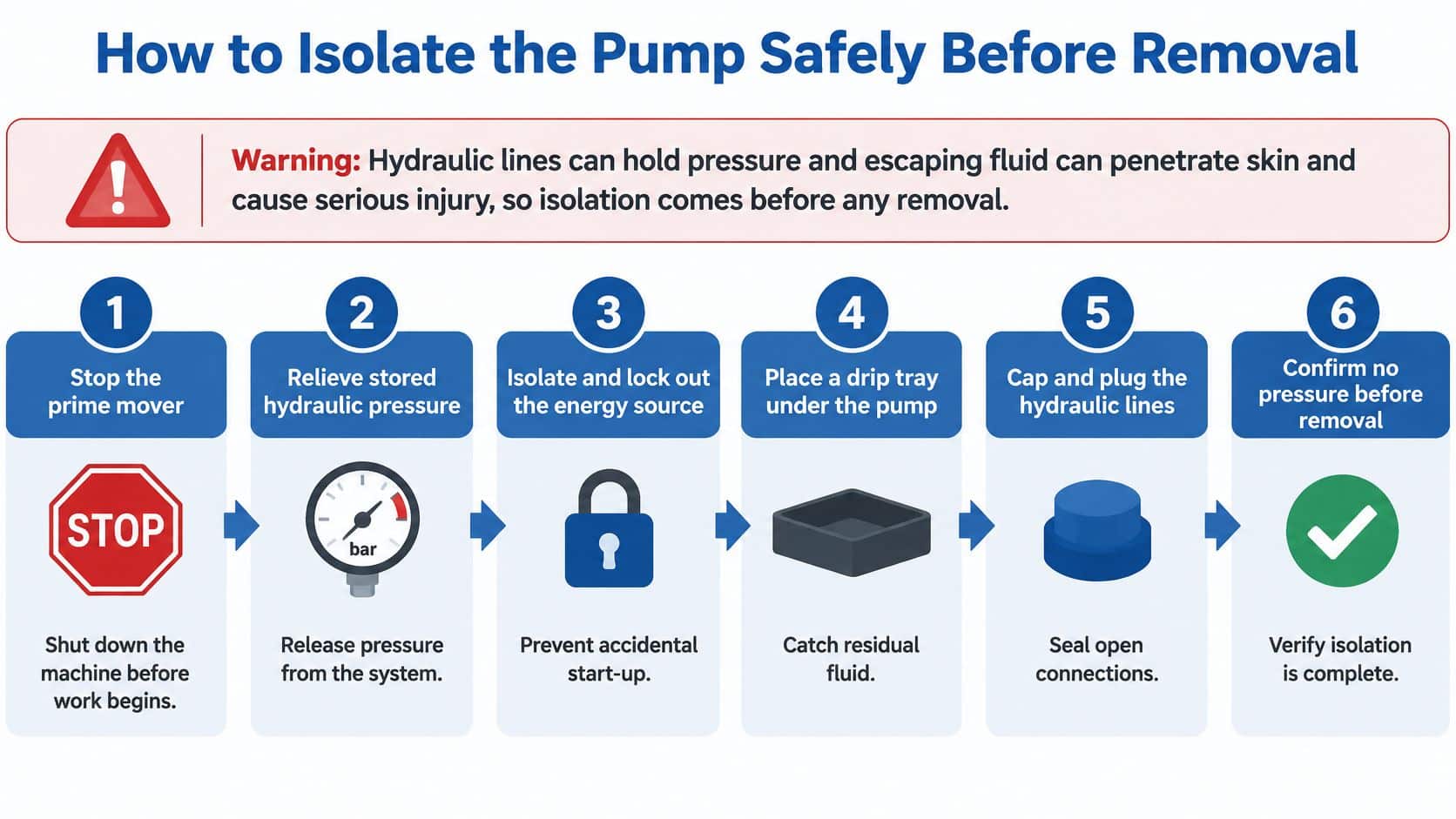
- Stop the prime mover. Remove the key or isolate the battery, then tag the controls so nobody can start the machine.
- Support raised loads mechanically. A deck, lift arm or implement held only by hydraulic pressure may drop when a line is opened.
- Shut off stored energy. Close shut-off valves on the lines, or drain the reservoir if no valves are fitted.
- Verify zero pressure at the relevant ports. Check at the ports, not only at the reservoir. Pressure can remain trapped between valves.
- Wear gloves and eye protection. Never search for a leak with your hand. A pinhole jet can cause severe injury without being easy to see.
- Cap the ports and lines. Keep dirt out during removal and rebuilding. Contamination can damage the replacement unit before it turns.
Recommissioning checks that catch a wrong unit
Before fitting a replacement, compare its displacement and rated speed with the original. Displacement sets theoretical flow. Excessive speed or inadequate inlet supply can cause aeration, cavitation and noise, followed by gear and bearing damage.
Start at low load. Check for leakage, confirm suction integrity and shaft alignment, and monitor temperature, noise and filter differential pressure. Increase the load gradually.
The video shows the sequence on a working machine:
GOV.UK publishing guidance requires a text alternative to video content. Captions and a short transcript help viewers follow details such as port markings, shaft form and plate information, including on noisy sites where the sound is off.
Confirm the Part Number Before You Order
Treat the order as confirmed only when the identification record is complete, with unknown fields marked, and label photographs and the manual edition recorded. Check any cross-reference against the original unit's measured details, not just a list of equivalents. Record the suspected system fault and confirm it has been addressed before ordering; otherwise, a replacement pump may face the same conditions. A guess can cost a delivery, a fitting slot and another attempt.
Send the record and photographs with your enquiry, rather than relying on a part name alone. Include the measurements and any cross-reference you are considering so MA Hydraulics can help with product sourcing, component selection and technical advice. The company supplies hydraulic components and can source equipment from major manufacturers.
MA Hydraulics Ltd supports customers by phone or email and supplies pumps, valves, gearboxes and power packs. Contact the team with the photographs and measurements attached, and ask them to check the identification before you order. Visit MA Hydraulics Ltd to view its range of pumps, valves, gearboxes and power packs.
