
A Saturday breakdown rarely starts with a dramatic bang. More often, a cylinder slows, a pressure gauge wanders, or a valve stops responding, and the maintenance team discovers that the replacement part on the shelf doesn't match the machine in front of them. By then, production has already started losing time.
That's where after-sales service for hydraulics earns its place. It covers far more than warranty paperwork. It includes accurate spares identification, technical diagnosis, emergency response, service records, planned maintenance, training and a supplier who understands the difference between a failed component and the cause of the failure.
UK consumer law provides an important baseline for faulty goods, but industrial hydraulic support depends just as heavily on the contract, the asset information and the supplier's ability to act. The practical question is simple: when a press, power pack or lift circuit stops working, can your supplier help you get it running safely and correctly?
When the Phone Rings on a Saturday Morning
At a Midlands food-processing plant, the maintenance supervisor takes a call from the shift leader on Saturday morning. The main press cylinder on Line 2 has dropped pressure. Output has halved, and three palletisers are standing idle downstream.
The first ten minutes are disciplined rather than heroic. The supervisor checks the reservoir level and looks for obvious leaks around the cylinder, hoses and manifold. The level is acceptable, but the pump is making the wrong noise. Once the guard is removed safely, the team finds a scored pump housing. The pump has been damaged internally, so replacing a seal or tightening a fitting won't restore pressure.
The spare on the shelf appears to be the same size. It isn't the same generation. The port arrangement is different, the drive details don't match and the displacement marking doesn't correspond with the original unit. Fitting it would mean modifying the circuit under pressure, with no certainty that the control valve or motor would tolerate the change.
The supervisor dials the supplier's out-of-hours line. What happens next tells him whether he bought a component or established a service relationship. A useful response starts with the machine details, pump code, photographs, operating symptoms and safe isolation status. It doesn't start with a generic promise to call back.
Practical rule: A hydraulic emergency needs a technically competent first conversation, not just an order number.
The supplier may need to cross-reference an obsolete pump, identify a compatible current model, check shaft and port specifications, locate a replacement, arrange an engineer and advise the plant on a safe temporary operating plan. If those steps aren't organised, a Saturday shift can disappear while people repeatedly describe the same fault to different departments.
That incident raises the wider issue. What separates a supplier who can rescue a Saturday shift from one who took the original order? The answer lies in how the supplier handles the entire period after delivery.
What After Sales Service Really Means in Industrial Hydraulics
In ordinary consumer terms, after-sales service means the support provided after purchase. That might include warranty repairs, returns, replacement goods, installation advice or help with a product that doesn't work as expected. The sale is the transaction, but the service determines whether the customer can use what they bought and whether they trust the supplier afterwards.
Hydraulics changes the scale of the problem. Returning a faulty kettle to Argos is inconvenient. Replacing a pump, proportional valve or bespoke power pack on a production machine can stop a process, delay orders and expose the maintenance team to pressure from operations. Hydraulic after-sales support is less like returning a household appliance and more like having a specialist mechanic available for a commercial vehicle fleet. The supplier needs to understand the equipment, the duty cycle, the installation and the consequences of getting the diagnosis wrong.
The UK Customer Satisfaction Index has run since 2008 and acts as a national barometer of customer satisfaction. Its July 2026 score was 78.3 out of 100, one point higher year on year and 0.1 points above January 2026, as reported by the Institute of Customer Service UKCSI. The relevance to industrial support is practical. Customers judge service through contact, communication, fault handling and the quality of the outcome, not through the original quotation alone.
The legal floor and the commercial contract
For business-to-consumer sales, the Consumer Rights Act 2015 establishes important rights when goods are faulty. A consumer has a short-term right to reject faulty goods and receive a full refund within 30 days of purchase or delivery. After that, the trader will usually have one opportunity to repair or replace the goods before other remedies apply, according to the UK Parliament briefing on the Consumer Rights Act.
Those statutory rights shouldn't be confused with a voluntary warranty. If a consumer requests or agrees to a repair or replacement, the 30-day rejection period pauses during the waiting period, as explained in the Consumer Rights Act explanatory notes. A repair or replacement must also be completed within a reasonable time, without significant inconvenience and at no cost to the consumer, including necessary labour, materials and postage, under the statutory remedies provisions.
Commercial hydraulic purchases are normally governed by negotiated terms, specifications, warranty clauses and service agreements. Even where consumer legislation doesn't directly govern the transaction, the same discipline remains useful. Define the responsibility, record the fault, state the response and document the fix.
That wider principle is also explored in why post-close experience matters, particularly where the relationship continues after the invoice has been paid.
The Six Building Blocks of a Strong After Sales Setup
A reliable setup has six connected parts. None works properly in isolation. A warranty without spares leaves a customer with a right but no working machine, while emergency response without technical records can produce a fast but incorrect repair.
| Building Block | What It Delivers | Evidence a Serious Provider Shows |
|---|---|---|
| Warranty | Clear coverage for parts, labour and defined exclusions | Serial-number records, claim forms and written decisions |
| Spare parts | Correct replacement components, including obsolete and cross-referenced items | Stock records, compatibility notes and dispatch history |
| Emergency response | A route to technical help when a breakdown threatens production | Call-out logs, engineer allocation and arrival records |
| Maintenance contracts | Planned intervention before contamination, wear or leakage becomes a failure | Visit reports, fluid samples and replacement schedules |
| Training | Safer operation and better fault diagnosis by plant personnel | Attendance sheets, course content and training records |
| Technical support | Drawings, circuit guidance, fitment checks and retrofit advice | Marked-up schematics, revision-controlled documents and support notes |
Warranty must be readable at the point of failure
A warranty should identify the covered component, the applicable period, the evidence required and the exclusions. Contamination, incorrect installation, unsuitable fluid, overload and unauthorised modification may all affect a claim, but hiding those conditions in dense wording creates disputes. A service provider should be able to explain whether the claim concerns a manufacturing defect, a fitment problem or a wider system fault.
Spares are an identification problem before they're a stock problem
The correct part isn't the part with the same description. A gear pump may need matching displacement, rotation, shaft, flange, port configuration and pressure capability. A valve may need the correct spool, coil voltage, mounting pattern and control signal.
Cross-referencing across brands matters when an original component is obsolete or unavailable. For a plant team, MA Hydraulics stock availability is relevant to that practical decision because the maintenance engineer needs to know what can be sourced, matched and supplied, not merely what appears in a catalogue.
Emergency response needs people and records
An out-of-hours phone line is useful only if the person answering can triage the fault or reach someone who can. Capture the asset identity, symptoms, pressures, photographs, operating conditions and isolation status at first contact. A missed call can also become a service failure, so teams reviewing continuity arrangements may find this guidance on a small business missed call solution useful for thinking about call routing and escalation.
Maintenance contracts should define scheduled visits, fluid sampling, filter checks and planned component replacement. Training should separate operator awareness from technician-level diagnosis. Technical support should include circuit diagrams, power-pack documentation, retrofit guidance and fitment confirmation, with every revision recorded.
A serious provider leaves a paper trail that another engineer can use at three o'clock in the morning.
KPIs and SLAs That Hold a Supplier to Account
“Rapid support” means little until the contract starts the clock. Does response time begin when an email arrives, when a purchase order is raised, or when a named engineer accepts the call? A useful Service Level Agreement defines the trigger, the priority and the action required.
For each asset, record the part number, site location, criticality, operating hours and the person authorised to request support. The supplier should then report measures that reflect the failure path. A first response is not a diagnosis, and an engineer arriving on site does not mean the machine is producing again.
| KPI | What It Measures | Typical SLA Threshold |
|---|---|---|
| Warranty resolution period | Time from accepted claim to agreed corrective action | Defined by component criticality and contract |
| Spare-parts availability | Whether agreed critical items can be supplied when needed | Agreed stock level and replenishment rule |
| Emergency response time | Time from logged incident to technical response or attendance | Written hourly target for each site |
| First-time-fix rate | Whether the first intervention resolves the recorded fault | Reviewed by asset and fault type |
| Planned maintenance completion | Whether scheduled visits occur as agreed | Completion against the approved service calendar |
| Training delivered | Whether agreed instruction reaches the nominated staff | Recorded hours, attendees and outcomes |
The UKCSI offers a broader comparison point for service operations. It covers 277 organisations across 13 sectors and is published twice a year. Maintenance and procurement teams can use that context alongside their own service records, as outlined in UK service and repair insights.
The measures that matter during a breakdown
A hydraulic service contract should define the following measures:
- Call-out time: State the maximum time in hours for each site and priority.
- First-time-fix rate: Separate faults resolved at the first visit from cases needing investigation or special-order parts.
- Uptime percentage: Define the equipment boundary, planned exclusions and calculation period.
- Penalty credit: Set a service credit for a verified breach, rather than relying on goodwill.
- Stock verification: Give the customer the right to check agreed critical spares and replenishment records.
Warranty wording also needs a practical route to resolution. State what evidence is required, who confirms whether a claim is accepted, and when corrective action must be agreed. A clear warranty coverage process prevents a failed pump or power-pack component from becoming an argument between the plant, installer and supplier.
Do not choose KPIs because they look impressive on a dashboard. The test is whether the measure changes behaviour on the shop floor. Guidance on beyond vanity metrics in support is useful because a fast first reply can conceal slow diagnosis, repeated hand-offs or a return visit for the wrong part.
A quarterly review should examine call-out logs, repeat failures, parts delays, warranty decisions, first-time fixes and maintenance findings. Compare the supplier's report with actual service records, job sheets and production interruptions. Give the customer audit rights and require agreed corrective actions with owners and dates. An SLA without that evidence is wallpaper.
Best Practice for Procurement and Maintenance Teams
Procurement teams often compare hydraulic suppliers on price and delivery date, then discover later that the cheapest route has no useful cross-reference data, no local technical contact and no defined response outside office hours. Maintenance engineers pay for that decision when a replacement arrives with the wrong shaft, port pattern or control specification.
The buyer's first task is to define the assets before requesting support. Build the register around the machine, not just the component. Include power-pack drawings, pump and valve codes, cylinder details, motor data, fluid type, filter elements, photographs and the production consequence of failure.
| Generic distributor support | Specialist industrial supplier support |
|---|---|
| Moves standard boxes against catalogue descriptions | Matches components to the installed circuit |
| May offer limited application discussion | Can review drawings, fitment and operating conditions |
| Treats obsolete codes as a sourcing problem | Cross-references obsolete parts against current alternatives |
| Provides a replacement component | Can support bespoke power packs and the wider repair decision |
| Leaves maintenance to the plant | Can combine spares, technical advice and service planning |
A specialist such as MA Hydraulics can support bespoke power packs, specific spares, component cross-referencing and engineered replacement decisions. That doesn’t remove the buyer’s responsibility to specify the system properly, but it gives the maintenance team a technical route when a standard catalogue answer isn’t enough.
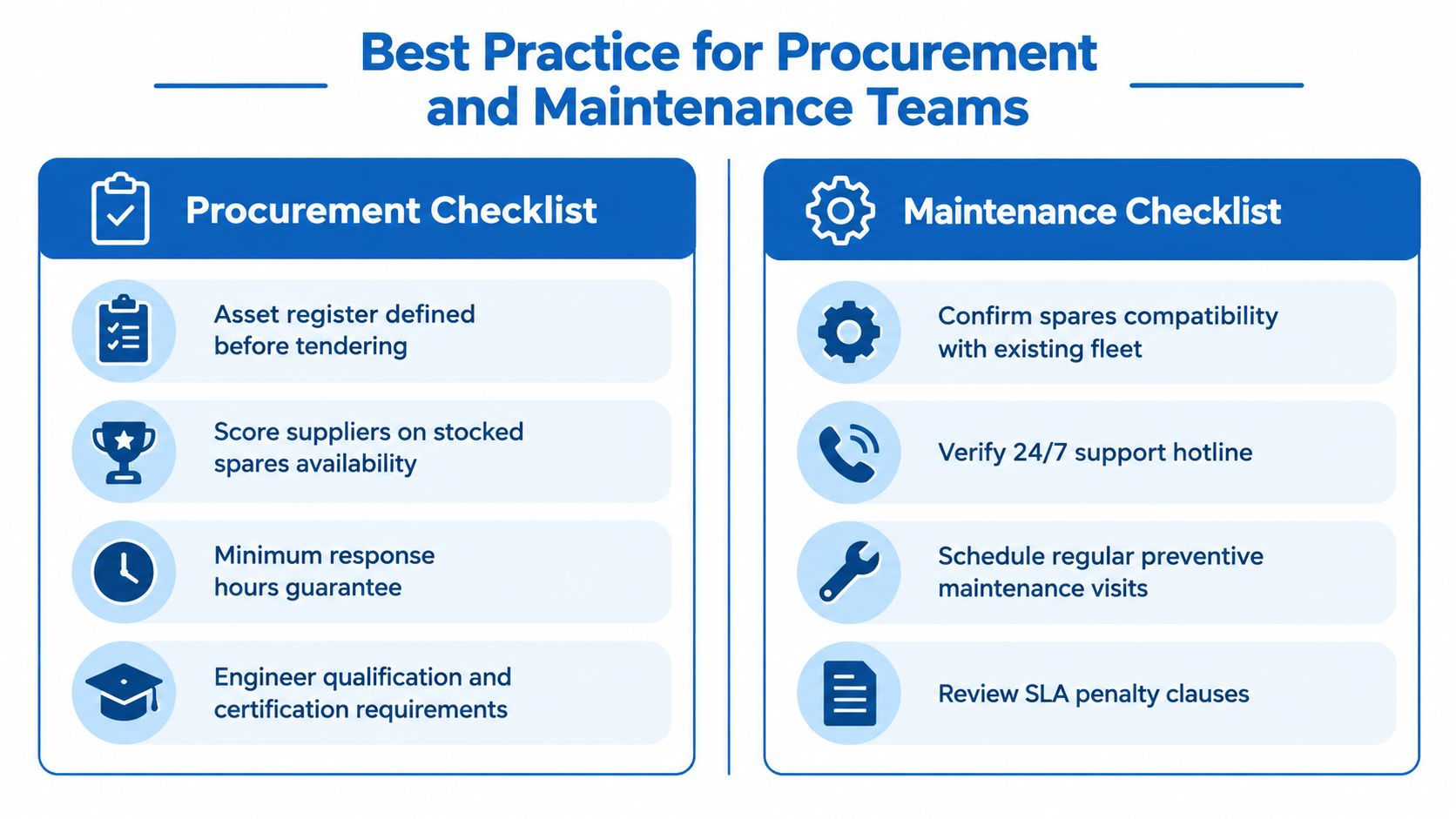
Procurement checklist
- Define the asset register: List critical machines, installed components, drawings and site locations before tendering.
- Score stocked spares: Ask which critical pumps, valves, filters and seals are held, how stock is checked and how replenishment works.
- Set response hours: Specify phone coverage, escalation stages and attendance expectations for each priority.
- Check engineer competence: Request evidence of relevant hydraulic experience, training and safe working arrangements.
- Test warranty handling: Ask for a sample claim process, required evidence and expected decision route.
- Name the contact: Put a named account contact and technical escalation route into the agreement.
- Demand sample reports: Review anonymised call-out records and service reports before awarding the work.
Maintenance checklist
Keep critical spares physically identified and protected from contamination. Log every failure against the asset register, photograph stripped components before disposal or quotation, and record pressure, temperature, fluid condition and filter status where safe to do so. Use the preventive maintenance checklist from MA Hydraulics as a prompt for turning routine inspection into recorded work.
Poor service discipline is expensive. The Institute of Customer Service reported that service failures and resulting complaints cost UK organisations about £7.3bn a month and take around four working days a month to fix, as described in its Green Shoots Recovery findings. In a plant, that waste appears as waiting, chasing, rework and production that never resumes when expected.
A Worked Example From a UK Production Line
A Midlands food-packaging line loses pressure on a hydraulic press on a Wednesday afternoon. The press stops mid-cycle, the line shuts down and the shift manager escalates because orders are already moving through the schedule.
The maintenance team doesn’t start by ordering the nearest-looking valve. It checks the asset register, opens the power-pack drawing and confirms that the unit is a bespoke MA Hydraulics assembly. The named contact receives the asset reference, photographs, pressure readings and the fault history, giving the supplier enough information to begin diagnosis without forcing the plant to repeat the basics.
The service agreement contains a four-hour response target for this site. Within that agreed period, an engineer attends and confirms that the proportional valve has failed. The engineer checks the electrical command, hydraulic contamination indicators, mounting arrangement and valve code before selecting a replacement. A current part is cross-referenced against the installed unit and stock is confirmed.
The response still involves a trade-off. The replacement is dispatched the same day under the agreed warranty process, but a loan valve is used to bridge production while the claim and permanent replacement are completed. That temporary measure is controlled, documented and checked for compatibility. It isn’t an improvised bypass that leaves the machine operating outside its design conditions.
Finding the reason for the failure
The failed valve isn’t treated as the whole story. Inspection shows contamination linked to a poorly maintained filter. Replacing the valve without correcting filtration would risk another failure, so the maintenance contract is invoked to schedule quarterly filter checks and fluid analysis.
The plant records the warranty claim, costs the downtime, updates the asset history and books a refresher session for fitters. The training focuses on contamination control, filter condition, valve identification and the evidence required for future diagnosis.
At the next quarterly meeting, the supplier and plant review attendance against the SLA, the first-time-fix outcome, parts handling, warranty progress and the maintenance action. The meeting isn’t a ceremonial presentation. It tests whether the agreed process worked and whether the filter problem was addressed.
That is the difference between structured after-sales service and reactive purchasing. The contract gives the team a route to diagnosis, a controlled temporary option, a documented replacement and a corrective maintenance action. It gives the shift manager a defined recovery instead of an open-ended chain of phone calls.
Checklists, Takeaways and How to Get in Touch
Use the first checklist when evaluating an after-sales offer. A supplier that can’t answer these points clearly will struggle when the plant is under pressure.
Procurement checklist
- Response times: Record the technical response and site attendance targets for each priority.
- Spares guarantee: Identify critical stock, cross-reference arrangements and replenishment responsibilities.
- Warranty terms: Define covered parts, labour, exclusions, evidence and claim decisions.
- Engineer qualifications: Confirm relevant hydraulic experience, training and site safety competence.
- SLA penalties: Include escalation routes, review dates, audit rights and service credits where appropriate.
- Training inclusion: State who receives operator and technician training, what it covers and how attendance is recorded.
Maintenance checklist
- Daily checks: Inspect fluid level, visible leakage, unusual noise, temperature and pressure indications.
- Filter schedule: Record filter changes and investigate blocked or bypassed elements rather than treating them as routine waste.
- Oil sampling: Agree sampling points, handling method and review responsibility with the service provider.
- Seal and hose inspection: Look for abrasion, bulging, cracking, damaged fittings and movement at clamps.
- Logbook discipline: Record the asset, symptom, intervention, part fitted, test result and follow-up action.
- Spare verification: Check that shelf stock matches the current machine generation, not just the old description.
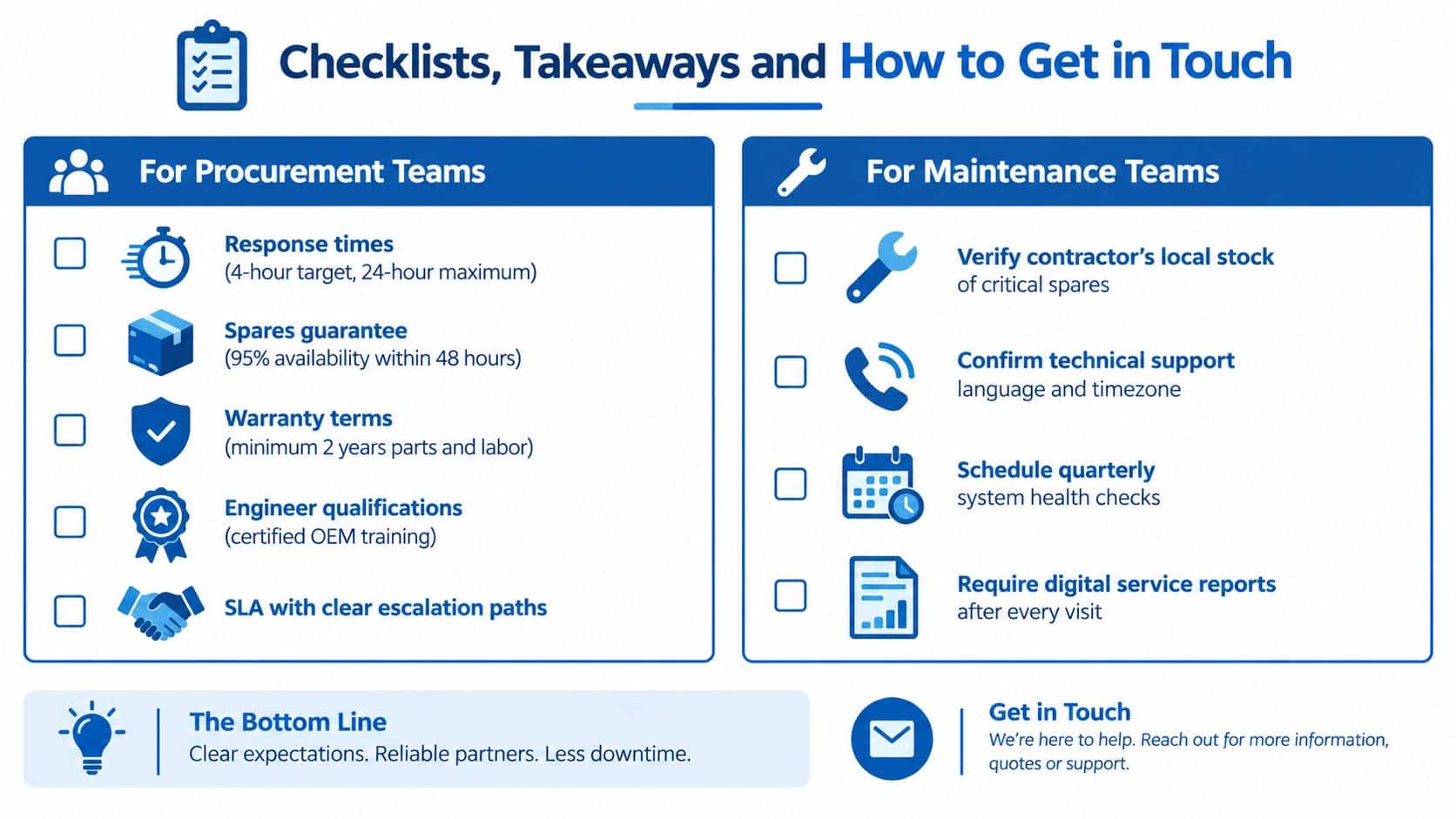
Three points deserve to stay on the noticeboard. After-sales support matters as much as the original hydraulic specification. KPIs need contractual definitions, not optimistic wording. A specialist supplier usually offers more useful depth than a general distributor when the issue involves bespoke assemblies, obsolete codes or system diagnosis.
MA Hydraulics Ltd can help with hydraulic spares, bespoke power-pack support, component cross-referencing, fitment questions and service agreements. Phone 01724 279508 today, or send a message through the MA Hydraulics Ltd contact page to discuss the equipment that needs dependable support after the sale.
MA Hydraulics Ltd supplies hydraulic components, supports bespoke power solutions and helps maintenance teams resolve difficult spares and fitment questions before they become prolonged stoppages. Visit MA Hydraulics Ltd to discuss spares, power-pack support, cross-referencing or a service agreement built around your plant.
