

A tractor is waiting beside the farm bowser, the tank is low, and the operator needs a clean refuel before the next field job. The pump starts, but the hose is too long, the filter restricts suction, and the motor overheats while the nozzle is held closed. What looked like a simple flow-rate purchase has become lost time, avoidable wear and a possible spill risk.
Diesel transfer pumps work best when they're selected as part of a complete fuel system. The bulk tank, bund, suction pipe, filter, hose, nozzle, electrical supply and operating routine all affect the result. A pump that performs well on a short workshop hose may struggle when mounted on a mobile bowser or asked to lift fuel from a low tank.
This guide is written for UK farms, fleet workshops, mobile plant operators and technicians who need practical answers. It uses metric units and focuses on the decisions that matter in service, including pump technology, flow, pressure, duty cycle, materials, containment and maintenance. Where pricing is discussed, use GBP UK pricing from the supplier rather than treating a foreign currency example as a UK buying guide.
Introduction to Diesel Transfer Pumps in UK Agriculture and Mobile Use
A diesel transfer pump moves fuel from storage to a vehicle, machine or intermediate container. On a farm, that might mean transferring fuel from a static tank into a tractor. On a fleet site, it could mean filling vans, excavators or generators from a controlled on-site installation. A service vehicle may use a compact pump to refuel machinery away from the main yard.
The pump saves more than carrying cans or relying on gravity. It gives the operator a controlled route through a hose, filter and nozzle, while making the refuelling point easier to organise. The important word is controlled. Fuel transfer needs a suitable tank, sound connections and spill protection, not just a motor with an inlet and outlet.
UK operators also need to understand where private transfer ends and regulated dispensing begins. Guidance covering diesel storage, workplace use and dispensing can apply differently depending on the site, the volume stored and whether fuel is being supplied internally or resold. UK trading standards guidance on petroleum storage and dispensing highlights why a pump specification alone doesn't establish compliance.
Practical perspective: Choose the pump around the whole refuelling arrangement, then confirm that the tank, containment and operating controls support it.
The guide follows the order a technician would normally use. First, understand how the pump creates and delivers flow. Then compare pump technologies, size the unit around the hose route and duty, check materials and seals, and finish with installation, inspection and purchasing decisions.
That approach matters because UK fuel systems are asset-heavy and often remain in service for many years. A market report estimates the UK fuel feed pumps market at approximately £140 million to £170 million in 2026, with an installed base of 85,000 to 100,000 units and a typical heavy-duty replacement cycle of 12 to 15 years. The report covers fuel feed pumps more broadly, but its figures are relevant to diesel transfer equipment used in industrial, agricultural and fleet applications. The referenced UK fuel storage and pump market material.pdf) describes a mature market where replacement demand matters alongside new installations.
How Diesel Transfer Pumps Work and Where They Fit
Think of the system as a chain rather than a single appliance:
- The tank stores the diesel.
- The pump creates movement and pressure.
- The hose carries fuel to the work area.
- The nozzle controls delivery into the vehicle or machine.
The pump's inlet side must bring fuel from the tank into the pump. That involves suction lift, which is the vertical distance and resistance the pump must overcome before fuel reaches its chamber. A short, large-bore inlet with few bends is easier to operate than a narrow line with several restrictions.
Once inside, the motor drives the pumping mechanism. Depending on the design, vanes, gears, a diaphragm or an impeller move the diesel. The outlet side then has to overcome hose friction and any rise in height. That combined resistance is commonly described as head, and it's why a pump can deliver differently through a short hose compared with a long, coiled hose.
Key concept: Flow tells you how quickly fuel moves. Pressure and head tell you how hard the pump must work to move it through the installation.
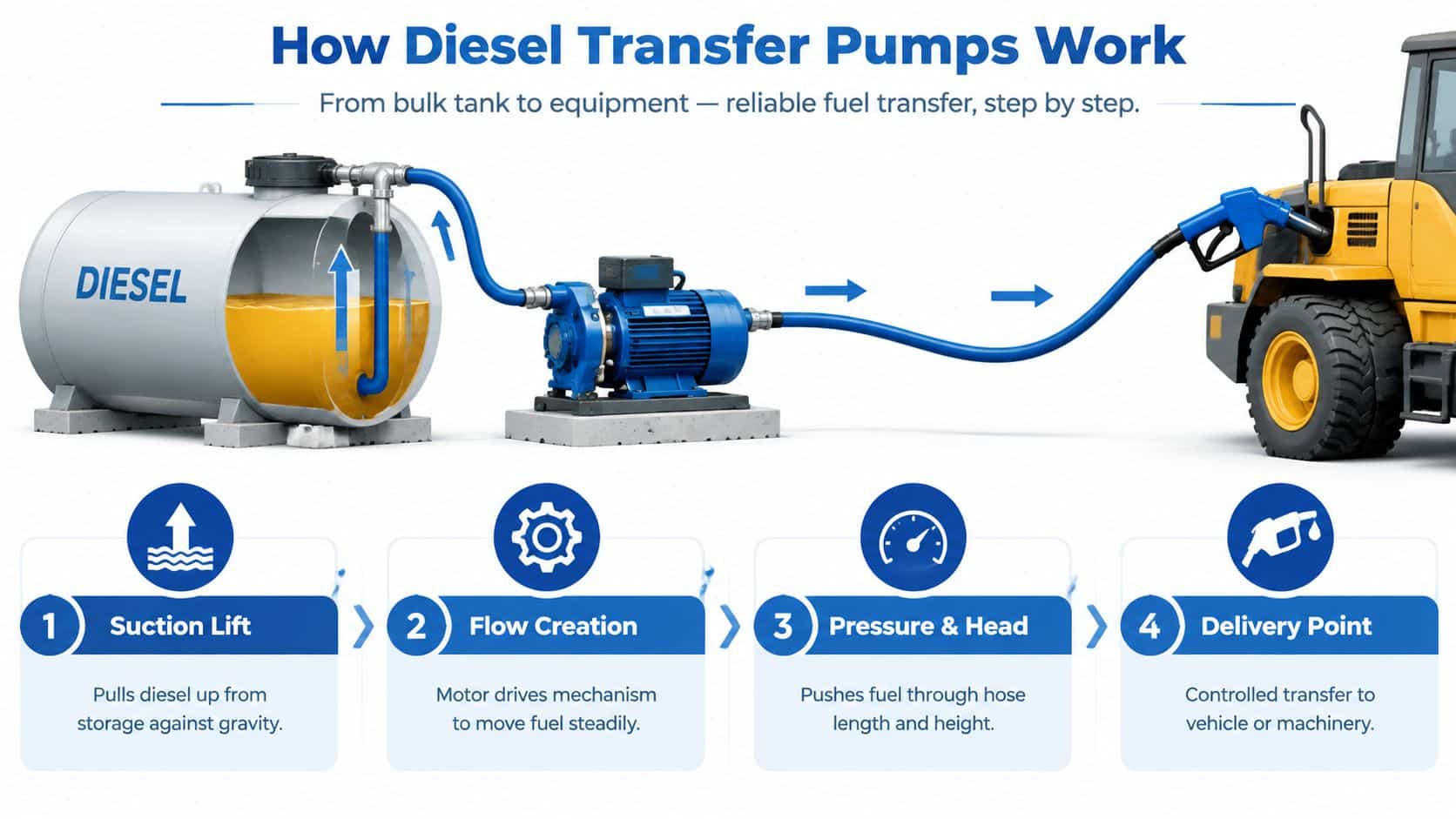
A transfer pump is intended to move diesel between storage and equipment. A dispensing pump adds the controlled outlet hardware needed for routine refuelling, which may include a meter, automatic nozzle and suitable filtration. A feed pump, by contrast, may be designed to supply fuel to another part of a machine rather than fill a vehicle tank.
Power supply changes the installation. 12V and 24V pumps suit mobile plant, agricultural equipment and service vehicles when the battery and wiring can support the load. Mains-driven units suit fixed refuelling points with an appropriate electrical installation. The voltage isn't a direct measure of pump quality. It tells you how the unit connects to the available power system.
The pump may also include a bypass route. When the nozzle closes, pressure can rise and fuel may circulate internally. That protects the system only when the manufacturer allows the operating condition and duration. A bypass isn't permission to leave the pump running against a closed nozzle.
The tank, bund, pipework and dispensing point determine whether the pump can be used safely. For UK sites, government guidance on storing oil at a home or business connects containment design to the stored container volume, not to the pump's advertised flow rate.
Types of Diesel Transfer Pump Technologies Compared
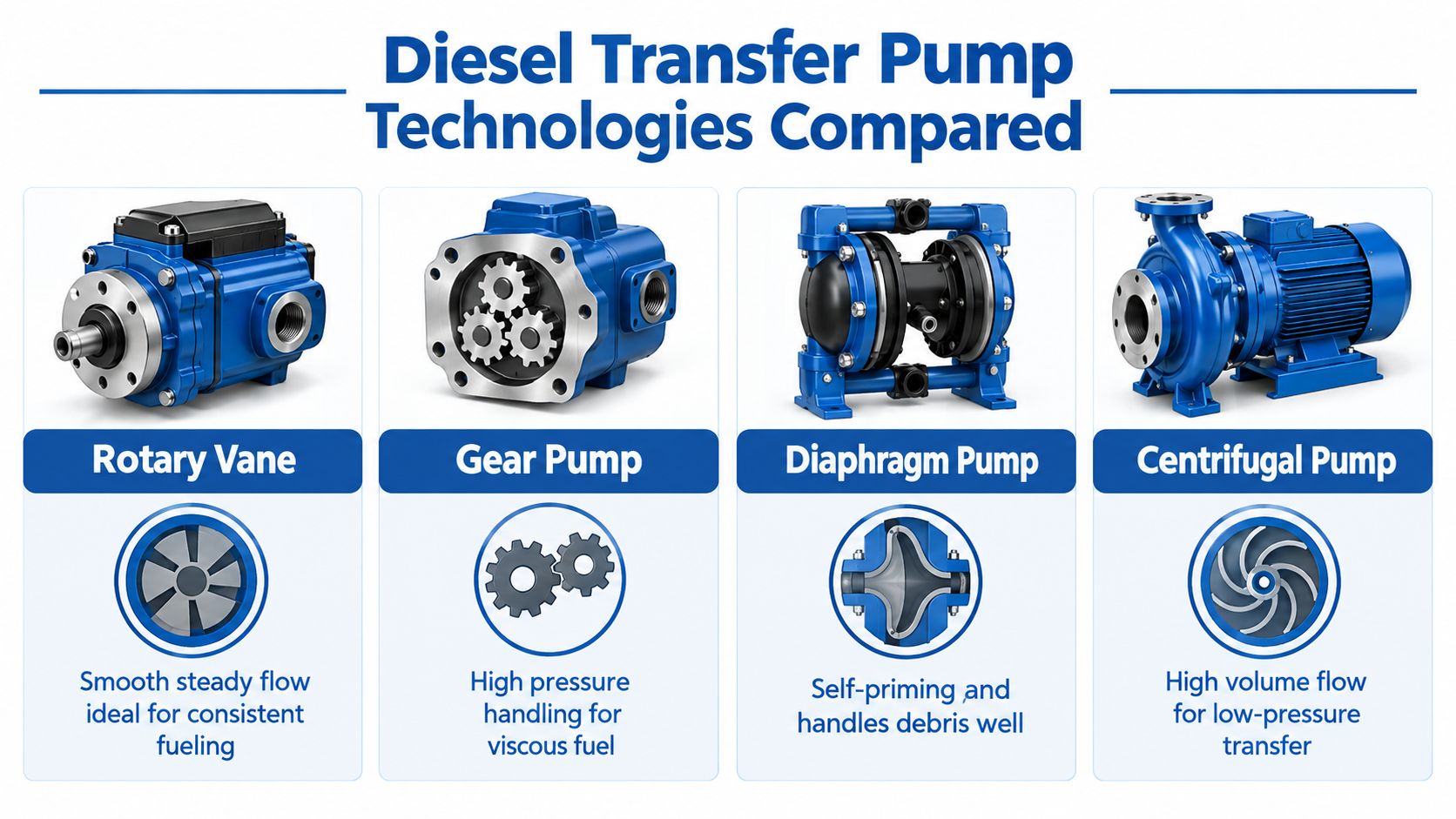
Different pump designs suit different refuelling jobs. A rotary vane unit is often chosen where the operator wants a smooth, steady delivery and a compact arrangement. A gear pump can provide useful pressure and is mechanically straightforward, but it needs clean fuel and careful attention to inlet conditions.
Diaphragm pumps are attractive where self-priming and tolerance of minor contamination matter. Their flexible membrane separates the drive mechanism from the fluid, although the diaphragm and valves remain service items. Centrifugal pumps are generally better suited to high-volume, lower-pressure movement where the installation gives them a favourable inlet condition.
| Pump Technology | Best For | Key Strength | Key Limitation |
|---|---|---|---|
| Rotary vane | Consistent vehicle and machinery refuelling | Smooth, steady flow | Vane wear and sensitivity to poor filtration can affect service |
| Gear pump | Pressurised transfer and robust fixed installations | Handles pressure effectively | Requires suitable fuel cleanliness and inlet design |
| Diaphragm pump | Mobile transfer and less predictable suction conditions | Self-priming capability and good debris tolerance | Pulsating delivery and diaphragm wear |
| Centrifugal pump | High-volume movement between tanks | Strong volume delivery at low pressure | Usually needs favourable priming and suction conditions |
The best choice depends on the job. A farm bowser used for regular tractor refuelling may favour a compact rotary vane or gear unit with proper filtration. A workshop transferring fuel between containers may prioritise self-priming and serviceability. A fixed bulk-transfer arrangement may use centrifugal equipment where the tank layout provides a short, flooded suction line.
Filtration belongs in the decision, not as an afterthought. A pump designed for clean diesel can suffer if the tank contains rust, water or sediment. Conversely, a more contamination-tolerant pump still needs a sensible filter arrangement because debris can damage the nozzle, meter and vehicle fuel system.
A meter also changes the application. If the operator only needs to move fuel, a meter may be unnecessary. If the site needs controlled issue records or repeatable dispensing, the meter becomes part of the system and adds resistance that the pump must overcome.
The following video gives a visual introduction to pump selection and transfer arrangements. Check that the embedded frame renders at the correct aspect ratio before publishing, because incorrectly sized video frames can make technical content difficult to follow.
Sizing Your Pump for Flow Rate Pressure and Duty Cycle
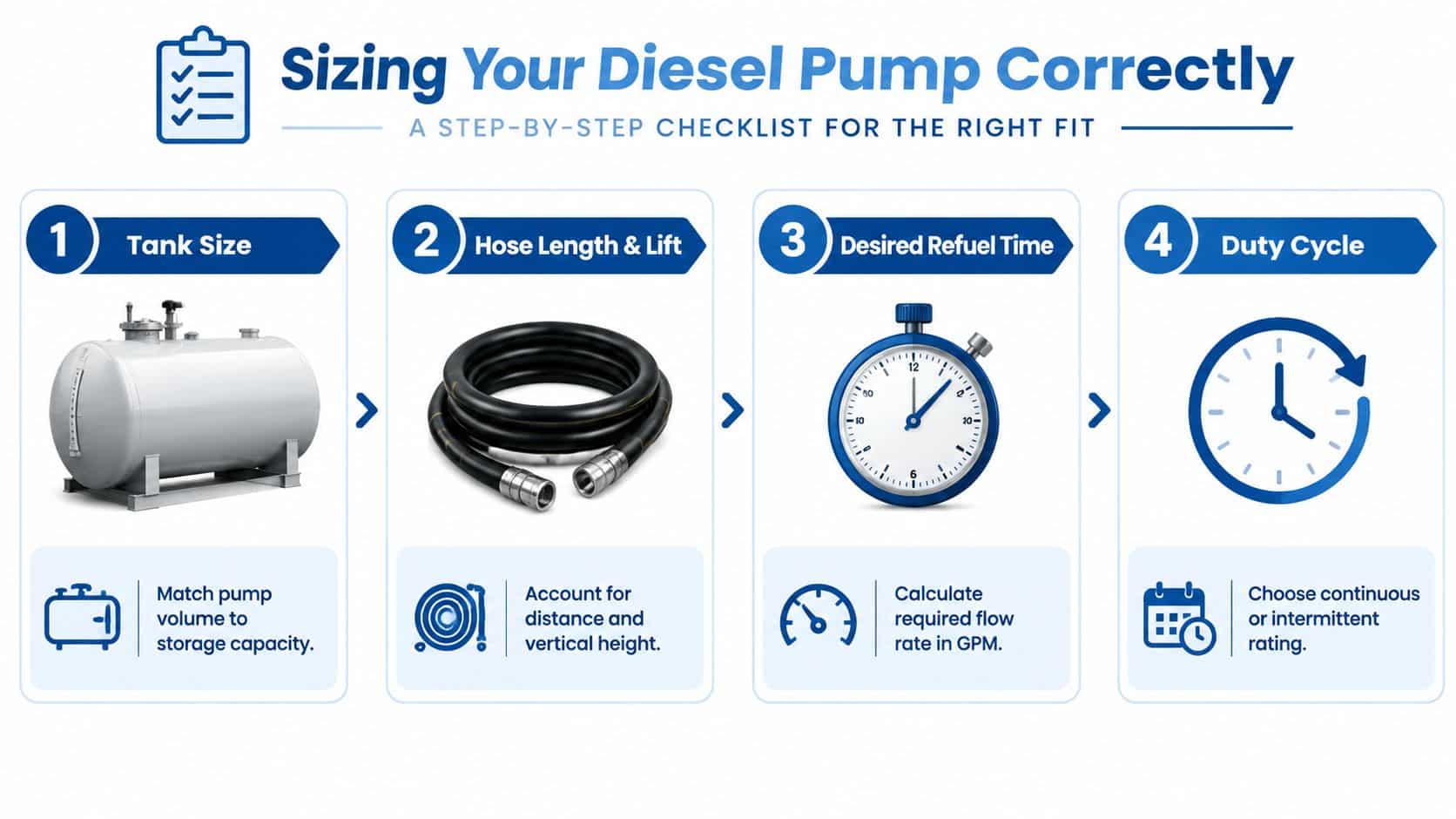
Pump sizing starts with the route the diesel must travel. List the tank position, suction lift, hose length, hose bore, filter, meter, nozzle and height of the receiving tank. Each item adds resistance, so an advertised free-flow figure won't necessarily equal the flow available at the nozzle.
Start with the work rate
Define the refuelling task in practical terms. If a fleet needs quick vehicle turnaround, the required flow will be higher than for occasional topping-up of a small machine. If the pump only transfers fuel between storage containers, the acceptable rate may be different again.
Use a simple relationship:
Required flow in litres per minute = volume to transfer in litres ÷ desired transfer time in minutes
For example, if the operator wants to move a known tank volume within a chosen time, divide that volume by the time available. This gives a target flow, not a guarantee. The pump curve must then be checked at the required pressure or head, with the actual hose and filter arrangement included.
Use this guide to read pump curves before comparing catalogue flow figures. The curve shows how delivery changes as system resistance rises, which is more useful than selecting the largest number printed in a product description.
Treat lift and restriction as real loads
A long hose, narrow bore, dirty filter or high nozzle position can reduce delivery. Keep the suction side particularly simple because the pump is pulling fuel into itself rather than pushing it. Large-bore suction pipe, secure joints and a clean strainer help protect the inlet conditions.
Avoid oversizing without a reason. A larger pump can demand more electrical power, create more pressure than the hose or nozzle needs and encourage operators to run the system outside its intended duty. Undersizing creates a different problem, with slow refuelling and a greater temptation to leave the pump bypassing against a closed nozzle.
Respect the duty cycle
Duty cycle is a hard limit on many mobile units. One manufacturer's guidance states that 12V pumps shouldn't run continuously for more than 30 minutes, while 24V pumps shouldn't run continuously for more than 15 minutes. The same guidance requires a cool-down period before operation resumes. The manufacturer's 12V and 24V pump installation guidance also warns against bypass operation with the nozzle closed for longer than 1 minute, because deadheading increases heat and can damage the pump and motor.
Check the battery voltage, cable run, connectors and fuse arrangement before choosing the unit. A pump can be correctly sized hydraulically but still perform poorly if voltage drops through undersized wiring. The installation drawing should state cable requirements and protection. Don't extend a high-current mobile circuit casually, especially where the cable passes around machinery or exposed metalwork.
Materials Seals and Fuel Compatibility Essentials
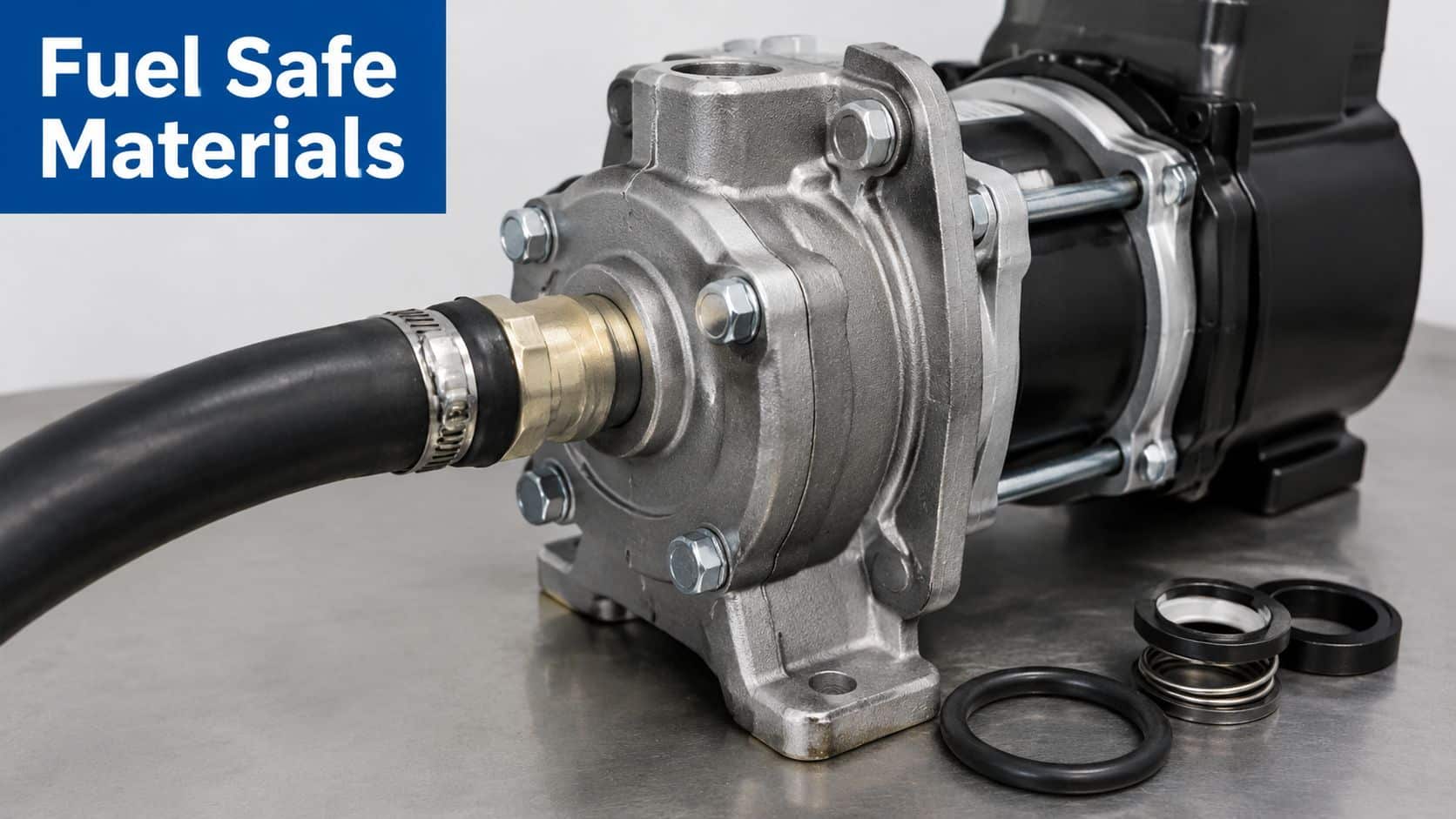
The fluid touching the pump matters as much as the motor driving it. Check the manufacturer's specification for diesel compatibility across the pump body, rotor or gears, shaft seal, diaphragm, hose, strainer and nozzle. A component suitable for hydraulic oil or water isn't automatically suitable for diesel, and petrol compatibility should never be assumed from a general “fuel” description.
Metal choice affects durability. Aluminium can keep a unit light, while cast iron or steel may suit a fixed installation where mass and mechanical strength matter. Stainless steel can offer useful corrosion resistance in demanding surroundings, but the correct choice still depends on the complete assembly, including galvanic contact between different metals and the quality of the diesel.
Seals are common failure points. An incompatible elastomer may swell, harden or lose its sealing force. Ask for the specified seal material rather than relying on a visual match. The same applies to hose. Use a hose rated for diesel, the intended pressure and the working environment, with fittings that resist loosening during vehicle movement.
Filter the fuel before it reaches sensitive parts
A suction strainer can catch larger debris before it enters the pump. A downstream filter can protect the meter, nozzle and receiving machine. Where water contamination is a known risk, use a suitable water-separating filter and provide a way to inspect or drain it safely.
Outdoor agricultural systems face dirt, rain, condensation and temperature changes. Keep caps fitted, protect electrical connections and route hoses so they don't sit in standing water or drag across sharp edges. The tank arrangement should prevent contamination from entering during normal filling and maintenance.
Control ignition and static risks
Workplace refuelling needs sensible ignition control. Keep flames, hot work and other ignition sources away from the transfer point. Use suitable earthing and bonding arrangements where the installation and risk assessment require them, particularly around anti-static precautions and conductive hoses.
Containment remains part of compatibility and installation quality. A chemically compatible pump attached to a poorly contained tank still leaves the operator exposed to pollution risk. The surrounding storage design has to protect the ground and nearby drains or watercourses if a hose, fitting or tank connection fails.
Installation Operation and Maintenance for Reliable Service
A reliable installation starts at the tank. Mount the pump securely, keep the suction route short and protected, and avoid sharp bends that can restrict inlet flow. Fit the correct strainer or filter in the position specified by the manufacturer, then use rated hose and properly tightened fittings on both sides of the pump.
Build the system in a safe sequence
- Secure the pump and tank connection. Check that vibration, vehicle movement and hose weight won't load the pump body or fittings.
- Install filtration in the correct direction. Confirm the flow arrow, provide access for inspection and leave enough room to replace the element.
- Connect the outlet equipment. The hose, nozzle and meter must suit diesel and the expected pressure.
- Complete the electrical circuit. Use the correct voltage, protection, switching and cable arrangement for the pump. Protect mobile wiring from abrasion and water.
- Prime according to the manufacturer's method. Don't run a dry pump unless the instructions specifically allow it.
- Inspect before transfer. Look for leaks, loose clamps, damaged hose, unusual tank pressure and an unsecured nozzle.
Before opening the nozzle, make sure the receiving tank can accept the fuel and that the operator can stop the pump quickly. Stay with the transfer. Don't leave a powered pump unattended beside an open vehicle tank or bowser connection.
Prevent overheating and spill escalation
Watch the sound of the motor and the delivery at the nozzle. A sudden drop in flow can indicate a blocked strainer, air entering the suction line, an empty tank or a restricted filter. Stop the unit before dismantling any connection, isolate the electrical supply and relieve pressure safely.
If the nozzle closes, stop the pump within the permitted bypass period. Don't use a bypass circuit as a substitute for an automatic shut-off routine. The manufacturer guidance cited earlier links prolonged closed-nozzle operation with heat build-up, component damage and possible warranty consequences.
For maintenance, inspect hoses, seals, filters, electrical connections and tank fittings at planned intervals. UK guidance says bunds and storage containers should be inspected at least once a week, and the NetRegs material describes secondary containment sized to at least 110% of the largest container or 25% of the total stored volume, whichever is greater. The UK fuel-storage guidance reference also explains that larger petroleum storage arrangements can bring additional emergency planning and reporting duties.
Use a written inspection record, and keep the preventive maintenance checklist for equipment care with the site's service documentation. If a spill occurs, stop the source if it's safe, protect drains and watercourses, contain the fuel with suitable materials and follow the site's pollution-response procedure.
Choosing and Buying Your Diesel Transfer Pump in the UK
A sound purchase specification should describe the application, not just the desired flow. State the fuel, tank type, suction lift, hose length, outlet equipment, power supply, operating pattern and environment. Include whether the pump is fixed, mobile, used for internal fleet refuelling or connected to a dispensing arrangement.
A practical buying checklist
- Application: Decide whether the unit transfers fuel, fills vehicles routinely or feeds another machine.
- Hydraulic requirement: Confirm the required flow at the pressure and head, not free-flow performance alone.
- Duty: Check whether the pump can run for the planned operating period, including cool-down requirements for mobile 12V and 24V units.
- Construction: Verify diesel-rated seals, hose, body materials and electrical components.
- Filtration: Specify suction protection and downstream filtration appropriate to the tank condition and receiving equipment.
- Containment: Size the bund around the stored volume and check that it's impermeable, secure and inspectable.
- Support: Confirm replacement filters, seals, motors, bypass parts and technical advice are available in the UK.
- Cost: Compare the complete installed price in GBP, including hose, nozzle, filter, meter, wiring, fittings and containment work. A low pump price can become expensive if the surrounding system is unsuitable.
The wider UK rules depend on the arrangement. Private on-site transfer, workplace dispensing and public or resale-like dispensing shouldn't be treated as identical activities. Storage volume, tank position, fire and pollution controls, inspection arrangements and equipment suitability can all affect the compliance picture. For Scottish installations, building standards reference OFTEC standards OFS T100 and OFS T200, while the relevant catchpit approach provides containment for the tank contents plus 10%. Scottish non-domestic fuel-storage guidance gives the regional detail.
For multiple tanks, bowsers or IBCs, UK guidance uses the greater of 110% of the largest single container or 25% of the combined capacity. This UK bunded fuel-tank compliance guide explains the calculation and points readers towards OFTEC and British Standard references.
If your installation needs a bespoke electrical arrangement, a vehicle-mounted power pack or hard-to-find replacement parts, treat the pump as one component in a designed system. A diesel hydraulic power-pack option may be relevant where the transfer equipment forms part of a wider mobile hydraulic installation, but the final selection should follow the machine's load, duty and safety requirements.
For help matching diesel transfer pumps to tanks, hoses, filtration, electrical supplies and UK operating conditions, contact MA Hydraulics Ltd on 01724 279508 today. You can also visit MA Hydraulics Ltd to discuss component selection, bespoke power solutions, replacement parts and practical application support.
