

A maintenance engineer arrives at a Yorkshire plant and finds a hydraulic power pack running hot, a pump shaft seal weeping, and a system using roughly 30 litres of ISO VG 46 fluid every quarter. Production still runs, so the fault has been treated as routine maintenance. The purchase orders, energy bill, used-oil collection and repeated pump repairs tell a different story.
That is where practical sustainability practices begin. They aren't separate from hydraulic engineering, and they don't start with a glossy ESG statement. They start with choosing the right pump, controlling contamination, preventing heat loss, repairing leaks properly and recording enough evidence to prove that a change worked.
What Sustainability Practices Mean for Hydraulic Systems
For a hydraulic system, sustainability means making engineering decisions that reduce wasted input energy, extend component life and limit fluid and material disposal. It covers pump efficiency, valve selection, filtration, fluid management, thermal control, noise reduction and end-of-life planning for pumps, motors, valves, cylinders and power units.
A compliance-only approach asks whether the business can complete a waste return or answer a customer questionnaire. A practical approach asks a more useful question: why is this power pack consuming so much energy, generating so much heat or replacing the same component repeatedly?
Practical rule: The most sustainable hydraulic component is often the one that runs efficiently and lasts in the actual duty cycle, not the one with the most impressive specification sheet.
Start with the operating profile. Record working pressure, flow demand, cycle duration, idle time, motor loading, oil temperature, filter condition and the frequency of leaks or component replacement. A fixed-displacement pump may be economical and dependable on a simple constant-flow circuit. It can be a poor choice where demand varies sharply and excess flow is throttled across valves or returned to tank.
Then examine the losses around the component. A pump that is correctly sized can still waste energy if the relief valve is set unnecessarily high. A clean filter can still have excessive pressure drop if it is undersized. A biodegradable fluid can still create problems if seals, hoses, coatings and operating temperatures aren't compatible.
The practical sustainability toolkit therefore combines several decisions:
- Energy efficiency: Match pump displacement, motor speed and valve control to the load.
- Fluid stewardship: Select a suitable mineral, synthetic or bio-based fluid, then prevent water and particle contamination.
- Component longevity: Reduce heat, pressure spikes, cavitation, leakage and abrasive wear.
- Resource recovery: Repair, recondition or remanufacture suitable components before treating them as waste.
- Evidence: Keep maintenance, utility and waste records that connect an engineering change with an operational result.
The trade-offs are familiar. A variable-displacement pump costs more to buy than a basic fixed-displacement unit. Offline filtration needs space and installation time. A fluid trial requires compatibility checks and controlled monitoring. Sustainability practices work when the team evaluates those costs against energy use, downtime, service life and disposal obligations rather than treating purchase price as the whole decision.
Why the UK Is Taking Industrial Sustainability Seriously
UK sustainability is increasingly measured as an economic and operational issue, not only a branding exercise. The Office for National Statistics environmental accounts provide dedicated UK-wide accounts covering environmental taxes, resource use, climate and nature insights. The ONS reports that environmental taxes fell from 1.9% of GDP in 2024 to 1.8% in 2025, which shows that environmental performance and policy intensity are being tracked through national statistics.
Industrial teams also have a longer efficiency trend to consider. Manufacturing energy intensity fell 42% between 1990 and 2017, while manufacturing carbon intensity fell 43% over the same period, according to the ONS analysis of the decoupling of economic growth from carbon emissions. More recently, industrial energy consumption per million units of GVA declined from 122.6 tonnes of oil equivalent in 2000 to 66.8 in 2024.
That progress doesn't remove hydraulic systems from the conversation. Foundries, plastics machinery, ports, agricultural equipment, mobile plant and manufacturing presses still rely on pumps, valves, motors, coolers and power packs. At component level, procurement decisions affect the energy required to produce each part, the heat rejected into the workshop and the frequency of fluid, filter and component replacement.
The government's Industrial Decarbonisation Strategy identifies efficiency measures as capable of delivering about 4 MtCO2e of annual industrial abatement by 2050, with heat recovery and process or equipment upgrades among the relevant levers. That gives maintenance and design teams a clear direction. Efficiency isn't an optional add-on to decarbonisation. It is one of the practical routes into it.
UK industrial energy and emissions snapshot
| Indicator | Latest UK figure | Relevance to hydraulics |
|---|---|---|
| Environmental taxes as a share of GDP | 1.8% in 2025, down from 1.9% in 2024 | Demonstrates that environmental policy is monitored through national economic accounts |
| Manufacturing energy intensity change | Down 42% between 1990 and 2017 | Supports benchmarking of process and asset efficiency |
| Manufacturing carbon intensity change | Down 43% between 1990 and 2017 | Links lower energy demand with lower emissions intensity |
| Industrial energy consumption per million units of GVA | 66.8 tonnes of oil equivalent in 2024, compared with 122.6 in 2000 | Shows why pump, motor and control efficiency matters at site level |
| Industrial efficiency abatement potential | About 4 MtCO2e annually by 2050 | Places retrofits, heat recovery and equipment upgrades within industrial decarbonisation planning |
Reporting expectations reinforce the need for usable evidence. Climate-related financial disclosure has been mandatory since 6 April 2022 for companies with more than 500 employees, under Companies Act 2006 section 414CB, as summarised by UK sustainability reporting guidance. The government has also published UK Sustainability Reporting Standards S1 and S2 for voluntary use, with S1 covering general sustainability-related risks and opportunities and S2 covering climate-related risks and opportunities.
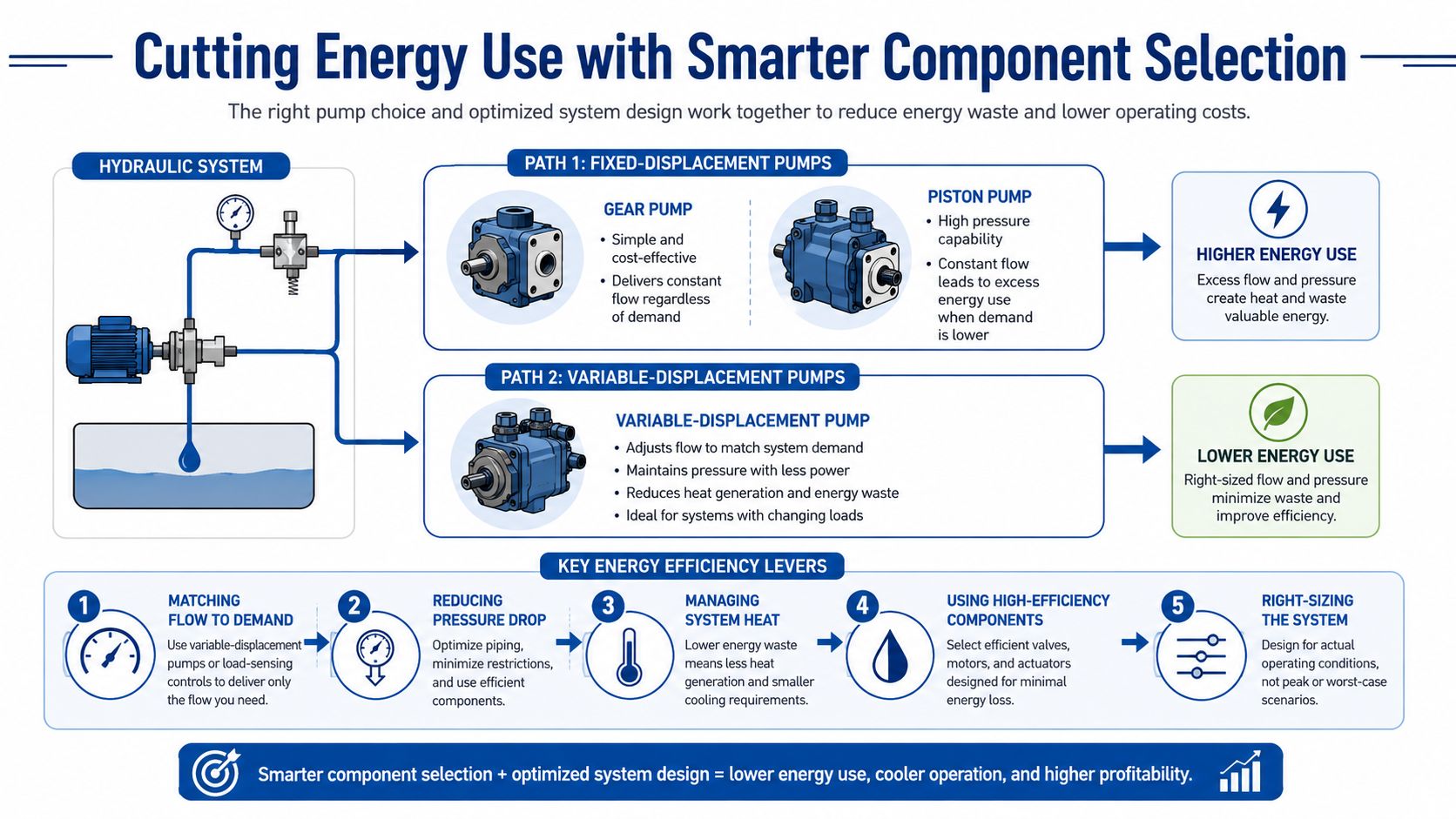
Cutting Energy Use with Smarter Component Selection
Hydraulic efficiency improves when the circuit supplies the work required. The right selection depends on the load profile, control philosophy, duty cycle and maintenance capability, not just on maximum pressure and flow.
Start with the pump
A fixed-displacement gear pump remains a sound choice for constant-flow work, straightforward circuits and applications where low purchase cost and easy replacement matter. In a cycle-loaded machine, however, it can continue producing flow during periods when the actuator isn't using it. The relief valve or control valve then converts excess hydraulic power into heat.
A variable-displacement piston pump can reduce those no-load losses by matching displacement to demand. The stated 20% to 45% reduction in no-load losses applies to suitable cycle-loaded applications, such as injection moulding clamps and mobile crane outriggers, but it shouldn't be treated as a universal saving. The retrofit needs correct pressure control, appropriate compensator settings and enough installation access to justify the additional complexity.
For digital control architectures, review digital displacement pump options alongside conventional variable units. Compare control response, electronic integration, contamination sensitivity and service support before specifying.
Control pressure and flow losses
Load-sensing pumps and proportional valve manifolds can reduce throttling losses when the valve block, pump control and actuator demand are properly matched. Pressure compensation helps maintain predictable flow across directional control sections, but poor commissioning can leave the system operating at excessive standby pressure.
Check the pressure differential across the valve under representative loads. A lower pressure drop may reduce heat generation, yet an aggressively sized passage or valve can affect response, stability and cost. The engineer's task is to find the operating point that delivers the required motion without paying for avoidable pressure loss.
Teams comparing automation strategies may also find process optimization AI examples useful when deciding how machine data could identify idle periods, repeated cycle losses or abnormal loading. AI won't correct an incorrectly selected pump, but better operating data can show where the correction belongs.
Treat the motor and peak load as one system
Pair the power pack with a properly selected high-efficiency motor, including IE4 or IE5 options where the application and supply arrangement justify them. A frequency inverter can control motor speed on variable-demand systems, while soft-starting can reduce mechanical and electrical stress during starting. Cooling and pilot circuits often offer useful targets because they may run continuously even when the main actuator is idle.
An accumulator can smooth short peak demands and allow the prime mover to be selected closer to the sustained load. It adds stored-energy hazards, pre-charge requirements and inspection responsibilities, so the safety case and maintenance procedure must be designed alongside the hardware.
Keep the fluid in its efficient operating range
A correctly selected cooler controls temperature without creating unnecessary fan or water demand. Cooler oil generally has more predictable viscosity behaviour, which can reduce internal leakage and friction losses, but excessive cooling can raise viscosity and increase start-up resistance.
Use measured temperature, pressure and flow data rather than selecting a cooler by habit. A sub-meter on the power pack, combined with logged production cycles, provides a stronger baseline than a nameplate motor rating.
The following video provides useful visual context for the relationship between hydraulic components and system efficiency.
Fluid Management and Filtration for Longer Service Life
Fluid management is a sustainability decision because contamination turns oil, filters and precision components into a repeated waste stream. Particle ingress, water contamination, aeration and overheating accelerate wear in gear pumps, piston pumps, proportional valves and servo-controlled circuits.
Set the cleanliness target from the most contamination-sensitive component, then design the filtration and handling process around that target. ISO 4406 coding, filter beta performance, reservoir breathers, transfer equipment and sampling procedures should appear in the maintenance plan, not only in the commissioning file.
Choose fluid for the duty, not the label
Mineral oil is familiar, widely available and often the simplest option for established equipment. Synthetic fluids may offer better performance across demanding temperature ranges, but they require a compatibility review and can carry a higher initial cost. Bio-based HEES and HETG fluids can break down more readily if released into the environment, but they still need checks for seal materials, coatings, water tolerance, temperature limits and manufacturer approval.
Don't assume a biodegradable fluid is automatically the sustainable choice. If it shortens seal life, increases leakage or causes premature component replacement, its total impact may be worse than a well-managed mineral fluid. The correct comparison includes energy draw, drain interval, component life, spill risk and end-of-life handling.
For fluid selection and compatibility discussion, biodegradable hydraulic fluid guidance can support the initial technical review.
Filter for the machine's real contamination risk
A return-line filter protects the reservoir from downstream debris. A pressure-line filter protects sensitive components, although it must withstand the circuit pressure and account for pressure-drop changes as the element loads. Offline kidney-loop filtration can clean stored oil continuously without forcing the main circuit to carry the entire filtration burden.
Reservoir design matters too. Adequate separation between return and suction zones, a suitable breather, sensible pipe entry and protection against water ingress reduce aeration and thermal stress. Particle counting and scheduled oil sampling are more reliable than replacing oil just because a calendar date has arrived.
The comparison below is intentionally qualitative. Actual service life and energy behaviour depend on fluid grade, temperature, contamination, seal compatibility and machine duty.
| Fluid type | Typical service life in hours | Energy draw vs mineral | End-of-life disposal |
|---|---|---|---|
| Mineral | Set by condition and duty | Baseline for comparison | Manage as used oil through an approved route |
| Synthetic | Potentially extended where temperature and oxidation performance justify it | May support lower losses in suitable operating conditions | Confirm handling requirements with the supplier and waste contractor |
| Bio-based HEES or HETG | Dependent on water, temperature and compatibility control | Application-dependent | Can offer environmental advantages in release scenarios, but still requires controlled collection and disposal |
A clean system is a repair strategy. Reducing abrasive particles and water ingress protects the component already installed, which is usually more sustainable than replacing it early.
Extending fluid life from 2,000 to 6,000 hours can cut used-oil volumes, disposal activity and the embodied impact associated with new fluid, provided condition monitoring confirms that the oil remains fit for service. For wider asset decisions, expert strategies for manufacturers offer useful context on connecting equipment life, maintenance planning and procurement.
How Real Workshops Apply These Practices
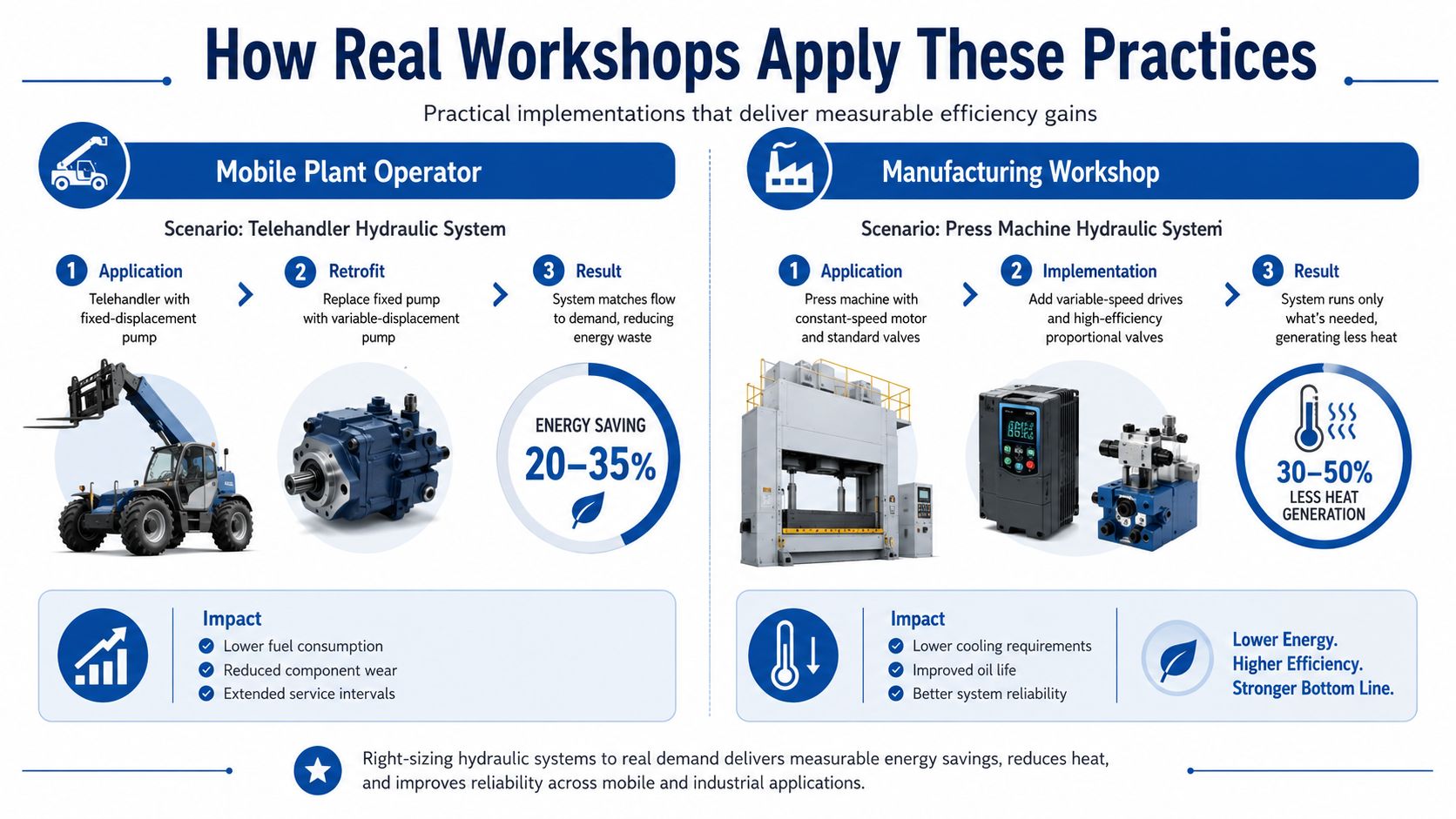
A sustainability plan becomes credible when a technician can apply it during a planned repair and the supervisor can verify the result from ordinary maintenance records. The following representative scenarios show the decisions and measurements that matter. They aren't promises of universal savings, because the outcome depends on duty cycle, machine condition and commissioning quality.
Mobile plant operator
A telehandler fleet has fixed-displacement pumps, frequent low-load travel and variable demand from lifting and attachment functions. The operator replaces suitable pump units with load-sensing variable-displacement pumps, installs proportional control valves and trials a higher-viscosity-index fluid after confirming seal and component compatibility.
The team records engine fuel use, hydraulic oil temperature, filter differential pressure, operating hours and attachment cycle times. It also checks standby pressure before and after the retrofit, because a pump that still runs against an unnecessarily high pressure setting will undermine the intended result.
The first review should take place after enough representative work has been completed to include normal loading, cold starts, hot operation and filter inspection. A second review should compare maintenance records over the next planned service period. The useful outcome isn't a single headline figure. It is evidence of whether the machine completes the same work with lower loading, less heat, longer filter service and fewer interventions.
Industrial press shop
An industrial press shop rebuilds a power pack that spends long periods at partial load. The revised design uses a variable-speed drive, a proportional valve arrangement and an offline filtration bank with a 3-micron absolute beta rating. The team also assesses whether waste heat from the power unit can be recovered for workshop space heating without compromising hydraulic cooling requirements.
Measurement starts before the rebuild. Engineers record electrical consumption, pressure, flow, oil temperature, cycle time and the existing filter-change pattern. After commissioning, they repeat the readings under equivalent production conditions, check inverter settings, inspect contamination data and confirm that the cooler still controls oil temperature during the longest production cycle.
The practical timeframe is staged. Commissioning checks identify installation or tuning faults immediately. The first operational comparison follows a representative production run. Longer-term conclusions require repeated maintenance and utility records, because one clean shift can't prove a service-life improvement.
A useful retrofit report should include the old and new circuit diagrams, component part numbers, commissioning settings, baseline readings, post-change readings and any changes to inspection intervals. That document helps procurement distinguish a measured improvement from an attractive but unverified specification.
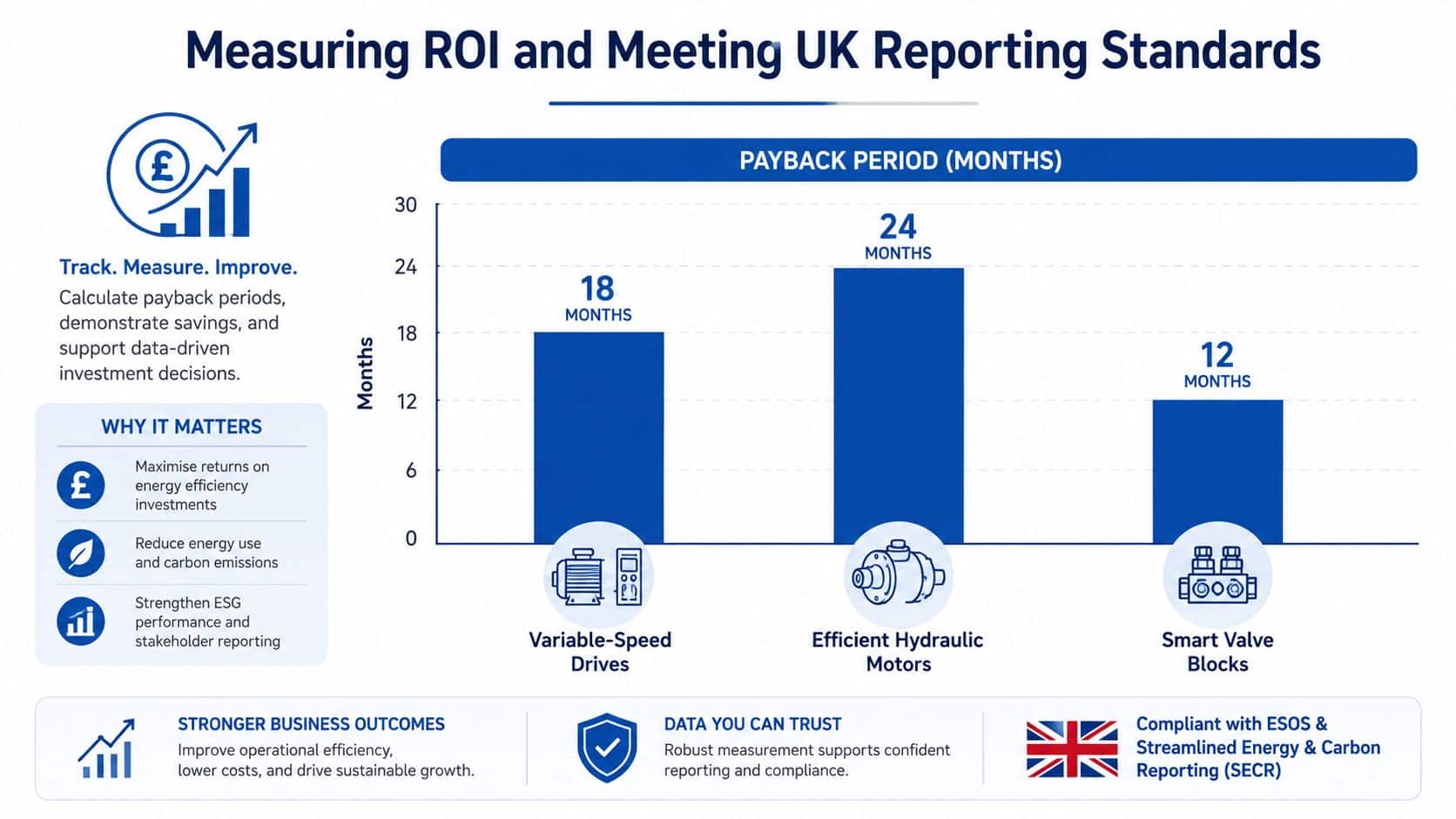
Measuring ROI and Meeting UK Reporting Standards
Procurement and finance teams need more than the phrase “energy efficient”. They need a baseline, a measured change, an installation cost and a defensible payback calculation.
Use this simple method for a power-pack upgrade:
- Record baseline electrical consumption under representative production conditions.
- Measure the same duty after commissioning.
- Convert the difference into annual kWh using actual operating hours.
- Apply the organisation's approved electricity cost and emissions factor.
- Subtract additional maintenance or monitoring costs from the annual benefit.
- Divide the net installed cost by the annual benefit.
Don't insert a tariff or carbon factor that hasn't been approved internally. Electricity prices, operating hours and grid factors vary, so a worked calculation should use the figures on the site's invoices and reporting methodology rather than an invented UK average.
Build the evidence trail
For a variable-speed drive, capture motor current, speed, pressure, flow and machine output before and after installation. For a load-sensing retrofit, record standby pressure, loaded pressure, cycle time, fuel or electricity use and valve temperatures. For offline filtration, record particle counts, filter differential pressure, oil analysis results and the volume of oil replaced.
A maintenance log can hold much of this information. Utility invoices provide the financial baseline, while work orders show leaks, seal replacements, pump failures and filter changes. Keep the measurement boundaries consistent. If production volume changes significantly, report energy per comparable machine cycle or output measure rather than presenting total site consumption without context.
The UK sustainability reporting standards provide the framework for voluntary S1 and S2 reporting. S1 addresses general sustainability-related risks and opportunities, while S2 focuses on climate-related risks and opportunities. Hydraulic upgrade records can support the operational evidence behind energy, climate risk, asset resilience and capital planning discussions.
The FCA's current proposal would phase in mandatory reporting from accounting periods beginning on or after 1 January 2027, with S2 expected first and wider S1 disclosures potentially following from accounting periods beginning on or after 1 January 2029, as outlined in current UK SRS reporting analysis. Treat those dates as a proposal, not as a universal current obligation.
Report waste as carefully as energy
For 2025-26, government sustainability reporting guidance requires annual waste reporting in absolute tonnes by stream and asks organisations to explain missing data and set an action plan where information isn't available. That makes used hydraulic oil, contaminated filters, damaged hoses and replaced components relevant to the same evidence system.
Digital reporting platforms can help organise supplier and operational information. Azure-based ESG reporting insights may be useful for teams deciding how to structure data flows, but software can't repair a weak baseline. Start with reliable readings from the machine and a clear record of what changed.
For a broader financial decision, compare purchase price, installation, energy, maintenance, downtime, fluid and disposal costs through total cost of ownership analysis. That is the level at which a sustainable component choice either earns its place or doesn't.
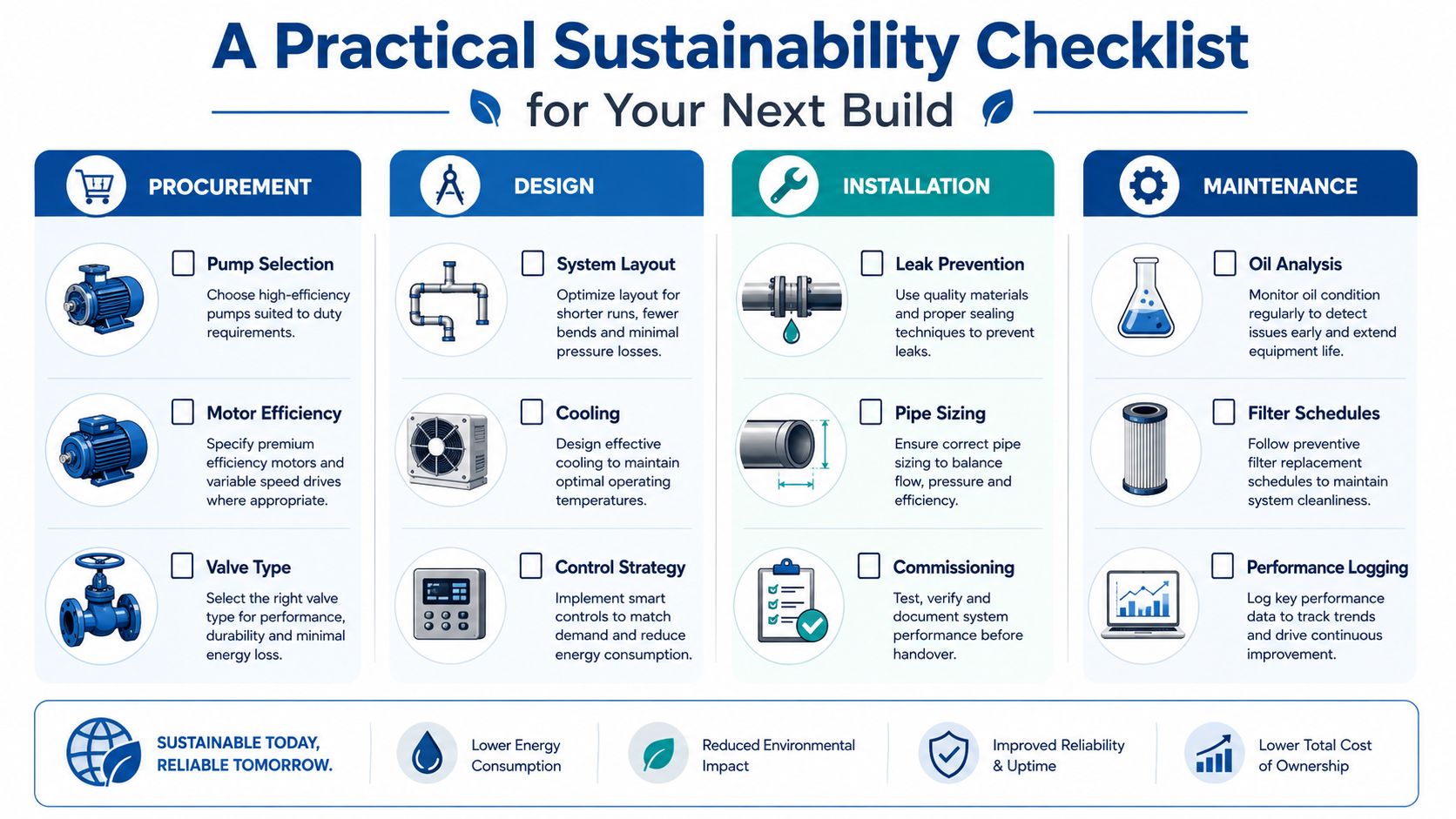
A Practical Sustainability Checklist for Your Next Build
Use the checklist during concept design, procurement review, installation and planned maintenance. Mark each action by its expected payback category, then replace the estimate with measured evidence once the system is operating.
Energy efficiency
- Pump selection, within 12 months where duty supports it: Compare fixed-displacement gear pumps with load-sensing or variable-displacement alternatives against actual flow demand and idle time.
- Motor and drive, one to three years: Assess an appropriately sized IE4 or IE5 motor and variable-speed drive for variable-load power packs. Include inverter compatibility, cooling and electrical installation costs.
- Valve control, within 12 months where throttling losses are high: Use pressure-compensated or proportional valves where the application needs variable flow, then commission standby and working pressures.
- Pressure calibration, within 12 months: Check relief-valve settings against the actuator requirement. Don't retain a high factory setting because the machine can tolerate it.
- Accumulator support, one to three years: Evaluate an accumulator for short peak loads, with pre-charge, guarding and inspection arrangements documented before installation.
Fluid and filtration
- Cleanliness target, within 12 months: Set an ISO 4406 target from the most sensitive component and specify filter performance, breather quality and transfer equipment accordingly.
- Fluid compatibility, beyond three years: Confirm seal, hose, paint and component compatibility before changing from mineral oil to synthetic or bio-based fluid.
- Reservoir design, one to three years: Provide effective return and suction separation, reduce aeration risk and prevent water entry through the breather and access points.
- Offline filtration, one to three years: Consider a kidney-loop unit for systems with high contamination risk or expensive downtime.
- Condition monitoring, within 12 months: Establish oil sampling, particle counting and differential-pressure checks before extending drain intervals.
Component life
- Filter sizing, within 12 months: Select elements for dirt-holding capacity and acceptable pressure drop, not only nominal micron rating.
- Hose routing, within 12 months: Protect hoses from abrasion, tight bends, heat and unnecessary movement. Correct routing prevents avoidable replacement.
- Cooler selection, one to three years: Size cooling for the measured heat load, then verify that fan, water or electrical demand doesn't create a new inefficiency.
- Repair and reconditioning, beyond three years: Define which pumps, valves and motors can be inspected, repaired or remanufactured before disposal.
- Leak control, within 12 months: Record recurring seal, fitting and hose failures by machine family so procurement can address the root cause rather than repeat the same order.
Measurement and reporting
- Sub-metering, one to three years: Measure power-pack consumption separately where site data cannot distinguish hydraulic demand from other loads.
- Baseline records, within 12 months: Keep pre-change readings, operating conditions, production context, component details and commissioning settings together.
- Waste mapping, within 12 months: Record used oil, filters, hoses and components by waste stream and destination, using absolute tonnes where required.
- SRS and SECR mapping, one to three years: Give finance and compliance teams the energy, climate, maintenance and waste evidence needed for applicable reporting.
- Review ownership, within 12 months: Assign a named engineer or maintenance lead to check whether the upgrade delivered its intended result.
A UK build may need a different balance from a mobile machine working outdoors or a press running repeated cycles. MA Hydraulics Ltd's technical team can help validate pump, valve, filter, fluid and power-pack choices against the duty, maintenance access and reporting evidence available at your site.
MA Hydraulics supplies hydraulic components and bespoke power solutions for UK mobile and industrial applications, including gear pumps, valves, filters, motors and Hydronit or in-house power packs. Visit MA Hydraulics Ltd to discuss a component selection, retrofit or maintenance plan, then phone 01724 279508 today or send us a message with your operating details.
