
You've got the gauge on the wall, the quote from the installer, and a system that's already crept up past where you expected it to sit. At that point, a 3 bar pressure relief valve is either the right safeguard, or it's a sticking plaster over a fault that needs proper diagnosis. The difference matters on a plant room floor, because the wrong part can hide an overpressure issue until the next nuisance trip, leak, or maintenance callout.
What a 3 Bar Pressure Relief Valve Does and Where It Fits
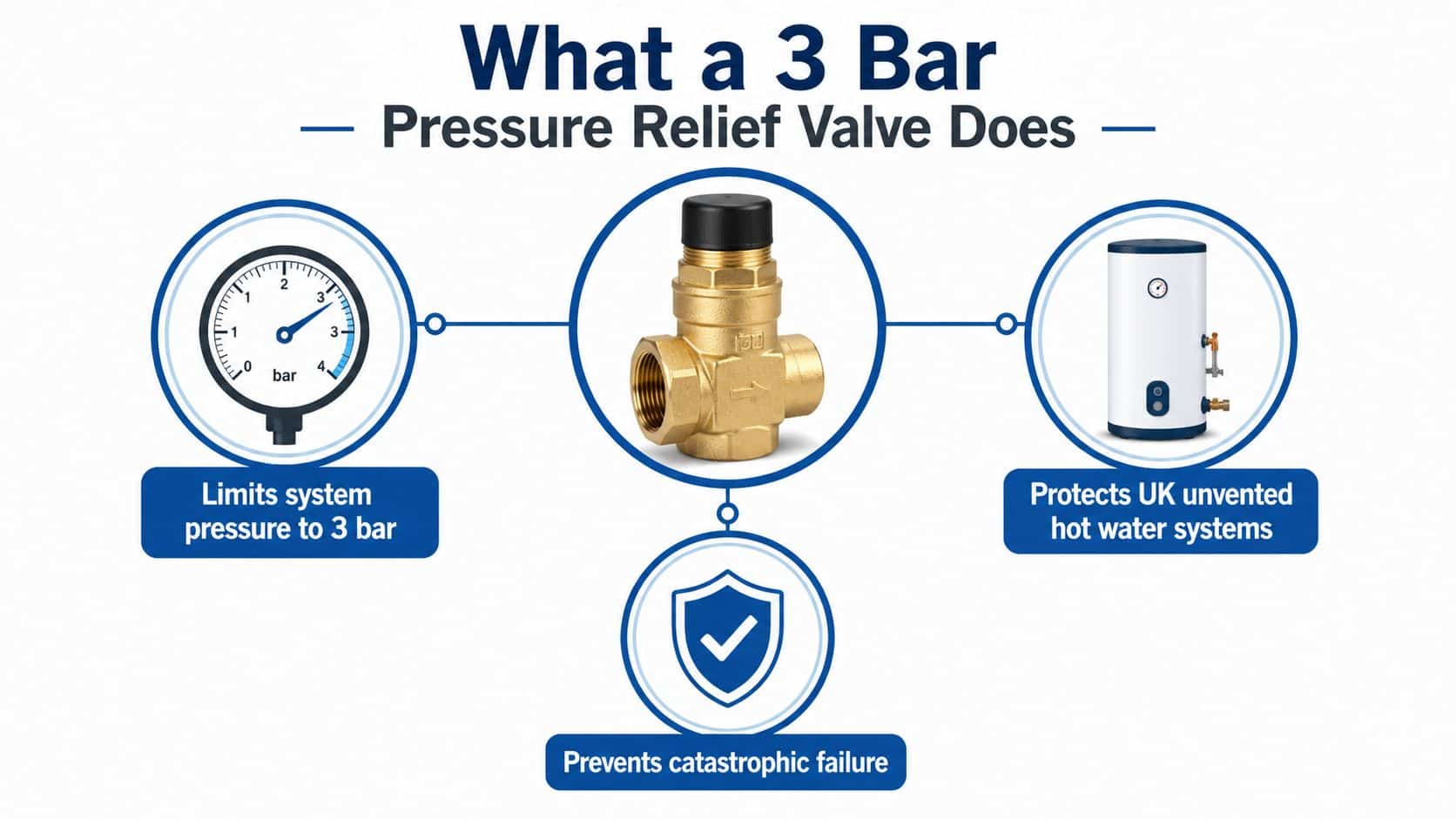
A 3 bar pressure relief valve is there to stop a system from climbing beyond a defined pressure ceiling. In plain terms, it opens when pressure reaches the set point and discharges fluid so the circuit doesn't keep rising into unsafe territory. For UK hot-water and unvented domestic systems, 3 bar is commonly used as that factory-set safety limit, and product data for UK-available models show female BSP or G threaded connections such as 1/2 in and 3/4 in, plus examples with PN 10 and a 100 kW maximum discharge rating on a 1/2 in G connection, which tells you these valves are built for real thermal loads, not just light overflow duty. Caleffi product data
Relief valve, safety valve and pressure reducing valve are not the same thing
The industry muddles these terms constantly. A relief valve opens to protect a system from overpressure, a safety valve is used in safety-critical service with defined relieving behaviour, and a pressure reducing valve sits upstream and regulates the outlet to a lower target pressure rather than waiting for an overpressure event. That distinction is exactly where buyers get caught out, because a 3 bar figure can describe different devices in hydraulic, domestic water and gas-related service.
A useful way to think about it is simple. If the valve is protecting against thermal expansion or pump-generated overpressure, it belongs in the relief family. If it is trying to hold a delivery pressure steady, it belongs in regulation, not relief. For a gas-side comparison point, a CNG safety valve from Blue Gas Express is useful background reading because it shows how the same safety logic can appear in a different service, with a different duty and different materials.
Practical rule: if the question is “how do I stop pressure exceeding 3 bar?”, you're dealing with relief duty. If the question is “how do I feed 3 bar downstream all the time?”, you're looking at regulation.
That's why the 3 bar figure needs context. It is a pressure rating, not a product type. Once you separate those two ideas, the rest of the selection becomes a lot more honest.
Set Pressure, Cracking Pressure and the 3 Bar Number Explained
A valve stamped 3 bar does not snap open at one perfect moment like a light switch. The internals work as a spring-loaded poppet in balance with system pressure, and the disc or poppet only starts to lift when the upstream force overcomes the spring setting. The published RS safety valve data show standard settings from 1.5 bar up to 9 bar, including a 3 bar version in the same family, which is a useful reminder that 3 bar sits within a wider range of relieving points rather than marking out a separate device class. RS threaded safety valve data
How the valve moves
Set pressure is the point the valve is calibrated or adjusted to reach. Cracking pressure is the point where it first starts to open. Reseat pressure is where it closes again after the pressure falls. Blowdown is the difference between the opening and closing points.
That sequence matters on the shop floor. A system can look fine on paper and still run badly if the valve chatters, leaks, or hovers too close to opening. A nominal 3 bar valve with poor reseat behaviour can simmer instead of staying quiet until it is needed. Product data do not always spell out cracking margin in plain language, so the full sheet needs reading, not just the headline number.
Practical rule: the nameplate tells you the target, not the whole operating behaviour.
A lot of confusion starts when buyers ask whether 3 bar means cracking pressure, set pressure, or a downstream target. For a relief valve, it normally refers to the set pressure. For a pressure reducing valve, it is often the regulated outlet target. Those are different duties, even though the figure looks the same on a search page. If you want to compare that downstream target with real domestic hot-water practice, you can browse hot water system types and costs at browse hot water system types and costs.
Why the nominal number can hide useful detail
The same nominal rating can still behave differently because the spring, seat geometry and discharge path are not identical from one model to another. In UK service, that shows up in the spread of available settings and in the way manufacturers define operating ranges around the same headline pressure. A careful buyer reads the data sheet for the actual opening behaviour, the reseat expectation, the service medium and the BSP porting before signing off a part number.
The 3 bar figure also needs to line up with the standard and inspection record behind the valve. On a control cabinet, plant room or cylinder install, the paperwork should show what the valve was set to, how it was tested, and whether it belongs in that duty at all. If that record is missing, the number on the body tells you very little about how the valve will behave in service.
Hydraulic, Domestic and Compressed-Air Use Cases
The first mistake I see on jobs is a buyer treating every 3 bar pressure relief valve as if it belongs in the same circuit. It doesn't. A hydraulic circuit, an unvented hot-water cylinder and a compressed-air receiver all create pressure for different reasons, and the valve body, seat material, approvals and porting need to match the actual service.
Where the 3 bar rating makes sense
In domestic and heating service, 3 bar is common because it protects against thermal expansion in hot-water systems and similar unvented arrangements. In hydraulic service, low-set relief valves are more about limiting pressure in compact circuits, mobile plant and agricultural machinery where the system might spike because a line is dead-headed or a load changes suddenly. In compressed-air or low-pressure gas service, the same nominal rating can appear in safety-oriented components, but the gas side needs its own material and approval logic, not a borrowed plumbing part.
The most expensive mistake is often the quiet one. A domestic safety relief valve may look suitable on the shelf, but if it has the wrong discharge geometry, the wrong temperature rating or no approval for the medium, it's the wrong answer. The reverse mistake happens too, when somebody fits a hydraulic valve into a potable-water line because the pressure number looked right.
A good selection process starts with the job, not the number on the spring.
Why the pipework matters as much as the valve
The engineering guidance in the selection literature is blunt on this point, inlet piping, backpressure and relief-line capacity can materially affect how a valve performs. If the inlet leg is badly arranged or the discharge path is too restrictive, the valve may not protect the system properly even though the set pressure is nominally correct. That's why a buyer searching for a “3 bar valve” often needs diagnostics as much as a part number.
Practical rule: if the real problem is inlet loss, trapped pressure or backpressure, changing the relief valve alone usually won't fix it.
For anyone comparing system types, it helps to check how different hot-water arrangements are specified before you buy. A simple reference like browse hot water system types and costs is useful context if you're trying to understand why a 3 bar valve is standard in one domestic setup and not in another. The point isn't the price page itself, it's the service architecture behind it.
Sizing and Specifying a 3 Bar Pressure Relief Valve
A 3 bar relief valve can be the right call and still be the wrong part if the rest of the specification is loose. On the shop floor, the usual confusion is between set pressure, cracking pressure and the downstream target pressure. A valve marked 3 bar does not tell you whether it will pass enough fluid, whether it will fit the pipework, or whether the discharge arrangement will protect the system. UK product data make that plain. One Reliance 3 bar valve is rated to 140°C with a 25 bar body test pressure, while an Altecnic 3 bar valve is limited to 110°C and shows a 5 to 110°C operating range, so the headline pressure alone is not enough to sign off a purchase. Reliance and Altecnic product data
The checklist that prevents bad orders
Start with maximum working pressure, not the set point on the spring. Then check the discharge capacity at the expected overpressure condition, because a valve that lifts but cannot pass enough mass flow still lets the system keep rising. After that, look at opening behaviour and reseat characteristics, especially where the circuit sees rapid thermal expansion, pump cycling or a pressure spike that comes and goes fast.
The mechanical details matter just as much. UK valves often use female BSP threads, and the exhaust side is a working outlet, not an extra detail to ignore. The RSDEL product listing shows a Reliance 3 bar valve with a 3/4 in BSP female connection and BSP 3/4 exhaust port, another with a 1/2 in BSP female connection and BSP 1/2 exhaust port, and an Altecnic/Caleffi model with a 1/2 in pushfit inlet x BSP female outlet. Reliance BSP port example
For a quotation review, I would compare the short list in a simple order. First, the port size. Then the discharge path. Then the temperature limit. A valve that fits the pressure rating but not the connection pattern usually turns into a site modification, and that is where time and cost get lost.
| Port size (BSP female) | Exhaust port | Temperature range | Typical approval |
|---|---|---|---|
| 1/2 in | Dedicated discharge port, often 1/2 in BSP | 5 to 110°C on one UK-listed design | Product-specific approval, check listing |
| 3/4 in | Dedicated discharge port, often 3/4 in BSP | Up to 140°C on one UK-listed design | Product-specific approval, check listing |
| 1/2 in pushfit inlet | BSP female outlet | Up to 110°C on listed models | Product-specific approval, check listing |
Read the body details, not just the headline pressure
If the valve is going into potable water, approval status matters as much as the pressure setting. For one UK-listed potable-water valve, the NABIC 3/4 in BSP 3 bar safety relief valve is described as WRc approved for potable water, WRAS approved, and conforming to BS EN ISO 4126-1/+A1, with a maximum operating temperature of 195°C and a factory set pressure of 3 bar. NABIC potable-water valve listing
Use the sizing method before you commit to stock or issue a purchase order, and compare the shortlist against the working duty rather than the catalog title. MA Hydraulics pressure relief valve sizing guidance gives a practical route through that check. The questions are the same every time. Does it open at the right pressure. Does it discharge enough. Does it fit the ports. Is it approved for the medium.
Installation and Commissioning Best Practice
A valve that's correct on paper can still fail if the fitter gives it a bad home. I've seen good hardware compromised by a tight inlet bend, a discharge line that dead-ends awkwardly, or a body fitted in the wrong orientation. On a live system, the installation sequence matters because a relief valve is only useful if it can sense pressure accurately and discharge safely.
Fit it like a protective device, not a plumbing accessory
Direct-acting spring valves are usually happiest when mounted in the orientation the manufacturer specifies, commonly vertical for many bodies. Keep the inlet line short and sensibly sized, because unnecessary pressure loss upstream changes how the valve sees the circuit. Route the discharge to a safe drain, tundish or other compliant discharge point, and support the pipework so vibration doesn't shake the valve body.
Cleanliness matters more than people think. Flush the line if there's any chance of debris, check the BSP threads are clean, and make sure the sealing method matches the approval status of the valve and system. If the installation is in a potable-water context, don't mix in a sealant practice that conflicts with the product approval or the site standard.
A straightforward commissioning sequence
- Pressurise slowly. Bring the system up in a controlled way so you can watch for leaks, seat noise or unexpected discharge.
- Confirm cracking on a gauge. Check that the valve begins to lift where the data sheet says it should.
- Verify reseat. Make sure it closes cleanly once pressure falls, instead of weeping or simmering.
- Log the set pressure. Record the reading, date, valve tag and any adjustment made.
The goal is simple. You want a valve that opens when it should, discharges where it should, and stays quiet when it should.
For a fitter working through a live installation, this internal reference keeps the sequence tidy: installation guidelines.
Adjustment, Testing and Troubleshooting in Service
A 3 bar pressure relief valve shouldn't be treated as a fit-and-forget part. In service, it needs records, periodic checking, and a clear view of what normal behaviour looks like on that specific system. If the valve is adjustable, the bonnet and setting screw give you a controlled way to bring it back to specification, but only if you've got a calibrated gauge and a record of what the valve did before the adjustment.
What to test and what the result tells you
Bench testing isn't just about proving the valve opens. It's about seeing whether the opening point, reseat point and discharge behaviour are all in the same band as the data sheet. If a valve opens early, it may be set too low or contaminated. If it opens late, the spring setting may have drifted or the mechanism may be sticking. If it won't reseat cleanly, backpressure or seat damage are common suspects.
Practical rule: the test sheet is evidence, not admin. If you can't show what the valve did, you can't show it was safe.
The faults that actually drive downtime
- Simmering: The valve leaks before it fully cracks. That usually points to a poor seat condition, contamination, or a set point that's too close to the operating pressure.
- Seat erosion: Particulate contamination can score the seat and leave the valve unable to hold shut. You'll often see repeat leakage after what should have been a clean reseat.
- Chatter: If the discharge line is undersized or the installation is too restrictive, the valve can open and close rapidly instead of lifting smoothly.
- Backpressure faults: Incorrect discharge arrangement can stop the valve reseating properly, especially if the outlet route is not designed as part of the pressure relief path.
The quickest diagnostic habit is to look at the symptom, then the installation, then the service record. A valve that was fine last year and noisy this month may not be “worn out”, it may be seeing dirt, backpressure or a changed operating profile.
UK Standards, Approvals and Maintenance Records
UK buyers need a valve that works and paperwork that will stand up to inspection. For pressure relief devices, that means matching the application to the relevant standard, then keeping a service record that shows the valve was checked, tested and left in the correct state. On potable-water and unvented hot-water duties, the approval on the nameplate matters just as much as the pressure figure.
The standards that keep showing up on real product data
BS EN ISO 4126-1/+A1 appears on potable-water and safety-relief product literature, and BS6283 Part 1 appears on UK valve approvals for unvented hot-water safety equipment. WRAS approval is the other marking you see repeatedly on UK potable-water listings, and some products also carry WRc approved for potable water wording. That mix tells you the valve is being positioned as part of a regulated safety chain, not as a generic spring-loaded component.
The NABIC 3/4 in BSP 3 bar safety relief valve is a clear example, because the listing ties together WRc approval, WRAS approval, BS EN ISO 4126-1/+A1 conformity, 195°C maximum operating temperature and 3 bar factory setting. NABIC compliance listing
Why the record matters as much as the valve
The practical maintenance question is not just “what valve did we fit?”. It is “when was it tested, what did it open at, and who signed it off?”. That matters in fleets, plant rooms and equipment that sees repeated thermal cycling, because a valve with no record is hard to defend if something goes wrong later.
UK HSE reporting keeps workplace transport and machinery on the list of persistent serious-injury sources, and that is why maintenance failures cannot be treated as paperwork noise. If a valve is part of the safety chain, proof testing, set-pressure records and inspection intervals are part of the job too.
For a compliance check that ties technical data to site paperwork, use the compliance verification guidance.
When to Choose MA Hydraulics for Your 3 Bar Relief Valve
A standard off-the-shelf 3 bar pressure relief valve is the right answer when the duty is clear, the ports match, the temperature range fits, and the discharge path is already designed properly. It's the wrong answer when the underlying problem is a circuit that needs redesign, better diagnostics, or a different pressure strategy altogether. If the nominal 3 bar figure is masking inlet loss, poor backpressure control, or a system that needs a different set point, changing the valve alone won't fix the job.
MA Hydraulics Ltd supplies hydraulic components for mobile and industrial systems, including valves, manifolds and power-pack assemblies, and the team also assembles Hydronit mini power packs to specification and builds bespoke industrial power packs up to 11 kW. They also work across brands such as Vivoil, Hydronit, OMT, Luen, Orta, Borelli and Hoyea, which matters when you're cross-referencing hard-to-find parts or matching an existing installation without re-engineering the whole circuit.
If you've got a 3 bar valve issue that keeps returning, the sensible move is to check whether the circuit needs a pressure relief component, a better discharge arrangement or a full hydraulic redesign. That's the point where MA Hydraulics can supply the component, build the assembly, or help you identify the correct replacement path instead of guessing from a catalogue page.
MA Hydraulics Ltd can help you specify the right 3 bar pressure relief valve, check the ports and approvals, and decide whether the fault sits in the valve or in the system around it. If you need a practical answer for a hydraulic circuit, unvented hot-water system or bespoke power unit, visit MA Hydraulics Ltd and speak to the team, or Phone 01724 279508 today and send a message through the contact page for sizing support and application advice.
