
If you've searched what is dwell time, you've probably noticed the problem straight away. One result talks about websites, another about trains, another about CNC code, and none of them quite answer the question you had in mind on the workshop floor.
That confusion is real. In UK search results, dwell time is used across cybersecurity, transport, marketing, logistics, and machining, which means many explainers miss the first thing readers need to know, namely which dwell time are we talking about? That gap matters in industrial settings because one business can easily deal with more than one meaning at once. A planner may mean waiting time at a depot, while a machinist means a programmed pause, and an engineer may be thinking about a hydraulic hold period. The wider point is noted in this dwell time glossary discussion.
For hydraulics professionals, the useful definition is narrower and more practical. It isn't about page visits or cyber threats. It's about a deliberate pause within a machine cycle so pressure, movement, clamping, settling, or process completion can happen properly. If you're already comfortable with the basics of how hydraulics work, dwell time is one of those control ideas that turns a functioning circuit into a dependable one.
An Introduction to Dwell Time and Its Many Meanings
The reason the term causes so much trouble is simple. Dwell time is a context word. It always means that something remains in place, or in a state, for a period before the next step happens. What changes is the thing that's waiting, and why that waiting matters.
In transport, dwell time can mean how long a train remains stationary at a platform while passengers board and alight. In UK rail planning, that isn't treated as a vague delay. It is formalised as part of timetable and capacity modelling, and even minimum dwell times are handled in seconds in operational guidance. That tells you something important about the nature of the term. Dwell time is often an engineered input, not just an observation after the fact, as described in this overview of dwell time in transport planning.
In freight and warehousing, the same phrase points to goods or vehicles sitting at a depot, terminal, warehouse, or port before processing, unloading, or onward movement. Longer dwell increases handling burden and slows throughput, so operations teams track it to find choke points, as outlined in this logistics explanation of dwell time.
A good rule in engineering is this. If a system keeps waiting in the same place, ask whether that wait is intentional, necessary, or wasteful.
That question is exactly why hydraulics engineers should care. In a hydraulic circuit, some waiting is productive. You may want a clamp to hold, a press to remain under pressure, or a valve sequence to pause before reversing. Other waiting is a fault. A sticky spool, trapped air, slow pressure build-up, or a leaking cylinder can all create delay that looks like dwell time but isn't designed into the process.
Where readers usually get crossed wires
Most confusion comes from two habits.
- Using one definition everywhere: People read a generic explanation online and assume it applies unchanged to machinery.
- Treating all pauses as lost time: In practice, some pauses are part of making the machine do useful work properly.
- Ignoring the process step: Dwell time only makes sense when tied to a specific action such as clamping, holding, curing, pressing, or pressure stabilisation.
For a hydraulics apprentice, the cleanest way to think about it is this. Dwell time is the hold period that lets the job finish before the system moves on.
Dwell Time Defined Across Different Industries
A quick comparison clears away a lot of noise. The same label appears in several fields, but the working meaning shifts with the process being measured.
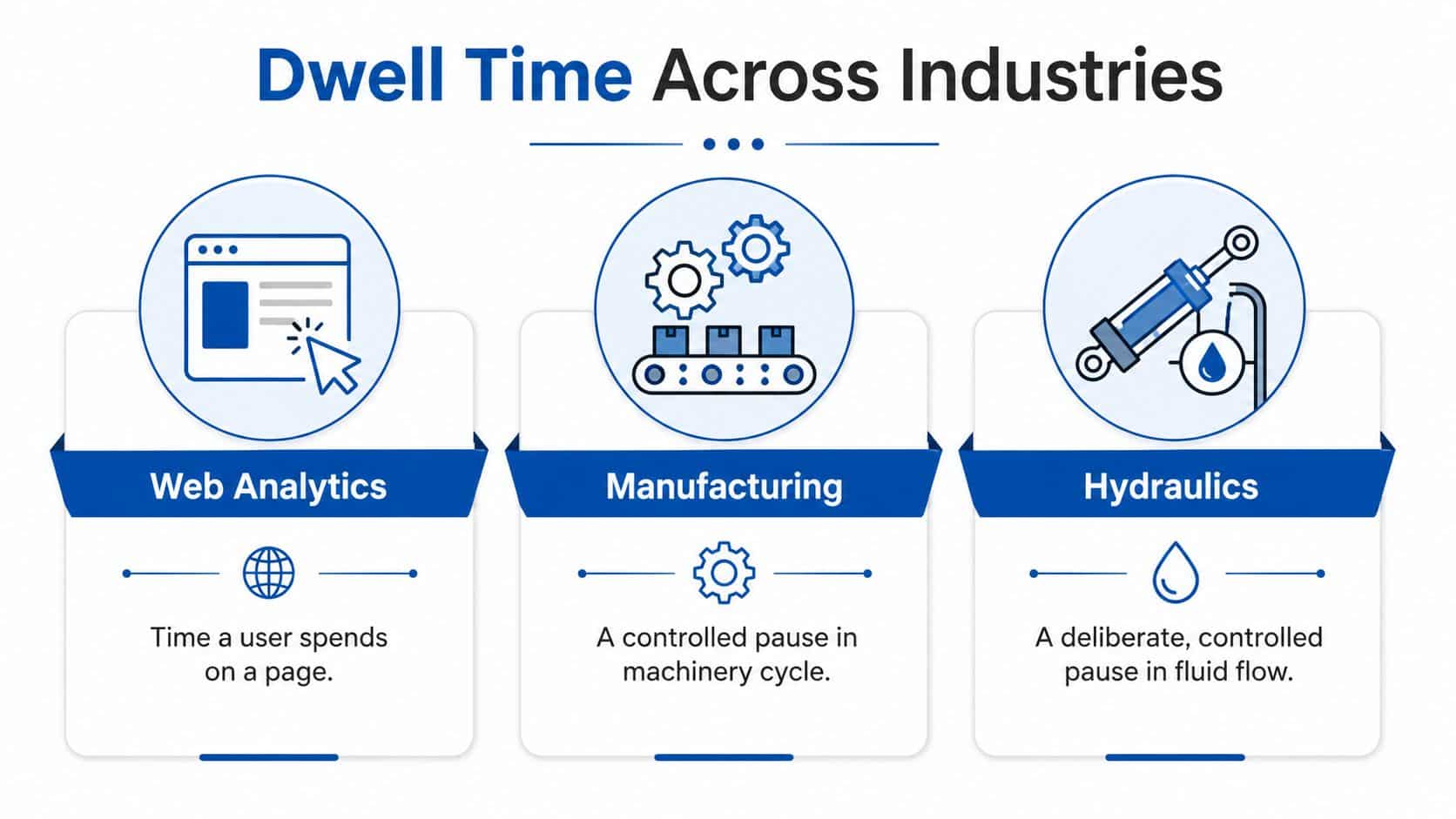
Dwell time definitions by industry
| Industry | Definition | Primary goal of measurement |
|---|---|---|
| Web analytics | The time a user remains on a page before returning to search results or leaving | Understand engagement and content relevance |
| CNC machining | A programmed pause in axis motion while the spindle continues to rotate | Improve part quality, chip clearing, and process control |
| Logistics | The period goods or vehicles remain at a warehouse, port, or distribution point before moving on | Reduce bottlenecks and improve throughput |
| Transport | The time a train spends stationary at a platform while passengers board and alight | Build realistic timetables and manage network capacity |
| Hydraulics | A deliberate hold in a machine state so pressure, clamping, settling, or process completion can occur | Achieve reliable cycle performance, quality, and safe sequencing |
The machining definition is especially useful because it resembles the hydraulic idea more closely than the web one does. In CNC work, dwell time is a programmed pause of the axis, commonly with a G04 command, while the spindle continues to rotate. That pause can help clear chips from a drilled hole or produce a flat bottom on a milled pocket, which directly affects part quality and precision, as described in this CNC dwell time explanation.
What these meanings have in common
They all share one backbone. Something stays put, or stays in one state, for long enough to serve a purpose.
What changes is the purpose:
- In machining, the pause supports tool action.
- In logistics, the pause often exposes inefficiency.
- In transport, the pause is part of planned capacity.
- In hydraulics, the pause is often built into the machine cycle itself.
When you hear the term in industry, don't ask only "how long is the dwell?" Ask "what is being held, and what must happen during that hold?"
That second question is where hydraulic understanding starts. The answer usually involves pressure reaching a stable value, a load remaining clamped, fluid settling, or one motion waiting until another condition is met.
Understanding Dwell Time in Hydraulic Systems
In hydraulic work, dwell time usually means a planned pause during which a component or actuator remains in a chosen state. A cylinder may stay extended. A clamp may stay pressurised. A valve may hold a flow path long enough for the process to complete before the next movement begins.
That pause is not dead space in the cycle. It's part of the cycle.
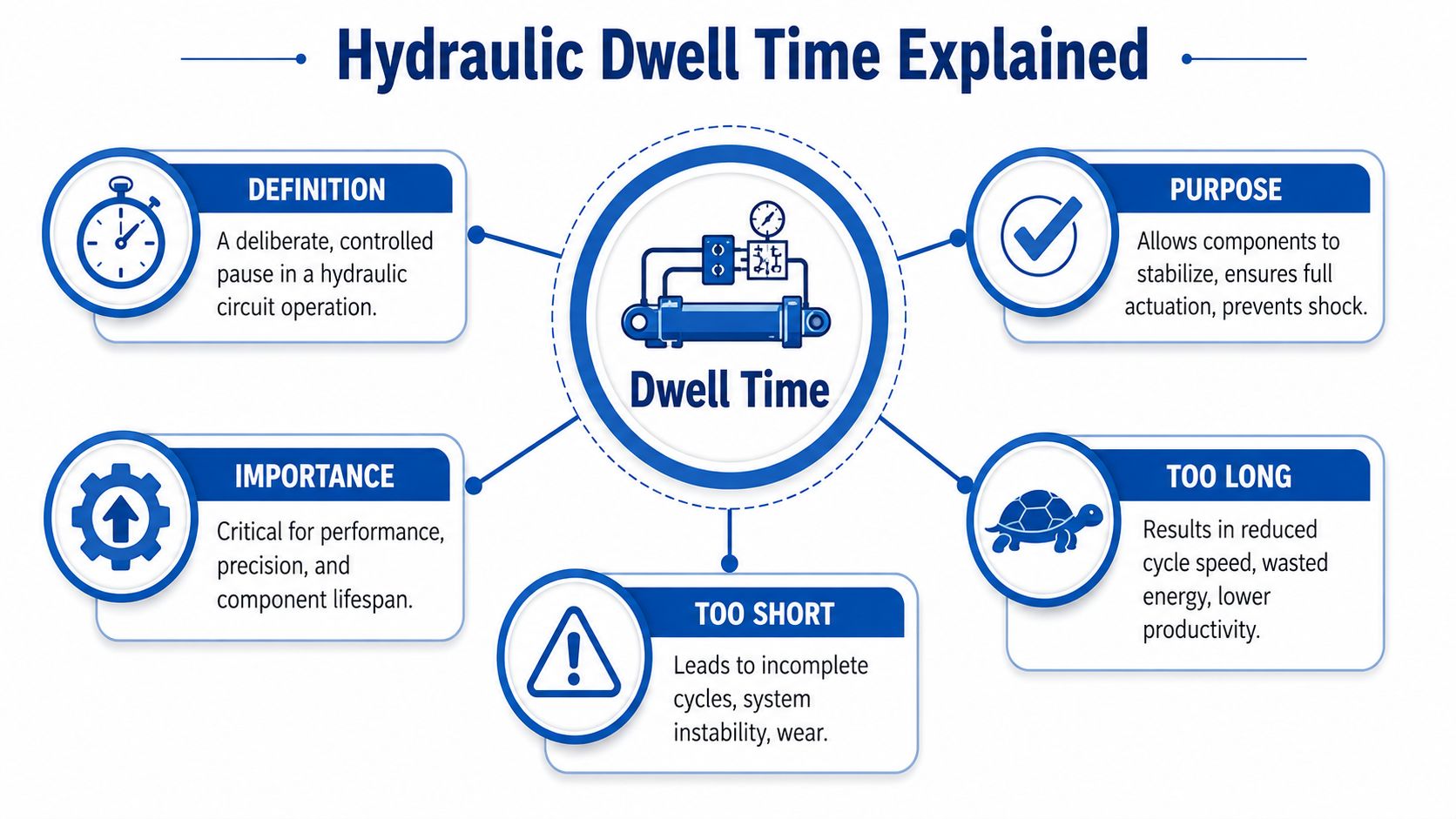
A simple way to picture it
Think of holding the brake pedal at a traffic light. The action isn't just pressing the pedal. The useful part is maintaining that state until it's time to move again.
A hydraulic dwell works in much the same way. The system reaches a required position or pressure, then holds there so the machine can do its job. On a press, that might mean keeping force on the work. On a clamp circuit, it may mean holding the part securely while another operation takes place. On a transfer system, it may mean waiting for another station to confirm ready status.
Where dwell appears in real circuits
You'll find dwell time in several familiar places:
- Pressing and forming: The ram reaches position and remains under load so the material can settle or form correctly.
- Clamping circuits: The actuator extends and holds pressure so the workpiece can't shift during machining or assembly.
- Sequenced valve logic: One function pauses briefly to let another line stabilise before the next command fires.
- Decompression and reversal: A short hold can prevent abrupt reversal and reduce hydraulic shock.
In more advanced systems, that hold can be managed through timer logic, pressure switches, proportional control, or a combination of all three. If you're dealing with circuits where timing and motion have to be tuned together, it's worth understanding how proportional valve control changes the way flow and pressure are applied through the cycle.
Why hydraulics professionals define it carefully
Hydraulic dwell is not "the machine stopped for a moment". That's too loose to be useful. A proper definition ties the dwell to an intended condition.
You can test whether a pause is true dwell by asking:
- Was it designed in?
- Is the system holding position, pressure, or valve state for a reason?
- Does the process need that hold to complete correctly?
If the answer is yes, you've got dwell time. If the answer is no, you may be looking at a fault, restriction, leak, or control issue.
Practical rule: If removing the pause damages quality, stability, or sequencing, it wasn't wasted time in the first place.
One more point often gets missed. Dwell doesn't only affect cylinders and valves. It influences fluid behaviour as well. During hold periods, fluid temperature, aeration, contamination behaviour, and component loading all continue to matter. That's one reason material choices inside pumping and fluid-handling equipment matter over the life of the system. For readers interested in wear reduction and flow-side durability, this piece on engineered polymer impellers gives useful background on cavitation and wear behaviour in pump and hydraulic contexts.
Why Hydraulic Dwell Time Matters for Performance and Safety
A machine can have the correct pressure rating, the right cylinder bore, and a capable pump, yet still perform badly because the dwell is wrong. Timing errors often hide inside otherwise sound hardware.
A dwell that's too short can leave the work half done. A dwell that's too long can slow the whole machine and keep heat in the oil for no good reason. In both cases, the operator feels the result before anyone reaches for a pressure gauge.
Performance effects on the machine cycle
The main performance question is straightforward. Does the dwell give the process enough time, but no more than necessary?
When the answer is yes, several things improve:
- Cycle consistency: The machine repeats the same sequence under similar conditions.
- Part quality: The workpiece sees the intended clamping, pressing, holding, or settling period.
- Flow transition: Reversals and changeovers happen with less shock and less hunting.
- Component life: Valves, seals, hoses, and cylinders avoid some of the stress caused by abrupt or unstable operation.
When the answer is no, the symptoms spread quickly. A press may mark material unevenly. A clamp may let the work shift. A transfer cylinder may reverse before the downstream station is ready. None of those faults necessarily point to a failed component first. They may point to poor dwell control.
Why safety is tied to dwell
Safety systems often rely on state confirmation, not just movement. It isn't enough for a guard to begin closing. It has to be fully in position before hazardous motion starts. It isn't enough for a clamp to touch the work. It has to hold the work securely before cutting or pressing begins.
That means dwell is sometimes part of safe sequencing. The pause allows:
- pressure to stabilise
- an interlock to confirm
- a load to settle
- decompression before reversal
If a machine jumps directly from one step to the next without that hold, the operator may see sudden motion, pressure spikes, or incomplete guarding.
A missing dwell can look like speed. In reality, it may be an unstable machine getting away with it for the moment.
The cost of getting it wrong
You won't always see a dramatic failure. More often, you get nuisance faults and creeping wear.
Common consequences include:
| Problem | Likely dwell issue | Typical result |
|---|---|---|
| Incomplete pressing or clamping | Too short | Variable output and rework |
| Slow production cycle | Too long | Lower throughput |
| Harsh reversal | No decompression hold | Shock loading and noise |
| Pressure decay during hold | Dwell exposes leakage | Drift, poor holding, heat generation |
That's why engineers should treat dwell as a design and maintenance setting, not an afterthought. It affects quality, uptime, and operator confidence all at once.
How to Measure and Calculate Hydraulic Dwell Time
On the workshop floor, dwell time has to be observable. If you can't see when the hold starts and ends, you can't tune it properly.
The most practical definition for measurement is this. Hydraulic dwell time is the period between the system reaching the required state and the command to begin the next state. The required state might be full extension, target pressure, closed clamp, or a confirmed valve position.
Start with the process, not the timer
A common mistake is setting a timer first and hoping the process suits it. Work the other way round.
Begin with three questions:
- What condition must be achieved before the hold starts?
- What needs to happen during the hold?
- What signal ends the hold and releases the next motion?
That prevents guesswork. For example, a clamp circuit shouldn't start timing from the instant the valve shifts if the cylinder still has travel left. The useful dwell begins when the clamp has seated and pressure has reached the intended holding condition.
Practical ways to measure it
You don't need the same method for every machine. The right approach depends on the control level and the cost of getting the timing wrong.
- PLC timer functions: Best where the sequence is already controlled electronically. You can tie dwell to timer blocks, sensor confirmation, or pressure switch input.
- External timer relays: Useful in simpler systems with limited logic.
- Pressure transducers and data logging: Helpful where the dwell depends on pressure build-up or hold stability, not just elapsed time.
- Flow and pressure traces on a scope or recorder: Good for seeing when movement stops, pressure rises, and the hold begins.
- Manual timing with operator observation: Crude, but sometimes enough for basic troubleshooting on older plant.
If you're selecting hardware for this sort of control work, one practical route is to combine conventional timing logic with suitable directional and modular valve arrangements. In that context, MA Hydraulics Ltd supplies components such as CETOP directional, proportional, modular and inline circuit valves that can form part of a timed or sequenced circuit.
A simple calculation framework
You don't need a complex equation to think clearly about dwell. A useful workshop-level approach is:
Dwell time = total required process hold time minus the time taken to reach the true hold condition
That wording matters. The time spent extending a cylinder is not dwell. The dwell starts when the machine has reached the condition it needs to maintain.
Worked example in plain language
Take a clamping station on a fabrication fixture. The operator starts the cycle, the cylinder extends, the clamp contacts the part, pressure rises, and the downstream operation needs the work held steady before it begins.
The timing logic should separate those stages:
- extension and approach
- seating and pressure rise
- hold period
- release to next operation
If you include all of that under one timer, the actual dwell may be shorter than you think. The fixture may appear to hold for long enough, but the effective clamped hold under proper pressure could be much shorter because part of the timer was spent only moving into place.
Measure the hold from the process condition that matters, not from the button press.
That one habit solves a lot of bad timing decisions.
Troubleshooting Common Dwell Time Problems
Most dwell problems announce themselves through symptoms rather than alarms. The machine still runs, but it doesn't run cleanly.
The quickest way to diagnose them is to look at the symptom, then ask whether the dwell is missing, excessive, or being interrupted by another fault such as leakage or unstable valve behaviour.
Symptom, cause, solution
-
Inconsistent clamping or poor repeatability
The dwell may be too short, or pressure may be decaying during the hold. Check whether the timer starts before full clamp contact, then inspect for internal leakage, pressure loss, or a drifting valve. -
Cycle time feels sluggish
The dwell may simply be longer than the process needs. Review the sequence and confirm whether the hold adds value or just waits. Trim it only after confirming quality remains stable. -
Harsh movement when reversing
The circuit may have no decompression hold. A short pause between pressure release and reversal often smooths the transition and reduces shock. -
Cylinder drifts during hold
The issue may not be the timer at all. It may be worn seals, a leaking valve, or load-induced movement across the circuit. Problems like these often sit alongside broader hydraulic valve problems and should be checked as part of the same diagnosis.
Checks worth doing first
Before changing settings, verify the basics:
- Confirm the trigger point: Make sure the dwell starts at the correct sensor or pressure condition.
- Watch pressure through the hold: If pressure falls away, the timer is not the whole story.
- Check valve response: Sticky spool movement can imitate timing faults.
- Look for heat build-up: Excess heat during long holds can point to energy being wasted across relief or restriction.
A machine with the wrong dwell often gets blamed on the wrong component. Careful observation usually shows whether the fault is in timing logic, pressure retention, or mechanical movement.
Optimise Your System with Expert Advice
In hydraulics, dwell time isn't spare time. It's controlled time. When the hold is set properly, the machine can clamp securely, press consistently, reverse more smoothly, and complete each cycle with less fuss. When it's wrong, the same circuit can become noisy, slow, inconsistent, or hard on components.
That matters beyond fixed industrial plant as well. Mobile equipment, service vehicles, and support fleets all rely on dependable cycle behaviour and minimal unplanned stoppage. For a wider maintenance perspective on keeping working assets available, this article on how to maximize fleet uptime is a useful companion read.
If you're reviewing timing in a hydraulic circuit, dealing with drift during a hold, or trying to balance cycle speed against stable operation, a second technical opinion can save a lot of trial and error.
If you need help with hydraulic dwell time, valve selection, circuit behaviour, or a bespoke power solution, contact MA Hydraulics Ltd. Phone 01724 279508 today, or send us a message.
