
A leaking IBC rarely starts as a dramatic failure. More often, it begins with a slow drip under the outlet, a damp pallet, or a hose connection that only seeps when the valve is opened fully. By the time someone notices product on the floor, the issue has already become a maintenance job, a clean-up job, and sometimes a safety incident.
That's why IBC tank fittings deserve more respect than they usually get. In a working plant, on a farm, or beside a washdown line, the fitting isn't just an add-on. It is the mechanical link between stored liquid and the rest of your process. If that link is wrong, worn, chemically unsuitable, or badly installed, everything downstream becomes unreliable.
The True Cost of an Incorrect IBC Fitting
A common failure starts during a routine changeover. An operator needs to connect an IBC to an existing transfer hose, the outlet thread looks close enough, and the adaptor in stores is fitted to keep production moving. It may tighten, but that does not mean the thread forms match or that the seal is being made in the right place. Once the valve is opened, any mismatch shows up under load, during movement, or after the plastic has relaxed.
The cost is usually out of proportion to the price of the fitting. A minor leak can turn usable product into waste, contaminate a bund, create a slip hazard, and pull operators away for clean-up and inspection. If the liquid is corrosive, food-related, or controlled under site procedures, the consequences escalate quickly from nuisance to reportable incident.
I see the same pattern repeatedly. Someone tries to rescue a poor connection with more PTFE tape, more torque, or a heavier adaptor stack. That may stop the drip for a shift, but it also increases the chance of split threads, distorted sealing faces, and valve damage from hose weight or side loading.
Practical rule: If an IBC connection only works when it is “done carefully” by one experienced person, it is not a reliable connection.
A key engineering problem is that an incorrect fitting can appear serviceable during installation while still being wrong in three separate ways. The thread may engage only partially. The sealing method may be unsuitable for the outlet design. The material may tolerate the liquid briefly, then harden, swell, or crack in service. Engineers who already deal with different hydraulic fitting types and thread forms will recognise the pattern immediately. A connection that looks close is often the one that fails first.
A correct fitting has to do three jobs at the same time. It must match the outlet thread exactly. It must seal using the correct face, gasket, or thread method for that design. It must remain secure through handling, repeated use, temperature changes, and normal plant abuse. If any one of those conditions is missed, the fitting is not cheaper. It is pushing cost into maintenance, downtime, and risk.
Anatomy of IBC Tank Fittings Types and Functions
A reliable IBC outlet is an assembly, not a single fitting. If you assess it as one part, you miss the places where loads transfer, where the seal is made, and where damage usually starts after a few handling cycles.
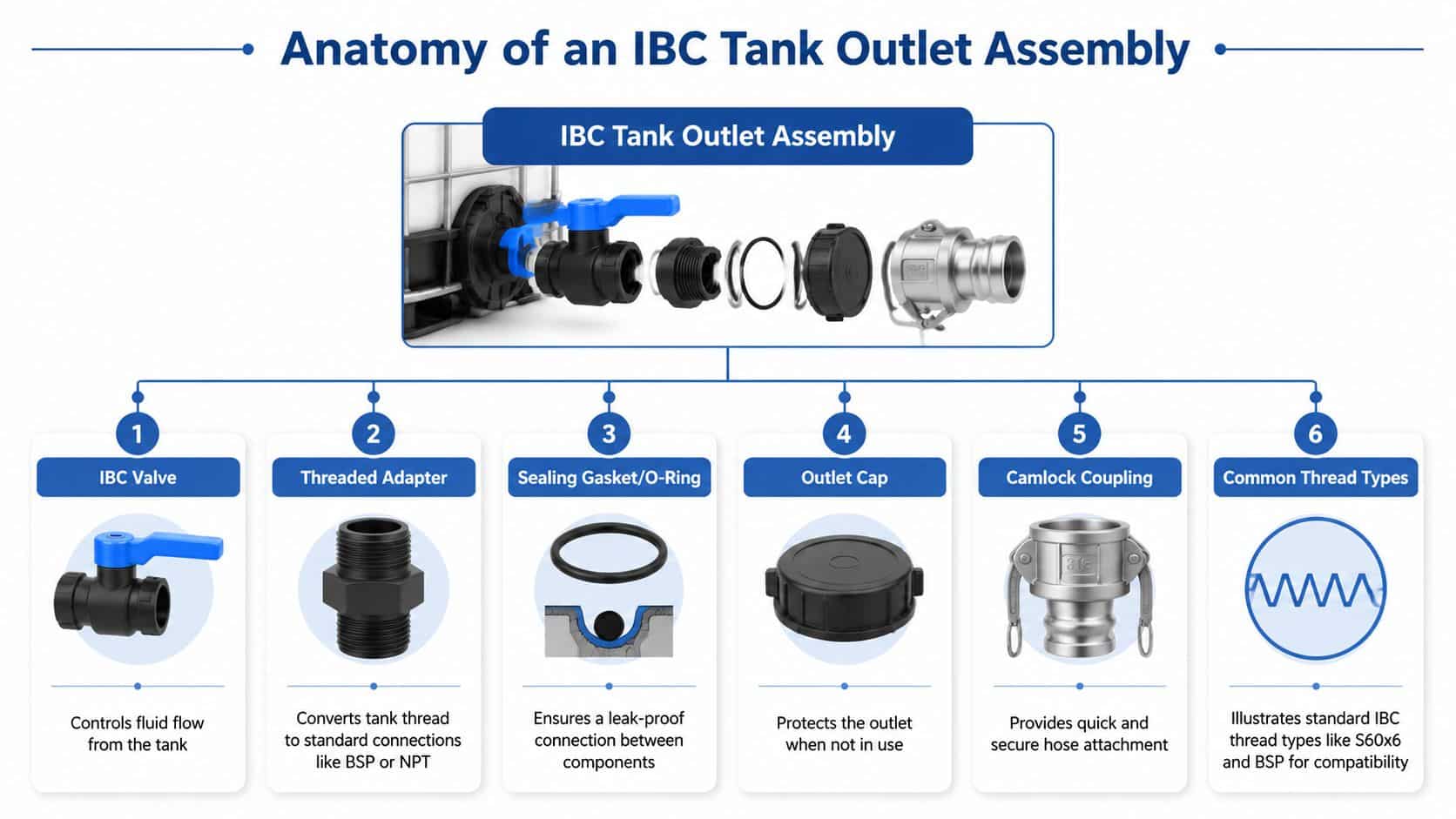
In plant service, I break the outlet into four functional parts. The valve controls flow. The adaptor converts the outlet to something the site can use. The seal creates the leak-tight joint. The cap or coupling protects the connection or makes repeat connection quicker. Each part has its own failure mode.
The valve body
The valve is the mechanical foundation of the outlet. It does more than open and shut. It carries the weight of the downstream connection, resists twisting during installation, and absorbs a lot of the abuse from hose movement and operator handling.
You will usually see ball valves and butterfly valves on IBCs. The practical difference is in service behaviour:
- Ball valves usually give a firmer shut-off and a clearer indication of open or closed position. They are often preferred where operators want a positive feel during manual transfer.
- Butterfly valves are common on IBCs and generally suit routine discharge duties well, provided the outlet thread and sealing face are matched correctly.
- Both types are vulnerable to side loading, especially if a long hose, metal adaptor chain, or unsupported cam coupling is left hanging from the outlet.
That last point matters more than many buyers expect. A valve can be perfectly serviceable and still fail early because the fitting arrangement turns it into a support bracket.
The adaptor
The adaptor is where compatibility is won or lost. Its job is to convert the IBC outlet into a connection that suits the site hose, pump, pipework, or temporary transfer rig. In practice, it also protects the valve. I often prefer the adaptor to take the wear, because replacing an adaptor is cheaper and simpler than replacing a damaged outlet valve.
Common adaptor functions include:
- Thread conversion from the IBC outlet to a site standard
- Connection changeover to hose tails, BSP, camlock, or other transfer hardware
- Size change where downstream equipment needs a different bore
- Wear isolation so repeated connection cycles do not damage the valve thread directly
The same discipline used for hydraulic fitting thread types and connection forms applies here. Identify the outlet correctly first, then choose the conversion fitting, then confirm how the joint seals. Guessing from appearance is what creates mixed-standard assemblies that work briefly and leak later.
Seals, caps, and couplings
The seal is usually a gasket or O-ring, and it has one job. Hold pressure and fluid without degrading in the product. If the geometry is right but the seal material is wrong, the joint still fails. If the material is right but the compression face is wrong, it still fails.
Protective parts matter as well. Dirty threads, damaged sealing faces, and dried product residue cause a surprising number of repeat leaks, especially on reused containers and fittings stored loose in vans or maintenance cages.
| Component | Job in service |
|---|---|
| Sealing gasket or O-ring | Creates the fluid-tight joint at the intended compression face |
| Dust cap or outlet cap | Protects threads and sealing faces when the tank is not connected |
| Camlock coupling | Allows fast hose connection where repeated setup and breakdown is needed |
| Secondary closure | Adds containment and keeps dirt out during storage or transport |
A good assembly is easy to inspect. You should be able to see where the load is carried, where the seal is made, and which part is intended to be replaced when it wears. If that is unclear, the fitting arrangement is usually too improvised for repeated industrial use.
Decoding Thread Types and Sealing Methods
A tote arrives on site full of product, the transfer line is waiting, and the adaptor that “looked right” picks up two turns before binding. That is how mixed-thread assemblies start. They may hold long enough for a quick drain-down, then leak on the next fill cycle when the seal face distorts or the threads let go.
For IBC work, thread identification is not a paperwork exercise. It is how you prevent cross-threading, avoid makeshift sealant fixes, and keep the valve outlet serviceable after repeated use. In UK service, many containers are fitted with S60x6 outlet threads, and suppliers commonly offer conversion fittings to BSP, Hozelock, and camlock ends. Direct Water Tanks explains the common S60x6 conversion options in its IBC fittings guide, which is why the valve standard should be confirmed before anyone selects the hose connection.
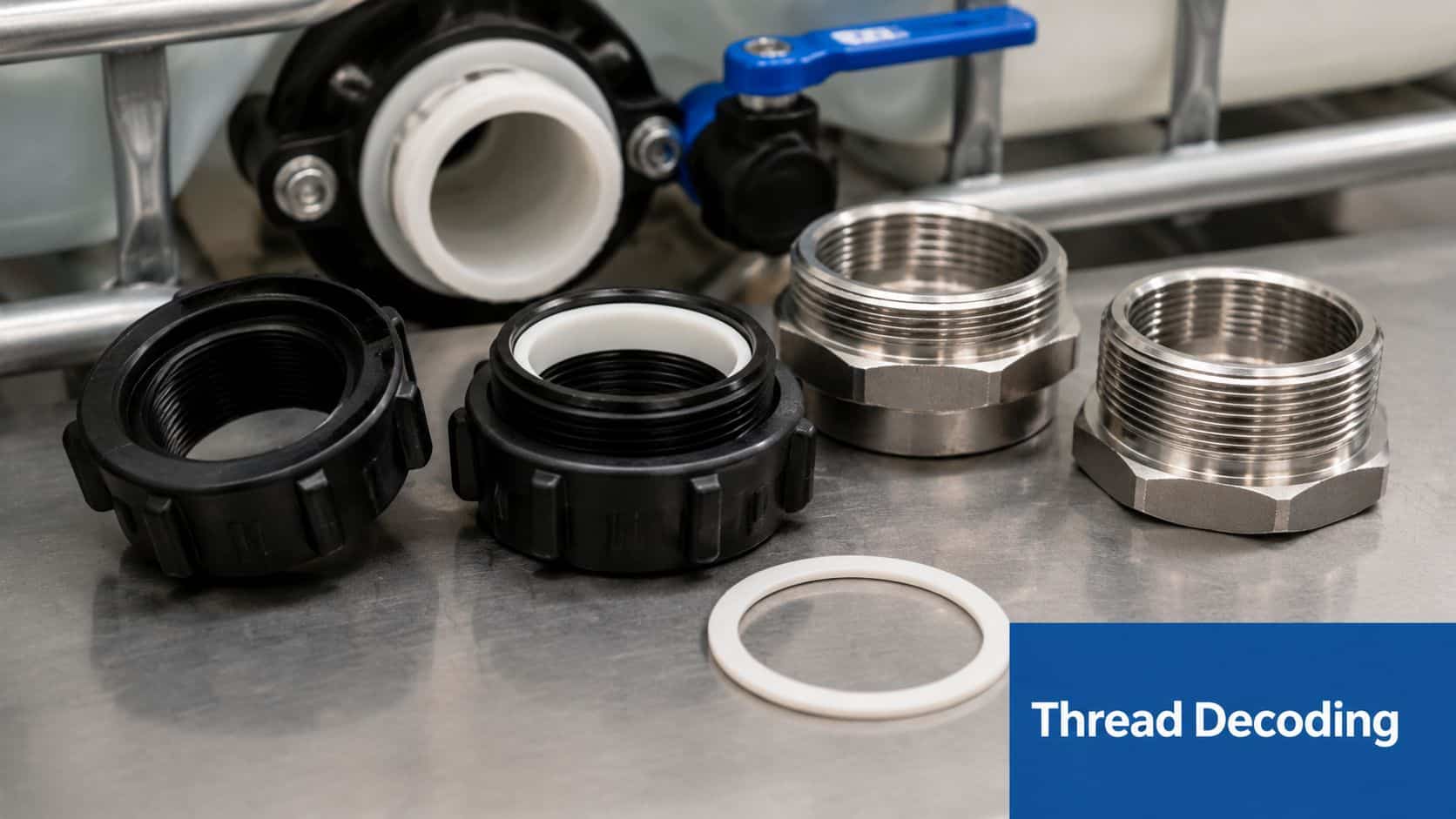
Measure first, then identify the seal
Appearance is a poor guide. I have seen fitters match a thread by eye, get partial engagement, and assume PTFE tape will rescue it. It will not. The right check is simple and repeatable.
- Measure the major outside diameter of the outlet thread.
- Measure the pitch with a thread gauge or by comparing against a known sample.
- Identify whether the thread is parallel or tapered.
- Inspect the actual sealing point. Face seal, captive gasket, O-ring land, or thread interference.
- Confirm the downstream connection standard before adding reducers, hose tails, or quick couplings.
That last point matters in plant rooms where one adaptor often feeds another. If you are converting between pipe standards elsewhere in the line, a part such as a 1/4 BSP to metric adaptor for thread conversion shows the same principle. One wrong assumption at the first joint usually creates two or three more downstream.
Threads hold the joint. The seal keeps it dry.
Engineers get into trouble when they treat the thread and the sealing method as the same thing. They are often not.
- Parallel threads usually provide mechanical retention. The seal is made at a washer face, flat gasket, bonded seal, or O-ring seat.
- Tapered threads can contribute to sealing through thread interference, but only if the thread form and sealant method are correct.
- IBC valve adaptors commonly seal at the valve face or against a dedicated gasket. Tightening the thread harder does not improve a face seal once the gasket is already compressed incorrectly.
If a joint only stops dripping when someone reaches for a bigger spanner, the joint design has not been understood.
A practical check is to ask a simple question before assembly. Where is the seal supposed to form? If nobody on the job can point to that exact surface, the fitting choice has not been verified properly.
The visual side of thread checking is useful, but a hands-on demonstration can also help when the team is training less experienced fitters:
Good practice in the workshop
Some habits consistently reduce failures.
- Start every threaded connection by hand. If it does not run freely at the start, stop and re-check the standard.
- Load the correct sealing face. A flat gasket, O-ring, and tapered thread each need a different approach.
- Keep adaptor stacks short. Every extra joint adds tolerance build-up, another seal, and another leak path.
- Inspect used valve outlets closely. Burrs, flattened threads, and damaged gasket lands are common on reused IBCs.
A few habits create repeat faults.
- PTFE tape on unsuitable threads. Tape does not correct a mismatch between thread form and sealing geometry.
- Forcing a near match. Partial engagement damages the outlet and makes the next fitting harder to seal properly.
- Choosing from the hose end first. Start at the valve outlet, then work outward through the rest of the assembly.
Reliable IBC connections come from identifying the thread standard, confirming how the joint seals, and tightening only to the point that the intended sealing surfaces do their job. That is the difference between a fitting that survives repeated service and one that only works on the day it was installed.
Material Selection and Chemical Compatibility
Choosing the thread correctly is only half the job. The other half is material suitability. An adaptor can fit perfectly and still fail early because the body material softens, the seal swells, or the liquid attacks the polymer over time.
Many basic guides fall short by stopping at compatibility in the narrow sense of “will it screw on?” Plant reliability depends on a wider question: Will it keep sealing after repeated drain and fill cycles, minor vibration, outdoor exposure, and contact with the actual product being handled?
Body material and gasket material are one decision
In practice, you are not choosing a fitting body and a gasket separately. You are choosing a sealing system. A decent plastic adaptor with the wrong elastomer is still the wrong fitting.
Typical material decisions look like this:
- Polypropylene or similar plastics can be suitable for many general liquid handling duties and are common where corrosion resistance matters more than mechanical toughness.
- Stainless steel is often chosen when users need a stronger connection, better resistance to repeated handling, or a material that stands up better in harsh environments.
- Elastomer selection matters just as much. Water-based products, oils, cleaning chemicals, and more aggressive fluids do not behave the same way against seals.
The mistake I see most often is buying on body material alone. The fitting arrives as “chemical resistant”, but the supplied gasket is only acceptable for a narrower range of fluids. That's how you end up with a connection that seals well on day one and starts weeping later.
Reliability under real service conditions
A fitting tested briefly on a bench tells you very little about its long-term behaviour. Real sites introduce three things that expose poor material selection quickly: movement, temperature variation, and time in contact with the liquid.
Recent coverage of IBC fitting practice leaves a useful gap here. It often focuses on convenience and installation tricks, but the more important engineering question is seal integrity under repeated cycles, vibration, and variable temperatures, as highlighted by this YouTube discussion of IBC fitting and sealing practice. That is the right lens for industrial users.
| Material | Gasket Material | Suitable For | Not Recommended For |
|---|---|---|---|
| Plastic adaptor body | EPDM | Water-based service, general washdown-style transfer where the liquid and cleaning regime suit EPDM | Oils, solvents, or any service where EPDM compatibility is uncertain |
| Plastic adaptor body | Viton type seal | Oils, fuels, solvents, and mixed chemical duties where the seal needs broader chemical resistance | Applications where the exact chemical compatibility is not confirmed |
| Stainless steel body | EPDM | Mechanically demanding water-based duties where corrosion resistance and physical robustness matter | Fluids that are unsuitable for EPDM sealing |
| Stainless steel body | Viton type seal | More demanding industrial transfer duties requiring both mechanical durability and broader seal resistance | Any application where either the product or cleaning chemical remains unverified |
The trade-off that matters
The cheapest fitting usually wins only on invoice price. It loses when operators replace it repeatedly, add workarounds, or have to strip and remake leaking joints during production hours.
A sound buying decision asks four questions:
- What liquid is in the IBC?
- What cleaning agents will contact the fitting?
- Will the connection stay static, or will hoses be connected and disconnected regularly?
- Is the fitting exposed to weather, UV, or mobile equipment vibration?
If any answer points to uncertainty, don't buy on convenience. Ask for body and seal material details before purchase.
Installation and Maintenance Best Practices
A good fitting can still fail if it is installed badly. Most workshop leaks come from ordinary mistakes. Dirt in the thread root, a twisted gasket, a joint started with tools instead of by hand, or a hose left unsupported so the adaptor carries bending load.
That matters even more because IBCs are part of a regulated handling system. UK-facing guidance states that IBCs should be tested at least once every 30 months, and stainless-steel IBCs manufactured with UN markings also require a thickness test once every 60 months. The same guidance notes a typical service life often quoted at 5 to 10 years depending on handling and maintenance, according to Container Exchanger's IBC overview. In practice, fittings sit inside that inspection reality. They are not exempt from wear just because they are replaceable.
Fit it as if it has to stay put
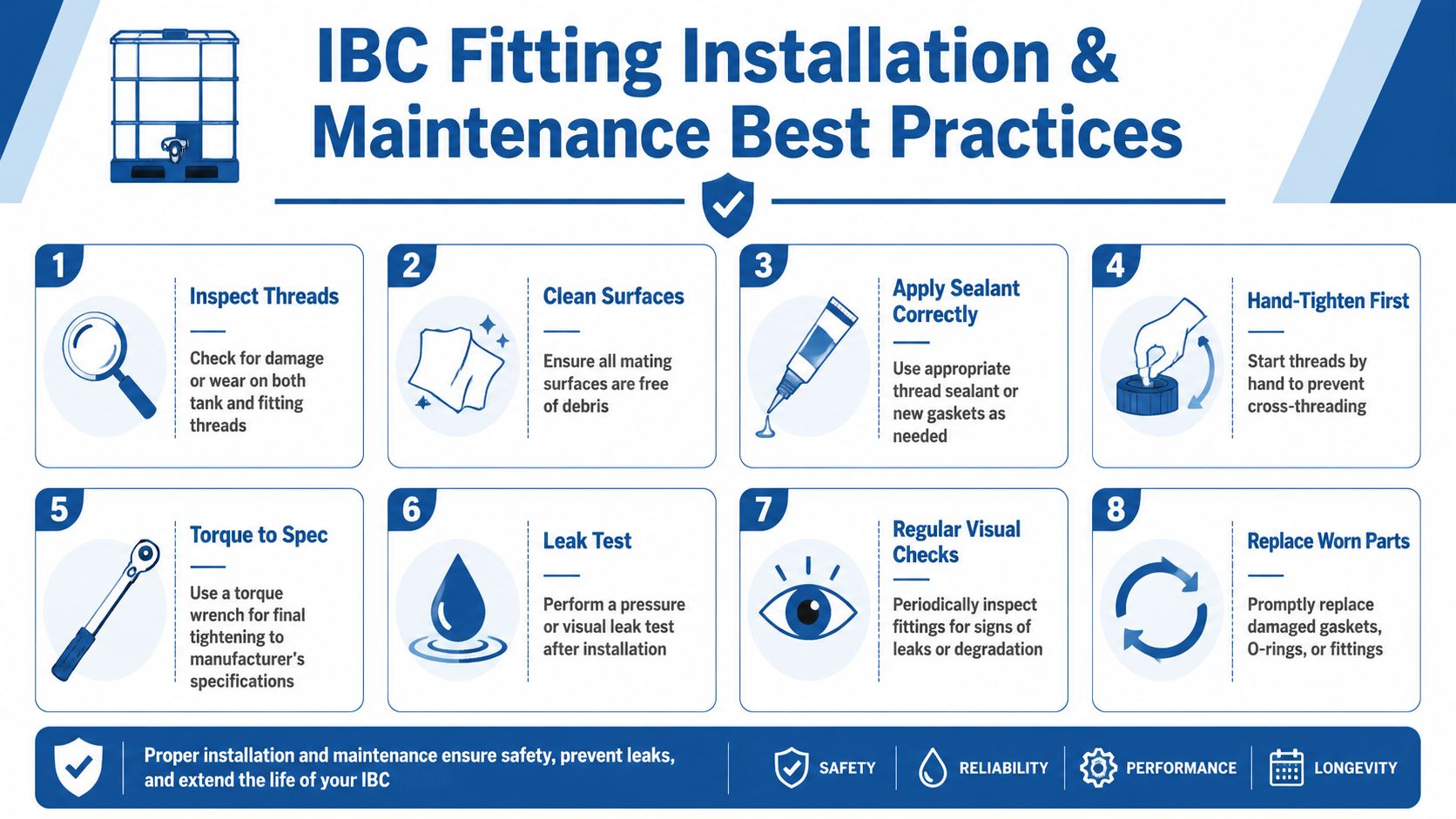
Professional installation is mostly disciplined basics:
- Inspect the threads: Look for flattening, chips, moulding flash, or previous cross-thread damage.
- Clean the mating faces: Product residue and grit stop seals seating properly.
- Seat the gasket correctly: Don't reuse a distorted seal because it “still looks alright”.
- Start by hand: If the fitting won't run on smoothly by hand, it isn't aligned.
- Support the hose: Don't ask the valve or adaptor to carry the weight of a hanging line.
A lot of these principles overlap with general pipework practice. If someone on your team needs a broader refresher on connection discipline outside IBC-specific assemblies, this copper pipe fittings guide is useful because it reinforces the same idea. Joint quality starts with preparation, alignment, and the right sealing method.
Don't confuse tight with secure
Hand-tightening is only the starting point. In service, vibration, pressure changes, and repeated handling can gradually loosen a connection that felt fine during installation.
The practical checks after assembly should include:
| Check | Why it matters |
|---|---|
| Visual leak check | Finds obvious drips around the sealing face and thread root |
| Short hold period after filling | Shows whether the seal remains stable under static load |
| Operational check with valve fully opened | Some leaks only appear at higher flow |
| Recheck after movement or hose use | Movement exposes poor support and marginal sealing |
A dry fitting at installation isn't the same as a reliable fitting in service. Recheck it after the first real operating cycle.
Build maintenance into routine inspection
Where teams struggle is not installation. It is follow-up. Fittings are often left untouched until they fail.
A sensible maintenance routine looks for:
- Stress cracking around plastic threads and flats
- Swelling or hardening of gaskets and O-rings
- UV degradation on exposed plastic parts
- Wear from repeated coupling cycles
- Thread damage from repeated removal and refitting
If the IBC is in regular use, treat the outlet assembly as a service item. That approach is more reliable than waiting for a leak and then treating it as an isolated fault.
Troubleshooting Common IBC Fitting Problems
A tote arrives on site, the adaptor screws on, and the connection looks dry during filling. Two hours later there is product on the bund floor and the outlet valve has a hairline crack. That is a typical IBC fitting failure. The first symptom is rarely the actual fault.
Good fault-finding starts with the load path and sealing method, not with the drip itself. Check whether the leak is coming from the thread engagement, the sealing face, the valve body, or the downstream hose connection. A torch, a clean rag, and a dry restart after inspection usually tell you more than adding more tape or tightening harder.
Slow drip at the connection
Symptom
A steady seep or intermittent drip appears where the adaptor meets the valve.
Likely cause
The gasket is damaged, out of position, chemically degraded, or the adaptor is bottoming on the thread before the sealing faces are fully compressed. In mixed fleets, a near-match thread can also screw on far enough to mislead the installer.
Solution
Strip the joint and inspect the seal first. Look for flattening, cuts, swelling, hardening, or a witness mark that shows uneven compression. Clean the mating faces and confirm the adaptor is sealing where it was designed to seal. If the joint only held when heavily tightened, treat that as a compatibility problem, not a tightening problem.
Adaptor binds after a partial turn
Symptom
The fitting starts correctly, then tightens abruptly and will not run on smoothly.
Likely cause
Cross-threading, the wrong thread form, moulding flash on a plastic adaptor, or damage on the valve outlet.
Solution
Stop immediately. Do not force it with a spanner. Back off, clean both sides, and inspect the first few threads closely. Measure the outlet and compare it with the adaptor specification you are holding, not the label from the order. If the fitting was chosen by eye because it looked close enough, this is usually where the mistake shows up.
A fitting that needs persuasion during the first turns is already telling you something useful.
Joint seals at first, then leaks after use
Symptom
The assembly is dry after installation but starts leaking after the hose is operated, the valve is cycled, or the IBC is repositioned.
Likely cause
Side load from the hose, vibration during handling, temperature change, or too many stacked adaptors creating a weak connection.
Solution
Support the hose independently and reduce bending load at the outlet. If operators connect and disconnect frequently, replace improvised threaded build-ups with a proper quick-coupling arrangement such as an industrial camlock fitting arrangement rated for the service. Then replace any gasket or O-ring that has already been disturbed. Once a seal has been dragged under load, it is rarely worth trusting again.
Plastic fitting cracks or swells
Symptom
The adaptor body shows whitening, stress marks, splitting, distortion, or obvious dimensional change.
Likely cause
Overtightening is common, but not the only cause. Chemical attack, cleaning residues, UV exposure, and impact during transport all produce similar-looking damage.
Solution
Replace the part. Do not try to save a cracked polymer fitting with extra tape, paste, or a tighter assembly. Review the body polymer and the seal material together against the actual media, concentration, and cleaning regime. A fitting that survives water service may fail quickly on caustic, solvent blends, or repeated washdown chemicals.
Camlock or hose connection works loose
Symptom
The threaded connection into the IBC stays sound, but the downstream coupling loosens, leaks, or disconnects poorly.
Likely cause
Worn cam arms, damaged coupling faces, poor hose support, or repeated handling beyond what a light-duty arrangement will tolerate.
Solution
Inspect the locking parts, gasket condition, and coupling wear pattern. Then check hose routing and support. If the hose is hanging off the outlet or being pulled sideways during use, the coupling is carrying loads it was never meant to carry. The fix is usually mechanical support and a better layout, not more tightening force.
Leak appears to come from the adaptor, but the valve is cracked
Symptom
Product tracks around the adaptor and drips from the lowest point, making the adaptor look like the failed part.
Likely cause
A cracked outlet stub or valve housing. This often follows cross-threading, overtightening, impact, or a hose strike during handling.
Solution
Dry the area completely and inspect the valve body under good light while the connection is static and then under flow. Hairline cracks can open only when the valve is loaded. If the valve outlet is damaged, replacing seals and adaptors will not solve it. Isolate the IBC and change the valve assembly or container as site procedure requires.
Troubleshooting works best when each fault is treated as a mechanical and materials problem, not just a leak to stop quickly. That approach prevents repeat failures, protects the valve outlet, and avoids turning a simple fitting issue into a container replacement.
Sourcing Quality Fittings and Expert Support
Buying IBC tank fittings as a commodity usually creates more work later. The better approach is to buy them as engineered connection components. That means asking for the thread standard, body material, gasket material, and intended service rather than ordering purely from a thumbnail photo and a nominal size label.
A good supplier should be able to answer straightforward practical questions. Is the adaptor intended for the outlet thread you have, or just “fits most”? What is the seal material? Is the fitting suitable for repeated coupling cycles, or only light static use? If the answer to those questions is vague, the product probably is too.
For many industrial setups, the best configuration is not the most complicated one. It is the one with the fewest interfaces, the clearest sealing method, and the least chance of side loading the valve. If your application needs fast hose changes, a properly selected camlock fitting arrangement is often a better route than stacking miscellaneous threaded reducers and tails until something happens to fit.
The biggest saving comes from getting the first decision right. A correct fitting reduces leakage risk, avoids thread damage, supports inspection routines, and gives operators confidence that the connection will behave the same way every time they use it.
If the liquid is awkward, the environment is harsh, or the thread identification is unclear, stop treating the fitting as an afterthought. It is part of the system design.
If you need help choosing the right IBC tank fittings, adaptor standard, seal material, or coupling arrangement, speak to MA Hydraulics Ltd. The team can help you work through compatibility, reliability, and application demands without guesswork. Phone 01724 279508 today, or send a message through the contact page.
