
Picture this: a powerful mechanism that doesn’t just push with immense force, but can also pull with the same level of control. That’s precisely what you get with a hydraulic double acting cylinder. It’s one of the real workhorses of modern machinery, turning fluid pressure into powerful, precise movement in two directions.
Understanding the Double Acting Cylinder
At its heart, a hydraulic double acting cylinder is a linear actuator. It takes hydraulic energy—pressurised oil—and converts it into mechanical force and straight-line motion. Where it differs from a single-acting cylinder, which often relies on a spring or gravity for its return journey, is that it uses fluid power for both extension and retraction. This two-way power gives you far superior control, making these cylinders essential across countless UK industries.
Think of it like a powerful, two-way mechanical muscle. When you pump hydraulic fluid into one port, the piston rod extends, pushing a load. To bring it back, you simply switch the flow to the opposite port, and the rod retracts with just as much force, pulling the load. This controlled push-and-pull is the secret behind the operation of everything from agricultural machinery to factory automation.
Why This Control Matters
The ability to apply controlled force in both directions is absolutely critical for tasks that need careful handling and manipulation.
For example, think about:
- Mobile Plant: The boom on an excavator has to powerfully push soil away, but then it needs to pull the heavy bucket back towards the cab with equal control.
- Manufacturing: A hydraulic press must apply pressure with incredible precision to form a metal part, and then release that pressure just as carefully.
- Agriculture: A tractor’s three-point hitch needs the power to lift heavy implements, but also the ability to apply downward pressure to make them bite into the ground.
In every one of these cases, a single-acting cylinder just wouldn't cut it. The double-acting design provides the robust, bidirectional force needed to get the job done efficiently and, most importantly, safely.
The UK's Hydraulic Heritage
The thinking behind this technology actually has deep roots in British innovation. It all started back in 1795 when London-based inventor Joseph Bramah patented the first proper hydraulic press, which used fluid pressure to multiply force. That breakthrough laid the foundations for all modern hydraulics. By the middle of the 19th century, engineers had built on Bramah's idea to create the double-acting cylinder we know today, and UK industry was changed forever. You can explore more on the history of hydraulic cylinders and their early development.
Here at MA Hydraulics, we're proud to continue that legacy. As a leading UK specialist, we supply a huge range of top-quality hydraulic components, including the incredibly versatile hydraulic double acting cylinder. We know the tough conditions our customers' equipment faces, and we provide the expert advice they need to choose the right parts for peak performance.
How a Double Acting Cylinder Really Works
Think of a hydraulic double acting cylinder as a powerful, two-way syringe. Instead of your thumb pushing a plunger, pressurised hydraulic fluid does all the heavy lifting. This gives you immense force and precise control over both the push and pull motions, which is what makes these cylinders so essential in modern machinery.
At its heart, the operation is all about directing the flow of hydraulic fluid (usually oil) with a control valve. Inside the cylinder's main housing, called the barrel, a piston and rod assembly moves back and forth. Seals keep the fluid on the correct side of the piston, turning hydraulic pressure into linear force.
The Extend Stroke: Powering Outward
When you need to push a load, you initiate the extend stroke, also known as the outstroke. It's a straightforward sequence.
- Fluid In: The hydraulic pump sends pressurised fluid to the A port, typically located at the rear (or cap end) of the cylinder.
- Pressure Builds: This high-pressure fluid immediately starts acting on the full face of the piston.
- Piston Moves Forward: Once the force generated is enough to overcome the load's resistance, the piston and its attached rod begin to extend out of the cylinder.
- Fluid Out: As the piston moves, it displaces the fluid on the other side. This oil is pushed out of the B port at the rod end and flows back to the system's reservoir at low pressure.
This is the 'push' that gives a double acting cylinder its reputation for strength. It provides the steady, reliable power needed to lift massive loads or drive powerful equipment.
The diagram below breaks down this fundamental push-and-pull action.
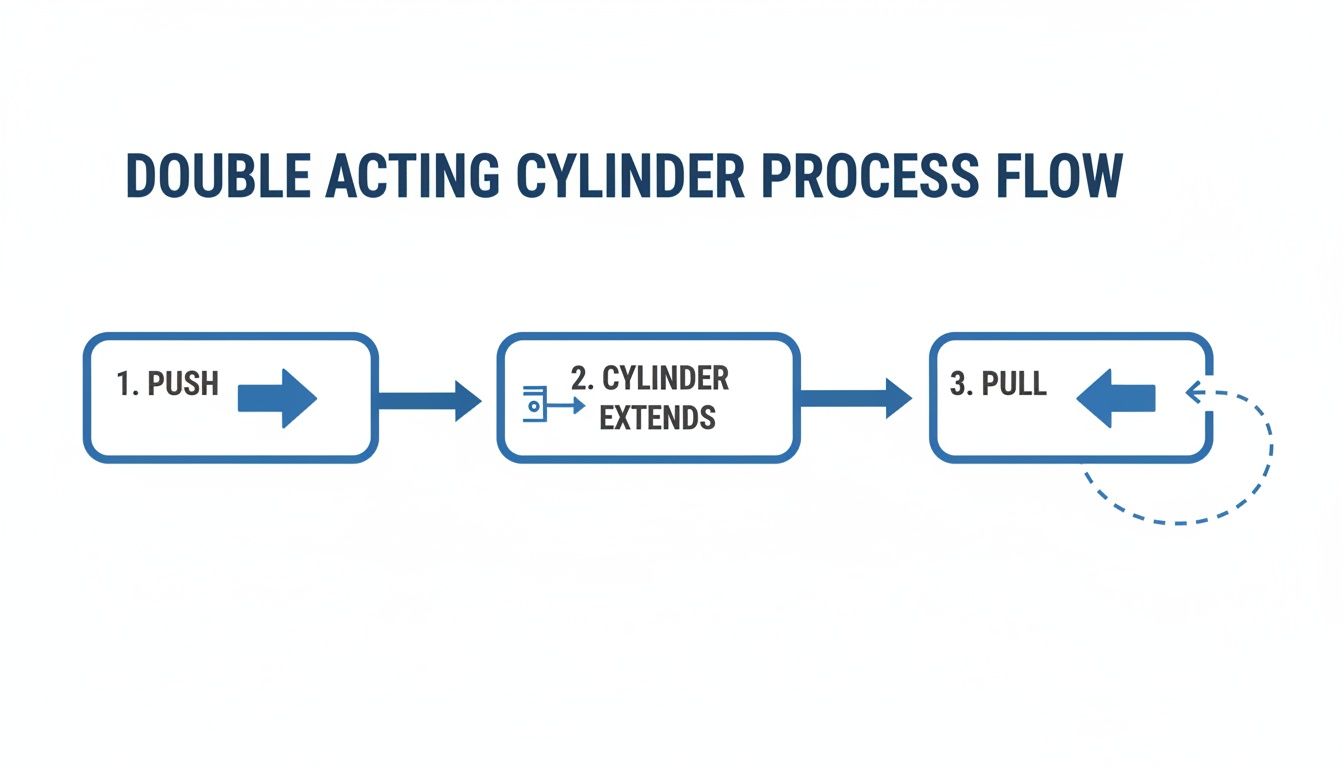
As you can see, simply changing which port receives the fluid flow is all it takes to switch between extending and retracting the cylinder.
The Retract Stroke: Pulling Back In
Bringing the rod back in is just as controlled and powerful. The retract stroke (or instroke) is essentially the extend stroke in reverse.
The secret is simply redirecting the pressurised fluid. By swapping the high-pressure flow from the cap end to the rod end, you instantly reverse the cylinder’s direction, giving you just as much control over pulling forces as you have over pushing forces.
Here’s how it works:
- Fluid In: The control valve now sends high-pressure fluid into the B port at the rod end of the cylinder.
- Pressure Acts on the Annulus: The fluid pushes against the piston face, but on a smaller surface area because the rod is in the way. This area is called the annulus.
- Piston Retracts: The pressure forces the piston back towards the cap end, pulling the rod neatly back inside the barrel.
- Fluid Out: The oil that was behind the piston is now forced out through the A port and back to the tank.
Because the surface area is smaller on the rod side, the retraction force is a little less than the extension force at the same pressure. On the flip side, this often makes the retraction stroke faster—a useful feature in many machine cycle designs. This controlled, two-way power is precisely why the hydraulic double acting cylinder remains a cornerstone of industrial and mobile equipment.
Single Acting vs Double Acting Cylinders: A Quick Comparison
Choosing the right cylinder type is crucial for any hydraulic system. While double acting cylinders offer two-way power, single acting cylinders have their own place. This table breaks down the key differences to help you decide.
| Feature | Single Acting Cylinder | Double Acting Cylinder |
|---|---|---|
| Operation | Powered in one direction only (extend or retract). | Powered in both directions (extend and retract). |
| Return Mechanism | Relies on an external force (gravity, load, or internal spring) to return to its starting position. | Uses hydraulic pressure for both the extend and retract strokes. |
| Control | Simpler control, often requiring only a 3-way valve. | Requires more complex control, typically a 4-way valve, to manage flow to two ports. |
| Ports | Features a single fluid port. | Features two fluid ports (one at each end). |
| Applications | Ideal for simple lifting, clamping, and pushing tasks where the return stroke is assisted by weight or gravity. | Perfect for applications needing precise control and force in both directions, like steering, pressing, and positioning. |
In short, if your application only needs powered movement in one direction and has a natural way to return, a single acting cylinder might be a simpler, more cost-effective choice. But for applications demanding powered control for both pushing and pulling, the double acting cylinder is the undisputed standard.
For expert advice on selecting the right cylinder for your application, phone 01724 279508 today, or send us a message.
The Anatomy of a High-Performance Cylinder
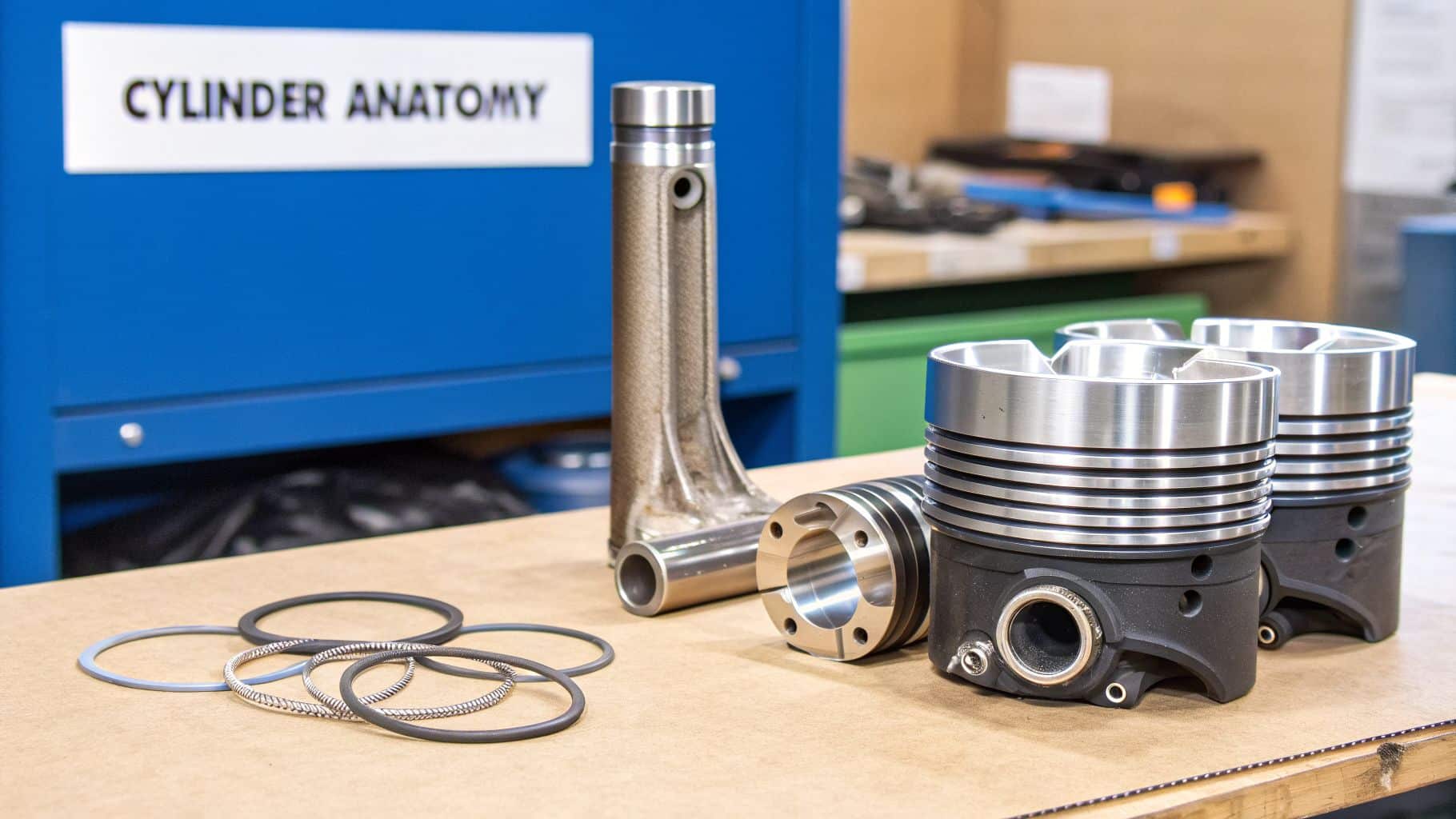
A hydraulic double acting cylinder might look like a simple tube with a rod sticking out, but on the inside, it's a collection of precision-engineered parts. The performance and, crucially, the lifespan of any cylinder come down to the quality of these internal components and the materials chosen for them. Let's take a look under the bonnet and see what makes them tick.
Core Structural Components
At its heart, a cylinder is built from a few key parts that work together to contain the immense pressure and generate movement.
-
Cylinder Barrel: This is the main body of the cylinder, often just called the 'tube'. It's usually made from seamless steel tubing with an internal surface that is 'honed' to an incredibly smooth finish. This isn't just for show; that smooth bore is essential for the seals to work effectively without friction or wear.
-
Piston Rod: This is the workhorse component, transmitting all that hydraulic force out to the job at hand. It has to be incredibly strong to resist bending or buckling under load, which is why it's typically machined from high-strength steel that is induction hardened. A hard chrome plating is then applied, giving it excellent protection against corrosion and wear—vital for a part that’s constantly sliding in and out, exposed to the elements.
-
End Caps: Often called the 'head' (rod end) and 'cap' (base end), these components seal off the cylinder barrel. They do more than just cap the ends; they also house the ports where the hydraulic fluid enters and exits, as well as the critical rod seals and mounting points.
The Crucial Role of the Sealing System
While the steel parts provide the muscle, it's the sealing system that gives the cylinder its finesse and reliability. Without good seals, the cylinder will leak, lose pressure, and ultimately fail. It’s a complete system, with each seal having a very specific job.
The sealing system is the single most critical element for preventing fluid leaks, maintaining system pressure, and ensuring the long-term operational integrity and safety of the entire hydraulic cylinder. Even a minor seal failure can lead to significant performance loss and potential hazards.
Here are the key players in the sealing game:
-
Piston Seals: Mounted directly on the piston, their job is to stop high-pressure fluid from bypassing from one side to the other (a failure known as 'blow-by'). This ensures every bit of hydraulic force is used to push the piston.
-
Rod Seals: You'll find these in the cylinder head, and they have one primary purpose: to stop hydraulic fluid from escaping the cylinder by leaking along the surface of the piston rod.
-
Wipers: Also found in the head, a wiper acts like a scraper. As the rod retracts, it cleans off any dirt, grit, or moisture. This simple action is vital for stopping contaminants from being dragged inside, where they could quickly destroy the seals and score the internal components.
Making sure all these parts fit together perfectly is a matter of incredibly fine margins. It involves a deep understanding of tolerance stack up analysis to ensure a perfect seal under thousands of PSI of pressure.
Construction Styles: Tie-Rod vs Welded
How all these components are held together defines the cylinder's basic construction, with two designs leading the pack.
Tie-Rod Cylinders:
This classic design uses long steel rods running along the outside of the cylinder to clamp the two end caps to the barrel. The big advantage here is serviceability. They are straightforward to dismantle for seal replacement or repairs, making them a favourite for factory and industrial applications. While NFPA standards are common in the USA, you’ll find ISO standards are more prevalent in the UK and Europe.
Welded Body Cylinders:
With this design, the end caps are welded directly onto the barrel. The result is a more compact, rigid, and ultimately tougher unit. You'll see them everywhere on mobile machinery like excavators, loaders, and farm equipment, where they need to handle constant vibration and heavy shocks. Their toughness comes at a cost, as they are much more difficult to repair.
Ultimately, choosing between a tie-rod and a welded cylinder comes down to balancing the need for easy servicing against the demand for absolute ruggedness.
For expert help selecting the right hydraulic double acting cylinder for your needs, phone 01724 279508 today, or send us a message.
How to Size and Select the Right Cylinder
Choosing the wrong hydraulic double acting cylinder is a recipe for trouble. It’s a mistake we see all too often, and it can lead to everything from sluggish performance and unexpected system failure to serious safety hazards.
This isn't about just picking a part from a catalogue. Getting it right means knowing how to interpret the technical data, calculate what your application truly needs, and consider the environment it will be living in. Let's walk through the process, so you can specify a cylinder that’s a perfect fit for both performance and longevity.
Understanding Key Technical Specifications
Before you can do any calculations, you need to get to grips with the four core specifications. These are the fundamental building blocks that define a cylinder's muscle and physical dimensions.
-
Bore Size (mm): This is the internal diameter of the cylinder tube. It's the single most important factor for force, as it defines the surface area where the hydraulic pressure pushes against the piston. A bigger bore means more force.
-
Rod Diameter (mm): Simply the diameter of the piston rod. This is crucial for two reasons: it helps determine the retraction force, and it’s a key factor in the rod’s ability to resist bending or buckling under heavy loads.
-
Stroke Length (mm): This one's straightforward – it’s the total travel distance of the piston from fully in to fully out. This is dictated entirely by how far your application needs to move something.
-
Pressure Rating (Bar): This tells you the maximum continuous pressure the cylinder is built to handle safely. You should always choose a cylinder with a pressure rating that gives you a comfortable safety margin above your system's maximum operating pressure.
Calculating the Required Force
With those key specs in mind, we can get down to the numbers. Calculating the force a cylinder can produce is fairly simple, but it’s vital to remember that the push (extend) force and pull (retract) force will be different.
1. Calculating Extension Force (Push)
The push force is generated by pressure acting across the entire face of the piston. It’s the cylinder’s maximum potential force.
Force (kgf) = (Pressure (Bar) × 3.1416 × (Bore Diameter (mm) / 2)²) / 9.81
As a real-world example, a cylinder with a 100mm bore running at 150 Bar will generate a push force of roughly 12,000 kgf, or 12 tonnes.
2. Calculating Retraction Force (Pull)
The pull force is always lower. This is because the piston rod itself takes up space, meaning there’s less surface area for the fluid to act upon.
Force (kgf) = (Pressure (Bar) × 3.1416 × ((Bore Ø (mm) / 2)² – (Rod Ø (mm) / 2)²)) / 9.81
Using our same cylinder, but now with a 50mm rod, the pull force drops to around 9,000 kgf. This difference is an inherent characteristic of every hydraulic double acting cylinder. For a deeper dive into these calculations, you can learn more about how pressure is calculated in hydraulic systems in our detailed article.
Essential Non-Technical Selection Factors
But the numbers are only half the story. Getting the practical side right is just as critical for a long, trouble-free service life.
-
Mounting Styles: How a cylinder is attached to the machine is fundamental. The mounting style—common UK options include clevis, trunnion, and flange mounts—determines how it transfers force and whether it can pivot or must remain fixed.
-
Environmental Conditions: Where will the cylinder live? A dusty quarry, a corrosive marine environment, or a high-temperature foundry each present unique challenges. The materials and seals must be chosen to survive. A stainless steel rod, for example, might be essential in a food processing plant to prevent rust.
-
Duty Cycle: How hard and how often will the cylinder work? A cylinder on a log splitter that sees intermittent use has a vastly different duty cycle to one on a 24/7 manufacturing line. This affects the required build quality and component selection.
Selecting the right cylinder is a balancing act between these technical calculations and practical, real-world factors. While the formulas give you a solid foundation, our experienced technical team is here to help simplify the process.
For expert guidance on specifying the perfect hydraulic double acting cylinder for your application, Phone 01724 279508 today, or send us a message.
Where Double Acting Cylinders Power UK Industry
The theory behind a hydraulic double acting cylinder is one thing, but seeing them in action is where you truly grasp their importance. All across the UK, these components are the hidden workhorses driving the machines we depend on daily. From muddy farm fields and bustling construction sites to sterile factory floors, their ability to apply controlled force in two directions is simply essential.
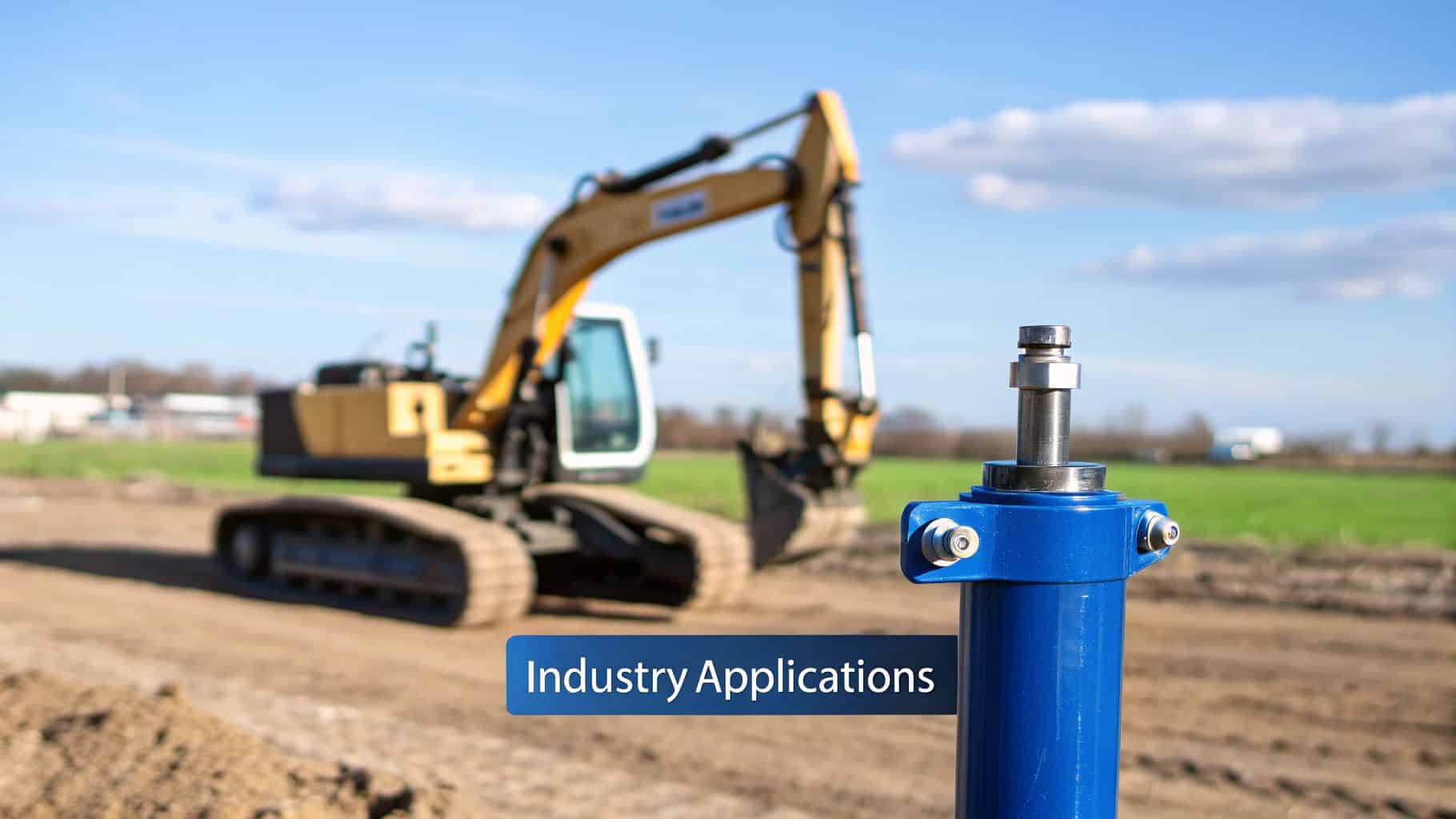
This versatility explains why they are so widespread. In fact, double-acting cylinders command a huge 75% share of the UK's £3.2 billion hydraulic components market. Their superior load-handling, outperforming single-acting versions by up to 60%, makes them the go-to choice for the UK's most demanding sectors. You can find more detailed analysis of the hydraulic cylinder market and its trends.
Powering UK Agriculture
In modern farming, it’s all about getting the job done efficiently and powerfully. Double acting cylinders are all over agricultural machinery, giving operators the muscle and precision needed for a tough day's work.
-
Tractor Three-Point Hitches: A tractor's strength is in its hydraulics. The ability to lift heavy ploughs or cultivators is one thing, but a double-acting cylinder also allows the operator to apply downward force. This ensures the implement bites into the soil correctly for proper cultivation.
-
Combine Harvester Header Lifts: That huge cutting header on a combine needs to follow the ground's contours precisely. Double-acting cylinders provide the smooth, responsive control needed to raise and lower it, maximising the harvest and preventing damage on uneven ground.
Precise control like this is vital, with hydraulic machinery underpinning 65% of the UK’s £29 billion annual agricultural output.
Driving UK Manufacturing and Production
Step inside a UK manufacturing plant, and you'll find that speed, precision, and reliability are everything. Double-acting cylinders are fundamental to the automated processes where controlled force is non-negotiable.
In a factory, a double-acting cylinder isn't just about brute force—it's about repeatable accuracy. Being able to precisely control both the press and the return stroke of a tool is what allows for consistent quality, part after part.
You'll see them in action here:
-
Hydraulic Presses: When stamping or moulding metal parts, these cylinders deliver incredible compressive force with pinpoint control. Just as importantly, the powered retraction stroke pulls the die back quickly and safely, ready for the next cycle.
-
Automated Assembly Lines: From robotic arms positioning heavy car doors to clamps holding parts steady for welding, double-acting cylinders deliver the fast, reliable actuation that modern automation depends on.
Mobilising Construction and Waste Management
Visit any construction site or waste transfer station, and you'll be surrounded by mobile machinery powered by these cylinders. Their robust build is a perfect match for the harsh conditions and heavy loads found in these environments. The UK construction industry alone uses them in 80% of all excavators.
-
Excavator Booms and Arms: The digging force of an excavator comes straight from its cylinders. One large cylinder pushes the boom out, while others articulate the arm and bucket. The ability to pull with force is just as vital for dragging materials and curling the bucket.
-
Forklift Tilts: The mast on a forklift uses a double-acting cylinder to tilt forwards and back. This gives the operator the control needed to securely cradle a load for transport and then position it precisely for stacking.
-
Waste Compaction Vehicles: That powerful blade inside a refuse lorry is driven by a huge double-acting cylinder. It provides the immense force needed to crush the waste and the strong pulling force to retract the blade for the next load.
From the farm to the factory floor, the hydraulic double acting cylinder is a true cornerstone of UK industry. For expert help in selecting the right cylinder for your machinery, Phone 01724 279508 today, or send us a message.
Putting It All Together with MA Hydraulics
Picking the right hydraulic double acting cylinder is a great start, but it's rarely the final step. To get the performance and reliability you need from your machinery, you need to see how that cylinder fits into the complete hydraulic system. At MA Hydraulics, that’s exactly what we help businesses do, right across the UK. We’re not just here to ship a part; we’re here to help you build a solution that works.
A quality double acting cylinder gives you powerful force in both directions and incredibly precise control. Our job is to help you turn those capabilities into genuine, real-world results. Whether you’re after a standard, off-the-shelf cylinder for a fast replacement or you need something built to a unique specification, our extensive stock and hands-on experience are here for you.
More Than Just a Cylinder Supplier
Many projects need more than just a single component; they need a fully integrated system designed to work in harmony. This is where we really come into our own. We work with customers every day to design and build complete hydraulic power packs tailored precisely to their operational demands.
We’re your complete solutions team. From sourcing the right pump and valves to designing a bespoke power pack from the ground up, our UK-based team provides the friendly, practical support needed to get your system running flawlessly.
We can manage the entire component selection for your custom build, ensuring everything works together perfectly. This includes:
- Pumps and Motors: Sourcing the correct Group size and flow rate for your application.
- Valves: Selecting the right CETOP, inline, or modular valves for total control.
- Filtration: Integrating proper filtration to protect your investment and extend its life.
- Ancillaries: Supplying all the bellhousings, couplings, and manifolds needed for a professional finish.
Your UK-Based Technical Team
When you work with MA Hydraulics, you get direct access to a knowledgeable technical team right here in the UK. We’re committed to being more than a catalogue of parts; think of us as your go-to advisors for anything hydraulics-related. We'll help you specify components that deliver the efficiency, reliability, and long service life your operation depends on.
Ready to get the best from your hydraulic system? For expert advice, component selection, or a quote on a bespoke power pack, give us a call on 01724 279508 today, or send us a message.
Frequently Asked Questions
Even after covering the basics, it's natural to have a few more questions. Let's tackle some of the most common ones we hear from our customers to round out your understanding of hydraulic double-acting cylinders.
What Is the Main Difference Between a Double Acting and Single Acting Cylinder?
The biggest difference comes down to control. A double-acting cylinder gives you powered force in two directions. Think of it as having both a 'push' and a 'pull' function, with hydraulic pressure actively controlling the piston's movement both outwards and back inwards.
A single-acting cylinder, on the other hand, only gets a powered push in one direction. To return to its starting position, it has to rely on something else—like gravity, a built-in spring, or the weight of the load itself. This makes the double-acting version essential for any job that needs precise, powered control during both extension and retraction.
Can You Use a Double Acting Cylinder as a Single Acting One?
Technically, you can. By connecting just one hydraulic port and putting a breather on the unused port, it will function in a single-acting capacity.
However, we really don't recommend it. It's an inefficient way to use a more sophisticated and expensive component. More importantly, you risk drawing contaminants into the cylinder through the breather port if it isn't perfectly maintained, which can cause serious internal damage over time. It’s always better, and usually cheaper, to use a dedicated single-acting cylinder for a single-acting job.
How Do I Know What Pressure Rating My Cylinder Needs?
Figuring out the right pressure rating starts with your application's requirements. First, you need to know the maximum force the cylinder will have to generate, which is typically measured in kilograms or Newtons.
Once you have that number, you can use a simple formula to work backwards and find the necessary pressure.
The relationship is Force = Pressure × Area (the area being the cylinder's bore). Always choose a cylinder with a maximum pressure rating that is comfortably higher than your calculated need. This safety margin is crucial for handling unexpected pressure spikes and ensuring a long, reliable service life for your equipment.
What Are Common Signs My Cylinder Is Failing?
Spotting the early warning signs of cylinder failure can save you from major downtime and expensive repairs. Keep an eye out for these tell-tale symptoms:
- External Fluid Leaks: The most obvious sign is oil weeping from the seals around the piston rod or the end caps.
- Drifting or Loss of Power: If the cylinder slowly creeps or sinks when holding a load, it’s a classic sign of worn internal seals. This is often called 'piston blow-by' and means fluid is leaking past the piston internally.
- Jerky Movement: The cylinder's movement should be smooth. If it starts to shudder or move erratically, something is wrong.
- Visible Damage: Check the chrome piston rod for any dents, scores, or bends. Any damage to this surface can shred the rod seal and lead to leaks.
If you see any of these signs, it's time to take action. We cover this topic in more detail in our guide on how to repair a hydraulic cylinder.
Ready to discuss your hydraulic cylinder needs? For expert advice and component selection, phone 01724 279508 today, or send us a message.
