
Think of a simple belt and buckle, but one designed for the demanding world of industrial hoses. That's the best way to understand stainless steel worm clamps. For engineers and fitters across the UK, they are the go-to solution for creating a secure, leak-proof seal on everything from hydraulic power packs to heavy-duty agricultural machinery.
The Essential Guide to Stainless Steel Worm Clamps
Stainless steel worm clamps, which you’ll often hear called worm gear hose clips, are the workhorses of fluid and gas systems. They have one crucial job: to clamp a hose tightly over a fitting or spigot, stopping any leaks right at the connection point. These are the unsung heroes keeping hydraulic fluid in a tractor or coolant in a generator exactly where it belongs.
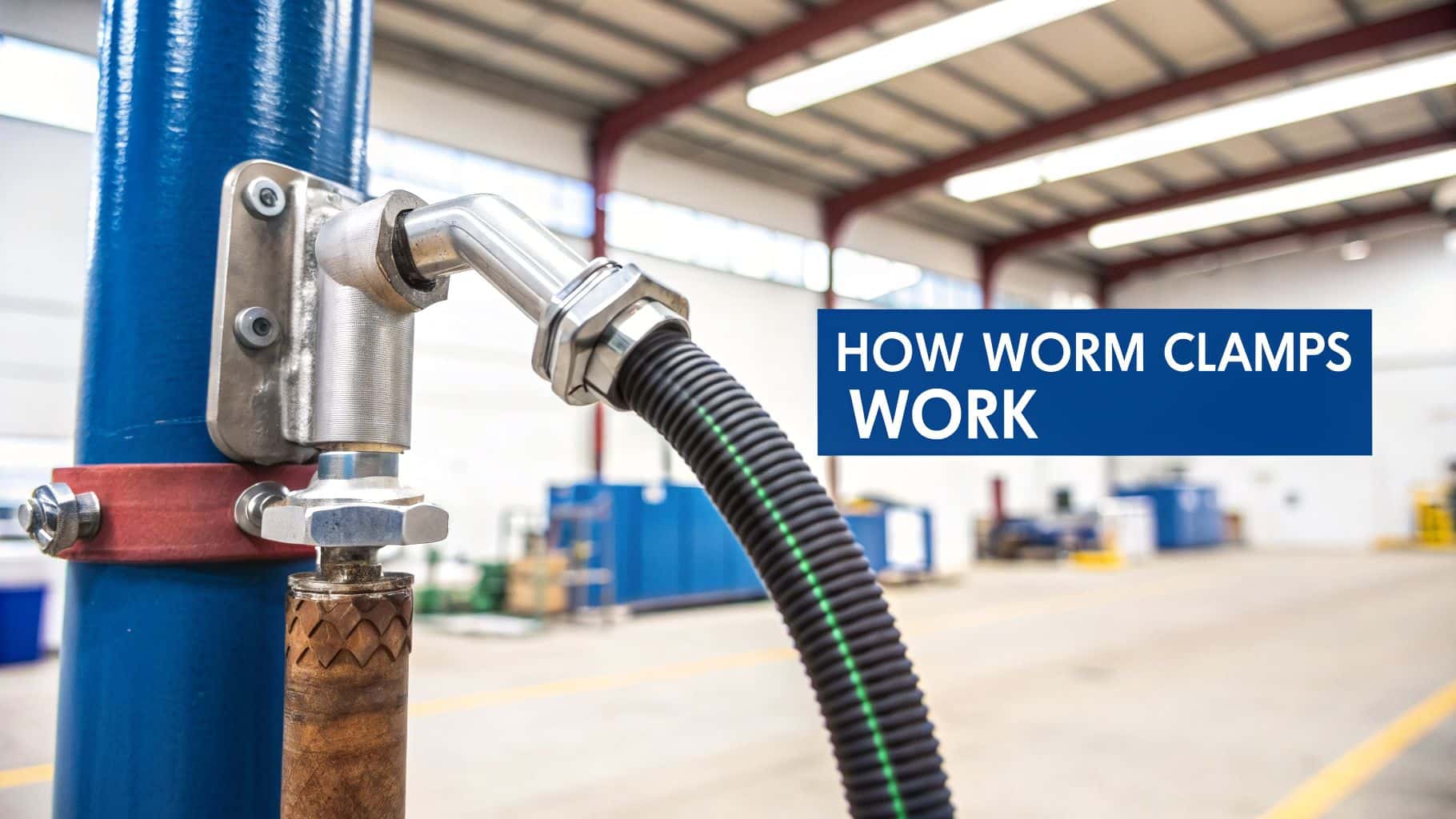
The design is brilliantly effective, relying on just three parts working together:
- The Band: This is a strip of stainless steel that wraps around the hose, featuring a series of slots or perforations.
- The Housing: This part sits on the band and holds the screw mechanism.
- The Screw: A worm gear screw that engages with the slots in the band.
When you turn the screw, its threads mesh with the slots, pulling the band and tightening its grip. It’s a simple winch-like action that creates a powerful and uniform 360-degree clamping force around the hose.
Why They're a Staple in the UK Market
The popularity of these clamps is no accident. Their combination of adjustability and serious clamping power has made them a firm favourite. In fact, for the UK's hydraulic and industrial sectors, especially for distributors and OEMs in agriculture and materials handling, they are a first-choice component.
The real magic of a worm clamp is its ability to apply consistent pressure around the entire circumference of the hose. This complete, all-around contact is what gives you a reliable, leak-free seal that stands up to the vibration and pressure changes common in mobile and industrial equipment.
This reliability is key to preventing expensive fluid leaks, equipment damage, and frustrating downtime. To get a better sense of the larger systems where these clamps are used, it helps to understand the basics of stainless steel pipe and fittings. Plus, the fact that you can install or remove them with just a screwdriver or nut driver makes them incredibly practical for field repairs and routine maintenance.
For expert advice on selecting the right components for your hydraulic systems, phone 01724 279508 today, or send us a message at https://www.mahydraulics.co.uk/contact-us/.
Choosing the Right Clamp Material and Design
At first glance, one stainless steel worm clamp looks much like another. It’s a common mistake to assume they’re all the same, but the grade of stainless steel is one of the biggest factors determining how long a clamp will last and how well it will perform. Getting this choice right is fundamental to a secure, long-lasting connection.
Not all stainless steel is created equal. For worm clamps, you'll mainly come across two grades: 304 and 316. You might also see them labelled by their European classifications, A2 and A4, respectively. Understanding the real-world difference between them is the key to avoiding a premature failure down the line.
The All-Rounder: 304 (A2) Stainless Steel
For most jobs, 304 (A2) stainless steel is your go-to. Think of it as the reliable workhorse of the clamp world. Made with about 18% chromium and 8% nickel, it has excellent resistance to rust and corrosion in most everyday environments.
This makes it the perfect choice for a huge range of indoor and sheltered outdoor uses. A 304 grade clamp is ideal for securing hoses on a factory power pack, inside the engine bay of a typical car, or on farm equipment that’s kept under cover. It’s a cost-effective solution, usually costing around £0.40 to £0.70 a piece, that delivers solid performance where it isn’t battling extreme corrosive elements.
The Specialist: 316 (A4) Stainless Steel for Harsh Conditions
But what happens when the working environment gets nasty? That’s where 316 (A4) stainless steel comes in. The secret ingredient here is molybdenum (usually 2-3%), which dramatically boosts its defence against corrosion, especially from chlorides like salt.
Think of 316 grade as your specialist defence force. It’s the non-negotiable choice for any application exposed to salt spray, de-icing salts, acidic chemicals, or marine air. Using a lesser grade in these conditions is just asking for trouble.
This makes 316 grade clamps a must for:
- Hydraulic systems on coastal equipment like wind turbines or offshore rigs.
- Anything in a marine setting, like boat engine hoses.
- Vehicles that spend their winters on heavily gritted roads.
- Chemical plants where the clamp might be exposed to corrosive substances.
A 316 clamp might set you back a little more, perhaps £0.60 to £1.00 each, but that small extra cost is cheap insurance against a catastrophic, and much more expensive, failure caused by corrosion.
Beyond the Material: Clamp Design Features
It’s not just about the metal, though. The physical design of the clamp is just as important. While the standard worm drive design is a classic for a reason, some situations call for a more specialised approach.
One of the most valuable variations is the clamp with an inner liner. This design adds a thin, smooth band inside the main slotted band. This liner acts as a protective shield, preventing the slots from cutting into or extruding the hose material as you tighten it down. This is absolutely vital when you're working with soft hoses like silicone, which you’ll often find in turbo and coolant systems.
The UK has a proud history in this field. Did you know that Jubilee Clips, the original name in worm drive hose clips, has been manufacturing them right here in the UK since 1921? The company was founded by Lumley Robinson, who held the very first patent for these clips. This legacy of British engineering excellence is why they are a key supplier for UK specialists like us. You can read more about it in the Jubilee product brochure.
Remember, the clamp is just one part of the system. Good hose management, using components like a retractable hose reel, also plays a part in extending the life of your connections by reducing strain and wear on the hose.
For expert advice on picking the perfect stainless steel worm clamps for your job, give us a call on 01724 279508 or send us a message.
How to Select the Correct Clamp Size
Getting the clamp size wrong is probably the fastest way to a failed connection. A clamp that’s too large will never quite bite down enough for a proper seal, and one that’s too small is a recipe for a snapped band or a damaged hose. It’s a simple thing to get right, but absolutely crucial for a leak-free, reliable system.
Here's the one non-negotiable rule: always measure the Outside Diameter (OD) of the hose after it’s been pushed onto the spigot or fitting. When you fit a hose, it expands. It might not look like much, but it’s enough to throw off your measurement. If you measure the hose beforehand, you'll end up with a clamp that's too small every time.
Measuring for the Perfect Fit
Once your hose is sitting securely on its fitting, grab a pair of Vernier callipers for the most accurate reading, though a flexible tape measure will also do the job. Measure the final outside diameter of the hose assembly. That one number is what you'll use to pick your clamp.
You’ll notice that stainless steel worm clamps are sold with a size range, like 32-50mm. This tells you the minimum and maximum diameters the clamp can handle.
The real secret to a rock-solid connection is picking a clamp where your measurement falls somewhere in the middle of its size range, not right at the edge. This gives the clamp the best mechanical advantage for even pressure and leaves you some room for adjustment.
Let's say your hose assembly measures 40mm on the nose. A clamp with a 32-50mm range is the perfect choice, placing your measurement right in that sweet spot. A 25-40mm clamp, on the other hand, would be a poor fit. You’d have to tighten it to its absolute limit, putting a huge amount of stress on the screw and band.
While sizing is critical, so is choosing the right material for your working environment. This is where you need to decide between different grades of stainless steel.
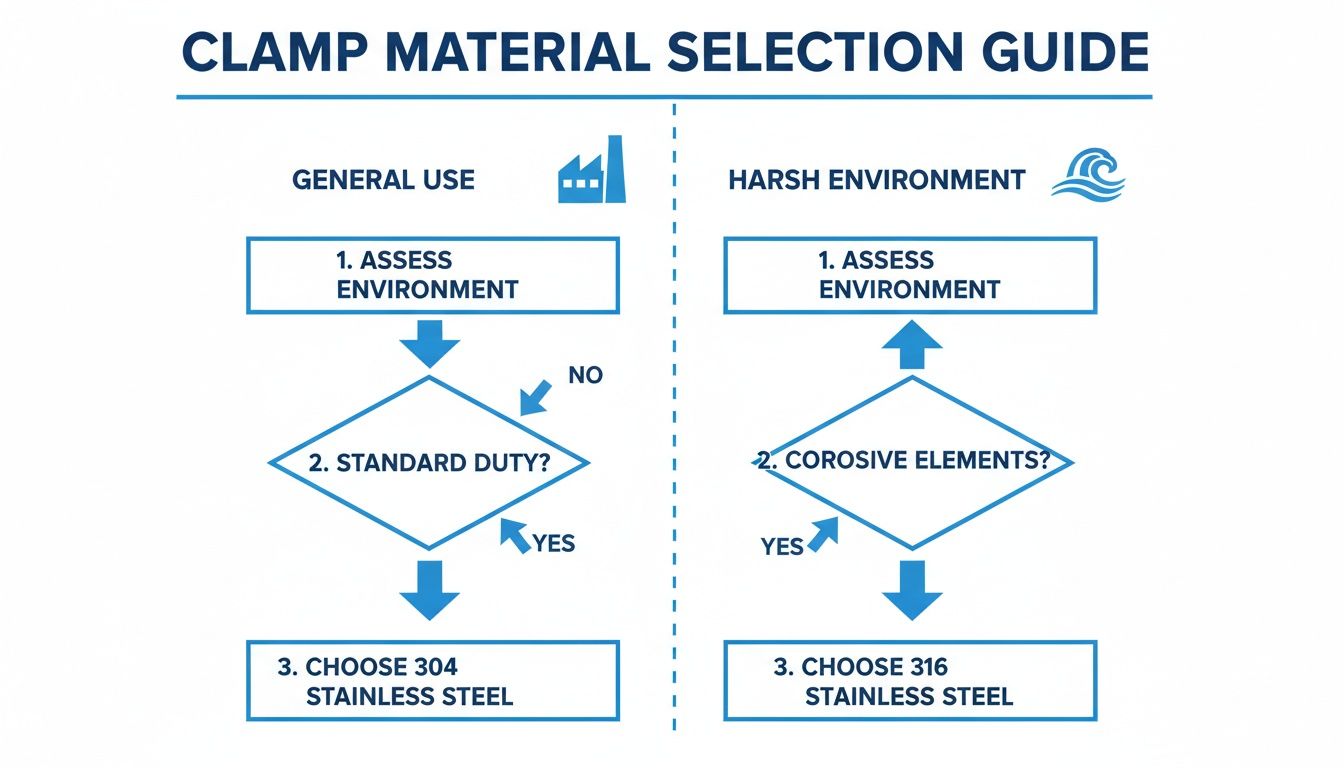
As the chart shows, a standard 304 grade is fine for most indoor or general-use scenarios. But if that clamp is going anywhere near salt, chemicals, or constant moisture—like on a boat or in a food processing plant—you need the superior corrosion resistance of 316 grade steel.
Considering Band Width and Other Factors
Diameter isn't the only thing to think about. The clamp's band width also plays a big part. A wider band spreads the clamping force over a larger area, which is a huge advantage. It gives you a more secure grip and stops the clamp from cutting into the hose, especially on softer materials or larger diameter lines.
Here’s a good rule of thumb:
- Standard Duty (e.g., 9mm band): Perfect for general-purpose jobs. Think small-bore coolant lines, vehicle fuel lines, or air hoses where pressures aren't extreme.
- Heavy Duty (e.g., 12mm band): Step up to this for more demanding work. This is what you want for hydraulic return lines, suction hoses, and any connection that sees a lot of vibration or higher pressures.
Using a wider band on a large, soft-walled hose gives it a much more stable footprint, preventing the hose from deforming under pressure and creating a leak path. It’s the same principle behind using application-specific parts like brake hose ferrules, which are engineered to reinforce a connection at a critical point.
Get these two things right—measure the OD on the fitting and aim for the middle of the clamp’s size range—and you've built the foundation for a durable, leak-free connection. Match that with the right band width and material, and your worm clamps will perform exactly as intended.
Achieving the Perfect Torque for a Secure Seal
In the world of hydraulics and industrial pipework, the line between a rock-solid connection and a costly failure often comes down to one thing: torque. Getting a worm clamp just right is a delicate balance. Go too loose, and vibration or pressure will eventually work the hose free. Go too tight, and you risk crushing the hose, stripping the screw, or even snapping the band. It’s a classic case of “more” not always being better.
Let's walk through how to tighten these clamps properly. When you get this right, you can be confident that every installation is secure, damage-free, and built to last.
What is Torque, and Why Does it Matter So Much?
Simply put, torque is the twisting force you apply to the screw. As you tighten it, that rotational force is converted into tension along the band, which then applies clamping pressure onto the hose. Applying the right amount of torque is the secret to getting a perfect, even seal without wrecking your components.
This is exactly why you can't rely on guesswork in any professional job. A calibrated torque wrench is the only tool that guarantees you're hitting the precise force recommended by the manufacturer. It removes the "feel" from the job and replaces it with repeatable accuracy.
A correctly torqued clamp creates a full 360-degree seal that can handle pressure spikes and constant vibration. Under-tightening is the number one cause of leaks, while over-tightening is the main reason clamps and hoses fail prematurely.
General Torque Recommendations for Stainless Steel Worm Clamps
While you should always treat the manufacturer's data sheet as the final word, there are some reliable guidelines. The required torque is almost always tied to the clamp's band width and its material. A wider, heavy-duty clamp is built to take more torque and spread that force more effectively than a skinnier, standard-duty one.
Here’s a quick guide to some typical torque values you’ll encounter. Think of these as a solid starting point, but always double-check the specs for the specific clamp you're using.
| Band Width (mm) | Material Grade | Recommended Torque Range (Nm) |
|---|---|---|
| 9mm (Standard Duty) | 304 (A2) / 316 (A4) | 3.0 – 5.0 Nm |
| 12mm (Heavy Duty) | 304 (A2) / 316 (A4) | 5.0 – 7.0 Nm |
| 14mm+ (Extra Heavy Duty) | 304 (A2) / 316 (A4) | 7.0 – 9.0 Nm+ |
You'll notice the torque values climb as the band gets wider. This directly reflects the clamp's beefier construction and its ability to secure larger hoses or handle the higher pressures common in hydraulic systems.
The Right Tools and Technique
Knowing the torque value is only half the job. You also need the right kit and a solid technique to apply it correctly.
Your Essential Toolkit:
- Calibrated Torque Wrench: For this kind of work, you need a small, low-range wrench, usually a 'click' type that works well in the 1-15 Nm range. This is non-negotiable for a reliable finish.
- Hex-Head Socket or Nut Driver: Most worm drive clamps have a 7mm or 8mm hexagonal screw head.
- Flexible Nut Driver: A lifesaver for clamps tucked away in awkward spots where a straight tool just won’t fit.
A good bit of trade practice is to snug the clamp up first with a standard screwdriver or nut driver. Just tighten it until the band sits flush and evenly all the way around the hose, and then stop. After that, pick up your calibrated torque wrench to apply the final, specified torque. Use a smooth, steady motion until the wrench clicks or indicates you've hit the target.
Common Mistakes to Avoid
Even with the best tools, a few common slip-ups can easily compromise a connection. Keep an eye out for these pitfalls:
- Never use an impact driver or a power drill. These tools are far too aggressive and deliver torque too quickly, making it almost certain you'll over-tighten. It’s a fast track to stripped threads, snapped bands, and damaged hoses.
- Don't ignore the manufacturer's specs. The values in our table are a general guide. A specific clamp from a top brand like Jubilee® or Mikalor will have its own precise torque recommendation—use it.
- Avoid "bottoming out" the clamp. If you have to tighten a clamp almost to its smallest possible size, it’s the wrong size for the job. You should always choose a clamp where your hose's outer diameter sits comfortably in the middle of the clamp's effective range.
By following these straightforward guidelines, you can make sure every worm clamp you fit provides a safe, dependable, and long-lasting seal.
For expert guidance on selecting and installing the right hydraulic components, phone 01724 279508 today, or send us a message at https://www.mahydraulics.co.uk/contact-us/.
Inspecting Clamps and Preventing Common Failures
Even the highest quality stainless steel worm clamps aren't a 'fit and forget' component. To ensure they perform reliably for the long haul, you need to keep a watchful eye on them. It’s always better to catch a small issue during a routine check than to deal with a full-blown failure and the costly downtime that comes with it.
For any maintenance team, a simple, regular inspection schedule is the secret to keeping connections secure.
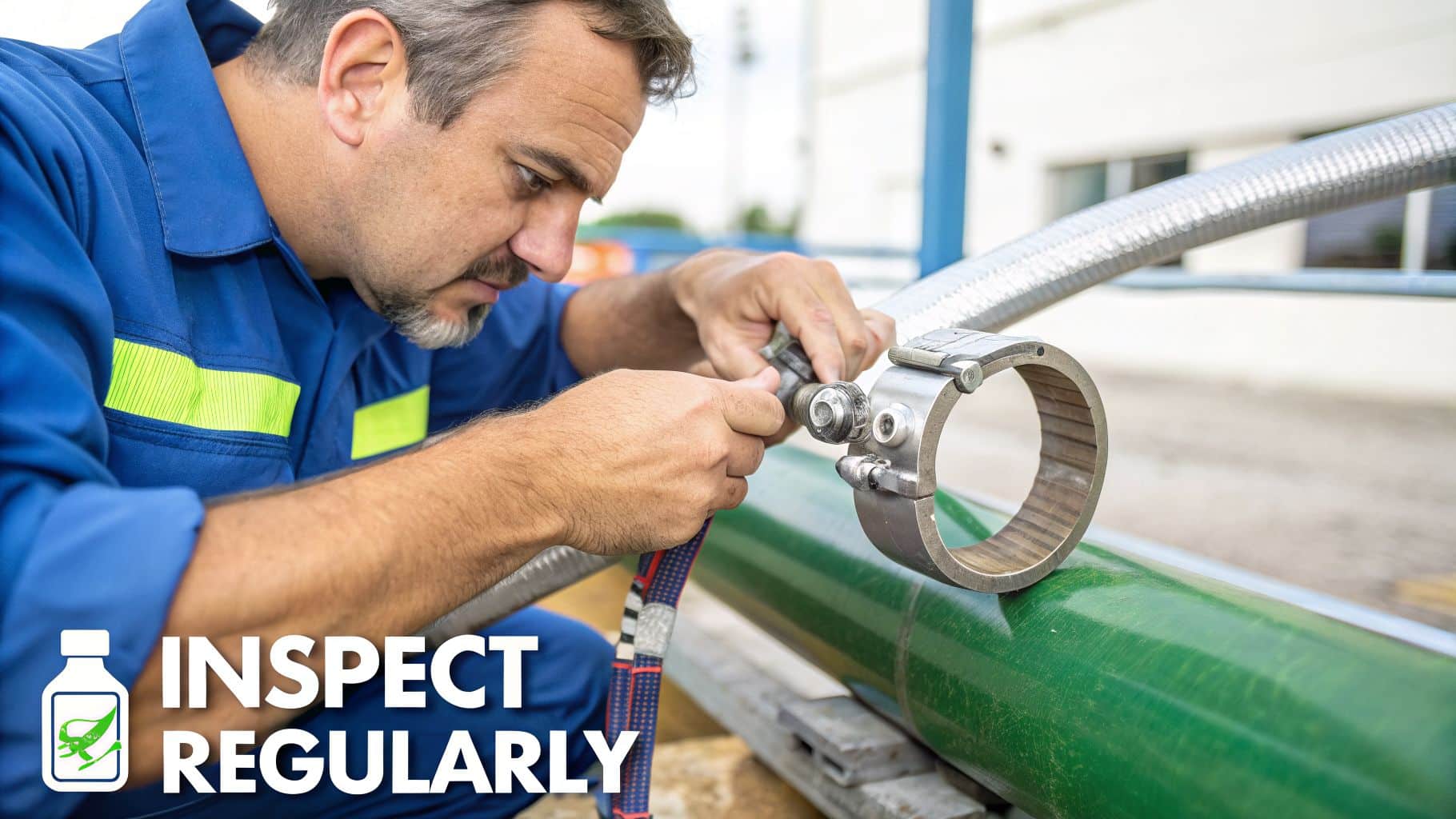
This doesn't have to be a complicated, time-consuming task. It's all about knowing the tell-tale signs of trouble and spotting them early.
Establishing an Inspection Schedule
How often you check your clamps really depends on the job they’re doing. The more demanding the environment, the more frequently you need to look.
- High-Vibration/High-Pressure Systems: Think mobile machinery or industrial power packs. Vibration is the enemy of a tight connection, so you should be checking these clamps weekly or bi-weekly.
- Systems with Temperature Swings: For equipment that gets hot and then cools down repeatedly, aim for a monthly inspection. Thermal cycles cause the hose to expand and contract, which can lead to a loss of tension over time.
- Standard, Stable Environments: On less demanding indoor applications, a quarterly or bi-annual check is usually plenty.
During these checks, you're hunting for any visible sign of trouble. A bit of corrosion or a slightly deformed band might seem minor, but it can be the tip of the iceberg.
The goal of proactive inspection is simple: spot the symptoms before the failure occurs. A discoloured clamp or a slightly loose hose is a warning sign, not a catastrophe—if you catch it in time.
Identifying Common Failure Modes
Your inspections will be much faster and more effective if you know exactly what to look for. Stainless steel worm clamps tend to fail in a few predictable ways, and each has its own clear signature.
Corrosion:
Yes, even stainless steel can rust if the conditions are right. Keep an eye out for any spots of rust or pitting, paying close attention to the screw and housing. This is often the first sign you've used a mixed-material clamp (like a zinc-plated screw on a stainless band) or that crevice corrosion is taking hold.
Band Deformation or Stretching:
If the band looks stretched, thinned out, or "pulled" where it enters the housing, that's a classic symptom of over-tightening. This permanently weakens the band, dramatically reducing its clamping force and setting you up for a leak.
Damage to the Screw or Housing:
Check the screw head for stripping. It's a dead giveaway that the wrong tool was used or far too much force was applied during installation. Also, give the housing a quick look to make sure it isn't cracked or bent, as this will stop the screw from properly engaging the band's threads. For extra peace of mind in high-vibration areas, applying a thread locking adhesive can be a smart move to prevent the screw from backing out.
The Importance of Periodic Torque Checks
Visual checks are great, but they don't tell the whole story. Periodic torque checks are absolutely vital, especially in systems with lots of vibration or big temperature swings.
Over time, the hose material itself can compress and "settle," and vibration can cause a screw to gradually loosen. Both of these things lead to a loss of clamping force.
Using a calibrated torque wrench, simply re-check the clamp to see if it’s still tightened to the original spec. If you find a clamp is consistently loose, it’s time to investigate. Is it extreme vibration? Is the hose material degrading? Or was it just under-torqued from the start? This simple check is the best way to ensure every connection is as secure as the day you installed it.
For specialist advice on maintaining your hydraulic systems and sourcing the right components, Phone 01724 279508 today or send us a message.
Your Partner for High-Performance Hydraulic Components
Getting the right stainless steel worm clamp might seem like a small detail, but it’s one that directly impacts the safety and reliability of your entire system. As we've covered, choosing the correct material, size, and applying the right torque is what creates that perfect, leak-free seal. It’s this attention to detail that prevents expensive downtime and failures.
Here at MA Hydraulics, we know that dependable machinery is built one quality component at a time. Think of us as your expert partner for more than just clamps. We supply a complete range of hydraulic solutions, from high-performance gear pumps and control valves to custom-built power packs designed for your specific needs.
Your Go-To Supplier for UK Industry
Our technical team spends their days sourcing and supplying first-rate parts for the UK's most demanding industrial and mobile applications. We understand that getting the right part, and getting it quickly, is what keeps your operation moving. Sometimes, securing a connection properly involves more than just the clamp itself. Sourcing other high-quality fasteners, for example, requires the same trust in your supplier as you'd have for your core hydraulic components.
At MA Hydraulics, we don’t just shift boxes. We provide practical solutions. Our team's expertise means you get the right part for the job, properly matched to your application for the best possible performance and service life.
Whether your machinery is working in agriculture, construction, or a factory floor, we have the components and the real-world experience to back you up. From a single replacement part to a complete system design, our focus is keeping your equipment running reliably and efficiently.
Ready to secure your hydraulic systems with components you can trust? Our friendly, knowledgeable team is on hand to help you find exactly what you need.
For expert advice or to source high-quality parts, give us a call on 01724 279508 today, or send us a message.
Frequently Asked Questions
Out in the field, we get a lot of questions about getting the most out of stainless steel worm clamps. It makes sense – they're a common part, but using them correctly is crucial for keeping a system safe and leak-free. Here are the answers to some of the queries we hear most often from engineers and fitters across the UK.
Can I Reuse a Stainless Steel Worm Clamp?
This is a big one, and our advice is simple: for any job where failure isn't an option, don't reuse a clamp. It might seem like a way to save a few pence, but it's a false economy.
Every time you tighten a clamp, the band stretches a tiny amount, and the screw threads wear down. This is a natural process of metal fatigue. When you try to use it a second time, it simply can't achieve the same reliable clamping force it did when it was new. For the sake of safety and performance, always use a new clamp for a new installation. The cost of a clamp, often less than a pound, is nothing compared to the price of equipment damage or an unexpected failure.
What Is the Difference Between a Jubilee Clip and a Worm Clamp?
You'll hear both terms used all the time in the UK, which can be confusing. 'Jubilee Clip' is actually a brand name. They were the original worm drive hose clamp, invented right here in Great Britain, and the name stuck – much like how people call all vacuum cleaners 'Hoovers'.
So, a Jubilee Clip is a type of worm clamp, but not every worm clamp is a genuine Jubilee®.
While they work on the same principle, specifying a genuine Jubilee® Clip or another quality brand name means you're getting a product built to strict quality standards. These manufacturers must meet benchmarks like BS 5315, which guarantees the materials, dimensions, and performance are exactly what they should be. For any critical system, sticking with a trusted brand is your best bet for reliability.
Why Is My Stainless Steel Clamp Rusting?
Finding rust on a component labelled 'stainless' is rightly a cause for concern. It almost always comes down to one of two things. First, check if you're using a mixed-material clamp. Cheaper versions often have a stainless steel band but pair it with a screw or housing made from zinc-plated carbon steel. That plated steel part will always be the weak link and will eventually start to rust, especially in damp conditions.
The other culprit is usually contamination. If you use regular carbon steel spanners or sockets to fit the clamp, you can unknowingly transfer tiny iron particles onto the surface, which then cause localised rust spots. This can also happen in the tight gaps under the band where oxygen is scarce, a process called crevice corrosion. The fix? For marine or other harsh environments, always choose high-purity 316-grade stainless steel and make sure your tools and working area are clean.
For expert technical advice on your specific application or to source the right hydraulic components, the team at MA Hydraulics is here to help. Phone 01724 279508 today, or send us a message through our website.
