
A machine doesn't usually stop at a convenient time. It stops when the trailer is loaded, when the press is due to start, or when the baler is already behind schedule. The first sign might be a whining pump, a sluggish ram, oil heating up faster than normal, or a pressure gauge that no longer behaves the way your team expects.
When that happens, generic helpdesk advice is no use. Hydraulic technical support has to deal with real loads, contaminated oil, worn seals, suction restrictions, incorrect valve settings, and machines that have often been modified over time. In the UK, that need isn't getting smaller. The United Kingdom hydraulics market is projected to grow from USD 1,627.4 million in 2024 to USD 2,143.8 million by 2035, at a CAGR of 2.54%. Using a simple currency conversion for readability, that's roughly £1.29 billion to £1.70 billion in market value.
Good technical support keeps equipment running, but it also prevents maintenance teams from replacing the wrong part, chasing the wrong fault, or wasting a day on a problem that could have been narrowed down in twenty minutes.
When Hydraulic Downtime is Not an Option
A familiar call starts like this. The machine was running yesterday. This morning, the boom won't lift properly, the conveyor is stalling under load, or the power pack starts, then struggles once the oil gets warm. Production doesn't stop neatly around that fault. Operators wait, fitters start checking hoses, planners start reshuffling work, and someone has to decide whether to strip the unit, order parts, or ask for outside technical support.
That decision matters because most hydraulic faults are not random. They leave clues. A pressure drop at a certain point in the cycle means something different from low pressure across the full stroke. Oil foaming points you in a different direction from oil darkening or a sudden temperature rise. Noise on the suction side tells a different story from a relief valve constantly bypassing.
For industrial and mobile plant operators, continuity depends on having access to the right level of diagnosis quickly. Sometimes that means talking a fitter through checks on site. Sometimes it means reviewing photos, a short video, and gauge behaviour. Sometimes it means using remote monitoring systems for hydraulic performance visibility to catch recurring issues earlier.
Practical rule: The fastest repair isn't the one where you change parts first. It's the one where you prove the fault path before spending money.
In day-to-day hydraulic work, technical support is less about call logging and more about fault isolation. That's the difference between replacing a pump because the actuator is slow, and discovering the actual issue is a blocked filter, internal leakage across a valve, or fluid that's no longer fit for service.
Our Comprehensive Hydraulic Technical Support Services
Hydraulic technical support works best when it matches the fault. Not every issue needs a site visit. Not every issue can be solved over the phone either. The right service model starts by deciding what information can be gathered quickly, what risk the machine is carrying, and whether the machine is safe to keep testing.
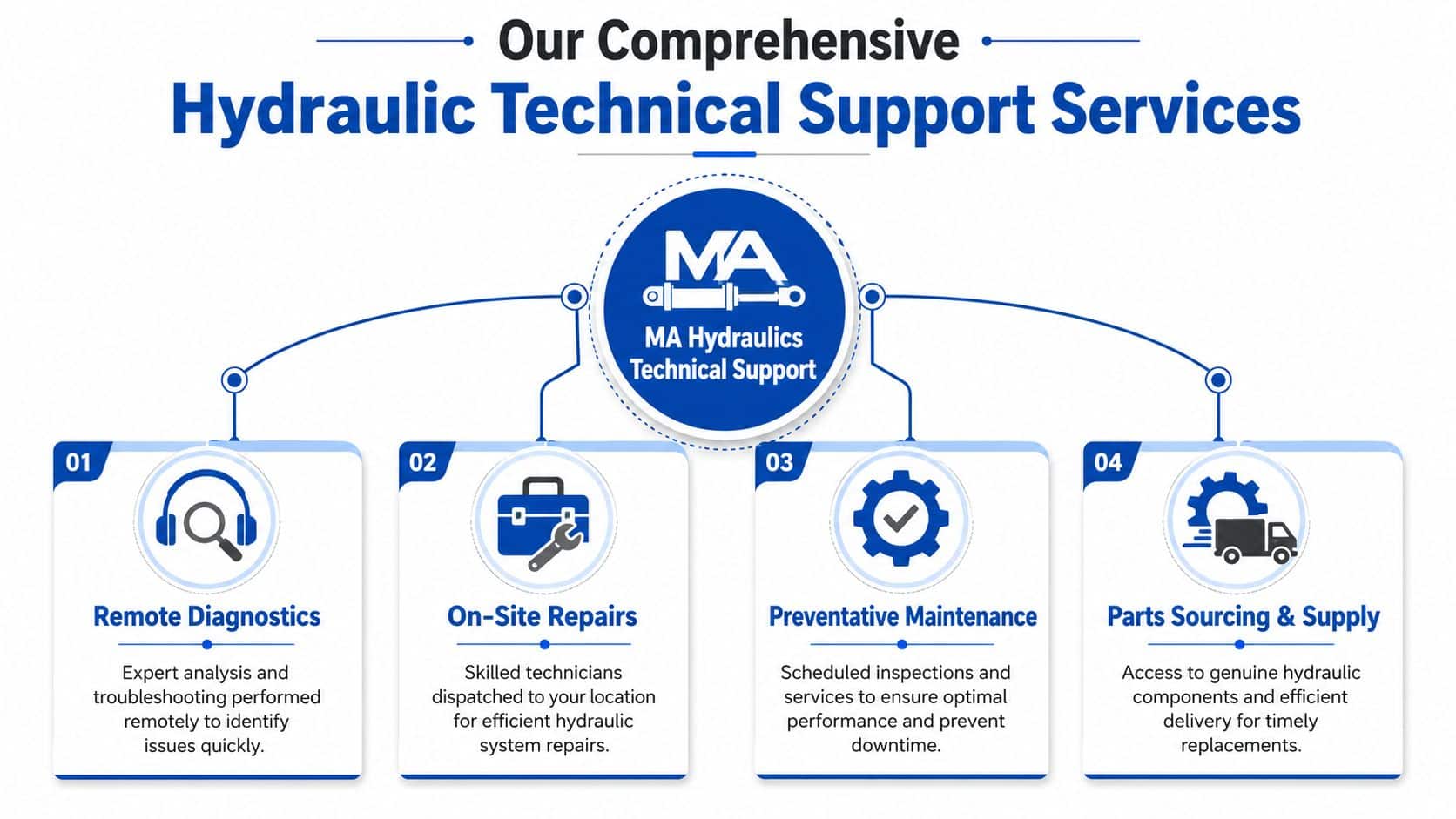
Remote diagnostics
Remote diagnosis is often the quickest starting point. A short call backed up by clear photos, a video of the cycle, and the machine details can narrow the problem much faster than many teams expect. You can often separate electrical command issues from hydraulic performance issues before anyone reaches for a spanner.
What works well remotely:
- Visible leaks and hose failures: These are usually straightforward to identify and prioritise.
- Abnormal cycle behaviour: Slow extension, uneven movement, drift, chatter, or loss of force under load can often be narrowed down by sequence.
- Gauge interpretation: If the customer can report pressure readings at defined points, the fault path becomes much clearer.
What doesn't work well remotely is guesswork. If nobody can confirm fluid level, filter condition, operating temperature trend, or actual pressure behaviour, the conversation becomes less useful. That's why support teams benefit when they analyse customer feedback from field issues and repeated failure patterns. The same principle applies in engineering support. Patterns in complaints often expose poor operating practice, weak documentation, or a component choice that isn't suited to the duty.
On-site repairs
Some faults need an engineer at the machine. That's usually the case when the system is unsafe to run, access is poor, the circuit is non-standard, or the fault only appears under real working load.
On site, the job is not just to swap parts. It's to verify the circuit, inspect the installation, measure pressure and flow where possible, and decide whether the root cause sits with the pump, valve bank, cylinder, cooler, filter line, or control logic. A field engineer can also spot issues that don't come through remotely, such as poor hose routing, vibration damage, contamination around breathers, and heat build-up caused by installation layout.
Preventative maintenance
Preventative maintenance gets overlooked because it doesn't shout as loudly as a breakdown. It still saves more trouble than reactive repair. A proper maintenance routine checks fluid condition, temperature trend, suction integrity, hose wear points, filter service intervals, and recurring pressure behaviour.
Keep records by machine and by duty. A unit running two shifts accumulates stress differently from one used intermittently, even if both sit in the same building.
This matters more as hydraulic systems become more integrated with automated equipment. The global hydraulic components market is forecast to rise from USD 50.6 billion in 2025 to USD 79.57 billion by 2035, growing at a CAGR of 4.3%. In rough GBP terms, that's about £39.84 billion to £62.67 billion. As systems become more efficient and more tightly specified, support has to become more precise too.
Parts sourcing and supply
Good technical support includes parts identification. That sounds basic until you're dealing with worn nameplates, obsolete manifolds, non-standard shaft sizes, or imported machinery with mixed specifications.
Useful support here usually falls into four jobs:
- Cross-referencing failed parts when the original code is unavailable.
- Checking functional equivalence so the replacement suits pressure, flow, mounting, and duty.
- Finding obsolete or hard-to-source items through established supply channels.
- Reviewing the application before replacement, in case the part failed because the system is wrong.
For broader system advice, including assemblies and application matching, hydraulic engineers often rely on specialist fluid power services for component selection and system support.
First Response Hydraulic Troubleshooting Guide
Before calling for technical support, the best thing you can do is gather clean information. Not guesses. Not “it sounds a bit wrong”. Clear observations. What changed, when it changed, whether the problem is constant or only under load, and what the gauges, oil, and machine movements are doing.
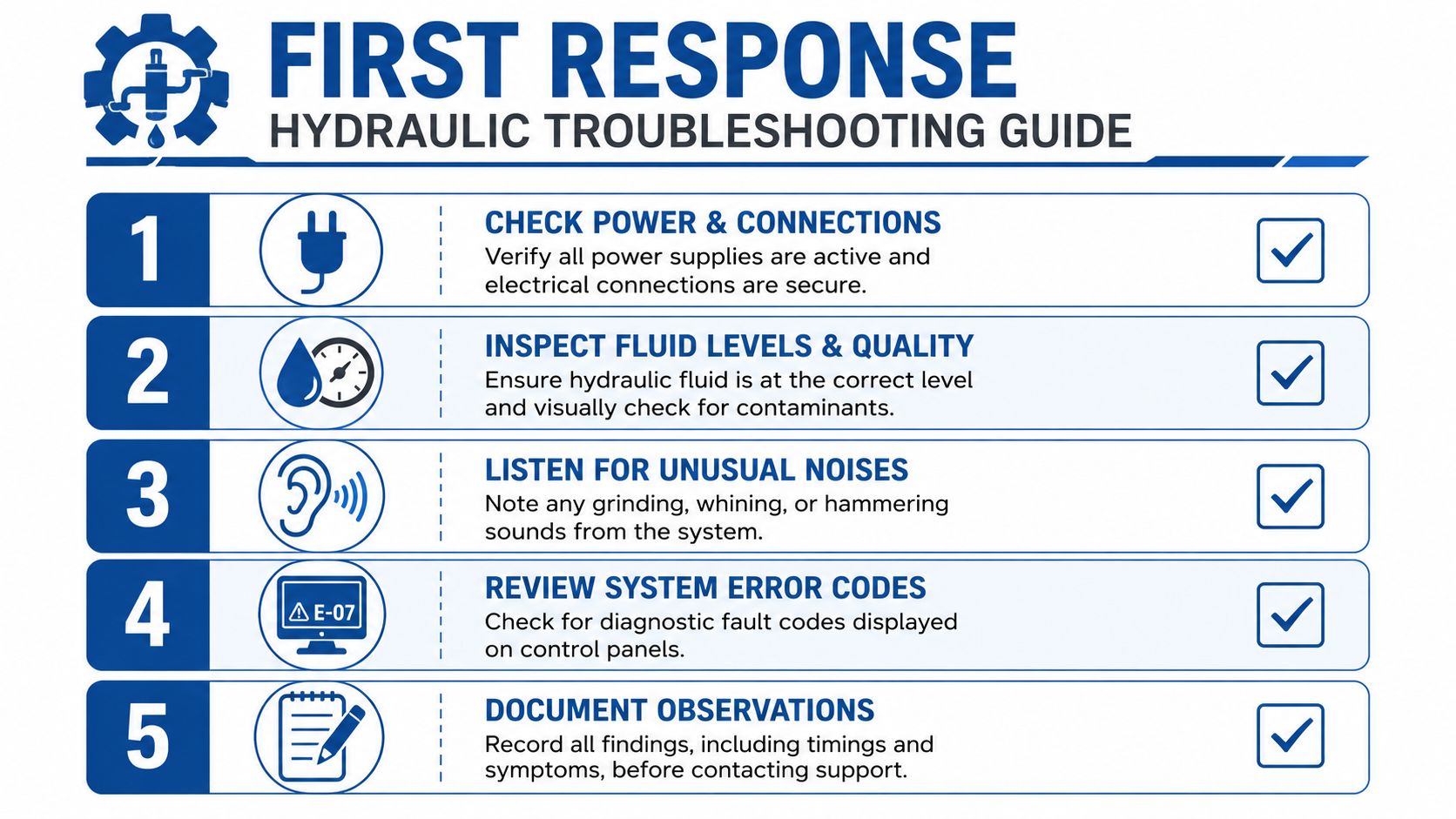
Start with safety and isolation
Isolate power before touching the system. Depressurise where the machine design allows it. Support any raised load mechanically. If the fault affects braking, steering, lifting, clamping, or load holding, don't keep cycling the machine to “see if it clears”.
Then write down the basics:
- Machine identity: Make, model, serial number if available.
- Fault behaviour: Cold only, hot only, under load only, intermittent, or constant.
- Recent changes: New hose, recent service, valve adjustment, fluid top-up, wiring work, or impact damage.
Check the obvious before the expensive
A surprising number of faults still come back to the basics. Low oil level. Wrong oil. Dirty breather. Crushed suction hose. Plugged filter. Loose coupling. A connector that looks plugged in but isn't making proper contact.
In UK hydraulic support work, maintenance intervals should be based on operating hours rather than calendar time, because a machine on heavier duty accumulates stress much faster. The same guidance also notes that pressure gauge readings should be checked against established norms for the specific machine and cycle stage, because deviations can indicate wear, contamination, or seal failure with much better precision than guesswork. That comes from practical hydraulic maintenance guidance for industrial systems.
Don't ask whether the gauge moves. Ask whether it reaches the pressure you normally see at that exact point in the cycle.
Read symptoms in sequence
The sequence matters. A machine that starts normally, then slows after ten minutes, points you in a different direction from one that is weak from startup. Likewise, noise at startup may suggest suction trouble, while heat build-up later in the shift may suggest bypassing, internal leakage, or cooling issues.
Here's a simple first-check table to use on site.
| Symptom | Potential Cause | First Check |
|---|---|---|
| Slow actuator movement | Low fluid, blocked filter, worn pump, internal leakage | Check reservoir level, filter condition, and whether speed changes under load |
| Pump whining or rattling | Cavitation, aeration, suction restriction | Check fluid level, suction hose condition, clamps, and signs of foaming |
| Oil running hot | Relief valve bypassing, contaminated fluid, undersized cooling, internal leakage | Check whether the relief is holding open, inspect fluid condition, and compare temperature rise through the cycle |
| Jerky or uneven movement | Air ingress, sticking valve spool, contaminated fluid | Inspect fluid appearance, repeat the cycle slowly, and note whether the fault occurs in one direction or both |
| Low force at actuator | Pressure loss, worn seals, relief set too low | Compare pressure reading to known normal operating value at the same stage |
| Cylinder drift | Internal cylinder leakage, valve leakage, load-holding issue | Isolate where possible and see whether the load drops with the control in neutral |
Use gauges properly
Pressure readings only help if they're taken at the right place and interpreted in context. One number on its own can mislead. A low reading upstream means something different from a low reading downstream of a valve bank. The point in the stroke matters too.
If your team doesn't already have one, a hydraulic pressure tester kit for on-site fault finding is one of the most useful tools you can keep in the workshop van. It turns “the machine feels weak” into measured evidence.
What to record before asking for help
A strong support request includes facts a technician can use straight away.
- Fluid condition: Clear, dark, milky, burnt smell, visible foam, or debris.
- Leak location: Hose end, rod seal, manifold face, pump shaft, or unknown.
- Temperature behaviour: Immediate rise, gradual rise, only hot under load.
- Pressure behaviour: Normal cold, drops hot, never reaches normal, spikes unexpectedly.
- Control behaviour: Manual override works or not, one function affected or several.
That information shortens diagnosis time and reduces the chance of ordering parts that won't solve the fault.
How to Request Support from MA Hydraulics
A machine can be standing still, the operator is waiting, and maintenance has already ruled out the obvious. At that point, the fastest support request is the one built around usable technical evidence, not a vague description of poor performance.
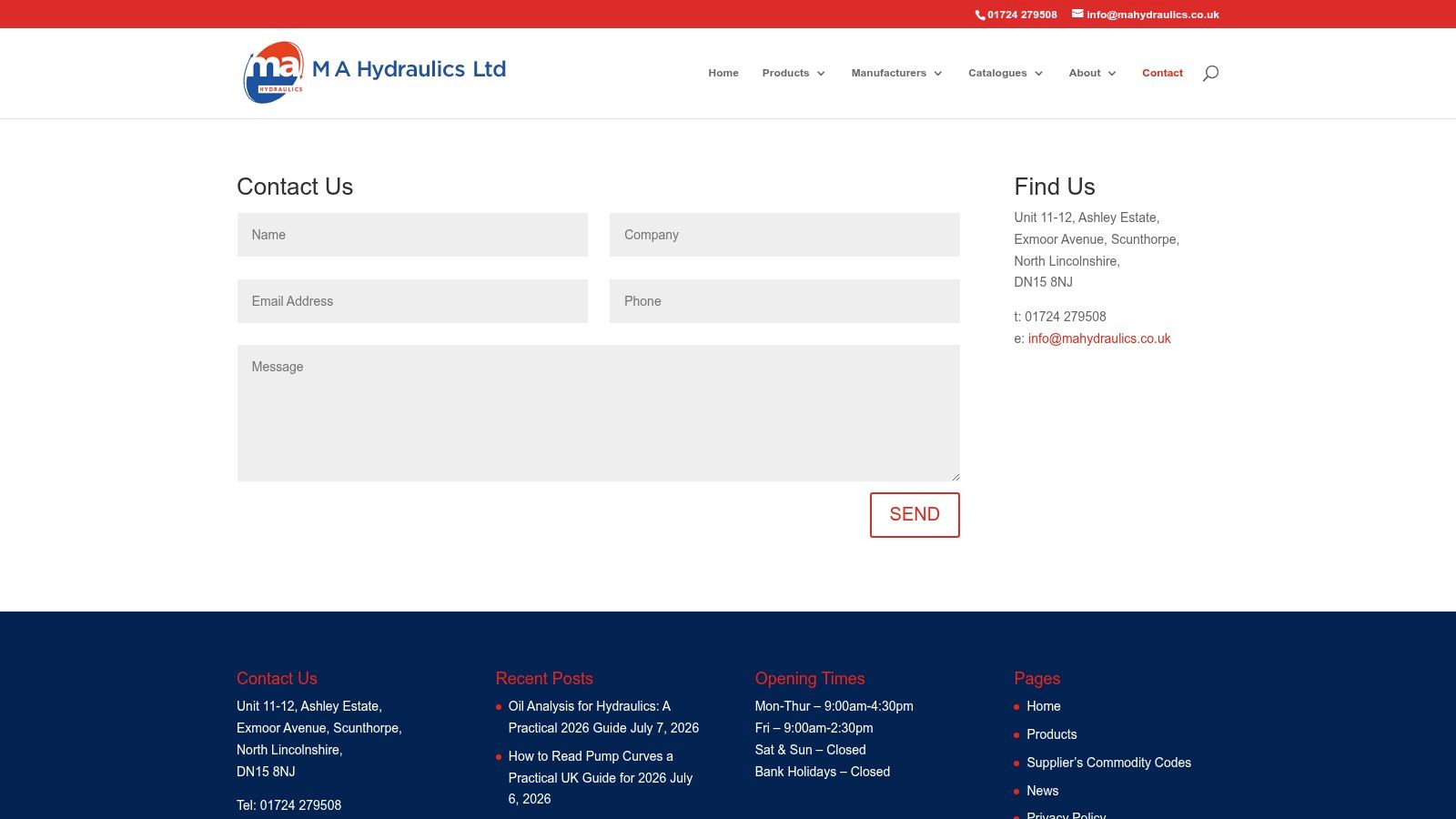
For urgent breakdowns, call first. A live conversation lets an engineer test assumptions quickly, ask where pressure was measured, and decide whether the fault points toward the pump, valve block, cylinder, filtration, or the way the circuit is being used on site.
For planned enquiries, part identification, application advice, or support on an OEM build, send a written enquiry with enough detail to avoid guesswork. Good remote support in hydraulics depends on accuracy. A missing part number or an unclear symptom can send the diagnosis in the wrong direction.
What to have ready
Bring together the machine details before you make contact:
- Machine make and model
- Component identification, including any codes stamped on pumps, valves, motors, filters, manifolds, or power units
- A clear fault description, stating what the machine does and when it does it
- Checks already carried out, so the same ground is not covered twice
- Photos or a short video showing the installation, leak point, gauge reading, hose movement, or actuator behaviour
A useful report sounds like this: the power pack starts normally, one function slows only when hot, pressure rises but stays below the machine's usual working figure, and the issue affects lift but not steer. That gives a hydraulic engineer something to work with.
How to make remote diagnosis faster
Short video clips often answer questions that emails cannot. We can see whether a hose is pulsing, whether a cylinder is hesitating at one point in the stroke, or whether a relief setting appears to be opening early. Photos also help confirm whether the installed component matches the specification, which matters more often than many teams expect on older or modified machines.
This short video gives a useful overview of the support route available online:
Choose the right route
Use the phone for downtime, repeat faults, or anything that may need immediate triage. Use the contact form for detailed technical enquiries, pricing requests, or cases where you need to attach photos and reference numbers.
If your team is sending documents, fault notes, or images from a managed incident workflow, clear records matter. The same principle sits behind the rules for using Resgrid's platform. Good support starts with information that is organised, relevant, and easy to verify.
The best results come from a straightforward split of responsibilities. Site teams report what the machine is doing under load. Our engineers narrow the fault, ask for targeted checks, and advise whether the next step is testing, parts replacement, workshop repair, or a deeper review of the hydraulic circuit.
Our Service Commitments and Commercial Terms
Clear commercial terms save time because they tell customers what they're getting and when a quick question turns into chargeable engineering work. In practice, most hydraulic support sits across two levels. There's informal problem-narrowing, which is often possible by phone or email. Then there's deeper work, such as on-site diagnosis, circuit review, bespoke system advice, or fault investigation that requires extended technical input.
That distinction matters because support itself has become a significant part of the wider UK service economy. The United Kingdom IT Services Market, including technical support components, was valued at USD 112.5 billion in 2025 and is projected to reach USD 120.11 billion in 2026. In rough GBP terms, that's about £88.59 billion in 2025 and £94.58 billion in 2026. Industrial customers already understand the reason behind that. Good support protects uptime.
What customers should expect
A sensible service model usually looks like this:
- Initial contact and triage: Short technical conversations to understand the fault and decide whether remote help is realistic.
- Chargeable engineering time: Applied when diagnosis becomes detailed, site attendance is needed, or a design review is required.
- Parts support after supply: Assistance with fitment questions, identification, and application checks where purchased components are involved.
There's a practical reason for separating these stages. Quick support should stay quick. If every enquiry is treated like a full consultancy job, response quality drops for everyone.
Why terms and scope matter
Support works better when scope is agreed early. If a customer wants fault diagnosis, that's different from wanting a repair, a redesign, or a like-for-like replacement. Clear terms protect both sides from crossed expectations.
For teams formalising internal support processes, it's often helpful to look at how digital incident systems define responsibilities and acceptable use. Even outside hydraulics, examples such as the rules for using Resgrid's platform show why written terms matter. They set boundaries, clarify service usage, and reduce confusion when an urgent issue lands.
Good technical support is transparent about what can be solved quickly, what needs testing, and what can't be confirmed without seeing the machine.
Pricing should follow the same logic. Phone guidance and straightforward email help can often remain light-touch. On-site attendance, deeper fault analysis, and bespoke engineering input should be quoted clearly before the work starts.
Technical Support in Action Short Case Studies
Real support work rarely arrives in a tidy format. The machine is usually in service, the information is partial, and the fault has already cost somebody time. These short examples show how specialist hydraulic technical support works in practice.
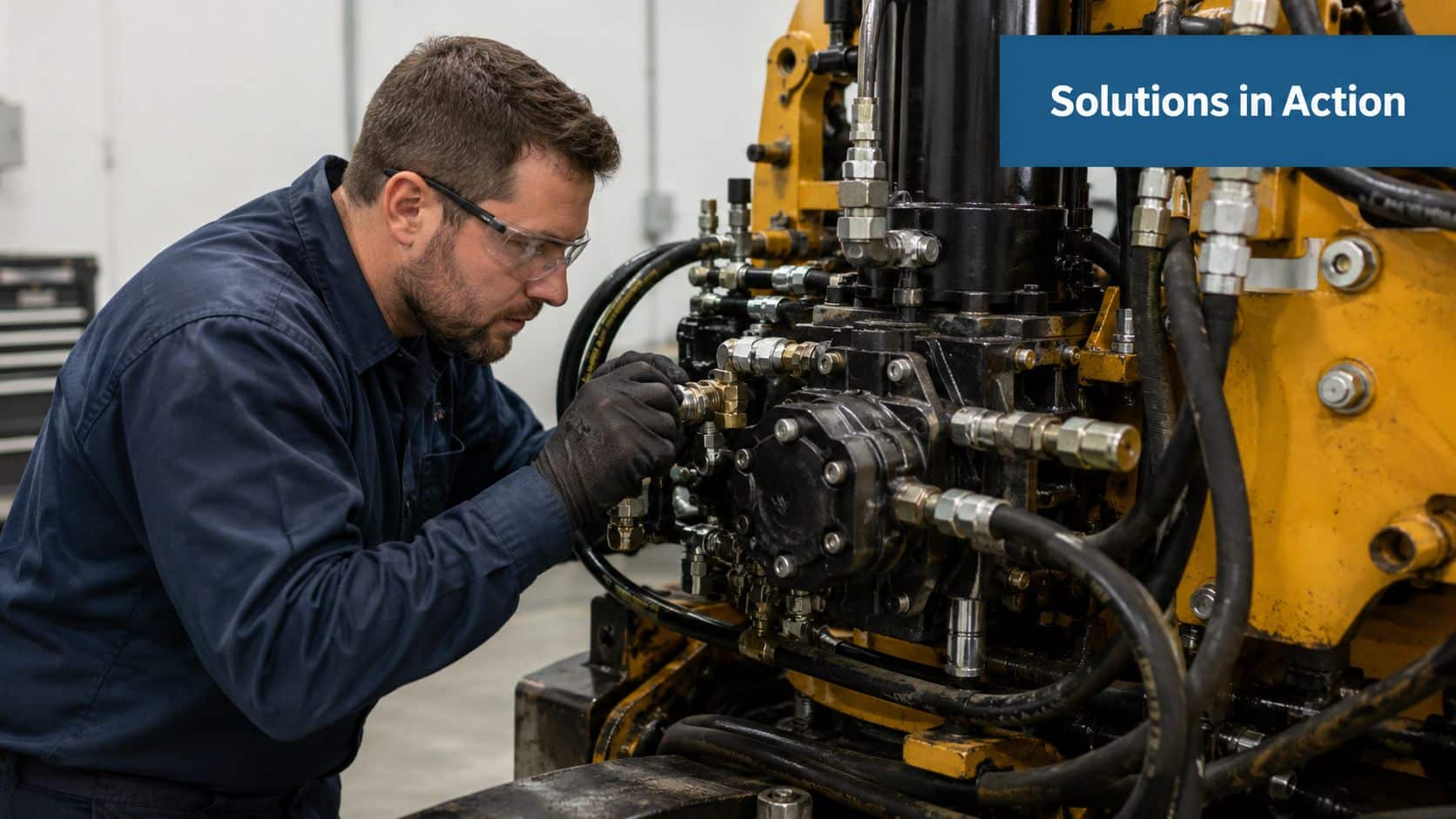
Case one, slow and erratic baler movement
Problem. A maintenance team reported that a baler ram had become slow and uneven, especially later in the day.
Action. The first step was to stop treating it as a simple “weak pump” complaint. The team was asked for fluid condition, temperature pattern, and pressure behaviour at the same point in the cycle. That exposed a maintenance gap. Checks had been scheduled by date, not by operating hours, so the machine had gone longer under actual duty than the service interval suggested.
Result. The fault path narrowed quickly to service-related deterioration rather than immediate major component failure. The customer could prioritise the right corrective work instead of stripping the whole hydraulic group.
Case two, repeated power pack issues caused by operation
Problem. An industrial unit kept returning with the same complaint after restart. The hardware looked sound, but the issue repeated.
Action. Support focused on operator practice rather than only hardware. That matters because 900,000 additional skilled workers are needed in the UK by 2030, and technical support teams increasingly have to help close training gaps that contribute to repeat equipment faults. In this case, the solution included clearer operating checks and a tighter handover routine for shift changes.
Result. Repeat fault calls dropped because the root issue wasn't hidden in the valve block. It sat in how the system was being used.
Case three, obsolete component identification
Problem. A customer had a failed hydraulic component with an unreadable plate and no parts history.
Action. The support process focused on dimensions, port layout, shaft details, mounting pattern, and application duty rather than relying on the missing code.
Result. The part could be cross-referenced on function, not just nameplate identity, which avoided a long delay and reduced the risk of fitting the wrong replacement.
Frequently Asked Questions About Hydraulic Support
Can you help identify obsolete or non-standard hydraulic parts
Yes. Missing nameplates and outdated part codes are common on older plant, mobile equipment, and modified power units. In those cases, identification starts with the component itself and the job it does in the circuit.
We usually work from port sizes, mounting pattern, shaft or spool details, pressure rating, flow requirement, and control function. That approach reduces the risk of ordering a part that fits physically but performs incorrectly once the machine is back under load.
Can you support hydraulic systems you didn't originally supply
Yes. A large share of support work involves machines built by other manufacturers or altered over years of service. The practical challenge is not who supplied it first. It is whether the fault can be tied back to a clear circuit function, a test result, or a repeatable symptom.
Good photos, valve and pump details, pressure readings, and a short description of when the fault appears will usually get the process started. If the circuit has been heavily modified, extra tracing time may be needed before any recommendation is made.
What should I do before I call
Start with safety. Isolate stored energy where required, make the machine safe to inspect, and avoid repeated restarts that could turn a minor issue into a pump or valve failure.
Then record what the machine is doing. Note whether the fault appears from cold, after warm-up, under one function only, or across the whole system. Pressure behaviour, unusual noise, slow movement, drift, and oil condition all help narrow the cause faster than a general report of "low power" or "not working."
Can technical support help with more than breakdowns
Yes. Breakdown support is only part of the job.
Support also covers replacement part matching, circuit reviews, filtration and cooling checks, power pack specification, and repeat fault analysis. For OEMs and maintenance teams, that often has more long-term value than a single fault fix because it helps prevent the same failure mode from returning on the next shift or the next site.
Is remote support enough, or will I need a site visit
That depends on the machine, the fault, and the quality of the information available. Remote support works well when symptoms are clear and someone on site can provide accurate readings, photos, and video. It is often the quickest way to decide whether the issue points to settings, contamination, wear, or an incorrect replacement part.
A site visit makes more sense where the machine cannot be run safely for testing, the circuit is unusual, or the fault only appears under live operating conditions. In practice, the best route is the one that gets to a reliable diagnosis without wasting teardown time.
For urgent hydraulic support, phone 01724 279508. If the issue is not time-critical, send over the machine details, the fault symptoms, and any test information you already have so the first response can be focused and useful.
