

Most workshops will tell you to fit the finest suction screen you can get into the tank. It sounds like care. On the pump inlet, it's often the quickest way to scrap a pump.
A hydraulic suction strainer sits between the reservoir and the pump, and the pressure available to push oil through it is whatever the atmosphere can supply. That's a small, fixed budget. Every extra mesh, elbow and frosty morning spends it. The arrangement that survives real machines is the opposite of the popular advice: a coarse, low-restriction strainer at the inlet, with the fine work handed to return-line or offline filtration downstream.
Here's the working detail behind that. What the screen should and shouldn't catch, what each filter position in the circuit is for, how to commission the inlet for a cold start, and how to service it without guessing.
Suction Strainer Limits That Protect the Pump
A hydraulic suction strainer is a coarse screen on the reservoir-to-pump inlet, and its job is narrower than workshop habit suggests. It stops bolts, swarf, rag fibres and flakes of reservoir scale from reaching the pump. A leaf guard on a gutter is the right comparison: it catches twigs, lets the rain through, and nobody calls it a failure when fine grit washes past.
The Honeywell Hydraulics suction strainer specification gives a typical filtration range of 125 to 149 micrometres, roughly 100 to 120 mesh, and a clean pressure drop below 0.02 bar at rated flow. That coarseness is the whole point. The same specification explains that the pump inlet depends on atmospheric pressure, about 1.013 bar absolute, to push oil into the pump chambers, and that a much finer element, a 10-micrometre filter for instance, can pull enough vacuum on the inlet side to vaporise the hydraulic fluid and produce cavitation.
The checks that decide whether a screen protects or starves
| Check | Working figure | Why it matters |
|---|---|---|
| Filtration rating | 125 to 149 micrometres, about 100 to 120 mesh | Stops coarse debris without acting as a silt filter |
| Clean pressure drop | Below 0.02 bar at rated flow | Keeps inlet pressure above the oil vapour pressure |
| Screen free area | At least 3 times the pipe cross-section | Limits velocity and pressure loss as the mesh loads |
| Port size | Equal to or larger than the pump inlet | Avoids a reducer that adds restriction |
| Sizing basis | Peak flow and cold-start viscosity | A warm average duty understates the vacuum |
| Available push | About 1.013 bar absolute from the atmosphere | Pipe friction, lift and a dirty screen all spend it |
Start with the free-area row, because it decides how the strainer behaves as the mesh loads. Suction pipeline design guidance from Michael Smith Engineers recommends a screen free area of at least three times the connected pipe cross-sectional area. A smaller effective area raises fluid velocity and pressure loss, and the pump ends up doing the pulling the atmosphere was supposed to do.
The port row is just as practical. Filtrec's suction strainer data states that the port should be equal to or larger than the pump inlet port, and that selection should account for the worst operating condition rather than nominal flow alone. A strainer with a big body and a small threaded neck is a restriction dressed up as a filter.
The atmospheric budget
Every hydraulic inlet runs on the same allowance: roughly one atmosphere pushing down on the oil in the tank. That allowance pays for pipe friction, the vertical lift from oil level to pump, the fittings in between, and the screen itself. Spend it all before the oil arrives and the pump stops drawing oil and starts drawing a vacuum.
Cavitation follows quickly. The pipeline guidance notes that if absolute pressure at the pump inlet falls to or below the fluid's vapour pressure, vapour bubbles form and then collapse inside the pump, producing shock loading, noise, erosion and accelerated wear. The screen that starves a pump damages it faster than most of the debris it was fitted to catch.
That trade-off is why the coarse option wins. A fine element spends the budget early; a coarse one keeps it in reserve.
Practical rule: if you can't state the inlet vacuum at peak flow on a cold start, you don't yet know whether the strainer fits the machine.
The real test is a frosty morning
Size the strainer on the pump's peak flow in litres per minute and on the oil's viscosity at the coldest temperature the machine will start in. An ISO VG 46 mineral oil that moves easily at 40 degrees Celsius turns thick enough on a frosty start to multiply the pressure drop across a loaded screen. A strainer chosen on a warm average is an unknown quantity on the first cold morning of the year.
Then put a number on it. A differential-pressure gauge or clogging indicator across the strainer, read at full flow on the coldest start, shows whether the pump maker's minimum inlet pressure is still met. Clean-looking oil in the sight glass says nothing about restriction.
The sizing logic also settles where fine filtration belongs. The inlet can only afford a coarse screen, so the particles that wear pumps and valves get caught downstream, on the return line or in an offline loop. Coarse at the inlet, fine downstream: that is the arrangement the numbers keep pointing to.
How a Suction Strainer Differs from Other Filters
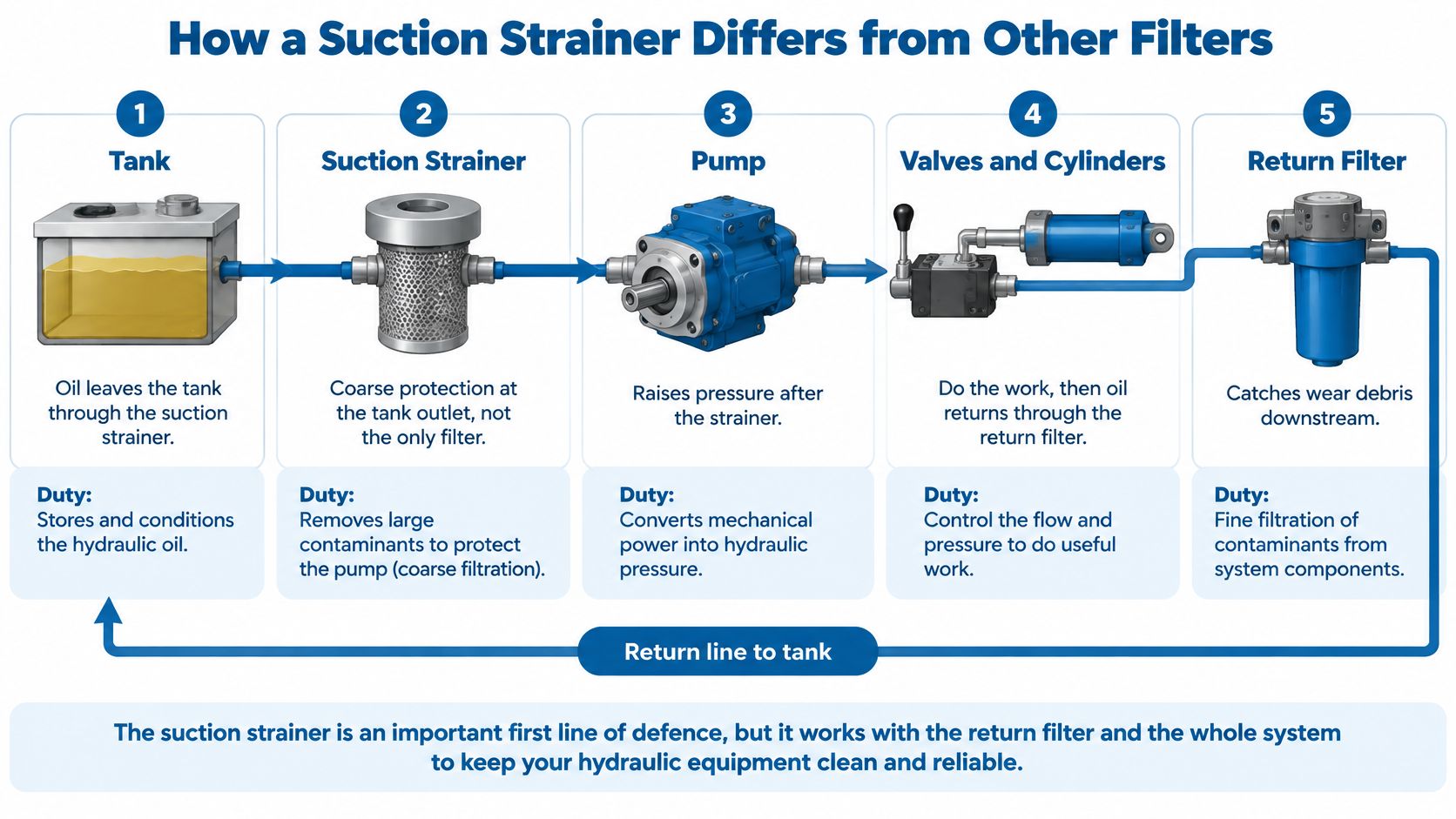
Oil leaves the tank through the suction strainer, the pump raises its pressure, valves and cylinders do the work, and the oil returns to the tank. Four positions on that loop, four different jobs. Ask one device to do two of them and it does neither well.
The strainer's authority ends at large foreign objects: assembly debris, dropped fasteners, reservoir scale. Fine wear metal, silt, water and entrained air belong to a return-line filter, a pressure-line filter or an offline polishing loop chosen for a stated cleanliness code.
The measurement system that keeps those positions honest is ISO 4406. As MA Hydraulics' guide to filtering hydraulic oil explains, the standard reports particle populations in three bands, greater than 4, 6 and 14 micrometres, and a code such as 18/16/13 summarises those counts. The same guidance attributes approximately 70 to 80 percent of hydraulic-system failures to particles, water, air or other contaminants in the fluid.
That figure gets quoted as though the suction strainer prevents it. It doesn't. A coarse inlet screen cannot deliver a cleanliness code, and a blocked fine screen on the inlet can damage a pump more thoroughly than the debris it was meant to stop.
| Device | Where it sits | What it is for | Capture or target |
|---|---|---|---|
| Suction strainer | Reservoir to pump inlet | Bolts, swarf and other coarse debris | 125 to 149 micrometres |
| Return-line filter | Flow back to the tank | Most wear debris generated in service | Selected to the ISO 4406 target |
| Pressure-line filter | After the pump | Sensitive valves and servos | Finer absolute rating than the strainer |
| Offline filter | Separate polishing loop | Hold the fluid at the target code | ISO 4406 such as 18/16/13 |
Name the hardware as well as the duty. On many machines the coarse device is an in-tank basket threaded onto the suction pipe below oil level, or an external body with a service cover on the tank wall. Knowing which you have decides how the element gets cleaned and how much oil you lose doing it. Our hydraulic filter selection guide walks through matching those components to a target code.
A bypass that opens on a loaded inlet dumps unfiltered oil straight into the pump. Bypass valves suit pressure and return filters, where the alternative is a stopped machine.
How to Commission for Cold Oil and Peak Flow
The commissioning question isn't "what micron rating should I use?". It's "what restriction is still acceptable when the oil is cold, flow is at its peak and the element is dirty?". The Health and Safety Executive's guidance covering hydraulic fluid systems tells operators to check strainers and filters regularly for blockages, which is sensible and silent on the harder half: telling a blocked strainer apart from an undersized one, or from oil that's too thick to move.
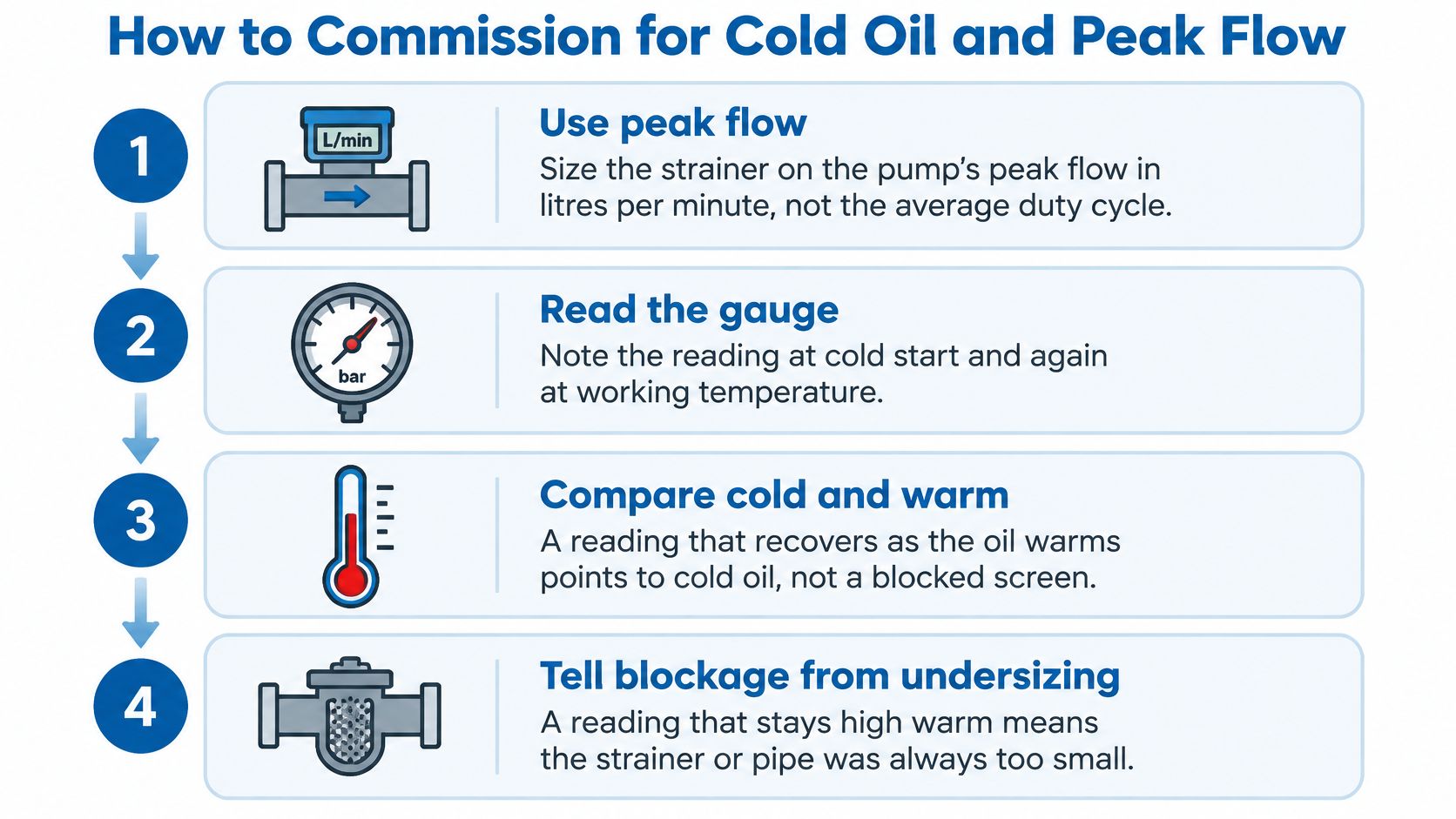
Six checks do the work, in this order:
- Use peak flow, not average duty. Take the pump's maximum delivery in litres per minute. A machine that only touches peak flow for ten seconds a shift still has to pass that flow through the screen without starving.
- Read the viscosity at the coldest start. Not the working temperature on the datasheet. The overnight low in a barn in February is the number that decides whether the pump cavitates on start-up.
- Keep the suction line boring. Short, straight and few fittings. Every elbow, reducer and high tee adds restriction, and a soft or collapsing suction hose will strangle the inlet before the screen has caught anything.
- Size for a part-loaded screen. Choose a strainer whose rated flow still leaves headroom once the mesh has collected a season of debris. Clean figures alone flatter the selection.
- Measure under three conditions. Cold start, peak flow, and with the element near the end of its life. Log the vacuum or differential pressure each time.
- Write those readings down. A baseline on the job sheet turns every later high reading into a diagnosis instead of an argument.
Step six pays for itself. A high vacuum on a brand new coarse screen usually means the strainer or the pipe was always too small for the flow. The same reading on a screen that used to run quiet means the mesh is loading and service is due. Those are different problems with different fixes, and without a baseline you can't tell them apart.
A coarse inlet screen paired with finer return-line or offline filtration protects the pump twice: once against debris at the inlet, and once against the fine wear particles that set off the wear cycle. Set the downstream filter against the machine's ISO 4406 target, tighter for servo and proportional equipment than for a simple industrial power pack.
Keep one question on the commissioning sheet and answer it in writing: what restriction is still acceptable when the oil is cold, flow is at its peak and the element is dirty?
How to Service a Strainer Without Guesswork
A screen that looks clean proves the oil carries no coarse debris. It proves nothing about the oil's cleanliness code, and it doesn't prove the pump is being fed properly. Service the inlet on a fixed sequence rather than on a glance at the mesh.
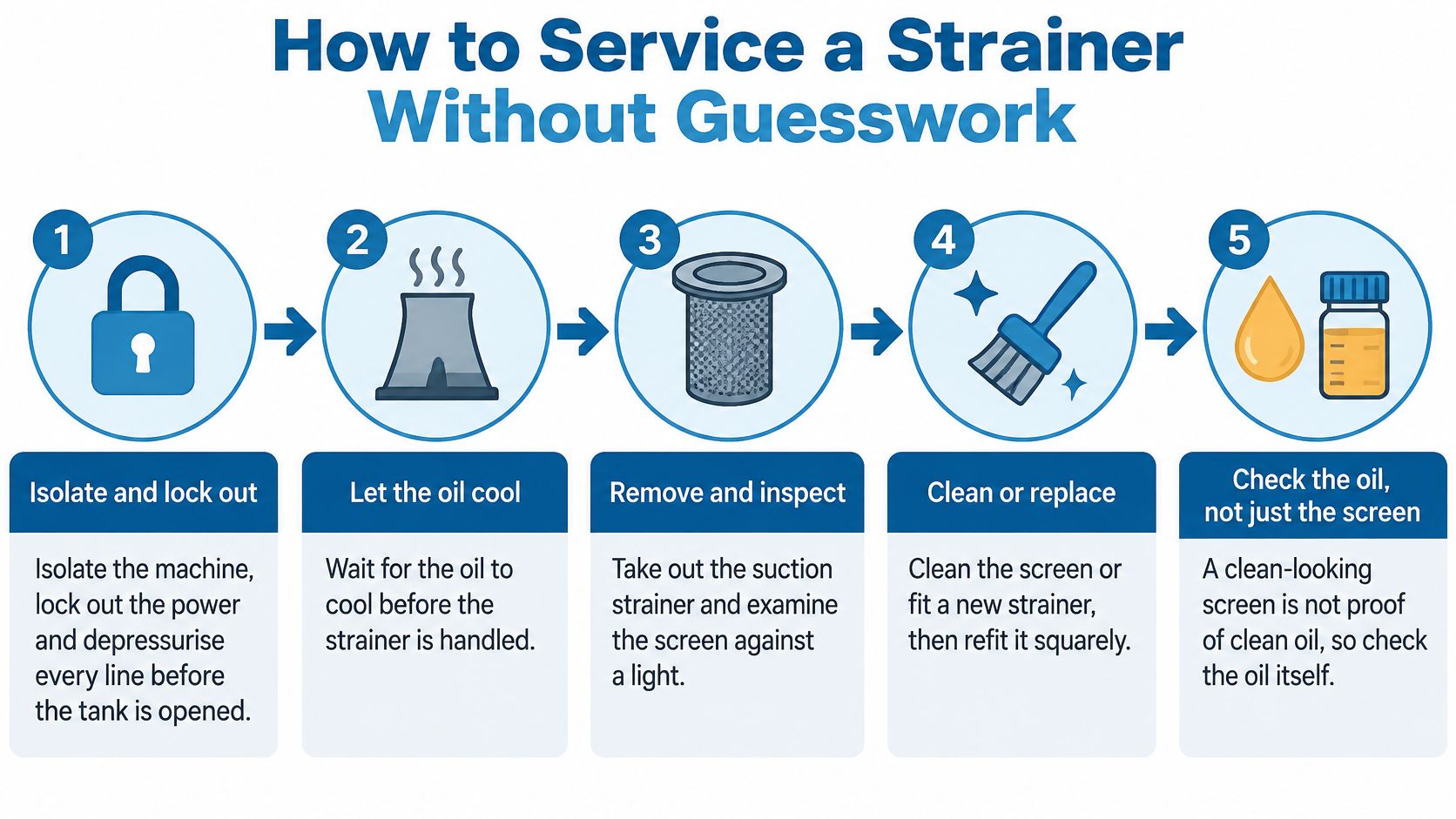
- Isolate, lock out and depressurise. Every line, not just the one you plan to open. The strainer sits on the low-pressure side, but the machine around it doesn't.
- Let the oil cool before you handle anything. Hot oil through a glove is a burn, and a tank opened warm releases vapour into a workshop.
- Cap the open port. Water, dust and rag fibres entering an open reservoir undo the point of the exercise. Have a clean bung or cap ready before the strainer comes out.
- Clean or replace the element, and renew the seals. A hardened or nicked O-ring lets oil bypass the screen entirely, which looks like a strainer that never catches anything.
- Bleed trapped air and listen on the first start. Refit squarely, restart, and check the pump note against the baseline. A new whine after a service is information, not bad luck.
German social accident insurance guidance on filtration of hydraulic fluids, built on DIN EN ISO 4413, expects hydraulic filters to carry a maintenance indication, to be checked regularly, and to be replaced according to the manufacturer's schedule or when a clogging indicator calls for it. That applies to the inlet element just as much as to the return filter.
Sampling is the other half of the routine. If valves are sticking or a pump is wearing, send the oil for a particle count against the target code instead of reading the colour. A clear suction screen and a dirty reservoir coexist happily.
For a practical walk through what a starved pump sounds and looks like, the video below is worth ten minutes before the next service.
Field Cases Where a Fine Screen Causes Harm
Three duties, three ways to starve the same pump.

On a tractor loader or telehandler, frost thickens the oil while dust loads the breather and the small in-tank strainer. The pump whines until the oil warms, then settles, which makes the noise easy to ignore for a season. Keep ignoring it and the inlet runs aerated and short of oil until the gear faces pit. That whine is the pump asking for oil it cannot get; the piece on what pump cavitation is and how it starts explains the mechanism.
On a factory power pack, the strainer sits in the tank beside a return filter. After a valve failure, a finer basket goes in "to be safe", and the next fortnight is spent chasing a cavitation noise the finer mesh created. The original coarse basket was never the problem. The safer pattern is boring but effective: coarse, low-restriction protection on the inlet, finer filtration on the return or offline loop where pressure drop is not fed straight into the pump.
On mobile plant such as a piling rig, the strainer still only stops coarse debris. It does not make a pressurised hose safe to work on. The Health and Safety Executive's bulletin on hydraulic injection injury records serious reported injection injuries above 100 bar (1,450 psi) and cites research indicating injection can occur at pressures as low as 7 bar (101.5 psi). Treat every suspected injection injury as urgent and get immediate medical treatment.
A strainer controls contamination; people stay safe through depressurisation, lockout, inspection and a competent person doing the work. Fine mesh belongs downstream.
Specify the Strainer and Phone for a Match
Before you ring anyone, put six things on one line of paper: peak pump flow in litres per minute, oil grade and the lowest start temperature, pump inlet port in millimetres, whether the element is an in-tank basket or an external body, the mesh marking on the fitted screen, and whether the whine appears only on a cold start or after the screen has loaded.
That's the whole brief. With it, a supplier can cross-reference your port and winter oil against a coarse suction strainer rather than talking you into a finer micron rating, and pair it with a return-line or offline filter aimed at the machine's ISO 4406 target. MA Hydraulics supplies OMT Group filters, filler breathers and level gauges, and can cross-reference a pump port against the catalogue when a listed screen is scarce, so the mesh and thread match the machine rather than whatever is nearest the shelf.
Availability is the reason to be precise. Flowtech's UK catalogue listed 23 suction-strainer products in 2025, and none of them is interchangeable with the rest on port size and flow rating alone.
Phone 01724 279508 today, email info@mahydraulics.co.uk, or send us a message with the six details above.
MA Hydraulics Ltd stocks OMT Group suction filters, return-line filters, filler breathers and level gauges at our Scunthorpe base and supports customers nationwide with component selection, cross-references and custom power-pack assembly. If you're matching a coarse inlet screen to a pump this week, send us the peak flow, the port size and the coldest start temperature and we'll check them against the catalogue rather than leave you guessing at a mesh rating. Visit MA Hydraulics Ltd to see the range, or call 01724 279508 to talk the selection through.
